
Is Methylisothiazolinone Safe? A Simple Answer You Can Trust
 Written by Irina Webb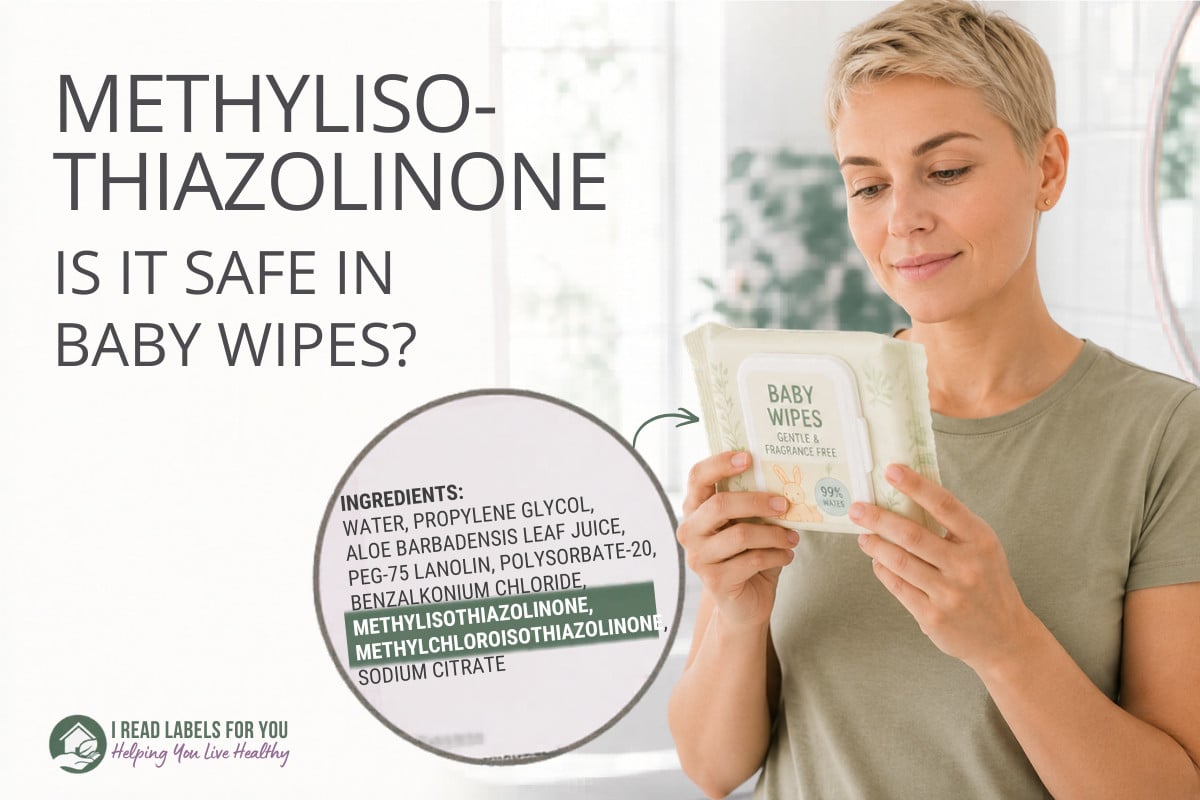
No, Methylisothiazolinone is not safe in leave-on products, and I avoid it in rinse-off products too. It’s a synthetic preservative that stops bacteria and mold from growing in water-based formulas. It can cause contact allergy, and roughly a third to a half of it passes through human skin. The rest of its record is calmer, with no cancer link and no reproductive harm in animal studies. I rate it Not A Fan.
Methylisothiazolinone is barred from leave-on cosmetics in Europe and capped at 15 parts per million in rinse-off products. Europe’s safety committee reached that position after finding that 100 parts per million “is not safe for the consumer.” For leave-on products, with wet wipes named specifically, it found no safe level at all. Health Canada matches those rules. The United States does not, and its industry panel still permits 100 parts per million.
Three things below are worth your time. First, why Methylisothiazolinone preservative carries two names on a label, and why the two almost always travel together. Second, how it compares with formaldehyde on a laboratory allergy scale. Third, what the nerve damage headlines actually rest on.
What is Methylisothiazolinone?
Methylisothiazolinone (MI) is a laboratory-made preservative. Chemists also shorten it to MIT. Its job is to keep bacteria, mold, and yeast from growing in anything that contains water.
It belongs to a chemical family called the isothiazolinones. Two close relatives turn up in the same shopping aisle: Methylchloroisothiazolinone and Benzisothiazolinone. All three kill microbes the same way, and all three can cause skin allergy.
PubChem describes Methylisothiazolinone as “a powerful biocide and preservative.” A biocide is a chemical designed to kill living things. That is the point of it, and it explains both its usefulness and its trouble.
What Does Methylisothiazolinone Do In Cosmetics?
Water invites microbial growth, and a shampoo left unprotected would spoil within weeks. Methylisothiazolinone prevents that at tiny concentrations, which is why brands like it. Furthermore, it costs very little and works across a wide pH range.
Counts from the U.S. Food and Drug Administration (FDA) show how common it is. Methylisothiazolinone was reported in 6,037 products, and its chlorinated partner in 5,137. That makes it the most widely reported ingredient I’ve reviewed.
Only 915 of those products use Methylisothiazolinone without its partner. That figure rose from 745 five years earlier, while Europe was tightening its rules.
The split inside the 915 matters too. Some 559 were leave-on products and 345 rinse-off. American use concentrates in exactly the category Europe prohibits.
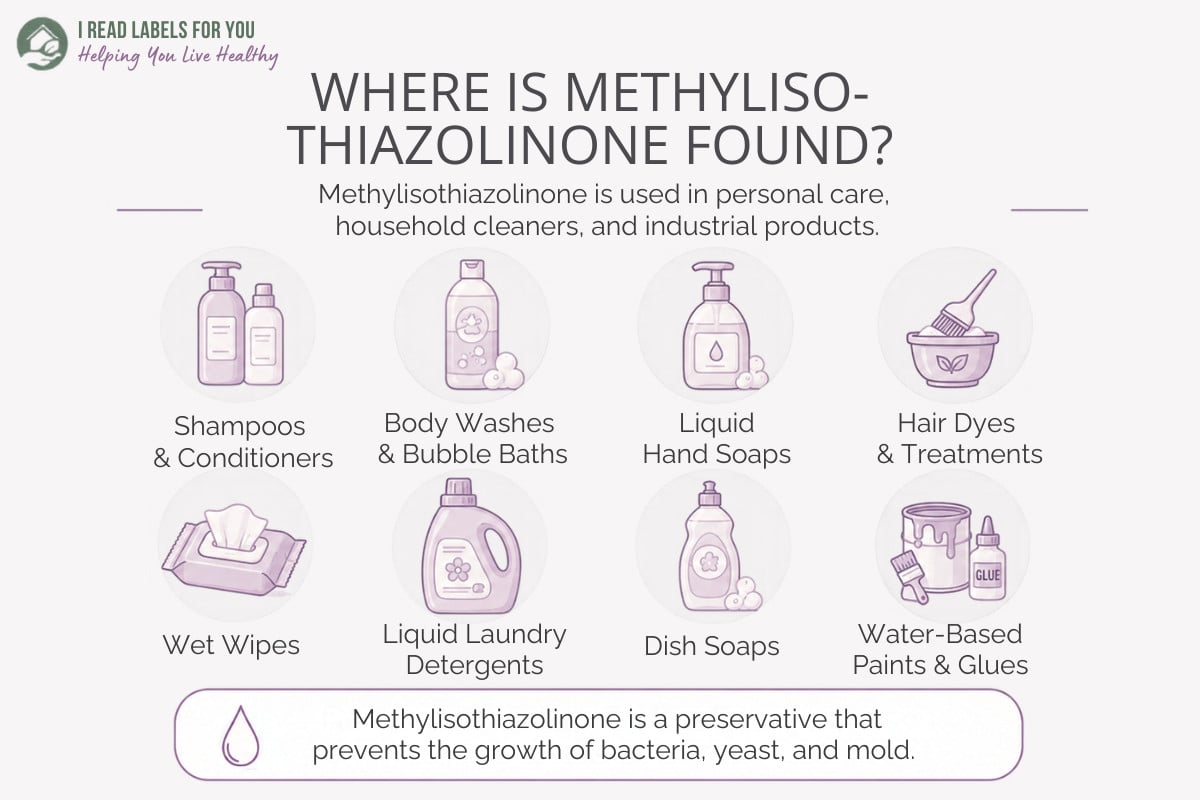
You’ll find Methylisothiazolinone most often in:
- shampoos and conditioners
- body washes and bubble baths
- liquid hand soaps
- hair dyes and hair treatments
- wet wipes
- liquid laundry detergents
- dish soaps
- water-based paints and glues
You will not find it in food. Unlike many preservatives, Methylisothiazolinone carries no food additive approval in Europe or the United States. In the United States the Environmental Protection Agency regulates it as a pesticide.
What Is The Difference Between Methylisothiazolinone And Methylchloroisothiazolinone?
Methylchloroisothiazolinone (MCI) is the same molecule with a chlorine atom attached. That single atom makes it a far stronger preservative, and a far stronger allergen. On a laboratory potency scale, MCI is roughly 300 times more sensitizing than MI.
Here’s the part most labels never explain. MCI is never sold on its own in Europe. The law permits it only as a fixed 3-to-1 blend with MI, which means Methylisothiazolinone always sits beside it.
The reverse is not true. MI is permitted alone, under its own entry in European law, and it appears alone in hundreds of products. Even then it’s not entirely MCI-free, because technical grade MI carries about 0.1% MCI as a leftover from manufacturing.
How Is Methylisothiazolinone Made?
Methylisothiazolinone is fully synthetic. Makers produce it by carefully chlorinating a sulfur-based compound called dimethyldithiodipropionamide. They then neutralize the result, pull it into water, and strip out the solvent.
Push that same reaction further and you get Methylchloroisothiazolinone instead. So the two ingredients come from one reaction, not two. MI also forms as a by-product when MCI is made, at about 25% yield.
One detail matters. The original process also made dimethylnitrosamine, which industry reports call a carcinogenic impurity. To stop it, makers changed the recipe and added a starting chemical, methyl 3-mercaptopropionate.
Regulators built that fix into the rules. The FDA allowed food-packaging uses only on that condition, and across 39 batches the nitrosamine stayed between 0.1 and 0.8 parts per million. Europe’s safety committee later found levels too low to detect. The problem is solved.
Does Methylisothiazolinone Penetrate The Skin?
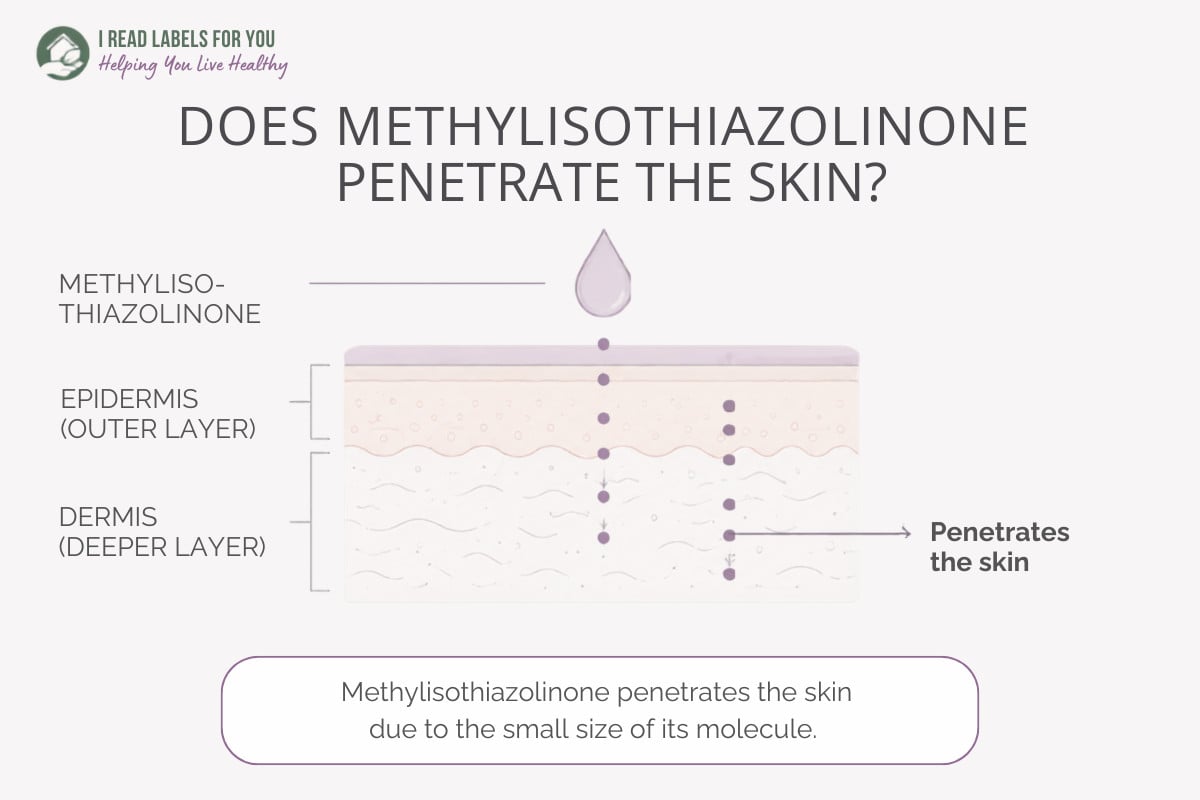
Yes, Methylisothiazolinone penetrates the skin, and the human numbers are unusually high. Two properties decide whether a molecule crosses skin: its size and its water-loving or oil-loving character. For this ingredient, size is the deciding factor.
Molecules under roughly 500 daltons are small enough that size stops being a barrier. Methylisothiazolinone weighs 115 daltons, which is among the smallest preservatives in cosmetic use. Its LogP, the measure of oil-versus-water preference, sits near zero, meaning it dissolves easily in water and moves with it.
Methylisothiazolinone lab testing on human skin found that 29.8% to 54.7% of an applied water solution crossed in 24 hours. From an actual shampoo formula, 29.5% was absorbed. Notably, the more that was applied, the greater the share that got through. This matters less for poisoning than for allergy. Systemic exposure stays low, with a safety margin above 2,000. Allergy begins when a molecule reaches the living layer of skin, and this one gets there easily.
What Is Methylisothiazolinone Called On Labels?
Cosmetic labels use the international naming system, which gives you two words to memorize. Cleaning product labels in Europe follow separate rules that also require preservatives to be named, whatever the amount.
Watch for these names:
- METHYLISOTHIAZOLINONE
- METHYLCHLOROISOTHIAZOLINONE
- 2-Methyl-4-Isothiazolin-3-One
- 5-Chloro-2-Methyl-4-Isothiazolin-3-One
- Kathon CG
- Neolone 950
- Microcare MT
- Euxyl K 100
- MI, MIT, MCI, or CMIT
Two entries on one label are normal here. When a product uses the blend, both names appear. They usually sit side by side near the end of the list.
Does The U.S. FDA Restrict Methylisothiazolinone In Food And Cosmetics?
Barely. The FDA has not placed Methylisothiazolinone on its list of prohibited or restricted cosmetic ingredients. There’s no federal limit on how much a company may put in your shampoo.
Here’s why I hold that lightly. The FDA’s restricted cosmetic list runs to roughly a dozen entries, against well over a thousand in Europe. Absence from a very short list tells you almost nothing.
The gap widens when you consider who does the reviewing. In the United States, the main cosmetic safety reviews come from an industry-funded panel. Europe uses a government committee instead.
Europe also leans on the precautionary principle. That means acting when evidence points to harm, rather than waiting for proof. On this ingredient, Europe acted.
EU Regulations About Methylisothiazolinone
Europe permits Methylisothiazolinone at 0.0015%, which equals 15 parts per million, and only in products you rinse off. That limit sits at entry 57 of Annex V of the Cosmetics Regulation. Leave-on use has been prohibited since February 2017.
The previous Methylisothiazolinone limit was 100 parts per million across every product type. Europe cut it by almost seven times and removed a whole category of products at the same time. Regulators rarely reverse themselves that sharply.
The reasoning appears in a 2013 opinion from the Scientific Committee on Consumer Safety. The wording is blunt:
Current clinical data indicate that 100 ppm MI in cosmetic products is not safe for the consumer.
The committee went further on leave-on products:
For leave-on cosmetic products (including ‘wet wipes’), no safe concentrations of MI for induction of contact allergy or elicitation have been adequately demonstrated.
That is the sentence that changed the law.
One caveat is easy to miss. The committee cleared 15 parts per million in rinse-off products for causing new allergy. It then added that “no information is available on elicitation.” In plain terms, nothing in the record tells someone already allergic to MI what level is safe for them. The limit guards against becoming allergic, not against reacting.
The MI/MCI blend sits under a separate entry, number 39, at the same 0.0015% ceiling and also rinse-off only. Europe additionally states that MI should not be added to a product that already contains the blend.
U.S. And EU Disagreements On Methylisothiazolinone
The American industry panel still permits 100 parts per million of MI in rinse-off products. It also allows leave-on use when a product is formulated not to cause sensitization. That ceiling is roughly seven times the European one.
What makes the gap awkward is the panel’s own arithmetic. Its 2014 risk assessment supported 100 parts per million of MI for rinse-off categories. For leave-on, it concluded they “would be safe only at lower concentrations.” The panel kept leave-on use open anyway, case by case.
The MI/MCI blend tells a similar story. Reviewing it, the panel calculated safety margins for individual product types. Several margins landed below 1, the value the method treats as the floor. Baby shampoo came out at 0.92, hair tints at 0.56, and permanent waves at 0.13.
The panel acknowledged the split in writing. Its conclusion on MI/MCI, it noted, “differs from that reached by counterparts in the European Union.” Two expert bodies read the same studies and parted ways. I follow the one that treats allergy as a reason to act.
Canadian Regulations About Methylisothiazolinone
Canada sides with Europe. The Health Canada Cosmetic Ingredient Hotlist calls Methylisothiazolinone “Not permitted in leave-on products.” Rinse-off products are limited to 0.0015%, and the blend carries the same rule.
Moreover, Health Canada closed an obvious loophole. Where a formula contains both the MI/MCI blend and extra MI, the combined total still may not exceed 0.0015%. Conversely, Canadian environmental law does not treat this preservative as a toxic substance.
Can Methylisothiazolinone Cause Skin Allergy And Sensitization?
Yes, Methylisothiazolinone causes skin allergy, and laboratory testing classifies it as a strong sensitizer. This is the reason every restriction on it exists.
The clearest comparison comes from Europe’s own review. On the standard laboratory potency scale, Methylisothiazolinone scores 0.4%, and formaldehyde scores exactly the same. The committee’s comment reads:
An EC3 of 0.4 categorises MI as a strong sensitizer.
Real-world numbers back that up. Patch testing of 6,958 patients across nine United Kingdom centers found a 2.0% reaction rate to the MI/MCI blend. A Spanish series reported 4.04%, and a European survey of 19,793 patients found 4.1% in southern Europe.
The American Contact Dermatitis Society tests for both MI and MCI on its core panel, at entries 9 and 17. Dermatologists screen every patient for them, which they reserve for allergens common enough to justify it. The society also named Methylisothiazolinone its Allergen of the Year in 2013.
One number should stay with you. Once someone is sensitized, a reaction to the MI/MCI blend can start below 2 parts per million. That’s well under the legal limit, which protects against becoming allergic rather than against reacting.
There is encouraging news too. A study across 14 European centres found that allergy to Methylisothiazolinone fell by half after the restrictions took effect. The rules worked, which is an argument for the rules.
Is Methylisothiazolinone A Hormone (Endocrine) Disruptor?
No, Methylisothiazolinone is not a hormone disruptor, and no regulator lists it as one. It does not appear on any European endocrine disruptor assessment list, and no human study has reported hormone effects.
A 2026 study is worth reporting precisely because of what it found. Researchers exposed marine medaka embryos to six isothiazolinones and reported that three relatives were potently estrogenic. Methylisothiazolinone was not among them. That is a useful result. A tested negative carries more weight than silence would.
Is Methylisothiazolinone Safe To Use While Pregnant?
The animal evidence on pregnancy is reassuring, and the open question sits elsewhere. In rats dosed with Methylisothiazolinone during pregnancy, researchers saw no treatment-related effects in the fetuses. The developmental no-effect level was 40 mg per kilogram daily, and rabbit studies agreed.
A two-generation study added more. Rats drinking water containing up to 1,000 parts per million of MI/MCI blend showed no reproductive toxicity across two generations. Those doses are enormously higher than anything a shampoo delivers.
The unresolved piece is nervous system development. In laboratory dishes, Methylisothiazolinone killed rat brain cells within 24 hours. Researchers concluded that prolonged exposure “may damage developing nervous systems.”
Importantly, the same reports state that no such effect has appeared in living animals. Dishes are not bodies, and the gap between them is real.
My own view is practical rather than alarmed. The animal data do not suggest harm to a pregnancy. Allergy is the real reason to skip Methylisothiazolinone.
If you are pregnant and weighing a specific product, you should consult with your medical provider.
Are There Any Cancer Concerns Linked To Methylisothiazolinone?
No study has linked Methylisothiazolinone to cancer, though part of the reason is that nobody has run the study. Industry reviews state plainly that carcinogenicity studies of this ingredient on its own were not available.
What exists belongs to the MI/MCI blend. Rats drinking water containing the blend for two years, at up to 300 parts per million, developed no cancer. That is a genuine negative result, but it was borrowed from a related substance.
The genetic testing is more direct and it favours the ingredient. Methylisothiazolinone was not mutagenic in bacterial tests, nor in a micronucleus test, nor in a DNA repair assay. Chromosome damage appeared only at doses that were already killing the cells.
The official lists agree. Methylisothiazolinone does not appear in the classifications of the International Agency for Research on Cancer, the U.S. National Toxicology Program Report on Carcinogens, or California Proposition 65. Its two manufacturing chemicals are absent from those lists as well.
A distinction is worth drawing here. Not listed is not the same as tested and cleared. On cancer specifically, though, the direct evidence that does exist points the reassuring way.
Is Methylisothiazolinone Bad For The Environment?
This is where the hazard labels turn severe. Under the international chemical labeling system, Methylisothiazolinone carries the codes H400 and H410. Those mean “very toxic to aquatic life with long lasting effects.”
The signal word on the concentrate is “Danger.” Context matters, since a shampoo contains 15 parts per million rather than the concentrate. Still, this preservative kills microorganisms by design, and it goes down the drain.
Its use in paints and cleaning products sends far more of it into water than cosmetics do. On the other hand, Canada has not placed it on Schedule 1. That is the national list of toxic substances.
Common Claims About Methylisothiazolinone: What’s True And What’s Not
Claim: Methylisothiazolinone Causes Nerve Damage
This claim circulates widely on ingredient-to-avoid lists, and it comes from real studies that are being overstated. Scientists grew rat brain cells in dishes, exposed them to Methylisothiazolinone, and saw widespread cell death within 24 hours.
Two details change the picture. The cells were bathed directly in the chemical, with no skin barrier and no liver in between. Additionally, industry reviews state that no evidence of neurotoxicity has been observed in living animals.
My honest reading is that this is unfinished science rather than a debunked myth. Newer work on human nerve cells continues.
In South Korea, the MI/MCI preservatives were put into humidifiers, and people suffered real lung harm. Neither finding supports the leap to nerve damage from shampoo.
Claim: Methylisothiazolinone Is Banned In Europe
Half true, and the half that is true is the important half. Europe banned Methylisothiazolinone from leave-on cosmetics in February 2017, which covers creams, lotions, sunscreens, and wet wipes.
It remains legal in Europe in products you rinse off, at up to 15 parts per million. Therefore a European shampoo may still contain it, and many do. The accurate sentence is that Europe banned it from leave-on products and cut the rinse-off limit sharply.
Claim: Rinsing The Product Off Removes The Risk
Rinsing helps, and it does not settle the matter. Europe accepted a rinse-off limit because contact time is shorter. Shorter contact lowers the chance of becoming allergic.
Two things complicate it. First, the committee cleared that level for causing new allergy only. It stated that no information exists on reactions in people already sensitized.
Second, a 2026 Danish market study looked at labelled rinse-off products. It found that 8% exceeded the legal MI/MCI limit, and four did not meet the required 3-to-1 ratio.
What I Think About Methylisothiazolinone — And What You Should Do
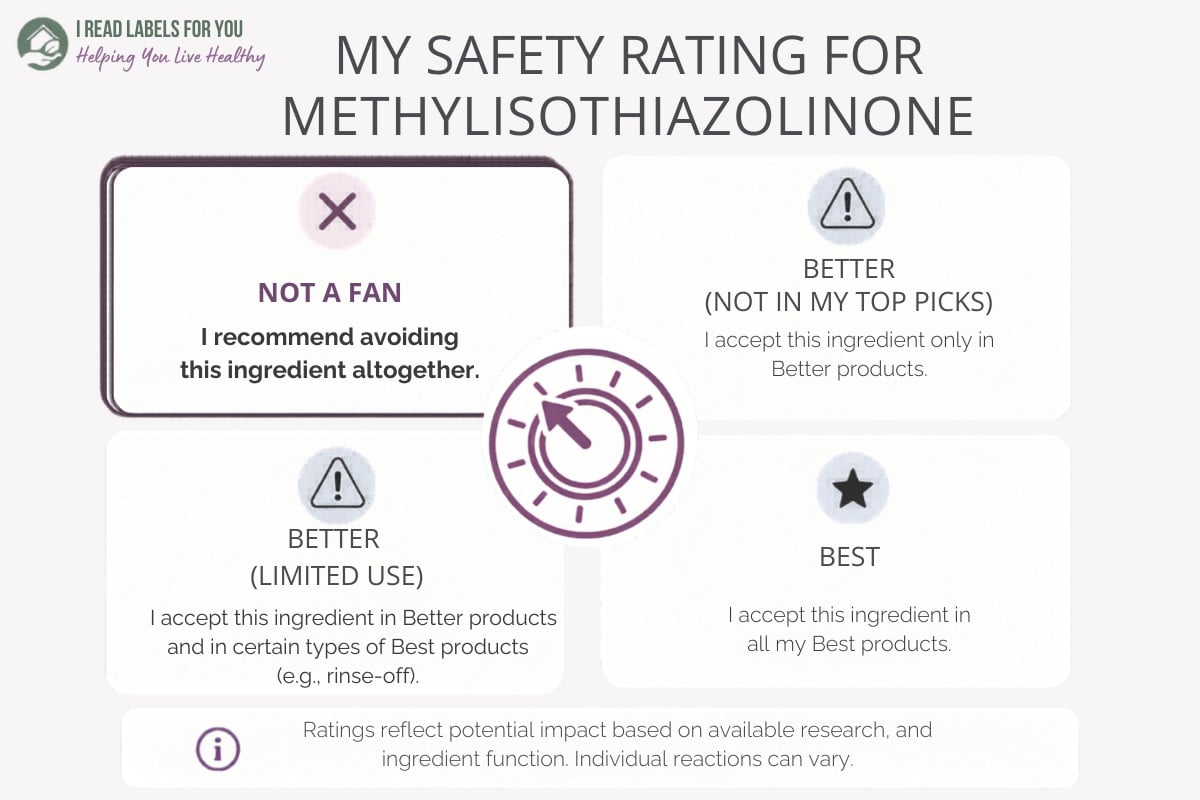
I rate Methylisothiazolinone (MI) Not a Fan, and the same applies to Methylchloroisothiazolinone (MCI). This is not a case of thin data or guesswork. Two expert panels agree that these preservatives can cause allergy, and they differ only on how strictly to manage it.
Three things drive my rating. First, Europe reviewed Methylisothiazolinone and reversed itself, cutting the limit almost sevenfold and banning leave-on use. Second, its allergy potency matches formaldehyde on the standard laboratory scale. Third, once someone is sensitized, reactions can start below 2 parts per million, which no label will ever show you.
I want to be fair about the other side of Methylisothiazolinone. The systemic toxicology is reassuring, with no reproductive harm, no teratogenicity, negative genetic tests, and a wide safety margin. Contact allergy, though, is permanent, and it spreads from the product that caused it to every product sharing the ingredient.
Here’s what I suggest. Scan the end of the ingredient list, where preservatives usually sit, and look for either MI or MCI. Skip the product if you find either. Other preservatives, like Sodium Benzoate and Pentylene Glycol, preserve well, and neither carries this allergy record. If shampoos or wipes make you react, and you have never been patch tested, raise this with a dermatologist. Methylisothiazolinone sits on the standard test panel for exactly that reason.
Frequently Asked Questions About Methylisothiazolinone
Is Methylisothiazolinone Safe For Hair?
Your hair is fine, and your scalp is the question. Hair is not living tissue, and a preservative cannot damage it. The scalp, ears, neck, and hands are where allergic reactions to shampoos actually show up.
Industry data record hair products among the most common uses of the Methylisothiazolinone preservative. If a shampoo leaves you itchy, flaky, or red along the hairline, the preservative belongs on your suspect list.
Is Methylisothiazolinone Safe In Laundry Detergent And Dish Soap?
Both are common places to find Methylisothiazolinone, and both keep it in contact with skin longer than you might expect. Dish soap meets your hands directly, and detergent residue stays in fabric that touches you all day.
European law helps here. Detergent labels in Europe must name any preservative, whatever the amount. The information is therefore on the package.
Formulas also differ by country and change over time. I check the current label rather than a brand’s reputation. My laundry detergent guide lists options that skip Methylisothiazolinone.
Is Methylisothiazolinone Safe In Baby Wipes?
No, Methylisothiazolinone is not safe in baby wipes. Europe’s safety committee named this exact product. Its ruling covers leave-on cosmetics “including ‘wet wipes’,” for which no safe concentration has been demonstrated. Health Canada bars it from leave-on products too.
The reasoning is straightforward. A wipe leaves Methylisothiazolinone on skin, and roughly a third to a half of it crosses human skin. Infant skin is also thinner than adult skin.
The diaper area is often already irritated, and an allergy acquired in infancy lasts for life. My baby wipes research goes through what to look for instead.
What Is Methylchloroisothiazolinone Made Of?
Methylchloroisothiazolinone is made from the same starting material as Methylisothiazolinone, taken one step further. Chemists chlorinate a sulfur-containing compound called dimethyldithiodipropionamide, and the amount of chlorine decides which molecule you get. Commercially it never arrives pure. It reaches manufacturers as a water solution of both molecules in a 3-to-1 ratio. Magnesium chloride and magnesium nitrate stabilize it, at about 14% active ingredient.
Sources
EU SCCS / SCCP Opinions:
SCCS/1521/13, Opinion on Methylisothiazolinone (P94) Submission II (Sensitisation only), adopted 12 December 2013, revision of 27 March 2014: the opinion that cut the limit and banned leave-on use. SCCS/1521/13
SCCS/1557/15, Opinion on Methylisothiazolinone (P94) Submission III (Sensitisation only), final December 2015 confirms that no safe leave-on concentration was demonstrated. SCCS/1557/15
SCCS/1238/09, Opinion on the mixture of 5-chloro-2-methylisothiazolin-3(2H)-one and 2-methylisothiazolin-3(2H)-one, adopted 8 December 2009: the opinion covering the 3-to-1 blend. SCCS/1238/09
Cosmetic Ingredient Review (CIR) Reports:
Burnett CL, Bergfeld WF, Belsito DV, et al. (2021). Amended Safety Assessment of Methylisothiazolinone as Used in Cosmetics. International Journal of Toxicology 40(Supplement 1): 5S-19S. cir-reports.cir-safety.org
Burnett CL, Bergfeld WF, Belsito DV, et al. (2021). Amended Safety Assessment of Methylchloroisothiazolinone and Methylisothiazolinone as Used in Cosmetics. International Journal of Toxicology 40(Supplement 1): 20S-33S: source of the product-by-product sensitization margins. cir-reports.cir-safety.org
Burnett CL, Boyer I, Bergfeld WF, et al. (2019). Amended Safety Assessment of Methylisothiazolinone as Used in Cosmetics. International Journal of Toxicology 38(Supplement 1): 70S-84S. cir-reports.cir-safety.org
Burnett CL, Bergfeld WF, Belsito DV, et al. (2010). Final Report of the Safety Assessment of Methylisothiazolinone. International Journal of Toxicology 29(Supplement 3): 187S-213S: source of the manufacturing route, impurity profile, and human skin absorption data. cir-reports.cir-safety.org
Cosmetic Ingredient Review (1992). Final Report on the Safety Assessment of Methylisothiazolinone and Methylchloroisothiazolinone. Journal of the American College of Toxicology 11(1): 75-128: source of the nitrosamine manufacturing history. cir-reports.cir-safety.org
European Union Regulatory Databases:
CosIng entry for METHYLISOTHIAZOLINONE (CAS 2682-20-4, EC 220-239-6), function preservative, Annex V entry 57, maximum 0.0015% in rinse-off products. EU CosIng database
CosIng entry for METHYLCHLOROISOTHIAZOLINONE (CAS 26172-55-4, EC 247-500-7), Annex V entry 39, maximum 0.0015% of the 3-to-1 blend in rinse-off products. EU CosIng database
CosIng Annexes II, III, IV and V checked; both ingredients appear only in Annex V, the list of allowed preservatives, and neither is on the Annex II prohibited list. EU CosIng database
ECHA substance record for 2-methyl-2H-isothiazol-3-one, four active REACH registrations, not a substance of very high concern, no Annex XIV or Annex XVII entry: ECHA CHEM 100.018.399
ECHA substance record for 5-chloro-2-methyl-2H-isothiazol-3-one, no active REACH dossier; the harmonised classification process closed on 1 July 2024 because the substance was not approved as a biocidal active: ECHA CHEM 100.043.167
Other Regulators:
U.S. Food and Drug Administration: neither ingredient appears on the list of prohibited and restricted ingredients in cosmetics, and neither holds food additive status. FDA prohibited and restricted cosmetic ingredients
Health Canada Cosmetic Ingredient Hotlist. Both listed as restricted: “Not permitted in leave-on products”, rinse-off limited to 0.0015%. Cosmetic Ingredient Hotlist
Environment Canada, CEPA Schedule 1 List of Toxic Substances. Neither ingredient is listed. CEPA Schedule 1
International Agency for Research on Cancer. Neither ingredient, nor manufacturing chemicals, are classified. IARC List of Classifications
U.S. National Toxicology Program, 15th Report on Carcinogens. Not listed. NTP Report on Carcinogens
California Proposition 65 chemical list. Not listed. OEHHA Proposition 65 list
PubChem Records (Chemistry, Identifiers, Skin Penetration, Hazard Codes):
Methylisothiazolinone, CID 39800. Molecular weight 115.16, XLogP3 0, hazard codes including H314, H317, H400 and H410. PubChem CID 39800
Methylchloroisothiazolinone, CID 33344. Molecular weight 149.60, XLogP3 0.9. PubChem CID 33344
Peer-Reviewed Studies:
Li J, et al. (2026). Endocrine-disruptive effects and mechanisms of isothiazolinone analogues in marine medaka embryos and H295R cells. Aquatic Toxicology 290: 107633. PMID 41187467. PubMed
Pedersen MK, et al. (2026). Methylchloroisothiazolinone and Methylisothiazolinone 10 Years After Regulation. Contact Dermatitis. PMID 42300206. The Danish market analysis showing products above the legal limit. PubMed
Aerts O, et al. (2018). Photoaggravated allergic contact dermatitis and transient photosensitivity caused by methylisothiazolinone. Contact Dermatitis 78(4): 241-245. PMID 29230841. PubMed
Natural Cosmetic Standards:
COSMOS-standard approved raw materials. Neither ingredient is approved or certified. COSMOS-standard database
NATRUE certified and approved raw materials. No result for either ingredient. NATRUE certified world
Skin Allergy Resource:
American Contact Dermatitis Society. Helpful References, including the Core Allergen Series 2020, where Methylisothiazolinone is entry 9 and the blend is entry 17; Methylisothiazolinone was Allergen of the Year in 2013. ACDS Helpful References
Last verified: 08-09-2026
Download The Free Guide!
5 Powerful Steps To A Non-Toxic Home
Join our informed consumer community and get our free guide the “5 Powerful Steps To A Non-Toxic Home”.
Before commenting, please read our Comment Policy.