
Heavy Metals in Food and Cosmetics: What Actually Matters (Without the Fear)
 Written by Irina Webb
If you’re worried about heavy metals in food or cosmetics, the short answer is this: Yes, small amounts can be present.
However, in most cases, the actual exposure is very low and not the main risk you need to focus on.
If you’ve seen test results online showing numbers like “100 ppb of lead,” it’s completely normal to feel concerned. Without context, those numbers can sound alarming.
The problem is not the data itself, but how the data is presented.
Indeed, detection levels should be explained from the perspective of your actual exposure. Otherwise, the missing context can make a very small risk feel much bigger than it is.
In this post, I’ll walk you through a simple way to understand detection level numbers, how to convert them into real exposure, and how they compare to everyday sources like food.
The goal is to help you feel clear and grounded so you can focus on what actually matters.
Are Heavy Metals In Food And Cosmetics Dangerous?
To begin with, heavy metals – like lead, arsenic, and cadmium – are naturally present in our environment. That means you’ll find trace amounts in food, water, and products we put on our bodies.
What matters is not just whether something is detected, but how much you’re actually exposed to and how much your body absorbs.
For instance, you might see a makeup product reported to contain 1,000 ppb of lead. That may sound concerning at first. But when you convert that into real-life use, the amount that may actually enter your body is extremely small.
Here is a simple example.
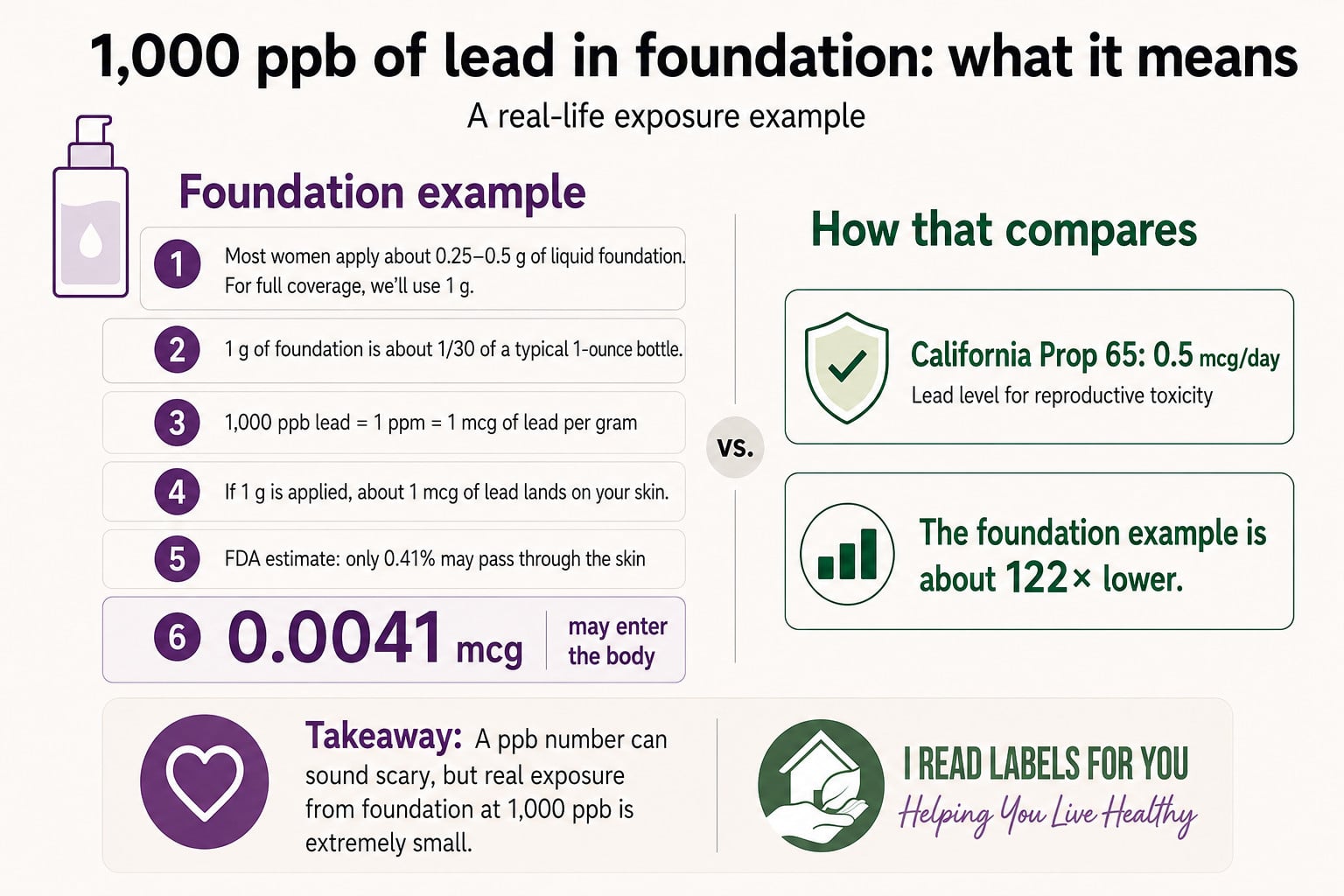
Most women apply about 0.25 to 0.5 grams of liquid foundation per use, or about 1 gram for full coverage.
Now let’s say the foundation contains 1,000 ppb of lead. That equals 1 ppm or 1 microgram of lead per gram of product.
In other words, if you apply 1 gram of foundation (1/30 of a typical 1-ounce bottle), 1 microgram of lead lands on your skin.
But your skin blocks most of it because the outer layer of your skin is very effective at preventing lead absorption.
The FDA estimated that only 0.41% of lead may pass through the skin. That means your body may absorb only 0.0041 micrograms of lead.
For context, California Proposition 65, one of the strictest regulations for lead exposure, sets the limit for reproductive toxicity at 0.5 micrograms per day.
That means the absorbed amount in this example is about 122 times lower.
If the math still feels confusing, don’t worry. I’ll break it down step by step further.
But first, let’s answer the bigger question:
If this exposure is so tiny, why do some claims sound so alarming?
Why You’re Seeing Alarming Claims
A big part of it comes down to how information spreads online.
Content that feels urgent or scary tends to get more attention. It gets more clicks, more shares, and more comments. And when something catches your attention, it’s natural to want to learn more.
If you’ve ever gone down a rabbit hole after seeing one alarming post, you’re not alone. That’s how most of us are wired.
At the same time, many of these posts present test results in the smallest units possible, like ppb (parts per billion), which can make the numbers look bigger and more concerning than they really are.
Now let me show you what ppb actually means.
What Do PPB, PPM, And MCG Actually Mean?
These units can sound confusing, but they’re actually simple once you see how they relate to each other.
Here’s an easy way to think about them:
- ppb (parts per billion) = a very small percentage in a product, specifically 0.0000001%
- ppm (parts per million) = 1,000× higher than ppb
- mcg (microgram) = 0.001 mg (milligram) = 0.000001 gram and used to estimate how much your body could actually be exposed to
Now let’s connect them:
- 1,000 ppb = 1 ppm
- 1 ppm = 1 mcg/gram
So, when you see a number in ppb, you’re looking at a very small concentration. Divide it by 1,000. 1,000 ppb is only 1 ppm.
What matters is turning that ppb into a real exposure amount (mcg) based on how much product you use per application.
10 ppm = 10 mcg/gram
Let’s do another example next.
Real-Life Example: Lead In Cosmetics And Food
Some readers emailed me because they were concerned that a popular toothpaste contained 5 ppb of lead.
In context, that is actually a very low amount, even compared with the proposed lead limit for baby food in Washington state. I don’t think baby food is the right benchmark for toothpaste, though, because the exposure is completely different.
A 6- to 12-month-old baby may eat about 200–500 grams of solid food per day. By comparison, a typical adult uses about 1 gram of toothpaste per day, and most of it is not swallowed.
For the sake of the argument, let’s assume the entire amount is swallowed.
Now let’s do the math:
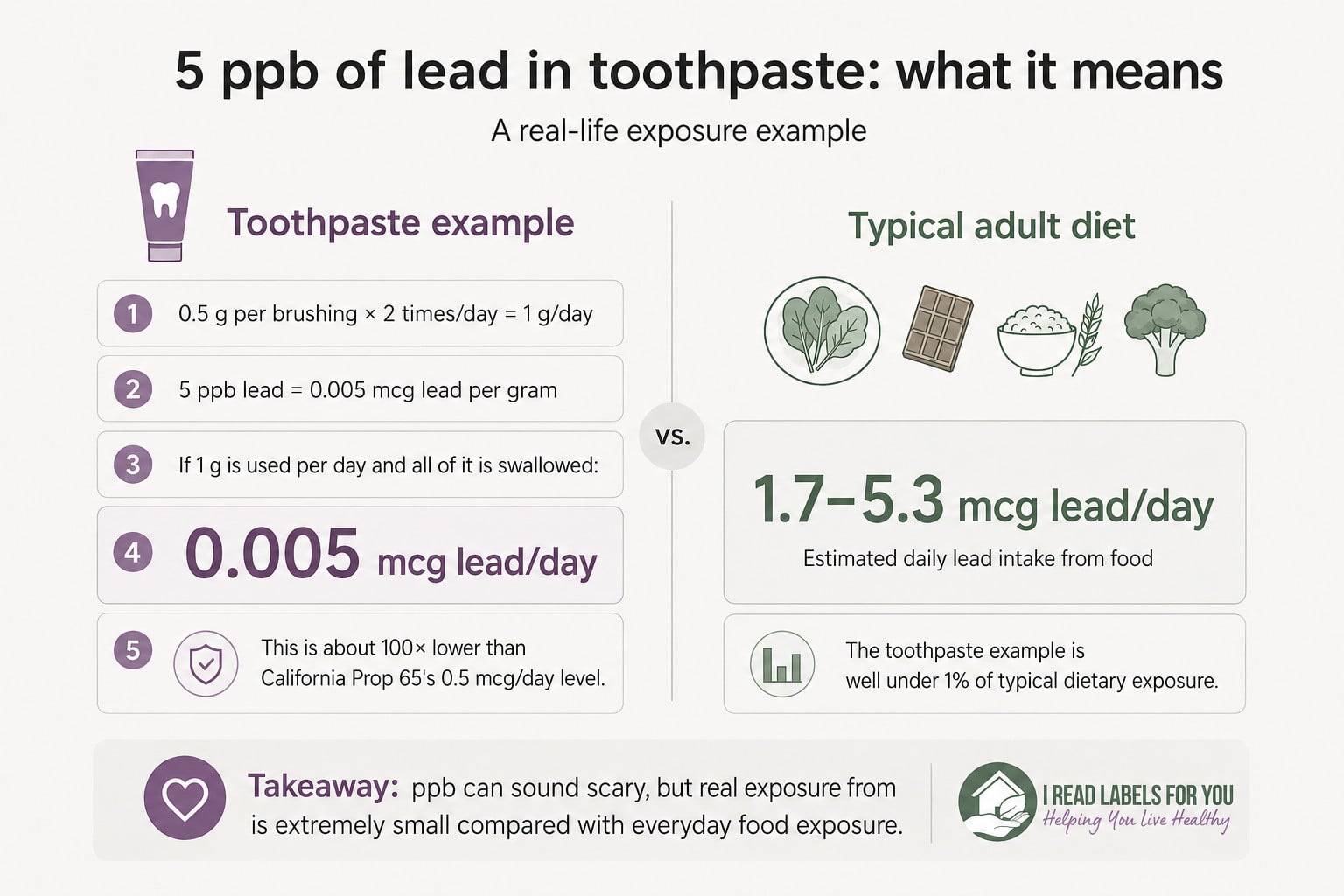
- 5 ppb = 5 ppb ÷ 1,000 = 0.005 ppm
- That equals 0.005 micrograms of lead per gram of product
If you use 1 gram of toothpaste per day:
- 1 gram × 0.005 mcg = 0.005 micrograms of lead per day
For context, California Proposition 65 sets the lead limit for reproductive toxicity at 0.5 micrograms per day.
That means this example is about 100 times lower than the Prop 65 level—even assuming 100% ingestion.
And this amount is not just small relative to Prop 65. It is also very small compared to daily ingestion of lead in food. Studies estimate that a typical adult diet provides about 1.7–5.3 micrograms of lead per day.
In other words, the lead exposure from this toothpaste example is 700 times lower than what an average adult already consumes from food. The toothpaste contribution is 0.1% of normal dietary exposure.
You might say, “I still want to find a toothpaste with zero lead.”
I understand that feeling. But in the real world, finding products with absolutely zero detectable lead can be very difficult because heavy metals naturally exist in soil, water, and raw materials.
And oftentimes, focusing too much on trace contaminants can distract from more important questions, like whether the toothpaste ingredients are actually beneficial for teeth and whether the product avoids ingredients with actual safety concerns.
For my calculations of how much lead you could be exposed to if a lipstick contains the maximum amount of lead found in testing, visit my lead in lipstick blog post.
Now compare that to food like dark chocolate:
- Most dark chocolate bars contain somewhere between 0.1 and 1.5 micrograms of lead per one ounce.
- Consumer Reports tested 28 dark chocolate bars, and for 23 of them, just one ounce exceeded California’s Proposition 65 maximum allowable daily level for lead or cadmium.
In other words, your exposure from food is much higher than your exposure from a cosmetic or personal care product, even when the product shows a high ppb number.
Lead Absorption Through Skin (What Actually Happens)
When you apply a product to your skin, not everything goes into your body.
Your skin is designed to act as a barrier. And when it comes to heavy metals like lead, it does that job very well.
Studies estimate that normally dermal absorption of lead through unabraded skin ranges from 0.01% to 0.18%. That’s why, in the earlier example, even though we took 0.41% dermal penetration rate, the absorbed amount was so small.
Here’s why this matters even more:
Not all ingredients behave the same way on your skin.
Some pass through the skin much more easily than heavy metals.
For example:
- parabens (used as preservatives): about 2% to over 50% absorbed depending on conditions (source)
- chemical UV filters, like endocrine-disrupting oxybenzone: about 10% absorbed (source)
In other words, some ingredients move through your skin dozens or even hundreds of times more easily than heavy metals.
To reiterate, a test report might show a “high” number for a heavy metal. But because your skin blocks most of it, your actual exposure is still very low.
At the same time, the ingredients intentionally used in a product (not just trace contaminants) are often more important to look at when you’re thinking about safety.
That’s what I’ve been focusing on as a product researcher and consumer advocate since 2013.
Heavy Metals In Food (Why They Exist)
Heavy metals like lead, arsenic, and cadmium are part of nature. They are naturally present in air, water, and soil, and they enter the food supply when plants take them up as they grow.
That means small amounts show up in everyday foods like:
- Vegetables, especially leafy and root vegetables.
- Grains like rice which absorbs more arsenic from the soil than other plants.
- Dark chocolate and cocoa, which often contain lead and cadmium picked up during growing and processing.
- Spices like cinnamon and turmeric which can pick up lead from the soil where they are grown or processed.
This is true even for organic and whole foods. Studies on baby food have shown that organic products are just as likely as conventional ones to contain heavy metals, because organic standards focus on pesticides, not soil contaminants.
It’s also helpful to know that a typical adult diet may provide about 1.7–5.3 micrograms of lead per day. This context is important for two reasons.
First, it helps you stop chasing impossible zeros.
Second, it helps you focus on the exposures that matter more.
For example, I use salt, protein powder, collagen, spices, and other supplements that have been tested among the lowest for heavy metals. I’m also mindful of foods known to contain higher levels of heavy metals.
A nutrient-dense diet matters, too. Foods rich in calcium, iron, and vitamin C can help reduce the body’s absorption of lead. Children with healthy diets tend to absorb less lead. (source)
And when it comes to toothpaste, I don’t focus on tiny ppb numbers because they will not move the needle in my total exposure. In other words, the lead exposure from the toothpaste example is 700 times lower than what an average adult already consumes from food. The toothpaste contribution is less than 0.1% of normal dietary exposure.
Instead, I focus on whether the toothpaste supports dental health and avoids ingredients linked to safety concerns, such as endocrine disruption, cancer concerns, and allergic reactions.
It’s also helpful to know that California Proposition 65 sets one of the lowest trigger levels for lead exposure at 0.5 micrograms per day for reproductive toxicity. This level is difficult to meet in real life, which is why warnings are often seen on processed products.
In my view, food and supplement companies that test their products and disclose this information are doing something truly important. It’s not easy to meet these low California Proposition 65 thresholds, and it takes courage to be transparent about them.
Heavy Metals In Cosmetics (Why They Exist)
Importantly, with rare exceptions (e.g., mercury in eye products), companies don’t add heavy metals to products we use on our bodies. However, they can still appear as ingredients in some imported products.
As contaminants, heavy metals can show up in many kinds of cosmetics—both conventional and natural.
Small traces of heavy metals may come from:
- synthetic or mineral pigments used to create color in makeup
- natural ingredients that absorb metals from soil and water as they grow
- environmental contamination during sourcing
- contamination from manufacturing equipment or storage
The important question is not whether a lab can detect a trace amount. Modern testing is extremely sensitive and can detect incredibly small levels, including parts per billion.
So, instead of asking, “Can I find a product with absolutely zero heavy metals?” a better question is:
Is this a well-made product without endocrine disruptors, carcinogens, and common allergens from a company that takes quality seriously?
This question will usually help you make a better decision with much less stress.
How Do I Know If A Company Takes Quality Seriously?
This is a good question because not every company approaches safety the same way.
When I evaluate a product, I don’t look at one test result in isolation. I look at the full picture.
I research each ingredient against more than 30 data points. These include regulatory, medical, and scientific sources. Then I compare that product with others in the same category. Depending on the category, I may review 20 to 100 similar products to see how the formula stacks up.
I also look at the company behind the product ingredients.
For example:
- Does the company publish its ingredients clearly, or does it make them hard to find?
- Does the company disclose ingredients in INCI naming conventions?
- Does it exaggerate the results you can expect from using the product?
- Does it answer consumer questions?
Moreover, I do my best to get to know the people behind the company.
- Do they understand how the products are made, or do they only rely on what their contract manufacturer tells them?
- Do they study ingredients for safety, or do they simply accept the claim that all their products are safe?
- Are they truly committed to healthy living, or are they just using wellness language to sell products?
For example, I stopped recommending one brand of skincare products that were supposedly made with organic ingredients after I learned more about the person behind the company. If someone does not seem to value healthy living in real life, I find it harder to trust that they understand the importance of organic ingredients or use the word “organic” carefully.
Yes, I study how products are made. This helps me notice when something may be missing from an ingredient list or when a company’s claims don’t fully make sense.
One example is 100% Pure.
For years, I had questions about their claim that they could make makeup with only fruit and vegetable pigments. I could have promoted those products and earned some income, but I did not feel comfortable doing that.
After more than a decade of my consumer advocacy, 100% Pure began disclosing petroleum-based dyes in some of their products.
This is exactly why I don’t rely on marketing claims alone.
To get my email with more details about 100% Pure and petroleum-based dyes, click here.
Download The Free Guide!
5 Powerful Steps To A Non-Toxic Home
Join our informed consumer community and get our free guide the “5 Powerful Steps To A Non-Toxic Home”.
When Should You Pay Attention To Heavy Metals?
Even though trace heavy metals in cosmetics are usually not a significant concern, there are still situations where it makes sense to keep heavy metal residue in mind.
For example:
- Children are more sensitive to lead exposure than adults, especially during brain development. To err on the side of caution, don’t let your children play with your makeup or personal care products.
- Poor-quality, unknown brands may carry a higher risk of meaningful contamination, especially if they don’t have a website, customer service, ingredient transparency, or basic quality information.
- Imported products from unknown sellers deserve extra caution because they may not follow the same safety standards or labeling rules.
Should I Request Heavy Metal Test Reports?
You can ask for heavy metal test reports, but know that there are big limitations of this time-consuming strategy.
Here’s why:
- Testing is helpful, but ingredient quality matters more. If a company uses high-purity ingredients from trusted suppliers, that lowers the risk before the product is even made. In other words, a company does not need to test every single batch.
- Suppliers often test raw materials. They usually provide documents that show ingredient purity.
- Test reports need context. They show results in ppm, so you don’t need to convert ppb to ppm. You only need to convert the result into micrograms based on how much product you actually use.
- Test results are not always simple. Different labs, methods, and equipment can produce different results.
- Test results can differ from batch to batch, especially if a company changed a supplier of raw ingredients.
- Careful companies that invest in high-purity ingredients, test their products, and have excellent results may still be nervous about sharing reports with consumers. This is especially true when they worry the results may be taken out of context or used to create unnecessary fear.
So, when you ask for a report, you can say something like:
I understand that zero detectable heavy metals is not realistic. I’m trying to understand real-life exposure in micrograms, not take the numbers out of context. If you’re comfortable sharing, could you tell me how your company monitors trace heavy metals—through supplier documentation, finished product testing, internal standards, or published guidance levels?
That kind of question is more fair and more likely to get a helpful answer.
Final Verdict: Should You Worry About Heavy Metals?
Trace amounts of heavy metals are part of real life.
They can show up in food, water, soil, supplements, cosmetics, and personal care products because they are naturally present in the environment.
What matters most is not just whether they are detected, but how many micrograms may actually end up inside your body.
Your goal does not need to be finding products with zero detectable heavy metals. That goal can create a lot of stress.
Unfortunately, I know that firsthand.
When I first learned about potentially harmful chemicals in everyday products, I became overwhelmed and anxious. Looking back, I believe that chronic stress contributed to the adrenal crisis I experienced years ago, which nearly took my life.
Importantly, if you focus only on finding “zero heavy metals” products and ignore the safety and quality of the ingredients, you may end up with products that do not support your overall health.
That’s why I research products for safety in a way that supports health, not fear. I focus on exposures that matter and that we can control, such as:
- hormone-disrupting ingredients that may interfere with the endocrine system
- known or suspected carcinogens linked to cancer concerns
- strong allergens that may trigger irritation, eczema, or allergic reactions
So don’t let fear-mongering information get in the way of your health.
Download The Free Guide!
5 Powerful Steps To A Non-Toxic Home
Join our informed consumer community and get our free guide the “5 Powerful Steps To A Non-Toxic Home”.
I have taken chlorella and cilantro pills after blood tests showed elevated levels of lead and aluminum in my body. I was retested and, although the blood levels went down, a urine test by an integrative medicine dr still showed elevated levels. He said it meant it was beyond my blood, possibly in my bones. I opted to continue on the chlorella and cilantro pills for 6 more months instead of undergoing chelation. I have not had my urine retested because the integrative medicine dr is no longer available. I have no symptoms that I am aware of that could be caused by elevated lead and aluminum levels. My bone density tests show osteopenia (not osteoporosis) which is normal for a 71 year old woman. I have no idea what could have caused these elevated levels of lead and aluminum. My son and husband do not have elevated levels of lead or aluminum in their blood. Any suggestions or thoughts?
Hi, Wendy! It sounds like you had exposure to the metals, which you don’t have anymore. Common sources for women in their 70s include:
• Older homes: Pre-1978 paint, old plumbing, lead solder in pipes
• Imported or vintage ceramics: Pottery, dishes, crystal (lead glazes can leach)
• Hair dye: Progressive hair dyes contained lead acetate until recently
• Spices: Imported turmeric, chili powder, and others have been recalled for lead
• Dietary supplements: Some herbal and ayurvedic supplements have been found to be contaminated
• Aluminum sources: Antiperspirants, certain antacids (Maalox, Mylanta), aluminum cookware, processed foods with aluminum additives
• Drinking water: Especially if you’ve spent time in homes with older pipes
Thank you for this perspective! For several years I have been anxious about heavy metals …the fear was almost overwhelming. Your analysis is a more realistic approach and less fear inducing. Thank you.
Hi, June! Thank you so much for saying this. I completely understand how heavy the fear can feel, especially when you see numbers without context.
My goal is never to dismiss the concern, but to help put it into real-life perspective so you can make good decisions without feeling overwhelmed.
I’m so glad this helped you feel more grounded. That means a lot to me. 💗