
Is Methylchloroisothiazolinone Safe? A Simple Answer You Can Trust
 Written by Irina Webb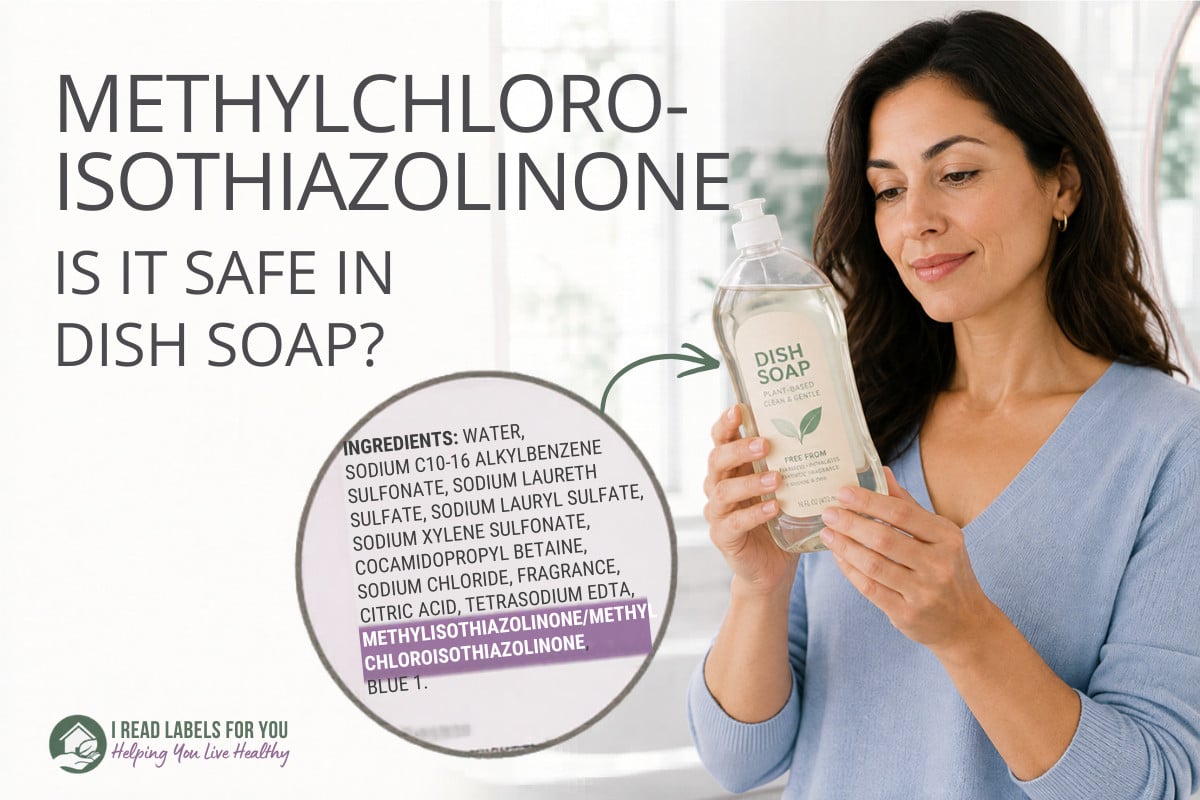
No, I avoid Methylchloroisothiazolinone, including the rinse-off products where the law still permits it. It’s a chlorinated preservative, sold only as a fixed blend with a second preservative. Laboratory testing rates the blend an extreme sensitizer, and it holds a place on the standard patch-test panel. Its whole-body record is genuinely clean, with no cancer signal and a wide safety margin. I rate it Not A Fan.
Methylchloroisothiazolinone appears in European law at entry 39 of Annex V, the list of permitted preservatives. Its ceiling is 0.0015%, and that allowance covers only products washed away after use. The rules also require the fixed 3-to-1 pairing, which is why it never stands alone on a label. Health Canada mirrors all of this. Europe went further in July 2024 and declined to approve the substance as a biocidal active.
Three findings below deserve your attention. First, how this preservative compares with its own blending partner on a laboratory allergy scale. Second, what becomes of the 62% of a dose that never leaves your skin. Third, why an impurity that appears on no label matches the active ingredient for allergy strength.
What Is Methylchloroisothiazolinone?
Methylchloroisothiazolinone (MCI) is a laboratory-made preservative. Chemists also write it as CMIT. PubChem describes it as “a powerful biocide and preservative” and “the major active ingredient in the commercial product Kathon.”
The name is a mouthful, and it decodes neatly. Take Methylisothiazolinone, attach one chlorine atom, and you have Methylchloroisothiazolinone. That single atom is the whole story. It turns a moderate preservative into the strongest common allergen in the isothiazolinone family.
Methylchloroisothiazolinone has never been a food ingredient. No European E number covers it, and no United States food approval applies. The Environmental Protection Agency registers it as a microbiocide instead.
What Does Methylchloroisothiazolinone Do In Cosmetics?
Anything containing water can grow bacteria, yeast, and mold. Methylchloroisothiazolinone preservative stops that at concentrations measured in parts per million, which is why formulators reached for it so widely. Moreover, it works across a broad pH range and costs very little.
The use of Methylchloroisothiazolinone extends well beyond the bathroom. Industry records list it in paints, adhesives, metalworking fluids, latex emulsions, paper mills, and cooling water systems.
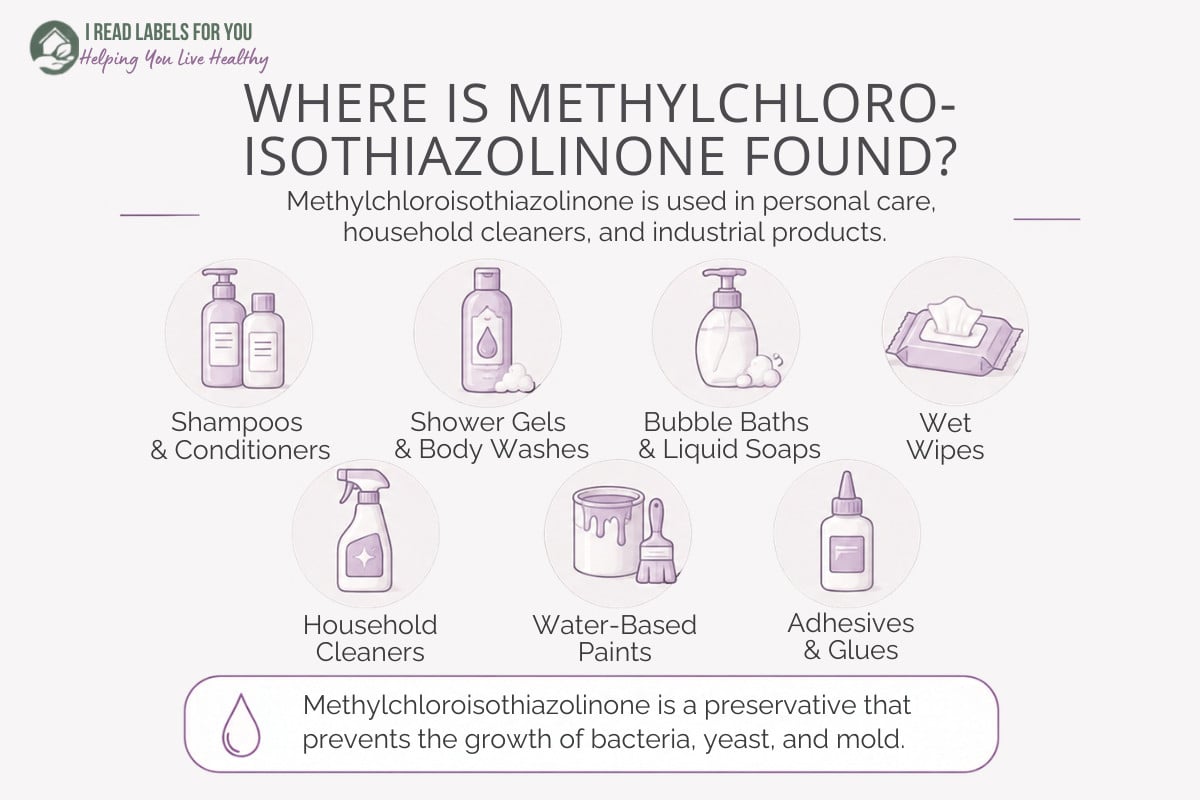
You’ll find Methylchloroisothiazolinone most often in:
- shampoos and conditioners
- shower gels and body washes
- bubble baths and liquid soaps
- wet wipes
- household cleaners
- water-based paints
- adhesives and glues
Notice what is missing from that list. Creams, lotions, and sunscreens no longer carry it in Europe or Canada. The law removed it from anything left on the skin.
Why Is Methylchloroisothiazolinone Always Sold With Methylisothiazolinone?
Methylchloroisothiazolinone is always sold with Methylisothiazolinone because European law permits nothing else. The Annex V entry covers a mixture in a fixed 3-to-1 ratio, never the chlorinated molecule on its own. Consequently, a label showing one of these names shows both.
The reason is chemistry rather than paperwork. Industry reports say the two actives “are not the result of blending two separately produced active ingredients.” One reaction produces both, and how far the chlorination runs decides the ratio.
The partnership is not equal. On the standard laboratory potency scale, the pure chlorinated molecule scores 81 parts per million, while Methylisothiazolinone scores 25,150. In plain terms, this is roughly 300 times the allergy strength of the preservative it travels with.
How Is Methylchloroisothiazolinone Made?
Methylchloroisothiazolinone (MCI) is made in a single reaction that produces two preservatives at once. Chemists start with a sulfur compound called dimethyldithiodipropionamide and treat it with chlorine. This step, known as chlorine-induced cyclization, builds the ring structure. More chlorine then finishes the molecule.
That same reaction also creates Methylisothiazolinone (MI) as a by-product, at about 25% yield. This is why your label shows a 3-to-1 ratio of the two. It reflects how the reaction naturally turns out.
The older version of this process had a problem: it created dimethylnitrosamine, a carcinogenic impurity. Manufacturers rewrote the recipe using a chemical called methyl 3-mercaptopropionate to keep that impurity down. Regulators made the change mandatory, and it worked. Europe’s safety committee later found nitrosamine levels too low to measure, under 0.3 parts per million. This is a solved problem.
One impurity is still worth noting. Europe’s review names 4,5-dichloro-2-methyl-4-isothiazolin-3-one, found at up to 100 parts per million of the raw material. According to that review, it “was as potent as the monochlorinated active as a sensitizer.” In plain terms, this impurity is not listed on labels, yet it can trigger allergies as strongly as the main ingredient.
Does Methylchloroisothiazolinone Penetrate The Skin?
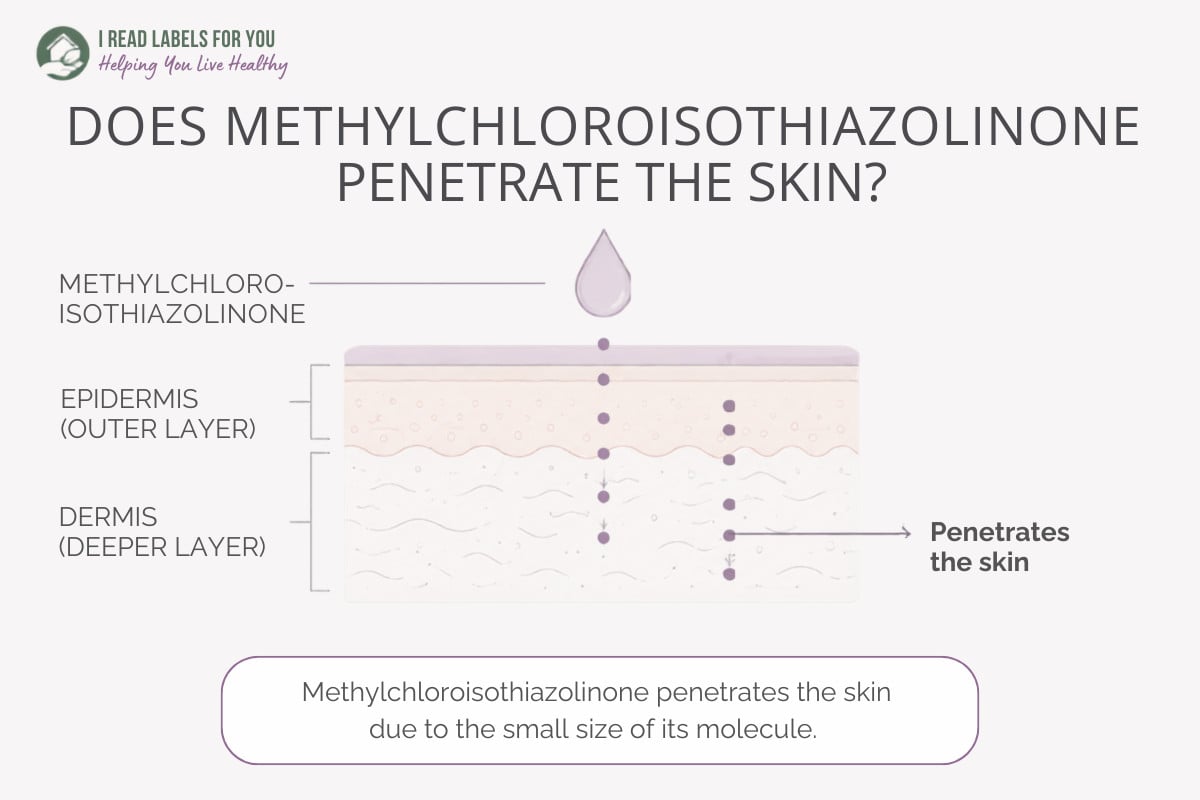
Yes, Methylchloroisothiazolinone (MCI) penetrates the skin. But the more useful question is not how much passes through. It’s how much stays behind.
Two things decide whether a molecule crosses skin: its size and its oil-versus-water balance. Molecules under about 500 daltons (a unit of molecular weight) are small enough to get through. MCI weighs just 150 daltons. Its oil-versus-water balance, measured as LogP, sits at 0.9, well within the range that crosses skin. So, entry is not in doubt.
How much crosses is harder to say. Across the studies Europe’s safety committee reviewed, anywhere from 7% to 56% of the dose crossed human skin in 24 hours. That range was too wide to trust, so the committee concluded “a reliable value for dermal absorption could not be determined.” For its safety math, it assumed 100%.
The number that matters most is different. Up to 62% of a single dose binds to the skin where it lands and stays. Its half-life there is 13.1 days, so half of what binds is still present almost two weeks after one wash.
This is why binding matters. Contact allergy starts when a reactive molecule attaches to a skin protein, and that attachment teaches your immune system to react later. Whole-body exposure, by contrast, stays low, with a large safety margin of 7,368. The concern with MCI is not what spreads through your body. It’s what stays on your skin.
What Is Methylchloroisothiazolinone Called On Labels?
Cosmetics use the international naming system, while cleaning products in Europe must name preservatives at any amount. Expect to see two names together rather than one.
Watch for these names:
- METHYLCHLOROISOTHIAZOLINONE
- METHYLISOTHIAZOLINONE
- 5-Chloro-2-Methyl-4-Isothiazolin-3-One
- Chloromethylisothiazolinone
- Kathon CG
- Kathon 886
- MCI Or CMIT
- MCI/MI
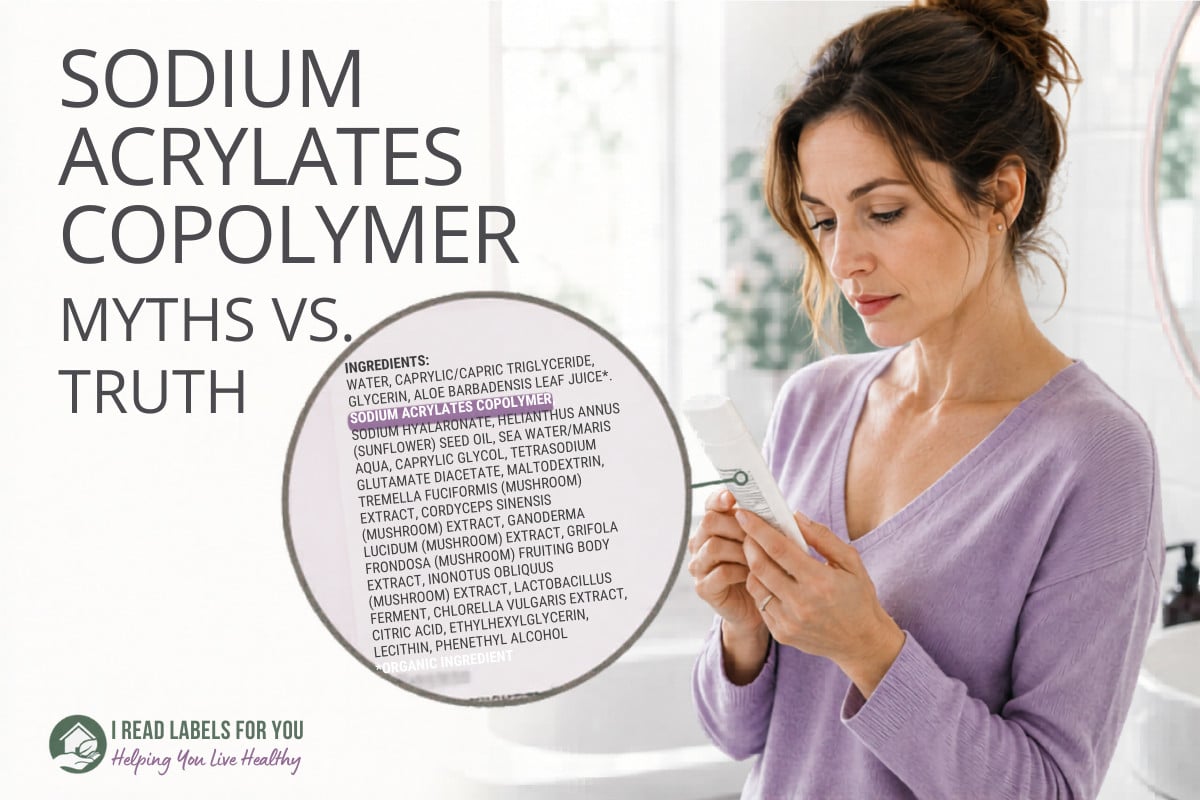
A pairing at the end of an ingredient list is the usual pattern. Preservatives appear last because they are used in the smallest amounts, and ingredient lists run from most to least.
Does The U.S. FDA Restrict Methylchloroisothiazolinone In Food And Cosmetics?
It does not. Methylchloroisothiazolinone appears nowhere on the FDA list of prohibited and restricted cosmetic ingredients. An American manufacturer faces no federal ceiling on how much goes into a shampoo.
That silence carries less weight than it sounds. The American restricted list holds roughly a dozen substances, against more than a thousand restricted across the European Union. A short list produces few entries, not few hazards.
Who does the reviewing differs too. American cosmetic safety conclusions come mainly from a panel that industry funds, while Europe uses an independent scientific committee. Europe also applies the precautionary principle, meaning it acts on strong evidence of harm instead of waiting for certainty.
EU Regulations About Methylchloroisothiazolinone
Europe allows Methylchloroisothiazolinone at 0.0015% in rinse-off products only, listed at entry 39 of Annex V of the Cosmetics Regulation. The entry covers the 3-to-1 blend, not the chlorinated molecule alone. No leave-on use is permitted.
The reasoning comes from a 2009 opinion of the Scientific Committee on Consumer Safety. The conclusion turns on its final four words:
The SCCS is of the opinion that the mixture… does not pose a risk to the health of the consumer when used as a preservative up to a maximum authorized concentration of 0.0015% in rinse-off cosmetic products, apart from its sensitizing potential.
Apart from its sensitizing potential. That is an approval with the main problem carved out of it. The same opinion calls the blend “well recognized as an important skin sensitizer at current conditions of use.”
A second decision is easy to miss. In July 2024, the harmonized classification process closed because the substance “has not been approved as an active substance in Biocidal Products.” Put simply, Europe declined to approve as a biocide the same chemical it permits in your shampoo.
U.S. And EU Disagreements On Methylchloroisothiazolinone
The American panel is stricter than Europe in one way and looser in another. It matches Europe’s 0.0015% limit for rinse-off products. But it also permits 7.5 parts per million in leave-on products, where Europe allows none.
That decision sits awkwardly next to the panel’s own risk assessment. A safety margin above 1 means the exposure is judged safe; below 1 means it is not. Several leave-on categories fell below that line: colognes at 0.50, skin cleansers at 0.61, and permanent waves at 0.13. Even the categories that passed, passed narrowly. Shampoos and hair rinses came in at 1.08, leaving almost no room to spare. The panel kept leave-on use on the table anyway, subject to case-by-case review.
To its credit, the panel was open about the split. Its conclusion, it wrote, “differs from that reached by counterparts in the European Union.” The difference came down to how each side read the early animal studies on allergy.
Canadian Regulations About Methylchloroisothiazolinone
Canada lines up with Europe. Its Cosmetic Ingredient Hotlist bars the blend from leave-on products and holds rinse-off products to 0.0015%.
Health Canada also blocked an obvious workaround. Where a formula contains the blend plus extra Methylisothiazolinone, the combined total still cannot exceed 0.0015%. On the environmental side, Canada has not added this preservative to its list of toxic substances.
Can Methylchloroisothiazolinone Cause Skin Allergy And Sensitization?
Yes, and Europe’s reviewers use the strongest term they have. Their conclusion:
The data demonstrates that CMI/MI is an extreme sensitizer in animals.
The potency behind that word is what stands out. On the standard lab scale, the blend triggers a reaction at 0.0082%. Formaldehyde, an allergen most people have heard of, needs 0.4% to do the same, about fifty times more.
Human data shows the effect. British clinics patch tested 6,958 people and found 2.0% positive. Spanish researchers found 4.04%, and a survey of 19,793 European patients put southern Europe at 4.1%. Children are affected too: in a Polish screening program, 6.3% of seven-year-olds with eczema tested positive. Europe’s summary is that contact allergy “remains high in European patients with eczema under current use and exposure conditions.”
The American Contact Dermatitis Society lists the blend at entry 17 of its core patch-test panel, at 100 parts per million. An allergen earns a place there only when it is common enough to screen every patient.
One figure decides my rating. In someone already sensitized, a reaction can start under 2 parts per million. The legal ceiling of 15 ppm sits well above that. It was set to prevent new allergies, not to protect people who already have one.
Is Methylchloroisothiazolinone A Hormone (Endocrine) Disruptor?
No, Methylchloroisothiazolinone is not a hormone disruptor, and no authority has classified it as one. Europe’s chemicals agency has run no endocrine assessment on it, and no human study reports hormone effects.
Related chemicals have raised flags: a 2026 study tested six isothiazolinones on marine medaka embryos and rated three of them potently estrogenic. Methylchloroisothiazolinone was not among them. Allergy remains the reason to avoid it, not hormones.
Is Methylchloroisothiazolinone Safe To Use While Pregnant?
The pregnancy data are more reassuring than the allergy data. Given by mouth to pregnant rabbits at up to 13.3 mg per kilogram daily, the blend harmed the mothers. Even so, “the compound was not teratogenic,” meaning it caused no birth defects.
Rats told the same story. At doses reaching 15 mg per kilogram daily, mothers showed toxicity while the pregnancies themselves came through unaffected. A two-generation study set the no-effect level at 2.8 mg per kilogram, the figure Europe used for its safety calculation.
Put beside real exposure, those doses are enormous. A rinse-off product delivers an estimated 0.00038 mg per kilogram daily, which is why the safety margin reaches 7,368.
My practical answer is that pregnancy is not the concern here. Developing an allergy during pregnancy is unpleasant and permanent, which is reason enough to skip it. For any specific product, you should consult with your medical provider.
Are There Any Cancer Concerns Linked To Methylchloroisothiazolinone?
No cancer link has been established for Methylchloroisothiazolinone, and the evidence is thinner than it first looks. Europe’s review records one relevant test, a mouse embryo cell transformation study, which was negative. A longer study backs it up: researchers applied the MCI blend to mouse skin three times a week for 30 months, most of a mouse’s life, and no tumors appeared. That is a meaningful negative.
Genetic testing is messier. Methylchloroisothiazolinone came back positive in bacterial mutation tests, hitting strain TA100 in four studies and five strains in a 1994 test. Mammalian cell assays were negative. Finished products behaved similarly: of five cosmetic products with the blend, three acted as direct mutagens in bacterial testing.
Regulators weigh the long animal study more heavily, and the official lists agree. The International Agency for Research on Cancer, the U.S. National Toxicology Program Report on Carcinogens, and California Proposition 65 all return nothing on Methylchloroisothiazolinone. Both manufacturing chemicals come back clear too.
Is Methylchloroisothiazolinone Bad For The Environment?
The hazard labels are severe, but they describe the concentrate, not your shampoo. Under the international labeling system, Methylchloroisothiazolinone carries H400 and H410, meaning “very toxic to aquatic life with long lasting effects.” Its signal word “Danger” belongs to the drum in a factory, not the bottle in your shower.
Scale keeps this in perspective. A finished product holds 15 parts per million, while the raw material runs near 14% active ingredient. Even so, a chemical built to kill microorganisms goes down the drain after every use.
Industrial uses dwarf cosmetic ones. Paints, cooling water, adhesives, and paper mills consume far more MCI than personal care does. Meanwhile Canada has not listed it as a toxic substance, and no European restriction targets it on environmental grounds.
Common Claims About Methylchloroisothiazolinone: What’s True And What’s Not
Claim: Methylchloroisothiazolinone Is Banned In Europe
Partly right, and the wording matters. Europe removed Methylchloroisothiazolinone from every product that stays on the skin. That covers moisturizers, body lotions, sunscreens, and baby wipes, and the change took effect in 2017.
Washed-off products may still carry Methylchloroisothiazolinone lawfully, at the 0.0015% ceiling. A shampoo bought in Paris can contain it, and plenty do. Say restricted rather than banned, and you will be right.
Claim: Methylchloroisothiazolinone Is Only A Problem If You Already Have Sensitive Skin
This one has it backwards. Contact allergy is not a trait you are born with. Anyone can acquire it through repeated exposure.
The history proves the point. During the 1980s, Methylchloroisothiazolinone and Methylisothiazolinone preservatives sat in leave-on products at up to 30 parts per million. Allergy rates among eczema patients climbed to between 3% and 8%, turning ordinary skin into allergic skin.
Once that switch flips, it stays flipped. There is no treatment that reverses contact allergy, and the reaction extends to every product carrying the ingredient.
Claim: The Amounts Of Methylchloroisothiazolinone Are Too Small To Matter
Fifteen parts per million does sound negligible, and for most chemicals it would be. But Methylchloroisothiazolinone triggers allergy, and allergy works on a different scale from poisoning. That is the piece this claim misses.
Two numbers show the gap. Whole-body exposure from a rinse-off product gives a comfortable safety margin of 7,368. Yet a person already sensitized to MCI can react below 2 parts per million.
There is also a compliance question. A 2026 Danish study analyzed 30 marketed rinse-off products. Two of the 25 labeled products exceeded the legal limit, and four missed the required 3-to-1 ratio.
What I Think About Methylchloroisothiazolinone — And What You Should Do
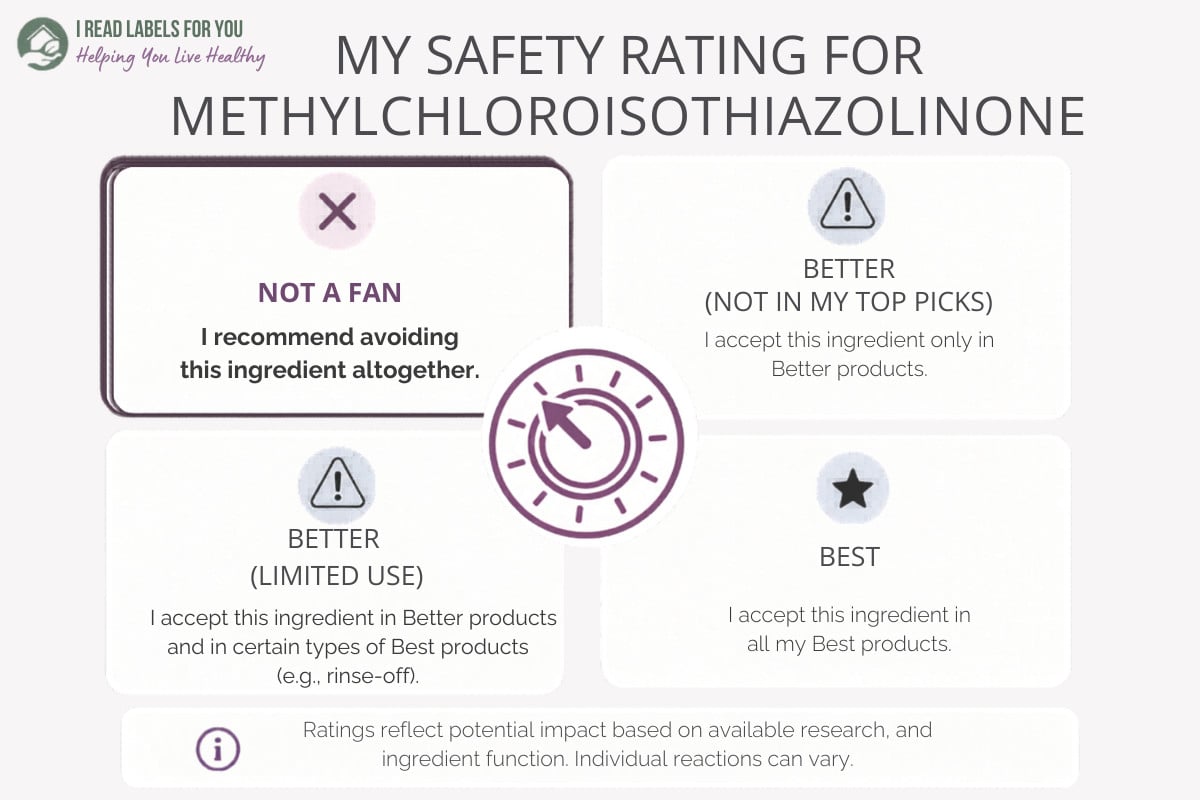
I rate Methylchloroisothiazolinone Not A Fan. What decided it was not a data gap. Europe reviewed this preservative thoroughly and approved it for rinse-off use with one condition attached: apart from its sensitizing potential. That carve-out is the whole ingredient. Strip away the allergy question and little remains to worry about. The whole-body toxicology is clean, and the safety margin is wide. Allergy is not a side effect here, though. It’s the main effect.
Three specifics push Methylchloroisothiazolinone into my lowest tier. First, Europe’s reviewers call it an extreme sensitizer, roughly fifty times more potent than formaldehyde on the laboratory scale. Second, up to 62% of a dose binds in skin for around two weeks. Third, sensitized people react below 2 parts per million, a level no label will ever disclose.
Fairness requires the other column. Methylchloroisothiazolinone showed no cancer signal, no birth defect signal, and no hormone activity. The nitrosamine problem from decades ago was fixed and verified.
Allergy still outweighs all of it. Contact allergy is permanent, and it spreads to every product carrying Methylchloroisothiazolinone.
What I suggest is simple. Read the last few lines of any ingredient list, where preservatives live, and look for either Methylchloroisothiazolinone or Methylisothiazolinone. Gentler options exist and they work. Pentylene Glycol and Sodium Benzoate handle the same job. Neither carries this allergy record.
Frequently Asked Questions About Methylchloroisothiazolinone
How Harmful Is Methylchloroisothiazolinone?
Methylchloroisothiazolinone is harmful in one specific way and unremarkable in the rest. At the levels used in cosmetics, it will not poison you, cause cancer, or affect pregnancy.
What Methylchloroisothiazolinone does is cause a permanent allergy in a meaningful share of people. European patch-test clinics report reaction rates to MCI between 2% and 4.1%, which is high for a single ingredient. Once you acquire that allergy, it’s yours for life.
Is Methylchloroisothiazolinone Safe In Shampoo?
Shampoo is the product European law had in mind when it allowed 15 parts per million. It is also where most reported reactions to Methylchloroisothiazolinone happen. Rinsing genuinely lowers the risk of becoming allergic. It does not protect someone already sensitized. Reactions show up on the scalp, hairline, ears, neck, and eyelids. Hair itself is not living tissue, and nothing happens there.
Is Methylchloroisothiazolinone Safe In Dish Soap?
Dish soap deserves more attention than shampoo, because your hands stay in it. Repeated wet work already damages the skin barrier, and damaged skin absorbs more of whatever it meets.
Hand dermatitis is one of the settings where Methylchloroisothiazolinone or Methylisothiazolinone preservatives turn up most often as the cause. If your hands crack or itch after washing up, the preservative is worth ruling out with a patch test.
Is Methylchloroisothiazolinone The Same As Methylisothiazolinone?
Methylchloroisothiazolinone or Methylisothiazolinone are two different molecules that arrive together. One carries a chlorine atom, and the other does not. European law permits the chlorinated one only inside a fixed blend with its partner. Their strengths are far apart. The chlorinated version is roughly 300 times more sensitizing. That is why the blend is capped at 15 parts per million, while Methylisothiazolinone alone once sat at 100.
Sources
EU SCCS / SCCP Opinions:
SCCS/1238/09, Opinion on the mixture of 5-chloro-2-methylisothiazolin-3(2H)-one and 2-methylisothiazolin-3(2H)-one (COLIPA n° P56), adopted 8 December 2009, the governing opinion, source of the “extreme sensitiser” finding and the margin of safety calculation: SCCS/1238/09
SCCS/1521/13, Opinion on Methylisothiazolinone (P94) Submission II, revision of 27 March 2014, covers the blending partner: SCCS/1521/13
SCCS/1557/15, Opinion on Methylisothiazolinone (P94) Submission III, final December 2015: SCCS/1557/15
Cosmetic Ingredient Review (CIR) Reports:
Burnett CL, Bergfeld WF, Belsito DV, et al. (2021). Amended Safety Assessment of Methylchloroisothiazolinone and Methylisothiazolinone as Used in Cosmetics. International Journal of Toxicology 40(Supplement 1): 20S-33S, source of the product-category safety margins and the acknowledgement of the split with Europe: cir-reports.cir-safety.org
Cosmetic Ingredient Review (1992). Final Report on the Safety Assessment of Methylisothiazolinone and Methylchloroisothiazolinone. Journal of the American College of Toxicology 11(1): 75-128, source of the manufacturing route and the nitrosamine history: cir-reports.cir-safety.org
Burnett CL, Bergfeld WF, Belsito DV, et al. (2021). Amended Safety Assessment of Methylisothiazolinone as Used in Cosmetics. International Journal of Toxicology 40(Supplement 1): 5S-19S: cir-reports.cir-safety.org
European Union Regulatory Databases:
CosIng entry for METHYLCHLOROISOTHIAZOLINONE (CAS 26172-55-4, EC 247-500-7), function preservative, Annex V entry 39, 0.0015% of the 3-to-1 blend in rinse-off products only: EU CosIng database
CosIng Annexes II, III, IV and V checked. The ingredient appears only in Annex V, the list of permitted preservatives, and is absent from the Annex II prohibited list: EU CosIng database
ECHA substance record 100.043.167. No active REACH registration. The harmonized classification process closed on 1 July 2024 because the substance was not approved as a biocidal active; not a substance of very high concern: ECHA CHEM 100.043.167
Other Regulators:
U.S. Food and Drug Administration. Not listed among prohibited or restricted cosmetic ingredients, and no food additive status: FDA prohibited and restricted cosmetic ingredients
Health Canada Cosmetic Ingredient Hotlist. Restricted: not permitted in leave-on products, rinse-off limited to 0.0015%: Cosmetic Ingredient Hotlist
Environment Canada, CEPA Schedule 1 List of Toxic Substances. Not listed: CEPA Schedule 1
International Agency for Research on Cancer. Not classified, and neither manufacturing chemical is classified either: IARC List of Classifications
U.S. National Toxicology Program, 15th Report on Carcinogens. Not listed: NTP Report on Carcinogens
California Proposition 65 chemical list. Not listed: OEHHA Proposition 65 list
PubChem Records (Chemistry, Identifiers, Skin Penetration, Hazard Codes):
Methylchloroisothiazolinone, CID 33344. Molecular weight 149.60, XLogP3 0.9, hazard codes including H314, H317, H400 and H410, signal word Danger: PubChem CID 33344
Methylisothiazolinone, CID 39800. Molecular weight 115.16, XLogP3 0: PubChem CID 39800
Peer-Reviewed Studies:
Pedersen MK, et al. (2026). Methylchloroisothiazolinone and Methylisothiazolinone 10 Years After Regulation. Contact Dermatitis. PMID 42300206. The Danish market analysis of label compliance: PubMed
Li J, et al. (2026). Endocrine-disruptive effects and mechanisms of isothiazolinone analogues in marine medaka embryos and H295R cells. Aquatic Toxicology 290: 107633. PMID 41187467: PubMed
Aerts O, et al. (2018). Photoaggravated allergic contact dermatitis caused by methylchloroisothiazolinone and methylisothiazolinone. Contact Dermatitis 78(4): 241-245. PMID 29230841: PubMed
Natural Cosmetic Standards:
COSMOS-standard approved raw materials. No result for this ingredient: COSMOS-standard database
NATRUE certified and approved raw materials. No result for this ingredient: NATRUE certified world
Skin Allergy Resource:
American Contact Dermatitis Society. Helpful References, including the Core Allergen Series 2020, where the blend is entry 17, tested at 100 parts per million: ACDS Helpful References
Last verified: 08-09-2026
Download The Free Guide!
5 Powerful Steps To A Non-Toxic Home
Join our informed consumer community and get our free guide the “5 Powerful Steps To A Non-Toxic Home”.

Before commenting, please read our Comment Policy.