
Organic Hair Color: Buyer Beware!
 Written by Irina Webb
Type ‘organic hair color’ into Google and you’ll get hundreds of results. It’s easy to assume that truly organic hair dyes must be widely available. And at first glance, that might seem to be the case—after all, plenty of brands feature the word ‘organic’ right on their labels. But what does that really mean? Is it actually possible for hair dye to be organic? Let’s break it down and get some clarity. Along the way, you’ll also learn more about popular brands, like Oway and Organic Colour Systems, and how they fit into the bigger picture.
Organic Hair Color: Does It Exist?
To begin with, the term ‘organic’ is officially defined and regulated by the United States Department Of Agriculture (USDA) under the National Organic Program (NOP)—but only for agricultural products like food and certain plant-based ingredients. When it comes to personal care items like hair color, the situation gets more complicated.
Next, unlike food, cosmetics and personal care products fall under the FDA’s oversight, and the FDA does not define or regulate the use of the word ‘organic’ (or the word ‘natural’ for that matter). This means some hair dye brands may use certified organic ingredients, but the products themselves aren’t held to an overall organic standard unless certified by the USDA.
Furthermore, to earn a USDA organic seal on a cosmetic product, at least 95% of the ingredients (excluding water and salt) must be individually certified organic. That’s a high bar—and for good reason. The process is strict, thorough, and often expensive. After I researched most permanent hair color brands available on the market, I can tell you that I haven’t seen any permanent hair color that can meet the USDA threshold.
Why Do Some Hair Dyes Have ‘Organic’ On The Label?
Here’s the catch: Since the FDA doesn’t regulate the term ‘organic’ in personal care products, brands are free to use it however they like—as long as they don’t display the USDA organic seal, unless they’ve earned it. This creates a loophole that some companies take advantage of, using the term ‘organic’ more as a marketing tool than a meaningful indicator of purity or safety.
That’s why it’s so important for consumers to stay informed. The word ‘organic’ tends to imply a product meets high safety and environmental standards. However, unless a legitimate third-party certification can back that, the label doesn’t carry much weight.

Can Hair Dye Actually Be Certified Organic?
In short, not really—at least not in the way we typically think of USDA-certified organic products.
To clarify, ingredients used in hair dye formulations do not qualify for organic certification because they’re not agricultural. Thus, most hair color products contain synthetic dyes and chemical agents like ammonia or ethanolamine that open the hair shaft so color can penetrate. These substances cannot be certified organic, even if the formulation includes a few plant-based ingredients.
Let’s take a closer look at what can and can’t be organic.
Ingredients That Can Be Certified Organic
To be eligible for organic certification, ingredients must come from agricultural sources and be processed in ways that preserve their integrity. Think cold-pressed oils (like jojoba or olive), dried herbs, and plant extracts processed without harsh chemicals (like hexane). Manufacturers often include these ingredients in hair dyes for their moisturizing or soothing properties—but not for their coloring abilities.
Ingredients That Cannot Be Certified Organic
First off, non-agricultural substances, such as synthetic surfactants or hair conditioning agents, don’t qualify—no matter how ‘natural’ they might sound. Take sodium laureth sulfate, for instance. It may start from coconut oil, but after going through several chemical reactions (including treatment with ethylene oxide), it bears little resemblance to anything ‘natural’ or ‘organic.’
Additionally, permanent hair dyeing products must include a hair shaft opener like ammonia to lift the natural pigment off your hair and let the chemical dye in. Oftentimes, ‘organic’ or ‘natural’ hair dyes advertise being ‘ammonia-free.’ What that means is they’ve swapped ammonia for ethanolamine—another chemical that serves the same purpose. While ammonia is notorious for its harsh smell, ethanolamine has its own set of concerns, including potential links to birth defects. So, while one may be less irritating in the short term, neither is inherently safe. In fact, ethanolamine is less studied and potentially more concerning than ammonia. Learn more in my blog post Are Ammonia-Free Hair Color Brands Better?.
On top of that, hair dyes include synthetic colorants like p-phenylenediamine (PPD), toluene-2,5-diamine sulfate, and similar chemicals—none of which is organic under any meaningful standard. These ingredients are strong sensitizers, meaning they can trigger allergic reactions with repeated exposure. In severe cases, these reactions can include swelling, skin blistering, and even anaphylactic shock. And unfortunately, you’ll find these ingredients in many hair dyes marketed as ‘organic.’ Learn How To Spot An Allergic Reaction To Hair Dye to act fast and prevent severe cases.

Are ‘Organic’ And ‘Natural’ Hair Dyes Safer?
Let’s look at a few popular examples:
- Organic Colour Systems: It lists a handful of certified organic ingredients, such as aloe vera and comfrey extract. While that’s great for scalp care, those ingredients make up a small fraction of the total formula—which still contains dozens of conventional, synthetic chemicals, including PPD.
- Oway Hair Color: Like the above-mentioned hair color, it touts organic plant extracts like hibiscus and wheat protein. Yet, the base formula contains strong synthetic colorants and chemical developers.
This pattern is common for some other hair dyes, such as:
So, to answer the question—based on my research and ingredient reviews, the answer is no, permanent hair colors marketed as ‘organic’ or ‘natural’ are not necessarily safer. In my own investigation of more than 60 hair color brands, the safest-rated product isn’t even marketed as ‘organic’ or ‘natural’—it simply has fewer harsh ingredients overall. Meanwhile, brands that leaned heavily into the ‘organic’ label still included some of the most potent sensitizers.
Conclusion: Is ‘Organic’ Hair Color Better For You?
Hair Dye Labeled ‘Organic’ Can Be Appealing—But Unless It’s Plant-Based And Carries A Certified Organic Seal, It Probably Isn’t What It Claims To Be.
In conclusion, marketing language can be persuasive, but when it comes to your health and safety, digging a little deeper is always worth it.
If you’re looking to minimize exposure to synthetic chemicals, plant-based powders like henna, indigo, and cassia—with a USDA organic seal—are your best bet. These can be genuinely organic, as they don’t rely on synthetic dyes or aggressive chemicals. You will find some options in my Amazon shop.
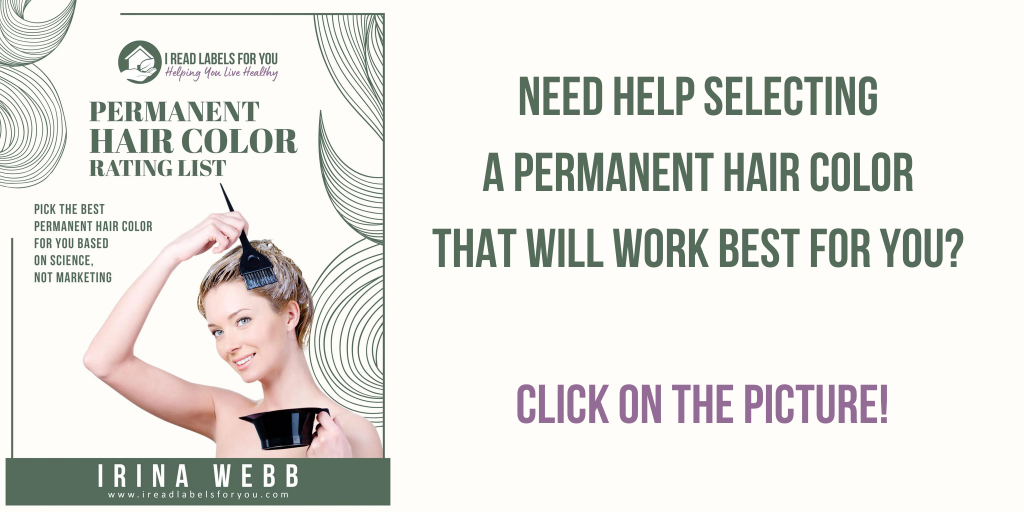
Check out my Permanent Hair Color Rating List for safer permanent hair color options. Visit the I Read Labels For You blog and the IRLFY non-toxic product shop, download my unprecedented e-books, and choose to receive my free emails for inspiration, encouragement, and generous discounts!
Download The Free Guide!
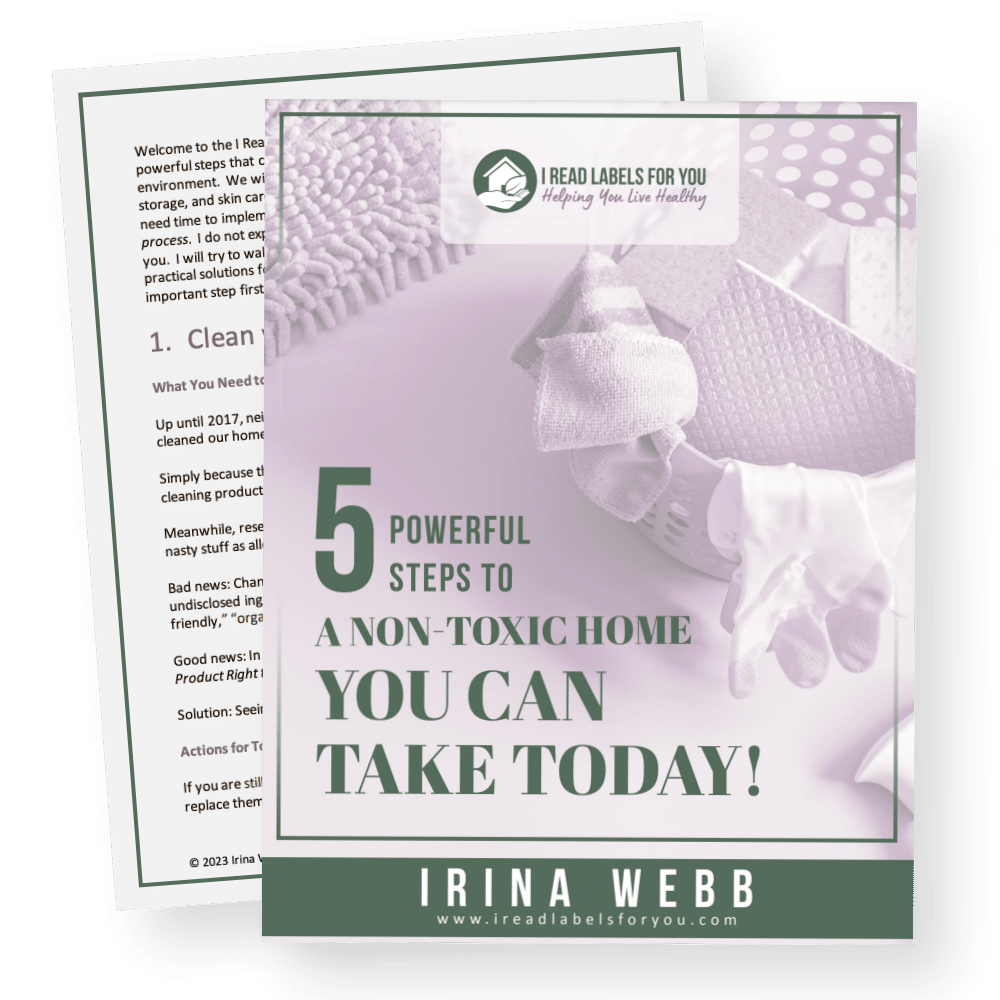
5 Powerful Steps To A Non-Toxic Home
Join our informed consumer community and get our free guide the “5 Powerful Steps To A Non-Toxic Home”.
This is such an informative and beautifully written post!
Hi! Great information.
I am grateful and appreciative for it. Do you recommend a semi permanent hair color?
It depends. Generally speaking, semi-permanent hair colors are safer in terms of allergic reaction risks and hair damage but not completely safe. Thank you for asking, Kecy. ~Irina
Great info! Thanks e-1! Now I’ll be searching for good ways to blend my gray gradually to no hair color soon. My question: If I use semi-permenant color temporarily with foiling in high and low lights and DON’T DO ANY ROOTS…besides the inhaling of chemicals, WILL THE COLOR ON MY HAIR STRANDS ENTER MY BODY?
Thanks all!
You will limit the absorption of chemicals significantly but not 100% as the freshly dyed hair will lie on your skin. ~Irina
Have you reviewed Original & Minerals hair color?
Hi, Kristie: yes – I reviewed it in the Permanent Hair Color Rating List ebook: https://ireadlabelsforyou.com/ebooks/permanent-hair-color/
Thank you for asking. ~Irina
Hi, sounds like you like hairprint, though since they make no hairprint for
very blonde hair what do you recommend? It can be semi perm or permanent.
Really appreciate your thoughts on this.
Lilly
Hi, Lily: It would depend on your health, hair condition, and tolerance for taking risks and aptitude for beauty. 🙂 I provide private consultations. By the way, Hairprint does not work for every brunette. Let me know if you need further assistance. Have a great Thanksgiving!
I did a patch test for OWAY hair dye and I have a raised, itchy, red sore that is still itching 5 days later. That product claims to be “chemical free”. I don’t think so…
:~{
Hi, Jeani: You are right. OWAY hair color is not chemical-free. Have you read my post about OWAY? https://ireadlabelsforyou.com/oway-hair-color-review/ ~Irina
Hi – I would love to be placed on your mailing list, and to find out how I can see the PERMANENT HAIR DYE RATING LIST. How would I be able to view this?
Thanks
Jan Marie Wall
Hi, Jan Marie: the subscription form is available in multiple places on the website including at the bottom of this post. And here is a link to the Permanent Hair Color Rating List: https://ireadlabelsforyou.com/ebooks/permanent-hair-color/. Let me know if you need help. ~Irina
Has anyone used palette by nature natural permanent hair color ?.& is it safe from toxic chemicals
Hello, i am a licensed hair stylist and have been doing research on gentler options for ‘organic” color systems. I recently spent some time on the phone with a rep from Natulique. Natulique was designed in Denmark, where the standards and certifications are much much higher than the United States. Carbon foot print to them is of the uttermost importance.
After speaking with her she told me her woes in finding a hair color as a stylist as well that didn’t cause reactions, long term issues, or everyday complications for her hair. After researching outside of he US she found Natulique. She then worked towards becoming the first Rep in the US…the company is still held by the same standards as it is in Denmark but is now being distributed in the US through her.
She is a wonderful women and the company is splendid; solar powered, they use a form of limestone instead or tree paper, all of there containers are recyclable and better yet they received the ECO stamp from Denmark which is a higher standard than our USDA, but the line is also USDA certified organic. The PPD contained in their darker colors is under .0% or a register-able amount which allows them to say it is PPD free, they also carry a line that is completely 100% free of any and all PPD. PPD is used in color in higher amounts for darker colors and in almost every color line. Here they use other sources to gain the depth in color they need.
I fully support and stand by this color line. For the health of the planet, the client, and the stylist.
Hi KJ: I am sorry to inform you that Naturlique hair color is not certified by the USDA. It can’t be simply because the USDA (United States Department of Agriculture) by definition certifies only agricultural products. I recommend looking into what they use instead of PPD. I know a lot of people make the same mistake, getting excited about the absence of a chemical and forgetting to ask about what is used instead. I highly suggest reading my ebook which will help understand how permanent hair colors are formulated and what type of questions we should be asking to protect our hair and health. By the way, Naturlique is included in the ebook: https://ireadlabelsforyou.com/ebooks/permanent-hair-color/ Thanks! ~Irina
They use cocomide a coconut derived catalyst that opens the cuticle. To be honest I have done a lot of research and I appreciate your feedback, but as a liscensed professional. I dont suggest people toy too much with pure form agents such as henna unless your a chemist/biologist, the results can be incredibly hard to reverse and unless your using completely organic/pure hair care products the chemicals in the hair products can react with the ‘natural’ color products as well, So basically what i am saying is i think if people want to color their hair, they should look to the most “natural” source they can, but if you are looking for a professional hair color it will have some form a catalyst to open the cuticle, and allow the color to drive in, color lines like Natulique do just that just using a ‘naturally’ occurring agent to do so. They are several catalysts found in nature, it doesn’t make them bad it is how they are used and the process of creation that makes them poisonous. I as a hair dresser feel good bringing my clients the most natural and effective source of color that I can. Your site is very helpful but also leaves people feeling that they have absolutely no choice for a safer version of color and that’s saddens me for my industry, I will continue to research and bring my clients the very best and effective options. Finding a color line that can remove the MEA, PPD, and amonia is impressive but something has to replace these chemical catlalysts in order to allow the color to work, even if it is a naturally occuring catalyst. Thank you again for our feedback.
What do you mean by “natural source”? And why would it matter? I understand that some people might feel sad after reading my reviews. However, I believe the more we talk about hair colors, eventually, companies will listen and produce safer products for us. ~Irina
I am hairdresser as well using Natulique. I appreciate the information and I’m greatly disappointed! This is nothing but green marketing from Natulique! They are now jumping on the “sustainable” bandwagon and seem more concerned with saving the planet, or at least that’s where the money is for now!
Hi Irina, I have encountered the same problem with not being able to get a list of ingredients. I have about an inch of untouched growth and the op of my hair is growing in white and the back looks to be salt and pepper. It is not a look that I feel I can pull off happily. Sigh. I am “dyeing” to try hairprint, but they do not have colors for blondes, and they just told me that they have halted in research since blondes are more complicated than they thought…. FRUSTRATING, especially since I can;t use henna because it goes red and I have not found any that can give me great color. I have tried Surya Brasil, and It did improve my hair condition & seemed to be safe, but my fussy taste (the perfect honey/wheat blonde “Jennifer Aniston”) could not be achieved. Please help list the ones in order of best to worst if possible. I have to chose something and I’m desperate! Here is a list: Madison Reed, Oway. Organic Hair Systems, Surya, herbatint, tints of nature, Original & Mineral, Keune-So Pure, Simply Organic, ecocolors, naturacolor, Saach Organics, Natralique, Lagona, Natrigin, shea moisture, Palette by nature, Radico Colour Me Organic, and any others I could have missed! Also, Has anyone tried ways to color their hair naturally? Camomile did not work for me… I don’t want my hair to look weird! Thanks, Brenda
http://www.ewg.org/skindeep/
http://eluxemagazine.com/beauty/10-of-the-best-natural-hair-dyes/
http://www.annmariegianni.com/7-ways-to-color-your-hair-naturally/
Hi Brenda: I completely understand your frustration. I have written an ebook to help people like you sort this out and find the solution that would work: https://ireadlabelsforyou.com/ebooks/permanent-hair-color/ I’d like you to read the e-book first and then I can answer questions you might have. Let me know what you think. Hang in there. I know it is hard. ~Irina
Hello!
I’m currently shopping for a colour range for my salon and was wondering if you could please share your opinion on Oway vs Natulique? I’m struggling to make a decision between the two. Thanks for your time 🙂
Hi, Toni! I wish I could tell you. Unfortunately, Natulique does not disclose ingredients… As for Oway, have you seen my article about them? https://ireadlabelsforyou.com/oway-hair-color-review/ Let me know what you think. ~Irina
Hi Irina, I would also like to know your findings on Natulique hair colours and shampoo’s
Hi Lesley, I can’t get any information from Natulique. They do not disclose ingredients on the website and only licensed hair stylist can contact them. If somebody sends me a full list of ingredients, I am happy to review. Thanks! ~Irina
Hi Irina, I used to use and stock Natulique and I still have some of the products at home. I can send you a list of the ingredients for colours, shampoo, conditioner and styling products if you like. Please send me an email with your email address. Many thanks.
Thanks, Debbie. I got a list of ingredients already and included Natulique into my Permanent Hair Color Rating List.
Have you heard about the hair dye called Oway by Simply Organic? I’m going to look into Hairprint but concerned I may not get enough coverage so heard about this product as well.
http://simplyorganicbeauty.com/organic-salon-products/oway/organic-hair-color/
Yes, I have. However, I was unable to get a list of ingredients to look at. Would you be able to contact them and ask for a complete list? Thank you, Amy!
Please advise which hair color is the least toxic to use. I have been using Organic Color Systems for a few yrs thinking it was vegan/organic …to find that it is now. I have been reading your website and cannot find anywhere where you advise readers which is the best to use, if they insist on coloring their hair …and cannot use henna as they have been coloring their hair for years with chemical products. Also I am in Canada and hoping to find a product that has a Cdn distributor. How about Natulique? Thanks very much for the courtesy of your impending reply.
Hello, Rhonda: I am glad you are looking for safer products. From what I have seen, all permanent hair dyes use the same pool of ingredients so the differences in safety are not prominent. You are not first one who asked about Natulique so I sent them a message to request a list of ingredients and will write a review when I can. I am one concerned mom behind this blog so as much as I want to do everything I can’t. If you’d like to hire me to review Natulique, I will make this review my priority. In the meantime, have you read my review of Organic Color Systems and Madison Reed? Also, next I am going to publish a review of a revolutionary product treatment that I used on my hair three times over the course of 9 months and like it a lot. Stay tuned. ~Irina
Hi Irina,
Have you looked into the Elumen line by Goldwell, or their other products? I found a stylist in San Rafael that uses this line and she explains it to be the best choice she has found (though not perfect) – I believe it’s a German company manufacturing to EU standards, which she stated are much safer than US standards. She seems very informed on this issue so I’m hoping this is a good choice!
Hi Joy, is it Becky? Yes, I looked into Elumen, and it is safer that permanent hair dyes simply because it is not a permanent dye hence the major offenders in permanent dyes are not needed. If non-permanent hair dye works for you, you are going to love a revolutionary hair treatment I am going to review next. Stay tuned! ~Irina
Hi Irina, yes, it’s becky! (@ pin up salon, for anyone else interested….) Thanks for your input, and I look forward to your revolutionary treatment 🙂 happy holidays!
Thank you Irina for all you do! So is there any dye that is better to use than another. My hair stylist uses
Organic Colour Systems.
From what I have seen, all permanent hair dyes use the same pool of ingredients. You can see my review of Organic Color Systems, here. Since we can’t avoid potentially harmful chemicals in hair dyes, I recommend knowing the risks of hair dyes and use them according to the risks. Opening detox pathways through healthy diet and stress management and mitigating exposures to toxic chemicals where you can control them (e.g. using non-toxic shampoos, soap, toothpaste, cookware, furniture, etc) becomes very important. I also believe that choosing hair dyes based on the companies’ honest marketing practices is a key to affecting a change for safer products. ~Irina