
Is Steartrimonium Chloride Safe? A Simple Answer You Can Trust
 Written by Irina Webb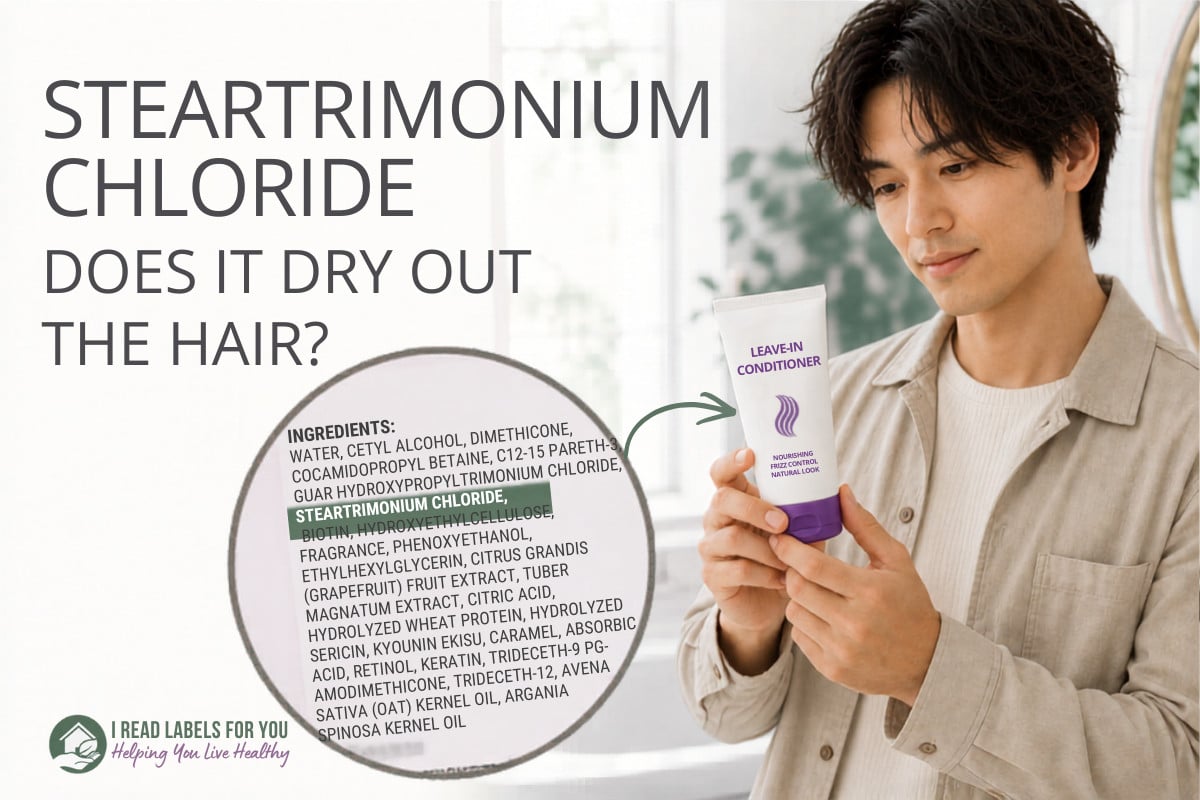
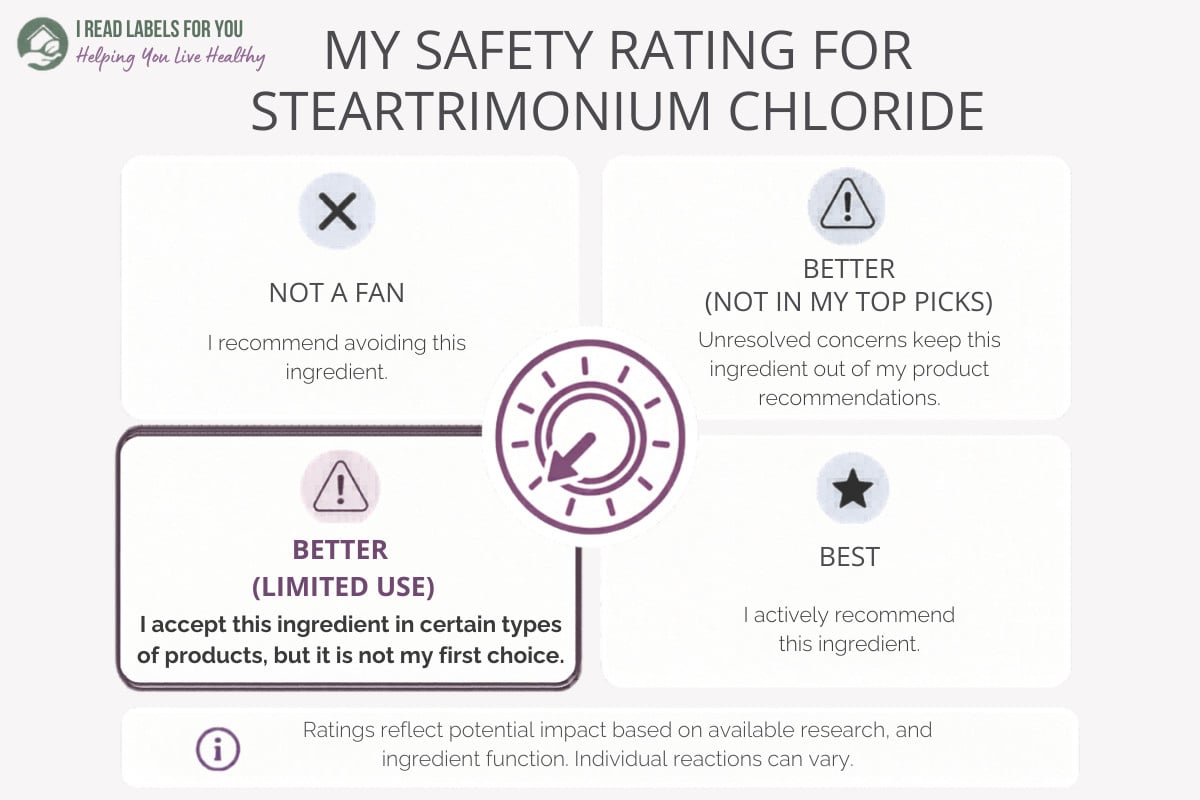
Yes, Steartrimonium Chloride is safe in rinse-off products. It’s mostly a hair conditioner but can also work as an emulsifier and a preservative. It does not penetrate the skin, has no cancer or hormone activity warnings, and does not carry any manufacturing concerns. Nevertheless, in concentrated form, it’s harsh on the skin, shows a mild allergy signal in animal studies, and can serve as a preservative. I rate it Better (Limited Use).
The European Union allows Steartrimonium Chloride in rinse-off hair products at up to 2.5%, in leave-on hair products at 1.0%, and in leave-on face creams at 0.5%. The reason for these limits is potential irritation at high amounts. When used as a preservative, the EU limits it to 0.1%.
Below you’ll see when Steartrimonium Chloride can dry out your hair, if it’s safe to use while pregnant, and why the EWG rates this ingredient differently.
What Is Steartrimonium Chloride?
Steartrimonium Chloride is a conditioning ingredient in the quaternary ammonium class, the group nicknamed “quats.” It wears a positive electric charge, which lets it bond to hair and lie flat along each strand. By chain length, it’s the C18 (stearyl) cousin of Cetrimonium Chloride (C16) and Behentrimonium Chloride (C22).
Among the trimethyl quats, Steartrimonium Chloride falls in the middle by size. Brands choose it for slip and an anti-static finish, although Cetrimonium Chloride tends to be the more common pick.
What Does Steartrimonium Chloride Do In Cosmetics?
The core job of Steartrimonium Chloride is conditioning. Damaged hair takes on a small negative charge, and the ingredient’s positive charge is pulled toward those worn patches. Coating them evens the surface, calms flyaways, and makes combing simpler.
Steartrimonium Chloride can also work as an emulsifier and hold back some microbes. Both are minor duties next to its main role of softening hair.
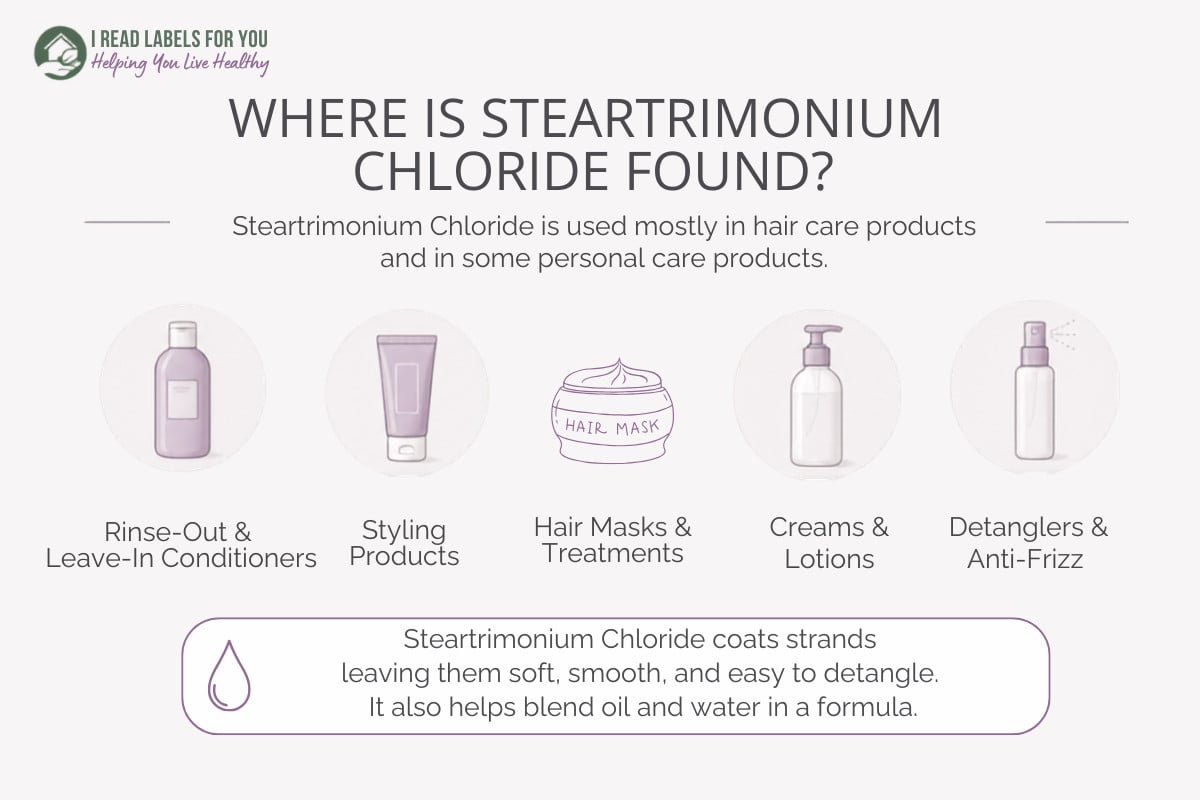
You’ll find Steartrimonium Chloride most often in:
- rinse-out conditioners
- leave-in conditioners and detanglers
- hair masks and treatments
- anti-frizz and styling creams
- some lotions and creams (as an emulsifier)
Steartrimonium Chloride has no food use. It serves as a cosmetic and industrial surfactant only.
How Is Steartrimonium Chloride Made?
Production begins with stearyl alcohol, a fatty alcohol commonly sourced from plant or palm oil. That alcohol is turned into a dimethyl amine, which then reacts with methyl chloride, the manufacturing chemical, to attach the charged group. The finished material is a stable, water-loving conditioning salt.
One mark in its favor sits right here. Methyl chloride falls in IARC Group 3 (“not classifiable” for cancer), a milder choice than the benzyl chloride used to build Stearalkonium Chloride. As a result, Steartrimonium Chloride avoids the benzyl-residue and nitrosamine worries tied to benzyl quats.
Does Steartrimonium Chloride Penetrate The Skin?
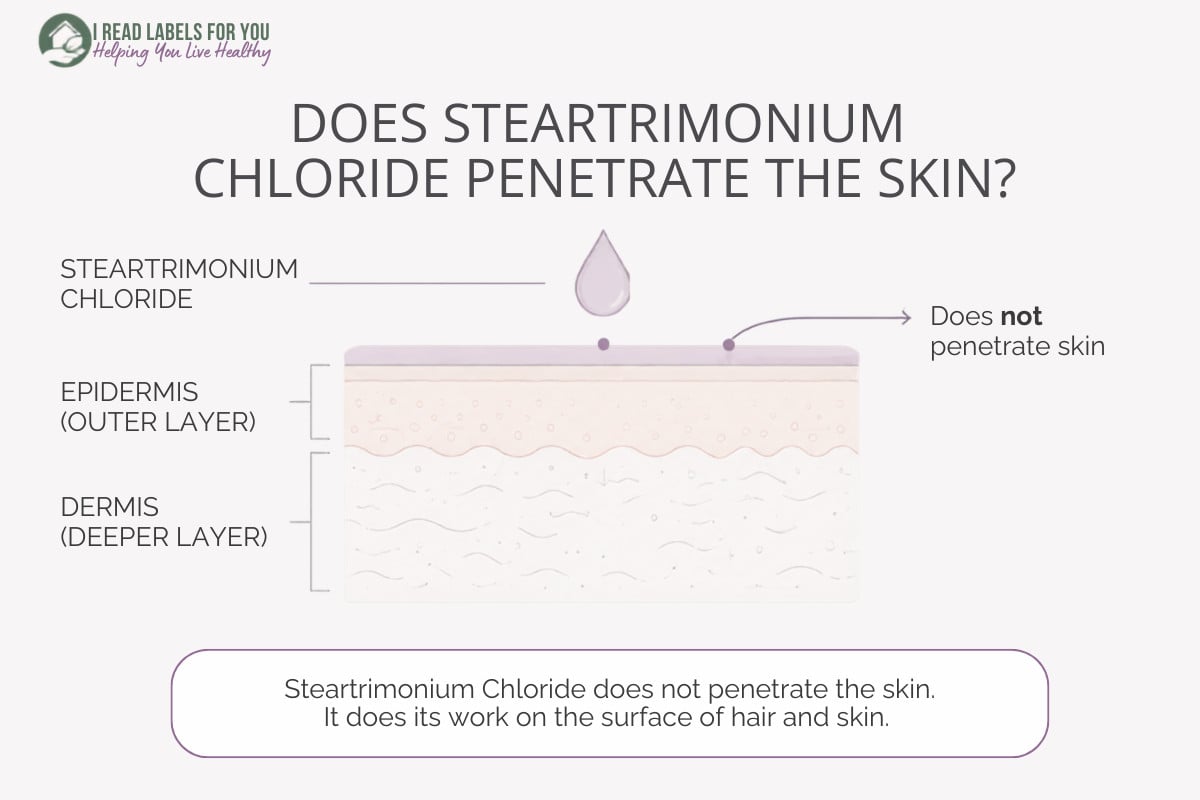
No, Steartrimonium Chloride does not pass through skin to any real degree. Its fixed positive charge is the deciding factor. A charged, water-friendly molecule like this gets turned away by the skin’s oily barrier.
Weight plays only a bit part. Steartrimonium Chloride weighs about 348 daltons, under the roughly 500-dalton line where size on its own would slow a molecule down. Because it stays permanently charged, it also has no measurable LogP, the figure that compares how oily or watery a substance is.
In sum, Steartrimonium Chloride does its work on the surface of hair and skin. Safety reviewers treat its skin absorption as essentially zero.
What Is Steartrimonium Chloride Called On Labels?
You may spot Steartrimonium Chloride under the names, including:
- Steartrimonium Chloride
- Stearyltrimethylammonium Chloride
- Octadecyltrimethylammonium Chloride
- Trimethylstearylammonium Chloride
- Quaternium-10
- N,N,N-Trimethyl-1-Octadecanaminium Chloride
Does The U.S. FDA Restrict Steartrimonium Chloride In Food And Cosmetics?
Steartrimonium Chloride is not a food substance. The U.S. Food and Drug Administration (FDA) permits it in cosmetics and attaches no specific limit to it.
That permission carries little weight with me. American cosmetic rules screen almost nothing before products reach shelves, and the Generally Recognized as Safe (GRAS) route lets makers grade their own homework. For an ingredient with a real irritation streak, I’d prefer enforceable caps.
Europe handles uncertainty the opposite way. Its precautionary principle lets regulators restrict an ingredient while doubt remains, instead of waiting for proof of harm, and for Steartrimonium Chloride, they wrote firm limits.
EU Regulations About Steartrimonium Chloride
The European Union (EU) allows Steartrimonium Chloride but ties it to strict concentration caps. A rinse-off hair product may contain up to 2.5%. That ceiling tightens to 1.0% in leave-on hair products and 0.5% in leave-on face creams, and it falls to 0.1% when the ingredient works as a preservative.
Those caps share a pool with Cetrimonium Chloride, because the two are counted together toward the same limit. Irritation is the reason behind the numbers: the SCCS notes that quats are known to irritate, which is why it set combination limits. It’s all spelled out in the CosIng listing.
U.S. And EU Disagreements On Steartrimonium Chloride
The two sides handle Steartrimonium Chloride differently. The EU sets product-by-product caps plus a shared ceiling with Cetrimonium Chloride. The FDA, by contrast, names no cosmetic ceiling and leaves the dosing to each brand’s judgment.
Canadian Regulations About Steartrimonium Chloride
Canada clears Steartrimonium Chloride for cosmetic use. Health Canada keeps it off its Cosmetic Ingredient Hotlist, the roster of prohibited and restricted ingredients, and it stays absent from the CEPA Schedule 1 toxic-substances list.
Can Steartrimonium Chloride Cause Skin Allergy And Sensitization?
Here the picture is mixed, which is part of why I hold back. In a guinea-pig Buehler test, concentrated Steartrimonium Chloride drew reactions in 15 of 20 animals. For cationic surfactants, that kind of result usually reflects irritation rather than true allergy.
Human data look calmer. Patch testing across this quat family found no sensitization at the low levels used in products, and Steartrimonium Chloride doesn’t appear on the American Contact Dermatitis Society’s (ACDS) list of core allergens. Even so, the concentrated ingredient rates as severely irritating, and reactive scalps may notice it in leave-on items.
Is Steartrimonium Chloride A Hormone (Endocrine) Disruptor?
No, hormones aren’t a concern with Steartrimonium Chloride. The European Chemicals Agency (ECHA) doesn’t include it on any endocrine watch list, and the research record turns up no hormonal activity.
The chemistry explains why. A bulky, permanently charged molecule that rests on the skin’s surface never reaches the receptors that hormones act on.
Is Steartrimonium Chloride Safe To Use While Pregnant?
Steartrimonium Chloride looks low-risk during pregnancy. Because it doesn’t cross skin, ordinary conditioner use should reach a developing baby in negligible amounts.
Animal work supports that read. In a dermal study, 2.5% Steartrimonium Chloride caused no birth defects and no harm to the mothers or their pups.
Pregnancy still calls for extra care, and you should consult with your medical provider about any product you’re unsure of.
Are There Any Cancer Concerns Linked To Steartrimonium Chloride?
No, Steartrimonium Chloride carries no cancer classification. No U.S. or global cancer authority lists it: not the U.S. National Toxicology Program (NTP), not the International Agency for Research on Cancer (IARC), not California’s Proposition 65.
Direct cancer studies on Steartrimonium Chloride are scarce, yet its close relative Cetrimonium Chloride came back negative for DNA damage in the Ames test. The methyl-chloride manufacturing route adds no probable carcinogen, which keeps the production side low-concern.
Is Steartrimonium Chloride Bad For The Environment?
The environment is a genuine weak spot. As a positively charged surfactant, Steartrimonium Chloride is very toxic to aquatic life and breaks down slowly. Its hazard labels carry the strongest aquatic warnings, H400 and H410.
Regulators have noticed. European authorities once placed it under substance evaluation over possible persistence concerns, then withdrew that review in 2020 without restrictions. Even so, rinse-off conditioners send a steady trickle of it down the drain.
Common Claims About Steartrimonium Chloride: What’s True And What’s Not
It Builds Up And Dries Out Hair
Possible with heavy use, not a given. Because Steartrimonium Chloride bonds firmly to keratin, layering on rich conditioners can leave a coated, dry feel over time. Clarifying now and then, or rotating in lighter products, keeps that in check.
What I Think About Steartrimonium Chloride — And What You Should Do
I rate Steartrimonium Chloride Better (Limited Use). The ingredient itself looks clean. It does not soak into the skin, and it has no cancer or hormone warnings. Unlike its cousin Stearalkonium Chloride, it is not made with benzyl chloride, a probable carcinogen, so it does not carry that manufacturing concern.
What keeps Steartrimonium Chloride out of the top spot is irritation. In concentrated form it is harsh on the skin, and animal studies show a mild allergy signal. The human data look reassuring but are limited for this particular quat. It also slows microbial growth, enough to serve as a preservative, so I would rather not leave that on skin in a leave-on product or in all baby products, where it could affect the skin microbiome. I also do not like its effect on the environment. Like all conditioning quats, it is toxic to water life and breaks down slowly in waterways.
In practice, keep Steartrimonium Chloride to rinse-off conditioners and rinses, where it performs well and leaves with the water. That earns it a place in my Best products for adults when it rinses off. In leave-on form it stays out of my Best products and sits only in my Better tier. For leave-on conditioning, quat-free formulas are the smarter pick, and they sidestep the aquatic-toxicity issue too. Babies’ skin is thinner and more absorbent, so even rinse-off baby products stay out of my Best products and sit only in my Better tier.
Frequently Asked Questions About Steartrimonium Chloride
Is Steartrimonium Chloride Good For Hair?
For most hair, yes. Steartrimonium Chloride smooths the cuticle, eases tangles, and cuts static. Dry, curly, and damaged hair tend to benefit the most.
Are Quats Cancerous?
No. Conditioning quats like Steartrimonium Chloride aren’t classified as carcinogens by any major authority. The related Cetrimonium Chloride tested negative for DNA damage, and these molecules don’t enter the body.
What Is The Use Of Steartrimonium Chloride?
It’s a hair conditioner and anti-static agent. Steartrimonium Chloride coats strands to leave them soft, smooth, and easy to detangle, and it can help blend oil and water in a formula.
Is Steartrimonium Chloride Toxic?
Not in cosmetics as used. Safety reviews clear it for rinse-off products and for the low leave-on levels regulators allow. Its toxicity warnings apply to the concentrated ingredient and to aquatic life, not to a dab in your conditioner.
Why Does EWG Rate It Differently?
The Environmental Working Group (EWG) rates Steartrimonium Chloride a 7 and labels it “Unacceptable” under EWG VERIFIED. That high mark rests on two concerns: allergies and use restrictions.
EWG builds the allergy flag mostly on group-level and workplace evidence rather than skin data for this exact ingredient. Its cited supports are the Cosmetic Ingredient Review, an occupational-asthma “asthmagen” exposure list, peer-reviewed literature, and EWG’s own 2020 read-across from the structural similarities shared across quaternary ammonium compounds.
Notice what is absent from that list: skin-contact studies of Steartrimonium Chloride itself. Human patch testing of the ingredient found no genuine sensitization; EWG’s allergy case instead leans on its quat relatives and on inhaled, workplace exposures.
As for the second flag, use restrictions, it simply reflects that the EU sets concentration caps for Steartrimonium Chloride by product type. That is not a red flag: the EU caps plenty of gentle, well-studied ingredients, and a defined safe-use level points to careful regulation, not danger.
Sources
EU SCCS / SCCP Opinions:
SCCS/1246/09, Opinion on Alkyl (C16, C18, C22) Trimethylammonium Chloride, for other uses than as a preservative (adopted 8 December 2009; COLIPA P72); covers Steartrimonium Chloride (C18). Predecessor: SCCP/0917/05 (2005): ec.europa.eu SCCS/1246/09 (PDF)
Cosmetic Ingredient Review (CIR) Reports:
Cosmetic Ingredient Review (CIR). Elder RL (ed.). (1997). Final Report on the Safety Assessment of Cetrimonium Chloride, Cetrimonium Bromide, and Steartrimonium Chloride. International Journal of Toxicology 16(3): 195-220: cir-reports.cir-safety.org
Cosmetic Ingredient Review (CIR). Becker LC, Bergfeld WF, Belsito DV, et al. (2012). Safety Assessment of Trimoniums as Used in Cosmetics (includes Steartrimonium Chloride). International Journal of Toxicology 31(Suppl. 3): 296S-341S: cir-reports.cir-safety.org
European Union Regulatory Databases:
EU CosIng entry for Steartrimonium Chloride (entry 38313; EC 203-929-1; Annex V/44 preservative 0.1%; Annex III/286 for non-preservative use, shared limit with Cetrimonium Chloride): ec.europa.eu CosIng
CLP Annex VI Harmonised Classifications / ECHA C&L (concentrated material: H311 toxic in contact with skin, H314 skin/eye corrosion, H318; aquatic H400/H410): echa.europa.eu Annex VI to CLP
ECHA CoRAP Substance Evaluation, listed 2018 (Italy), withdrawn March 2020 with no restriction: echa.europa.eu CoRAP
Other Regulators:
U.S. FDA, Cosmetic conditioning/surfactant ingredient with no special restriction; not an approved food substance: fda.gov/cosmetics
Health Canada Cosmetic Ingredient Hotlist (Steartrimonium Chloride not listed): canada.ca Hotlist
Environment and Climate Change Canada, CEPA Schedule 1 List of Toxic Substances (Steartrimonium Chloride not listed): canada.ca CEPA Schedule 1
IARC List of Classifications (Steartrimonium Chloride not classified): monographs.iarc.who.int
NTP 15th Report on Carcinogens (Steartrimonium Chloride not listed): ntp.niehs.nih.gov
California Proposition 65 List (Steartrimonium Chloride not listed): oehha.ca.gov Prop 65 list
PubChem Records (Chemistry, Identifiers, Skin Penetration, Hazard Codes):
Steartrimonium Chloride, PubChem CID 8155 (CAS 112-03-8; C21H46ClN; MW 348.0): pubchem.ncbi.nlm.nih.gov/compound/8155
Natural Cosmetic Standards:
COSMOS-standard databases (Steartrimonium Chloride not found; a synthetic quat not permitted by the COSMOS-standard): cosmos-standard.org
NATRUE certified/approved raw materials (Steartrimonium Chloride not found): natrue.org
Skin Allergy Resource:
American Contact Dermatitis Society (ACDS), Helpful References (including Core Allergen Series 2020; Steartrimonium Chloride not listed): contactderm.org
Advocacy groups:
Environmental Working Group (EWG) Skin Deep, Steartrimonium Chloride (hazard score 7; Allergies & Immunotoxicity high, Use Restrictions high; EWG VERIFIED unacceptable): ewg.org/skindeep
Last verified: 06-13–2026
Download The Free Guide!
5 Powerful Steps To A Non-Toxic Home
Join our informed consumer community and get our free guide the “5 Powerful Steps To A Non-Toxic Home”.

Before commenting, please read our Comment Policy.