
Is Behentrimonium Chloride Safe? A Simple Answer You Can Trust
 Written by Irina Webb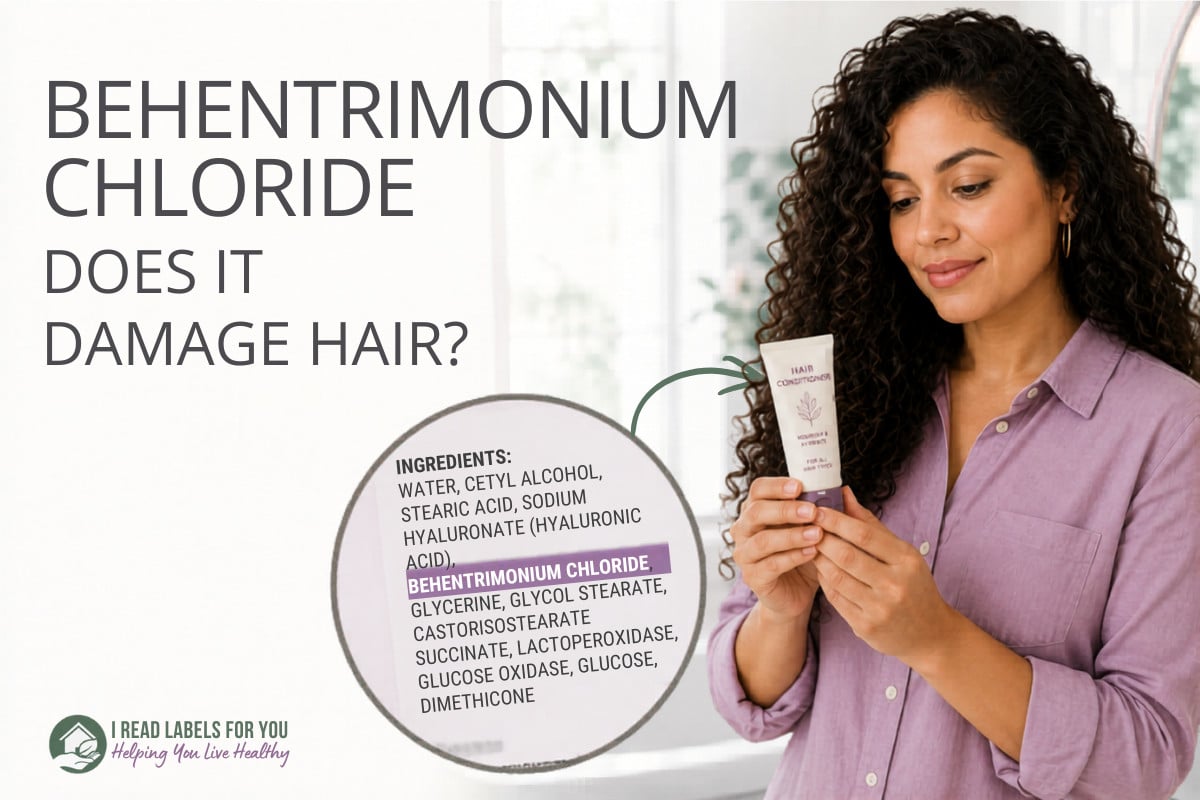
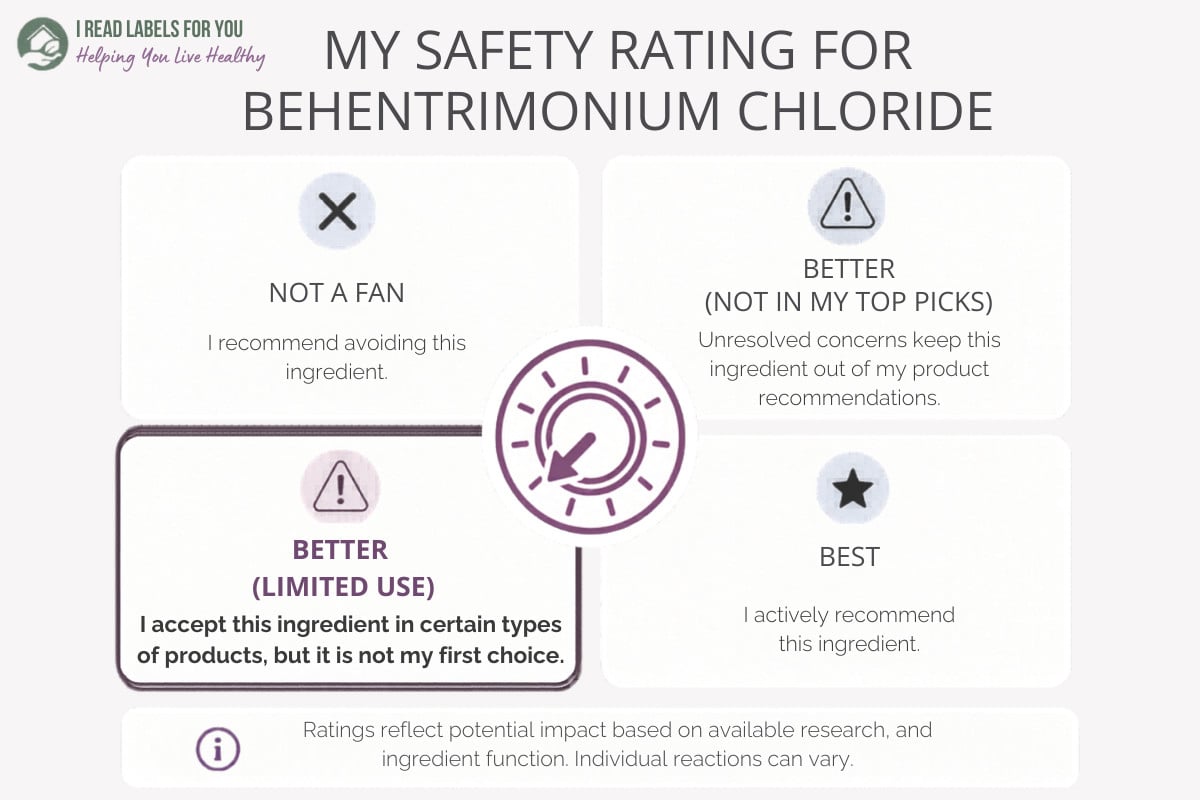
Yes, Behentrimonium Chloride is safe in rinse-off hair products. Despite the name, chloride here means a salt, not chlorine. It’s a gentle conditioner built partly from rapeseed oil. It does not soak into your body, and it is neither a hormone disruptor nor a carcinogen. Two things keep it to wash-off use. It works as a mild antimicrobial, which I would rather not leave on skin. It’s also hard on aquatic life. I rate it Better (Limited Use).
Behentrimonium Chloride is one of the few conditioning quats Europe has actually reviewed. The EU safety panel cleared the ingredient at up to 5% in rinse-off hair products. Leave-on hair and face products are capped at 3%. Those caps reflect irritation at higher levels, not a deeper worry. A separate 0.1% limit applies when it acts as a preservative. That is a blanket rule the EU applies to all preservatives.
Three things are worth reading on for. First, whether it disturbs your skin microbiome. Second, whether it builds up and damages hair. Third, what the word chloride really means on a label.
What Is Behentrimonium Chloride?
Behentrimonium Chloride is a hair-conditioning quaternary ammonium compound that carries a positive electric charge. That charge makes it cling to hair and smooth each strand. Despite the “chloride” name, it’s a mild conditioner, not a harsh chemical.
Behentrimonium Chloride comes partly from plants. Makers usually start with behenyl alcohol, a waxy fatty alcohol from rapeseed or other plant oils.
What Does Behentrimonium Chloride Do In Cosmetics?
This ingredient earns its place mainly in hair care. To begin with, it conditions: its positive charge sticks to damaged, negatively charged hair and smooths the cuticle. As a result, hair detangles easily and feels soft.
Behentrimonium Chloride also reduces static and flyaways. Furthermore, it works as a mild emulsifier, helping oil and water blend in creams.
Also, Behentrimonium Chloride has genuine antimicrobial activity — enough for the EU to list it as an approved preservative at 0.1%. Most brands still use it to condition and add a separate preservative, but that germ-slowing power is real, and it shapes how I think about leave-on use.
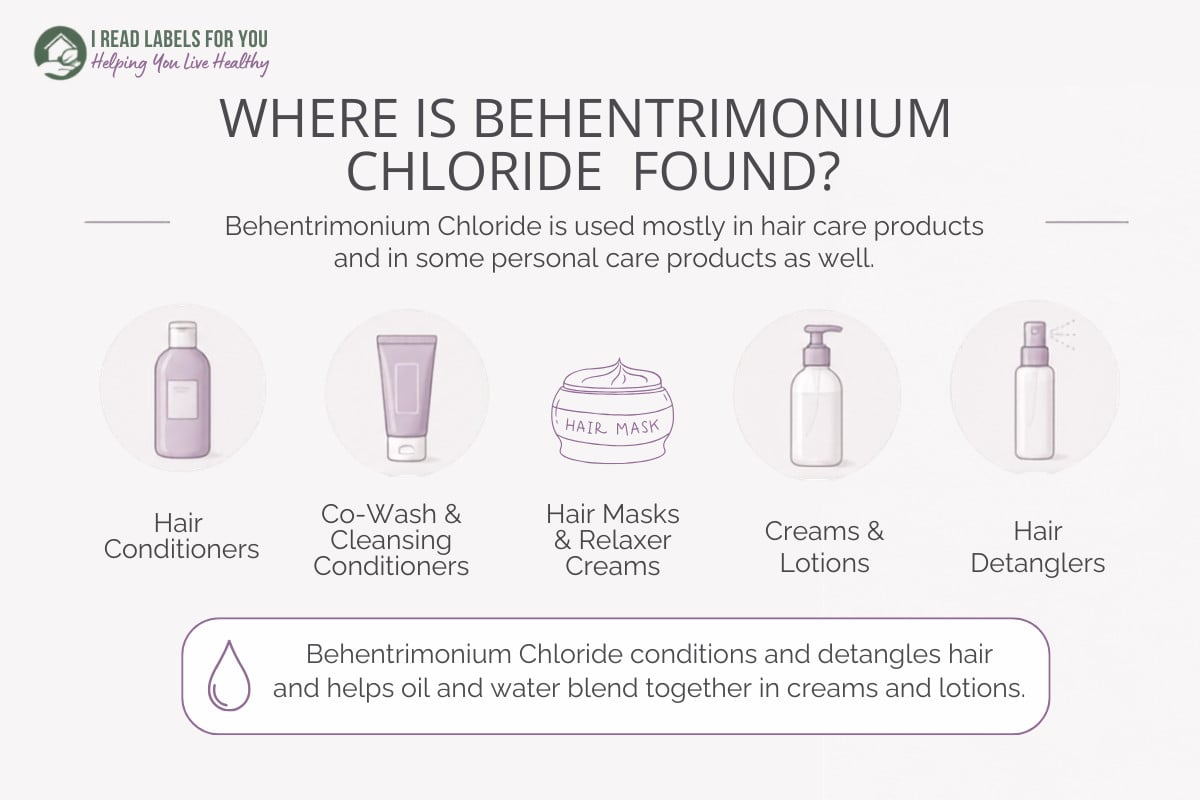
You’ll find Behentrimonium Chloride most often in:
- hair conditioners
- deep conditioners
- leave-in conditioners
- co-wash and cleansing conditioners
- hair masks
- detanglers
- straightening and relaxer creams
It has no food uses. You won’t find Behentrimonium Chloride in anything you eat or drink.
How Is Behentrimonium Chloride Made?
Behentrimonium Chloride starts from behenyl alcohol, usually plant-derived. Makers turn that into behenyl dimethylamine, then add a charged group using methyl chloride, the chemical used to make it. The result is a stable conditioning salt.
Here’s the key point: unlike its close cousin, Behentrimonium Chloride is not made with a carcinogen. Its cousin Behentrimonium Methosulfate is made with dimethyl sulfate, a probable cancer-causing chemical. Instead, Behentrimonium Chloride uses methyl chloride, which is not classified as a carcinogen.
You might wonder about contaminants. The raw material is mostly Behentrimonium Chloride in a little isopropanol and water, plus tiny traces of leftover starting material.
The heavy processing used to make it also strips out the usual worries about pesticides, heavy metals, and similar residues. Furthermore, methyl chloride is a gas that reacts away, leaving little to none behind. There’s also none of the harsher byproducts linked to some other ingredient types.
Does Behentrimonium Chloride Penetrate The Skin?
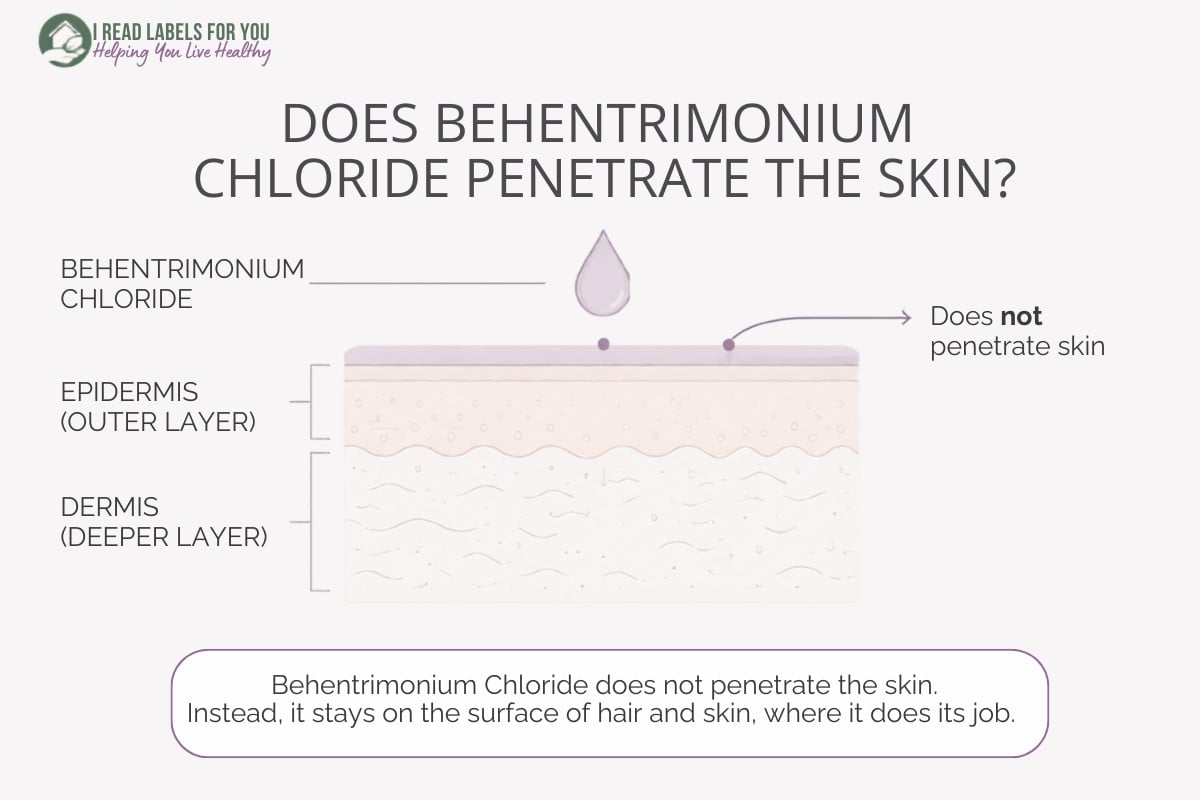
No, not in any real way. Two clues tell us this: its size and its electrical charge. Scientists use both to predict whether an ingredient can cross the skin.
Behentrimonium Chloride weighs about 404 daltons. That’s on the heavy side for a skin ingredient, and bigger molecules have a harder time slipping in.
Its real barrier is charge. The molecule carries a permanent positive charge, and the outer skin acts like an oily shield that repels charged, water-friendly molecules. Scientists can’t even give it a normal LogP, the usual oil-versus-water score, because that number assumes a molecule with no charge.
Instead of soaking in, its charged end grips the surface of hair and skin, which carry a slight negative charge. That’s exactly how it conditions. It stays on the outside and doesn’t reach the bloodstream.
What Is Behentrimonium Chloride Called On Labels?
You may see it under several names:
- Behentrimonium Chloride
- BTC (common short name)
- Behenyltrimonium Chloride
- Docosyltrimethylammonium Chloride
- Behenyl Trimethyl Ammonium Chloride
Does The U.S. FDA Restrict Behentrimonium Chloride In Food And Cosmetics?
No. The U.S. Food and Drug Administration (FDA) allows Behentrimonium Chloride in cosmetics. It is not a food ingredient and has no food use.
Keep in mind that the FDA’s standards for cosmetics are not especially strict. So far, just 11 ingredients have been banned or restricted.
On top of that, the FDA’s Generally Recognized as Safe (GRAS) program lets companies vet their own ingredients. Hence, I don’t lean on it.
By contrast, the European Union leans on the precautionary principle. In short, it can limit an ingredient when there’s reasonable doubt, even before harm is proven.
EU Regulations About Behentrimonium Chloride
The European Union (EU) allows Behentrimonium Chloride but sets clear limits. The Scientific Committee on Consumer Safety (SCCS) reviewed it and found it safe within those limits. You can see its entry in the EU cosmetic ingredient database (CosIng).
Under the EU rules (CosIng Annex III), products can hold up to 5% in rinse-off hair products. Leave-on hair and face products are capped at 3%. When used as a preservative, the limit drops to 0.1%.
Those two numbers can look confusing. Here’s the reason. The 0.1% cap is a blanket rule the EU puts on preservatives as a group, set years ago. It doesn’t mean the ingredient is only safe at 0.1%.
The higher 3–5% limits come from a separate SCCS safety review for conditioning use. That review is the one backed by an actual exposure calculation. Simply put, the ingredient and its safety are the same; only the use and the regulatory category change the number.
The 3–5% cap reflects irritation, not a deeper worry. These conditioners can irritate skin and eyes as the level rises.
Therefore, the EU keeps the limit modest. The lower leave-on limit reflects the longer time a product stays on skin.
U.S. And EU Disagreements On Behentrimonium Chloride
Here the two countries differ. The EU sets firm caps on how much Behentrimonium Chloride a product can hold. Meanwhile, the U.S. sets no such limit and trusts industry to formulate it safely.
Canadian Regulations About Behentrimonium Chloride
Canada allows Behentrimonium Chloride in cosmetics. It is not on the Health Canada Cosmetic Ingredient Hotlist. Furthermore, it does not appear on Canada’s CEPA list of toxic substances.
Can Behentrimonium Chloride Cause Skin Allergy And Sensitization?
Allergy to Behentrimonium Chloride is rare. The SCCS stated there’s “no reason to consider” it a skin sensitizer.
A 2013 clinical study tested leave-on body lotions with 1–5% Behentrimonium Chloride in human patch tests. It found no allergic reactions and no cumulative irritation, and real-world reports of side effects stayed very low.
Behentrimonium Chloride also doesn’t appear on the American Contact Dermatitis Society (ACDS) core allergen list. As a strong positively charged surfactant, the raw material can irritate skin and eyes at high amounts. However, at the low levels in finished products, that risk is small.
Is Behentrimonium Chloride A Hormone (Endocrine) Disruptor?
No. Behentrimonium Chloride is not a hormone disruptor. No study has flagged it, and it’s not on the European Chemicals Agency (ECHA) endocrine list.
It’s a large molecule that doesn’t act on hormone receptors, and it doesn’t enter the body. Therefore, you can set this concern aside.
Is Behentrimonium Chloride Safe To Use While Pregnant?
Behentrimonium Chloride is considered safe to use during pregnancy. It stays on the surface of hair and skin and does not enter the body. As a result, it cannot reach a developing baby.
If you have specific health concerns, it’s always a good idea to talk with your healthcare provider.
Are There Any Cancer Concerns Linked To Behentrimonium Chloride?
No. Behentrimonium Chloride is not classified as a carcinogen. It is not listed by the International Agency for Research on Cancer (IARC), the U.S. National Toxicology Program (NTP), or California Proposition 65.
DNA damage is a key warning sign for cancer, and Behentrimonium Chloride doesn’t cause it. In the Ames test, a standard check for DNA damage, it came back negative. It also doesn’t penetrate skin. Together, that points to no real cancer concern.
Unlike its cousin Behentrimonium Methosulfate, Behentrimonium Chloride is not made with any carcinogen. Consequently, even the manufacturing concern is smaller.
Is Behentrimonium Chloride Bad For The Environment?
This is where Behentrimonium Chloride has its main downside. As a cationic (positively charged) surfactant, it’s toxic to aquatic life and slow to break down. Hazard labels mark it as very toxic to fish and water organisms.
The amount in any single product is small. However, it adds up across the many rinse-off hair products that wash down the drain.
Common Claims About Behentrimonium Chloride: What’s True And What’s Not
Claim: The “Chloride” Means It’s Toxic
This is false. The “chloride” is just a tiny salt that balances the molecule’s positive charge. It is not chlorine or bleach. In fact, ordinary table salt is also a chloride.
Claim: It’s A Harsh Disinfectant “Quat”
This mixes up two different groups. Behentrimonium Chloride is a conditioning quaternary ammonium compound, or “quat.” It is not the same as cleaning quats, like Benzalkonium Chloride, linked to asthma concerns. Conditioning quats stay on the hair surface and have a long, safe record.
Claim: It Builds Up And Damages Hair
Not for most people. Behentrimonium Chloride is water-dispersible, which means it rinses away more easily than heavy silicones. It smooths hair without the waxy buildup some folks fear. If buildup happens, gentle washing clears it.
What I Think About Behentrimonium Chloride — And What You Should Do
I rate Behentrimonium Chloride Better (Limited Use). In rinse-off products it’s genuinely low-risk: it doesn’t penetrate, rarely causes allergy, and carries no cancer, hormone, or reproductive concerns.
What holds it back from my top tier is its antimicrobial side. Behentrimonium Chloride is potent enough to serve as an approved preservative, and I’d rather not leave that germ-killing action on skin, where it could disturb the skin microbiome. For that reason, I don’t recommend it in leave-on products.
Further, Behentrimonium Chloride has an environmental cost: like every cationic conditioner, it’s toxic to aquatic life and slow to break down.
My take: for adults, I accept Behentrimonium Chloride in my Best rinse-off products like conditioners. In leave-on products for adults, I keep it out of my Best products and accept it only in my Better products. For leave-on, a quat-free formula is the better route. For babies I’m stricter: even rinse-off baby products stay out of my Best products and sit only in my Better tier.
Frequently Asked Questions About Behentrimonium Chloride
Is Behentrimonium Chloride Allowed In Europe?
Yes. The EU allows it within set limits: up to 5% in rinse-off hair products and 3% in leave-on hair and face products. The SCCS reviewed it and found it safe at those levels.
Does Behentrimonium Chloride Damage Hair?
No, it generally helps hair. It coats the strand, smooths the cuticle, and cuts static and frizz. Most hair types tolerate it well, including curly and damaged hair.
Is Behentrimonium Chloride Hazardous?
On its own, the concentrated raw material carries hazard labels for skin and eye irritation. In finished products, though, it’s used at low, safe levels. The EU’s safety committee (SCCS) reviewed it and set those levels to keep products non-irritating.
Does Behentrimonium Chloride Affect The Skin Microbiome?
Possibly, which is part of why I limit it to rinse-off. Behentrimonium Chloride is antimicrobial enough to act as a preservative, and antimicrobials can shift the balance of bacteria on skin. No study proves it disturbs the microbiome at conditioning levels, and rinse-off use keeps contact brief. Still, I don’t recommend it in leave-on products, where it would stay on the skin.
Is Behentrimonium Chloride Natural Or Synthetic?
It’s a bit of both. The starting material, behenyl alcohol, usually comes from plants like rapeseed. Makers then process it in a factory. The final ingredient is plant-derived but lab-finished.
Behentrimonium Chloride Vs Behentrimonium Methosulfate
Both are gentle conditioning quats from the same plant-based fatty alcohol. The main difference is how they’re made: Behentrimonium Methosulfate is made with dimethyl sulfate, a probable carcinogen, while Behentrimonium Chloride is not made with any carcinogen. Both work well, and neither penetrates the skin.
Why Does EWG Rate It Differently?
The Environmental Working Group (EWG) gives Behentrimonium Chloride a moderate score of 6. That score rests on two flags: “allergies and immunotoxicity” and “use restrictions.” Neither flag comes from evidence on this ingredient.
For the allergy flag, EWG points to an occupational asthma list and to its own grouping of quaternary ammonium compounds. That asthma list covers disinfectant quats, like benzalkonium chloride, that cleaning workers breathe in at work. Behentrimonium Chloride is a hair conditioner, not a disinfectant, and you don’t inhale it.
EWG’s other source is its own 2020 analysis. It grouped Behentrimonium Chloride with similar quats and assumed it shares their risk, rather than testing the ingredient directly. The direct evidence points the other way: the SCCS found no reason to consider it a sensitizer, and it’s absent from the ACDS allergen lists.
For the “use restrictions” flag, EWG cites the Cosmetic Ingredient Review (CIR) and the EU Cosmetics Directive. The EU sets the actual caps; CIR did not set a number, but judged the ingredient safe as used when formulated to be non-irritating. Neither finding signals harm, yet the existence of these guidelines gets counted as a strike.
That’s the gist of the disagreement: I found no real evidence behind EWG’s allergy or use-restriction flags. My own reason for a Limited Use rating is different — its preservative-grade antimicrobial action and what that could mean for the skin microbiome in leave-on products.
Sources
EU SCCS / SCCP Opinions:
SCCS/1246/09, Opinion on Alkyl (C16, C18, C22) Trimethylammonium Chloride, for other uses than as a preservative (adopted 8 December 2009; COLIPA P72); covers Behentrimonium Chloride (C22); ec.europa.eu — SCCS/1246/09 (PDF)
Cosmetic Ingredient Review (CIR) Reports:
Becker LC, Bergfeld WF, Belsito DV, et al. (2012). Safety Assessment of Trimoniums as Used in Cosmetics (includes Behentrimonium Chloride). International Journal of Toxicology 31(Suppl. 3): 296S–341S: cir-reports.cir-safety.org
European Union Regulatory Databases:
EU CosIng entry for Behentrimonium Chloride (EC 241-327-0; Annex III/287 and Annex V/44): ec.europa.eu CosIng
CLP Annex VI Harmonised Classifications (no harmonised classification for Behentrimonium Chloride): echa.europa.eu Annex VI to CLP
ECHA Substance and regulatory obligations (Cosmetic Products Regulation entries; no SVHC, REACH Annex XIV/XVII, or endocrine assessment listed): echa.europa.eu
Other Regulators:
U.S. FDA, Cosmetic Ingredients (Behentrimonium Chloride is a cosmetic conditioning ingredient; not a food additive): fda.gov/cosmetics
Health Canada Cosmetic Ingredient Hotlist (Behentrimonium Chloride not listed): canada.ca Hotlist
Environment and Climate Change Canada, CEPA Schedule 1 List of Toxic Substances (Behentrimonium Chloride not listed): canada.ca CEPA Schedule 1
IARC List of Classifications (Behentrimonium Chloride not classified): monographs.iarc.who.int
NTP 15th Report on Carcinogens (Behentrimonium Chloride not listed): ntp.niehs.nih.gov
California Proposition 65 List (Behentrimonium Chloride not listed): oehha.ca.gov Prop 65 list
PubChem Records (Chemistry, Identifiers, Skin Penetration, Hazard Codes):
Behentrimonium Chloride, PubChem CID 3014969 (CAS 17301-53-0; C25H54ClN; MW 404.2): pubchem.ncbi.nlm.nih.gov/compound/3014969
Peer-Reviewed Studies:
Cameron DM, Donahue DA, Costin GE, et al. (2013). Confirmation of in vitro and clinical safety assessment of behentrimonium chloride-containing leave-on body lotions using post-marketing adverse event data. Toxicology in Vitro 27(8): 2203–2212 (PMID 24064305): pubmed.ncbi.nlm.nih.gov/24064305
Natural Cosmetic Standards:
COSMOS-standard databases (no Behentrimonium Chloride entry found; database is non-exhaustive): cosmos-standard.org
NATRUE certified/approved raw materials (no Behentrimonium Chloride entry found; database is non-exhaustive): natrue.org
Skin Allergy Resource:
American Contact Dermatitis Society (ACDS), Helpful References (including Core Allergen Series 2020; Behentrimonium Chloride not listed): contactderm.org
Advocacy groups:
Environmental Working Group (EWG) Skin Deep, Behentrimonium Chloride (hazard score 6; not allowed in EWG VERIFIED products): ewg.org/skindeep
Last verified: 06-10-2026
Download The Free Guide!
5 Powerful Steps To A Non-Toxic Home
Join our informed consumer community and get our free guide the “5 Powerful Steps To A Non-Toxic Home”.
Before commenting, please read our Comment Policy.