
Is Behentrimonium Methosulfate Safe? A Simple Answer You Can Trust
 Written by Irina Webb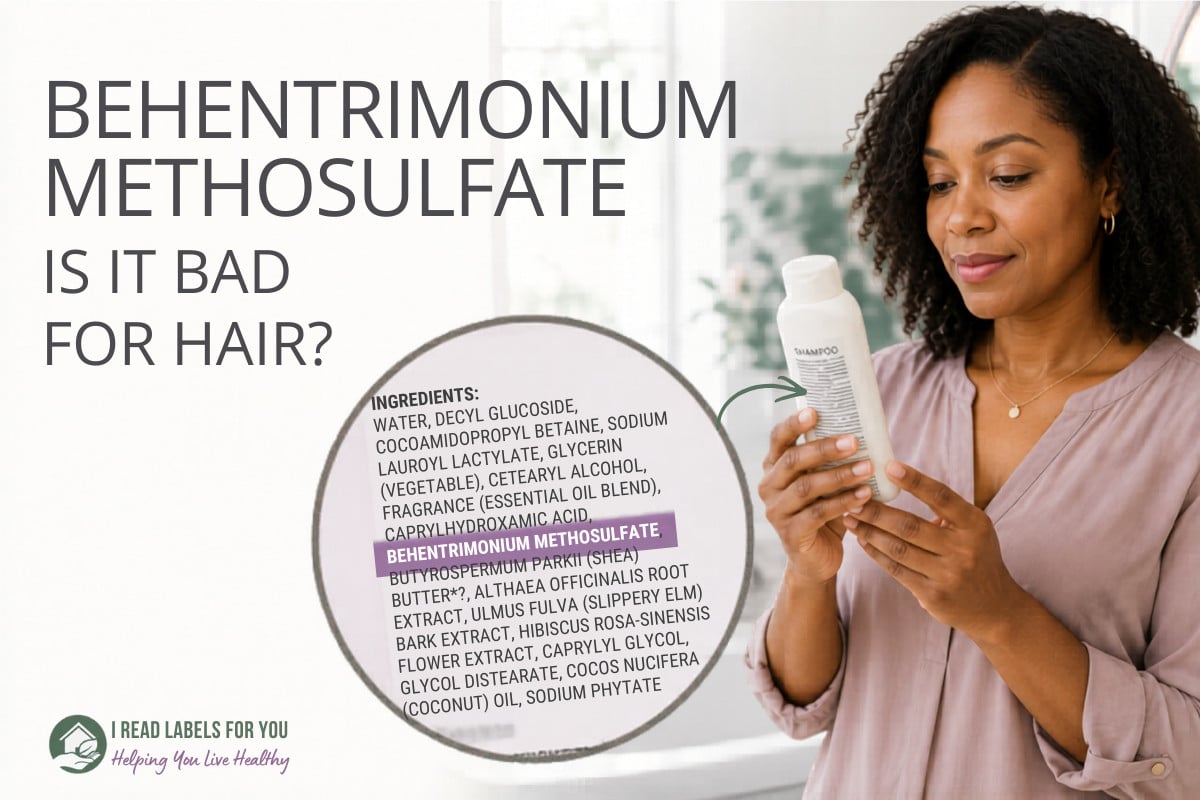
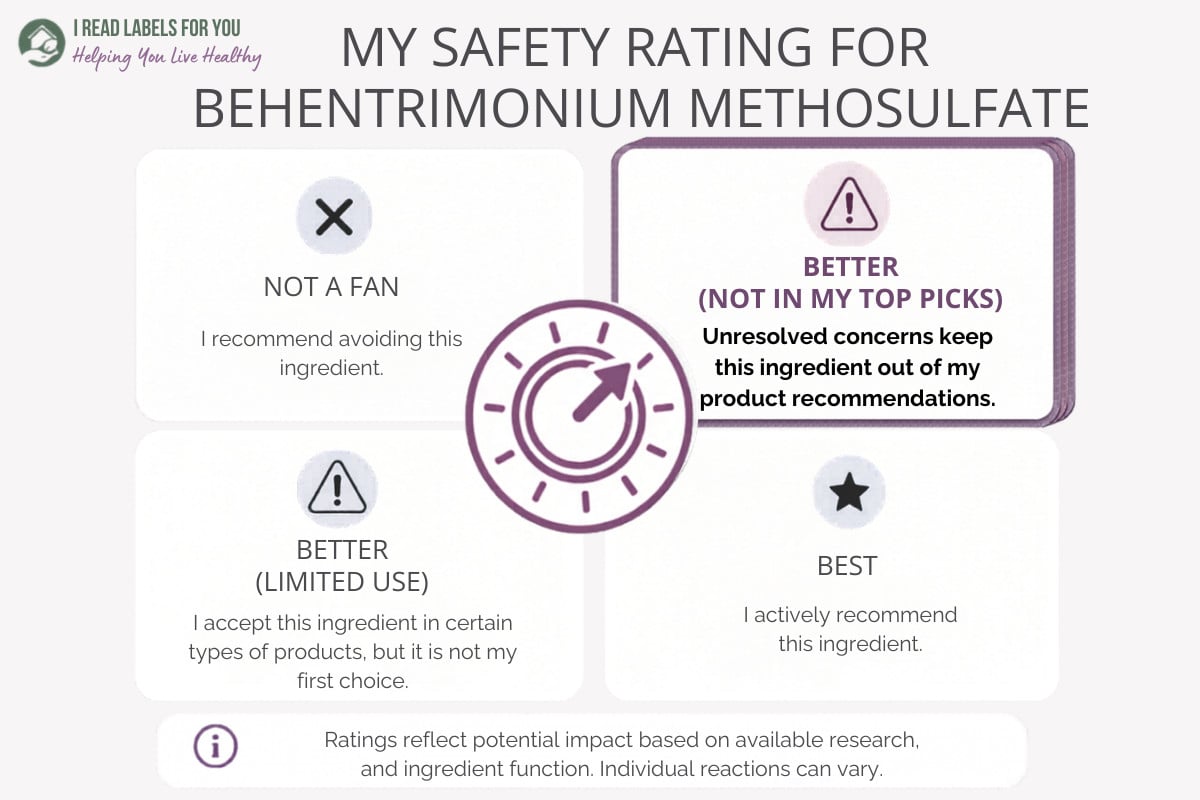
Yes, Behentrimonium Methosulfate is safe for most people. Despite the name, it is not a harsh sulfate. It’s a gentle conditioner made from a plant-derived fatty alcohol. It stays on the surface of hair rather than entering your body. Two things hold it back. Its production uses dimethyl sulfate, a probable carcinogen, and the finished ingredient is toxic to aquatic life. I rate it Better (Not In My Top Picks).
Behentrimonium Methosulfate faces no restrictions from any regulator. The European Union places no limit on it, and the EU cosmetic database lists it with no Annex restriction. One gap is worth naming. Europe’s safety committee has never studied this ingredient, which is not the same as approval. Canada leaves it off both its Cosmetic Ingredient Hotlist and its list of toxic substances.
Three things are worth reading on for. First, why the word sulfate in the name misleads almost everyone. Second, whether it conditions hair or weighs it down. Third, what happens to the carcinogenic dimethyl sulfate during manufacturing.
What Is Behentrimonium Methosulfate?
Behentrimonium Methosulfate, often shortened to BTMS, is a hair-conditioning ingredient and one of seven common quaternary ammonium compounds. It carries a positive charge, so it clings to hair and smooths it. Despite the name, it’s a gentle conditioner, not a harsh detergent.
It’s built from behenyl alcohol, a fatty alcohol usually sourced from rapeseed. As a result, part of the molecule comes from a plant, even though it’s finished in a factory.
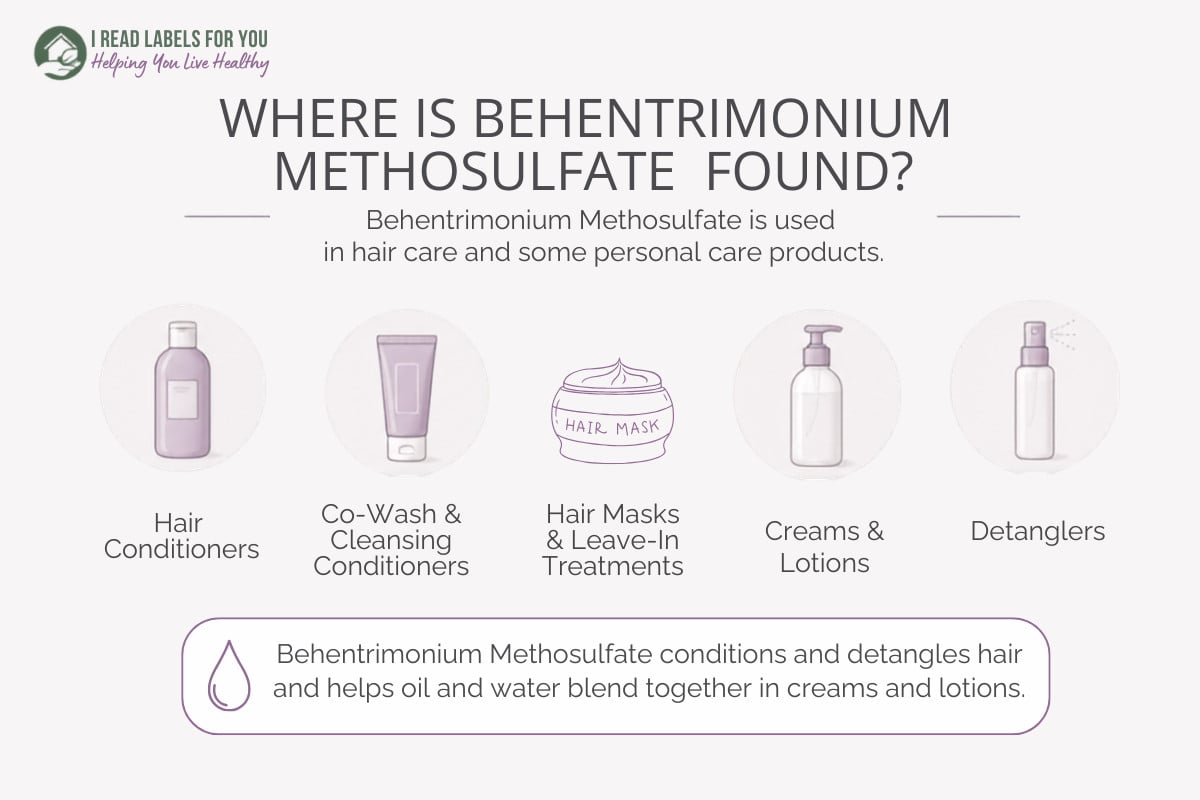
In cosmetics, you’ll find Behentrimonium Methosulfate most often in:
- hair conditioners
- hair masks
- leave-in conditioners and detanglers
- co-wash and cleansing conditioners
- creams and lotions (as an emulsifier)
What Does Behentrimonium Methosulfate Do In Cosmetics?
This ingredient earns its place mainly in hair care. To begin with, it conditions: its positive charge sticks to damaged, negatively charged hair and smooths the cuticle. As a result, hair detangles easily and feels soft.
Furthermore, it cuts down on static and flyaways. It also works as a mild emulsifier, helping oil and water blend together in creams.
How Is Behentrimonium Methosulfate Made?
It starts from behenyl alcohol, usually plant-derived. Makers then attach a charged group using dimethyl sulfate, a methylating chemical. That chemical is a probable human carcinogen, so it’s a concern at the production stage.
Here’s the key point: dimethyl sulfate is not the same as the word “methosulfate” in the name. It gets used up in the reaction and leaves behind a stable, harmless methyl sulfate salt. Little to none remains in the finished ingredient, and it breaks down quickly in water.
Even so, the bigger concern sits upstream, at the factory. Making this ingredient relies on a probable carcinogen, which carries costs for workers and the environment.
Does Behentrimonium Methosulfate Penetrate The Skin?
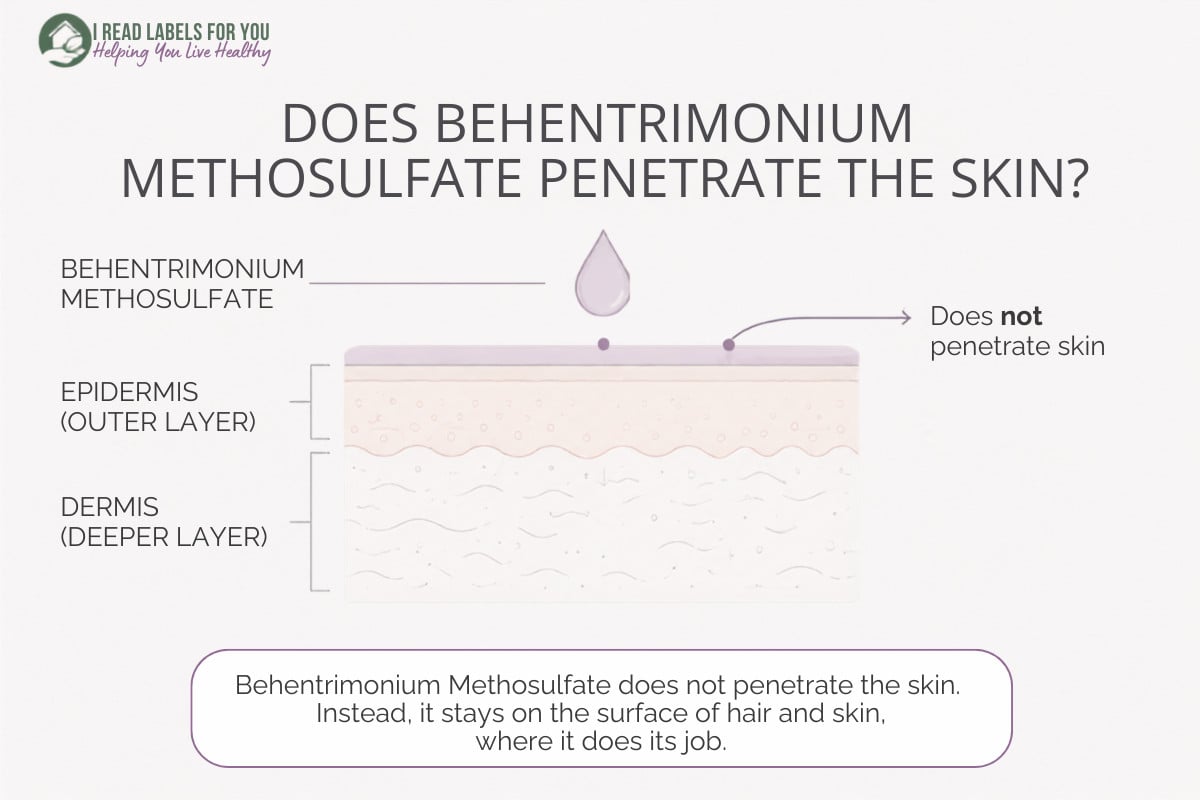
No, not in any real way. It’s a large molecule (about 480 daltons) with a big, positively charged structure.
Instead, it stays on the surface of hair and skin, where it does its job. Therefore, it does not reach the bloodstream.
What Is Behentrimonium Methosulfate Called On Labels?
You may see it under several names:
- Behentrimonium Methosulfate
- BTMS (common short name)
- Behenyl Trimethyl Ammonium Methosulfate
- Docosyltrimethylammonium Methyl Sulfate
Does The U.S. FDA Restrict Behentrimonium Methosulfate In Food And Cosmetics?
No. The U.S. Food and Drug Administration (FDA) allows Behentrimonium Methosulfate in cosmetics. It is not a food ingredient and has no food use. For cosmetics, the FDA sets no restriction on it.
Note that the FDA does not take a particularly strict approach to cosmetic ingredients. In fact, it has banned or restricted only 11 of them so far. Still, this ingredient has a clean safety record in the available reviews.
EU Regulations About Behentrimonium Methosulfate
The European Union (EU) also allows Behentrimonium Methosulfate. It carries no restriction in the EU cosmetic ingredient database (CosIng). No special limit applies to it.
The EU leans on the precautionary principle, yet it has flagged no concern for this ingredient. There is also no Scientific Committee on Consumer Safety (SCCS) opinion on it.
Canadian Regulations About Behentrimonium Methosulfate
Canada allows Behentrimonium Methosulfate in cosmetics. It is not on the Health Canada Cosmetic Ingredient Hotlist. Furthermore, it does not appear on Canada’s CEPA list of toxic substances.
Can Behentrimonium Methosulfate Cause Skin Allergy And Sensitization?
Allergy to Behentrimonium Methosulfate is rare. The CIR reviewed the related conditioning quats and found them non-sensitizing in animal tests. A patch test on products containing Behentrimonium Methosulfate showed no irritation or allergy.
It also does not appear on the American Contact Dermatitis Society (ACDS) core allergen list. As a strong cationic surfactant, the raw material can irritate skin and eyes at high amounts. However, at the low levels used in products, that risk is minimal.
Is Behentrimonium Methosulfate A Hormone (Endocrine) Disruptor?
No. Behentrimonium Methosulfate is not a hormone disruptor. No study has flagged it, and it is not on the European Chemicals Agency (ECHA) endocrine list. It is a large molecule that does not act on hormone receptors. That means you can set this concern aside.
Is Behentrimonium Methosulfate Safe To Use While Pregnant?
Behentrimonium Methosulfate is considered safe to use during pregnancy. It stays on the surface of hair and skin and does not enter the body. As a result, it cannot reach a developing baby.
If you’re unsure whether this is right for you, discuss it with your healthcare provider.
Are There Any Cancer Concerns Linked To Behentrimonium Methosulfate?
No, not from the finished ingredient. It is not listed by the International Agency for Research on Cancer (IARC), the U.S. National Toxicology Program (NTP), or California Proposition 65. The CIR also found this conditioning agent is not genotoxic.
The cancer link people cite is really about dimethyl sulfate, the chemical used to make it, not the Behentrimonium Methosulfate ingredient itself. As covered above, little to none of dimethyl sulfate remains in the finished product.
Is Behentrimonium Methosulfate Bad For The Environment?
This is where Behentrimonium Methosulfate has a real downside. As a cationic (positively charged) surfactant, it is toxic to aquatic life and slow to break down. Hazard labels mark it as harmful to fish and water organisms.
The amount in any single product is small. However, it adds up across the many rinse-off products that wash down the drain.
Common Claims About Behentrimonium Methosulfate: What’s True And What’s Not
Claim: It’s A Harsh Sulfate Like SLS
This is the most common myth, and it’s false. The “methosulfate” in the name is just a tiny salt attached to the molecule. It is not a cleansing sulfate like sodium lauryl sulfate (SLS). In fact, it does the opposite job, smoothing hair rather than stripping it.
Claim: It’s A Toxic “Quat”
This mixes up two different groups. Behentrimonium Methosulfate is a conditioning quaternary ammonium compound, or “quat.” It is not the same as the disinfectant quats, like benzalkonium chloride, linked to asthma concerns. Conditioning quats stay on the hair surface and have a long record of safe use.
Claim: It Causes Buildup
Not for most people. Behentrimonium Methosulfate is water-dispersible, which means it rinses away more easily than heavier conditioners. It softens hair without the waxy buildup some folks fear. If buildup happens, gentle washing clears it.
What I Think About Behentrimonium Methosulfate — And What You Should Do
I rate Behentrimonium Methosulfate Better (Not in My Top Picks). For your hair and skin, it’s genuinely low-risk. It doesn’t penetrate skin, rarely causes allergy, and has no cancer, hormone, or reproductive concerns. Still, two things hold it back from my recommendations.
First, it’s made using dimethyl sulfate, a probable carcinogen, so its production carries costs for workers and the environment. Second, as a cationic surfactant, it’s toxic to aquatic life and slow to break down.
Here’s my take: most people can use it without worry. If you love how your hair feels with it, it’s a reasonable choice. Personally, though, I lean toward quat-free conditioners.
Frequently Asked Questions About Behentrimonium Methosulfate
Is Behentrimonium Methosulfate Bad For Hair?
No, it’s generally good for hair. It smooths the cuticle, detangles, and cuts static and frizz. Most hair types tolerate it well, including curly and damaged hair. It’s even popular in curly-girl-friendly conditioners.
Is Behentrimonium Methosulfate Bad For Skin?
No, it’s considered low-risk for skin. It stays on the surface and rarely causes allergy. The raw material can irritate at high amounts, but finished products use much gentler levels. Sensitive skin usually tolerates it well.
Is Behentrimonium Methosulfate Drying?
No, quite the opposite. It’s a conditioning agent that helps hair feel soft and stay smooth. It does not strip natural oils the way harsh detergents can. If your hair feels dry, another ingredient is usually the cause.
Is Behentrimonium Methosulfate A Sulfate?
Not the kind people worry about. Despite the name, it is not a cleansing sulfate like Sodium Lauryl Sulfate or Sodium Laureth Sulfate. The “methosulfate” is simply a small salt that balances the molecule’s charge. It’s a conditioner, not a foaming detergent.
Sources
EU SCCS / SCCP Opinions:
No SCCS or SCCP opinion on Behentrimonium Methosulfate (checked; the EU Scientific Committee has not issued an opinion on this ingredient): https://health.ec.europa.eu/scientific-committees/scientific-committee-consumer-safety-sccs/sccs-opinions_en
Cosmetic Ingredient Review (CIR) Reports:
Cosmetic Ingredient Review (CIR). (2012). Becker LC, Bergfeld WF, Belsito DV, et al. Safety Assessment of Trimoniums as Used in Cosmetics (includes Behentrimonium Methosulfate). International Journal of Toxicology 31(Suppl. 3): 296S-341S: https://cir-reports.cir-safety.org
CIR safety assessments index: https://cir-reports.cir-safety.org
European Union Regulatory Databases:
EU CosIng entry for Behentrimonium Methosulfate (entry 74588; functions Antistatic, Hair Conditioning; no Annex restriction): https://ec.europa.eu/growth/tools-databases/cosing/details/74588
EU CosIng Annexes II, III, V (Behentrimonium Methosulfate not listed): https://ec.europa.eu/growth/tools-databases/cosing/reference/annexes
CLP Annex VI Harmonised Classifications (no harmonised classification for Behentrimonium Methosulfate): https://echa.europa.eu/information-on-chemicals/annex-vi-to-clp
ECHA CHEM portal: Docosyltrimethylammonium methyl sulphate / Behentrimonium Methosulfate (CAS 81646-13-1, EC 279-791-1); self-classified H315, H318, H373, aquatic toxicity: https://echa.europa.eu/substance-information/-/substanceinfo/100.072.516
Other Regulators:
U.S. FDA, Cosmetic Ingredients (Behentrimonium Methosulfate is a cosmetic conditioning ingredient; not a food additive): https://www.fda.gov/cosmetics/cosmetic-ingredients
Health Canada Cosmetic Ingredient Hotlist (Behentrimonium Methosulfate not listed): https://www.canada.ca/en/health-canada/services/consumer-product-safety/cosmetics/cosmetic-ingredient-hotlist-prohibited-restricted-ingredients/hotlist.html
Environment and Climate Change Canada, CEPA Schedule 1 List of Toxic Substances (Behentrimonium Methosulfate not listed): https://www.canada.ca/en/environment-climate-change/services/canadian-environmental-protection-act-registry/substances-list/toxic/schedule-1.html
IARC List of Classifications (Behentrimonium Methosulfate not classified): https://monographs.iarc.who.int/list-of-classifications
IARC Monographs Vol. 71, Dimethyl Sulfate, Group 2A (the alkylating chemical used to make Behentrimonium Methosulfate): https://www.inchem.org/documents/iarc/vol71/018-dimethsulf.html
NTP 15th Report on Carcinogens (Behentrimonium Methosulfate not listed): https://ntp.niehs.nih.gov/whatwestudy/assessments/cancer/roc
California Proposition 65 List (Behentrimonium Methosulfate not listed): https://oehha.ca.gov/proposition-65/proposition-65-list
PubChem Records (Chemistry, Identifiers, Skin Penetration, Hazard Codes):
Behentrimonium Methosulfate, PubChem CID 157846: https://pubchem.ncbi.nlm.nih.gov/compound/157846
Natural Cosmetic Standards:
COSMOS-standard certified raw materials (Behentrimonium Methosulfate appears as a carrier/conditioner in certified raw materials): https://www.cosmos-standard.org/en/databases/certified-raw-materials/
NATRUE certified/approved raw materials (status not determinable from the public database): https://natrue.org/natrue-certified-world/
Skin Allergy Resource:
American Contact Dermatitis Society (ACDS), Helpful References (including Core Allergen Series 2020; Behentrimonium Methosulfate not listed): https://www.contactderm.org/resources/helpful-references
Last verified: 06-10-2026
Download The Free Guide!
5 Powerful Steps To A Non-Toxic Home
Join our informed consumer community and get our free guide the “5 Powerful Steps To A Non-Toxic Home”.


Before commenting, please read our Comment Policy.