
Is Dimethicone Safe? A Simple Answer You Can Trust
 Written by Irina Webb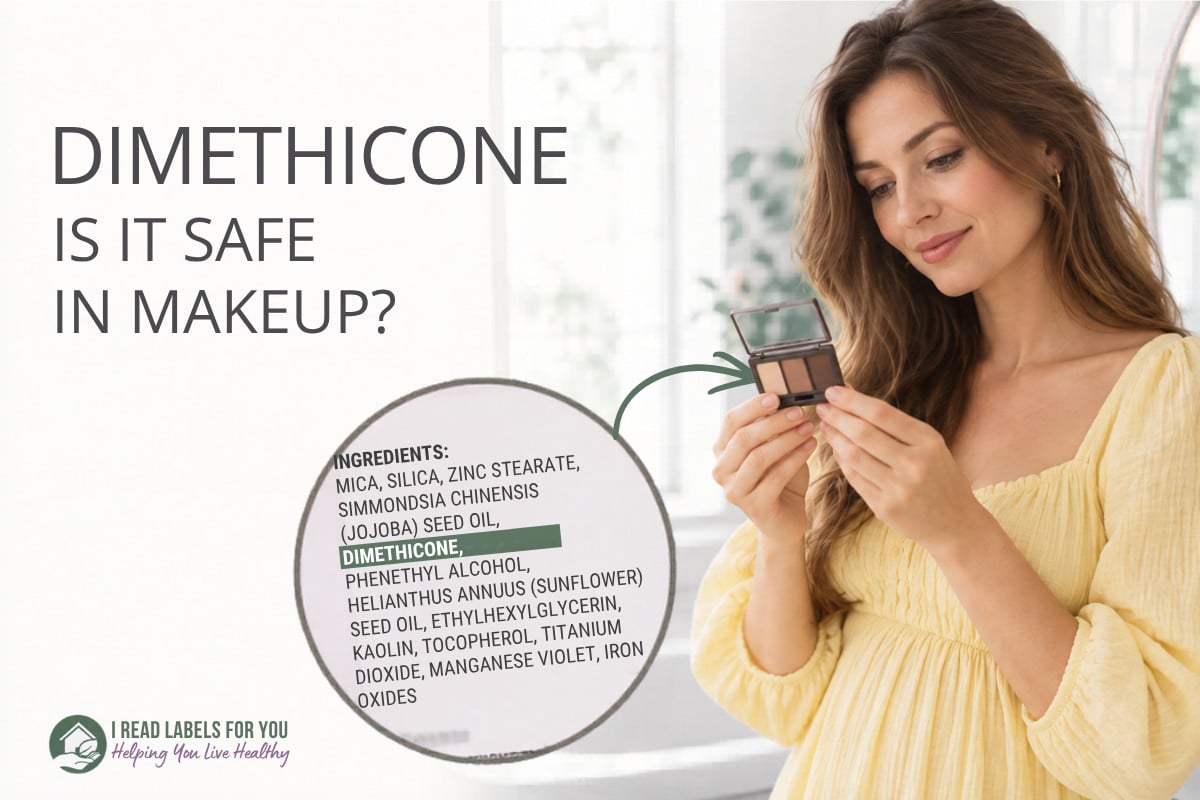
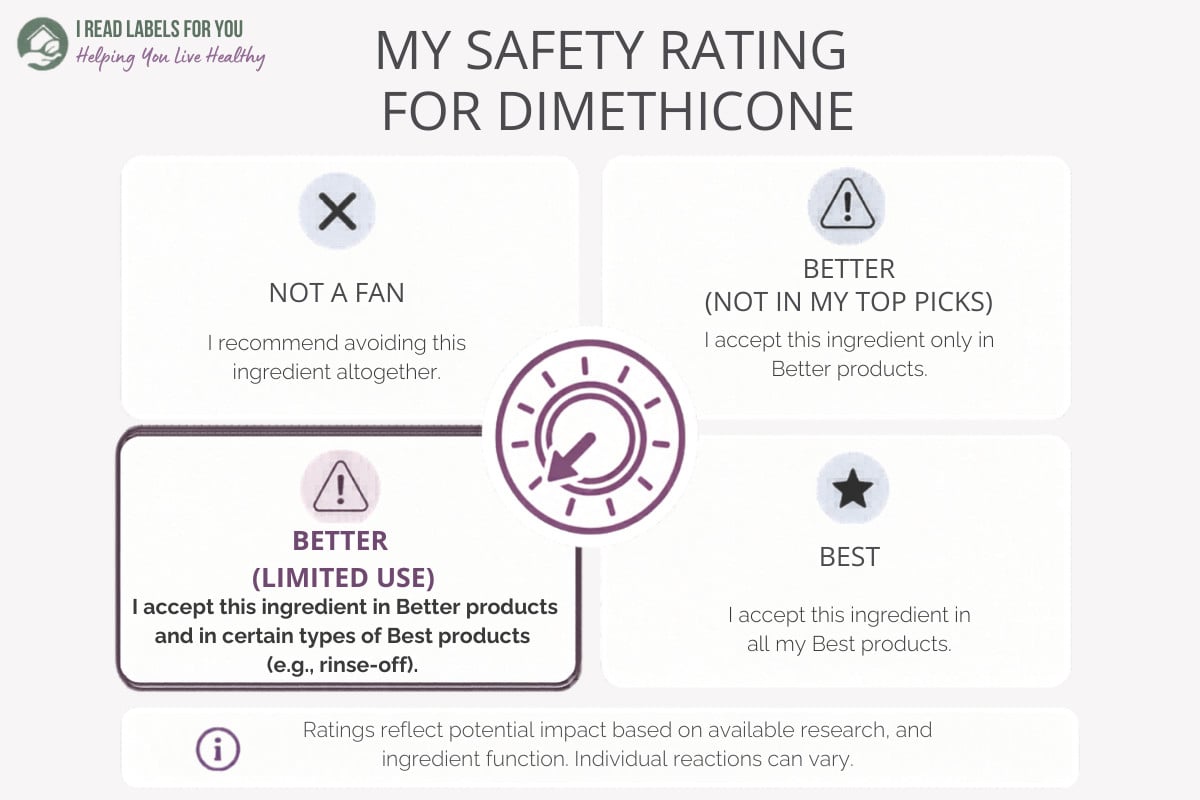
Yes, Dimethicone is safe on skin, and I accept it in makeup rather than in skincare. It’s a silicone oil that spreads into a thin film and stays on the surface. Its safety file is the cleanest of any silicone I review: no allergy, no hormone disruption, and no cancer. What keeps it from my top tier is purpose, because a film on the surface feeds skin nothing. I rate it Better (Limited Use).
Dimethicone carries no restriction anywhere in the European Union: no annex entry, no concentration limit, no committee opinion. The same regulator now removing Cyclopentasiloxane from cosmetics has left Dimethicone entirely alone. In the United States, the FDA permits it in food and lists it as an over-the-counter skin protectant.
First, you’ll find out which way of applying Dimethicone has never been assessed for safety. Second, you’ll learn why the cancer claim keeps spreading while the testing says otherwise. Third, I’ll show you where I allow Dimethicone and where I ask for more.
What Is Dimethicone?
Dimethicone is a silicone, a family of materials built on silicon and oxygen rather than carbon. Silicon itself is the second most common element in the earth’s crust, found in ordinary sand. Getting from sand to Dimethicone takes several factory steps, which the manufacturing section below walks through.
The molecule is a long straight chain of repeating units. Each unit holds one silicon atom, one oxygen atom, and two small carbon groups. Chain length varies from grade to grade, therefore Dimethicone has no single molecular weight.
Manufacturers sell Dimethicone by thickness instead, which is why a label may read Dimethicone 350 or Dimethicone 1000.
What Does Dimethicone Do In Cosmetics?
Dimethicone earns its place through feel. It fills the microscopic gaps in skin texture, which is why foundation glides on instead of dragging. On hair it coats each strand and cuts the friction that creates frizz. It also seals.
Europe’s cosmetics database lists four functions for Dimethicone: antifoaming, skin conditioning, emollient, and skin protecting.
Use has climbed steeply. Industry reporting to the FDA counted Dimethicone in 1,659 products in 1998 and in 7,747 by 2022. Few cosmetic ingredients appear that widely.
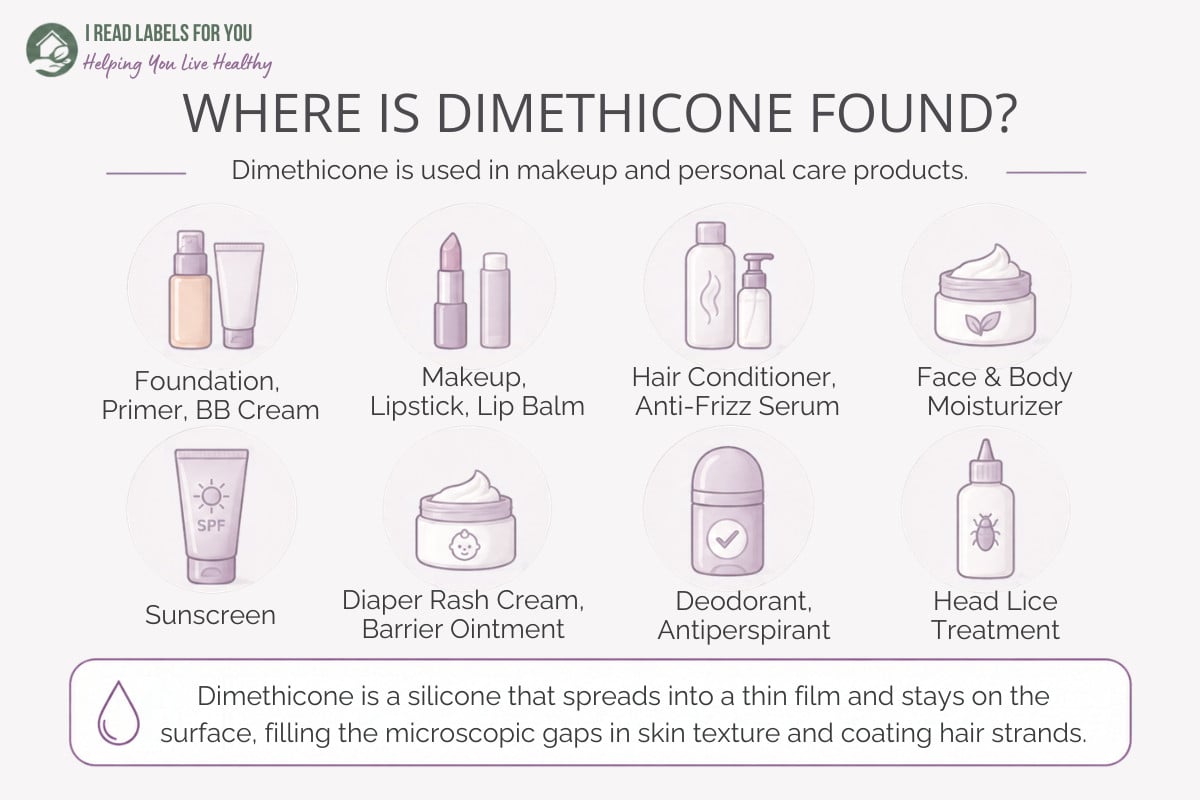
You’ll find Dimethicone most often in:
- foundation, primer, BB cream
- makeup, lipstick, lip balm
- hair conditioner and anti-frizz serum
- face and body moisturizer
- sunscreen
- diaper rash cream and barrier ointment
- deodorant and antiperspirant
- head lice treatment
Dimethicone has food uses too. The FDA permits it as a defoaming agent at 10 parts per million in food. Europe authorizes the same substance as food additive E 900.
Is Dimethicone A Silicone?
Yes, Dimethicone is a silicone, and it belongs to the branch that stays where you put it. Silicones split by shape into rings and chains, and the two behave nothing alike.
Dimethicone is a chain. Chains are large, stable, and remain on the skin surface until you wash them off. Ring silicones evaporate within minutes and travel into the air around you.
Names give the shape away. Ring silicones begin with cyclo, as in Cyclopentasiloxane and Cyclotetrasiloxane. Chain silicones carry no such prefix, and Dimethicone is the chain you’ll meet most.
Chemistry explains the rest of this post. Almost nothing in the Dimethicone molecule wants to react, which is why its toxicology reads so quietly.
How Is Dimethicone Made?
Dimethicone starts nowhere near a plant. The Handbook of Pharmaceutical Excipients describes it as “obtained by hydrolysis and polycondensation of dichlorodimethylsilane and chlorotrimethylsilane.” In plain terms, two chlorine-bearing silicon chemicals meet water. The chlorine leaves, and the remaining fragments link into silicon-oxygen chains. One of the two acts as a stopper, therefore adjusting its amount sets the chain length.
Both manufacturing chemicals are hazardous on their own. Dichlorodimethylsilane is flammable and corrosive. Chlorotrimethylsilane is flammable, corrosive, and self-classified by industry as suspected of causing cancer.
This self-classification needs a caveat, and it matters. Europe’s harmonized classification list holds no entry for Chlorotrimethylsilane, meaning no regulator has confirmed the suspicion. Neither Chlorotrimethylsilane nor Dichlorodimethylsilane is a skin sensitizer, and neither appears on the IARC list or California’s Proposition 65. Both also wash out. Chlorosilanes react with water and leave during processing. The FDA’s food-grade specification requires the polymer be “substantially free from hydrolyzable chloride and alkoxy groups.”
Does Dimethicone Penetrate The Skin?
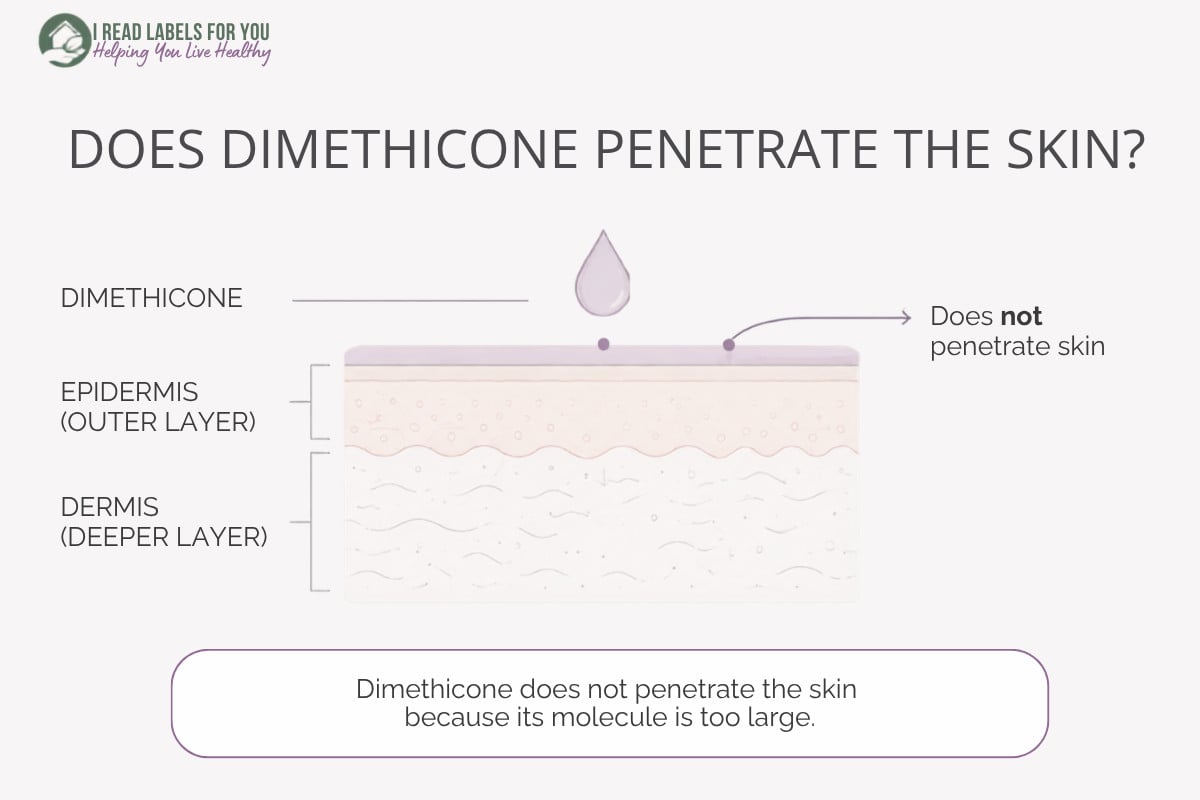
No, Dimethicone does not penetrate the skin, and the evidence here is stronger than usual. Size settles it. Molecules under roughly 500 daltons can slip between skin cells, while larger ones cannot. Dimethicone is a chain polymer that sits well beyond that ceiling in every cosmetic grade.
Measurement backs up the reasoning. Researchers applied Dimethicone to human abdominal skin and vaginal tissue in a laboratory diffusion cell. Flux through abdominal skin measured 0.2 to 0.3 nanograms per square centimeter per hour. A nanogram is one billionth of a gram, which puts that figure close to nothing. The authors described the penetration rate as low and noted it ran faster in vaginal tissue.
A second study asked a subtler question. It tested whether Dimethicone loosens the skin barrier for other ingredients, and the answer was no. Dimethicone “did not disturb or interact with the liquid crystalline structure of the upper layer of the epidermis.”
Swallowing Dimethicone tells the same story. Dogs, rats, and a monkey absorbed almost none of an oral dose, with up to 99.99 percent recovered in excretion. After 120 days of feeding, dogs showed no Dimethicone in any organ. Human data agrees. Four people took 376.5 milligrams twice daily for ten days, and their urine showed no rise in silicate. Investigators found no evidence of Dimethicone absorption at all.
Both silicones stay out of the body, for opposite reasons. Cyclopentasiloxane leaves by evaporating, while Dimethicone stays put because it’s simply too large.
What Is Dimethicone Called On Labels?
Dimethicone appears under several names:
- Dimethicone
- Dimeticone
- Dimethyl Polysiloxane
- Polydimethylsiloxane, or PDMS
- Dimethicone 350, Dimethicone 1000 (or another number)
- E 900 (on food labels)
Other names look similar but describe different substances:
- Dimethiconol
- Cyclopentasiloxane
- Cyclotetrasiloxane
- Cetyl PEG/PPG-10/1 Dimethicone
- Simethicone
One label habit is worth learning. A silicone name beginning with cyclo is a ring silicone, and Europe is pulling those out of cosmetics. A silicone name containing PEG has been ethoxylated, which I avoid for a separate reason.
Does The U.S. FDA Restrict Dimethicone In Food And Cosmetics?
The FDA permits Dimethicone in both, and it examined this ingredient more closely than it examines most cosmetics.
For food, the agency wrote a specification. Regulation 21 CFR 173.340 allows Dimethicone as a defoaming agent at 10 parts per million in food generally. Milk gets zero, dry gelatin dessert mixes get 110 parts per million, and cooking salt gets 250.
For skin, the FDA went further and treated Dimethicone as a drug. It sits in the over-the-counter skin protectant rules at 1 to 30 percent. That means the agency actually reviewed it for that purpose.
My usual doubts about the FDA still apply elsewhere. The agency cannot demand safety testing before a cosmetic product reaches shelves. Its GRAS pathway also lets companies declare their own food ingredients safe, using panels they hire and pay.
Dimethicone happens to sit outside that pathway. It carries a written food additive regulation instead.
One gap remains, and the industry review panel drew the line itself. It concluded on the safety of Dimethicone in sprays and powders, weighing particle size against the absence of inhalation toxicity. For airbrush devices it found the available data insufficient to make a determination.
Europe starts from a different place. Its precautionary principle lets regulators act on a credible risk before science finishes settling. U.S. rules usually wait for proof of harm to arrive first.
EU Regulations About Dimethicone
Europe places no limit on Dimethicone at all. Its cosmetics database record lists the four functions and nothing more, with the restriction fields left empty. Dimethicone appears on none of the prohibited, restricted, colorant, preservative, or UV filter annexes.
The chemicals agency records even less. ECHA’s file reads “No associated activities” under regulatory activities, with no substance evaluation and no proposed restriction. Dimethicone is not a Substance of Very High Concern, and it carries no Annex XVII restriction.
Compare that with Dimethicone’s ring-shaped relatives. Annex XVII entry 70 pushes D4, D5, and D6 below 0.1 percent in all cosmetics from June 6, 2026. Leave-on products follow one year later, on June 6, 2027.
One caveat belongs here. REACH exempts polymers from registration, therefore Dimethicone holds zero registration dossiers in Europe. Absence of concern and absence of scrutiny can look alike from the outside.
Food is where Europe did look. Dimethicone is authorized as food additive E 900, and the European Food Safety Authority re-evaluated it in 2020.
Canadian Regulations About Dimethicone
Canada takes the same view as Europe. Dimethicone appears nowhere on the Cosmetic Ingredient Hotlist. That list is where Health Canada names the cosmetic ingredients it bans or caps.
Canadian environmental law separates the silicones just as sharply. Schedule 1 of the Canadian Environmental Protection Act names a single siloxane, D4. It reads “Cyclotetrasiloxane, octamethyl-,” and Dimethicone is nowhere on the list.
Can Dimethicone Cause Skin Allergy And Sensitization?
No, Dimethicone does not cause skin allergy or sensitization, and the testing behind that answer is unusually thorough.
Animal work came first. Dimethicone was not a sensitizer in four assays using mice and guinea pigs, tested both undiluted and at 79 percent. Human testing followed. A repeated insult patch test on 83 people at 5 percent produced no sensitization.
Irritation is minimal as well. Most rabbit studies classified Dimethicone as a minimal irritant. Primary irritation indices measured 2.8 or less from 5 to 100 percent.
The allergy registries agree. Dimethicone appears nowhere in the American Contact Dermatitis Society’s Core Allergen Series for 2020. The society has also never named it Allergen of the Year.
Published silicone allergy reports point elsewhere. Documented cases name phenyl dimethicone in a sunscreen and cetyl PEG/PPG-10/1 dimethicone. Others involve a cochlear implant and a CPAP mask.
Hazard data closes the loop. Of 249 reports to Europe’s classification inventory, 153 concluded Dimethicone meets no hazard criteria whatsoever. The remainder flagged eye irritation and nothing else.
Is Dimethicone A Hormone (Endocrine) Disruptor?
No, Dimethicone is not a hormone disruptor, though I want to be precise about what’s actually known.
No regulator has assessed it. ECHA records no endocrine assessment for Dimethicone. It holds no place on the Endocrine Disruptor Assessment List, having opened no activity at all.
No published study reports it either. A PubMed search for endocrine or estrogenic activity in Dimethicone and polydimethylsiloxane returns nothing on the polymer itself.
The nearest study looked at something else. Researchers tested 42 food-contact silicone rubber products and found endocrine activity in substances leaching out of them. Those leachables are additives and residues, not the silicone chain.
Biology explains why the pattern makes sense. Hormone disruption needs a molecule small enough to reach a receptor and fit into it. A polymer, such as Dimethicone, that crosses neither skin nor gut wall never gets the chance.
Even so, I’ll call this untested rather than proven clean. The distinction matters, and I make it in both directions.
Is Dimethicone Safe To Use While Pregnant?
Yes, Dimethicone is safe to use while pregnant, for one straightforward reason: almost none of it enters your body.
Animal studies support that. Rats, rabbits, and monkeys received Dimethicone orally, through diet, and on skin. Reviewers recorded “no treatment-related adverse findings” in pregnant females or fetuses. The developmental no-effect level exceeded 1,000 milligrams per kilogram of body weight daily. That leaves an enormous margin against any cosmetic exposure.
One study leaves a loose end. Male rats given 3.3 milliliters of Dimethicone per kilogram daily for six days showed lower body weight. One of three samples also lowered testes or seminal vesicle weight, with no further detail given.
Another study is weak by design. It fed a motor oil containing an unspecified amount of Dimethicone across generations. That tells us very little about the cosmetic ingredient.
My practical view stays calm. Dimethicone in a foundation or a moisturizer raises no meaningful pregnancy concern. Pregnancy is certainly not the reason I limit it.
Still, pregnancy raises personal questions of its own. You should consult with your medical provider about anything you apply daily.
Are There Any Cancer Concerns Linked To Dimethicone?
No, Dimethicone has no established link to cancer, and this question has been examined more thoroughly than most. Gene damage testing returned negative in every format. Ames tests ran up to 5,000 micrograms per plate, and micronucleus tests up to 5 grams per kilogram. Mouse and Chinese hamster ovary cell assays reached 10,000 micrograms per milliliter, with and without metabolic activation.
Animal cancer studies came back negative too. Mice fed up to 2.5 percent Dimethicone for 76 weeks developed no cancer, nor did mice given lifetime skin application. A 104-week rat feeding study of a resin containing 92 percent Dimethicone found the same.
Every cancer authority agrees. Dimethicone is not classified by IARC and not listed in the 15th Report on Carcinogens. California’s Proposition 65 omits it, and the EPA holds no assessment.
Where does the fear come from? Three sources feed it, and I take each one apart in the claims section below.
Is Dimethicone Bad For The Environment?
This is the honest weak spot, and it’s the only concern here with real substance. Dimethicone does persist, and researchers have studied that directly. A review of the environmental fate and effects of dimethicone tracked where the polymer goes after it washes off.
No regulator has called it a problem. ECHA has made no persistent, bioaccumulative, or toxic determination. Canada’s list of toxic substances omits Dimethicone entirely.
Wastewater data on its PubChem record calculate 99.7 percent Dimethicone removal during treatment. Most of what goes down the drain never reaches open water.
The polymer exemption cuts in again. Because REACH never required a registration dossier, Europe holds less environmental data on Dimethicone than on a comparable non-polymer.
My reading is measured. A silicone film washing down the drain will not biodegrade the way a plant oil does. That’s a real environmental trade-off rather than a health one, and I keep the two separate.
Common Claims About Dimethicone: What’s True And What’s Not
Claim: Dimethicone Causes Cancer
False, and the testing is unusually complete. Dimethicone came back negative in oral and lifetime skin cancer studies in mice. A 104-week rat study and every gene damage assay agreed, and no cancer agency lists it.
Three things keep the claim that Dimethicone causes cancer alive, and each holds a grain of truth. First, the ring silicones D4 and D5 do carry rat cancer studies and European restrictions. Second, one chemical used to make Dimethicone carries a cancer warning. Industry self-classifies Chlorotrimethylsilane as suspected of causing cancer, though no regulator has confirmed it. Third, the chemical name works against it. Dimethicone is also called polydimethylsiloxane, and a search for siloxane and cancer lands on D4.
None of that touches the testing on Dimethicone itself. A factory chemical under suspicion, a shared name, and studies of another molecule do not make a carcinogen.
Claim: Dimethicone Is An Endocrine (Hormone) Disruptor
Unsupported. No regulator has assessed Dimethicone for endocrine activity, and no published study reports any for the polymer. The claim likely borrows from a real study of food-contact silicone rubber, where leachable substances showed activity. Those leachables are additives and residues, not the Dimethicone chain itself.
Claim: All Silicones Are The Same
False, and Europe’s own rulebook proves it. Annex XVII entry 70 pushes D4, D5, and D6 below 0.1 percent in cosmetics. Dimethicone carries no restriction of any kind. Canada draws the identical line. Its list of toxic substances names D4 and stops there.
Read the prefix and you’ll sort them yourself. Cyclo means a ring that evaporates, while no prefix means a chain that stays put.
Claim: Dimethicone Is Plastic On Your Skin
Partly fair as language, wrong as chemistry. Dimethicone is a polymer, and PubChem does file it under plastics and rubber, which is why the word feels right. The backbone tells a different story. Plastics are built on carbon chains, while Dimethicone runs on alternating silicon and oxygen. It’s also a liquid oil rather than a solid sheet.
Claim: Dimethicone Is A Microplastic
No, and the legal definition settles it. Europe’s microplastics restriction covers synthetic polymer particles that are solid, and Dimethicone is a liquid.
That regulation carries teeth, which makes its silence meaningful. It forced glitter and microbeads out of cosmetics, yet Dimethicone sits under no Annex XVII restriction at all.
Claim: Dimethicone Suffocates The Skin
Half true, in a strange way. Dimethicone genuinely does suffocate head lice, which is how silicone lice treatments work. The World Health Organization assigns it a drug code for exactly that use.
Your skin is a different matter. Lice breathe through openings along their bodies, while your skin draws its oxygen from blood rather than from air.
The FDA classifies Dimethicone as a skin protectant, and its recorded action is barrier activity. Holding water in is the whole point.
Claim: Dimethicone Clogs Pores
Unproven in either direction, and I want to be straight about that. Neither industry review of Dimethicone contains comedogenicity testing, therefore nobody can point to a study.
Reasoning helps where data is missing. A molecule too large to enter skin is also too large to lodge in a pore lining. Dimethicone appears in plenty of acne products. Judge the whole formula instead. Heavy waxes and rich oils sitting under a silicone film are the likelier trouble.
Claim: Dimethicone Is A PFAS Or Forever Chemical
False on the first half. PFAS are carbon chains bonded to fluorine, and Dimethicone contains no fluorine whatsoever.
The second half borrows a real fact and misplaces it. Dimethicone does persist in the environment, which is an ecological point rather than a sign it builds up in you.
What I Think About Dimethicone — And What You Should Do
I rate Dimethicone Better (Limited Use). It has the cleanest safety file of any silicone in my database, and I want to say so plainly. It gets condemned by association far more often than by evidence. One thing keeps Dimethicone out of my Best skincare picks, and it’s not a safety scare. It’s purpose.
A silicone film gives skin nothing to work with. In skincare that makes it texture standing in for care, while plant oils and butters feed the barrier.
One use of Dimethicone also sits unresolved, and it belongs in a separate box. The industry’s own panel cleared sprays and powders, then found the data insufficient to judge airbrush application. Its reasoning is worth knowing. Airbrush use means breathing micro- and nano-sized particles for long stretches, and nobody has measured that exposure.
My guidance follows the product type. In makeup, I accept Dimethicone in my Best products. It gives foundation glide, keeps pigment out of fine lines, and holds wear all day.
I explained why Dimethicone belongs in toxin-free makeup a while back, and I still hold that view. In skincare, though, Dimethicone drops to my Better tier and stays out of the Best one.
Keep the foundation you love if it lists Dimethicone. In your serum and moisturizer, reach for plant oils instead.
Frequently Asked Questions About Dimethicone
Is Dimethicone Safe For Babies?
Mostly yes, with a preference for something simpler. Dimethicone neither penetrates, sensitizes, nor meaningfully irritates, and it appears in some diaper rash barrier products.
Even so, I prefer simpler formulas on infant skin. A barrier film has its place, though plant oils do more of the work.
Is Dimethicone Bad For Your Hair?
No, though it can build up. Dimethicone coats the hair shaft and stays there until a strong enough cleanser lifts it. Layer on layer, that can leave hair limp over time.
Hair loss is a separate claim with no support behind it. Dimethicone rests on the strand and the scalp surface, and nothing in the record shows it reaching follicles.
Is Dimethicone Natural Or Synthetic?
Dimethicone is fully synthetic. It begins with silicon, an element found in sand. Reaching Dimethicone then takes chlorine-based chemistry that happens only in a factory.
“Synthetic” by itself tells you nothing about safety, in either direction. I judge each ingredient on how it’s made, what rides along with it, and what it actually does.
Is Dimethicone A Chemical?
Yes, Dimethicone is a chemical, and so is water. Every substance in every product is a chemical, including the plant oils I prefer.
The useful question is which chemical and how it’s made. Dimethicone is a large, unreactive silicone polymer, which is precisely why its toxicology reads so quietly.
Is Dimethicone An Active Ingredient?
Sometimes Dimethicone is an active Ingredient, and this surprises people. In the United States, the FDA recognizes Dimethicone at 1 to 30 percent as an over-the-counter skin protectant active ingredient.
On those products, Dimethicone appears under Active Ingredients on a Drug Facts panel, not in the regular ingredient list. In a foundation or a conditioner, it’s an ordinary cosmetic ingredient instead.
What Is The Difference Between Dimethicone And Dimethiconol?
The chains end differently. Dimethicone finishes with a plain carbon cap, while Dimethiconol finishes with a hydroxyl group, the same pairing found in water. Both are straight-chain silicones that stay on the surface. Neither one is a ring silicone, and neither carries the D4 and D5 restrictions.
Is Dimethicone The Same As Simethicone?
No, Dimethicone is not the same as Simethicone, though they’re closely related. The Merck Index puts it precisely: “Dimethicone mixed with silicon dioxide is known as simethicone.”
Simethicone is the anti-gas medicine version. Adding silicon dioxide gives it the foam-breaking action that settles gas in the gut.
Is Dimethicone Flammable?
No, Dimethicone is not flammable. Europe’s classification inventory records Dimethicone as not classified, and the only hazard reported for it is eye irritation.
An aerosol can containing Dimethicone may still catch fire. The propellant is the flammable part there, not the silicone.
Is Dimethicone Good For Eczema?
It can help, and it’s a reasonable choice for a damaged barrier. Dimethicone holds water in without sensitizing, which matters when skin is already inflamed.
I’d still reach for something that feeds skin. Plant oils and butters give the barrier material to rebuild with, while a silicone film gives none.
Is Dimethicone Vegan And Halal?
Dimethicone is vegan. It comes from mineral silicon and involves no animal material at any step.
Halal depends on the certifier rather than on the ingredient. Dimethicone brings no alcohol and no animal source, though certification always considers the whole formula.
What Is A Natural Alternative To Dimethicone?
For skincare, plant oils and butters do the job better than Dimethicone. Squalane, jojoba, and shea deliver slip and hold water in, while also giving skin material to use.
For makeup, the honest answer is that nothing matches Dimethicone. Long-wear foundation without silicone tends to move more, which is exactly why I accept Dimethicone there.
Sources
EU SCCS / SCCP Opinions:
No SCCS or SCCP opinion on Dimethicone (checked); the CosIng record carries an empty opinions section, and a full-text scan of the current and archived opinion indexes returned no match for dimethicone, siloxane, silicone, or polydimethyl: SCCS Opinions portal
Cosmetic Ingredient Review (CIR) Reports:
Cosmetic Ingredient Review (2022), Amended Safety Assessment of Dimethicone, Methicone, and Substituted-Methicone Polymers as Used in Cosmetics, final report released April 19, 2022; source of the use frequency, penetration, sensitization, genotoxicity, and carcinogenicity data cited above: CIR Reports
Nair B, Cosmetic Ingredient Review Expert Panel (2003), safety assessment of 20 dimethicone, methicone, and substituted-methicone polymers, International Journal of Toxicology, 22 (Suppl 2): 11-35, PMID 14555417; the earlier assessment that the 2022 report amends: CIR Reports
Kawabe M et al. (2005), 104-week rat feeding study of a silicone resin containing 92 percent dimethicone, reviewed inside the 2022 CIR report rather than cited separately here: CIR Reports
European Union Regulatory Databases:
CosIng ingredient record 33401 for DIMETHICONE, functions antifoaming, skin conditioning, emollient, and skin protecting, with no Annex entry, no concentration limit, and no restrictions: CosIng record 33401
CosIng Annexes checked and Dimethicone not listed in any of them, covering Annex II (prohibited), Annex III (restricted), Annex IV (colorants), Annex V (preservatives), and Annex VI (UV filters): CosIng record 33401
CLP Annex VI harmonized classifications, no entry for Dimethicone; ECHA CHEM shows harmonized classifications 0, industry classifications not classified, and regulatory activities “No associated activities”: ECHA CHEM 100.109.080
ECHA dossier and obligations, zero REACH registrations because polymers are exempt under REACH Article 2(9); not a Substance of Very High Concern, not on Annex XIV, not on Annex XVII, with a single obligation under the Drinking Water Directive: ECHA CHEM obligations
Commission Regulation (EU) 2024/1328 restricting D4, D5, and D6 under REACH Annex XVII entry 70, cited for contrast because it does not cover Dimethicone: EUR-Lex
Commission Regulation (EU) 2023/2055 on synthetic polymer microparticles, whose definition applies to solid particles: EUR-Lex
European Food Safety Authority (2020), re-evaluation of dimethyl polysiloxane (E 900) as a food additive, EFSA Journal 2020;18(5):6107: EFSA Journal
Other Regulators:
U.S. FDA, 21 CFR 173.340, Dimethylpolysiloxane permitted as a defoaming agent with the specification and the 10 ppm, 110 ppm, and 250 ppm limits quoted above: eCFR 21 CFR 173.340
U.S. FDA, 21 CFR 347.10, Dimethicone listed at 1 to 30 percent as an over-the-counter skin protectant active ingredient: eCFR 21 CFR 347.10
Health Canada Cosmetic Ingredient Hotlist, Dimethicone not listed, neither prohibited nor restricted: Cosmetic Ingredient Hotlist
Environment Canada, CEPA Schedule 1 List of Toxic Substances, Dimethicone not listed; the only siloxane present is item 92, D4: CEPA Schedule 1
IARC Monographs, List of Classifications, Dimethicone not classified; neither manufacturing chemical is listed: IARC List of Classifications
U.S. NTP, 15th Report on Carcinogens, Dimethicone not listed among the 256 entries: NTP Report on Carcinogens
California OEHHA, Proposition 65 list, Dimethicone not listed; neither manufacturing chemical is listed: OEHHA Proposition 65 list
U.S. EPA, Integrated Risk Information System, no assessment for Dimethicone or any siloxane: EPA IRIS
PubChem Records (Chemistry, Identifiers, Skin Penetration, Hazard Codes):
PubChem record for Dimethicone, CAS 9006-65-9, EC 618-433-4, with no discrete compound identifier because Dimethicone is “Not available and might not be a discrete structure”; source of the manufacturing description, the GHS report counts, the Merck Index simethicone definition, and the human absorption data: PubChem: Dimethicone
Peer-Reviewed Studies:
Environmental fate and effects of dimethicone, PMID 18505514: PubMed 18505514
Cytotoxicity, endocrine disrupting activity, and chemical analysis of 42 food contact silicone rubber products, PMID 36801328; cited for the leachables finding, not for the polymer: PubMed 36801328
Allergic reaction to phenyl dimethicone in a sunscreen, PMID 6721517: PubMed 6721517
Allergic contact dermatitis resulting from cetyl PEG/PPG-10/1 dimethicone, PMID 29430705: PubMed 29430705
Contact dermatitis to silicone after cochlear implantation, PMID 16222190: PubMed 16222190
Allergic contact dermatitis to silicone in a continuous positive airway pressure mask, PMID 33306196: PubMed 33306196
Chronic toxicity and oncogenicity of octamethylcyclotetrasiloxane (D4) in the Fischer 344 rat, PMID 28676441; cited for contrast with the ring silicones: PubMed 28676441
Chronic toxicity and oncogenicity of decamethylcyclopentasiloxane (D5) in the Fischer 344 rat, PMID 26184430; cited for contrast with the ring silicones: PubMed 26184430
Natural Cosmetic Standards:
COSMOS-standard approved raw materials, Dimethicone not found on either the approved or the certified list, since the standard permits no silicones: COSMOS-standard approved raw materials
NATRUE certified and approved raw materials, Dimethicone not listed: NATRUE certified world
Skin Allergy Resource:
American Contact Dermatitis Society (ACDS), Helpful References including the Core Allergen Series 2020, in which Dimethicone does not appear: ACDS Helpful References
Last verified: 09-04-2026

Download The Free Guide!
5 Powerful Steps To A Non-Toxic Home
Join our informed consumer community and get our free guide the “5 Powerful Steps To A Non-Toxic Home”.
Before commenting, please read our Comment Policy.