
Is Citric Acid Safe? A Simple Answer You Can Trust
 Written by Irina Webb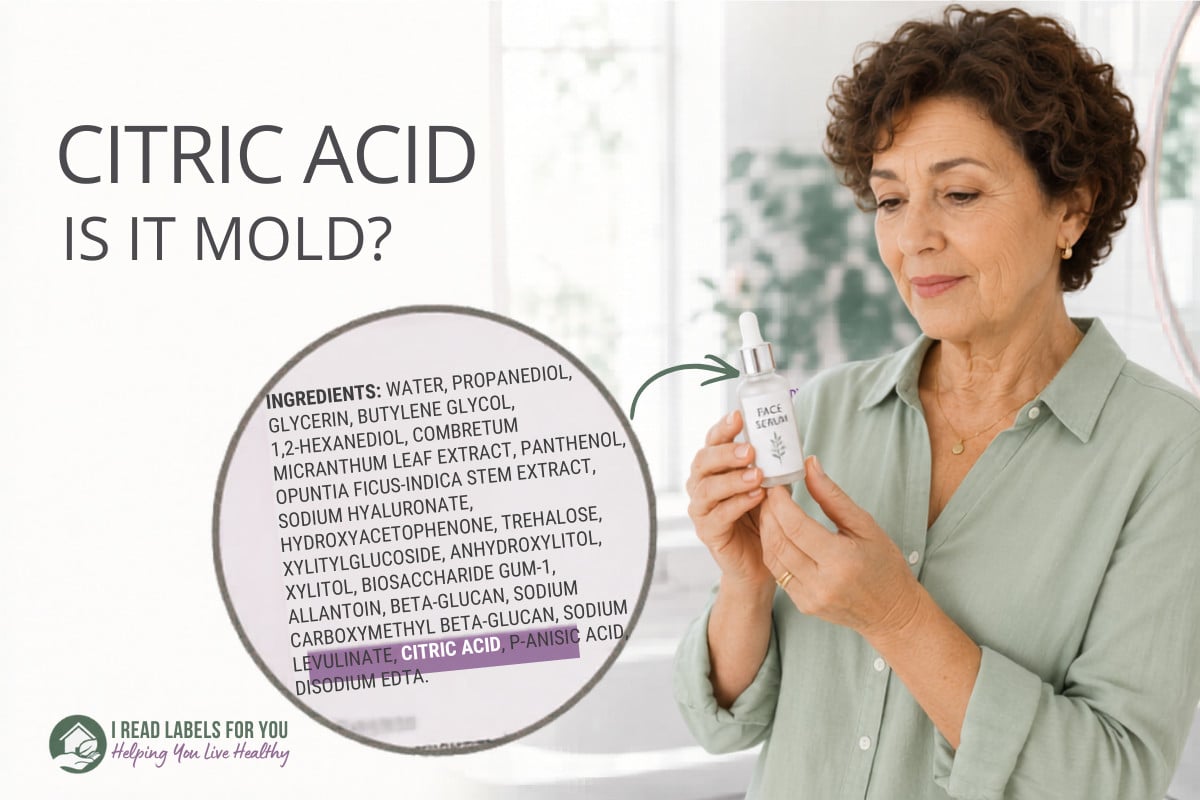
Yes, citric acid is safe in typical skincare, and it’s a common, well-studied food additive too. I rate it Best. It’s a natural fruit acid, a normal part of your own metabolism, and accepted by strict natural standards. Commercial citric acid is often made by fermentation with a mold, but the mold is filtered out; the finished ingredient is not mold.
The one caveat: at exfoliating strengths citric acid can raise sun sensitivity, so use sunscreen with strong AHA peels or toners. Tiny pH-adjusting amounts near the end of an ingredient list are harmless.
Below, I’ll show you how the mold actually makes citric acid without ending up in it, and whether that sun caveat applies to your product.
How Do We Know Citric Acid Is Safe?
The most reassuring proof comes from your own body. Citric acid sits at the center of the citric-acid cycle, the process every one of your cells uses to turn food into energy. It is present in your blood and urine right now. In plain terms, citric acid is not a foreign chemical; it is one of the most basic molecules in human life.
You also take in far more of it from food than any skin cream could ever hold. Lemon juice is about 5% citric acid, so one glass of lemonade delivers more than a lifetime of the tiny amounts used in skincare. If citric acid were harmful, lemons and oranges would be the real problem.
The world’s top food-safety bodies agree. The World Health Organization’s expert committee places citric acid in its safest category, so low in toxicity that no daily limit is set. Europe’s food-safety authority reached the same conclusion in 2020, finding no safety concern when it re-reviewed the ingredient.
What Is Citric Acid?
Citric acid is a weak fruit acid found naturally in citrus, which is where it gets its name. Lemons and limes are especially rich in it, and it gives them their sharp, sour taste.
It is also a normal part of how your body makes energy, through a process called the citric-acid cycle. In other words, your cells produce and use citric acid every second of the day.
What Does Citric Acid Do In Cosmetics?
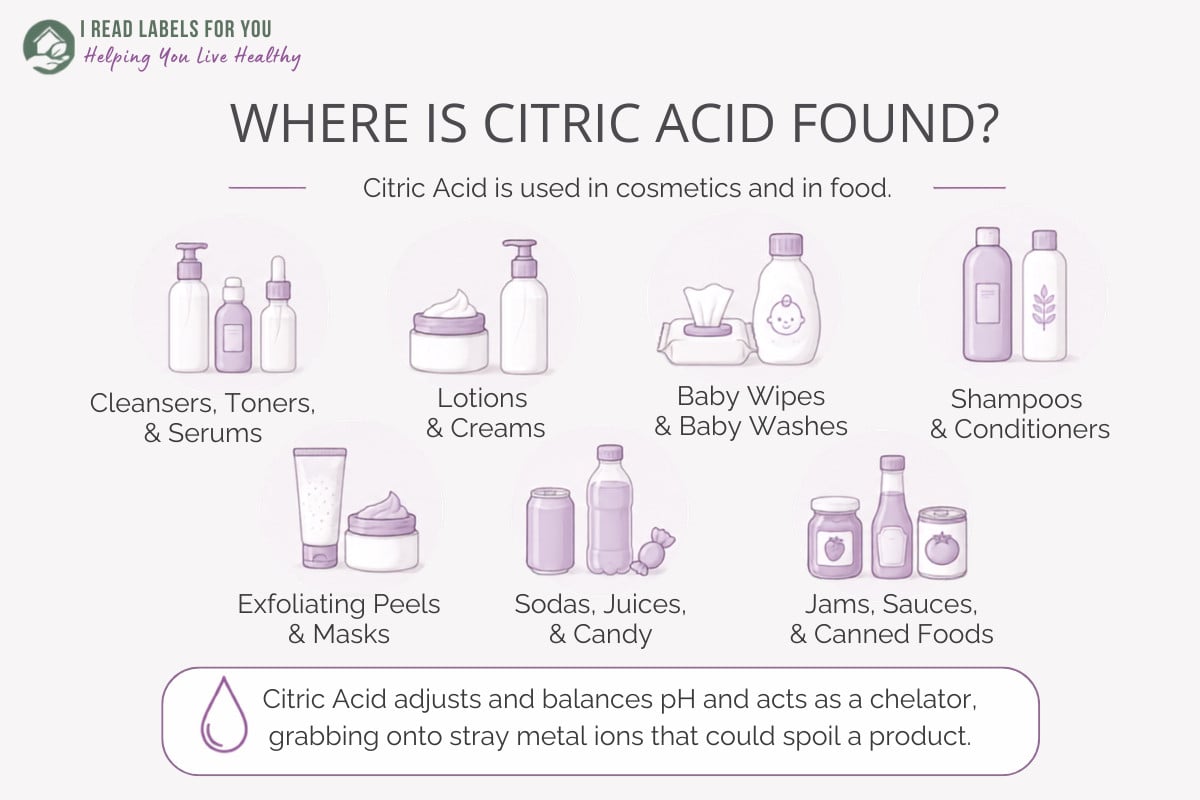
In most products, citric acid’s main job is to adjust and balance pH, keeping a formula at the right level of acidity. It also acts as a chelator, meaning it grabs onto stray metal ions that could spoil a product.
At higher strengths it works as a gentle exfoliant, since it belongs to the alpha-hydroxy acid (AHA) family. Furthermore, it can round out a fragrance. You’ll find citric acid most often in:
- cleansers, toners, and serums
- lotions and creams
- baby wipes and baby washes
- shampoos and conditioners
- exfoliating peels and masks
- sodas, juices, and candy
- jams, sauces, and canned foods
As a food additive it carries the code E330, and it is one of the most widely used ingredients in the grocery store.
How Is Citric Acid Made?
Most commercial citric acid is not squeezed from lemons. Instead, it is made by fermentation: a mold called Aspergillus niger is fed sugar, and as it grows it releases citric acid, much like yeast makes alcohol in beer.
The mold is the maker, not an ingredient. After fermentation, the citric acid is filtered away from the mold and crystallized into a clean, dry powder. Every mold cell is removed in the process, so what is left is citric acid, not mold, and no carcinogen is needed to produce it.
Does Citric Acid Penetrate The Skin?
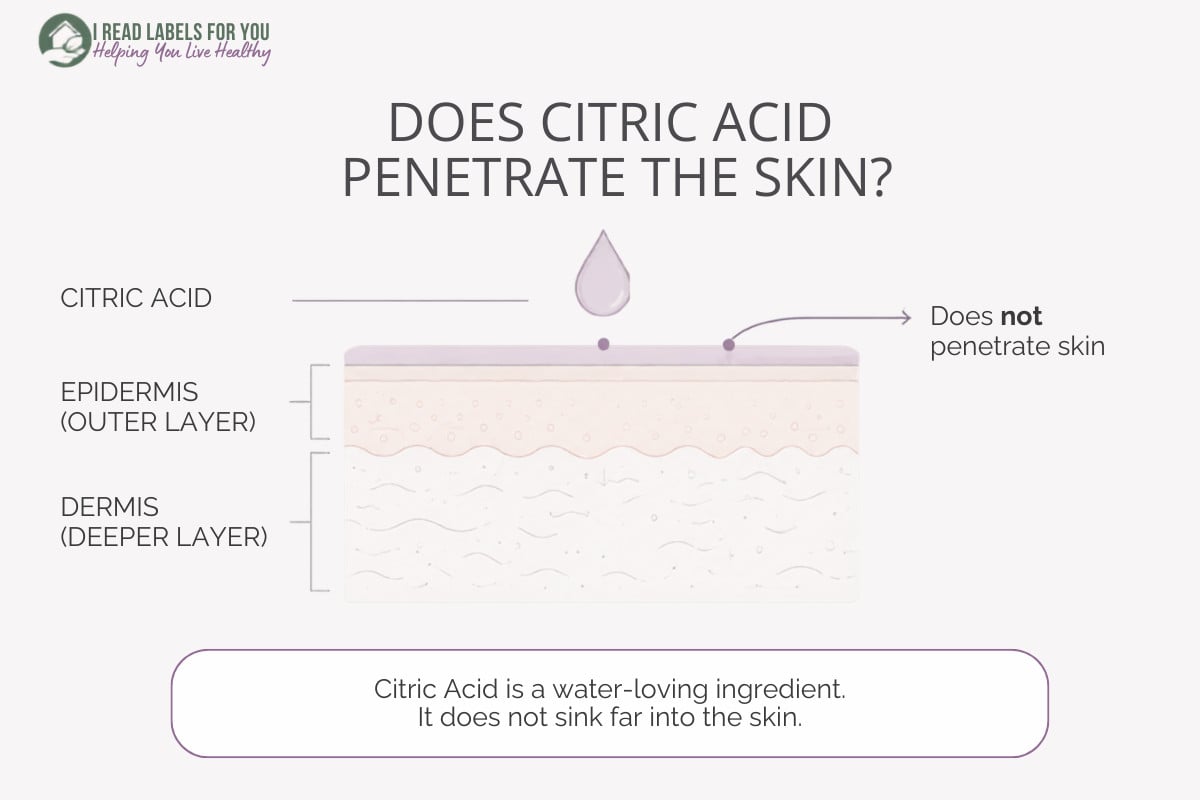
No, citric acid does not sink far into the skin. Its water-loving nature is the reason, so here is the quick science.
Citric acid is small, at 192 daltons, so size is not the barrier. What stops it is that the molecule is charged and strongly water-loving, with a very low LogP of minus 1.7, and charged, watery molecules struggle to cross the skin’s oily outer layer.
Instead, citric acid works mostly on the surface. At exfoliating strengths it loosens the glue between dead surface cells, and any small amount that is absorbed is simply used by the body as the everyday metabolite it already is.
What Is Citric Acid Called On Labels?
On an ingredient list it almost always appears as Citric Acid. Other names and codes you might see include:
- Citric Acid (E330)
- 2-Hydroxypropane-1,2,3-Tricarboxylic Acid
- Anhydrous Citric Acid
- Citric Acid Monohydrate
You will often spot it near the end of an ingredient list, paired with a preservative, because it helps set the pH that keeps preservatives working.
Does The U.S. FDA Restrict Citric Acid In Food And Cosmetics?
No, the U.S. Food and Drug Administration (FDA) does not restrict citric acid in cosmetics, and it treats the ingredient as Generally Recognized As Safe (GRAS) in food. It is used freely as an acidity regulator and flavoring.
I usually read GRAS status with a careful eye, because the program can rest on older or industry-shaped reviews. In this case, though, citric acid is a substance your own body makes and uses, which puts it on very solid ground.
Citric acid is not on the FDA’s list of prohibited and restricted cosmetic ingredients. Even so, I like to see how other regulators handle an ingredient, since Europe and Canada lean on the precautionary principle and act on early warning signs.
EU Regulations About Citric Acid
The European Union permits citric acid and does not place it on any restriction annex. In everyday use as a pH adjuster or chelator, it is treated as a well-understood, permitted ingredient.
There is one nuance tied to its role as an alpha-hydroxy acid. Europe’s science panels have reviewed AHAs and advise that, at exfoliating strengths (they consider consumer AHA products safe up to 10% at a pH of 3.5 or higher), products should be formulated and labeled to protect against extra sun sensitivity. In food, the EU allows citric acid too, under the code E330.
Canadian Regulations About Citric Acid
Canada is the strictest of the three, and its rule is specifically about exfoliation. On the Health Canada Cosmetic Ingredient Hotlist, citric acid is restricted as an alpha-hydroxy acid: between about 3% and 18% at a pH of 3.5 or higher, with cautionary and sunscreen labeling.
That restriction targets peel-strength products, not the tiny amounts used to balance a lotion’s pH. Citric acid is not on Canada’s list of toxic substances under Schedule 1 of the Canadian Environmental Protection Act.
Can Citric Acid Cause Skin Allergy And Sensitization?
No, citric acid rarely causes a true skin allergy. When skin does react, it is usually mild irritation, a temporary sting or redness, rather than an immune allergy. Human safety testing supports this. In repeat-insult patch tests, a leave-on product with 4% citric acid, several times the amount in most formulas, produced no sensitization at all.
That irritation depends on strength and pH: the more concentrated and acidic the product, the more likely a sting. Citric acid is not on the American Contact Dermatitis Society core allergen panel, and it is not one of the fragrance allergens the EU asks brands to declare.
Is Citric Acid A Hormone (Endocrine) Disruptor?
No, citric acid is not a hormone disruptor. Regulators have not identified it as one, and no hormone-focused review has flagged it.
Since your body already makes and uses this molecule every day, there is no plausible way for it to disturb your hormones. This is simply not a worry with citric acid.
Is Citric Acid Safe To Use While Pregnant?
Yes, citric acid is widely regarded as safe during pregnancy, in both food and skincare. It is a normal part of human metabolism, barely penetrates the skin, and carries no reproductive or developmental toxicity in the research.
Every pregnancy is personal, though, and I am not a medical professional. If a product ever gives you pause, you should consult with your medical provider before using it.
Are There Any Cancer Concerns Linked To Citric Acid?
No, citric acid is not linked to cancer. It is a normal metabolite, not classified by IARC, the National Toxicology Program, or California’s Proposition 65, and it was not genotoxic in testing.
Unlike some ingredients, citric acid is not made using a carcinogen either. Its fermentation route is clean, so there is no worrisome manufacturing chemical hiding in the recipe.
Is Citric Acid Bad For The Environment?
Citric acid is not an environmental concern. It breaks down quickly and completely in water and soil, and it does not build up in wildlife.
It is also biodegradable and often used in greener cleaning products for exactly that reason. In everyday use, it poses little risk to the environment.
Common Claims About Citric Acid: What’s True And What’s Not
Claim: Citric Acid Is Made From Black Mold
This claim is technically half true but badly framed. Most citric acid is fermented using Aspergillus niger, a fungus sometimes nicknamed black mold because of its dark spores.
Here is the key: Aspergillus niger is not the toxic household black mold people fear, and the citric acid is purified away from it. A refined crystal cannot contain mold any more than table sugar contains sugarcane leaves, and citric acid is acidic enough that mold cannot grow in it.
Claim: Manufactured Citric Acid Causes Inflammation
This one traces to a single 2018 paper, and it is worth knowing up front that it was about people eating manufactured citric acid in food, not putting it on their skin. The authors described four people who reported inflammation-type symptoms after consuming foods and drinks made with it, and suggested trace residues from the manufacturing fungus might be to blame.
It rested on just four anecdotal cases, never confirmed by larger studies, so it stays a hypothesis rather than established science. And because purified citric acid is the very molecule your own cells make, there is no biological reason for it to inflame healthy skin.
Claim: Citric Acid Makes Your Skin More Sun-Sensitive
This claim is true, and it is the one real caveat worth respecting. As an alpha-hydroxy acid, citric acid at exfoliating strengths can thin the outer skin and leave it more vulnerable to sunburn.
Here is how to tell which situation you are in, right from the label. If citric acid sits near the end of the ingredient list and the product does not promise any exfoliation, it is there in a tiny amount (usually well under 1%) to balance pH, and the sun-sensitivity concern simply does not apply. That effect only matters at exfoliating strengths, roughly 4% to 10% at a low pH, in a product sold as a peel, toner, or exfoliating treatment, where citric acid tends to sit higher up the list. In that case the fix is simple: wear sunscreen while you use it, and consider applying it at night.
What I Think About Citric Acid — And What You Should Do
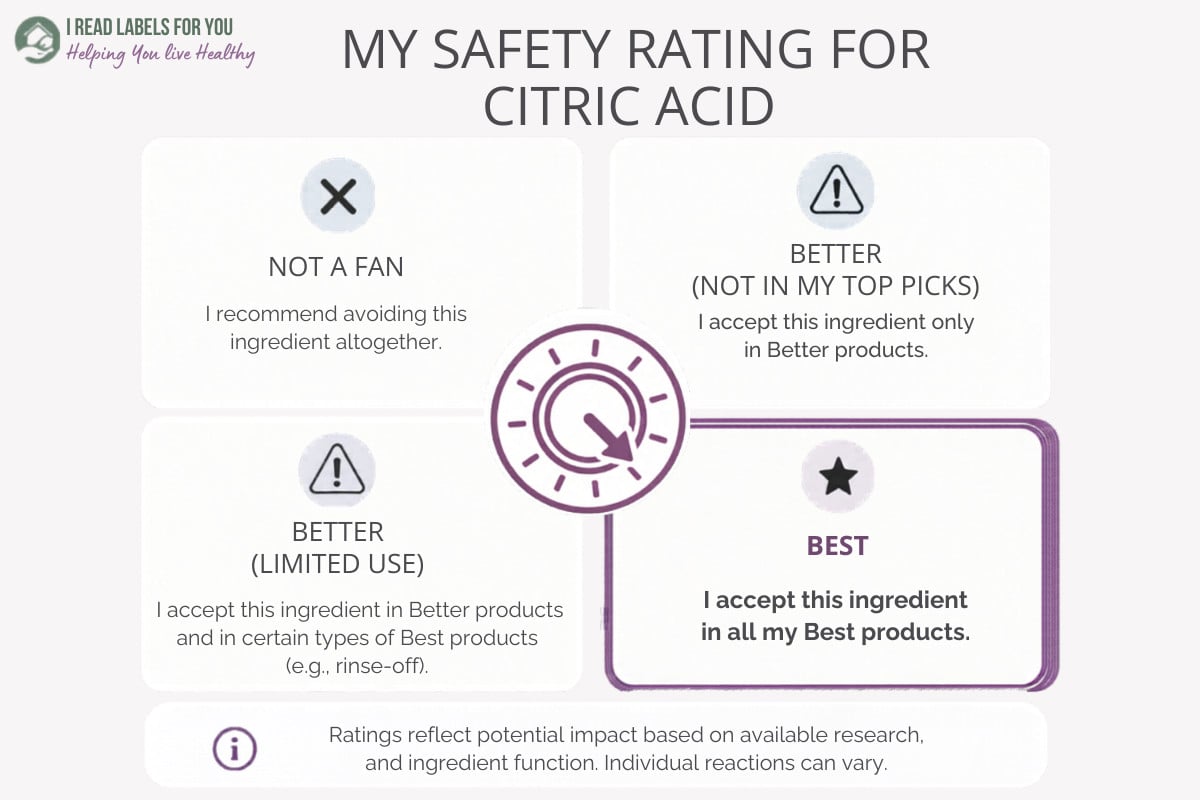
Citric acid earns my Best rating without hesitation. It occurs in nature, your own body makes it, it is a GRAS food ingredient, and strict natural standards like COSMOS and NATRUE accept this ingredient. Its safety data run deep.
The scary stories mostly fall apart on inspection. The mold worry misreads how fermentation works, and the inflammation claim rests on a handful of unconfirmed cases. Neither changes my confidence in the ingredient.
My one practical tip involves exfoliation. If you use a strong citric-acid peel or toner, pair it with daily sunscreen, since acids of this kind raise sun sensitivity. Otherwise, citric acid is a clean, useful ingredient you can feel good about.
Frequently Asked Questions About Citric Acid
Is Citric Acid Mold?
No, citric acid is not mold. It is fermented using a mold called Aspergillus niger, but the mold is filtered out and the citric acid is purified into clean crystals. The final ingredient contains no mold, and mold cannot grow in it because it is acidic.
Why Is Citric Acid In Everything?
Citric acid is cheap, versatile, and food-safe, which is why it shows up almost everywhere. It adjusts pH, sharpens flavor, helps preservatives work, and grabs stray metals that would spoil a product, all in one simple ingredient.
Is Citric Acid 100% Natural?
Citric acid is nature-identical rather than strictly natural. It occurs naturally in citrus fruits, but the version in most products is fermented in a lab to match. Even so, natural and organic standards like COSMOS and NATRUE accept this ingredient.
What Does Citric Acid Do To Your Brain?
Citric acid does nothing harmful to your brain at the levels found in food or skincare. It is a normal molecule your body uses for energy. Claims linking it to brain inflammation rest on a single unconfirmed hypothesis, not solid evidence.
Does Citric Acid Help The Liver?
The body processes citric acid in a normal way, and it is not harmful to a healthy liver at everyday amounts. It is not a detox cure, though. Your liver handles it as part of routine metabolism, nothing more.
Sources
EU SCCS / SCCP Opinions:
SCCP Opinion on Citric Acid (and) Silver Citrate (SCCP/1196/08, 2009), and SCCS/SCCNFP position papers on the safety of alpha-hydroxy acids (2000, 2004). SCCS opinions portal
Cosmetic Ingredient Review (CIR) Reports:
Fiume MM, et al. Safety Assessment of Citric Acid, Inorganic Citrate Salts, and Alkyl Citrate Esters as Used in Cosmetics. International Journal of Toxicology. 2014. cir-reports.cir-safety.org
European Union Regulatory Databases:
CosIng entry for Citric Acid — functions buffering, chelating, fragrance; not Annex-restricted. CosIng record
EU Cosmetics Regulation Annexes checked (II–VI) — no restriction on citric acid itself. CosIng Annexes
CLP Annex VI / ECHA C&L — signal word Warning; H319 (eye irritation), H335 (respiratory irritation); no harmonised carcinogen classification. Annex VI to CLP
Other Regulators:
U.S. FDA — GRAS food additive (E330 equivalent); not on the prohibited/restricted cosmetics list. FDA prohibited & restricted ingredients
Health Canada Cosmetic Ingredient Hotlist — RESTRICTED as an alpha-hydroxy acid (3–18% total mono-AHA, pH ≥3.5, cautionary/sunscreen labeling). Hotlist
Environment Canada CEPA Schedule 1 — not listed. Schedule 1
IARC, NTP Report on Carcinogens, and California Proposition 65 — citric acid not listed on any. IARC classifications
EFSA (European Food Safety Authority) 2020 re-evaluation of citric acid and related acids — concluded no safety concern and set no numerical ADI. EFSA Journal 2020;18(6):6032
JECFA (FAO/WHO Joint Expert Committee on Food Additives) — citric acid ADI ‘not limited’ / ‘not specified’, the category for substances of very low toxicity. JECFA monograph
PubChem Records (Chemistry, Identifiers, Skin Penetration, Hazard Codes):
Citric Acid, PubChem CID 311 (CAS 77-92-9; molecular weight 192.12; LogP -1.7). PubChem CID 311
Peer-Reviewed Studies:
Sweis IE, Cressey BC. Potential role of the common food additive manufactured citric acid in eliciting significant inflammatory reactions… A series of four case reports. Toxicology Reports. 2018;5:808–812 (a hypothesis based on four anecdotal cases). ScienceDirect / Toxicology Reports
Natural Cosmetic Standards:
COSMOS-standard — Citric Acid is an approved and certified raw material. COSMOS approved raw materials
NATRUE — Citric Acid is listed among certified/approved raw materials. NATRUE certified world
Skin Allergy Resource:
American Contact Dermatitis Society — Helpful References, including the Core Allergen Series 2020 (citric acid is not a panel allergen). ACDS Helpful References
Last verified: 2026-07-16

Download The Free Guide!
5 Powerful Steps To A Non-Toxic Home
Join our informed consumer community and get our free guide the “5 Powerful Steps To A Non-Toxic Home”.

Before commenting, please read our Comment Policy.