
Is Stearalkonium Chloride Safe? A Simple Answer You Can Trust
 Written by Irina Webb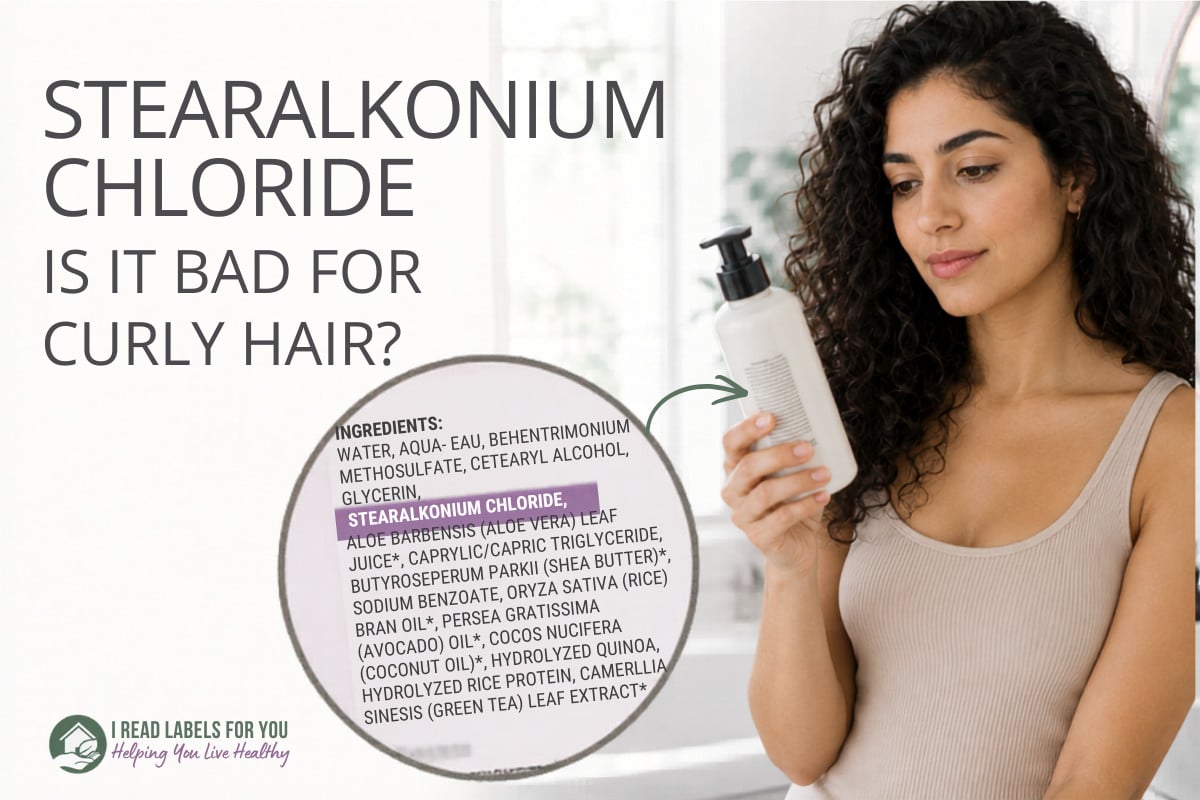
Yes, Stearalkonium Chloride is safe on your hair and skin. It’s mainly a conditioner, but it also has mild cleansing and preservation properties. There’s no real absorption, little irritation or allergy, and no cancer or endocrine concerns. Yet, it’s made with carcinogenic benzyl chloride and can form trace potentially carcinogenic nitrosamines with the nitrosating preservative like bronopol. I rate it Better (Not In My Top Picks).
The European Union allows Stearalkonium Chloride with no restrictions, unlike its trimethyl cousins Cetrimonium Chloride and Behentrimonium Chloride. However, Stearalkonium Chloride has never had a dedicated SCCS opinion, and it simply sits unassessed.
Below, I investigate if Stearalkonium Chloride is bad for your curls or prone to building up, how it differs from Benzalkonium Chloride, and why its high EWG score does not reflect how it behaves on your hair.
What Is Stearalkonium Chloride?
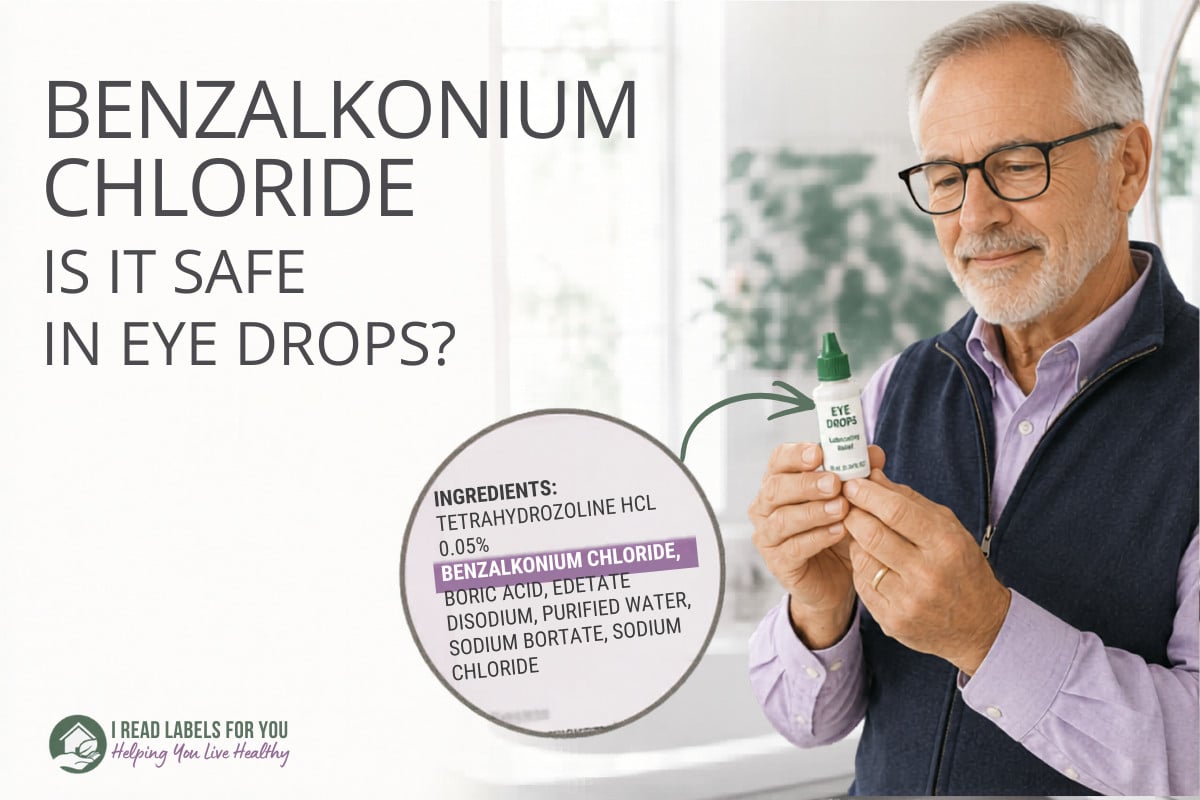
To begin with, Stearalkonium Chloride belongs to a group of positively charged ingredients called quaternary ammonium compounds, or “quats.” That positive charge is the whole point: it makes the ingredient grab onto hair and lay the cuticle flat. Picture it as the soft-spoken, long-tailed relative of the disinfectant Benzalkonium Chloride.
Despite sharing a family, Stearalkonium Chloride behaves very differently from Benzalkonium Chloride. It’s built to soften hair, not to kill germs.
What Does Stearalkonium Chloride Do In Cosmetics?
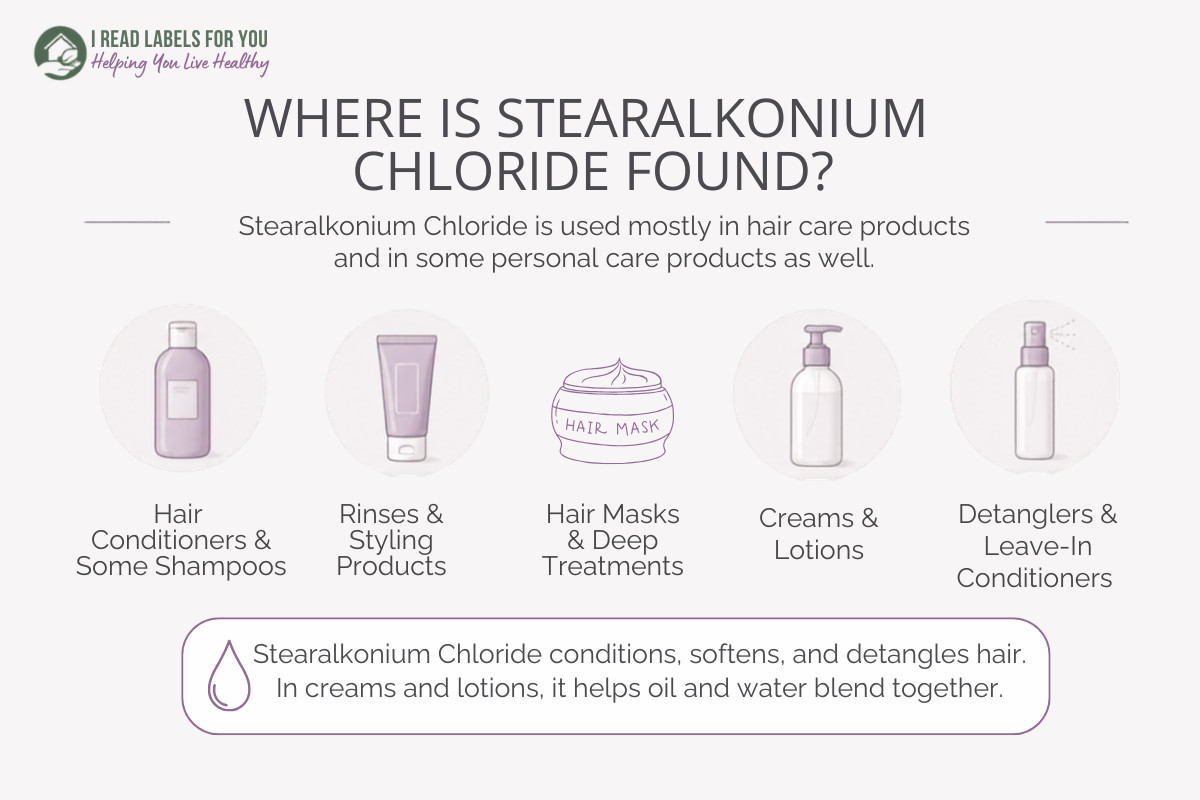
Conditioning hair is Stearalkonium Chloride’s main role. Damaged hair carries a slight negative charge, and this positively charged ingredient is drawn right to it. It coats and smooths each strand, leaving hair soft and easy to comb.
Stearalkonium Chloride also has mild surfactant and germ-slowing properties. Those are minor side roles, not the reason it’s in your conditioner.
You’ll find Stearalkonium Chloride most often in:
- hair conditioners and rinses
- leave-in conditioners and detanglers
- hair masks and deep treatments
- some shampoos and styling products
- a few cleansing lotions and creams (less common)
Stearalkonium Chloride isn’t used in food. The closest food link is industrial: the FDA permits it in food-packaging adhesives and as a slimicide in paper mills, not as anything you eat.
How Is Stearalkonium Chloride Made?
Stearalkonium Chloride starts with a fatty amine derived from stearyl alcohol, often from plant or animal fats. Makers join that amine to a benzyl group using benzyl chloride, the chemical used to make it. The result is a stable, positively charged conditioning salt.
Here’s the catch at the factory: benzyl chloride is a probable carcinogen (IARC Group 2A). It gets used up in the reaction and isn’t a reported leftover, yet it gives Stearalkonium Chloride a harsher production footprint than gentler conditioners carry.
Does Stearalkonium Chloride Penetrate The Skin?
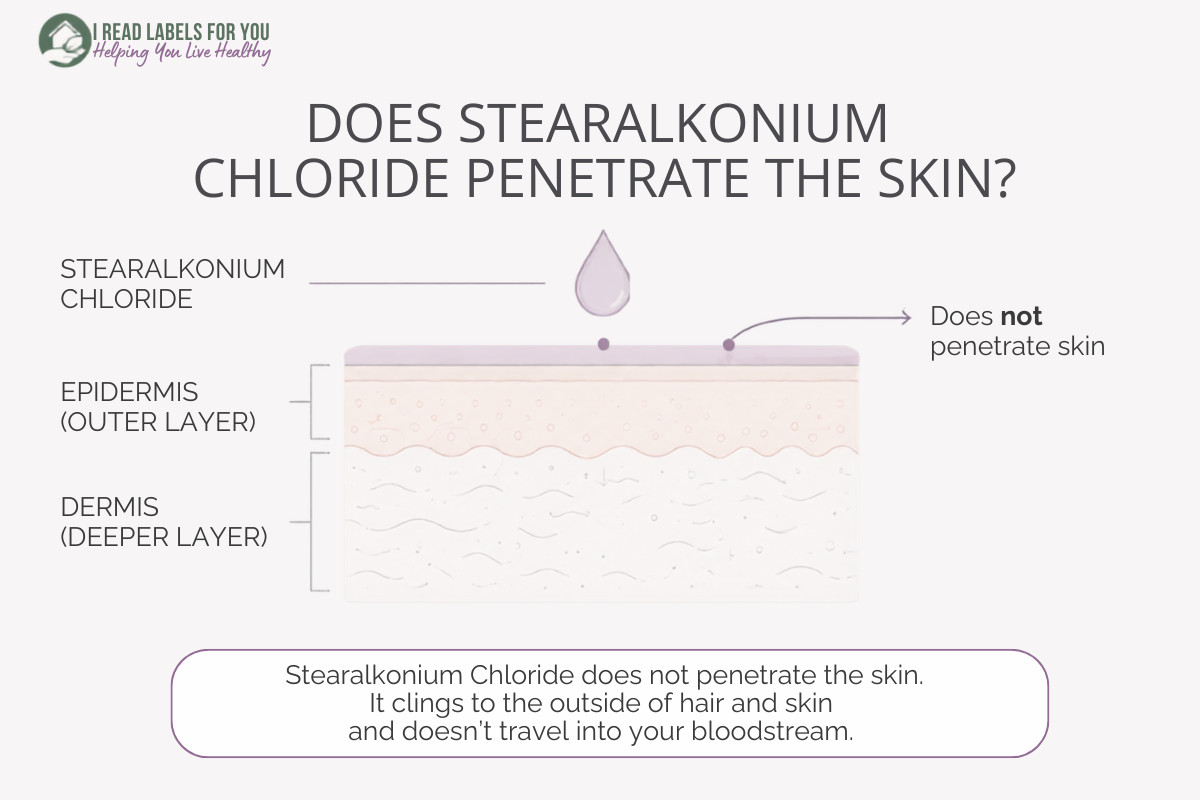
No. Stearalkonium Chloride stays on the surface. A permanent positive charge is the main reason. The outer skin is oily and waxy, and it turns away charged, water-friendly molecules like this one.
Being charged also means Stearalkonium Chloride has no normal LogP, the score that rates oily versus watery. Size plays only a small part. At about 424 daltons it falls under the rough 500-dalton mark, where molecules aren’t held back by size alone.
Put simply, Stearalkonium Chloride clings to the outside of hair and skin. Almost none of it travels into your bloodstream.
What Is Stearalkonium Chloride Called On Labels?
You may see it under several names:
- Stearalkonium Chloride
- Stearyl Dimethyl Benzyl Ammonium Chloride
- Benzyldimethylstearylammonium Chloride
- Stearyldimethylbenzylammonium Chloride
- Stebac (a trade name)
Does The U.S. FDA Restrict Stearalkonium Chloride In Food And Cosmetics?
The U.S. Food and Drug Administration (FDA) allows Stearalkonium Chloride in cosmetics with no special limit. It isn’t a food ingredient, though the FDA does permit it in food-packaging adhesives and as a paper-mill slimicide.
I take the FDA’s cosmetic clearance lightly. The agency vets few ingredients before they hit shelves and lets companies vouch for their own; even its food-contact “Generally Recognized as Safe” (GRAS) path leans on industry judgment. For a benzyl quat made with a probable carcinogen, that light touch isn’t very comforting.
Europe leans the other way, toward caution. Its precautionary principle lets regulators cap or restrict an ingredient on reasonable doubt. With Stearalkonium Chloride, though, the EU hasn’t taken that step. It has neither set a limit nor cleared the ingredient with defined safe levels.
EU Regulations About Stearalkonium Chloride
The European Union (EU) sets no specific limit for Stearalkonium Chloride. The ingredient isn’t named in the EU’s restricted-ingredient annexes, unlike its trimethyl cousins Cetrimonium Chloride and Behentrimonium Chloride, which the SCCS reviewed and capped. In practice, brands use it freely, most often in rinse-off conditioners.
Why the gap? Stearalkonium Chloride is a benzyl quat, chemically close to benzalkonium chloride, yet it carries its own name and CAS number. It has never had a dedicated SCCS opinion, which is why Europe hasn’t assigned it the safe-use limits its trimethyl cousins received.
That leaves a blind spot rather than a green light. Europe has neither restricted Stearalkonium Chloride nor confirmed safe levels for it; the ingredient simply sits unassessed. You can see its listing in the CosIng entry.
U.S. And EU Disagreements On Stearalkonium Chloride
Here the U.S. and the EU largely align: neither sets a specific cap on Stearalkonium Chloride. The contrast is that the EU has reviewed and limited its trimethyl cousins, showing a readiness to act that the U.S. system lacks.
Canadian Regulations About Stearalkonium Chloride
Canada doesn’t restrict Stearalkonium Chloride by name either. The ingredient isn’t on Health Canada’s Cosmetic Ingredient Hotlist of banned or restricted ingredients. The Hotlist does cap benzalkonium chloride, a related but chemically distinct benzyl quat.
Can Stearalkonium Chloride Cause Skin Allergy And Sensitization?
Allergy is rare, and that’s one of Stearalkonium Chloride’s strong points. In a human patch test on 50 people, a 1% solution was neither an irritant nor an allergen. A separate 20% patch test also showed no sensitization.
Unlike its cousin Benzalkonium Chloride, Stearalkonium Chloride is not on the American Contact Dermatitis Society (ACDS) core allergen list. As a strong positively charged surfactant, the concentrated ingredient can sting the eyes and skin, but finished products use gentle, low levels.
For that reason, allergy is a low concern for most people, even sensitive types.
Is Stearalkonium Chloride A Hormone (Endocrine) Disruptor?
There’s no sign that Stearalkonium Chloride meddles with hormones. Regulators have not placed it on the European Chemicals Agency (ECHA) endocrine list, and the research record is quiet too.
Stearalkonium Chloride stays outside the body and never reaches hormone receptors. It’s a worry you can comfortably skip.
Is Stearalkonium Chloride Safe To Use While Pregnant?
During pregnancy, Stearalkonium Chloride looks low-risk. It barely crosses skin and rinses away in wash-out products, which means a developing baby would meet little or none of it.
A two-generation study on related quats found no harm to fertility except at high feeding doses, and a read-across test showed no birth defects. Those doses sit far above what any conditioner delivers.
Even so, if you’re expecting and unsure, it’s worth checking with your medical provider.
Are There Any Cancer Concerns Linked To Stearalkonium Chloride?
No cancer authority flags Stearalkonium Chloride. You won’t find it on the International Agency for Research on Cancer (IARC) roster, the U.S. National Toxicology Program (NTP) report, or California Proposition 65.
In an Ames test, it didn’t damage bacterial DNA, with or without activation. In other words, the molecule itself shows no cancer signal.
Two cancer-adjacent points sit upstream, not in the finished conditioner. Stearalkonium Chloride is made with benzyl chloride, a probable carcinogen that reacts away during production.
The other is nitrosamines. This benzyl quat, and its leftover amine, can form trace nitrosamines only when a product also contains a nitrosating preservative such as bronopol. In a formula without those, it’s a non-issue.
Is Stearalkonium Chloride Bad For The Environment?
Stearalkonium Chloride’s environmental record is modest. As a positively charged surfactant, its family can be hard on water life. Yet, unlike Benzalkonium Chloride, its official hazard labels don’t carry the “toxic to aquatic life” warnings.
Stearalkonium Chloride is also used in small amounts, mostly in rinse-off hair products. The bigger green concern is its benzyl-chloride-based, petroleum-leaning production.
Common Claims About Stearalkonium Chloride: What’s True And What’s Not
Claim: It Irritates The Scalp And Builds Up
For most people, neither happens. A few report scalp irritation, usually from leave-on use or already-sensitive skin. Stearalkonium Chloride is water-dispersible, which means it rinses out and doesn’t pile up like heavy silicones.
Claim: It’s Bad For Curly Hair
Quite the opposite. Stearalkonium Chloride is accepted in the Curly Girl Method and appears in many co-washes. Its gentle conditioning helps curls detangle and stay soft.
What I Think About Stearalkonium Chloride — And What You Should Do
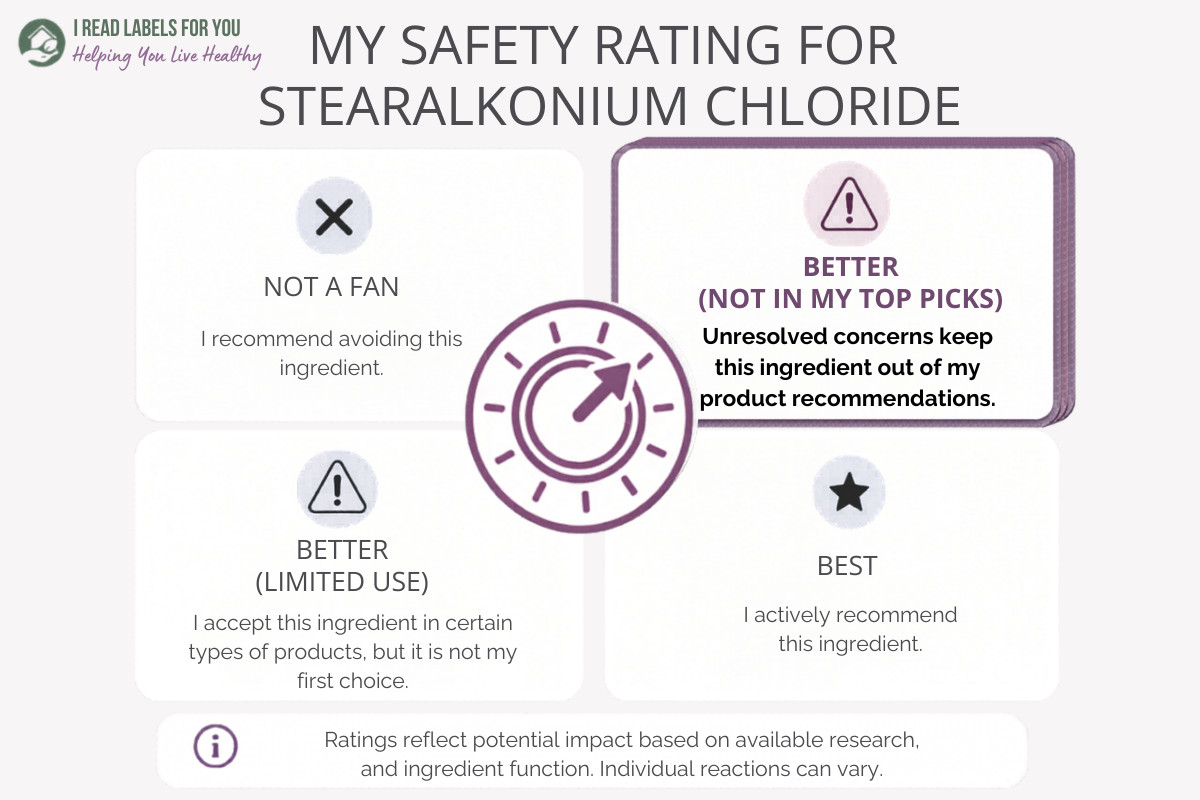
My rating for Stearalkonium Chloride is Better (Not in My Top Picks). On your hair and skin the risks are small: no real absorption, little irritation, and clean allergy tests in people. It isn’t alarming in a rinse-off conditioner, but it isn’t one I actively recommend.
Three things keep it off my top picks. It’s made with benzyl chloride, a probable carcinogen, and it can form trace potentially carcinogenic nitrosamines with the nitrosating preservative like bronopol.
The third is a regulatory blind spot. Europe reviewed and set safe limits for the trimethyl quats, yet it never gave Stearalkonium Chloride that scrutiny. The ingredient sits unassessed, with no defined safe level. For a benzyl quat made with a probable carcinogen, that missing review is its own reason for caution.
I’d reach for a different conditioner instead, since better and quat-free options exist.
Frequently Asked Questions About Stearalkonium Chloride
Is Stearalkonium Chloride Bad For Hair?
No, Stearalkonium Chloride is good for most hair. It coats and smooths the cuticle, tames static, and helps with detangling. Curly and damaged hair types often love it.
Stearalkonium Chloride Vs Benzalkonium Chloride
Both are benzyl quats, but they play different roles. Benzalkonium Chloride is a disinfectant and a recognized allergen; Stearalkonium Chloride is a hair conditioner that tests show doesn’t sensitize. The longer C18 chain makes Stearalkonium Chloride gentler.
Stearalkonium Chloride Side Effects
For most people, side effects from Stearalkonium Chloride are rare. In concentrated form, it can irritate eyes and skin, but finished products use low, gentle levels. Real-world reactions in hair products are uncommon.
Stearalkonium Chloride Side Effects On Skin
On skin, Stearalkonium Chloride is low-risk. It stays on the surface, rarely causes allergy, and human patch tests found no irritation at use levels. Sensitive skin usually tolerates it well in rinse-off products.
Is Stearalkonium Chloride Plant Derived?
Stearalkonium Chloride can be plant derived. The fatty part often comes from stearyl alcohol, which can be plant-sourced (such as coconut or palm) or animal-sourced. Makers then build the finished ingredient in a factory, which makes it plant-based but lab-finished.
Why Does EWG Rate It Differently?
The Environmental Working Group (EWG) gives Stearalkonium Chloride a high score of 7 and bars it from EWG VERIFIED products. Two flags drive that score, and neither rests on how the ingredient behaves in a rinse-off product.
The biggest is “allergies and immunotoxicity.” For it, EWG points to an occupational asthma list (the AOEC Asthmagen compilation) and occupational clinics. Those sources track asthma in workers who inhale disinfectant quats, not a waxy hair conditioner you rinse out.
On skin, the picture is different. Stearalkonium Chloride was non-sensitizing in human patch tests, and it’s absent from the ACDS contact-allergen list. In the form you’d actually meet it (a conditioner), there’s no real allergy signal.
EWG’s second flag is “use restrictions.” EWG ties this to recommended limits on the benzyl-quat family rather than a specific EU cap on Stearalkonium Chloride, since the EU sets none. Even so, I share the underlying caution: a benzyl quat made with a 2A carcinogen deserves a caution.
That leaves us partly aligned. EWG’s high score leans mostly on its allergy flag, which draws on occupational, inhaled-quat data rather than skin contact, and there I part ways. On using it sparingly, though, we land in a similar place, which helps keep it at Better (Not in My Top Picks).
Sources
EU SCCS / SCCP Opinions:
No dedicated SCCS or SCCP opinion on Stearalkonium Chloride (checked; the ingredient is not individually listed in the EU cosmetic annexes II–V): SCCS opinions portal
Cosmetic Ingredient Review (CIR) Reports:
Cosmetic Ingredient Review (CIR). Elder RL (ed.). (1982). Final Report on the Safety Assessment of Stearalkonium Chloride. Journal of the American College of Toxicology 1(2): 57-69: cir-reports.cir-safety.org
Cosmetic Ingredient Review (CIR). (2003). Annual Review re-affirming Stearalkonium Chloride. International Journal of Toxicology 22(Suppl. 1): 1-35: cir-reports.cir-safety.org
Cosmetic Ingredient Review (CIR). (2023). Re-Review of the Safety Assessment of Stearalkonium Chloride (Panel determined not to reopen): cir-reports.cir-safety.org
European Union Regulatory Databases:
EU CosIng entry for Stearalkonium Chloride (entry 38237; EC 204-527-9; functions Antistatic, Preservative, Surfactant; not individually listed in Annex III or V (no substance-specific EU limit): ec.europa.eu CosIng
CLP Annex VI / ECHA C&L (concentrated material self-classified H314 skin corrosion, H318 eye damage, H330): echa.europa.eu Annex VI to CLP
ECHA registration dossier, Stearalkonium Chloride (read-across data for ADME, DART, genotoxicity, irritation): echa.europa.eu
Other Regulators:
U.S. FDA, Cosmetic conditioning ingredient with no special restriction; not a direct food additive, but FDA-permitted in food-packaging adhesives and as a slimicide: fda.gov/cosmetics
U.S. FDA, Prohibited & Restricted cosmetic ingredients (Stearalkonium Chloride not listed): fda.gov
Health Canada Cosmetic Ingredient Hotlist (Stearalkonium Chloride not listed; the Hotlist caps the distinct ingredient benzalkonium chloride): canada.ca Hotlist
Environment and Climate Change Canada, CEPA Schedule 1 List of Toxic Substances (Stearalkonium Chloride not listed): canada.ca CEPA Schedule 1
IARC List of Classifications (Stearalkonium Chloride not classified): monographs.iarc.who.int
IARC Monographs Vol. 71, alpha-chlorinated toluenes (which include benzyl chloride) and benzoyl chloride, classified Group 2A (probably carcinogenic); the basis for flagging the manufacturing chemical: inchem.org IARC Vol. 71
NTP 15th Report on Carcinogens (Stearalkonium Chloride not listed): ntp.niehs.nih.gov
NTP 15th Report on Carcinogens: N-Nitrosamines profile (the nitrosamine class is reasonably anticipated to be human carcinogens; relevant to the benzyl-quat nitrosamine pathway): ntp.niehs.nih.gov N-Nitrosamines
California Proposition 65 List (Stearalkonium Chloride not listed): oehha.ca.gov Prop 65 list
PubChem Records (Chemistry, Identifiers, Skin Penetration, Hazard Codes):
Stearalkonium Chloride, PubChem CID 31204 (CAS 122-19-0; C27H50ClN; MW 424.1): pubchem.ncbi.nlm.nih.gov/compound/31204
Natural Cosmetic Standards:
COSMOS-standard databases (Stearalkonium Chloride not found; a synthetic quat not permitted by the COSMOS-standard): cosmos-standard.org
NATRUE certified/approved raw materials (Stearalkonium Chloride not found): natrue.org
Skin Allergy Resource:
American Contact Dermatitis Society (ACDS), Helpful References (including Core Allergen Series 2020; Stearalkonium Chloride not listed): contactderm.org
Advocacy groups:
Environmental Working Group (EWG) Skin Deep Stearalkonium Chloride (hazard score 7; not allowed in EWG VERIFIED products): ewg.org/skindeep
Last verified: 06-12–2026
Download The Free Guide!
5 Powerful Steps To A Non-Toxic Home
Join our informed consumer community and get our free guide the “5 Powerful Steps To A Non-Toxic Home”.

Before commenting, please read our Comment Policy.