
Is Propylene Glycol Safe? A Simple Answer You Can Trust
 Written by Irina Webb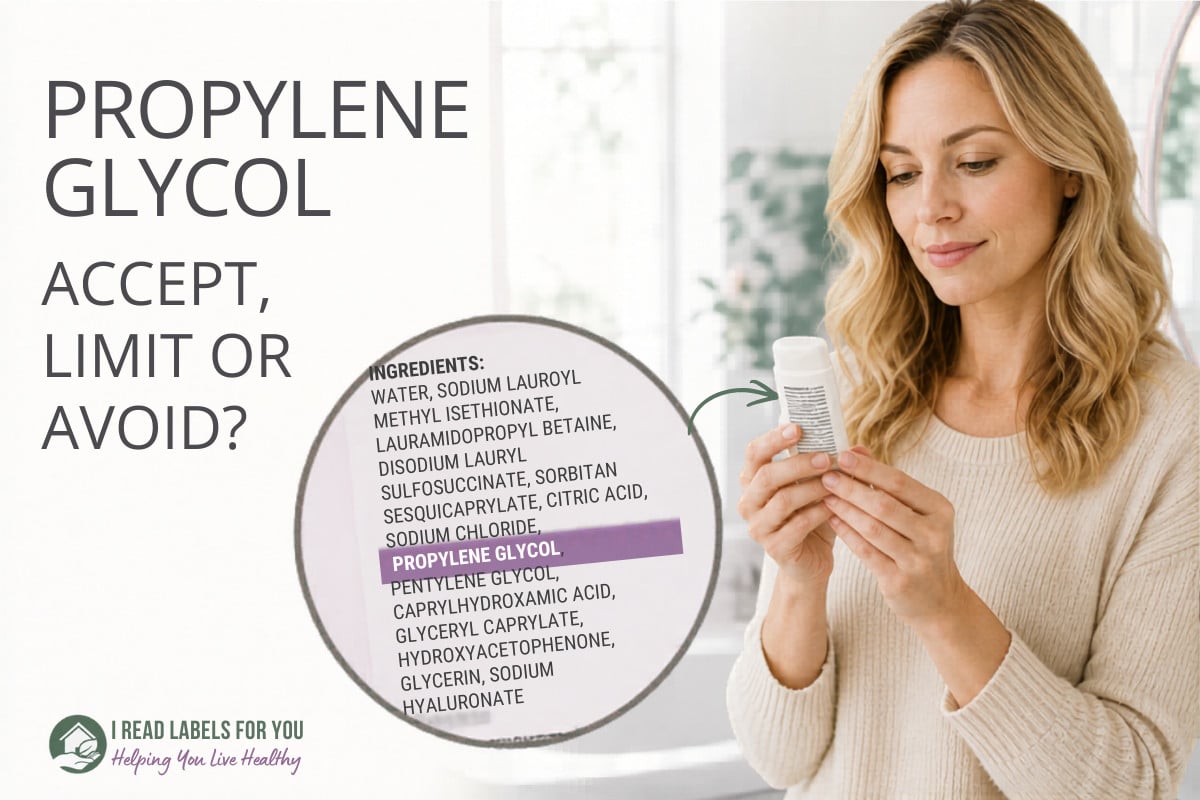
Yes, Propylene Glycol is safe for most people, though people with sensitive and eczema-prone skin are the exception. It’s a humectant, solvent, and fragrance carrier found in deodorants, lotions, and foods. It raises no cancer, hormone, or reproductive concerns, and it has a long safety record in food and medicine. Two things hold it back. It’s a recognized allergen, named Allergen of the Year in 2018. Its manufacture also relies on propylene oxide, a possible carcinogen. I rate it Better (Not In My Top Picks).
Propylene Glycol faces no restrictions in cosmetics anywhere. The European Union places no limit on it, and the EU database lists it with no restriction attached. The EU does cap it in certain foods and drinks, where it’s the additive E1520. That food cap is the source of the rumor that Europe bans it. Canada leaves it off both its Cosmetic Ingredient Hotlist and its list of toxic substances.
Below, three questions are worth your time. You’ll see whether it clogs pores, whether it’s really the stuff in antifreeze, and why dermatologists flagged it as an allergen.
What Is Propylene Glycol?
Propylene Glycol is a clear, syrupy liquid alcohol. It pulls in water and dissolves other ingredients, so formulators rely on it. The food world knows it as E1520. In short, it’s one of the most common helper ingredients in personal care.
In cosmetics, you’ll find Propylene Glycol most often in:
- deodorants and antiperspirants
- lotions and creams
- bath products and body washes
- shampoos and hair products
- makeup and toothpaste
As the food additive E1520, it also turns up in many foods, such as:
- flavoring and food-coloring mixes
- baked goods and frostings
- salad dressings and sauces
- soft drinks and drink mixes
- some processed snacks
What Does Propylene Glycol Do In Cosmetics?
In a formula, Propylene Glycol does several jobs at once. First, it acts as a humectant, drawing water into the skin to keep it soft. Second, it works as a solvent, helping active ingredients dissolve and spread. It also thins thick formulas and carries fragrance.
On top of that, it helps other ingredients absorb better. That trait is useful for formulators, but it’s also worth watching, as you’ll see below.
How Is Propylene Glycol Made?
Most Propylene Glycol starts from propylene oxide, which reacts with water. Propylene oxide itself comes from propylene, a petroleum gas. This manufacturing chemical is classified as possibly cancer-causing.
Here’s the reassuring part: little of that propylene oxide ends up in the finished ingredient. It gets used up in the reaction and removed by distillation. Cosmetic-grade (USP) Propylene Glycol is also purified to tight limits, with related impurities, like ethylene glycol, non-detectable.
The bigger concern sits upstream, at the factory. Making Propylene Glycol still relies on a possible carcinogen, which carries costs for workers and the environment. A greener route also exists, though, making Propylene Glycol from plant-based glycerin.
Does Propylene Glycol Penetrate The Skin?
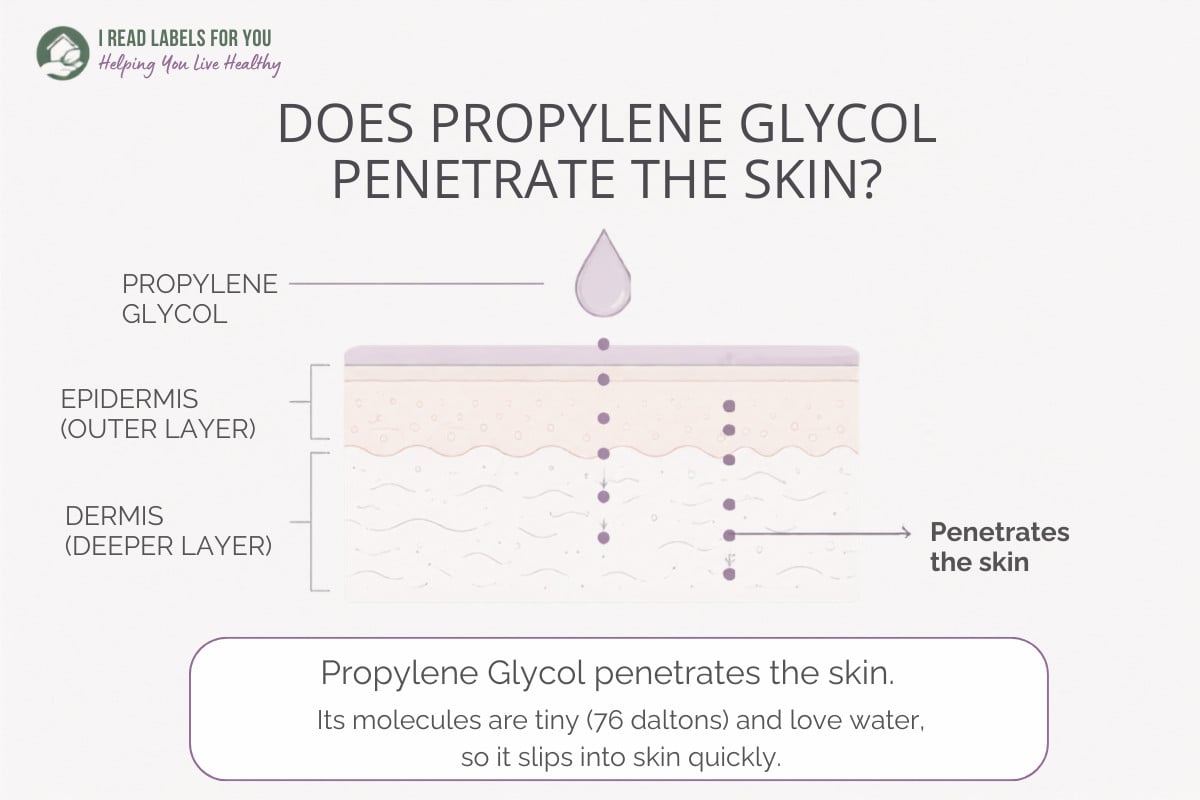
Yes, easily. Propylene Glycol is tiny (76 daltons) and loves water, so it slips into skin quickly. In one test, about 57% passed through skin over 24 hours.
More importantly, it’s a known penetration enhancer. In other words, it can pull other ingredients deeper into your skin along with it.
What Is Propylene Glycol Called On Labels?
You may see it under several names:
- Propylene Glycol
- Propane-1,2-Diol
- 1,2-Propanediol
- Methyl Ethyl Glycol
- E1520 (on food labels)
Does The U.S. FDA Restrict Propylene Glycol In Food And Cosmetics?
Not really. The U.S. Food and Drug Administration (FDA) allows Propylene Glycol in both food and cosmetics. In food, it’s generally recognized as safe (GRAS) under 21 CFR 184.1666. For cosmetics, the FDA sets no restriction on it.
As I always note, the FDA’s bar is low. To date, it has banned or restricted only 11 ingredients in cosmetics. That said, Propylene Glycol’s safety record here is genuinely strong, backed by decades of use in food and medicine.
EU Regulations About Propylene Glycol
The European Union (EU) also allows Propylene Glycol. It carries no restriction in the EU cosmetic ingredient database (CosIng). As a food additive, it’s approved under the number E1520.
The EU does cap how much E1520 can go into certain foods and drinks. Even so, Propylene Glycol is clearly permitted there. Despite a common rumor, it is not banned in Europe.
Canadian Regulations About Propylene Glycol
Canada allows Propylene Glycol in cosmetics. It is not on the Health Canada Cosmetic Ingredient Hotlist. Furthermore, it does not appear on Canada’s CEPA list of toxic substances.

Can Propylene Glycol Cause Skin Allergy And Sensitization?
Yes, and this is the main reason I hold back. In 2018, the American Contact Dermatitis Society (ACDS) named Propylene Glycol its Allergen of the Year. It also sits on the ACDS core patch-test panel, tested at 30%. So, dermatologists do see real cases of allergy to it.
That said, the picture is nuanced. A 2023 review found Propylene Glycol negative in predictive allergy tests. Reactions mostly hit people who already have damaged or eczema-prone skin. In a large Australian clinic study, only 0.31% of patch-tested patients reacted to it. The Cosmetic Ingredient Review (CIR) also looked at deodorants with up to 86% Propylene Glycol and saw little sensitization.
Even so, the CIR panel questioned those industry results, since repeated reactions kept showing up. Propylene Glycol can also simply irritate skin at higher amounts, apart from true allergy. Therefore, if your skin is sensitive or eczema-prone, this is one to watch.
Is Propylene Glycol A Hormone (Endocrine) Disruptor?
No. Propylene Glycol is not a hormone disruptor. No study has flagged it as one, and it is not on the European Chemicals Agency (ECHA) endocrine list. Its small, simple structure does not act on hormone receptors. So, this is one concern you can set aside.
Is Propylene Glycol Safe To Use While Pregnant?
Propylene Glycol is considered safe during pregnancy in normal amounts. Animal studies showed no harm to reproduction or development, even at high doses. Your body also clears it quickly, much like it clears food.
As always, if you have any concerns, you should consult with your medical provider.
Are There Any Cancer Concerns Linked To Propylene Glycol?
No credible cancer concerns exist. The CIR found Propylene Glycol is not carcinogenic and not genotoxic. Moreover, it is not listed by the International Agency for Research on Cancer (IARC), the U.S. National Toxicology Program (NTP), or California Proposition 65. So no major body flags it as a cancer risk.
Is Propylene Glycol Bad For The Environment?
Propylene Glycol is fairly gentle on the environment. It is not classified as hazardous under global safety rules. It also breaks down quickly in water and does not build up in nature. For that reason, it does not appear on Canada’s toxic substances list.
Common Claims About Propylene Glycol: What’s True And What’s Not
Claim: Propylene Glycol Is Banned In Europe
This one is false. The EU allows Propylene Glycol in both cosmetics and food. In cosmetics, it carries no restriction at all. In food, it’s the approved additive E1520.
The EU does limit how much E1520 can go into certain foods and drinks. That limit is likely the source of the myth. In truth, a capped food level is not the same as a ban.
Claim: It’s Used In Antifreeze, So It Must Be Toxic
This one mixes up two different chemicals. The toxic antifreeze ingredient is ethylene glycol, which is sweet, poisonous, and dangerous to pets. Propylene Glycol is a separate molecule, and it’s far safer.
In fact, Propylene Glycol is used in the “non-toxic” antifreeze made for campers, boats, and food equipment. Makers choose it there precisely because it’s low in toxicity. So, a use in antifreeze doesn’t make it harmful, and it’s also found in food and medicine.
What I Think About Propylene Glycol — And What You Should Do
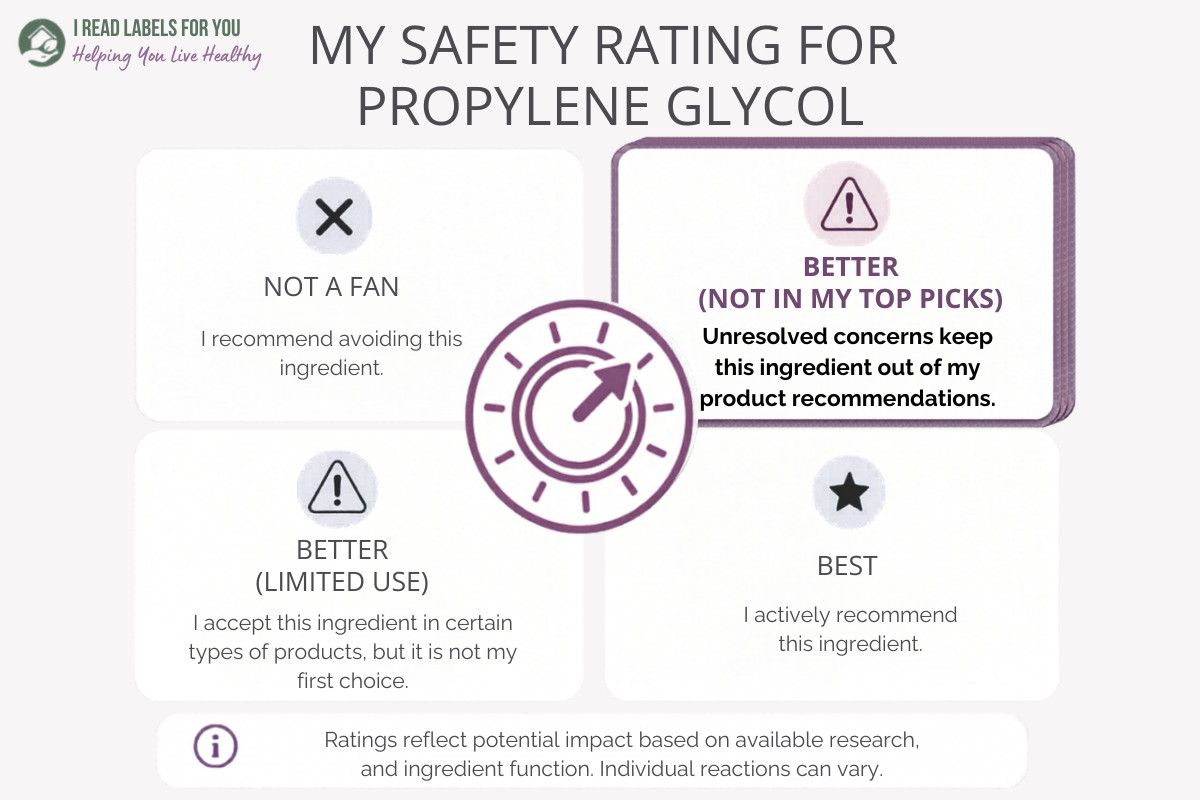
I rate Propylene Glycol Better (Not in My Top Picks). It is genuinely low-risk for most people. It has no cancer, hormone, or reproductive concerns, plus a long safety record in food and medicine. Still, three things hold it back from my recommendations.
First, it’s a real allergen for some, serious enough to earn Allergen of the Year. Second, it’s a penetration enhancer, so it can carry other ingredients deeper into your skin. Third, its manufacture relies on propylene oxide, a possible carcinogen, with real costs for workers and the environment.
Hence, here’s my take: most people can use Propylene Glycol without worry. However, if your skin is sensitive, reactive, or eczema-prone, you may prefer products without it. As always, read the label and pick what suits your skin.
Frequently Asked Questions About Propylene Glycol
Is Propylene Glycol Safe For Skin?
Yes, for most people. Propylene Glycol is well tolerated and actually helps keep skin hydrated. The main exception is sensitive or eczema-prone skin, which may react to it. If that’s you, patch-test new products first.
Is Propylene Glycol Comedogenic?
No. Propylene Glycol is considered non-comedogenic, meaning it does not clog pores. In fact, it’s lightweight and water-loving, not oily. So, it’s generally fine for acne-prone skin.
Is Propylene Glycol Safe During Pregnancy?
Yes, it’s considered safe in normal cosmetic and food amounts. Animal studies found no harm to reproduction or development. Your body also clears it quickly. Still, if you’re pregnant and unsure, you should consult with your medical provider.
Where Does Propylene Glycol Come From?
Most Propylene Glycol is made from propylene oxide, a petroleum-based chemical, reacted with water. A plant-based version, made from glycerin, is also available. Either way, the finished ingredient is the same safe Propylene Glycol.
What Are Propylene Glycol Side Effects?
For most people, none. At higher amounts it can cause skin irritation, and some people develop an allergy to it. Large medical doses taken by mouth have rarely caused other effects. At the levels in cosmetics and food, though, it’s well tolerated.
Sources
Cosmetic Ingredient Review (CIR) safety assessment:
Cosmetic Ingredient Review (CIR). (2012). Fiume MM, Bergfeld WF, Belsito DV, et al. Safety Assessment of Propylene Glycol, Tripropylene Glycol, and PPGs as Used in Cosmetics. International Journal of Toxicology 31 (Suppl. 2): 245S-260S https://cir-reports.cir-safety.org
Cosmetic Ingredient Review (CIR). (1994). Final Report on the Safety Assessment of Propylene Glycol and Polypropylene Glycols. Journal of the American College of Toxicology: https://cir-reports.cir-safety.org
CIR safety assessments index: https://cir-reports.cir-safety.org
European Union regulatory databases:
EU CosIng entry for Propylene Glycol (entry 37269; no Annex restriction): https://ec.europa.eu/growth/tools-databases/cosing/details/37269
EU CosIng Annexes II, III, V (Propylene Glycol not listed): https://ec.europa.eu/growth/tools-databases/cosing/reference/annexes
CLP Annex VI Harmonised Classifications (no harmonised classification for Propylene Glycol): https://echa.europa.eu/information-on-chemicals/annex-vi-to-clp
ECHA CHEM portal Propane-1,2-diol / Propylene Glycol (CAS 57-55-6, EC 200-338-0): https://echa.europa.eu/substance-information/-/substanceinfo/100.000.307
Other regulators:
U.S. FDA 21 CFR 184.1666, Propylene Glycol affirmed GRAS food additive: https://www.ecfr.gov/current/title-21/chapter-I/subchapter-B/part-184/subpart-B/section-184.1666
Health Canada Cosmetic Ingredient Hotlist (Propylene Glycol not listed): https://www.canada.ca/en/health-canada/services/consumer-product-safety/cosmetics/cosmetic-ingredient-hotlist-prohibited-restricted-ingredients/hotlist.html
Environment and Climate Change Canada CEPA Schedule 1 List of Toxic Substances (Propylene Glycol not listed): https://www.canada.ca/en/environment-climate-change/services/canadian-environmental-protection-act-registry/substances-list/toxic/schedule-1.html
IARC List of Classifications (Propylene Glycol not classified): https://monographs.iarc.who.int/list-of-classifications/
NTP 15th Report on Carcinogens (Propylene Glycol not listed): https://ntp.niehs.nih.gov/whatwestudy/assessments/cancer/roc
California Proposition 65 List (Propylene Glycol not listed): https://oehha.ca.gov/proposition-65/proposition-65-list
PubChem records (chemistry, identifiers, hazard codes):
Propylene Glycol, PubChem CID 1030: https://pubchem.ncbi.nlm.nih.gov/compound/1030
Natural cosmetic standards:
COSMOS-standard approved raw materials (Propylene Glycol appears in approved raw materials): https://www.cosmos-standard.org/en/databases/approved-raw-materials/
NATRUE certified/approved raw materials (derived-natural grades may qualify): https://natrue.org/natrue-certified-world/
Skin allergy resource:
American Contact Dermatitis Society (ACDS) Helpful References (Propylene Glycol = Allergen of the Year 2018; Core Allergen Series #37, 30% aq): https://www.contactderm.org/resources/helpful-references
Pemberton MA, Kimber I. (2023). Propylene Glycol, skin sensitisation and allergic contact dermatitis: A scientific and regulatory conundrum. Regulatory Toxicology and Pharmacology 138: 105341. PMID 36702195: https://pubmed.ncbi.nlm.nih.gov/36702195/
Patel S, Toholka R, Nixon R, et al. (2023). Allergic contact dermatitis from Propylene Glycol: A case series from Australia. Contact Dermatitis (21/6761 patients = 0.31% reacted). PMID 37100088: https://pubmed.ncbi.nlm.nih.gov/37100088/
Last verified: 06-10-2026

Download The Free Guide!
5 Powerful Steps To A Non-Toxic Home
Join our informed consumer community and get our free guide the “5 Powerful Steps To A Non-Toxic Home”.


Before commenting, please read our Comment Policy.