
Is Cetrimonium Chloride Safe? A Simple Answer You Can Trust
 Written by Irina Webb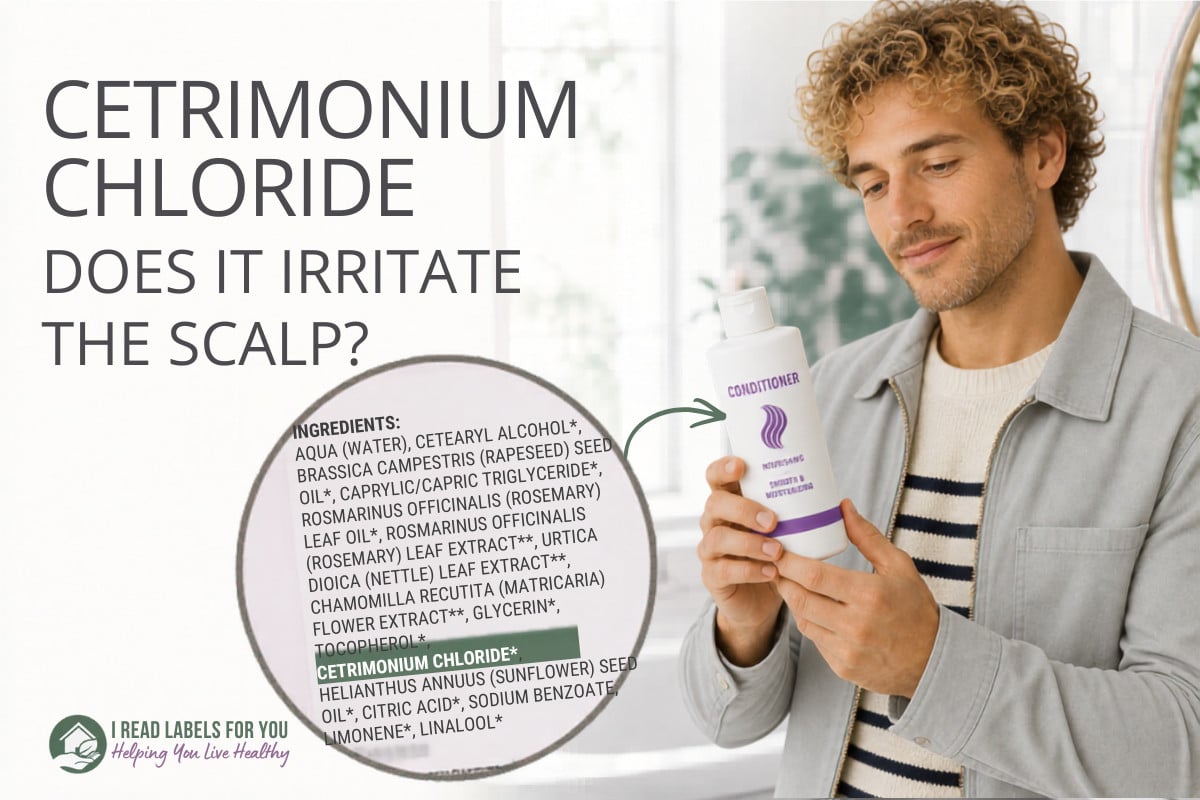
Yes, Cetrimonium Chloride is safe in rinse-off hair products where it functions as a gentle conditioner that does not absorb into your body. Because it can irritate at higher levels and has a faint antimicrobial side, I keep it to wash-off products and rate it Better (Limited Use).
The European Union allows Cetrimonium Chloride at up to 2.5% in rinse-off hair products, up to 1.0% in leave-on hair products, and up to 0.5% in leave-on face creams. In short, the amount is tied to how long a product stays on skin. The longer the skin contact, the smaller the amount because the ingredient can irritate at higher amounts. When used as a preservative, Cetrimonium Chloride is limited to 0.1%.
Read on to see why Cetrimonium Chloride lands on some “avoid” lists, if it’s actually bad for your hair, scalp, or curls, and if it’s okay to use leave-in conditioners and detanglers with this ingredient.
What Is Cetrimonium Chloride?
Cetrimonium Chloride is a hair-conditioning agent from the quaternary ammonium family (“quats”). Because it carries a positive electric charge, it grips hair and leaves the surface smooth. Chemists know it as the C16 (cetyl) member of the gentle trimethyl quats, alongside Behentrimonium Chloride.
Of that group, Cetrimonium Chloride turns up in more products than any other. Its talent for calming frizz and static is what makes formulators favor it.
What Does Cetrimonium Chloride Do In Cosmetics?
Cetrimonium Chloride earns its spot by softening and detangling hair. Worn strands hold a faint negative charge, and Cetrimonium Chloride’s positive charge locks onto exactly those damaged areas. The payoff is hair that feels smoother, combs more easily, and carries less static.
Cetrimonium Chloride can also lend a little cleansing power and slow microbial growth. Both stay in the background with softening hair being the headline.
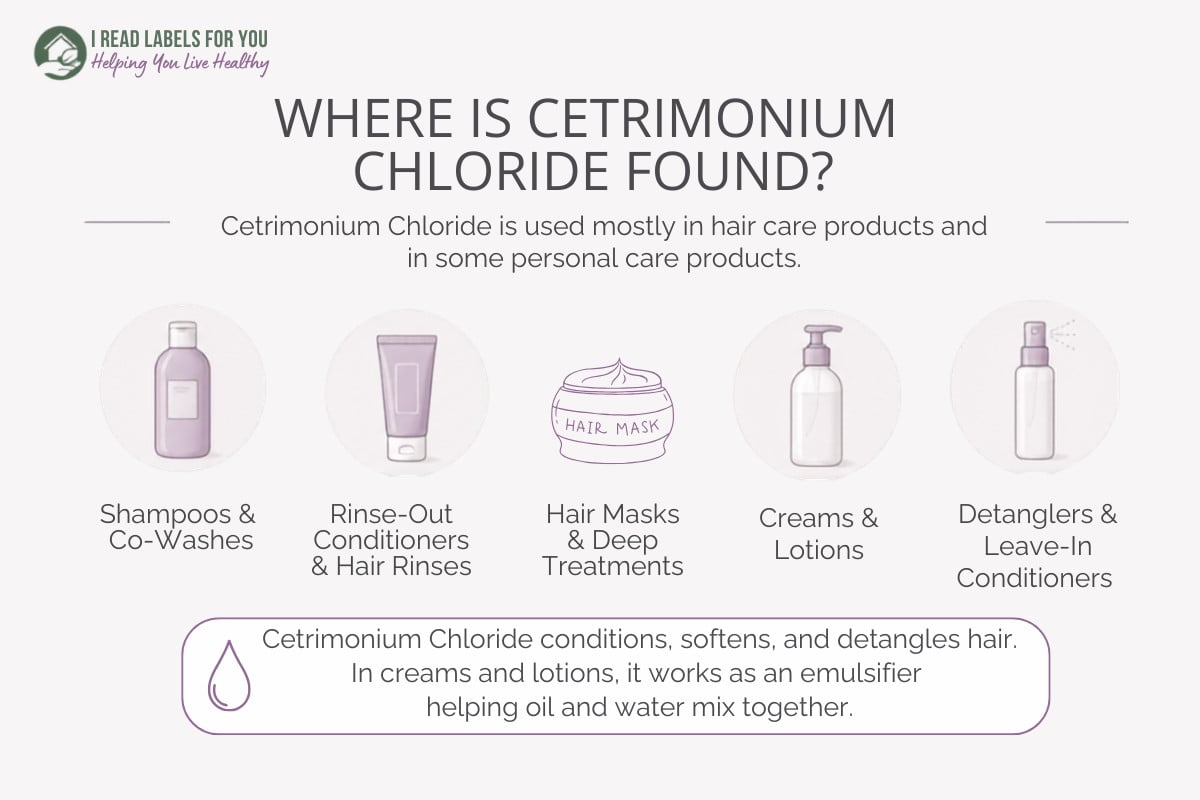
You’ll find Cetrimonium Chloride most often in:
- rinse-out conditioners and hair rinses
- leave-in conditioners and detanglers
- hair masks and deep treatments
- shampoos and co-washes
- some creams and lotions (as an emulsifier)
Cetrimonium Chloride isn’t used in food. It’s a cosmetic and industrial surfactant, not a food ingredient.
How Is Cetrimonium Chloride Made?
To make Cetrimonium Chloride, manufacturers begin with cetyl alcohol, a fatty alcohol usually drawn from plant or palm oil. They turn it into a fatty amine, then attach a charged group with methyl chloride, the manufacturing chemical. What comes out is a stable, positively charged salt that conditions hair.
That detail works in its favor. Methyl chloride sits in IARC Group 3, “not classifiable” as a carcinogen, far less worrying than the benzyl chloride or dimethyl sulfate behind some other quats.
Does Cetrimonium Chloride Penetrate The Skin?
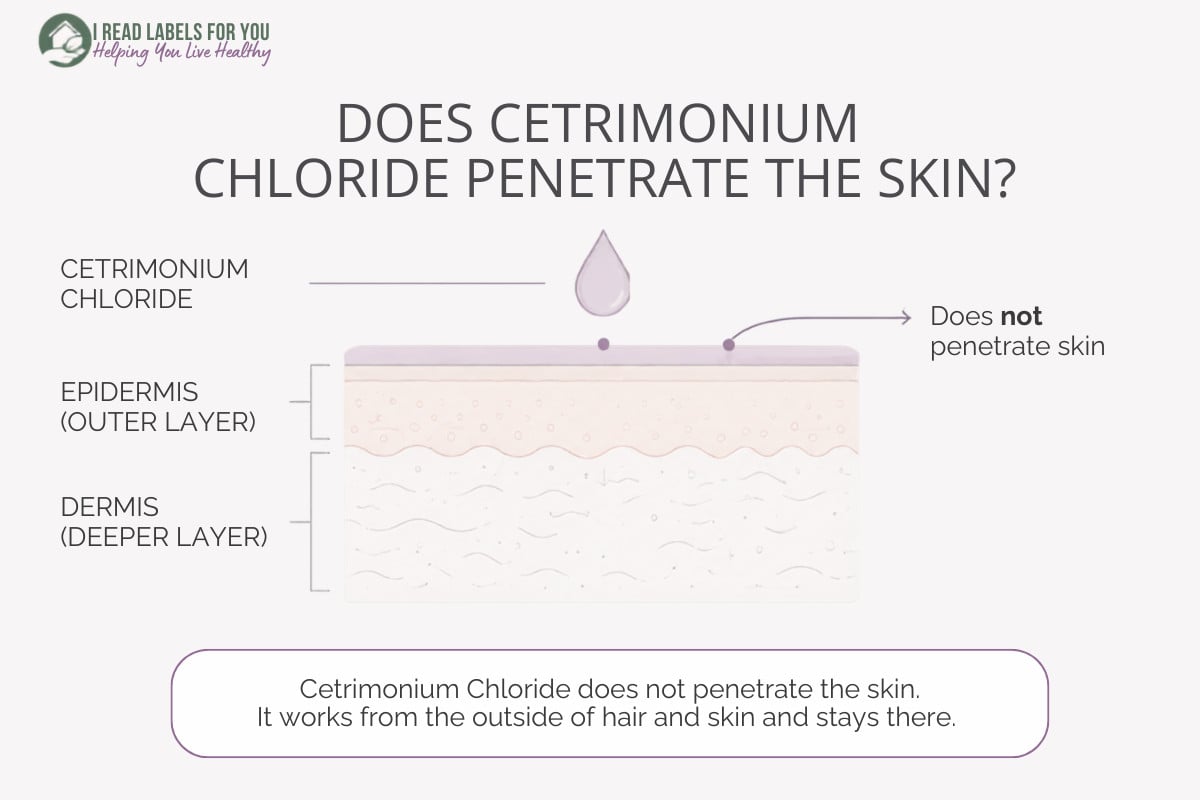
No, Cetrimonium Chloride barely gets past the surface. The reason is its built-in positive charge. Skin’s outer layer is oily, and oil pushes back charged, water-loving molecules.
Its weight isn’t the deciding factor. At about 320 daltons, Cetrimonium Chloride sits below the ~500 mark where size starts to stop molecules. The charge does the blocking instead, which is also why it has no standard LogP, the oily-versus-watery rating.
The upshot: Cetrimonium Chloride works from the outside of hair and skin and stays there. Practically none of it makes its way into your bloodstream.
What Is Cetrimonium Chloride Called On Labels?
You may see it under several names:
- Cetrimonium Chloride
- Cetyltrimethylammonium Chloride (CTAC)
- Hexadecyltrimethylammonium Chloride
- Palmityltrimethylammonium Chloride
- Trimethylcetylammonium Chloride
Does The U.S. FDA Restrict Cetrimonium Chloride In Food And Cosmetics?
Cetrimonium Chloride is not a food ingredient. The U.S. Food and Drug Administration (FDA) allows it in cosmetics and sets no specific limit on it.
I don’t put much weight on that approval. U.S. cosmetics get little pre-market review, and the Generally Recognized as Safe (GRAS) program lets the industry largely vouch for itself. With an ingredient that irritates at higher doses, I’d want clearer limits.
Europe is more cautious by design. Its precautionary principle means regulators can limit an ingredient on reasonable doubt alone, and for Cetrimonium Chloride, they set clear caps.
EU Regulations About Cetrimonium Chloride
The European Union (EU) allows Cetrimonium Chloride but caps it by product type. Rinse-off hair products can use up to 2.5%, leave-on hair up to 1.0%, and leave-on face creams up to 0.5%. As a preservative, the limit is 0.1%.
Why is the preservative cap so much lower? The split comes down to stated purpose, not chemistry. Cetrimonium Chloride is a quat, so it fights microbes at any level, including the 2.5% used for conditioning. If a brand relies on it to preserve a product, EU rules cap it at 0.1%. If it is there to condition hair, higher levels are allowed, as long as preserving the product isn’t its declared job.
The EU’s tiered caps tell a story: the longer a product stays on skin, the less it allows. The reason is that Cetrimonium Chloride can irritate at higher amounts. You can see the entry in its CosIng listing.
U.S. And EU Disagreements On Cetrimonium Chloride
The U.S. and the EU differ on limits. The EU sets specific caps for rinse-off and leave-on use. Meanwhile, the U.S. sets no cosmetic limit and trusts brands to formulate it sensibly.
Canadian Regulations About Cetrimonium Chloride
Health Canada places no special limits on Cetrimonium Chloride. The ingredient is absent from the Health Canada Cosmetic Ingredient Hotlist of banned and restricted substances.
Can Cetrimonium Chloride Cause Skin Allergy And Sensitization?
Allergic reactions to Cetrimonium Chloride are uncommon. Across repeated human patch tests, Cetrimonium Chloride caused no sensitization at concentrations up to 0.25%. It does not appear on the American Contact Dermatitis Society (ACDS) core allergen list either.
The pure ingredient is a different story: concentrated, Cetrimonium Chloride can sting the eyes and redden skin. Products use it at far lower amounts, where that effect fades. Anyone with a reactive scalp may still do better with wash-out forms.
Is Cetrimonium Chloride A Hormone (Endocrine) Disruptor?
Hormones aren’t a worry here. Cetrimonium Chloride does not appear on the European Chemicals Agency (ECHA) endocrine list, and no study has tied it to hormonal effects.
As a big, charged molecule that never enters the body, it has no way to reach hormone receptors. This is one concern you can let go.
Is Cetrimonium Chloride Safe To Use While Pregnant?
Pregnancy is unlikely to be a problem with Cetrimonium Chloride. Since it doesn’t pass through skin, normal conditioner use would reach a developing baby in trace amounts at most.
Animal tests back this up for the skin route: dermal exposure to Cetrimonium Chloride showed no birth defects. Harmful effects appeared only with high-dose injections, far from how you’d ever use a conditioner.
When in doubt during pregnancy, your medical provider is the best person to ask.
Are There Any Cancer Concerns Linked To Cetrimonium Chloride?
There’s no cancer link to Cetrimonium Chloride. It holds no carcinogen classification and shows up on none of the major lists: the International Agency for Research on Cancer (IARC), the U.S. National Toxicology Program (NTP), and California Proposition 65.
Bacterial DNA-damage testing, the Ames test, came back clean as well. And because it’s built with methyl chloride rather than a probable carcinogen, the manufacturing side stays low-concern.
Is Cetrimonium Chloride Bad For The Environment?
The environment is where Cetrimonium Chloride loses points. Positively charged surfactants like it are rough on water life and slow to degrade. Its hazard labels warn that it is very toxic to fish and aquatic organisms.
Any single bottle adds little. The real issue is the cumulative load, as rinse-off conditioners send it down the drain in large volumes, which is true about the whole quat family.
Common Claims About Cetrimonium Chloride: What’s True And What’s Not
Claim: It’s A Harmful Chemical To Avoid
That’s a stretch. Cetrimonium Chloride lands on a few “avoid” lists, yet the safety reviews behind it found no sensitization at the concentrations cosmetics actually use. The alarming figures trace to lab tests on the pure material, not a bottle of conditioner.
Claim: It Irritates Your Scalp
It can, but chiefly when concentrated. That is precisely why leave-on formulas hold it to low levels. Rinsed out of a conditioner, it sits comfortably on most scalps.
Claim: It Builds Up And Is Bad For Curls
Curl communities sometimes lump it with silicones, but it behaves differently. Cetrimonium Chloride dissolves in water and washes out, which keeps it from coating or weighing hair down. Plenty of Curly-Girl-friendly conditioners include it for exactly that reason.
What I Think About Cetrimonium Chloride — And What You Should Do
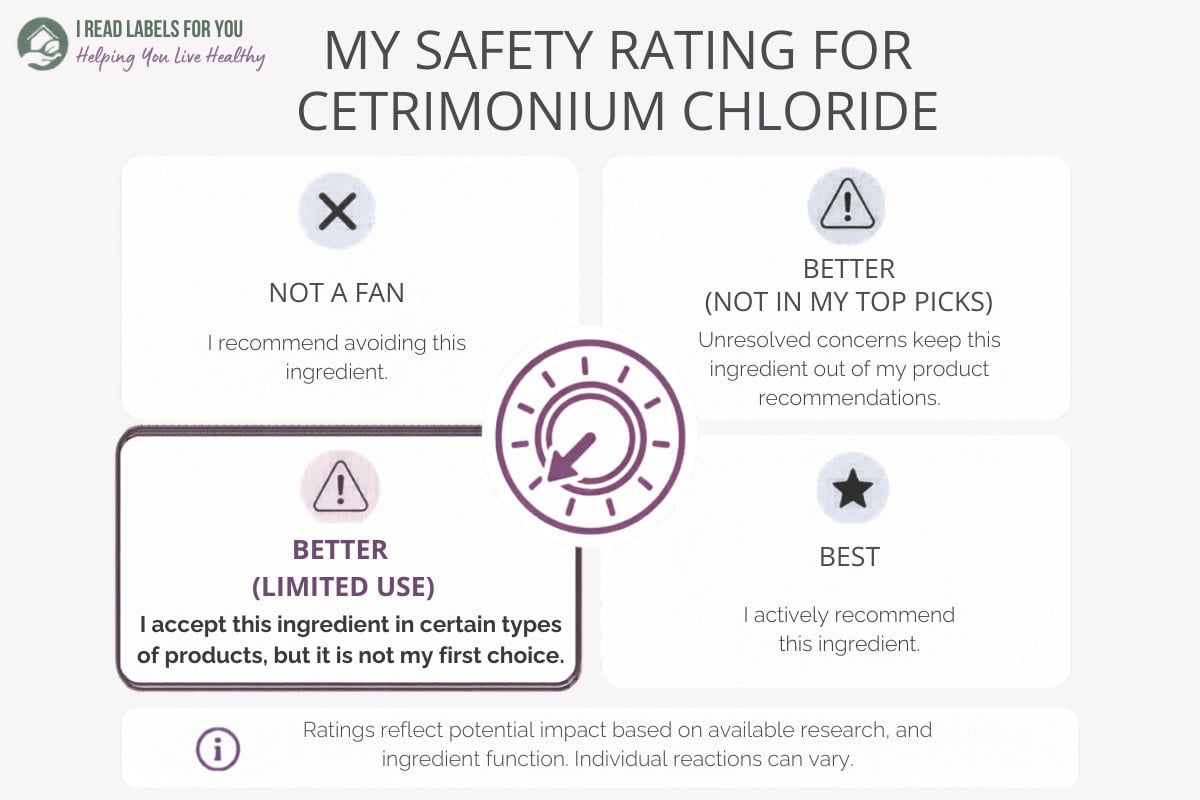
My verdict on Cetrimonium Chloride is Better (Limited Use). In a rinse-off conditioner it’s a gentle, low-risk ingredient that conditions well. It stays on the surface, rarely triggers allergy, and raises no cancer or hormone red flags.
A few things keep Cetrimonium Chloride out of my top tier. Its shorter C16 chain makes it more irritating than Behentrimonium Chloride, which is why regulators cap its leave-on use tightly. It is also mildly antimicrobial, enough that the EU lists it as a preservative, and I would rather not leave that germ-slowing action on skin in a leave-on product or in all baby products. I’m also no fan of the environmental hit: as a cationic surfactant, it’s toxic to aquatic life.
Practically speaking, Cetrimonium Chloride does its best work in rinse-off conditioners, where it conditions well and washes cleanly away. For adults, that puts it in my Best products when it rinses off, but only in my Better tier for leave-on use, where I keep it out of my Best picks. For a leave-on conditioner, a quat-free formula is the better choice. Babies’ skin is thinner and more absorbent, so even rinse-off baby products stay out of my Best products and sit only in my Better tier.
Frequently Asked Questions About Cetrimonium Chloride
Is Cetrimonium Chloride Bad For Your Hair?
No. Generally, it’s good for hair. Cetrimonium Chloride flattens the cuticle, fights static, and loosens tangles. It’s a favorite in products for curly, dry, and color-treated hair.
What Are The Side Effects Of Cetrimonium Chloride?
Side effects are uncommon for most users. In concentrated form Cetrimonium Chloride can sting the eyes and irritate skin, yet finished products dilute it well below that point. A sensitive scalp might feel slight irritation from leave-on versions.
Is Cetrimonium Chloride In Leave-In Conditioner?
Yes, it’s common in leave-in conditioners and detanglers. In leave-on products the EU caps it at 1% for hair. At those low levels it is generally well tolerated. Still, I recommend a rinse-off version, since I don’t suggest leave-on use.
Is Cetrimonium Chloride Naturally Derived?
Partly. Its fatty backbone comes from cetyl alcohol, usually sourced from plants or palm. That starting material is then processed in a lab, making the final ingredient plant-based in origin but synthetic by the end.
Is Cetrimonium Chloride Safe For Skin?
Yes, Cetrimonium Chloride is safe for most skin. It works on the surface only, and patch testing showed no allergy at the amounts products use. Strong concentrations can irritate, but you won’t meet those in a finished formula.
The skin microbiome is a newer question. Cetrimonium Chloride is a mildly antimicrobial quat, and strong antiseptics are known to shift skin bacteria. No study shows that conditioning levels disturb the microbiome, though, and most of it washes off in rinse-off products. It is one more reason I don’t recommend it in leave-on products.
Why Does EWG Rate It Differently?
The Environmental Working Group (EWG) gives Cetrimonium Chloride a 6. Break that score apart and only the ‘use restrictions’ category is rated high while allergies and immunotoxicity land at moderate, and both cancer and developmental toxicity are low.
That high use-restrictions flag is the main driver of the unfavorable rating, yet it is misleading. EWG triggers it simply because the ingredient carries concentration limits: the EU caps it by product type, and the CIR cleared it “with qualifications.” A limit like that is not a danger sign; it means regulators studied Cetrimonium Chloride and assigned safe levels, which is exactly how careful oversight should work.
Its moderate allergy mark rests on read-across, not on Cetrimonium Chloride’s own skin data. EWG cites the CIR, an occupational-asthma “asthmagen” list, and its 2020 comparison of quaternary ammonium compounds by structure while the ingredient’s own human patch testing found no sensitization.
Sources
EU SCCS / SCCP Opinions:
SCCS/1246/09, Opinion on Alkyl (C16, C18, C22) Trimethylammonium Chloride, for other uses than as a preservative (adopted 8 December 2009; COLIPA P72); covers Cetrimonium Chloride (C16). Predecessor: SCCP/0917/05 (2005): ec.europa.eu SCCS/1246/09 (PDF)
Cosmetic Ingredient Review (CIR) Reports:
Cosmetic Ingredient Review (CIR). Elder RL (ed.). (1997). Final Report on the Safety Assessment of Cetrimonium Chloride, Cetrimonium Bromide, and Steartrimonium Chloride. International Journal of Toxicology 16(3): 195-220: cir-reports.cir-safety.org
Cosmetic Ingredient Review (CIR). Becker LC, Bergfeld WF, Belsito DV, et al. (2012). Safety Assessment of Trimoniums as Used in Cosmetics (includes Cetrimonium Chloride). International Journal of Toxicology 31(Suppl. 3): 296S-341S: cir-reports.cir-safety.org
European Union Regulatory Databases:
EU CosIng entry for Cetrimonium Chloride (entry 32590; EC 203-928-6; Annex V/44 preservative 0.1%; Annex III/286 for non-preservative use): ec.europa.eu CosIng
CLP Annex VI Harmonised Classifications / ECHA C&L (concentrated material: H314 skin/eye corrosion, H318; aquatic H400/H410): echa.europa.eu Annex VI to CLP
Other Regulators:
U.S. FDA, Cosmetic conditioning/surfactant ingredient with no special restriction; not an approved food substance: fda.gov/cosmetics
Health Canada Cosmetic Ingredient Hotlist (Cetrimonium Chloride not listed): canada.ca Hotlist
Environment and Climate Change Canada, CEPA Schedule 1 List of Toxic Substances (Cetrimonium Chloride not listed): canada.ca CEPA Schedule 1
IARC List of Classifications (Cetrimonium Chloride not classified): monographs.iarc.who.int
NTP 15th Report on Carcinogens (Cetrimonium Chloride not listed): ntp.niehs.nih.gov
California Proposition 65 List (Cetrimonium Chloride not listed): oehha.ca.gov Prop 65 list
PubChem Records (Chemistry, Identifiers, Skin Penetration, Hazard Codes):
Cetrimonium Chloride, PubChem CID 8154 (CAS 112-02-7; C19H42ClN; MW 320.0): pubchem.ncbi.nlm.nih.gov/compound/8154
Natural Cosmetic Standards:
COSMOS-standard databases (Cetrimonium Chloride not found; a synthetic quat not permitted by the COSMOS-standard): cosmos-standard.org
NATRUE certified/approved raw materials (Cetrimonium Chloride not found): natrue.org
Skin Allergy Resource:
American Contact Dermatitis Society (ACDS), Helpful References (including Core Allergen Series 2020; Cetrimonium Chloride not listed): contactderm.org
Advocacy groups:
Environmental Working Group (EWG) Skin Deep, Cetrimonium Chloride (hazard score 6; Allergies & Immunotoxicity moderate, Use Restrictions high): ewg.org/skindeep
Last verified: 06-13-2026
Download The Free Guide!
5 Powerful Steps To A Non-Toxic Home
Join our informed consumer community and get our free guide the “5 Powerful Steps To A Non-Toxic Home”.
Before commenting, please read our Comment Policy.