
Is Sodium Benzoate Safe? A Simple Answer You Can Trust
 Written by Irina Webb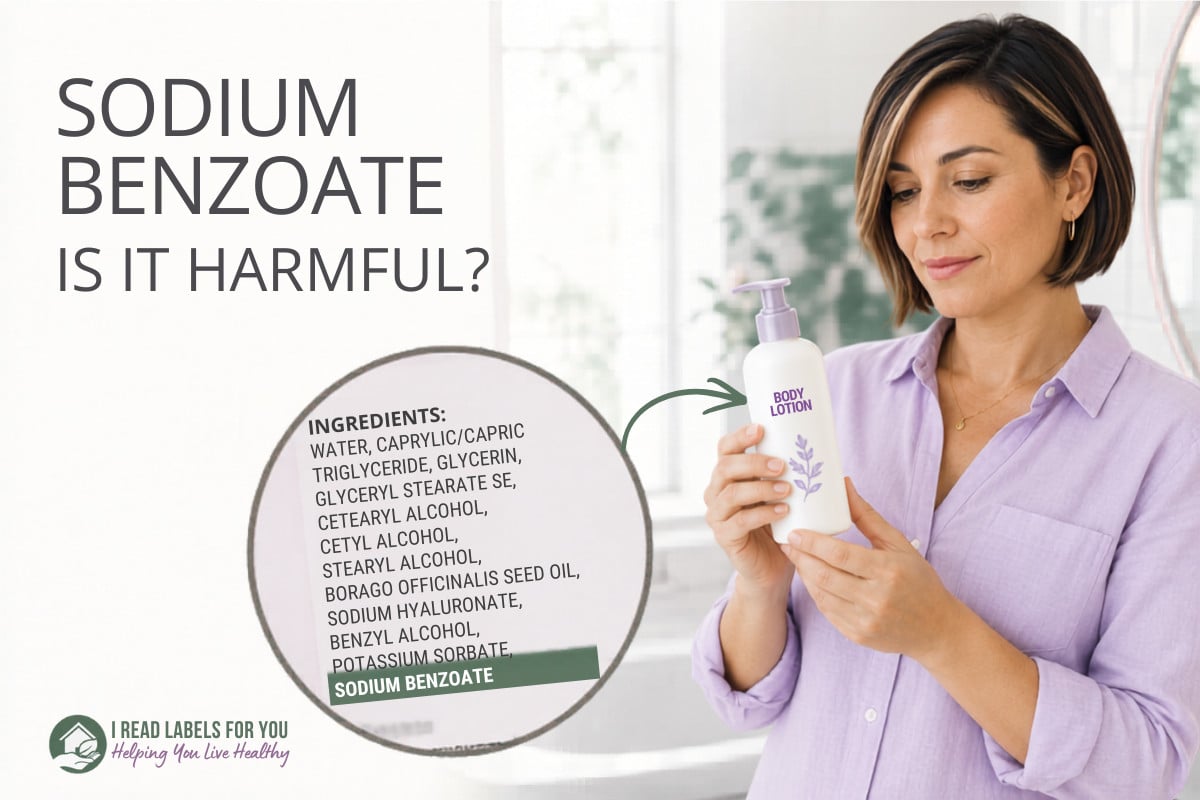
Yes, Sodium Benzoate is safe in skincare. Sodium Benzoate is a preservative that keeps bacteria, yeast, and mold out of water-based products. It barely enters the skin, and any trace that slips in leaves the body in urine within hours. I rate it Best.
The safety data on Sodium Benzoate run deep and span decades. Even Europe, which reviews preservatives under the cautious “prove it safe first” principle, allows it at up to 2.5% in rinse-off and 0.5% in leave-on products. One caveat: in drinks with vitamin C, benzoate can form a trace of benzene under heat and light. That is a beverage issue, not a property of the preservative itself.
Below, I’ll show you where the benzene-in-soda story really comes from, and why even strict natural standards accept Sodium Benzoate.
What Is Sodium Benzoate?
Sodium Benzoate is the sodium salt of benzoic acid, a compound that occurs naturally in many foods. Cranberries, prunes, cinnamon, and cloves all contain benzoic acid on their own.
In products, Sodium Benzoate works as a preservative that stops bacteria, yeast, and mold from spoiling a formula. It’s also one of the most thoroughly studied preservatives, which gives us a deep body of safety data to judge it by.
What Does Sodium Benzoate Do In Cosmetics?
First, Sodium Benzoate keeps water-based products fresh and safe to use. It’s most active in slightly acidic formulas, which is why you often see it paired with a pH adjuster such as Citric Acid.
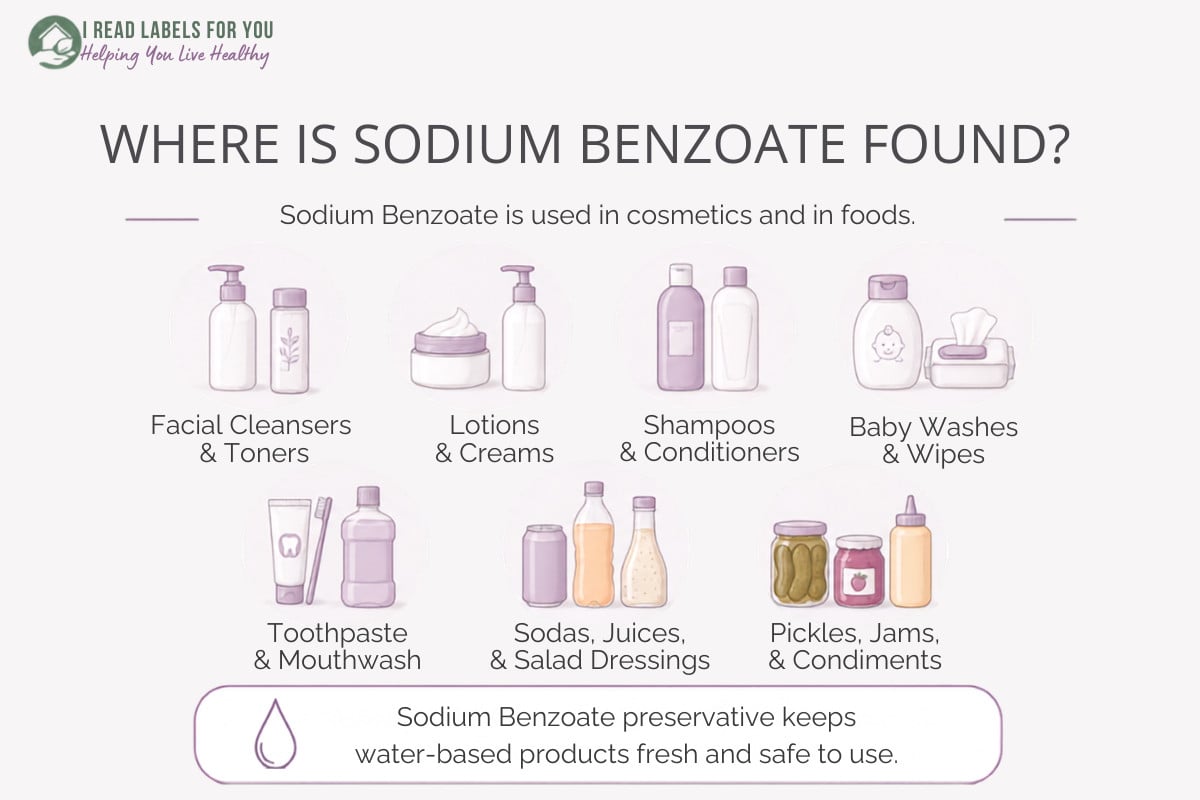
Beyond preserving, it helps guard against the germs that thrive in creams, gels, and liquids. Consequently, brands rely on it to give products a safe shelf life without harsh chemicals. You’ll find Sodium Benzoate most often in:
- facial cleansers and toners
- lotions and creams
- shampoos and conditioners
- baby washes and wipes
- toothpaste and mouthwash
- sodas, juices, and salad dressings
- pickles, jams, and condiments
As a food additive it carries the label E211, and it’s one of the most common preservatives in the grocery aisle.
How Is Sodium Benzoate Made?
Sodium Benzoate is made by combining benzoic acid with a simple base, either sodium hydroxide or sodium bicarbonate. The result is a mild, water-soluble salt.
This matters for a clean-beauty shopper. Unlike some preservatives, its manufacturing doesn’t rely on a carcinogen like ethylene oxide or benzyl chloride. In other words, there’s no carcinogenic ingredient lurking in the recipe.
Does Sodium Benzoate Penetrate The Skin?
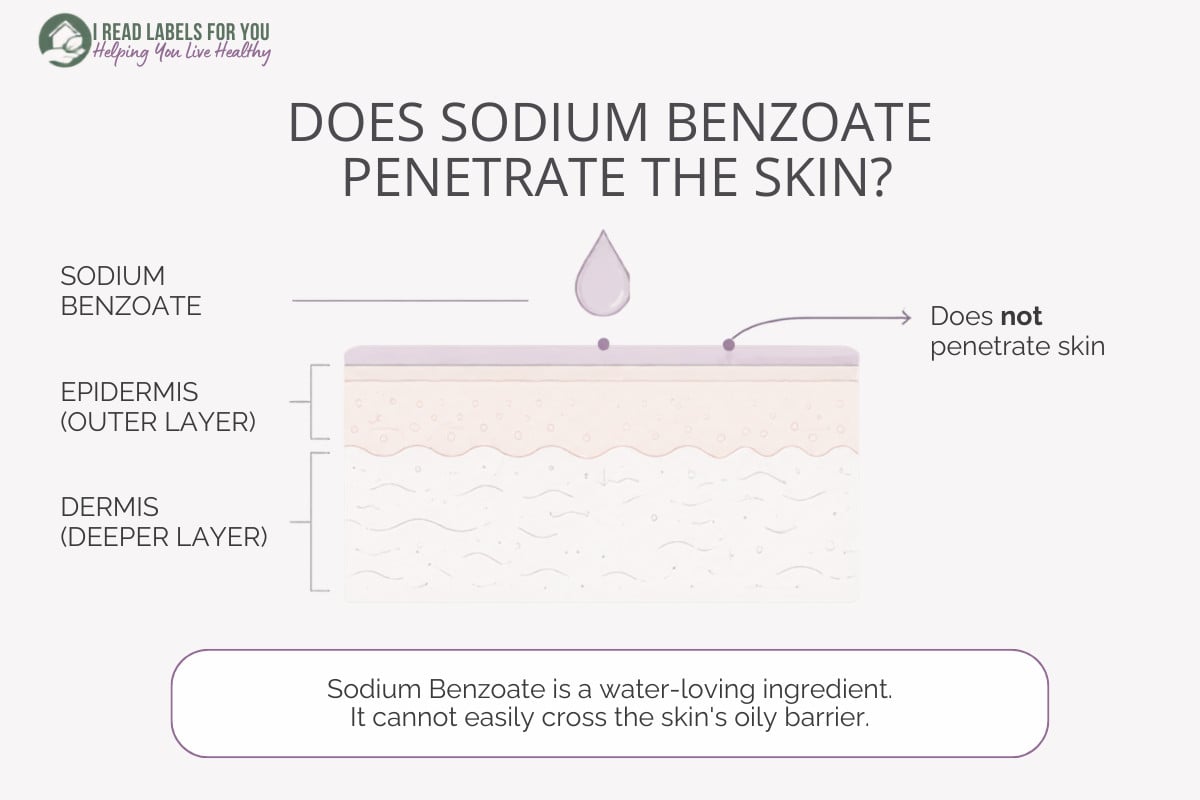
No, Sodium Benzoate barely enters the skin, and its charge explains why. Two things decide whether an ingredient gets through.
One is size, measured in daltons. Sodium Benzoate is small at 144 daltons, which means size isn’t what holds it back.
The other is electrical charge. Because Sodium Benzoate carries a charge and loves water, it can’t easily cross the skin’s oily barrier. Any trace that slips in becomes hippuric acid and leaves the body in urine, so it never builds up.
What Is Sodium Benzoate Called On Labels?
On a label it almost always reads as Sodium Benzoate. Other names and forms you might see include:
- E211
- Benzoic Acid, Sodium Salt
- Benzoate Of Soda
- Sodium Benzocarbonate
In foods, the E211 code is the giveaway, and it often sits next to other preservatives like Potassium Sorbate.
Does The U.S. FDA Restrict Sodium Benzoate In Food And Cosmetics?
No, the U.S. Food and Drug Administration (FDA) does not restrict Sodium Benzoate in cosmetics, and it treats the ingredient as Generally Recognized As Safe (GRAS) in food. In food, its use is capped at 0.1% by weight.
I usually read GRAS status with a skeptical eye, since the program can lean on older or industry-run reviews. Here, though, the safety data run deep and span decades, which is unusual and reassuring.
Sodium Benzoate is not on the FDA’s list of prohibited and restricted cosmetic ingredients. Even so, I still like to see how Europe handles an ingredient, since the EU applies the precautionary principle and limits substances when real doubt exists.
EU Regulations About Sodium Benzoate
The European Union permits Sodium Benzoate as a preservative and sets clear limits on it. As a preservative it may be used up to 2.5% in rinse-off products, 1.7% in oral-care products, and 0.5% in leave-on products, measured as benzoic acid.
Why three different caps? Each one tracks how much of the ingredient your body actually meets. A rinse-off product washes away in seconds, which earns it the highest limit. An oral-care product can be swallowed, so it sits lower to keep the amount you take in small. A leave-on product lingers on skin for hours and has the most time to absorb, hence its strictest cap. Europe’s reviewers judged these levels, which match the maximum the industry requested, to be safe with room to spare.
What does a cap actually protect against? At higher concentrations, Sodium Benzoate can irritate the skin and eyes. It can also set off a harmless but real flushing-and-stinging reaction called contact urticaria. That effect grows with the dose, so leave-on products, which sit on skin longest, get the strictest 0.5% cap. Keeping the swallowed or absorbed amount low also holds your total intake within the level regulators consider safe.
Those caps come from Annex V of the EU Cosmetics Regulation, which lists approved preservatives. In food, the EU allows it too, under the additive code E211. Far from banning it, Europe treats Sodium Benzoate as a well-understood, permitted ingredient.
Canadian Regulations About Sodium Benzoate
Canada allows Sodium Benzoate in cosmetics and doesn’t flag it on the Health Canada Cosmetic Ingredient Hotlist, its list of banned or capped cosmetic ingredients.
It also doesn’t appear on Canada’s roster of toxic substances, Schedule 1 of the Canadian Environmental Protection Act. Canada, like the EU, raises no alarm.
Can Sodium Benzoate Cause Skin Allergy And Sensitization?
No, Sodium Benzoate rarely causes true skin allergy, and it is regarded as a weak sensitizer. In safety reviews it was only slightly irritating, and most positive skin reactions were traced to a harmless flushing effect rather than a true immune allergy.
It does sit on the American Contact Dermatitis Society core testing panel, which means doctors keep an eye on it. Even so, true allergy is uncommon: in a 2025 patch-test study of more than 3,000 people, fewer than 2% reacted allergically to Sodium Benzoate. That test also used a strong 5% dose, well above the amount in most real products. Non-allergic irritation reactions were over three times as common as real allergy. If you have very reactive skin, a patch test is still a smart habit with any new product.
Is Sodium Benzoate A Hormone (Endocrine) Disruptor?
No, Sodium Benzoate is not a hormone disruptor. European chemical authorities have not identified it as one, and no hormone-related review has raised a concern.
Your body processes benzoate quickly and clears it, which leaves no lasting hormonal effect. Consequently, this isn’t an ingredient I worry about on the endocrine front.
Is Sodium Benzoate Safe To Use While Pregnant?
Yes, Sodium Benzoate is widely regarded as low risk during pregnancy, whether in food or skincare. It barely penetrates the skin, converts to hippuric acid, and leaves the body fast.
Pregnancy is personal, though, and I’m not a medical professional. When an ingredient worries you, it’s always worth a quick chat with your medical provider before using it.
Are There Any Cancer Concerns Linked To Sodium Benzoate?
No, Sodium Benzoate is not a carcinogen. In lifetime feeding and drinking-water studies, rats and mice given large oral doses showed no cancer tied to the ingredient. It is not listed by IARC, the National Toxicology Program, or California’s Proposition 65.
The only cancer talk around Sodium Benzoate involves benzene, and that comes from a specific reaction I explain just below. It’s a beverage issue, not a property of the preservative itself.
Is Sodium Benzoate Bad For The Environment?
Sodium Benzoate is not considered an environmental hazard. It breaks down easily in water and does not accumulate in fish or wildlife.
Its ecological rating sits on the low end, and it doesn’t linger in soil or rivers. In normal use, it poses only a minor risk to water life.
Common Claims About Sodium Benzoate: What’s True And What’s Not
Claim: Sodium Benzoate And Citric Acid Form Cancer-Causing Benzene
This mixes up two ingredients. It’s vitamin C (ascorbic acid), not citric acid, that can react with benzoate to form a trace of benzene, and only with heat, light, and metal. Citric acid on its own doesn’t do this.
Claim: Sodium Benzoate Is An Unnatural, Harmful Chemical
This claim misses the mark. Benzoic acid, the parent of Sodium Benzoate, occurs naturally in cranberries, prunes, cinnamon, and many other foods. The version in products is made to match it.
Your body treats benzoate as something it already knows how to handle. It joins the benzoate to another molecule and sends it out in urine within hours, so nothing accumulates.
Claim: Sodium Benzoate Damages Your DNA
This claim points to real studies, and the details matter. In standard bacterial safety tests, Sodium Benzoate is not mutagenic. But a cell-culture study and a study in rats given high oral doses did report DNA and chromosome changes.
Two things put this in perspective. Those effects came from large oral or cell-culture doses, well above real exposure, and each result comes from a single lab rather than the standard safety battery. After weighing the whole body of evidence, European food-safety reviewers found no genotoxicity concern at real-world levels.
One more point matters for skincare. These are studies about swallowing Sodium Benzoate, not wearing it. On skin it barely absorbs, so a rinse-off or leave-on product is a very different situation from a large dose by mouth.
What I Think About Sodium Benzoate — And What You Should Do
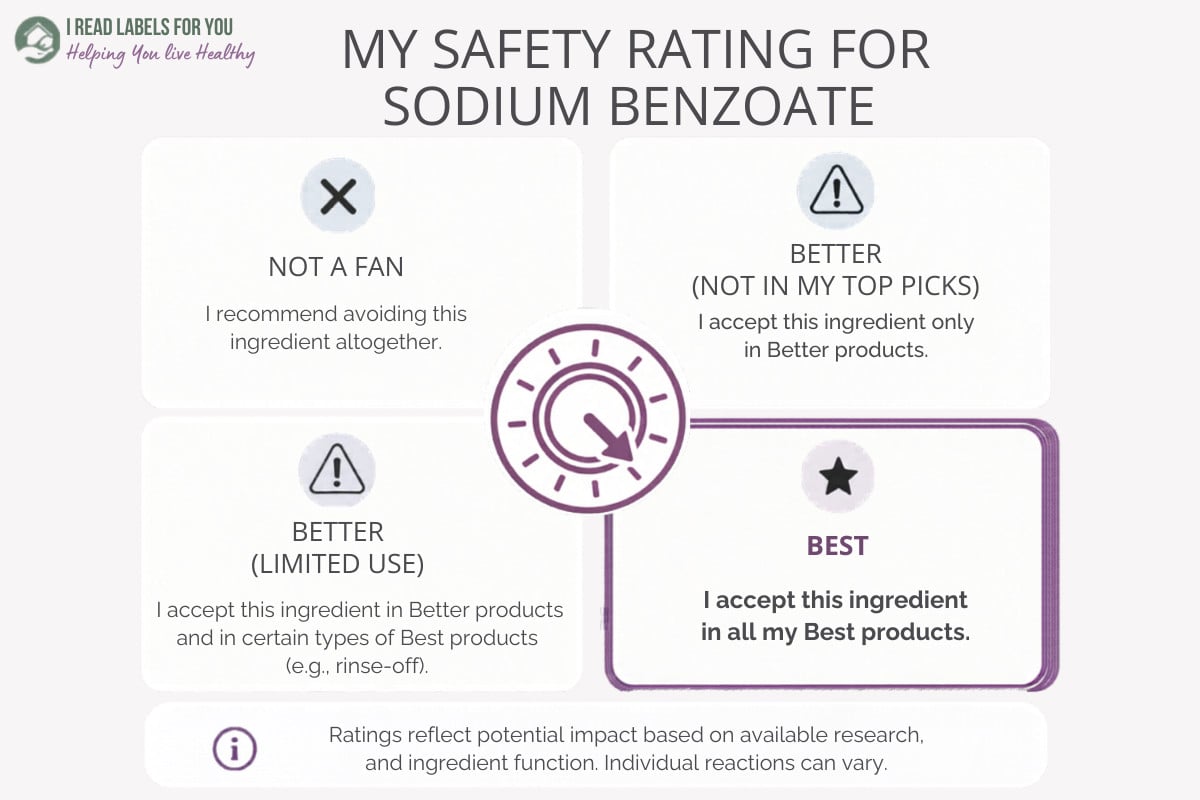
Sodium Benzoate earns a spot in my Best category, and I don’t say that lightly about a synthetic-sounding preservative. Its safety data are deep, its toxicity is low across cancer, hormones, and reproduction, and it barely touches the skin.
Two things seal it for me. Its recipe uses no carcinogenic ingredient, and it’s one of the rare preservatives that COSMOS-certified and NATRUE-approved products can carry. When the strict natural standards trust a preservative, that tells you a lot.
Here is what I actually do. I’m comfortable choosing Sodium Benzoate in leave-on and rinse-off products alike, for adults and for babies. The one setting where I stay alert is a product that pairs it with a high dose of pure vitamin C, and even then the risk is small.
Frequently Asked Questions About Sodium Benzoate
Is Sodium Benzoate Harmful To Health?
Sodium Benzoate is not harmful to health at the levels used in food and cosmetics. Your body breaks it down and clears it quickly, and it shows no cancer, hormone, or reproductive toxicity. Only large experimental doses, far above real-life exposure, cause any effect.
Is Sodium Benzoate Banned In Europe?
No, Sodium Benzoate is not banned in Europe. The European Union permits it as a cosmetic preservative up to set limits and allows it in food as additive E211. It’s regulated, not prohibited.
Is Sodium Benzoate Bad For The Liver?
Sodium Benzoate is not bad for the liver at normal exposures. In fact, the liver is where benzoate is processed into hippuric acid and cleared, a route the body uses routinely. Harm only appears in animal studies at very high doses.
Is Sodium Benzoate A Natural Ingredient?
Sodium Benzoate is nature-identical rather than strictly natural. Its parent, benzoic acid, occurs naturally in fruits and spices, but the ingredient in products is usually made in a lab to match. Strict natural standards like COSMOS and NATRUE still accept it.
Does Coca-Cola Have Sodium Benzoate In It?
Some Coca-Cola drinks contain Sodium Benzoate, though the classic cola formula mainly relies on other preservatives. It appears more often in flavored and diet sodas. This is also the product type where the vitamin C benzene issue once came up.
Where Does The Benzene-In-Soda Story Come From?
The worry traces back to the mid-2000s, when testing found trace benzene in a small number of sodas that paired Sodium Benzoate with vitamin C. Makers reformulated, and regulators have watched beverages since. I walk through the whole story in my Sodium Benzoate and Citric Acid Myth post.
Does Ketchup Have Sodium Benzoate?
Most major ketchup brands don’t need Sodium Benzoate, because vinegar and its acidity preserve the sauce naturally. Some other condiments and dressings do use it. Checking the label is the surest way to know.
Sources
EU SCCS / SCCP Opinions:
SCCP Opinion on Benzoic Acid and Sodium Benzoate (SCCP/0891/05) — the basis for the Annex V/1 preservative limits (2.5% rinse-off, 1.7% oral care, 0.5% leave-on, as benzoic acid). SCCP/0891/05 (PDF)
Cosmetic Ingredient Review (CIR) Reports:
Johnson W Jr, et al. Safety Assessment of Benzyl Alcohol, Benzoic Acid and Its Salts, and Benzyl Benzoate. International Journal of Toxicology. 2017;36(Suppl 3):5S–30S. Also the 2001 Final Report on Benzoic Acid and Sodium Benzoate. cir-reports.cir-safety.org
European Union Regulatory Databases:
CosIng entry for Sodium Benzoate (Annex V/1 preservative; also anticorrosive/fragrance functions). CosIng record
EU Cosmetics Regulation Annexes — Annex V/1 preservative limits (2.5% rinse-off, 1.7% oral, 0.5% leave-on, as benzoic acid). CosIng Annexes
CLP Annex VI / ECHA C&L — signal word Warning, H319 (eye irritation) by some notifiers; no harmonised carcinogen classification. Annex VI to CLP and ECHA CHEM
Other Regulators:
U.S. FDA — GRAS in food (E211 equivalent), capped at 0.1%; not on the prohibited/restricted cosmetics list. Benzene-in-beverages guidance. FDA benzene Q&A
Health Canada Cosmetic Ingredient Hotlist — not listed. Hotlist
Environment Canada CEPA Schedule 1 — not listed. Schedule 1
IARC — not classified. IARC classifications
NTP Report on Carcinogens — not listed. NTP RoC
California Proposition 65 — not listed. Prop 65 list
EFSA (European Food Safety Authority) 2016 re-evaluation of benzoic acid and benzoates — set an ADI of 5 mg/kg body weight/day and found no concern for genotoxicity or carcinogenicity. EFSA Journal 2016;14(11):4433
PubChem Records (Chemistry, Identifiers, Skin Penetration, Hazard Codes):
Sodium Benzoate, PubChem CID 517055 (CAS 532-32-1; molecular weight 144.10). PubChem CID 517055
Peer-Reviewed Studies:
Zengin N, Yüzbaşıoğlu D, Ünal F, Yılmaz S, Aksoy H. The evaluation of the genotoxicity of two food preservatives: sodium benzoate and potassium benzoate. Food and Chemical Toxicology. 2011;49(4):763–769. PMID 21130826 (in-vitro chromosome effects at high concentrations). PubMed 21130826
Yılmaz S, et al. Effect of sodium benzoate on DNA breakage, micronucleus formation and mitotic index in peripheral blood of pregnant rats and their newborns. Biotechnology & Biotechnological Equipment. 2016;30(6):1144–1149 (in-vivo DNA changes at high oral doses). tandfonline 10.1080/13102818.2016.1224979
Lawrance NJ, Holden CR, Gawkrodger DJ. Sodium Benzoate as an Emerging but Problematic Allergen: Retrospective Analysis of Patch Test Results in 3198 Cases. Contact Dermatitis. 2025. PMID 40342057 (1.8% allergic positivity; non-allergic reactions >3x more common). PubMed 40342057
Natural Cosmetic Standards:
COSMOS-standard — Sodium Benzoate is a permitted preservative and appears in approved and certified raw materials. COSMOS approved raw materials
NATRUE — Sodium Benzoate is a permitted preservative in approved raw materials. NATRUE certified world
Skin Allergy Resource:
American Contact Dermatitis Society — Helpful References, including the Core Allergen Series 2020 (Sodium benzoate is panel entry #62). ACDS Helpful References
Last verified: 2026-07-11
Download The Free Guide!
5 Powerful Steps To A Non-Toxic Home
Join our informed consumer community and get our free guide the “5 Powerful Steps To A Non-Toxic Home”.

Before commenting, please read our Comment Policy.