
Is Guar Hydroxypropyltrimonium Chloride Safe? A Simple Answer You Can Trust
 Written by Irina Webb
Yes, Guar Hydroxypropyltrimonium Chloride is safe in rinse-off products. It’s a conditioning agent made from guar beans, the same plant that gives us guar gum. It smooths hair and adds slip to body washes. It does not penetrate skin, and it carries no cancer, hormone, or allergy concerns. What holds it back is CHPTAC, the manufacturing chemical used to make it, which Europe classifies as a suspected carcinogen. I rate it Better (Limited Use).
Guar Hydroxypropyltrimonium Chloride faces no restrictions from any major regulator. The European Union places no cap on its concentration, no product-type limits, and no warning label. Canada leaves it off its Cosmetic Ingredient Hotlist, and the United States sets no limit either. Notably, no regulator has reviewed how much CHPTAC remains in the finished ingredient.
Three questions are worth your time. You’ll see whether it builds up in hair, whether it triggers allergies, and why my rating differs from the EWG’s.
What Is Guar Hydroxypropyltrimonium Chloride?
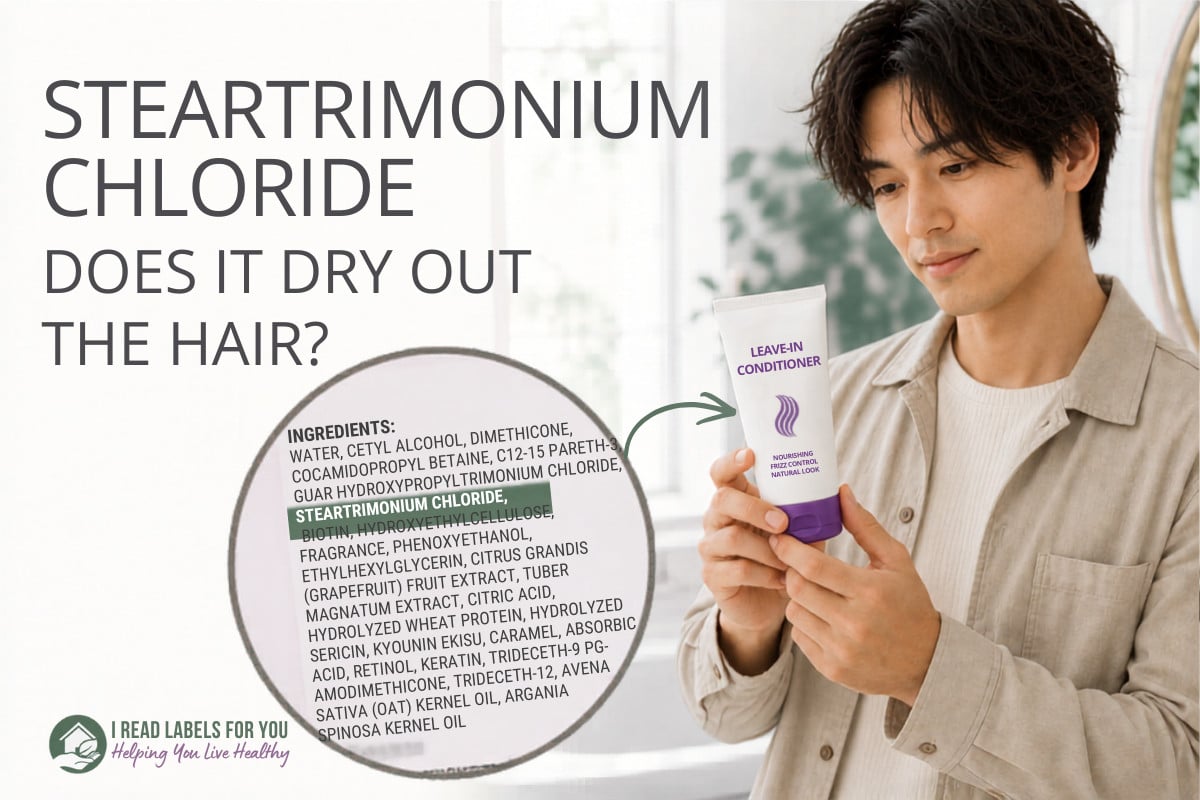
Guar Hydroxypropyltrimonium Chloride is a conditioning ingredient from the quaternary ammonium family used in hair and some skin care products. Its job is to make hair feel smoother and easier to manage, and to give body washes and lotions extra slip.
What Does Guar Hydroxypropyltrimonium Chloride Do In Cosmetics?
Guar Hydroxypropyltrimonium Chloride works by depositing on the surface of hair and skin. It’s a chemically modified form of guar gum, a natural plant material. The modification gives it a permanent positive electrical charge that’s attracted to the negatively charged surface of hair and skin.
Once there, it smooths the hair cuticle, reduces static, and helps hair detangle more easily. In body washes and lotions, it makes the product feel silkier as you spread it.
You’ll find it most often in:
- shampoo
- conditioner
- hair masks and leave-in treatments
- body wash
- some lotions and detangling sprays
How Is Guar Hydroxypropyltrimonium Chloride Made?
It starts as guar gum, a natural gum from the seeds of the guar bean plant (Cyamopsis tetragonoloba). The plant is grown mostly in India and Pakistan.
In a factory, manufacturers react the gum with a chemical called 3-chloro-2-hydroxypropyltrimethylammonium chloride (CHPTAC). This step adds the positively charged groups that make the final ingredient work as a conditioner.
CHPTAC itself carries an EU harmonised hazard label. Under Annex VI of the Classification, Labelling and Packaging (CLP) regulation, the EU classifies it as a Category 2 suspected carcinogen (H351). It’s also classified as Aquatic Chronic 3 (H412), meaning it’s harmful to aquatic life with long-lasting effects.
Cosmetic-grade manufacturers wash and dry the finished material. These steps typically reduce residual CHPTAC to low parts-per-million levels.
However, the U.S. Cosmetic Ingredient Review (CIR) Panel’s 2015 review didn’t independently measure how much CHPTAC residue remains. So, we have an industry expectation, but no third-party verification.
Does Guar Hydroxypropyltrimonium Chloride Penetrate The Skin?
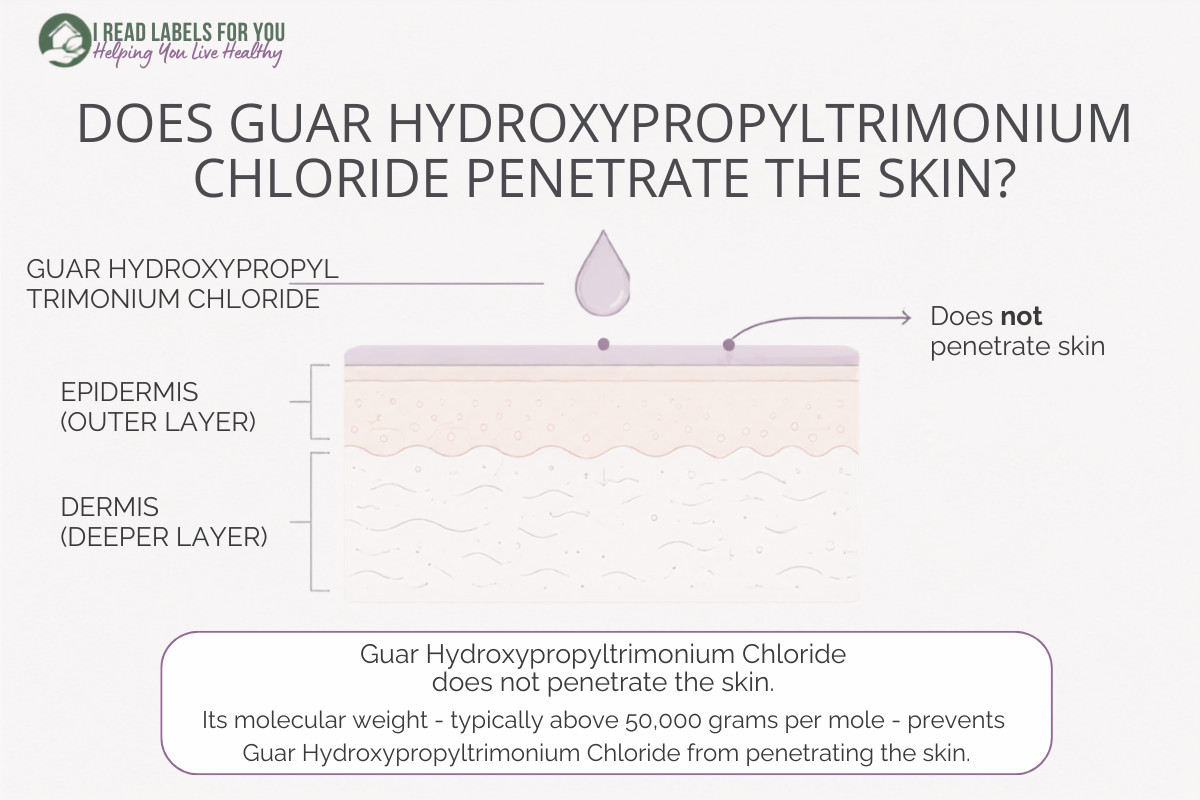
No. The polymer is far too large to cross the skin barrier.
Its molecular weight is typically above 50,000 grams per mole. That’s roughly 100 times larger than the 500-Dalton cutoff that scientists use to estimate skin penetration. The CIR Panel reviewed this and concluded that systemic absorption is unlikely.
CHPTAC, the manufacturing chemical, is much smaller (molecular weight 188). However, it carries a permanent positive electrical charge that makes it too water-loving to cross the skin’s oily barrier efficiently.
What Is Guar Hydroxypropyltrimonium Chloride Called On Labels?
On a label, you’ll most often see Guar Hydroxypropyltrimonium Chloride spelled out in full. You may also see:
- Cationic Guar
- Guar HPTC
- Trade names like Jaguar C 13S, Jaguar C 14S, or Cosmedia Guar C 261
Does The U.S. FDA Restrict Guar Hydroxypropyltrimonium Chloride In Food And Cosmetics?
In cosmetics, no. The U.S. Food and Drug Administration (FDA) allows Guar Hydroxypropyltrimonium Chloride without bans or restrictions. It’s widely used in shampoos, conditioners, and other personal care products.
In food, this specific cationic version isn’t approved as a food additive. The unmodified parent material, plain guar gum, is approved by the FDA under 21 CFR 184.1339 and is used as a thickener in many foods. But the cationic version reviewed here is a cosmetic ingredient only.
Here’s some important context. The FDA doesn’t review cosmetic ingredients before products reach store shelves. It usually can act only after someone reports a safety concern.
Even so, the Cosmetic Ingredient Review (CIR), the U.S. cosmetic industry safety panel, published a thorough review in 2015. That review cleared Guar Hydroxypropyltrimonium Chloride for cosmetic use.
EU Regulations About Guar Hydroxypropyltrimonium Chloride
The European Union doesn’t restrict Guar Hydroxypropyltrimonium Chloride. The EU Cosmetic Ingredient Database (CosIng) lists it as an Inventory ingredient with no Annex listing. In plain terms, that means no concentration limits, no product-type restrictions, and no required warning labels.
In addition, CosIng records its cosmetic functions as antistatic, film forming, skin conditioning, and viscosity controlling.
The European Chemicals Agency (ECHA) shows zero REACH registrations for the polymer itself. It’s not on the Candidate List of Substances of Very High Concern.
On top of that, it’s not on REACH Annex XIV (Authorization) or Annex XVII (Restrictions).
The EU hasn’t issued a Scientific Committee on Consumer Safety (SCCS) opinion on this ingredient. SCCS reviews usually start because of a safety signal. The absence of one here fits the ingredient’s low-concern profile.
Canadian Regulations About Guar Hydroxypropyltrimonium Chloride
Health Canada hasn’t banned or restricted Guar Hydroxypropyltrimonium Chloride in cosmetics. It’s not on the Cosmetic Ingredient Hotlist of prohibited or restricted ingredients.
Likewise, Environment and Climate Change Canada hasn’t listed it either. It’s not on Schedule 1 of the Canadian Environmental Protection Act (CEPA), the country’s list of toxic substances.

Can Guar Hydroxypropyltrimonium Chloride Cause Skin Allergy And Sensitization?
Skin allergy from cosmetic products containing Guar Hydroxypropyltrimonium Chloride is very rare. The CIR Panel’s 2015 review didn’t identify a sensitization signal across the galactomannan family. A repeated insult patch test on a related ingredient (2 percent hydroxypropyl guar in a leave-on hair styling product, in 111 people) was negative, and CIR concluded the family is safe based on read-across.
The American Contact Dermatitis Society (ACDS) doesn’t list Guar Hydroxypropyltrimonium Chloride on its Core Allergen Series 2020. That’s the standard set of allergens used to patch-test for contact allergy. Also, the ACDS hasn’t named it Allergen of the Year.
There’s one important nuance, though. The native guar gum (the unmodified parent material) is associated with occupational allergic reactions in some specific workplaces.
One occupational study at a carpet-manufacturing plant documented IgE sensitization rates between 5 and 8.3 percent. Case reports of guar gum allergy have also been described in pet food workers and others exposed to fine guar gum dust.
However, the CIR Panel concluded these findings don’t apply to cosmetic use of the cationic derivative. Occupational sensitization typically involves inhaling fine powder over long periods. That’s not how anyone meets this ingredient in a shampoo or lotion.
The sensitization is also tied to protein contamination of raw guar gum, not to the cationic polymer itself.
Is Guar Hydroxypropyltrimonium Chloride A Hormone (Endocrine) Disruptor?
No. There’s no evidence that this ingredient interferes with hormones in the body. It’s not listed on any ECHA endocrine disruptor assessment. The CIR Panel didn’t flag endocrine activity as a concern in its 2015 review.
There’s also no plausible mechanism. A large positively charged polymer that doesn’t cross skin can’t reach hormone receptors inside the body.
Is Guar Hydroxypropyltrimonium Chloride Safe To Use While Pregnant?
No regulator has placed pregnancy-specific restrictions on Guar Hydroxypropyltrimonium Chloride. The CIR 2015 review didn’t raise reproductive or developmental concerns.
For rinse-off adult products like shampoo or body wash, it’s acceptable during pregnancy. For leave-on adult products, I prefer alternatives as a precautionary approach.
And for products applied to or near a pregnant woman’s belly or breasts that stay on skin for hours, the unmeasured CHPTAC residue is the relevant question.
Still, for pregnancy-related questions about any cosmetic ingredient, you should consult with your medical provider, who knows your full medical history.
Are There Any Cancer Concerns Linked To Guar Hydroxypropyltrimonium Chloride?
Guar Hydroxypropyltrimonium Chloride itself isn’t classified as a carcinogen by any major regulatory body.
The International Agency for Research on Cancer (IARC) hasn’t classified it. It’s also not on the U.S. National Toxicology Program (NTP) 15th Report on Carcinogens. It’s not on California Proposition 65. And the U.S. Environmental Protection Agency (EPA) Integrated Risk Information System hasn’t assessed it.
Furthermore, the lab data backs this up. Standard DNA-damage tests (the Ames mutagenicity test) on the trade-name material Cosmedia Guar C 261 were negative, as reported to CIR. Long-term feeding studies on related guar polysaccharides in rats and mice didn’t show cancer activity.
The cancer concern, where one exists, traces back to the manufacturing chemical. CHPTAC carries an EU Annex VI harmonised classification of Category 2 suspected carcinogen (H351). This is the binding EU-wide hazard label, documented on the ECHA CHEM portal.
The CIR 2015 review didn’t specifically measure residual CHPTAC in finished cosmetic-grade material. Standard cosmetic-grade purification typically reduces CHPTAC to low parts-per-million levels.
However, the missing independent measurement is the documentation gap that drives my Better (Limited Use) rating.
Is Guar Hydroxypropyltrimonium Chloride Bad For The Environment?
The polymer itself biodegrades reasonably well. Plant-derived polysaccharides break down in wastewater treatment.
The environmental concern, again, is about CHPTAC. The EU’s Annex VI harmonised classification for CHPTAC includes Aquatic Chronic 3 (H412) which means ‘harmful to aquatic life with long-lasting effects.’
Indeed, this applies to the chemical used to make it, not to the finished polymer.
Cationic compounds in personal care products can bind to anionic materials in sewage treatment. Most of them are removed from water before discharge. The environmental footprint at consumer use levels is modest but not zero.
Common Claims About Guar Hydroxypropyltrimonium Chloride: What’s True And What’s Not
Claim: Guar Hydroxypropyltrimonium Chloride Causes Hair Buildup
Partially true, with context. All positively charged conditioning polymers can build up on hair over repeated use. The same property that makes them conditioning, i.e. binding to the negatively charged hair surface, also lets them accumulate if not washed out periodically.
This is most noticeable for people with fine hair, low-porosity hair, or curly hair textures. The fix is a clarifying shampoo (a stronger cleanser without heavy conditioners) every one to four weeks.
This is a hair-feel preference, not a safety concern.
Claim: Guar Hydroxypropyltrimonium Chloride Causes Allergies
Largely incorrect. Contact allergy from cosmetic products containing this ingredient is very rare. The ACDS doesn’t list it as a contact allergen.
The confusion may come from native guar gum, a different unmodified ingredient. That material has caused occupational IgE-mediated allergy in workers exposed to fine guar gum dust in industrial settings.
However, that’s not the same exposure or the same ingredient as the cosmetic version on your shampoo bottle.
Claim: Guar Hydroxypropyltrimonium Chloride Is A ‘Chemical’ And Should Be Avoided
This claim confuses ‘synthetic modification’ with ‘unsafe.’ Guar Hydroxypropyltrimonium Chloride is a chemically modified version of a natural plant polysaccharide.
The starting material (guar gum) is natural. The modification process is industrial.
Multiple regulatory bodies have reviewed it and found no safety concerns about the polymer itself. It’s even approved for use in COSMOS-certified natural cosmetics.
What I Think About Guar Hydroxypropyltrimonium Chloride — And What You Should Do
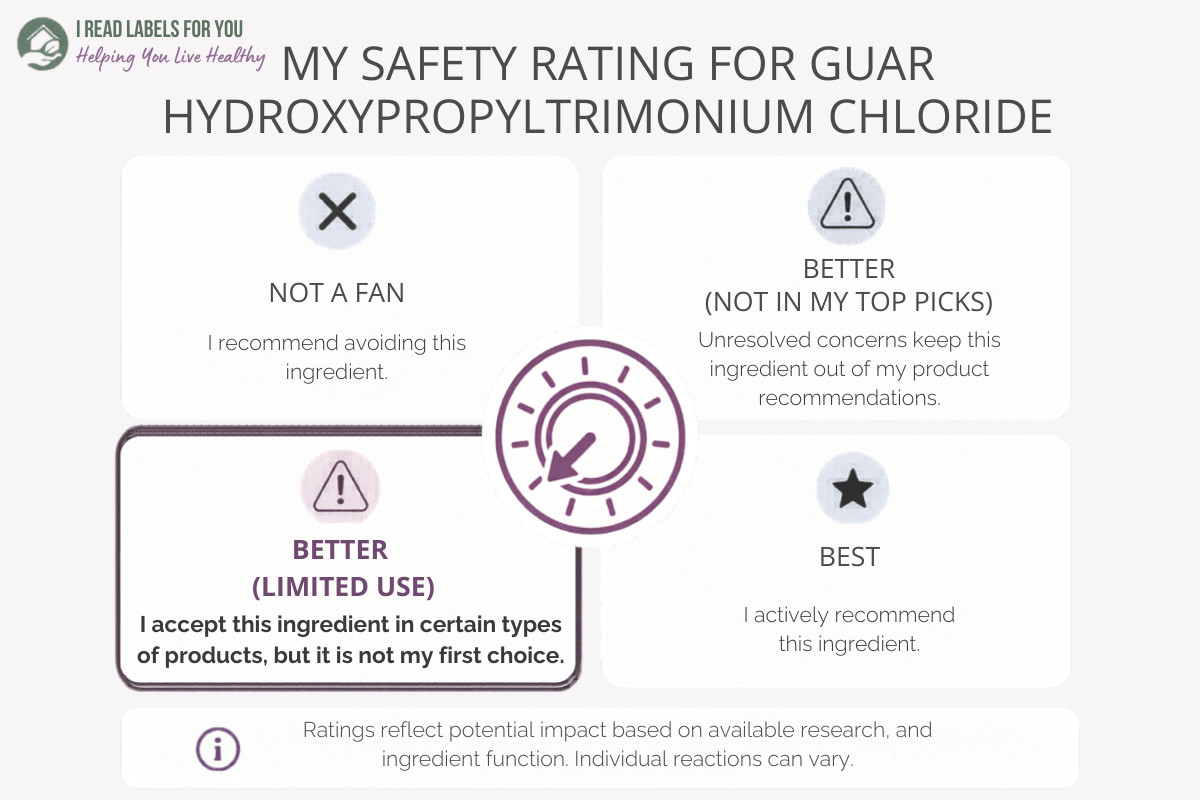
I rate Guar Hydroxypropyltrimonium Chloride Better (Limited Use). The polymer itself is reassuring: it doesn’t penetrate skin and raises no cancer, hormone, or allergy concerns. The catch is how it’s made. Its manufacturing chemical, CHPTAC, has an EU Annex VI classification as a Category 2 suspected carcinogen. Purification usually leaves only trace amounts in the finished ingredient, but the CIR safety review never independently measured that residue, so the gap is unverified.
My guidance for Guar Hydroxypropyltrimonium Chloride depends on the product type and on who it is for. In rinse-off products for adults, like shampoo, body wash, and rinse-out conditioner, contact is brief and most of it washes away, so I accept it in my Best products. In leave-on products for adults, like lotions, leave-in conditioners, and eye or lip makeup, it stays on the skin for hours, so I keep it out of my Best products and accept it only in my Better products.
For babies I am stricter: even rinse-off baby products, which would earn a Best spot for an adult, stay out of my Best products and sit only in my Better tier, because infant skin is thinner and the exposure risks add up.
Frequently Asked Questions About Guar Hydroxypropyltrimonium Chloride
Is Guar Hydroxypropyltrimonium Chloride Harmful?
No, not at the levels you’re exposed to. It’s a large-molecule plant-derived polymer that doesn’t pass through skin into the body.
No major regulator classifies it as a carcinogen, hormone disruptor, or contact allergen. The CIR Panel concluded in 2015 that it’s safe in current practices of use and concentration. The EU doesn’t restrict it in any way.
The one nuance: the manufacturing process uses CHPTAC, which the EU has classified as a suspected carcinogen. The CIR safety review didn’t specifically measure how much CHPTAC remains in the finished ingredient.
That gap drives my Limited Use tier, but it isn’t evidence of harm.
Does Guar Hydroxypropyltrimonium Chloride Cause Allergies?
Very rarely. The ACDS doesn’t list it as a contact allergen. The CIR didn’t identify a sensitization signal across the galactomannan family, and a patch test on a related ingredient (2 percent hydroxypropyl guar, in 111 people) was negative.
There is a documented occupational allergy to native guar gum, a different unmodified substance. It affects workers who inhale guar gum dust in industrial settings.
However, that’s not the same ingredient and not the same exposure that anyone would meet from a cosmetic.
Does Guar Hydroxypropyltrimonium Chloride Cause Buildup?
Yes, it can. This is a property of all positively charged conditioning polymers.
Because it binds to the negatively charged surface of hair, it can build up over repeated washes if not cleared periodically. Most people won’t notice this.
People with fine hair, low-porosity hair, or curly hair textures may notice that their hair feels weighed down or limp after several washes with conditioner-rich products. The fix is to use a clarifying shampoo every one to four weeks.
This is a hair-feel question, not a safety concern.
What Products Contain Guar Hydroxypropyltrimonium Chloride?
Mostly hair care. According to the CIR 2015 review, there were 818 reported cosmetic uses. Most were in rinse-off products (709). The rest were in leave-on (107) and bath products (2).
The most common categories are:
- conditioners
- shampoos
- hair masks
- leave-in conditioners
- hair-styling products
- curl creams
- detangling sprays
It also appears in some body washes and lotions for added slip and feel. A few baby products use it at very low concentrations (around 0.3 percent). It shows up occasionally in hair-color formulations.
Why Does EWG Rate Guar Hydroxypropyltrimonium Chloride Differently?
The Environmental Working Group (EWG) Skin Deep database gives Guar Hydroxypropyltrimonium Chloride a hazard score of 1 out of 10 (low concern, green). I rate it Better (Limited Use), which is more cautious than EWG.
Here’s why we differ. EWG’s score is built mainly on consumer-exposure hazard, i.e. what the ingredient does to a person who uses a product containing it.
By that test, this ingredient scores well. The polymer is too large to enter the body, the safety reviews are clean, and there are no contact-allergy or hormone-disruption flags.
My framework includes a separate axis: manufacturing footprint. It asks what it takes to make this ingredient, and whether those upstream chemicals reach the user as residue.
For Guar Hydroxypropyltrimonium Chloride, the manufacturing chemical is CHPTAC. The EU has classified CHPTAC as a Category 2 suspected carcinogen (H351) and Aquatic Chronic 3 (H412).
The CIR 2015 safety review didn’t specifically measure residual CHPTAC in finished material. That gap is why my rating adds the Limited Use qualifier. EWG doesn’t penalize ingredients on this dimension when consumer-exposure data is clean.
We’re reading the same evidence and weighing it differently. Neither of us is wrong. It’s the frameworks that ask different questions.
Sources
Cosmetic Ingredient Review (CIR) safety assessment:
Johnson W. Jr., Heldreth B., Bergfeld W.F., et al. (2015). Safety Assessment of Galactomannans as Used in Cosmetics (includes Guar Hydroxypropyltrimonium Chloride). International Journal of Toxicology 34(Supplement 1): 35S-65S: https://journals.sagepub.com/doi/10.1177/1091581815586798
CIR safety assessments index: https://cir-reports.cir-safety.org
European Union regulatory databases:
EU CosIng entry for Guar Hydroxypropyltrimonium Chloride (Inventory ingredient, no Annex restriction): https://ec.europa.eu/growth/tools-databases/cosing/details/34177
EU CosIng Annexes (II, III, IV, V): https://ec.europa.eu/growth/tools-databases/cosing/reference/annexes
CLP Annex VI Harmonised Classifications (legally binding EU hazard classifications): https://echa.europa.eu/information-on-chemicals/annex-vi-to-clp
ECHA CHEM portal, (3-Chloro-2-hydroxypropyl)trimethylammonium chloride (CHPTAC, CAS 3327-22-8, EC 222-048-3), EU Annex VI harmonised classification Carc. 2 (H351); Aquatic Chronic 3 (H412); signal word: Warning; pictogram: GHS08: https://chem.echa.europa.eu/100.020.045
ECHA CHEM portal, Guar Hydroxypropyltrimonium Chloride (CAS 65497-29-2, EC 613-809-4); https://chem.echa.europa.eu/100.114.215/overview?searchText=65497-29-2
Other regulators:
FDA on Cosmetic Ingredients: https://www.fda.gov/cosmetics/cosmetic-ingredients
Health Canada Cosmetic Ingredient Hotlist (Guar Hydroxypropyltrimonium Chloride not listed): https://www.canada.ca/en/health-canada/services/consumer-product-safety/cosmetics/cosmetic-ingredient-hotlist-prohibited-restricted-ingredients.html
Environment and Climate Change Canada, CEPA Schedule 1 List of Toxic Substances: https://www.canada.ca/en/environment-climate-change/services/canadian-environmental-protection-act-registry/substances-list/toxic/schedule-1.html
IARC List of Classifications (Guar Hydroxypropyltrimonium Chloride not classified): https://monographs.iarc.who.int/list-of-classifications
NTP 15th Report on Carcinogens, Appendix G CAS-number index (Guar Hydroxypropyltrimonium Chloride, CAS 65497-29-2, verified absent): https://ntp.niehs.nih.gov/sites/default/files/ntp/roc/content/appendix_g.pdf
California Proposition 65 List (Guar Hydroxypropyltrimonium Chloride not listed): https://oehha.ca.gov/proposition-65/proposition-65-list
PubChem records (chemistry, identifiers, hazard codes):
Guar Hydroxypropyltrimonium Chloride, PubChem Substance SID 135333784: https://pubchem.ncbi.nlm.nih.gov/substance/135333784
CHPTAC (3-Chloro-2-hydroxypropyl)trimethylammonium chloride, PubChem CID 18732: https://pubchem.ncbi.nlm.nih.gov/compound/18732
Native guar gum (for context), PubChem CID 24847856: https://pubchem.ncbi.nlm.nih.gov/compound/24847856
Natural cosmetic standards:
COSMOS-standard approved raw materials (Guar Hydroxypropyltrimonium Chloride appears in approved products): https://www.cosmos-standard.org/en/databases/approved-raw-materials/
Skin allergy resource:
American Contact Dermatitis Society (ACDS): Helpful References (including Core Allergen Series 2020): https://www.contactderm.org/resources/helpful-references
Advocacy group:
Environmental Working Group (EWG) Skin Deep entry for Guar Hydroxypropyltrimonium Chloride (hazard score 1, low concern): https://www.ewg.org/skindeep/ingredients/702759-GUAR_HYDROXYPROPYLTRIMONIUM_CHLORIDE/
Last verified: 06-05-2026
Download The Free Guide!
5 Powerful Steps To A Non-Toxic Home
Join our informed consumer community and get our free guide the “5 Powerful Steps To A Non-Toxic Home”.


Before commenting, please read our Comment Policy.