
Is Sodium Cocoyl Isethionate Safe? A Simple Answer You Can Trust
 Written by Irina Webb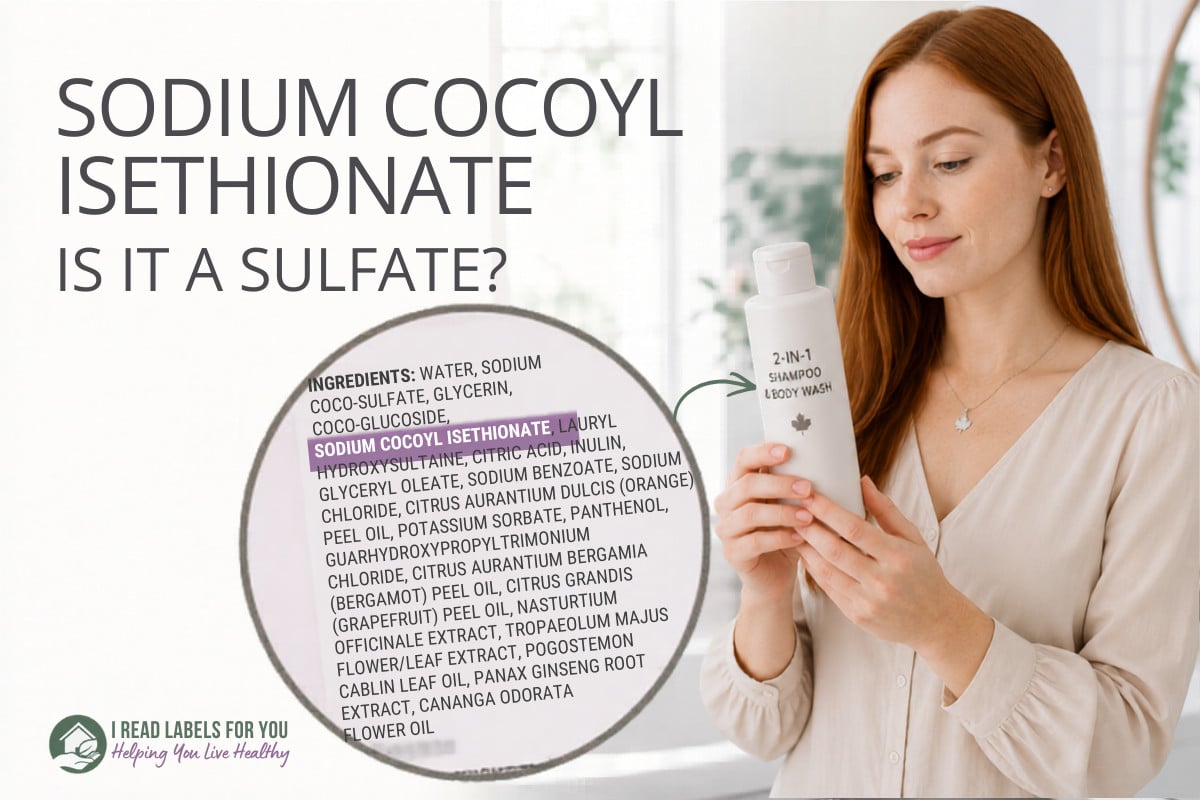
Yes, Sodium Cocoyl Isethionate is safe in rinse-off products for grownups. It’s a surfactant that produces rich and stable foam. It’s low in allergy risk, does not penetrate the skin, and does not build up. My one reservation is the manufacturing process that utilizes ethylene-oxide, a known carcinogen. I rate it Better (Limited Use).
The European Union allows Sodium Cocoyl Isethionate without any limits. However, the EU bans ethylene oxide in cosmetics, which is used to produce Sodium Cocoyl Isethionate, and requires the potential 1,4-dioxane contaminant to be as low as possible. Canada does not restrict Sodium Cocoyl Isethionate but prohibits both ethylene oxide and 1,4-dioxane as ingredients in cosmetics.
In the post, you will find out if Sodium Cocoyl Isethionate is a harsh sulfate or a natural, coconut ingredient, if it’s drying on your skin, and why my take on this ingredient’s safety is different from the EWG’s.
What Is Sodium Cocoyl Isethionate?
Sodium Cocoyl Isethionate is a mild cleansing agent, known in chemistry terms as an anionic surfactant. It is the sodium salt formed when coconut fatty acids join with a molecule called isethionate. Formulators often shorten its name to SCI.
It is a synthetic detergent, or syndet, not a true soap. That difference matters, because it lets SCI clean gently at skin-friendly pH without the tightness soap can leave behind.
What Does Sodium Cocoyl Isethionate Do In Cosmetics?
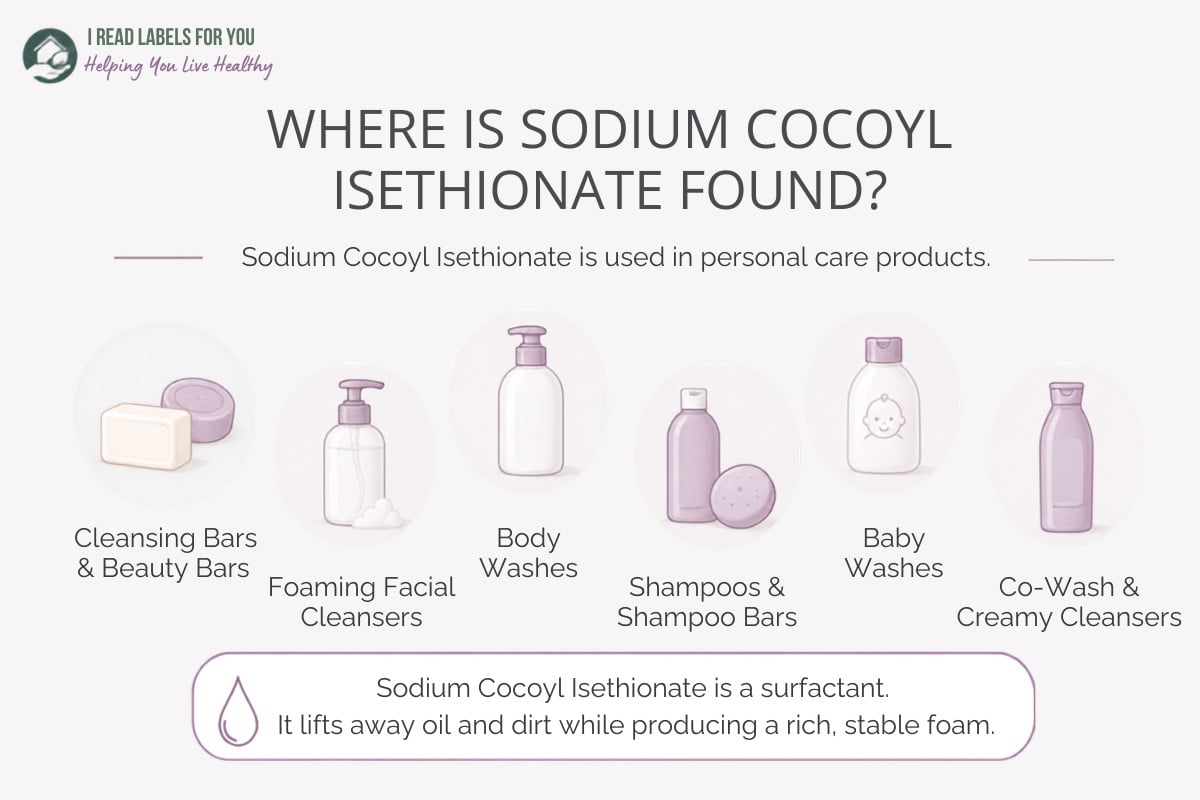
First and foremost, SCI cleans. It lifts away oil and dirt while producing a rich, stable foam that feels soft on the skin. Because it is mild, brands reach for it when they want a cleanser that won’t strip the skin barrier.
On top of cleansing, SCI helps a formula lather in hard water and gives bars their smooth, creamy glide. Furthermore, it pairs well with harsher surfactants to soften their edge. You’ll find Sodium Cocoyl Isethionate most often in:
- syndet cleansing bars and beauty bars
- foaming facial cleansers
- sulfate-free shampoos and shampoo bars
- body washes
- baby washes
- co-wash and creamy cleansers
Unlike many cosmetic ingredients, SCI is not used in food and does not occur naturally in plants or foods.
How Is Sodium Cocoyl Isethionate Made?
SCI is made in two stages, and the second stage is the one worth knowing about. First, coconut fatty acids are joined to sodium isethionate to build the surfactant. That coconut half is where the ingredient earns its plant-based reputation.
The sodium isethionate half, though, is built using ethylene oxide, a gas that is a known human carcinogen. The International Agency for Research on Cancer classifies ethylene oxide in its highest-certainty group for cancer. That is the heart of my caution here.
The good news is that reputable cosmetic-grade SCI is purified and tested. Supplier data sheets specify residual ethylene oxide and carcinogenic 1,4-dioxane at under 1 part per million each. In other words, the finished ingredient carries only a very small residue of those carcinogens; the real concern is the carcinogen used along the way.
Does Sodium Cocoyl Isethionate Penetrate The Skin?
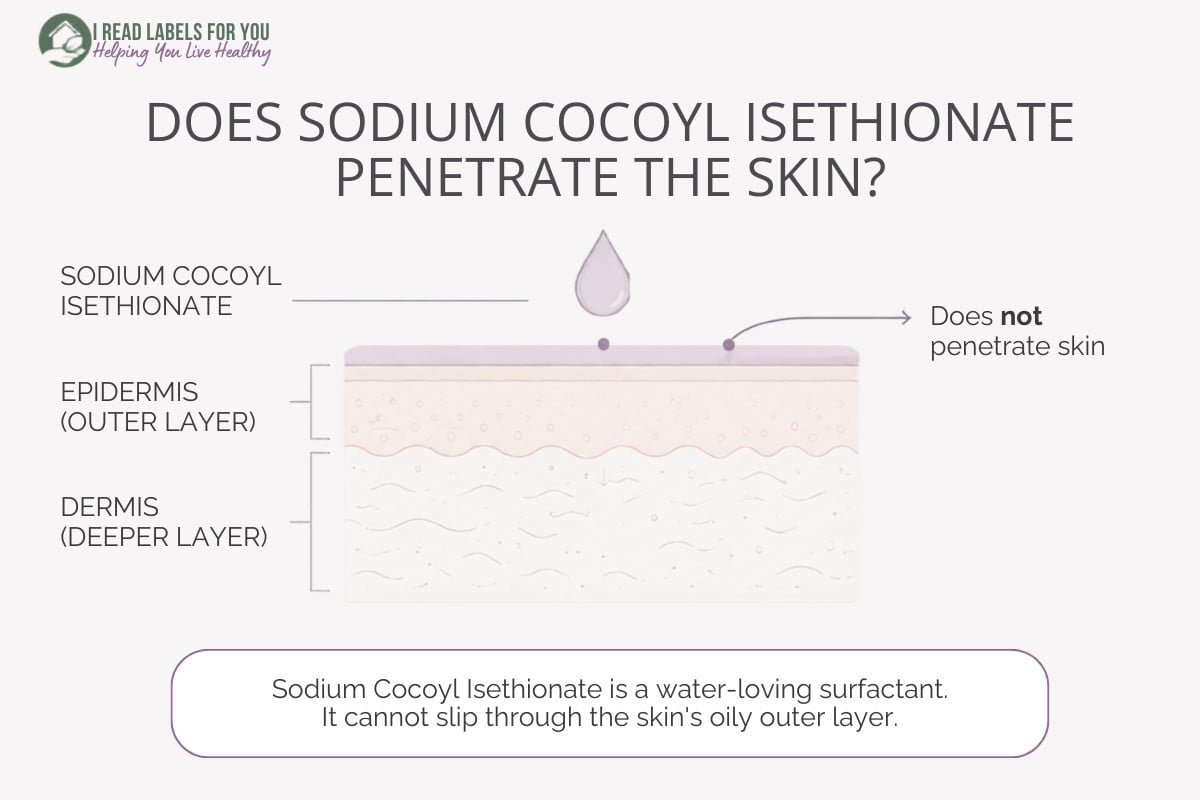
No, Sodium Cocoyl Isethionate does not meaningfully sink into the skin. Its electric charge is the main reason, so let me explain the two markers I weigh.
The first is molecular weight, which measures a molecule’s size in units called daltons. Anything below roughly 500 daltons is small enough that size by itself is no barrier, and SCI’s main portion sits near 330.
The second marker is charge. SCI is an ionic, water-loving surfactant, and charged molecules like this cannot slip through the skin’s oily outer layer. Therefore charge, not size, is what keeps it on the surface, which is exactly where a cleanser should stay.
What Is Sodium Cocoyl Isethionate Called On Labels?
On an ingredient list it usually appears by its full name, Sodium Cocoyl Isethionate. Other names and forms you might spot include:
- SCI
- Fatty Acids, Coco, 2-Sulfoethyl Esters, Sodium Salts
- Sodium Cocoyl Isethionate (Coconut-Derived)
- Jordapon CI
You may also see it blended with other gentle surfactants, such as Cocamidopropyl Betaine, in the first few lines of a cleanser.
Does The U.S. FDA Restrict Sodium Cocoyl Isethionate In Food And Cosmetics?
No, the U.S. Food and Drug Administration (FDA) does not restrict Sodium Cocoyl Isethionate in cosmetics. It is not a food ingredient, so it carries no food status at all. In cosmetics, brands may use it without a set limit.
I hold that light-touch approach at arm’s length. The FDA does not review most cosmetic ingredients before they reach shelves, and it does not require contaminants like ethylene oxide or 1,4-dioxane to be named on labels. In plain terms, permitted does not mean fully vetted for every shopper.
SCI is also absent from the FDA’s short list of prohibited and restricted cosmetic ingredients. Because that oversight is thin, I lean on Europe, which follows the precautionary principle and acts on early warning signs rather than waiting for proof of harm.
EU Regulations About Sodium Cocoyl Isethionate
The European Union permits Sodium Cocoyl Isethionate and does not place it on any restriction annex. In practice, that means it is allowed with no special concentration cap for the finished surfactant.
There is an important detail underneath, though. The EU bans ethylene oxide itself as a cosmetic ingredient, and it treats 1,4-dioxane as a contaminant to keep as low as possible. That is why responsible suppliers test each batch and keep both by-products below 1 part per million.
Canadian Regulations About Sodium Cocoyl Isethionate
Canada allows Sodium Cocoyl Isethionate and does not place it on the Health Canada Cosmetic Ingredient Hotlist, its roster of banned or capped cosmetic ingredients.
Notably, Canada does prohibit both ethylene oxide and 1,4-dioxane as ingredients in cosmetics. So, the surfactant is welcome, while the manufacturing chemicals behind it are not, which mirrors my own view.
Can Sodium Cocoyl Isethionate Cause Skin Allergy And Sensitization?
No, Sodium Cocoyl Isethionate rarely causes skin allergy, and it is considered a low-risk sensitizer. In the safety data, it tested as non-sensitizing and only mildly irritating at high strength.
It is not one of the fragrance allergens the European Union asks brands to declare, and it does not appear on the American Contact Dermatitis Society core allergen panel. Human sensitization tests came back negative, and there are no confirmed reports of true allergy to Sodium Cocoyl Isethionate itself.
The rare reactions people notice from SCI-containing products usually trace to a coconut allergy or to other ingredients in the formula. If you have a known coconut allergy, a coconut-derived cleanser like this may not suit you, and patch testing can help.
Is Sodium Cocoyl Isethionate A Hormone (Endocrine) Disruptor?
No, Sodium Cocoyl Isethionate is not a hormone disruptor. No regulator treats it as one, and no hormone-related review has turned up a concern.
SCI’s large, charged structure keeps it on the skin’s surface rather than entering the body. Consequently, it has no realistic path to interfere with your hormones.
Is Sodium Cocoyl Isethionate Safe To Use While Pregnant?
Yes, in a rinse-off product for an adult, Sodium Cocoyl Isethionate poses little concern during pregnancy. It sits on the skin surface, washes away, and showed no reproductive or developmental harm in animal testing.
That said, every pregnancy is unique, and I am not a medical professional. If any ingredient gives you pause, you should consult with your medical provider before using it.
Are There Any Cancer Concerns Linked To Sodium Cocoyl Isethionate?
No, Sodium Cocoyl Isethionate itself is not a carcinogen. It was not genotoxic in laboratory testing, and no cancer agency lists the finished ingredient. It is not on the National Toxicology Program report or on California’s Proposition 65 list.
The cancer thread is tied to production, not to the ingredient in your bottle. Ethylene oxide, used to build one half of SCI, is a known human carcinogen, and its by-product 1,4-dioxane is listed as possibly carcinogenic to humans. Careful purification drives both down to trace levels under 1 part per million, which is why this is a caution rather than a red flag.
Is Sodium Cocoyl Isethionate Bad For The Environment?
Sodium Cocoyl Isethionate is not considered a serious environmental hazard. It biodegrades well and does not build up in fish or wildlife, and its ecological rating sits on the low end.
The greener concern, again, is the making rather than the molecule. The ethylene-oxide route is not clean chemistry, which is one reason certified natural and organic standards keep SCI at arm’s length. The finished surfactant, by contrast, breaks down cleanly once it goes down the drain.
Common Claims About Sodium Cocoyl Isethionate: What’s True And What’s Not
Claim: Sodium Cocoyl Isethionate Is A Natural, Coconut Ingredient
This one is only half true, and it is a common marketing stretch. Yes, part of SCI comes from coconut oil, which lets brands call it coconut-derived.
The other half, though, is built with ethylene oxide in a lab, so the ingredient is not truly natural. Its standing even varies by certifier. Sodium Cocoyl Isethionate can appear in some COSMOS-approved rinse-off formulas, yet stricter natural and organic programs like Ecocert exclude it over that ethylene-oxide step.
Claim: Sodium Cocoyl Isethionate Is Dangerous Because Of 1,4-Dioxane
There is a real kernel here, which is why I rate SCI the way I do. The manufacturing does involve ethylene oxide, and it can leave trace carcinogenic ethylene oxide and 1,4-dioxane behind.
The finished SCI ingredient, though, is purified, and reputable suppliers keep both by-products under 1 part per million. So the concern is genuine but small, and it belongs to the factory, not to a well-made product.
Claim: Sodium Cocoyl Isethionate Is A Harsh Sulfate
This claim mixes up two different things. Despite the sulfur in its structure, SCI is not a sulfate like Sodium Lauryl Sulfate. It is a much gentler surfactant.
In practice, SCI is one of the mildest cleansers on the shelf and is often chosen specifically to replace harsher sulfates. Simply put, it is the opposite of harsh.
What I Think About Sodium Cocoyl Isethionate — And What You Should Do
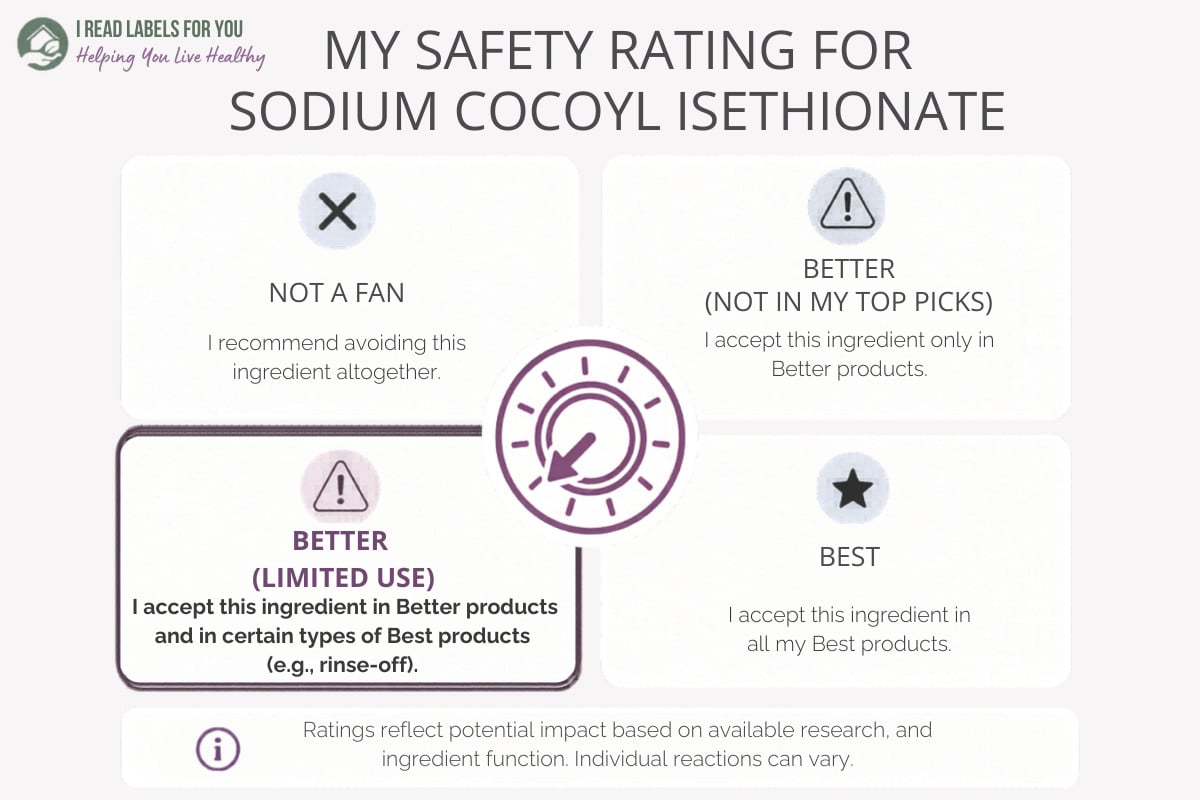
I see Sodium Cocoyl Isethionate as a good ingredient with one asterisk, which is why it lands in Better (Limited Use). On its own it is mild, gentle on the skin barrier, low in allergy risk, and it does not penetrate or build up. Those are real strengths.
My one reservation is the ethylene-oxide manufacturing route, a known carcinogen used to build the ingredient. Even though good purification keeps residues to trace levels, I give extra weight to that footprint, especially for delicate baby skin.
Here is what I actually do. For rinse-off products used by adults, such as a cleanser or a shampoo bar, I accept SCI as a Best-tier choice because it washes right off. I keep it out of my Best products, and I avoid it in leave-on products and in anything for a baby, where I choose surfactants with no manufacturing concern like Coco-Betaine, Alkyl Glucosides, or a true saponified soap. Choose what fits your skin and your comfort.
Frequently Asked Questions About Sodium Cocoyl Isethionate
Is Sodium Cocoyl Isethionate Natural?
Sodium Cocoyl Isethionate is not a fully natural ingredient. One half comes from coconut oil, but the other half is made with ethylene oxide in a lab. Because of that step, certified natural and organic standards usually exclude Sodium Cocoyl Isethionate.
Is Sodium Cocoyl Isethionate Safe For Babies?
Sodium Cocoyl Isethionate is not my top pick for babies. The ingredient is mild, yet its carcinogen-based manufacturing route makes me cautious for delicate baby skin. For babies, gentler cleansers like alkyl glucosides or a simple saponified soap are better choices.
Is Sodium Cocoyl Isethionate Drying?
Sodium Cocoyl Isethionate is usually not drying. It is one of the gentler surfactants and tends to cleanse without stripping the skin barrier. Very dry or sensitive skin may still prefer formulas that pair Sodium Cocoyl Isethionate with extra moisturizers.
Is Sodium Cocoyl Isethionate The Same As A Sulfate?
No, Sodium Cocoyl Isethionate is not a sulfate. It contains sulfur but is not a sulfate like Sodium Lauryl Sulfate. Sodium Cocoyl Isethionate is a milder surfactant and is often used to replace harsher sulfates in sulfate-free products.
Why Does EWG Rate Sodium Cocoyl Isethionate Differently?
The Environmental Working Group (EWG) gives SCI a low-hazard score of 1, its best rating. That score reflects the finished ingredient, which truly is mild and low in toxicity.
My rating is more cautious because I also weigh how the ingredient is made. The ethylene-oxide route is a carcinogen-based process, and that manufacturing footprint keeps SCI out of my Best products and out of anything I would choose for a baby.
Sources
EU SCCS / SCCP Opinions:
No dedicated SCCS or SCCP opinion on Sodium Cocoyl Isethionate (checked). SCCS opinions portal
Cosmetic Ingredient Review (CIR) Reports:
Burnett CL, et al. Amended Safety Assessment of Isethionate Salts as Used in Cosmetics. International Journal of Toxicology. 2017 (final). Also the 1993 Final Report on Sodium Cocoyl Isethionate. cir-reports.cir-safety.org
European Union Regulatory Databases:
CosIng entry for Sodium Cocoyl Isethionate (functions: cleansing, surfactant); not listed in any Annex. CosIng record
EU Cosmetics Regulation Annexes checked II/III/IV/V/VI (no restriction). CosIng Annexes
CLP Annex VI harmonised classifications (ECHA); ethylene oxide carries a harmonised carcinogen classification. Annex VI to CLP and ECHA CHEM
Other Regulators:
U.S. FDA (not a food ingredient; not on the prohibited/restricted cosmetics list) FDA prohibited & restricted ingredients
Health Canada Cosmetic Ingredient Hotlist, not listed (ethylene oxide and 1,4-dioxane are prohibited as ingredients). Hotlist
Environment Canada CEPA Schedule 1 (not listed) Schedule 1
IARC, Sodium Cocoyl Isethionate not classified; ethylene oxide (a manufacturing input) is Group 1. IARC classifications
NTP Report on Carcinogens, SCI not listed. NTP RoC
California Proposition 65, SCI not listed. Prop 65 list
PubChem Records (Chemistry, Identifiers, Skin Penetration, Hazard Codes):
Sodium Cocoyl Isethionate is a coconut-derived mixture; representative component Sodium Lauroyl Isethionate, PubChem CID 23668826 (CAS 61789-32-0). PubChem CID 23668826
Natural Cosmetic Standards:
COSMOS-standard approved raw materials; one approved SCI-containing grade (rinse-off only); SCI is generally excluded from certified natural/organic lines. COSMOS approved raw materials
NATRUE: no NATRUE-certified/approved raw material found for SCI. NATRUE certified world
Skin Allergy Resource:
American Contact Dermatitis Society, Helpful References, including the Core Allergen Series 2020 (SCI is not a panel allergen). ACDS Helpful References
Advocacy groups:
Environmental Working Group (EWG) Skin Deep entry for Sodium Cocoyl Isethionate: hazard score 1 (low). EWG Skin Deep Sodium Cocoyl Isethionate
Last verified: 07-09–2026

Download The Free Guide!
5 Powerful Steps To A Non-Toxic Home
Join our informed consumer community and get our free guide the “5 Powerful Steps To A Non-Toxic Home”.



Before commenting, please read our Comment Policy.