
Is Talc Safe? A Simple Answer You Can Trust
 Written by Irina Webb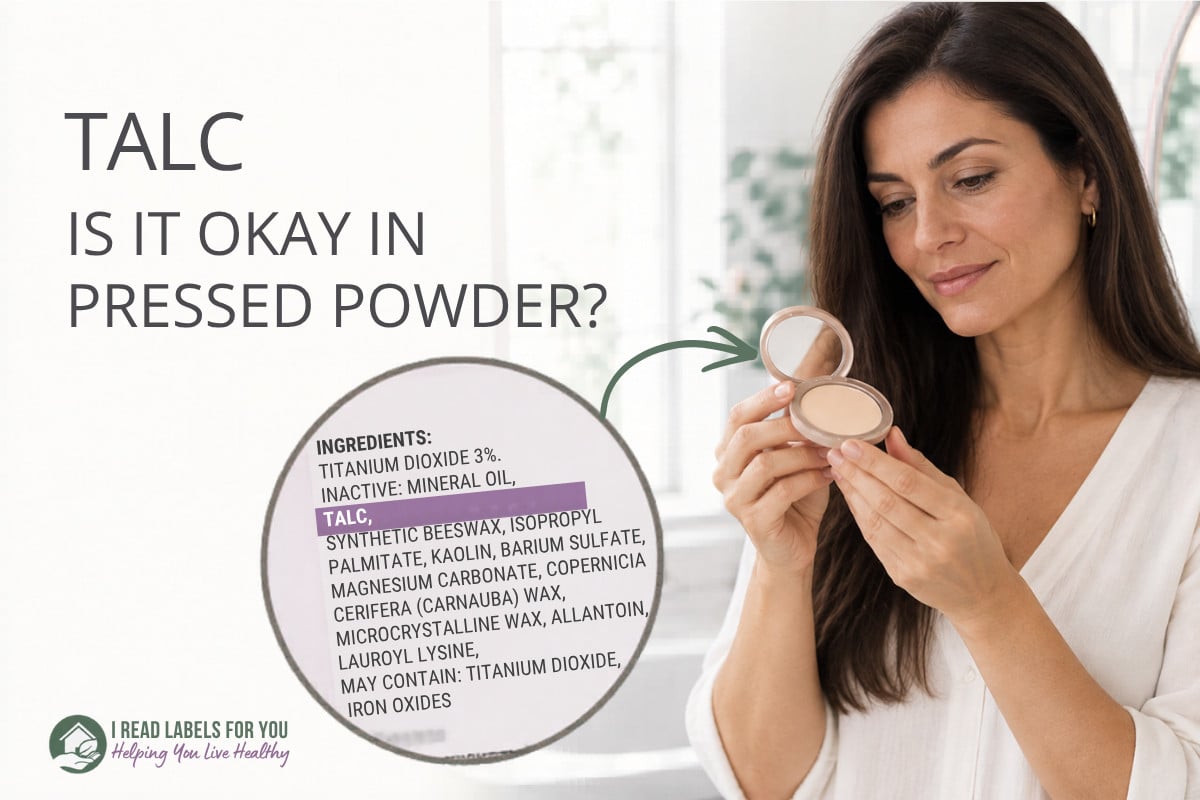
No, Talc is not an ingredient I recommend, and my reason has grown stronger since 2024. Talc is a soft mineral dug out of the ground, then crushed and purified for use in powders and makeup. Most of its lab testing is reassuring, and I’ll show you that testing. What decides my rating is a cancer classification, a broken purity promise, and two exposure routes you cannot see. I rate it Not A Fan.
Talc is regulated more tightly in Canada than anywhere else, and Europe added a warning label in 2024. Health Canada bars it from products meant for the genital area and restricts loose powders. The United States sets no limit on it at all.
Below you’ll find the exact wording the world’s cancer agency used in 2025, and why it matters. You’ll also see why testing for asbestos in talc may not be good enough. Finally, you’ll learn why a pressed powder and a body lotion are not the same question.
What Is Talc?
Talc is a natural mineral made of magnesium, silicon, oxygen, and water. Chemists write it as Mg3Si4O10(OH)2, and its common name is hydrous magnesium silicate. It’s the softest mineral on earth, scoring 1 on the 10-point hardness scale.
That softness explains everything talc does. Its crystals form flat sheets held together very weakly, so they slide apart under the lightest pressure. That sliding is the silky feel of a body powder.
Cosmetic-grade talc must be at least 90 percent pure talc by weight.
What Does Talc Do In Cosmetics?
Talc does seven different jobs, which is why it turns up so widely. The industry review lists them as abrasive, absorbent, anticaking agent, bulking agent, opacifying agent, skin protectant, and slip modifier.
In practice, it soaks up moisture and oil, stops caked powder from clumping, and gives makeup its smooth glide. It also bulks out a formula cheaply, which is part of why brands like it.
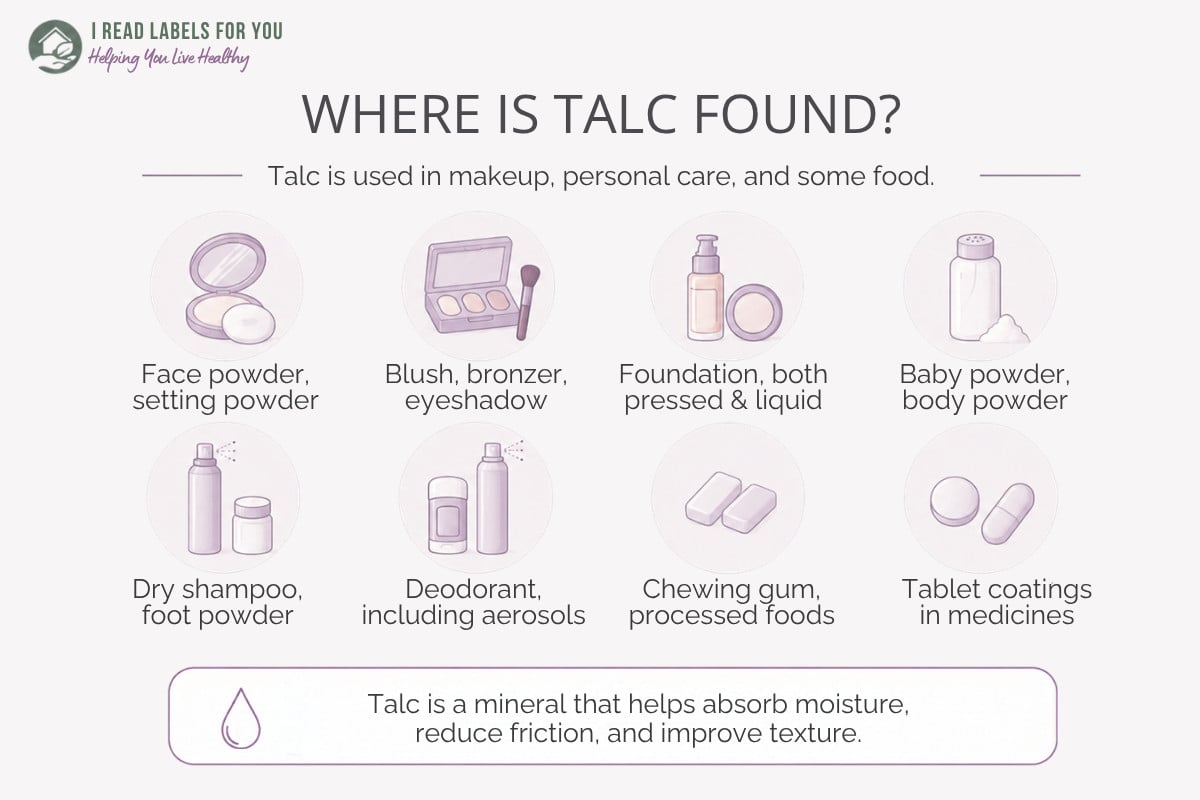
You’ll find Talc most often in:
- face powder and setting powder
- blush, bronzer and eyeshadow
- foundation, both pressed and liquid
- baby powder and body powder
- dry shampoo and foot powder
- deodorant, including aerosols
- chewing gum and some processed foods, where it carries the code E 553(iii)
- tablet coatings in medicines
How Is Talc Made?
Talc is not made, it’s mined, and that single fact drives the whole safety debate. The industry review states it plainly: “Talc is obtained from naturally occurring rock ore.” Most comes from open-pit mines in Italy, France, Norway, India, Spain, China, Egypt, Japan and the United States.
Purification uses froth flotation, where talc sticks to air bubbles and the other minerals sink.
The problem is geological, not chemical. Talc forms alongside other minerals like chlorite, magnesite, dolomite, calcite, mica, quartz, and fluorapatite. Amphiboles and serpentine are associated with certain specific talc deposits, and amphiboles include asbestos.
Does Talc Penetrate The Skin?
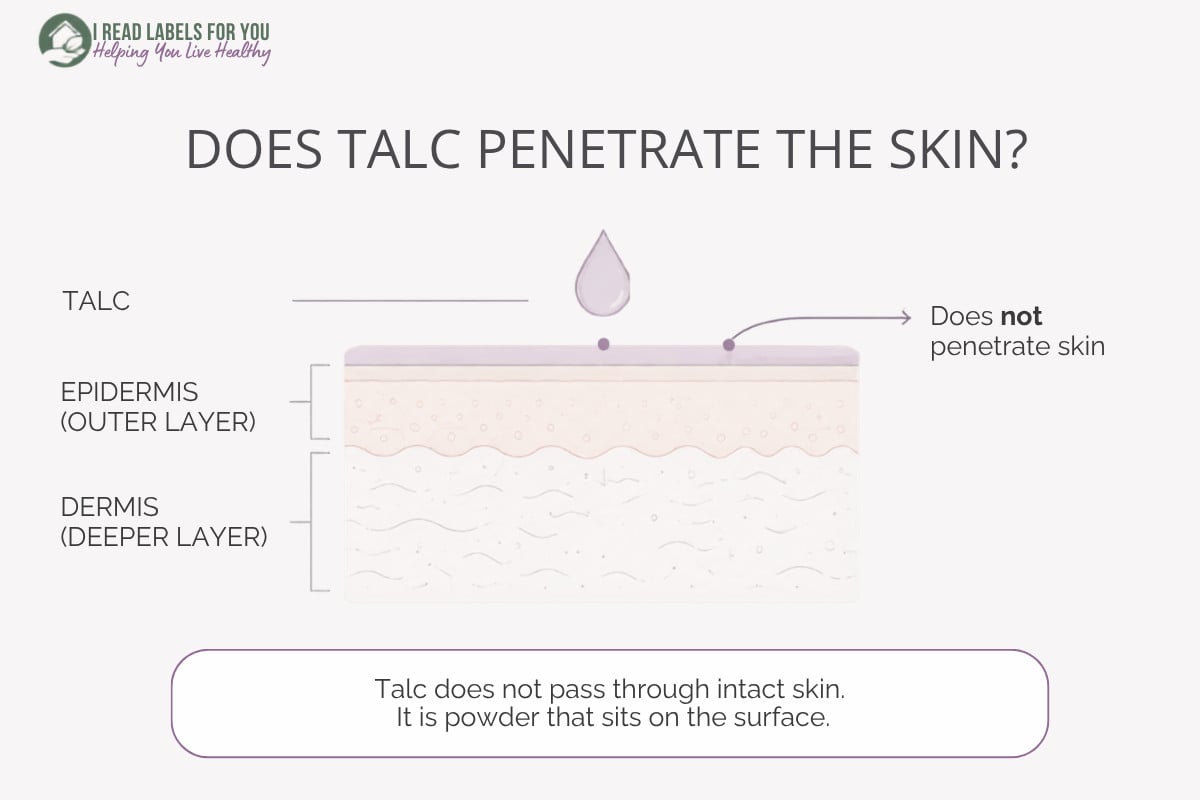
No, Talc does not pass through intact skin, and size is the reason. A molecule generally needs to be under about 500 daltons to slip between skin cells. Talc particles are not molecules at all, they are mineral platelets measuring 4 to 15 micrometers across.
Talc sits on the surface, which is exactly what a powder is meant to do.
There’s one exception, and the industry panel put it in writing. Their report says Talc should not be applied to the skin when the epidermal barrier is missing or significantly disrupted. On broken skin, particles lodge in the wound and the body walls them off into small lumps called granulomas.
Here’s the part that trips people up. No skin penetration does not mean low concern. Talc’s real routes are breathing it in and applying it to the genital area.
What Is Talc Called On Labels?
Talc hides behind several names, and one of them sounds like a different ingredient entirely. Look for these:
- Talc
- Talcum
- Talcum Powder
- Cosmetic Talc
- Hydrous Magnesium Silicate
- Magnesium Silicate
- French Chalk
- E 553(iii), the food additive code
Does The U.S. FDA Restrict Talc In Food And Cosmetics?
No, Talc faces no United States Food and Drug Administration (FDA) limit in cosmetics at all. It’s absent from the agency roster of prohibited and restricted cosmetic ingredients. Consequently a brand may use it at any strength, in any product, including body powders.
The FDA also permits talc in food as a processing aid. Sterile talc is even an approved prescription drug for fluid around the lungs.
I stay skeptical of that permission, and here’s why. American cosmetic law lets a company decide for itself that an ingredient is fine, with no pre-market review. The Generally Recognized As Safe pathway for food works much the same way, and many decisions rest on industry judgment.
Europe starts from the opposite instinct, known as the precautionary principle. Under it, a regulator can restrict an ingredient while the science is still being argued over.
EU Regulations On Talc
Europe restricts Talc, though more lightly than you might expect. It sits at entry 59 of Annex III in the European cosmetics regulation, the list of restricted substances.
The entry sets no concentration limit whatsoever. What it requires is a warning, worded exactly as: “Keep powder away from children’s nose and mouth.” That wording was updated on October 22, 2024.
Notice how narrow the warning is. It attaches to “powdery products intended to be used for children under 3 years”, not to talc generally.
Notice what Europe chose to regulate. It targeted breathing, and it targeted children, and it left everything else to the brand. There’s no ban on genital-area products and no requirement to test for asbestos written into the entry.
Canadian Regulations On Talc
Canada is the strictest jurisdiction on Talc by a wide margin, and its rules are worth reading closely. Health Canada lists talc on its Cosmetic Ingredient Hotlist with conditions by product type.
Canada completed a full chemical risk assessment and found two problems. Talc may be harmful to your lungs (difficulty breathing, scarring of the lungs) if you breathe in loose powder products. It also may cause ovarian cancer when using products with talc in the genital area.
The Hotlist entry was amended in May 2024 for exactly those reasons. Health Canada made the change to reduce chronic inhalation exposure to talc in cosmetics. The stated lung effects are “non-cancer lung effects (such as inflammation or fibrosis).”
Its second target is written just as plainly. The amendment also targets genital exposure to the population with intact ovary/ovaries which may result in ovarian cancer.
Warning labels have been required on children’s powders since 2007. One reads, “keep out of reach of children.” The other says, “keep powder away from children’s face to avoid inhalation which can cause breathing problems.”
Canada is therefore the only regulator acting on both exposure routes at once. Europe addressed inhalation only, and the United States addressed neither.
What Canada Cleared, And Why It Matters
The same assessment gave talc a clean bill in several uses, which is unusual and worth repeating. Health Canada found no health concerns from breathing in pressed-powder products, such as pressed powder makeup.
It also cleared dry shampoo or foot powder and contact with your skin, excluding the female genital area. Food and swallowed products were cleared too.
That’s a regulator drawing the line by product form rather than by ingredient. Loose powder and genital-area use are the problems; a pressed compact is not.
Can Talc Cause Skin Allergy And Sensitization?
No, Talc does not cause skin allergy, and the answer here is unusually clear cut.
Talc is absent from the American Contact Dermatitis Society Core Allergen Series, the panel dermatologists use to screen patients. It carries no allergen classification in Europe either.
The one animal test on record came back negative. The industry review reports that Talc was not a sensitizer in female Hartley guinea pigs.
Allergy needs a molecule small enough to enter skin and bind a protein. A mineral platelet can do neither.
Is Talc A Hormone (Endocrine) Disruptor?
No, Talc is not a hormone disruptor, and nobody has ever argued that it is.
The industry review contains no hormone section, no receptor test, and no thyroid data.
Hormone disruption requires a molecule that dissolves, travels in blood, and fits a receptor. Talc does none of that. When rats swallowed it, roughly 95 percent came straight back out in the feces within four days.
Is Talc Safe To Use While Pregnant?
No, Talc is not one I would choose during pregnancy, though the developmental testing itself looks clean.
The industry review found that orally administered talc was not a developmental toxicant in mice, rats, hamsters, or rabbits. In rabbits, high doses had no discernible effect on nidation or on maternal or fetal survival.
My hesitation is about the ovarian question rather than the baby. Pregnancy and the months after it are a time when powder use around the genital area often increases.
Since no source measures that risk for you, this belongs in a conversation rather than an article. For products you use daily on your body, you should consult with your medical provider.
Are There Any Cancer Concerns Linked To Talc?
Yes, and in 2025 the world’s cancer agency reached a firmer conclusion than before.
The International Agency for Research on Cancer (IARC) published its full review of talc as Volume 136. Its verdict reads: “Talc is probably carcinogenic to humans (Group 2A).”
That sits one step below a proven human carcinogen. Importantly, the agency was not judging contaminated talc. Its report states: “Talc containing asbestos was not evaluated in the present volume.”
The rating rests on three separate findings. For people, there’s “limited evidence” in humans for the carcinogenicity of talc, specifically for ovarian cancer. For animals, there’s “sufficient evidence” in experimental animals for the carcinogenicity of talc.
The third strand is mechanism. The agency found “strong evidence” that talc exhibits key characteristics of carcinogens, chiefly by causing lasting inflammation.
What The Human Studies Actually Show
Human evidence comes from one specific habit. Risk rose in studies that assessed perineal use of talc-based body powder.
The agency is honest about the weakness. Because contamination is documented, confounding by asbestos contamination of the talc cannot be ruled out. In plain terms, asbestos may be doing some or all of the damage.
For every other cancer site the answer was no. The report says that for all other cancers, including lung and stomach, the evidence was considered “inadequate.”
The Migration Question Has Changed
For years, the industry answer was that powder cannot travel from the outside to the ovaries. The 2015 industry review leaned on exactly that, saying there’s “no known physiological mechanism” for it.
Human tissue samples now say otherwise. The cancer agency reports that talc was identified at multiple pelvic sites distant from the perineum. It was found lodged in the female reproductive tract.
In fairness, animal work still points the other way. The same report notes that most animal studies found no translocation from the perineal region to the ovaries.
Is Talc Bad For The Environment?
No, Talc itself is not an environmental pollutant, and no regulator treats it as one.
Health Canada states that Talc is not harmful to the environment after a full assessment. The United States Environmental Protection Agency has never produced a hazard assessment for it either.
The reason is simple chemistry. Talc is an insoluble rock that does not dissolve, react or build up in living tissue.
One change is coming, though it’s about people rather than wildlife. Canada is proposing further action on talc, including adding talc to the Toxic Substances List. The genuine environmental cost meanwhile is the open-pit mining itself, not the mineral in your compact.
Common Claims About Talc: What’s True And What’s Not
Claim: Talc Causes Ovarian Cancer
Partly true, and the honest word is “may” rather than “does.” Many studies link perineal powder use to ovarian cancer, and the cancer agency calls that evidence limited, not sufficient.
“Limited” has a technical meaning here. It means a real association exists that chance cannot explain, but bias and asbestos contamination cannot be ruled out either.
Claim: Talc Contains Asbestos
Sometimes, and nobody can promise you otherwise. Talc and asbestos form in neighboring rock, so contamination depends on the deposit and the mining care.
The cancer agency puts the testing problem bluntly. Industry methods are currently not sufficiently sensitive to rule out asbestos contamination. It also notes that some talc products have been repeatedly shown to be contaminated with asbestos.
Claim: All Talc Is Contaminated
False, and this overstatement actually helps the industry. Clean deposits exist, and a 2012 American survey of talc samples and products detected no asbestos in any of them.
The catch is what that survey could see. Older detection methods missed asbestos below roughly half a percent, while newer electron microscopy can reach 0.001 percent. Absence of detection is not the same as absence of the substance itself.
Claim: Talc-Free Automatically Means Safe
False, and worth thinking through before you switch. Cornstarch is the usual replacement, and it’s a fine, breathable powder too.
Fine powders of any kind should stay away from a baby’s face. Choose a talc-free product for the right reason, which is avoiding the mineral, rather than assuming any powder is harmless.
What I Think About Talc — And What You Should Do
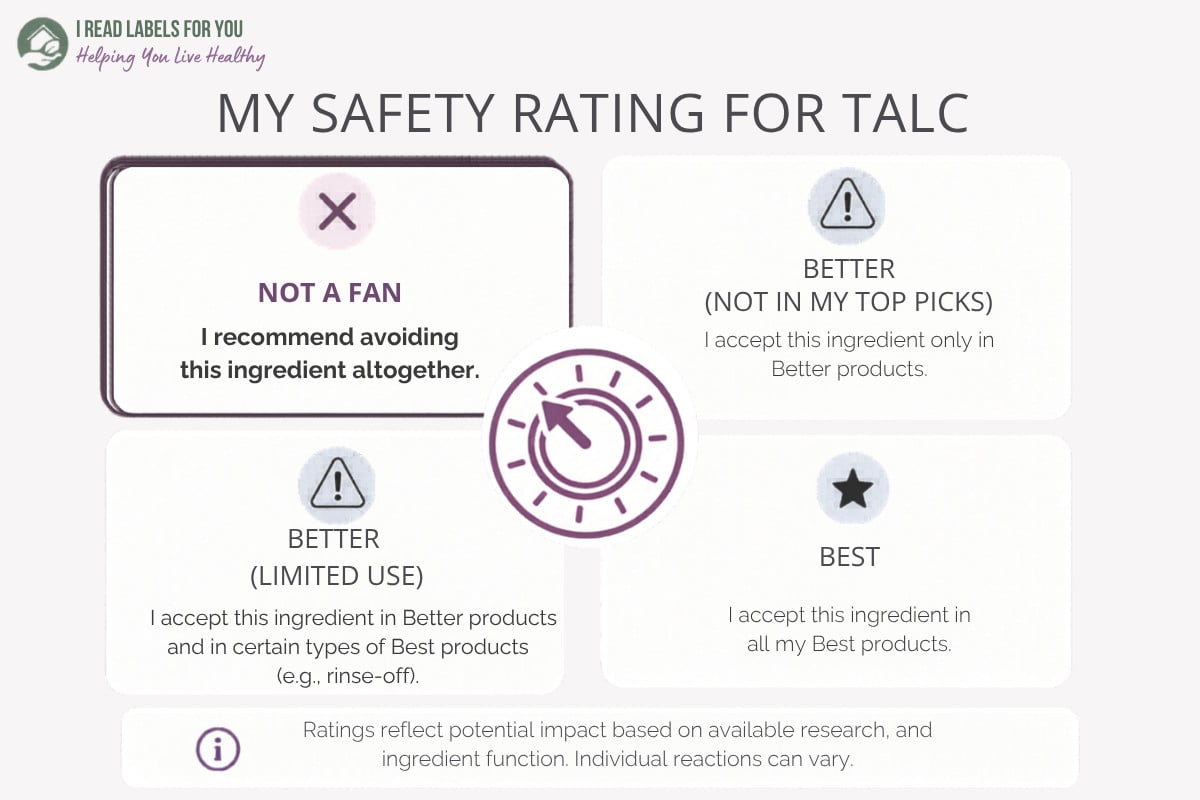
My rating for Talc is Not A Fan. Talc looks better in the laboratory than its reputation suggests, and worse in real life than its industry panel allows.
Take the reassuring part first. Talc does not penetrate skin, causes no allergy, and shows no hormone activity. It was not mutagenic in testing and not a developmental toxicant.
Then comes 2025. A world cancer agency set the asbestos question aside and still called talc probably carcinogenic to humans. The purity promise is the part that troubles me most. The industry case rests on a specification written in 1976. Its test method cannot rule contamination out today, the cancer agency says.
Regulators have moved while that promise stood still. Canada barred talc from genital-area products and tightened its loose-powder warnings; Europe added a children’s inhalation warning in 2024.
The Form Of The Product Matters
Here’s the nuance most coverage misses. Both strands of the cancer evidence are tied to physical form. One is inhaled dust, and the other is powder on the genital area.
Talc bound inside a lotion, cream or liquid foundation offers neither route. A cancer agency classifies an ingredient by its hazard, not a product by its risk.
What should you do? Skip loose powder, baby powder and any talc aerosol. Never use talc near the genital area. Treat talc in a pressed powder as a reason to look elsewhere. Talc in a liquid is a much smaller worry.
Frequently Asked Questions About Talc
Is Talc The Same As Asbestos?
No, Talc and asbestos are different minerals with different shapes. Talc forms flat plates, while asbestos forms thin needle-like fibers that lodge in lung tissue. They are related by geography rather than chemistry. The two form in neighboring rock, which is why one can contaminate the other during mining.
Is Talc Safe For Babies?
No, Talc is not safe for babies, and two governments have now written that into law. Europe requires a warning to keep powder away from a child’s nose and mouth. Canada found that breathing loose powder may harm the lungs and has required warnings on children’s powders since 2007.
Inhaling powder is a real pediatric emergency, not a theoretical one. Baby powder has historically contained up to 99 percent talc.
Is Talc Safe In Eyeshadow, Blush, And Pressed Powder?
I would pick a talc-free option where one exists, and my reason is contamination rather than dust. The asbestos question applies to every grade of cosmetic talc equally.
That said, pressed powders are the mildest case, as the Canadian assessment above explains. Binding the mineral into a cake removes most of the Talc inhalation problem.
Is Talcum Baby Powder Still Sold?
Yes in many places, though the market has shifted hard toward cornstarch. Several major brands withdrew talc-based baby powder from North America, while continuing to sell talc products elsewhere.
No country bans talc in cosmetics outright, though Canada comes closest.
Is Talc Allowed In Natural And Organic Products?
Yes, and this surprises people. COSMOS and NATRUE are the two main natural cosmetic standards. Both approve talc as a raw material, and NATRUE classes it as 100 percent natural.
“Natural” and “safe” are separate claims. A certified natural label on a powder tells you nothing about whether that powder contains talc.
What Is A Good Talc-Free Alternative Like Cornstarch?
Cornstarch, arrowroot powder, rice starch and kaolin clay all absorb moisture well. Cornstarch is the most common swap and carries no mineral contamination question.
One old worry about cornstarch feeding yeast infections has not held up well in practice. Still, treat any fine powder the same way around a baby’s face.
Sources
EU SCCS / SCCP Opinions:
No SCCS or SCCP opinion on Talc (checked); the EU acted through Annex III instead: SCCS opinions portal
Cosmetic Ingredient Review (CIR) Reports:
Fiume MM, Boyer I, Bergfeld WF, et al. (2015), Safety Assessment of Talc as Used in Cosmetics, International Journal of Toxicology, 34(Supplement 1): 66S-129S; source of the purity specification, use concentrations and the broken-skin caution: CIR reports
European Union Regulatory Databases:
CosIng ingredient record 38438, TALC; functions abrasive, absorbent, anticaking, bulking, opacifying, skin protecting and slip modifier: CosIng record 38438
Regulation (EC) No 1223/2009, Annex III entry 59, Talc: Hydrated magnesium silicate, CAS 14807-96-6, EC 238-877-9; warning “Keep powder away from children’s nose and mouth”, updated October 22, 2024; not listed in Annex II: CosIng annexes
ECHA substance record 100.035.328, talc; no harmonized CLP classification and no Candidate List entry: ECHA CHEM 100.035.328
Other Regulators:
International Agency for Research on Cancer, IARC Monographs Volume 136, Talc and Acrylonitrile (2025); talc classified Group 2A, probably carcinogenic to humans: IARC Volume 136
IARC List of Classifications, talc, CAS 14807-96-6, Group 2A: IARC list of classifications
U.S. NTP, 15th Report on Carcinogens, talc not listed; separately NTP Technical Report TR-421 reported clear evidence of carcinogenic activity in female rats by inhalation, a study reviewed in IARC Volume 136: NTP Report on Carcinogens
California OEHHA, Proposition 65 list; the listing reads “Talc containing asbestiform fibers”, dated 1990, and plain talc is not listed: OEHHA Proposition 65 list
U.S. EPA, Integrated Risk Information System; no assessment for talc, while asbestos has one: EPA IRIS
U.S. FDA, Prohibited and Restricted Ingredients in Cosmetics; talc is not named, so it carries no US cosmetic restriction: FDA prohibited and restricted ingredients
Health Canada, Talc; the final chemical risk assessment found concerns for loose powder inhalation and genital-area use, and no concern for pressed powder, dry shampoo, foot powder, skin contact or food: Health Canada talc page
Health Canada, Changes to the Cosmetic Ingredient Hotlist; the May 2024 amendment to the talc entry and its stated reasons: Changes to the Hotlist
Health Canada Cosmetic Ingredient Hotlist; talc is a restricted ingredient with conditions by product type: Cosmetic Ingredient Hotlist
Environment Canada, CEPA Schedule 1 List of Toxic Substances; talc not currently listed while asbestos is, though Health Canada has proposed adding talc: CEPA Schedule 1
PubChem Records (Chemistry, Identifiers, Skin Penetration, Hazard Codes):
PubChem CID 165411828, talc, CAS 14807-96-6, EC 238-877-9, formula H2Mg3O12Si4: PubChem CID 165411828
Peer-Reviewed Studies:
No standalone PubMed study is cited in this post. The epidemiology discussed here is the body of cohort and case-control studies reviewed and weighed in IARC Volume 136, which is cited above.
Natural Cosmetic Standards:
COSMOS-standard approved raw materials; talc appears as an approved raw material, certified by ECOCERT GREENLIFE: COSMOS-standard approved raw materials
NATRUE certified and approved raw materials; talc listed as approved, composition 100 percent natural: NATRUE certified world
Skin Allergy Resource:
American Contact Dermatitis Society (ACDS), Helpful References including the Core Allergen Series 2020; talc is not listed among the 90 screening allergens: ACDS Helpful References
Last verified: 09-19-2026
Download The Free Guide!
5 Powerful Steps To A Non-Toxic Home
Join our informed consumer community and get our free guide the “5 Powerful Steps To A Non-Toxic Home”.

Before commenting, please read our Comment Policy.