
Are Rosin Ingredients Safe? A Simple Answer You Can Trust
 Written by Irina Webb
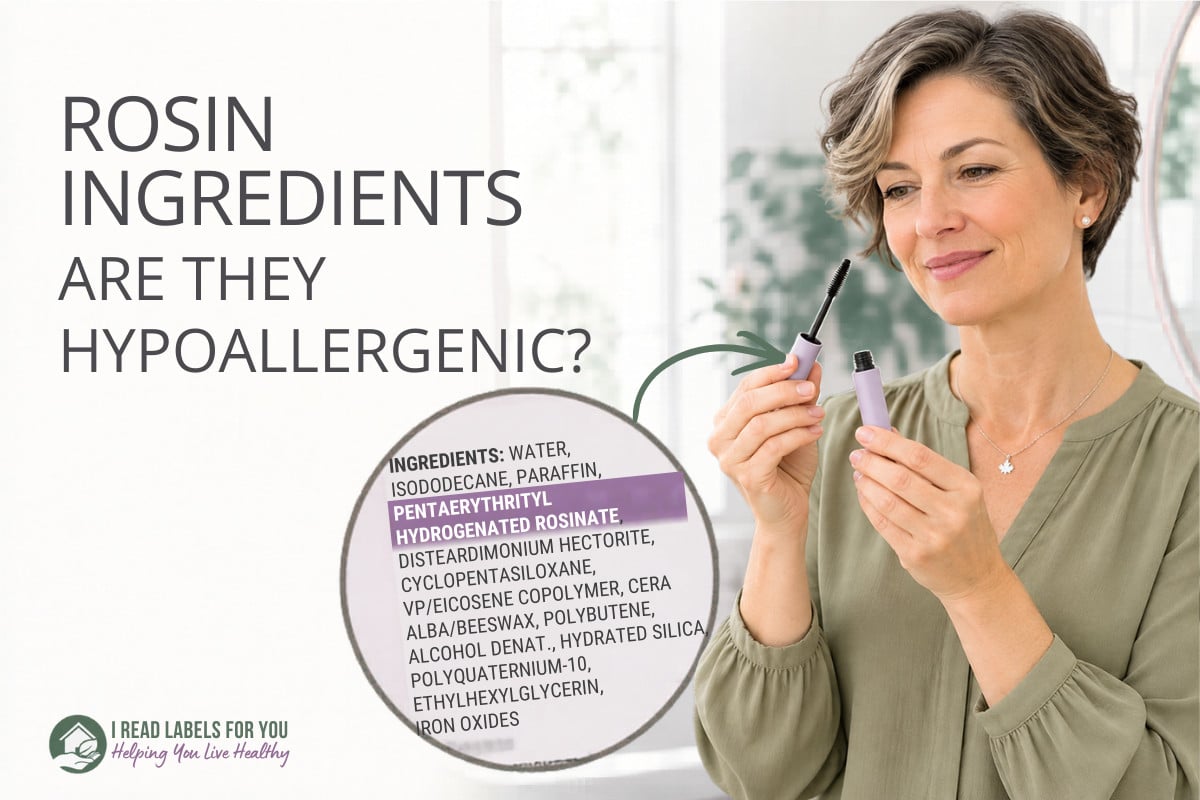
No, not all rosin ingredients are safe. I do not consider Rosin, Hydrogenated Rosin, and Pentaerythrityl Rosinate safe, while three other esters are safe for most people. Rosin is the sticky resin left from pine sap, and its relatives hold mascara, lipstick, and waxes together. Rosin itself is a classic skin allergen, and every ester made from it can carry some leftover rosin. My ratings for these six range from Better (Not In My Top Picks) to Not A Fan.
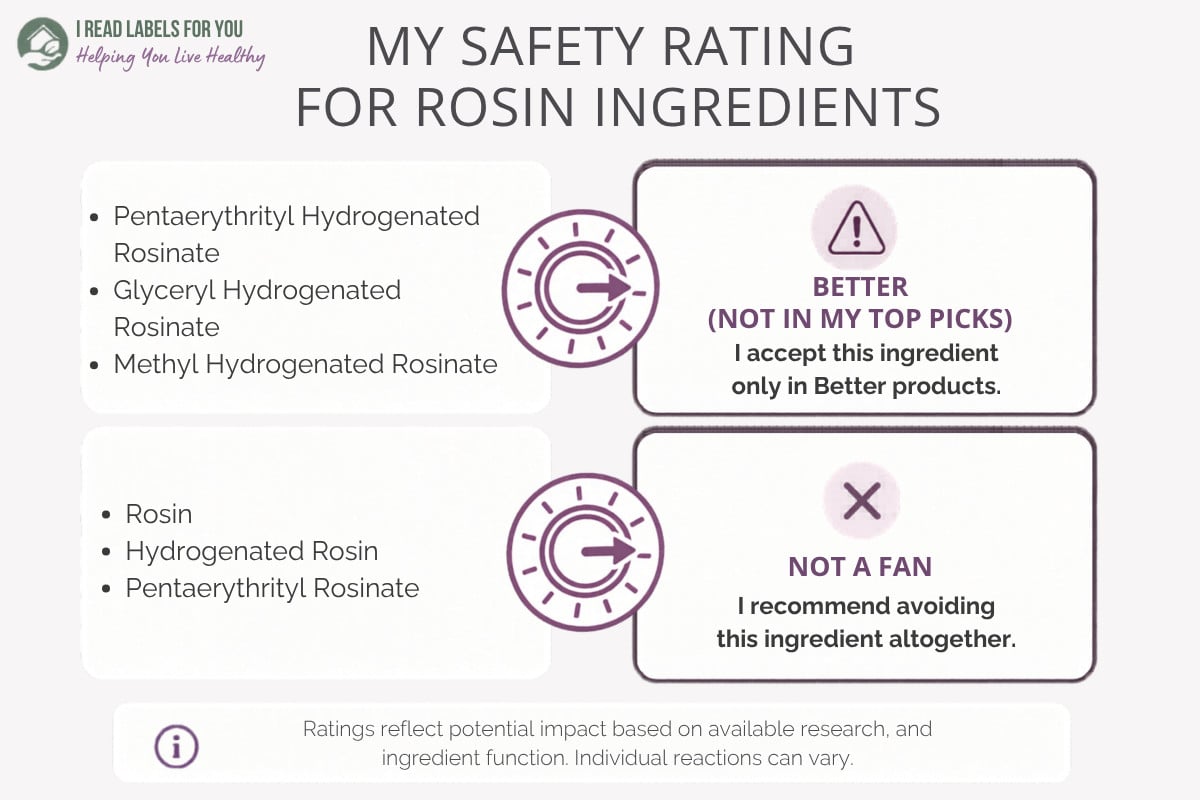
This post covers six rosin ingredients, with my rating for each:
- Rosin (Colophonium): Not A Fan
- Hydrogenated Rosin: Not A Fan
- Pentaerythrityl Rosinate: Not A Fan
- Pentaerythrityl Hydrogenated Rosinate: Better (Not In My Top Picks)
- Methyl Hydrogenated Rosinate: Better (Not In My Top Picks)
- Glyceryl Hydrogenated Rosinate: Better (Not In My Top Picks)
Rosin, also called colophonium, is the only one of the six that European Union law already classifies, as a skin sensitizer. In September 2026, Europe’s Committee for Risk Assessment also backed labeling Rosin and Hydrogenated Rosin as suspected reproductive toxicants. None of the four esters carries any EU restriction, and neither the U.S. nor Canada limits any of the six.
Keep reading to discover:
- why Europe softened its planned pregnancy warning for rosin, and what could still remove it from EU cosmetics
- which rosin ester a safety panel refused to support, twice
- why a standard patch test for rosin allergy can miss the ester in your mascara
What Are Rosin Ingredients?
Rosin ingredients are a family of sticky, resin-based materials that all start from pine trees. The parent, Rosin, is the solid left behind after turpentine is distilled from pine oleoresin, the thick sap that seeps from cut bark.
Chemically, Rosin is mostly resin acids, chiefly abietic acid and dehydroabietic acid. The other five ingredients in this post are Rosin that manufacturers have changed, either with hydrogen, with an alcohol, or with both.
For Glyceryl Rosinate, the seventh member of the family, see my full Glyceryl Rosinate review here.
What Do Rosin Ingredients Do In Cosmetics?
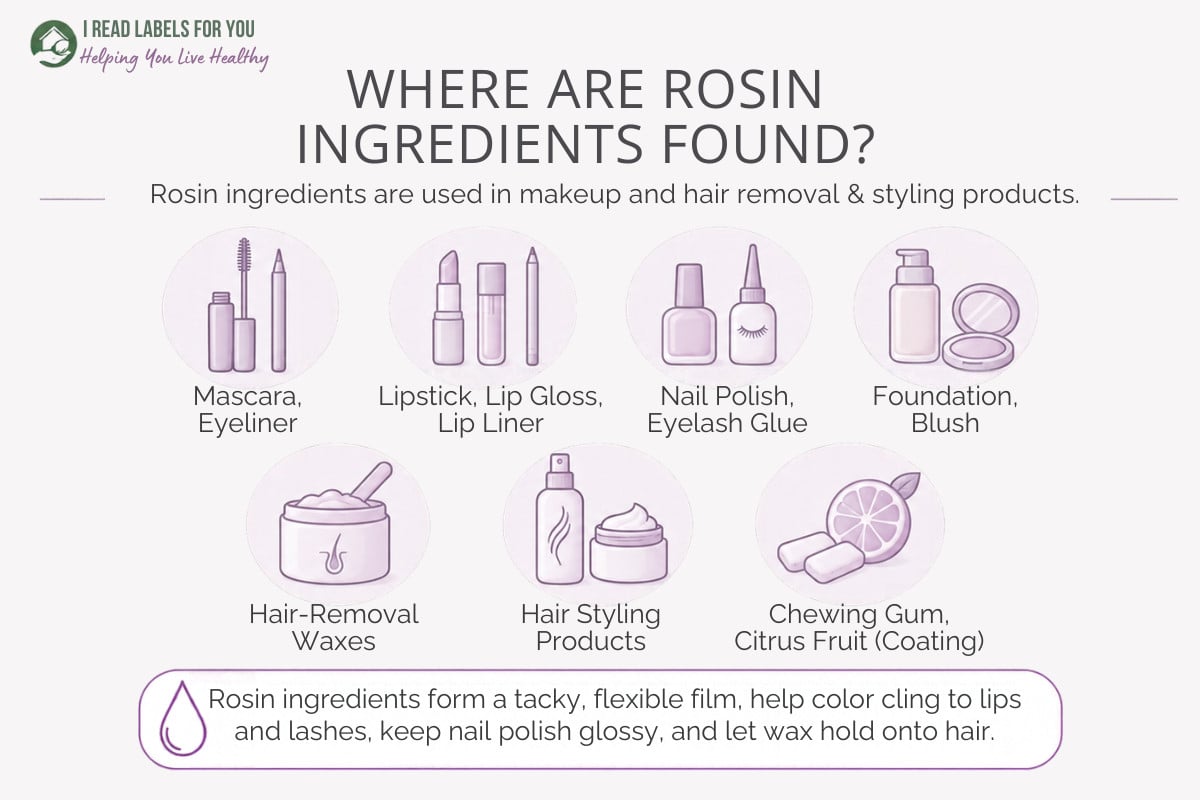
Their job is grip. A rosin ingredient forms a tacky, flexible film. It helps color cling to lips and lashes, keeps nail polish glossy, and lets wax hold onto hair.
The EU’s ingredient database, CosIng, names film forming as the main role for most of them. Beyond that, Colophonium is also listed as a binder and hair-removal agent, while Methyl Hydrogenated Rosinate and Hydrogenated Rosin also work as perfuming ingredients.
Use levels can be high. The industry-funded Cosmetic Ingredient Review (CIR) recorded Pentaerythrityl Rosinate at up to 9.6% in mascara. It also found Glyceryl Hydrogenated Rosinate at up to 10% in lipstick and 76.8% in hair-removal wax.
You’ll find rosin ingredients most often in:
- mascara and eyeliner
- lipstick, lip gloss, and lip liner
- nail polish
- eyelash glue
- foundation and blush
- hair-removal waxes
- hair styling products
- chewing gum base
- wax coatings on fresh citrus fruit
Outside cosmetics, the same materials show up in adhesive bandages, wound dressings, glucose-sensor patches, paper, inks, and solder.
How Are Rosin Ingredients Made?
Everything starts with rosin. Gum rosin comes from tapping living pines, wood rosin is extracted from old pine stumps, and tall oil rosin is a by-product of paper pulping.
Next, manufacturers may treat rosin with hydrogen, usually over a metal catalyst. Hydrogenation saturates the resin acids, which makes them far less likely to react with air. Notably, US food rules and ECHA describe the result as only partially hydrogenated.
Finally, rosin or hydrogenated rosin can be joined to an alcohol to form an ester. Glycerin gives the glyceryl esters, pentaerythritol gives the pentaerythrityl esters, and methanol gives the methyl ester.
None of these reactions runs to completion. In the 1998 CIR review of Pentaerythrityl Rosinate, one supplier’s ingredient still held 6.3% unreacted rosin. Moreover, no cosmetic specification limits how much free rosin any of these esters may contain.
Do Rosin Ingredients Penetrate The Skin?
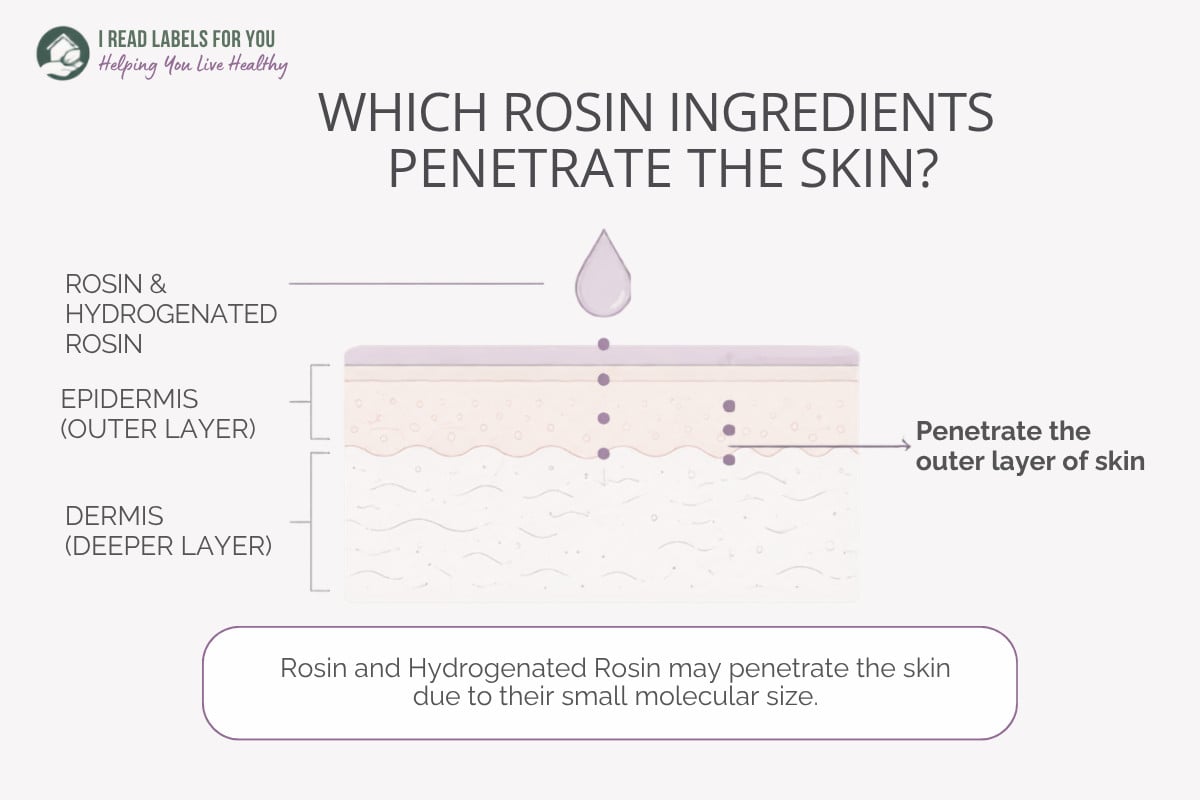
Partly. Rosin and Hydrogenated Rosin can enter the outer skin, while the large esters mostly cannot. Still, no study has measured absorption for any of the six.
Size decides most of it. Daltons measure how heavy a molecule is, and healthy skin turns away most molecules above roughly 500 of them. The resin acids in Rosin and Hydrogenated Rosin weigh only about 300 to 306 daltons. They also dissolve in oil, which helps them slip into the skin’s fatty top layer.
The pentaerythrityl and glyceryl esters are different. Each molecule joins two to four resin acids to one alcohol, which pushes most of them well past the 500-dalton mark. The methyl ester sits in between, at about 318 daltons for its main parts.
For allergy, though, deep absorption is not needed. An allergen only has to reach the upper skin, and that is exactly where free resin acids, including the leftovers inside the esters, end up.
What Are Rosin Ingredients Called On Labels?
On a label, rosin ingredients can appear under any of these names:
- Colophonium
- Rosin
- Colophony
- Gum Rosin
- Wood Rosin
- Hydrogenated Rosin
- Rosin, Hydrogenated
- Pentaerythrityl Rosinate
- Pentaerythrityl Rosinates
- Pentaerythritol Ester Of Rosin
- Pentaerythrityl Hydrogenated Rosinate
- Hydrogenated Rosin, Pentaerythritol Ester
- Ester Gum HP
- Methyl Hydrogenated Rosinate
- Hydrogenated Rosin Methyl Ester
- Methyl Ester Of Rosin, Partially Hydrogenated
- Glyceryl Hydrogenated Rosinate
- Glycerol Ester Of Hydrogenated Rosin
- Hydrogenated Glyceryl Rosinate
Two near-names are different ingredients. Methyl Dihydroabietate has its own INCI entry, and Hydroabietyl Alcohol is a rosin-derived alcohol that Europe prohibits as a fragrance ingredient.
Why Do My Ratings Differ From One Rosin Ingredient To Another?
Three questions decided each rating:
- Is the ingredient itself classified, or about to be?
- Has a safety panel reviewed it, and did it support the ingredient?
- How much allergy risk does the ingredient carry?
| Ingredient | What it is | What decided my rating | My rating |
| Rosin (Colophonium) | unmodified pine resin | EU skin sensitizer by law; RAC backed a suspected reproductive classification | Not A Fan |
| Hydrogenated Rosin | rosin treated with hydrogen | RAC backed classifying it as suspected of harming fertility; no safety-panel review | Not A Fan |
| Pentaerythrityl Rosinate | rosin joined to pentaerythritol | CIR found the data insufficient in 1994 and 1998; 6.3% unreacted rosin | Not A Fan |
| Pentaerythrityl Hydrogenated Rosinate | hydrogenated rosin joined to pentaerythritol | documented allergen in wound dressings; never reviewed by a safety panel; leftover rosin may top 3% but was never measured | Better (Not In My Top Picks) |
| Methyl Hydrogenated Rosinate | hydrogenated rosin joined to methanol | never reviewed by a safety panel; methyl esters keep rosin’s allergy potential | Better (Not In My Top Picks) |
| Glyceryl Hydrogenated Rosinate | hydrogenated rosin joined to glycerin | CIR names leftover rosin as an allergy concern; recent case reports | Better (Not In My Top Picks) |
Simply put, three ingredients are Not A Fan: two are classified themselves, and a safety panel declined to support the third. The three esters that carry rosin’s risks only through leftover rosin stay at Better (Not In My Top Picks).
Does The U.S. FDA Restrict Rosin Ingredients In Food And Cosmetics?
No, cosmetic use of the six faces no limit from the U.S. Food and Drug Administration (FDA). Not one shows up on its roster of banned and limited cosmetic chemicals.
Food rules are a different matter, because several of the six are approved there. The FDA chewing gum rule lists the partially hydrogenated methyl ester and pentaerythritol esters of both plain and partially hydrogenated rosin, among others. A separate rule allows partially hydrogenated rosin in coatings on fresh citrus fruit.
Those food rules quietly confirm a point that matters here. Each ester must meet an acid number, a measure of free resin acid. In other words, the FDA itself expects some leftover rosin to remain.
I would not lean on the cosmetic silence, either. The FDA does not review cosmetic formulas before they reach stores, and its short restricted list tends to grow only once harm is reported.
Europe takes the opposite approach. Under its precautionary principle, regulators may step in on credible early warning signs instead of waiting for proof of harm.
EU Regulations On Rosin Ingredients
Today, the European Union restricts none of the six in cosmetics. CosIng lists each of them outside every annex. Moreover, the Scientific Committee on Consumer Safety (SCCS), the EU’s independent cosmetic safety panel, has never reviewed any of them.
Rosin already carries a legal hazard classification. Since December 1, 2010, the EU has classified it as a category 1 skin sensitizer, meaning a substance that may cause an allergic skin reaction.
What Europe Decided About Rosin In September 2026
In 2024, Norway asked the European Chemicals Agency (ECHA) to classify rosin as a presumed reproductive toxicant, category 1B. Its case rested on rat feeding studies in which fewer pups survived.
ECHA’s Committee for Risk Assessment (RAC) did not go that far. Its September 2026 meeting minutes show it adopted the milder category 2 instead, meaning suspected of damaging fertility and the unborn child.
For Hydrogenated Rosin, RAC agreed with Norway’s proposal: category 2, suspected of damaging fertility. In contrast, RAC kept the stronger category 1B for rosin oligomers, rosin molecules joined together, sold in cosmetics as Dimer Rosin.
These opinions are not law yet. The European Commission must first add them to Annex VI of the CLP Regulation, Europe’s official hazard list.
What A Category 2 Classification Would Mean For Cosmetics
Under Article 15 of the EU Cosmetics Regulation, a substance classified as a category 2 reproductive toxicant is prohibited in cosmetics. The only way back is an SCCS evaluation that finds the use safe.
Consequently, once the Commission adopts the RAC opinions, Rosin and Hydrogenated Rosin would leave EU cosmetics unless someone asks the SCCS to clear them. No such request exists as of November 2026.
The four esters fall outside these opinions. RAC did classify two other rosin esters, a fumarated glycerol ester and a maleated pentaerythritol ester. Neither is one of the ingredients in this post.
There’s a catch for the esters, though. Under EU hazard rules, a material usually takes on a category 2 reproductive classification once a category 2 ingredient reaches 3% of it. The 1998 CIR review found 6.3% unreacted rosin in one supplier’s Pentaerythrityl Rosinate, more than twice that line.
Nobody has published leftover levels for the other esters. However, FDA food specifications cap their free resin acid. By my rough estimate, those caps allow about 4% to 10% in Pentaerythrityl Hydrogenated Rosinate and 2% to 5% in the glyceryl and methyl versions.
Two Esters Under EU Environmental Review
Finland is evaluating Pentaerythrityl Hydrogenated Rosinate for persistent, bioaccumulative and toxic properties, a review that remained open as of November 2026. A similar evaluation of Glyceryl Hydrogenated Rosinate closed in 2021 with too little information to reach a conclusion.
U.S. And EU Disagreements On Rosin Ingredients
The two sides start from different places. Europe classifies rosin as an allergen in law and is preparing a second classification. Meanwhile, the United States lists rosin as a natural flavoring substance and sets no cosmetic limit.
Canadian Regulations On Rosin Ingredients
Canada restricts none of the six. Health Canada’s Cosmetic Ingredient Hotlist leaves them all off, although it does list Hydroabietyl Alcohol, a different rosin derivative.
Likewise, none appears on Schedule 1 of the Canadian Environmental Protection Act, the national toxic substances roster.
Can Rosin Ingredients Cause Skin Allergy And Sensitization?
Yes, rosin ingredients can cause skin allergy, mainly through rosin itself and the leftover rosin inside the esters, although most people never react. Allergy is the main reason none of the six reaches my Best list.
Why Rosin Is One Of The Best-Known Skin Allergens
Patch-test clinics check for rosin allergy as a matter of course. On the Core Allergen Series of the American Contact Dermatitis Society (ACDS), the panel dermatologists start with, “Colophony 20% pet.” sits at position 7.
The numbers are steady. A 2026 analysis of 73 studies covering 459,757 dermatitis patients found that 3.54% were allergic to colophonium, a rate that has held for decades.
Storage makes rosin worse. When abietic acid meets air, it turns into stronger allergens, and a 2007 laboratory study named 15-hydroperoxyabietic acid as the most potent one. For this reason, IFRA, the fragrance industry’s standards body, prohibits colophony as a fragrance ingredient.
What Hydrogenation And Esters Change
Hydrogenation helps. In a 1988 patch-test study, rosin-allergic patients reacted far less often to hydrogenated rosin, although guinea pigs still reacted at the highest dose.
Joining rosin to glycerin also lowers its allergy potential, according to CIR. Methyl esters behave differently: the same 2007 study found that turning the acid into a methyl ester “does not affect the allergenic activity.”
Leftovers remain the weak spot. A 2009 Danish government report explains that modified rosin usually still contains unmodified rosin, and that this leftover can cause allergy on its own.
Allergy Cases Reported For Each Ester
Every ester in this post has its own case reports. However, nearly all involve medical adhesives held against the skin, rather than everyday makeup.
Glyceryl Hydrogenated Rosinate caused allergic rashes in five patients described in 2025. Earlier, it caused a reaction to a medicated plaster in 2006 and reactions in two children wearing a glucose sensor in 2024.
Methyl Hydrogenated Rosinate was positive in one of those two children. A 2025 review of diabetes-device allergy also describes a patient who reacted strongly to it while barely reacting to plain colophony.
Pentaerythrityl Hydrogenated Rosinate, sold to dressing makers as Pentalyn H, has the strongest record. A 1997 report found it “retains the sensitizing potential of colophony,” and a 2025 analysis of 73 wound dressings called it “the most sensitising agent.”
Pentaerythrityl Rosinate is the one with a cosmetic case. A 2003 report describes allergic inflammation of the lips caused by it in a lipstick. In addition, one volunteer in a CIR mascara test developed a blistering rash.
Why A Normal Rosin Patch Test Can Miss It
The standard patch test checks only for plain rosin, also called colophony. Some people allergic to Pentaerythrityl Hydrogenated Rosinate, Methyl Hydrogenated Rosinate or Glyceryl Rosinate showed no reaction, or only a faint one, to that test. If you think your mascara or lip color caused a rash, ask your dermatologist to patch test the product itself. Also ask for tests with any of these on its label: Glyceryl Rosinate, Glyceryl Hydrogenated Rosinate, Pentaerythrityl Rosinate, Pentaerythrityl Hydrogenated Rosinate or Methyl Hydrogenated Rosinate.
Are Rosin Ingredients Hormone (Endocrine) Disruptors?
No, none of the six rosin ingredients is a known hormone disruptor, although none has been properly tested for hormone effects. Moreover, ECHA has not placed any of the six on its endocrine disruptor assessment list.
Similarly, PubMed searches for hormone studies on the four esters and on Hydrogenated Rosin returned nothing relevant. The only data concern abietic acid, a rosin component, which showed no effect in a fish androgen test.
Are Rosin Ingredients Safe To Use While Pregnant?
There is no clear answer for rosin ingredients during pregnancy, because the only reproductive data come from rat feeding studies on Rosin and Hydrogenated Rosin. RAC judged those findings strong enough for a “suspected” classification, not a “presumed” one.
The cause is debated. An industry-funded 2026 study argues the rats ate less because the feed tasted bad, which would explain the effect on pups. Even so, its authors could not rule out a direct effect on ovulation.
Meanwhile, none of the four esters has a reproductive study. In 1998, the CIR called that gap a “deficiency” for Pentaerythrityl Rosinate.
Leftover rosin adds a second question. The free resin acids inside the esters are the same materials RAC placed in category 2. Still, exposure is small: a mascara with 9.6% Pentaerythrityl Rosinate would hold roughly 0.6% free rosin, and nobody has measured how much crosses skin.
If you’re pregnant or trying to conceive, choosing lip and eye products without rosin ingredients costs you very little. For a product you rely on, you should consult with your medical provider.
Are There Any Cancer Concerns Linked To Rosin Ingredients?
No, none of the six rosin ingredients is a listed carcinogen, but cancer testing on them is thin. None appears on the lists kept by the International Agency for Research on Cancer (IARC), the U.S. National Toxicology Program or California’s Proposition 65.
Pentaerythrityl Rosinate has the weakest file. In 1998, the CIR noted it had no gene-damage tests at all. The panel also called its only cancer data, low-dose 1960s feeding studies, inadequate.
Those old studies came from Industrial Bio-Test Laboratories, a contract lab later found to have produced invalid data for many products. The CIR did not raise this point; I add it because it explains why those results deserve little weight.
One more caveat applies to the whole family. The 2020 CIR review notes that neoabietic acid, a minor rosin component, damaged bacterial genes in the Ames test.
Are Rosin Ingredients Bad For The Environment?
Possibly, for some of them. As noted above, Finland is still evaluating whether Pentaerythrityl Hydrogenated Rosinate persists in the environment and builds up in living things.
Among the companies that notified ECHA, most classify Methyl Hydrogenated Rosinate as harmful to aquatic life with long-lasting effects. In contrast, plain rosin passed an EU screening for persistent, bioaccumulative and toxic properties in 2015.
Natural certifiers draw their own lines. COSMOS approves several Colophonium grades and three Glyceryl Hydrogenated Rosinate grades, while NATRUE approves Colophonium but none of the other five.
Common Claims About Rosin Ingredients: What’s True And What’s Not
Claim: Rosin Can Damage An Unborn Baby
This claim is partly true and partly out of date. Trade news from 2024 reported Norway’s proposal to classify rosin as a presumed reproductive toxicant, the most serious category.
In September 2026, RAC chose the weaker “suspected” category for rosin. The “presumed” category now applies only to rosin oligomers, sold as Dimer Rosin, which none of the six in this post is.
Claim: Hypoallergenic Mascara Is Free Of Rosin
This claim is false. The 2009 Danish government report notes that colophony was detected in mascaras marketed as “hypoallergenic,” at levels high enough to trigger reactions in allergic people.
Earlier, a 1991 Swedish study found colophony in 3 of 8 mascaras, and colophony-allergic patients reacted to the two with the most. The word hypoallergenic has no legal definition in the U.S.; therefore, read the ingredient list instead.
Claim: Hydrogenated Or Modified Rosin Will Not Trigger A Rosin Allergy
This claim is partly true. Hydrogenation clearly lowers the risk, as the 1988 patch-test study showed.
Still, lower is not zero. Pentaerythrityl Hydrogenated Rosinate is the leading dressing allergen, and Glyceryl Hydrogenated Rosinate now has a five-patient case series. With a confirmed colophony allergy, the safest move is to avoid the whole family.
What I Think About Rosin Ingredients — And What You Should Do
My ratings for rosin ingredients run from Better (Not In My Top Picks) to Not A Fan, and none of the six earns Best. Each one either is a recognized allergen or carries that allergen as a leftover.
Not A Fan: Rosin, Hydrogenated Rosin, and Pentaerythrityl Rosinate.
I keep them out of every product I recommend. The first two are heading for an EU prohibition, and the third failed its safety review twice.
Better (Not In My Top Picks): Pentaerythrityl Hydrogenated Rosinate, Methyl Hydrogenated Rosinate, and Glyceryl Hydrogenated Rosinate.
They can appear in my Better products, while my Best products leave them out. Pentaerythrityl Hydrogenated Rosinate comes closest to Not A Fan, because it has the strongest allergy record and may carry more than 3% leftover rosin.
My practical suggestions:
- avoid all six if patch testing has shown you’re allergic to colophony
- read lip, eye, and nail labels for Colophonium and the ester names above
- ignore “hypoallergenic” on the front of the box and check the ingredient list
- patch test a new hair-removal wax on a small area first
- toss old mascara and lip color after their use-by date, because aging rosin grows more allergenic
Frequently Asked Questions About Rosin Ingredients
Is Colophonium The Same As Rosin?
Yes. Colophonium is the INCI label name and rosin is the common name for the same pine resin, with the same CAS number. CosIng even keeps two separate entries, one under each name.
Which Rosin Ingredient Is The Mildest?
Among these six, Glyceryl Hydrogenated Rosinate is the mildest on the evidence we have. It passed both allergy tests the CIR reviewed, which are designed to predict whether an ingredient can make people allergic. None of 51 volunteers became allergic after repeated patches of a product with 10%, and guinea pigs did not react at up to 50%.
It also has the most recent CIR review, from 2020, and hydrogenation makes its rosin less prone to turning into allergy-causing forms in air. Even so, it has caused allergy in a few people, mostly from medical adhesives worn on the skin for long periods.
Are Rosin Ingredients Used In Baby Products?
Companies reported no baby-product uses of Pentaerythrityl Rosinate or Glyceryl Hydrogenated Rosinate to the CIR. The other four have no use survey at all; hence, nobody can say for certain.
Why Does EWG Rate Rosin Ingredients Differently?
The Environmental Working Group (EWG) scores Pentaerythrityl Rosinate and Pentaerythrityl Hydrogenated Rosinate a 1, and Hydrogenated Rosin, Methyl Hydrogenated Rosinate and Colophonium a 2. Its Rosin page scores 6, and Glyceryl Hydrogenated Rosinate scores 3 to 4.
My ratings are stricter because I weigh evidence that EWG’s pages leave out or score as low:
- Europe’s reproductive findings. In September 2026, Europe’s Committee for Risk Assessment backed classifying Rosin and Hydrogenated Rosin as suspected reproductive toxicants. EWG still rates reproductive concern as low for both.
- Rosin’s legal allergy status. EU law classifies rosin as a skin sensitizer, yet EWG’s Hydrogenated Rosin page lists no allergy concern at all.
- Allergy cases on the esters. A 2025 analysis of wound dressings named the hydrogenated pentaerythritol ester the most sensitizing ingredient. EWG lists no allergy concern for Pentaerythrityl Hydrogenated Rosinate or Methyl Hydrogenated Rosinate.
- Missing safety data. EWG’s page notes the CIR found insufficient data on Pentaerythrityl Rosinate, yet scores it 1. It also marks Pentaerythrityl Hydrogenated Rosinate “Data: None,” meaning not assessed, yet shows a 1.
- Leftover rosin. The CIR measured 6.3% unreacted rosin in Pentaerythrityl Rosinate, and every ester can carry some. None of EWG’s ester pages flags leftover rosin as a contaminant.
On rosin itself, EWG’s Verified program lands nearer to my position. It calls Rosin “Unacceptable” and Colophonium “Restricted,” yet scores the same substance 6 on one page and 2 on the other. In short, many low EWG scores here reflect missing data, not proof of safety.
Sources
EU SCCS / SCCP Opinions:
No SCCS or SCCP opinion on Rosin, Colophonium, Hydrogenated Rosin, Pentaerythrityl Rosinate, Pentaerythrityl Hydrogenated Rosinate, Methyl Hydrogenated Rosinate or Glyceryl Hydrogenated Rosinate (checked). SCCS opinions portal: SCCS opinions
Cosmetic Ingredient Review (CIR) Reports:
All CIR reports are funded by the Personal Care Products Council, the cosmetics industry trade group.
Cosmetic Ingredient Review Expert Panel (prepared by Pang SNJ), 1994. Final Report on the Safety Assessment of Pentaerythritol Rosinate. Journal of the American College of Toxicology 13(5):395 to 399. Insufficient data: cir-reports.cir-safety.org
Cosmetic Ingredient Review Expert Panel (prepared by Lanigan RS), 1998. Amended Final Report on the Safety Assessment of Pentaerythrityl Rosinate. International Journal of Toxicology 17(Suppl 4):83 to 94. Composition (6.3% unreacted rosin), patch tests, insufficient data: cir-reports.cir-safety.org
Andersen FA (ed.), prepared by Johnson W Jr, 2004. Final Report of the Amended Safety Assessment of Glyceryl Laurate, … Glyceryl Hydrogenated Rosinate, … and Glyceryl Undecylenate. International Journal of Toxicology 23(Suppl 2):55 to 94. Residual rosin, oxidation and hydrogenation: cir-reports.cir-safety.org
Fiume MM, Bergfeld WF, Belsito DV, et al., 2020. Safety Assessment of Monoglyceryl Monoesters as Used in Cosmetics. International Journal of Toxicology 39(Suppl 3):93S to 126S. Use concentrations of Glyceryl Hydrogenated Rosinate, neoabietic acid: cir-reports.cir-safety.org
No CIR report on Rosin, Hydrogenated Rosin, Methyl Hydrogenated Rosinate or Pentaerythrityl Hydrogenated Rosinate (checked).
European Union Regulatory Databases:
CosIng entry 33012, COLOPHONIUM, functions binding, depilatory, film forming and viscosity controlling; no annex restrictions: CosIng 33012
CosIng entry 92437, ROSIN; no annex restrictions: CosIng 92437
The CosIng entry 34383, HYDROGENATED ROSIN, functions film forming, viscosity controlling and perfuming; no annex restrictions: CosIng 34383
CosIng entry 36461, PENTAERYTHRITYL ROSINATES; no annex restrictions: CosIng 36461
CosIng entry 36459, PENTAERYTHRITYL HYDROGENATED ROSINATE, function film forming; no annex restrictions: CosIng 36459
The CosIng entry 78361, METHYL HYDROGENATED ROSINATE, functions film forming, skin conditioning and perfuming; no annex restrictions: CosIng 78361
CosIng entry 34072, GLYCERYL HYDROGENATED ROSINATE, function film forming; no annex restrictions: CosIng 34072
CLP Annex VI harmonized classifications (2026 table): rosin (Index 650-015-00-7) Skin Sens. 1, H317; no entry for the other five: CLP Annex VI
ECHA CHEM, rosin (EC 232-475-7), harmonized classification: ECHA CHEM, rosin
ECHA CHEM, rosin, hydrogenated (EC 266-041-3), classification process: ECHA CHEM, hydrogenated rosin
The ECHA CHEM, Pentaerythrityl Hydrogenated Rosinate (EC 264-848-5), substance evaluation for PBT and vPvB properties, ongoing: ECHA CHEM, Pentaerythrityl Hydrogenated Rosinate
ECHA CHEM, Glyceryl Hydrogenated Rosinate (EC 266-042-9), substance evaluation closed 2021: ECHA CHEM, Glyceryl Hydrogenated Rosinate
ECHA CHEM, Methyl Hydrogenated Rosinate (EC 232-476-2), no harmonized classification: ECHA CHEM, Methyl Hydrogenated Rosinate
The ECHA CHEM, Pentaerythrityl Rosinate (EC 232-479-9), no harmonized classification: ECHA CHEM, Pentaerythrityl Rosinate
ECHA Committee for Risk Assessment, minutes of the 78th meeting (RAC/M/78/2026), September 2026. Rosin: Repr. 2, H361fd (proposed Repr. 1B); hydrogenated rosin: Repr. 2, H361f; rosin oligomers: Repr. 1B, H360Df: RAC-78 minutes
Regulation (EC) No 1223/2009 on cosmetic products, Article 15 (substances classified as CMR): EUR-Lex
ECHA endocrine disruptor assessment list. None of the six listed: ECHA ED assessment
Other Regulators:
U.S. FDA, prohibited and restricted cosmetic ingredients. None of the six listed: FDA
U.S. Code of Federal Regulations, 21 CFR 172.615, chewing gum base, including rosin esters with acid-number limits: eCFR 172.615
U.S. Code of Federal Regulations, 21 CFR 172.210, coatings on fresh citrus fruit, partially hydrogenated rosin: eCFR 172.210
IFRA Standard, Colophony (prohibition, Amendment 40): IFRA Standards Library
Health Canada Cosmetic Ingredient Hotlist. None of the six listed; Hydroabietyl Alcohol listed: Health Canada Hotlist
Environment Canada, CEPA Schedule 1. None of the six listed: CEPA Schedule 1
International Agency for Research on Cancer (IARC). None of the six classified: IARC classifications
U.S. National Toxicology Program, Report on Carcinogens. None of the six listed: NTP Report on Carcinogens
California Proposition 65 list. None of the six listed: OEHHA
U.S. EPA Integrated Risk Information System. No assessment of any of the six: IRIS A to Z list
PubChem Records (Chemistry, Identifiers, Skin Penetration, Hazard Codes):
All six are natural or modified mixtures, so PubChem has no single compound record (CID) for them. Reference records used:
Rosin: PubChem, Rosin
Hydrogenated Rosin: PubChem, Rosin, hydrogenated
Pentaerythrityl Rosinate: PubChem, resin acids, esters with pentaerythritol
Pentaerythrityl Hydrogenated Rosinate: PubChem, resin acids, hydrogenated, esters with pentaerythritol
Methyl Hydrogenated Rosinate: PubChem, Methyl Hydrogenated Rosinate
Glyceryl Hydrogenated Rosinate: PubChem, resin acids, hydrogenated, esters with glycerol
Peer-Reviewed Studies:
Karimian et al., 2026. Systematic review and meta-analysis of colophonium contact allergy, 73 studies, 459,757 dermatitis patients. Contact Dermatitis. PMID 41936388: PubMed 41936388
Karlberg AT et al., 2007. Mechanism study of abietic acid oxidation and the allergenic activity of rosin and its methyl esters. Contact Dermatitis. PMID 17577378: PubMed 17577378
Karlberg AT, Boman A, Nilsson JL, 1988. Hydrogenated rosin in guinea pig and human patch tests. Contact Dermatitis. PMID 3180766: PubMed 3180766
Shao LP, Gäfvert E, Karlberg AT, Nilsson U, Nilsson JL, 1993. The allergenicity of glycerol esters and other esters of rosin (colophony). Contact Dermatitis 28(4):229 to 234. Reviewed in CIR 2004. PMID 8508634: PubMed 8508634
Iijima et al., 2025. Concomitant reactions among rosin-related compounds in five cases of allergic contact dermatitis caused by glyceryl hydrogenated rosinate. Contact Dermatitis. PMID 40000378: PubMed 40000378
Foti et al., 2006. Allergic contact dermatitis to glyceryl-hydrogenated rosinate in a topical plaster. Case report, reviewed in CIR 2020. PMID 16930243: PubMed 16930243
Mowitz et al., 2024. Allergic contact dermatitis from a glucose sensor in two children, with reactions to modified colophonium. Contact Dermatitis. PMID 38316128: PubMed 38316128
de Groot AC, 2025. Review of allergic contact dermatitis from diabetes devices. Free full text. PMID 39600106: PubMed 39600106
Sasseville D et al., 1997. Allergic contact dermatitis from hydrocolloid dressings containing the pentaerythritol ester of hydrogenated rosin. American Journal of Contact Dermatitis. PMID 9358118: PubMed 9358118
Kucuk et al., 2025. Analysis of allergens in 73 wound dressings. International Wound Journal. PMID 40069101: PubMed 40069101
Ichihashi K, Soga F, Katoh N, Kishimoto S, 2003. Allergic contact cheilitis from pentaerythritol rosinate in a lipstick. Contact Dermatitis 49(4):213. Letter. PMID 14996071: PubMed 14996071
Karlberg AT, Lidén C, Ehrin E, 1991. Colophony in mascara as a cause of eyelid dermatitis. Chemical analyses and patch testing. Acta Dermato-Venereologica 71(5):445 to 447: Acta Dermato-Venereologica
Le Godec et al., 2026. Reproductive effects of rosin and 14 derivatives in OECD 422 studies and the role of undernutrition. Reproductive Toxicology. Funded by the H4R REACH Consortium, an industry group. PMID 42107735: PubMed 42107735
Danish Environmental Protection Agency, 2009. Environmental Project No. 1272: Development of an analysis method for quantification of colophonium components in cosmetic products, chapter 1: Danish EPA
Natural Cosmetic Standards:
COSMOS-standard approved raw materials. Colophonium grades and three Glyceryl Hydrogenated Rosinate grades approved; the other four not found: COSMOS-standard approved raw materials
NATRUE certified and approved raw materials. Colophonium grades approved; the other five not found: NATRUE certified raw materials
Skin Allergy Resource:
American Contact Dermatitis Society (ACDS), Helpful References, including the Core Allergen Series 2020. Colophony 20% pet. is allergen number 7; the five other ingredients are not on the series: ACDS Helpful References
Advocacy groups:
Environmental Working Group (EWG) Skin Deep entries. Rosin, score 6, Unacceptable in EWG Verified: EWG Rosin
Colophonium, score 2, Restricted in EWG Verified: EWG Colophonium
Hydrogenated Rosin, score 2: EWG Hydrogenated Rosin
Pentaerythrityl Rosinate, score 1: EWG Pentaerythrityl Rosinate
Pentaerythrityl Hydrogenated Rosinate, score 1: EWG Pentaerythrityl Hydrogenated Rosinate
Methyl Hydrogenated Rosinate, score 2: EWG Methyl Hydrogenated Rosinate
Glyceryl Hydrogenated Rosinate, score 3 to 4 depending on use: EWG Glyceryl Hydrogenated Rosinate
Last verified: 11-07-2026
Download The Free Guide!
5 Powerful Steps To A Non-Toxic Home
Join our informed consumer community and get our free guide the “5 Powerful Steps To A Non-Toxic Home”.

Before commenting, please read our Comment Policy.