
Are Sodium Sulfite And Sodium Metabisulfite Safe? A Simple Answer You Can Trust
 Written by Irina Webb
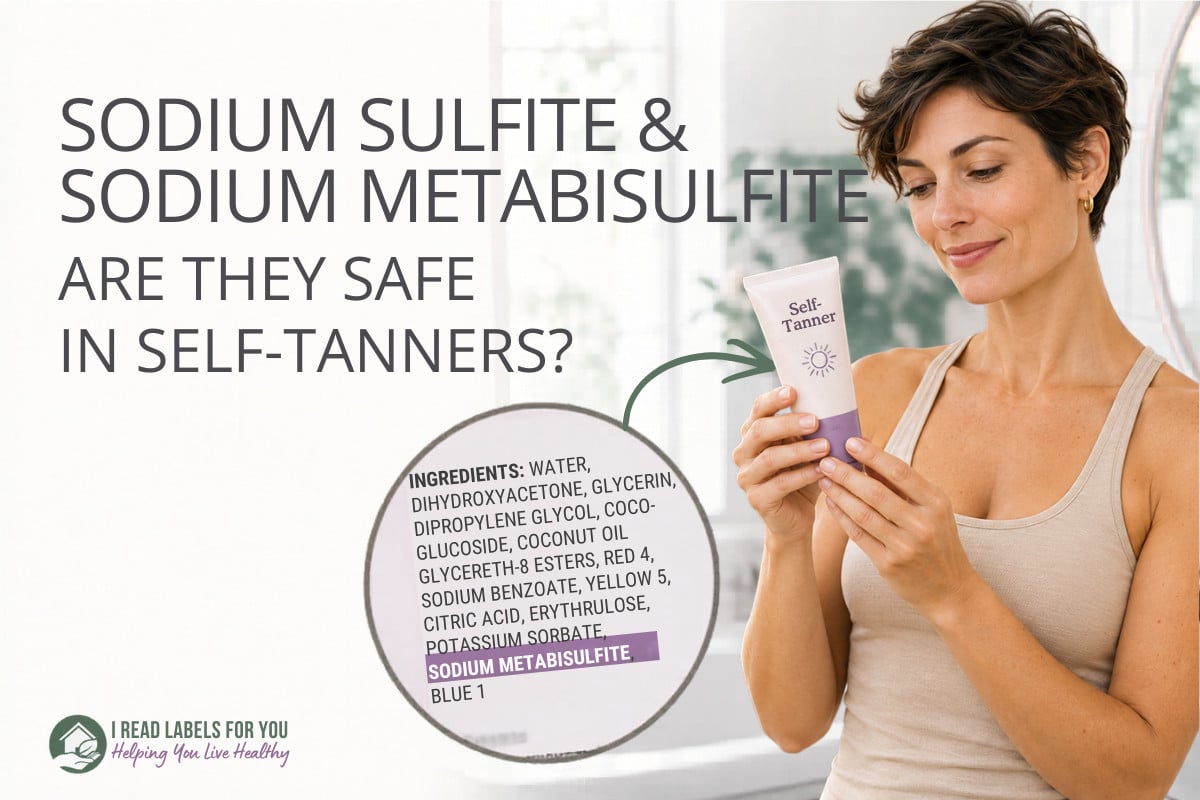
Yes, Sodium Sulfite and Sodium Metabisulfite are safe for most people in cosmetics, but not if you have a sulfite allergy or sulfite-sensitive asthma. Both are sulfite salts that protect formulas from air, mostly in hair dye. Neither is linked to cancer or hormone disruption, but both can cause skin allergy in some people. I rate them Better (Not In My Top Picks).
Sodium Sulfite and Sodium Metabisulfite are allowed in European Union cosmetics only within set limits. These include 0.2% as a preservative and 0.67% in oxidative hair dye. In food, Europe’s food safety agency withdrew its safe daily intake for sulfites in 2022, warning that diet alone raises a safety concern. Neither the U.S. nor Canada limits either ingredient in cosmetics.
Keep reading to discover:
- why a standard patch test can miss a sulfite allergy
- which product type puts the most sulfites on your skin
- why European food scientists now say food alone may supply too many sulfites
What Are Sodium Sulfite And Sodium Metabisulfite?
Sodium Sulfite and Sodium Metabisulfite are white, salty-looking powders made of sodium and sulfur-oxygen ions. They belong to the sulfite family, a group of ingredients that grab oxygen before it can spoil a product.
The two are close cousins. In water, Sodium Metabisulfite breaks apart into bisulfite, which settles into the same sulfite chemistry as Sodium Sulfite. In fact, the European Union regulates both, along with six relatives, under one shared entry.
What Do Sodium Sulfite and Sodium Metabisulfite Do In Cosmetics?
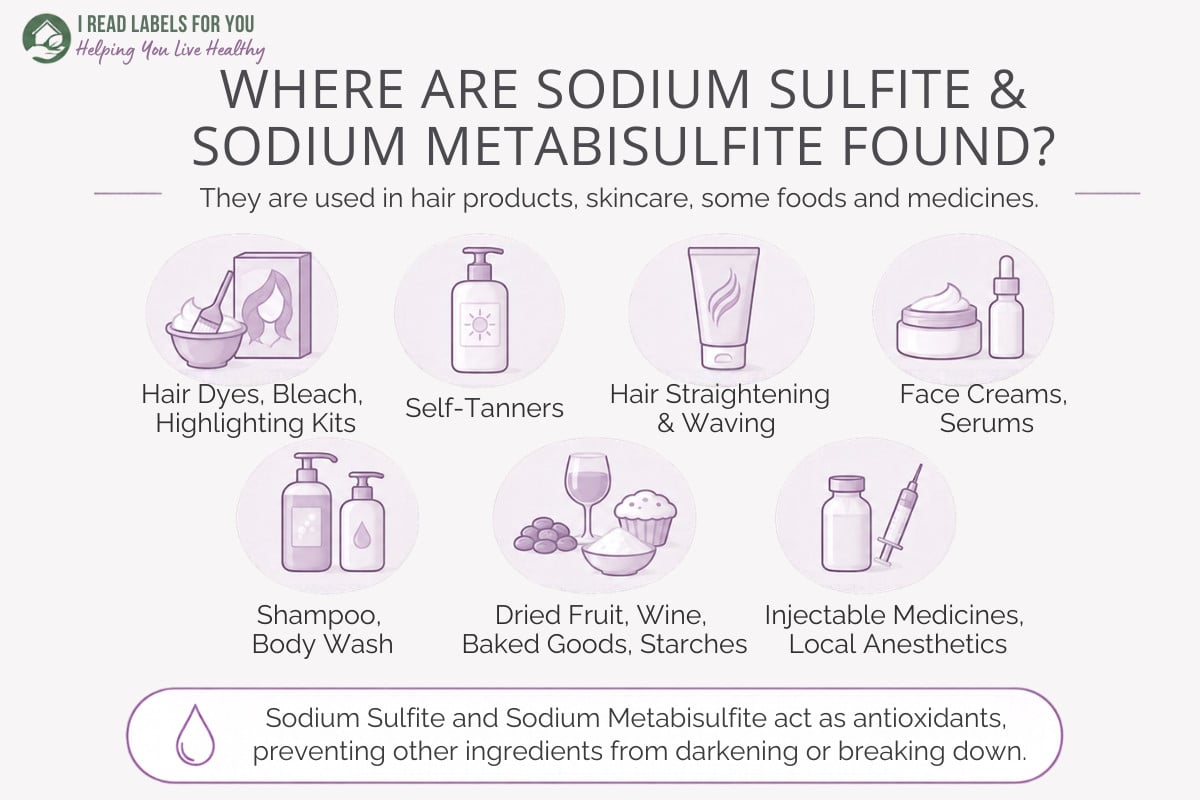
Their main job is to act as antioxidants and reducing agents. Simply put, they react with oxygen first, which keeps other ingredients from darkening or breaking down. Besides that, Sodium Sulfite helps reshape hair in waving and straightening products, while Sodium Metabisulfite can also work as a preservative.
Hair dye dominates. According to the industry-funded Cosmetic Ingredient Review (CIR), 1,525 of the 1,713 reported uses of Sodium Sulfite in 2020 were in hair coloring. Similarly, Sodium Metabisulfite appeared in 916 products, 537 of them hair color.
Use levels are low. Sodium Sulfite was reported at up to 3% in rinse-off products and 0.12% in leave-on products. Sodium Metabisulfite topped out at 0.6% in rinse-off and 0.25% in leave-on products.
You’ll find Sodium Sulfite and Sodium Metabisulfite most often in:
- permanent and semi-permanent hair dyes
- hair bleach and highlighting kits
- self-tanners
- hair straightening and waving products
- face creams and serums
- shampoo and body wash
- dried fruit and wine
- baked goods and food starches
- some injectable medicines and local anesthetics
How Are Sodium Sulfite And Sodium Metabisulfite Made?
Both start with sulfur dioxide, a toxic gas, which manufacturers bubble through sodium hydroxide or a sodium carbonate (soda ash) solution. First, this forms sodium bisulfite. Next, adding more soda ash yields Sodium Sulfite, while removing water joins two bisulfite units into Sodium Metabisulfite.
The manufacturing chemicals are harsh, but none of them is a carcinogen or a skin allergen, and they leave no organic residue. The real impurities are metals. For instance, the EU food-grade specification allows up to 3 mg/kg of arsenic, 2 mg/kg of lead, and 1 mg/kg of mercury.
Those metal limits are a known weak spot. In its 2016 re-evaluation of sulfites, the European Food Safety Authority (EFSA) asked for the arsenic, lead, and mercury limits to be revised. I found no cosmetic-grade impurity data for either ingredient.
Do Sodium Sulfite And Sodium Metabisulfite Penetrate The Skin?
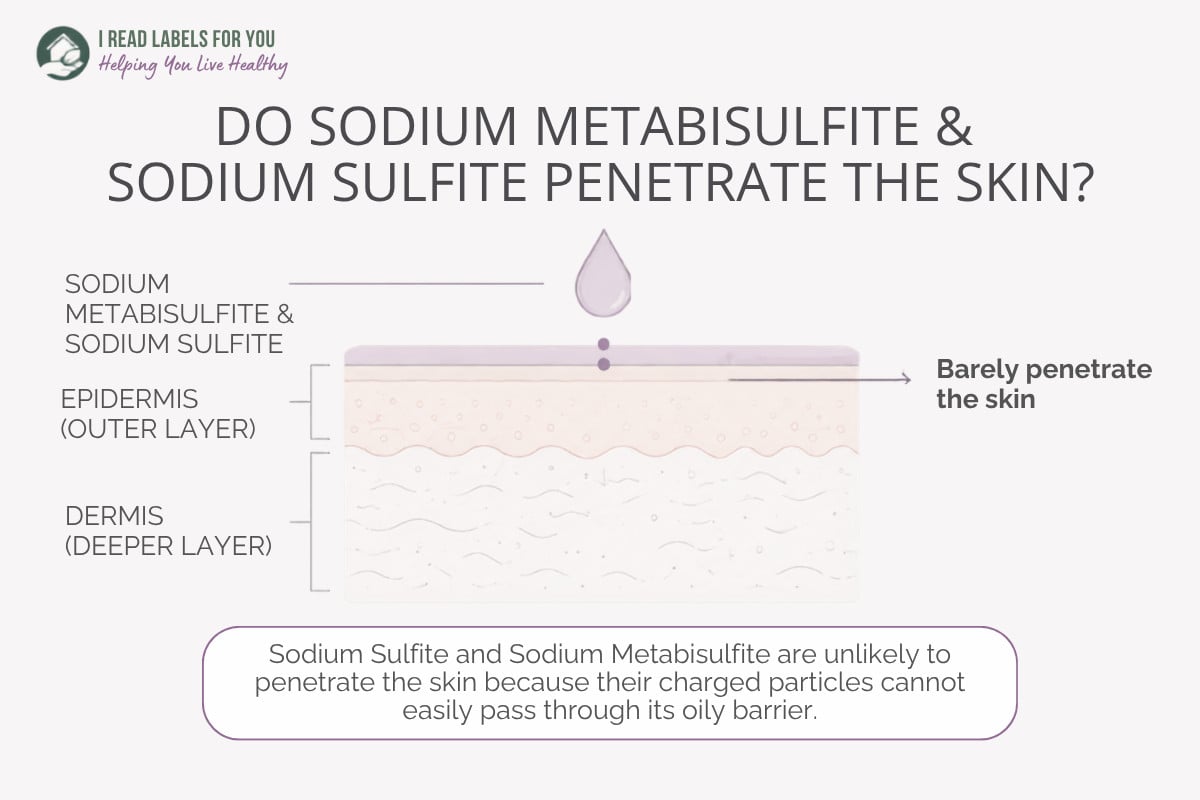
Very little, as far as anyone can tell, although no one has ever measured it. The main barrier is electric charge, not size. Both are salts that split into charged ions, and particles carrying a charge are repelled by the fatty layer on top of your skin.
Size alone would not stop them. Sodium Sulfite weighs 126 daltons and Sodium Metabisulfite 190 daltons, a dalton being a unit of molecular size. Molecules below roughly 500 daltons can pass between skin cells, but only if they also mix with skin oils.
That oil test is where they fail. LogP measures whether a molecule prefers oil or water, and fully charged salts like these have no meaningful LogP at all. Instead, they stay dissolved in water, where your skin’s barrier keeps them out.
Europe’s Scientific Committee on Cosmetic Products and Non-Food Products (SCCNFP), the forerunner of today’s SCCS, assumed up to 10% absorption as a worst case. Whatever does get in is converted to harmless sulfate by an enzyme called sulfite oxidase. Still, low absorption does not prevent allergy, which starts on the skin’s surface.
What Are Sodium Sulfite and Sodium Metabisulfite Called On Labels?
Sodium Sulfite may appear as:
- Sodium Sulfite
- Sodium Sulphite
- Disodium Sulfite
- Anhydrous Sodium Sulfite
- Sulfurous Acid, Disodium Salt
- E 221 (in food)
Sodium Metabisulfite may appear as:
- Sodium Metabisulfite
- Sodium Metabisulphite
- Sodium Disulfite
- Sodium Pyrosulfite
- Disodium Pyrosulfite
- Disodium Disulfite
- E 223 (in food)
Does The U.S. FDA Restrict Sodium Sulfite And Sodium Metabisulfite In Food And Cosmetics?
For cosmetics, the answer is no. Neither sulfite appears among the U.S. Food and Drug Administration (FDA) banned and restricted cosmetic ingredients, and the agency sets no concentration limit.
In food, the FDA lists both as generally recognized as safe (GRAS), with exceptions. Under its rules for sodium sulfite and sodium metabisulfite, neither may go on raw produce, in meats, or in foods relied on for vitamin B1.
Those exceptions followed reports of harm. According to the 2003 CIR report, the FDA reviewed 22 deaths and judged 9 probably and 5 possibly caused by eating sulfites. All were in people with asthma. Today, the FDA requires a label on any food with 10 parts per million (ppm) or more of sulfite.
GRAS deserves caution, however. The program lets companies decide on their own that a food chemical is safe, often without telling the FDA. Europe takes a different path, called the precautionary principle: when the evidence is incomplete, regulators restrict first and wait for proof of safety.
EU Regulations On Sodium Sulfite And Sodium Metabisulfite
Europe permits both ingredients in cosmetics, but under two separate limits. As preservatives, they fall under Annex V, entry 9 of the EU Cosmetics Regulation, capped at 0.2% measured as free sulfur dioxide. By my calculation, that equals about 0.39% Sodium Sulfite or 0.30% Sodium Metabisulfite.
For other uses, Annex III, entry 99 sets these maximums, all measured as free sulfur dioxide:
- oxidative hair dye: 0.67%
- hair straightening products: 6.7%
- self-tanners for the face: 0.45%
- other self-tanners: 0.40%
Those limits rest on the 2003 opinion on inorganic sulfites from the SCCNFP. It found no health risk at these levels, and it called sulfites rare contact allergens. Europe has not reassessed them for cosmetics since.
On hazard classification, the two differ. Europe classifies Sodium Metabisulfite as harmful if swallowed and damaging to the eyes, and as releasing toxic gas on contact with acids. Sodium Sulfite has no harmonized classification.
In food, Europe went further. In its 2022 follow-up opinion, EFSA withdrew the temporary safe daily intake for sulfites, calling the toxicity data inadequate. It also warned that sulfite intake from food raises a safety concern for high consumers in every age group.
U.S. And EU Disagreements On Sodium Sulfite And Sodium Metabisulfite
The two sides split on both fronts. In cosmetics, Europe sets product-by-product caps, while the U.S. sets none. In food, the FDA still treats both sulfites as GRAS, whereas EFSA has dropped its safe daily intake entirely and flagged a safety concern.
Neither side, however, adds up sulfites from food, medicine and cosmetics together. That cumulative picture matters most for people who are sensitive to sulfites.
Canadian Regulations On Sodium Sulfite And Sodium Metabisulfite
Canada does not restrict either ingredient in cosmetics. Neither appears on the Cosmetic Ingredient Hotlist, where Health Canada names the ingredients it prohibits or limits in cosmetics.
Likewise, the toxic substances schedule of the Canadian Environmental Protection Act leaves out both salts. Interestingly, sulfur dioxide, the gas both are made from, is on that list.
Can Sodium Sulfite And Sodium Metabisulfite Cause Skin Allergy And Sensitization?
Yes, Sodium Sulfite and Sodium Metabisulfite can cause skin allergy, although only a small share of people react. The American Contact Dermatitis Society (ACDS) named sulfites its Allergen of the Year for 2024.
The numbers come from patch tests on people with suspected skin allergies. In the North American Contact Dermatitis Group study of 2017 to 2018, 132 of 4,885 patients (2.7%) reacted to Sodium Metabisulfite. Moreover, doctors judged about two-thirds of those reactions relevant to the patient’s rash, with personal care products, especially hair dye, the leading source.
European rates run similar. A 2019 to 2020 European network study found 3.75% of patients positive to Sodium Metabisulfite, and a 20-year Belgian series found 4.5%. Meanwhile, 3.8% of 183 patients reacted to Sodium Sulfite itself in a 2012 Leeds study. Of those allergic to Sodium Metabisulfite, 60% reacted to Sodium Sulfite too.
A sulfite allergy is easy to miss. As the 2024 Allergen of the Year paper points out, sulfites are not in most standard patch test series. Consequently, if your scalp or face reacts to hair dye and tests come back clear, ask your dermatologist to add Sodium Metabisulfite.
Sulfite sensitivity is a separate, more serious problem. A 2009 review of sulfite sensitivity found that 3% to 10% of people with asthma react after eating sulfites, sometimes with severe breathing trouble. For that reason, the CIR advised sulfite-allergic people to take care with sprays and powders they might inhale.
Are Sodium Sulfite And Sodium Metabisulfite Hormone (Endocrine) Disruptors?
No, Sodium Sulfite and Sodium Metabisulfite are not known hormone disruptors. Neither appears on the European Commission’s endocrine disruptor lists for cosmetics, and no regulator has opened an endocrine assessment of either.
A few small rat studies raise questions, though. In a 2015 rat study, Sodium Metabisulfite at 10 to 260 mg per kilogram of body weight for 28 days lowered sperm counts and testosterone. The study also found oxidative stress in the testes, which points to cell damage rather than a hormone mechanism.
Those doses dwarf cosmetic exposure. The SCCNFP’s worst case assumed daily hair dye, self-tanner and preserved products together. Even then, it came to 0.17 mg of sulfur dioxide per kilogram per day. No similar study exists for Sodium Sulfite, and none has tested skin exposure.
Are Sodium Sulfite And Sodium Metabisulfite Safe To Use While Pregnant?
Whether Sodium Sulfite and Sodium Metabisulfite are safe in pregnancy has no clear answer yet, because skin absorption has never been measured. What exists are animal feeding studies, and they are mostly reassuring.
In the same CIR report, Sodium Metabisulfite caused no birth defects in mice, rats, hamsters or rabbits at doses up to 160 mg per kilogram. In a three-generation rat study, though, rats eating 0.5% or more of it had fewer pups in a later generation.
Since hair dye is the main source of both sulfites, pregnancy is a fair time to think about how often you color your hair. Before deciding, you should consult with your medical provider, especially if you have asthma or have ever reacted to sulfites in food.
Are There Any Cancer Concerns Linked To Sodium Sulfite And Sodium Metabisulfite?
No, Sodium Sulfite and Sodium Metabisulfite are not linked to cancer. The International Agency for Research on Cancer (IARC) places sulfites, bisulfites and metabisulfites in Group 3, meaning not classifiable as a human carcinogen.
The key animal study fed rats up to 2% Sodium Metabisulfite for two years. Treated males had more thyroid and pituitary tumors, but the rise did not grow with dose, and the control group’s tumor rate was unusually low.
DNA damage shows up only at extreme exposures, such as test-tube cells or gram-per-kilogram doses in mice. In fact, EFSA concluded in 2022 that the genotoxicity of sulfites does not raise a concern. Neither salt appears in the U.S. National Toxicology Program’s Report on Carcinogens or on California’s Proposition 65 list.
Are Sodium Sulfite And Sodium Metabisulfite Bad For The Environment?
No, Sodium Sulfite and Sodium Metabisulfite are not a known environmental problem. Neither carries an EU environmental hazard classification, and Canada does not list either as toxic.
Once washed down the drain, sulfites gradually react with oxygen and turn into sulfate, a common mineral salt. The bigger environmental burden sits at the factory, where manufacturers handle sulfur dioxide, a toxic gas and air pollutant.
Common Claims About Sodium Sulfite And Sodium Metabisulfite: What’s True And What’s Not
Claim: Sulfites In Food Are Dangerous
Partly true. For most people, sulfites in food cause no reaction at all. However, 3% to 10% of people with asthma react to them, and the FDA linked several deaths to sulfite ingestion before it restricted their use.
The newer concern is broader. EFSA’s 2022 opinion found that high sulfite intake from food raises a safety concern in every age group. It based this on nervous system effects in test animals. Hence, Europe now treats total sulfite intake as an open question rather than a settled one.
Claim: Sodium Sulfite And Sodium Sulfate Are The Same Thing
False. Sodium Sulfite still has the ability to grab oxygen, while sodium sulfate has already reacted fully and does not. In fact, sulfate is what your body turns sulfite into to get rid of it.
The names also cause confusion with “sulfate-free” shampoo. That label refers to cleansers like Sodium Lauryl Sulfate, which have nothing to do with sulfite allergy.
What I Think About Sodium Sulfite And Sodium Metabisulfite, And What You Should Do
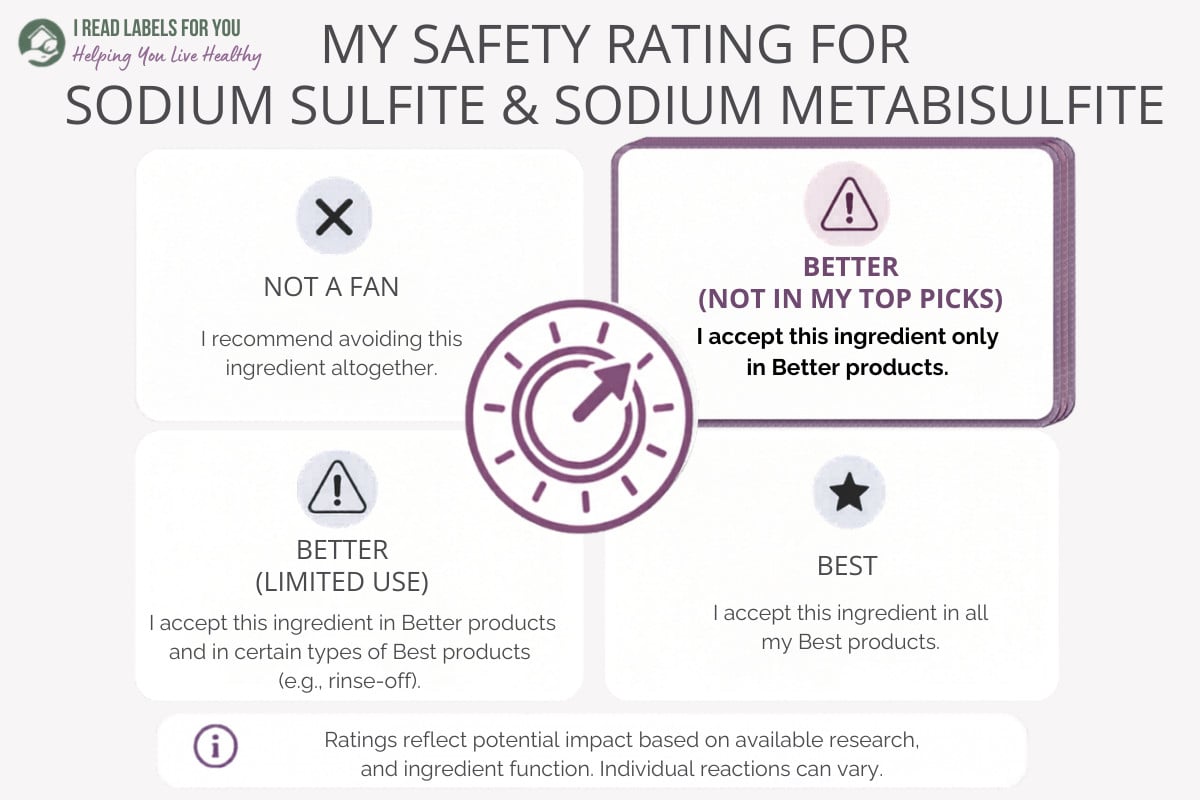
My rating for both Sodium Sulfite and Sodium Metabisulfite is Better (Not In My Top Picks). Neither shows a cancer, hormone or birth-defect signal at cosmetic levels, and very little gets through the skin.
Two things keep them out of my Best products. First, both can cause skin allergy, and that allergy is easy to miss on standard patch tests. Second, Europe’s food scientists say food alone can push sulfite intake into a range of concern, and no one counts the extra from cosmetics.
Accordingly, I accept both in my Better products, but I keep them out of my Best ones. I chose not to limit them by product type, because the risk depends on the person more than the product. Besides, their main use, hair dye, is also the top source of allergic reactions.
Here is what you can do. If your asthma flares with wine or dried fruit, or you have reacted to sulfites, skip products listing either name, especially sprays and powders. Otherwise, there is no reason to panic over a trace of either in your shampoo.
Frequently Asked Questions About Sodium Sulfite And Sodium Metabisulfite
What Are Sodium Sulfite And Sodium Metabisulfite Used For?
Beyond cosmetics, both keep food from browning and spoiling, and they help control fermentation in winemaking. Moreover, a review of sulfite reactions to medicines found sulfites in injectable drugs such as epinephrine and dexamethasone. They also appear in photographic developers and leather processing.
What Is The Common Name For Sodium Metabisulfite?
Sodium Metabisulfite also goes by sodium pyrosulfite and sodium disulfite. In food, it’s listed as E 223, and home winemakers know it from Campden tablets.
What Is The Difference Between Sodium Metabisulfite And Potassium Metabisulfite?
The only difference is the metal attached: sodium in one, potassium in the other. Both release the same sulfite in water, and patch-test patients who react to one usually react to the other.
Is Sodium Metabisulfite In Wine Safe?
For most people, sulfites in wine cause no problem. If you react to sulfites, however, wine deserves attention. In a 2014 to 2023 Melbourne patch-test study, wine and dried fruit were the main sources of relevant sulfite reactions.
Is Sodium Sulfite The Same As Salt?
No. Table salt is sodium chloride. Sodium Sulfite shares the sodium, but its sulfite part behaves completely differently, and it’s the part that causes allergies.
Why Does EWG Rate Sodium Sulfite And Sodium Metabisulfite Differently?
The Environmental Working Group (EWG) scores Sodium Sulfite 1 to 4 and Sodium Metabisulfite 2 to 6, depending on whether the product can be inhaled. It rates the allergy concern for Sodium Sulfite as low and for Sodium Metabisulfite as moderate.
My rating is stricter because I treat both as one sulfite allergy problem, since patients who react to one often react to the other. I also weigh the fact that standard patch tests can miss sulfite allergy, and EFSA’s 2022 warning about sulfite intake from food.
Sources
EU SCCS / SCCP Opinions:
SCCNFP/0648/03, final, Opinion concerning Inorganic Sulfites and Bisulfites (COLIPA P51), adopted March 18, 2003. No health risk at the Annex III levels; “rare contact allergens”: SCCNFP/0648/03
No later SCCS or SCCP opinion on Sodium Sulfite or Sodium Metabisulfite (checked). SCCS opinions portal: SCCS opinions
Cosmetic Ingredient Review (CIR) Reports:
CIR reports are funded by the Personal Care Products Council, the cosmetics industry trade group.
Nair B, Elmore AR, Cosmetic Ingredient Review Expert Panel, 2003. Final Report on the Safety Assessment of Sodium Sulfite, Potassium Sulfite, Ammonium Sulfite, Sodium Bisulfite, Ammonium Bisulfite, Sodium Metabisulfite and Potassium Metabisulfite. International Journal of Toxicology 22(Suppl 2):63 to 88. Manufacturing, patch tests, animal reproduction and cancer studies, FDA death review: cir-reports.cir-safety.org
Johnson W Jr et al., 2023. Sulfites (re-review). International Journal of Toxicology 42(Suppl 3):110S to 114S. 2020 use counts and concentrations: cir-reports.cir-safety.org
European Union Regulatory Databases:
CosIng, SODIUM SULFITE, functions antioxidant, hair waving or straightening, reducing; Annex III/99 and V/9: CosIng SODIUM SULFITE
CosIng, SODIUM METABISULFITE, functions antioxidant, preservative, reducing; Annex III/99 and V/9: CosIng SODIUM METABISULFITE
The CosIng, Annex III entry 99, inorganic sulfites and bisulfites, limits for hair dye, hair straightening and self-tanners: Annex III/99
The CosIng, Annex V entry 9, inorganic sulfites and bisulfites as preservatives, 0.2% as free sulfur dioxide: Annex V/9
Regulation (EC) No 1223/2009 on cosmetic products, consolidated version: EUR-Lex 1223/2009
CLP Annex VI harmonized classifications (2026 table): sodium metabisulphite, index 016-063-00-2, Acute Tox. 4, H302; Eye Dam. 1, H318; EUH031. No entry for sodium sulfite: CLP Annex VI
The ECHA CHEM, disodium disulphite (EC 231-673-0), harmonized classification: ECHA CHEM, sodium metabisulfite
ECHA CHEM, disodium disulphite, regulatory activities; substance evaluation by Hungary, 2014 to 2015, closed: ECHA CHEM activities
ECHA CHEM, sodium sulphite (EC 231-821-4), no harmonized classification: ECHA CHEM, sodium sulfite
Commission Regulation (EU) No 231/2012, food additive specifications for E 221 and E 223, including metal limits: EUR-Lex 231/2012
EFSA Panel on Food Additives and Nutrient Sources added to Food, 2016. Scientific Opinion on the re-evaluation of sulfur dioxide (E 220), sodium sulfite (E 221), sodium bisulfite (E 222), sodium metabisulfite (E 223) and related sulfites as food additives. EFSA Journal 14(4):4438: EFSA Journal 2016
EFSA Panel on Food Additives and Flavourings, 2022. Follow-up of the re-evaluation of sulfur dioxide (E 220) and sulfites (E 221 to E 228). EFSA Journal 20(11):7594. Temporary group ADI withdrawn; dietary exposure “raises a safety concern”: EFSA Journal 2022
European Commission, endocrine disruptors in cosmetics; neither ingredient listed (checked): European Commission endocrine disruptors page
Other Regulators:
U.S. FDA, 21 CFR 182.3798, Sodium sulfite, GRAS with use limits: 21 CFR 182.3798
U.S. FDA, 21 CFR 182.3766, Sodium metabisulfite, GRAS with use limits: 21 CFR 182.3766
U.S. FDA, 21 CFR 101.100, labeling of sulfiting agents at 10 ppm or more: 21 CFR 101.100
U.S. FDA, prohibited and restricted ingredients in cosmetics; neither listed: FDA prohibited and restricted ingredients
Health Canada, Cosmetic Ingredient Hotlist; neither listed: Cosmetic Ingredient Hotlist
Environment and Climate Change Canada, CEPA Schedule 1; neither listed (sulfur dioxide is listed): CEPA Schedule 1
IARC, List of Classifications; sulfites, bisulfites and metabisulfites, Group 3, Volume 54 (1992): IARC List of Classifications
IARC Monographs Volume 54, Sulfur Dioxide and Some Sulfites, Bisulfites and Metabisulfites, evaluation: IARC Volume 54
U.S. National Toxicology Program, Report on Carcinogens, Fifteenth Edition; neither listed: NTP Report on Carcinogens
California Proposition 65 list; neither listed (sulfur dioxide is listed for developmental toxicity): Proposition 65 list
The PubChem Records (Chemistry, Identifiers, Skin Penetration, Hazard Codes):
PubChem CID 24437, Sodium Sulfite, molecular weight 126.05: PubChem CID 24437
PubChem CID 656671, Sodium Pyrosulfite (Sodium Metabisulfite), molecular weight 190.11: PubChem CID 656671
Peer-Reviewed Studies:
North American Contact Dermatitis Group, 2021. Patch testing with sodium disulfite: North American Contact Dermatitis Group experience, 2017 to 2018. Dermatitis. PMID 33843061: PubMed 33843061
European Surveillance System on Contact Allergies (ESSCA) network, 2022. Patch-test results from 2019 and 2020, including sodium metabisulfite 1%. PMID 35099073: PubMed 35099073
García-Gavín J et al., 2012. Allergic contact dermatitis caused by sodium metabisulfite: a challenging allergen: a case series and literature review. Contact Dermatitis. PMID 23039002: PubMed 23039002
Oliphant T, Mitra A, Wilkinson M, 2012. Leeds patch-test study of sodium sulfite and sodium metabisulfite in 183 patients. Contact Dermatitis. PMID 22320666: PubMed 22320666
ACDS Allergen of the Year 2024, sulfites. Dermatitis. PMID 37590472: PubMed 37590472
Vally H et al., 2009. Review of the clinical effects of sulfite additives. Clinical and Experimental Allergy. PMID 19775253: PubMed 19775253
Melbourne patch-test series, 2014 to 2023, sodium metabisulfite reactions and their sources. PMID 42486535: PubMed 42486535
Review of adverse reactions to sulfites in parenteral medicines, 1992. PMID 1433430: PubMed 1433430
Rat study of oral sodium metabisulfite and the testes, International Journal of Reproductive BioMedicine, 2015. PMID 27141536: PubMed 27141536
CIR 2003 sulfites report as indexed in PubMed. PMID 14555420: PubMed 14555420
Natural Cosmetic Standards:
COSMOS-standard approved raw materials; neither ingredient found: COSMOS-standard approved raw materials
NATRUE certified and approved raw materials; neither ingredient found: NATRUE certified raw materials
Skin Allergy Resource:
American Contact Dermatitis Society (ACDS), Helpful References, including the Core Allergen Series 2020. Sulfites, Allergen of the Year 2024; not on the 2020 core series: ACDS Helpful References
Advocacy groups:
Environmental Working Group (EWG) Skin Deep, Sodium Sulfite, score 1 to 4 depending on use: EWG Sodium Sulfite
Environmental Working Group (EWG) Skin Deep, Sodium Metabisulfite, score 2 to 6 depending on use: EWG Sodium Metabisulfite
Last verified: 11-08-2026
Download The Free Guide!
5 Powerful Steps To A Non-Toxic Home
Join our informed consumer community and get our free guide the “5 Powerful Steps To A Non-Toxic Home”.

Before commenting, please read our Comment Policy.