
Is Sodium Acrylates Copolymer Safe? A Simple Answer You Can Trust
 Written by Irina Webb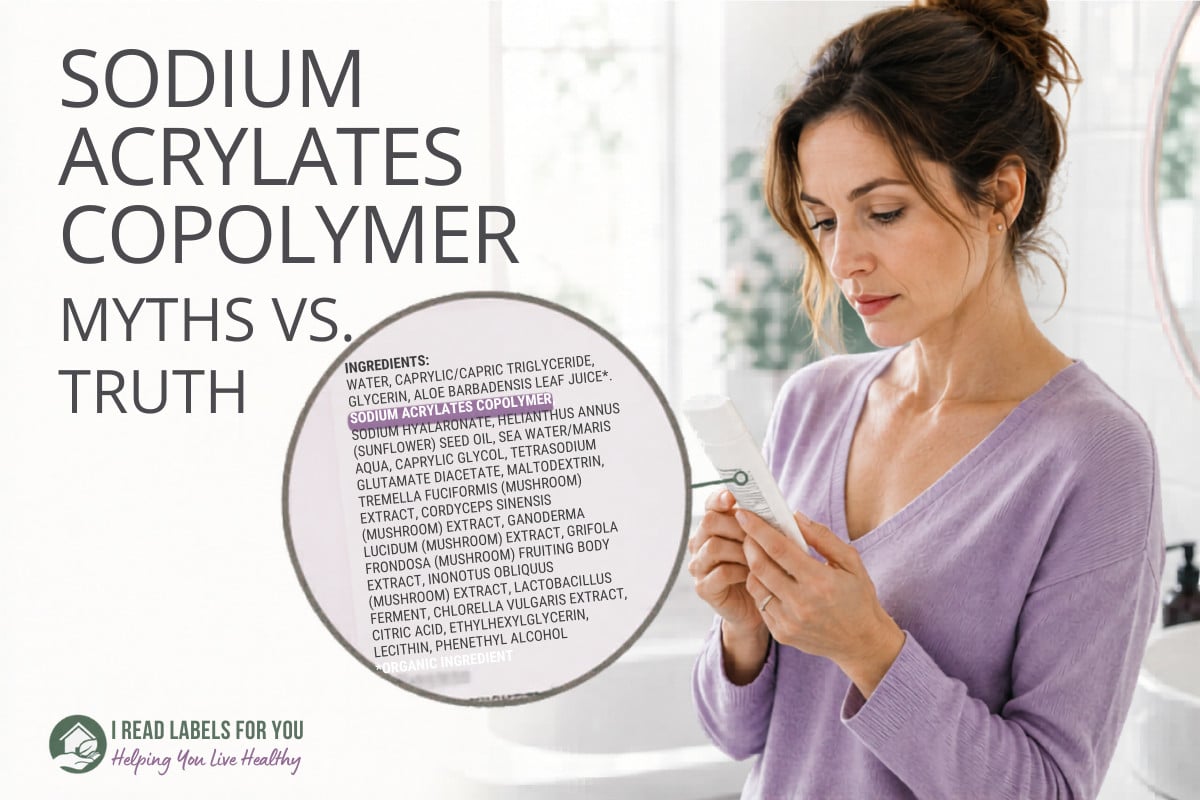
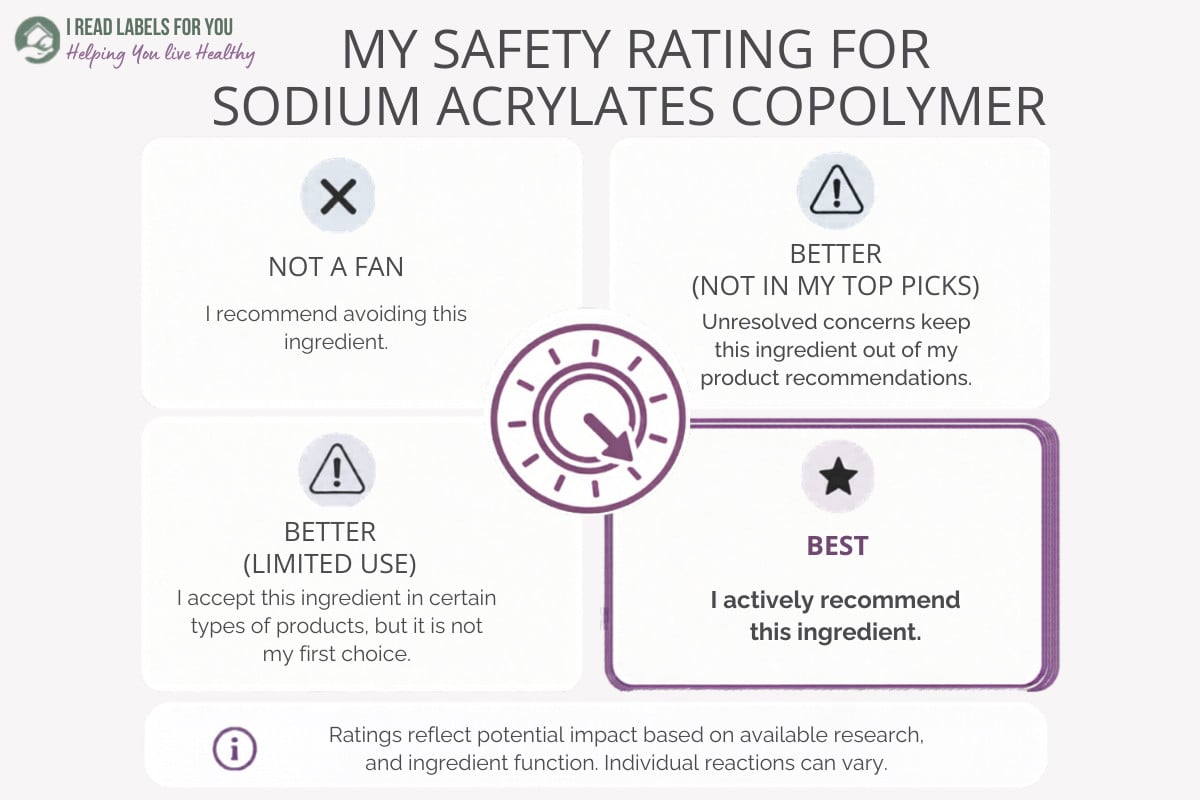
Yes, Sodium Acrylates Copolymer is safe. It’s a thickener and film former that carries no concerns related to cancer, hormone disruption, reproductive toxicity, contact allergy or sensitization. It does not penetrate the skin, and trace leftover acrylic acid sits far below any irritation level. I rate this ingredient Best.
The European Union sets no concentration limits on Sodium Acrylates Copolymer, no product-type restrictions, and no required warning labels. The EU Scientific Committee on Consumer Safety has not issued their opinion on this ingredient, which fits its low-concern profile.
Below, you will find out if Sodium Acrylates Copolymer has any skincare benefits, if it’s a microplastic that suffocates your skin, and why the acrylate-related allergy worry does not apply here.
What Is Sodium Acrylates Copolymer?
Sodium Acrylates Copolymer is a performance booster in the products we put on our skin and hair. It doesn’t treat or change skin. Instead, it shapes how a product feels and behaves.
What Does Sodium Acrylates Copolymer Do In Cosmetics?
Sodium Acrylates Copolymer is a thickener and film former. It makes products thicker, so they feel gel-like or creamy. It also holds water in a stable mix, and it forms a flexible film as products dry on skin or hair.
Sodium Acrylates Copolymer belongs to a large family of acrylates copolymers used across cosmetics. Other members of this family share similar safety profiles and similar jobs.
You’ll find Sodium Acrylates Copolymer most often in:
- gels and serums
- lotions and creams
- hair styling products
- sunscreens (as a film former)
- eye-area products such as eyeliner and brow gel
- some color cosmetics
How Is Sodium Acrylates Copolymer Made?
Sodium Acrylates Copolymer is a polymer built from two related building blocks: acrylic acid and methacrylic acid. It’s used in its sodium salt form, which makes it water-soluble and easy to formulate with.
To begin with, both starting materials are industrially produced chemicals. In their concentrated raw form, the European Union classifies both as skin corrosives.
Here’s an important point about corrosives. Allergens can trigger a reaction at very low amounts, because they work through the immune system. Corrosives and irritants are different from allergens because they’re dose-dependent. They have to be present in a high enough amount to damage skin. Below that level, no reaction happens.
In contrast, in the finished polymer, the long molecule locks in both acids. So they can’t interact with skin.
Furthermore, manufacturing leaves behind only tiny residual amounts of unreacted acrylic acid. These typically run from 10 to 1,000 parts per million. That’s well below the levels needed for any corrosive or irritant effect.
Does Sodium Acrylates Copolymer Penetrate The Skin?
No. Sodium Acrylates Copolymer is too large to penetrate intact skin.
It belongs to a group of large molecules called polymers. These molecules are much larger than the 500-Dalton size limit that scientists often use to estimate whether a substance can pass through the skin. Because of their size, they stay on the skin’s surface.
In its 2018 safety assessment, the Cosmetic Ingredient Review (CIR) Expert Panel concluded that acrylates copolymers act as film-forming and thickening agents and are not expected to enter the bloodstream.
Some products may contain trace amounts of residual acrylic acid left over from manufacturing. Unlike the polymer, acrylic acid is small enough that it could theoretically pass through the skin. However, the amount present is extremely low, often less than 5 parts per million, so meaningful exposure is unlikely.
It’s also worth noting that the European Union does not classify acrylic acid as a carcinogen, mutagen, reproductive toxicant, endocrine disruptor, or skin allergen. Its main hazard is that concentrated acrylic acid can be corrosive, but that does not apply to the tiny amounts that may be present in finished cosmetic products.
What Is Sodium Acrylates Copolymer Called On Labels?
On a label, you’ll see Sodium Acrylates Copolymer written out in full. You may also spot related members of the same family:
- Acrylates Copolymer
- Acrylates Crosspolymer
- Sodium Polyacrylate
- Acrylates/C10-30 Alkyl Acrylate Crosspolymer
Does The U.S. FDA Restrict Sodium Acrylates Copolymer In Food And Cosmetics?
In cosmetics, no. The U.S. Food and Drug Administration (FDA) does not ban or restrict Sodium Acrylates Copolymer. It’s widely used as a thickener and film former in lotions, gels, sunscreens, and color cosmetics.
Conversely, in food it’s a different story. The FDA has not approved Sodium Acrylates Copolymer as a food additive, so it’s a cosmetic-use polymer only.
Related sodium polyacrylates do appear in food packaging and other indirect food-contact uses, under specific FDA rules. But the cosmetic-grade ingredient isn’t meant for direct food contact.
Here’s some important context. The FDA doesn’t review cosmetic ingredients before products reach store shelves. It usually acts only after someone reports a safety problem.
Even so, the Cosmetic Ingredient Review (CIR), the U.S. industry safety panel, published thorough reviews in 2002 and 2018. Both cleared Sodium Acrylates Copolymer for cosmetic use.
EU Regulations About Sodium Acrylates Copolymer
The European Union doesn’t restrict Sodium Acrylates Copolymer. The EU lists it in its Cosmetic Ingredient Database (CosIng) as an Inventory ingredient with no Annex listing. In plain terms, that means no concentration limits, no product-type restrictions, and no required warning labels.
In addition, CosIng records its cosmetic jobs as binding, film forming, opacifying, and viscosity controlling. These are all surface-level, structural roles.
The European Chemicals Agency (ECHA) shows no registration for the polymer under REACH, the EU’s main chemical safety law. In other words, it isn’t registered as a separate substance.
On top of that, it’s not on the Candidate List of Substances of Very High Concern. It’s also not on the REACH lists for authorization (Annex XIV) or restriction (Annex XVII).
The EU has not issued a Scientific Committee on Consumer Safety (SCCS) opinion on Sodium Acrylates Copolymer. It did publish a 2018 SCCS opinion on a related but different ingredient, Styrene/Acrylates copolymer in nanoparticle form. That opinion doesn’t apply to standard Sodium Acrylates Copolymer used in dissolved cosmetic form.
Indeed, the lack of an SCCS review here fits its low-concern profile. SCCS reviews usually start because of a safety signal. Routine, well-understood ingredients without red flags simply don’t trigger one.
Canadian Regulations About Sodium Acrylates Copolymer
Health Canada has not banned or restricted Sodium Acrylates Copolymer in cosmetics. It’s not on the Cosmetic Ingredient Hotlist of prohibited or restricted ingredients.
Likewise, Environment and Climate Change Canada hasn’t listed it either. It’s not on Schedule 1 of the Canadian Environmental Protection Act (CEPA), the country’s list of toxic substances.
Can Sodium Acrylates Copolymer Cause Skin Allergy And Sensitization?
Skin allergy from Sodium Acrylates Copolymer is very rare.
The Cosmetic Ingredient Review (CIR) examined studies in both humans and animals and found no evidence that this ingredient causes skin sensitization. In one human study, a 25% Acrylates Copolymer solution was tested on 47 people. In another, undiluted Sodium Polyacrylate was tested on 50 people. Neither study found irritation or allergic reactions.
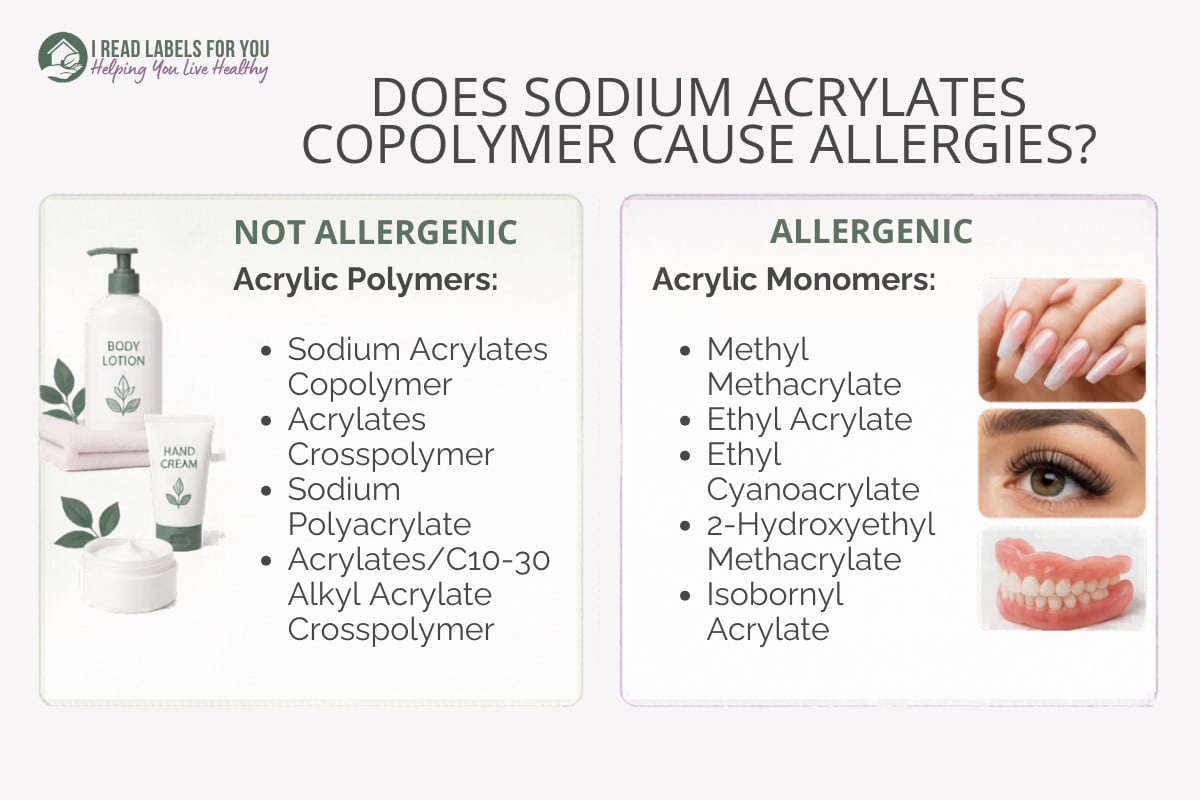
In 2012, the American Contact Dermatitis Society (ACDS) Society named acrylates “Allergen of the Year.” However, that designation referred to small, reactive acrylate chemicals such as methyl methacrylate, ethyl acrylate, and 2-hydroxyethyl methacrylate. These ingredients are commonly used in gel nails, acrylic nails, dental materials, eyelash adhesives, and some medical devices.
A 2021 review by Kucharczyk et al. in Advances in Dermatology and Allergology found that acrylate allergies have increased in recent years. However, the review pointed to exposure to these small, uncured acrylate molecules as the main cause. It also noted that acrylic polymers are relatively inert and that allergic reactions are primarily linked to the reactive monomers, not the finished polymers.
Sodium Acrylates Copolymer is a fully polymerized ingredient. Finished cosmetic products contain only trace amounts of residual monomers, typically 1 to 5 parts per million. Besides, the review doesn’t flag finished lotions, creams, or sunscreens with acrylate copolymers as a meaningful source of acrylate allergy.
Is Sodium Acrylates Copolymer A Hormone (Endocrine) Disruptor?
No. There’s no evidence that Sodium Acrylates Copolymer interferes with hormones in the body. It’s not listed on any ECHA endocrine disruptor assessment, and the CIR panel didn’t flag endocrine activity as a concern.
There’s also no plausible mechanism for it. A large polymer that doesn’t cross skin can’t reach hormone receptors inside the body.
Is Sodium Acrylates Copolymer Safe To Use While Pregnant?
No regulator has placed pregnancy-specific restrictions on Sodium Acrylates Copolymer. The CIR 2018 review didn’t raise any reproductive or developmental concerns.
The polymer doesn’t penetrate skin, so meaningful exposure during pregnancy is implausible.
Still, for pregnancy-related questions about any cosmetic ingredient, you should consult with your medical provider, who knows your full medical history.
Are There Any Cancer Concerns Linked To Sodium Acrylates Copolymer?
No major regulatory body classifies Sodium Acrylates Copolymer as a carcinogen.
The International Agency for Research on Cancer (IARC) hasn’t classified it. It’s also not on the U.S. National Toxicology Program’s 15th Report on Carcinogens.
It’s not on California’s Proposition 65 list. And the U.S. Environmental Protection Agency’s Integrated Risk Information System hasn’t assessed it.
Furthermore, the lab data backs this up. Standard DNA-damage tests (the Ames mutagenicity test) on Acrylates Copolymer were negative, as reported to the CIR. Long-term feeding studies on related acrylic acid polymers in rats showed no cancer activity.
There’s one historical finding worth addressing. One specific monomer in the wider acrylates family, 2-ethylhexyl acrylate, caused tumors in C3H mice when painted on their skin at 21 percent.
This doesn’t apply to Sodium Acrylates Copolymer, for two reasons. First, 2-ethylhexyl acrylate isn’t a typical monomer used to make it. Second, even where related esters show up as residuals, finished products usually hold under 5 parts per million.
Indeed, that’s many thousands of times below the levels that caused tumors in those mouse studies.
Is Sodium Acrylates Copolymer Bad For The Environment?
Here the answer is more mixed, but still reassuring: moderate concern, not severe.
Acrylic acid, the residual monomer, carries an EU classification as Aquatic Acute 1, which means very toxic to aquatic life. That sounds alarming on its own.
But acrylic acid is readily biodegradable. Microorganisms break it down in standard wastewater treatment. Unlike pollutants that build up over time, it doesn’t linger once it reaches water systems.
Moreover, the amount reaching waterways from cosmetics is very small. Residual acrylic acid in the raw polymer runs about 10 to 1,000 parts per million.
From there, the polymer makes up at most 18 percent of a finished product. You dilute it further during use, and wastewater treatment handles the rest. So the total acrylic acid load on aquatic ecosystems from cosmetic-grade Sodium Acrylates Copolymer is modest.
In addition, the polymer itself has no EU environmental classification. It’s not on the Substances of Very High Concern list.
One more environmental angle deserves attention: microplastics. In October 2023, the EU adopted Commission Regulation (EU) 2023/2055, which phases out intentionally added microplastics in cosmetics.
That rule targets synthetic polymers in solid particle form. Solid-particle uses of Sodium Acrylates Copolymer are rare. It’s commonly used in dissolved, gel, or solubilized form and doesn’t fall under the restriction.
Common Claims About Sodium Acrylates Copolymer: What’s True And What’s Not
Claim: Sodium Acrylates Copolymer Is A Microplastic
Mostly false, with some nuance. Sodium Acrylates Copolymer is a synthetic polymer. But the EU’s microplastics rule specifically targets polymers in solid particle form that persist in the environment.
Used in dissolved or gel form, which is essentially all cosmetic use, it doesn’t qualify as a microplastic under the regulation. The rule clearly carves out water-soluble polymers and polymers that don’t form lasting solid particles.
Claim: Synthetic Polymers Are Bad For Skin
Not supported by the evidence. Safety depends on the specific chemistry of an ingredient, not on whether it’s synthetic or natural. Synthetic and plant-derived polymers both follow that rule.
Sodium Acrylates Copolymer has no record as an allergen or skin sensitizer at cosmetic use levels. It doesn’t appear on the American Contact Dermatitis Society Core Allergen Series, or on any other major contact-dermatitis list.
Decades of wide use in lotions, gels, sunscreens, and color cosmetics haven’t produced a real pattern of skin reactions. Its synthetic origin isn’t a safety concern by itself.
Claim: Acrylates Cause Skin Allergy
Partly true, but not for Sodium Acrylates Copolymer.
“Acrylates” is a big family of chemicals. Some are small, reactive molecules called monomers. Others are finished polymers built from those monomers.
The two kinds behave very differently on skin. The acrylates that can cause skin allergy are monomers, such as:
- 2-hydroxyethyl methacrylate (HEMA)
- methyl methacrylate (MMA)
- ethylene glycol dimethacrylate (EGDMA)
- ethyl cyanoacrylate
- isobornyl acrylate.
They can cause allergy when wet, uncured material sits on or near the skin. Think gel and acrylic nails, dental work, eyelash glue, surgical glue, and the adhesive parts of insulin pumps and glucose sensors.
Sodium Acrylates Copolymer is a finished polymer, not a monomer. The only acrylate it carries is a tiny leftover amount of acrylic acid, usually 1 to 5 parts per million in the final product.
Acrylic acid is also chemically different from those allergy-causing acrylates. Those are ester forms; acrylic acid is the parent acid.
The reactivity that lets the esters bind to skin proteins is dampened in the free acid. That’s why the EU doesn’t classify acrylic acid as a skin sensitizer. It’s classified as a corrosive at high concentrations, not as an allergen at any level.
The polymer itself has no record of causing skin allergy, and it doesn’t appear on any major contact-allergen list. Bottom line: yes, some acrylate monomers cause skin allergy in nail, dental, and medical-device settings. Sodium Acrylates Copolymer isn’t one of them.
Claim: Sodium Acrylates Copolymer Suffocates The Skin Or Prevents It From Breathing
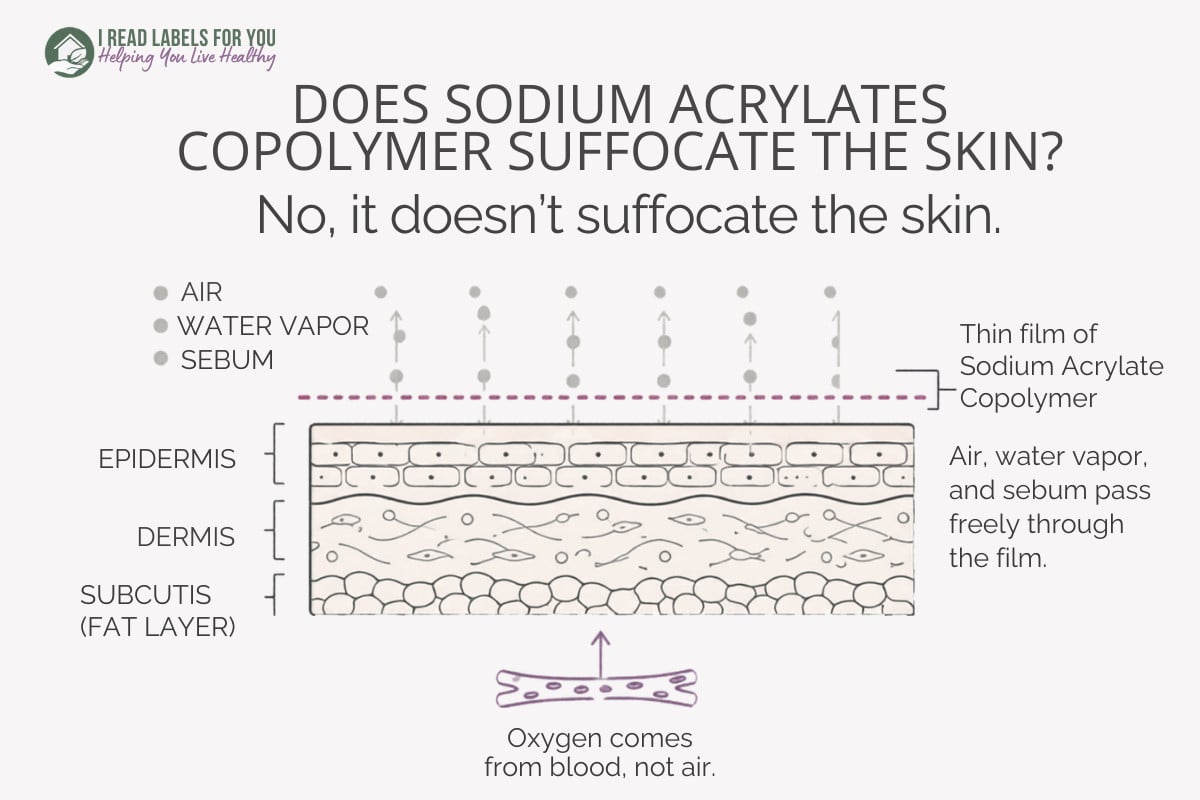
Anatomically, this one doesn’t hold up. Skin doesn’t “breathe” the way lungs do. Skin cells get almost all their oxygen from the bloodstream beneath them, not from the air.
Pores push sebum and sweat outward; they don’t pull oxygen in. The popular idea that skin needs to “breathe” through pores is a marketing concept, not a physiological one.
Beyond that, the film Sodium Acrylates Copolymer forms is very thin and lets gases through. It isn’t a heavy occlusive barrier like petrolatum, and it doesn’t seal the skin surface.
Water vapor, gases, and sebum still move through and around it normally. There’s no mechanism by which this ingredient could suffocate skin cells or block pores in a way that affects how skin works.
What I Think About Sodium Acrylates Copolymer — And What You Should Do
I rate Sodium Acrylates Copolymer Best because:
- The polymer doesn’t penetrate skin. High-molecular-weight ingredients stay on the surface.
- No regulatory body has flagged it as a carcinogen, hormone disruptor, reproductive toxicant, or contact allergen.
- Sensitization tests on the polymer and its close relatives came back negative.
- Residual acrylic acid is a real chemistry point, but at use levels the exposure sits far below the threshold for irritation.
- Its environmental impact is moderate and well managed by biodegradation in wastewater treatment.
- It doesn’t qualify as a microplastic in typical cosmetic use.
So, there’s no reason to avoid a product just because you see Sodium Acrylates Copolymer among its ingredients. Keep in mind, though, that this is a safety verdict, not a benefit verdict. This polymer functions in a product by thickening and stabilizing its formula rather than acting on your skin. In other words, any skincare benefits come from the other ingredients in the product, not Sodium Acrylates Copolymer.
Frequently Asked Questions
Is Sodium Acrylates Copolymer Harmful?
No, not at the levels you’re exposed to. It’s a high-molecular-weight polymer that doesn’t pass through skin into the body.
No major regulator classifies it as a carcinogen, hormone disruptor, or contact allergen. The CIR panel cleared it as safe in cosmetics in its 2018 amended safety assessment. And the EU doesn’t restrict it in any way.
Is Sodium Acrylates Copolymer Comedogenic?
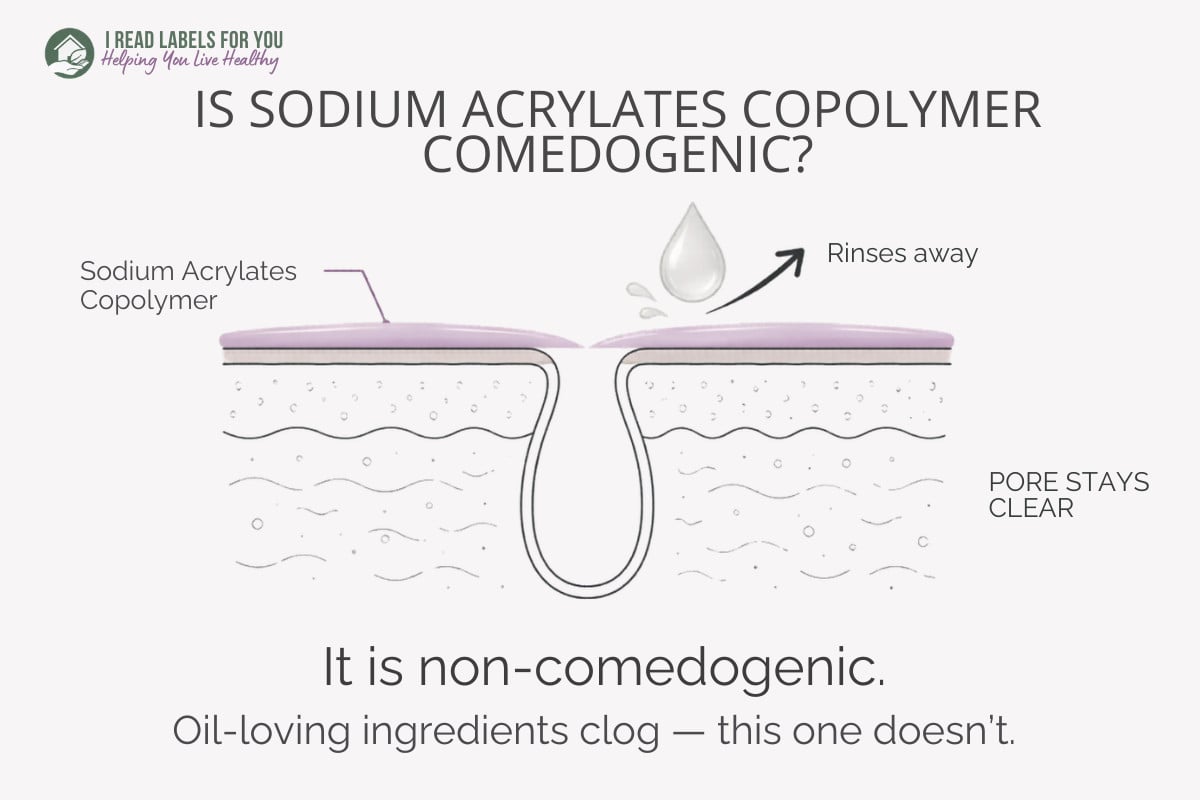
No, it’s generally considered non-comedogenic. Comedogenic ingredients tend to be oil-loving molecules that settle into pores and trap sebum.
Sodium Acrylates Copolymer is the opposite. It’s a water-soluble polymer that sits on the skin surface and rinses or comes off easily. You’ll find it in lightweight gels, serums, and products made for acne-prone or oily skin.
If a product with this ingredient has caused congestion for you, the cause is more likely other oils or waxes in the formula than the polymer itself.
What Are Sodium Acrylates Copolymer Side Effects?
Side effects are very rare. Most people use products with this ingredient without any reaction at all.
In the few documented cases, the most common reports are:
- mild skin irritation in people with very sensitive skin, usually tied to the whole formula rather than the polymer itself
- a sticky or tacky feel during application, which is a texture complaint rather than a safety issue
Because the polymer doesn’t cross into the body, there are no documented systemic side effects: no organ effects, no hormone effects, no reproductive concerns. If you do react to a product with Sodium Acrylates Copolymer, the more likely culprits are preservatives, fragrances, or surfactants in the formula.
Is Sodium Acrylates Copolymer Good For The Skin?
It isn’t a skincare active. It doesn’t give skin direct benefits the way moisturizers, antioxidants, or sunscreen filters do.
Its job is to make products work and feel the way the formulator intended. That means thickening watery formulas into gels, holding water in a stable mix, and forming a smooth film that helps other actives spread evenly.
Think of flour thickening a sauce. While the flavor originates in the stock and seasonings, without flour the sauce wouldn’t have the right body.
Sodium Acrylates Copolymer plays a similar structural role. It helps the active ingredients do their work; it isn’t the active ingredient.
Sources
Cosmetic Ingredient Review (CIR) safety assessments:
Fiume M.M. (ed.) (2002). Final Report on the Safety Assessment of Acrylates Copolymer and 33 Related Cosmetic Ingredients. International Journal of Toxicology 21 Supplement 3: 1-50: cir-reports.cir-safety.org
Fiume M.M. (Senior Director); Bergfeld W.F. et al. (2018). Amended Safety Assessment of Acrylates Copolymers as Used in Cosmetics (Final Amended Report, released 23 January 2019; panel meeting 3-4 December 2018): cir-reports.cir-safety.org
European Union regulatory databases:
EU CosIng entry for Sodium Acrylates Copolymer (Inventory ingredient, no Annex restriction): ec.europa.eu/growth/tools-databases/cosing
EU CosIng Annexes (II, III, IV, V): ec.europa.eu/growth/tools-databases/cosing/reference/annexes
CLP Annex VI Harmonized Classifications (legally binding EU hazard classifications; acrylic acid CAS 79-10-7 is classified as Skin Corr. 1A, Acute Tox. 4, and Aquatic Acute 1, with no Carc., Muta., Repr., or Skin Sens. entries): echa.europa.eu/information-on-chemicals/annex-vi-to-clp
ECHA Candidate List of Substances of Very High Concern (Sodium Acrylates Copolymer not listed): echa.europa.eu/candidate-list-table
ECHA Endocrine Disruptor Assessment List (official EU registry of substances under or having completed an informal ED hazard assessment; acrylic acid CAS 79-10-7 is not present on this list as of the last verified date): echa.europa.eu/ed-assessment
Commission Regulation (EU) 2023/2055 (microplastics restriction): eur-lex.europa.eu/eli/reg/2023/2055/oj
EU SCCS opinion on a related ingredient:
SCCS/1595/18 Final Opinion on Styrene/acrylates copolymer (nano) and Sodium styrene/acrylates copolymer (nano) (adopted 5 March 2018), addresses nano versions of related but distinct ingredients; does not apply to standard non-nano Sodium Acrylates Copolymer: health.ec.europa.eu/sccs-opinions
Other regulators:
FDA on Cosmetic Ingredients: fda.gov/cosmetics/cosmetic-ingredients
Health Canada Cosmetic Ingredient Hotlist (Sodium Acrylates Copolymer not listed): canada.ca Cosmetic Ingredient Hotlist
Environment and Climate Change Canada CEPA Schedule 1 (Sodium Acrylates Copolymer not listed): canada.ca CEPA Schedule 1
IARC List of Classifications (neither Sodium Acrylates Copolymer nor acrylic acid CAS 79-10-7 is classified as a human carcinogen): monographs.iarc.who.int/list-of-classifications
NTP 15th Report on Carcinogens Appendix G CAS-number index (Sodium Acrylates Copolymer not listed): ntp.niehs.nih.gov Report on Carcinogens Appendix G
California Proposition 65 List (Sodium Acrylates Copolymer not listed): oehha.ca.gov/proposition-65/proposition-65-list
PubChem records (chemistry, identifiers, hazard codes):
Sodium Acrylates Copolymer, PubChem Substance SID 135333784: pubchem.ncbi.nlm.nih.gov/substance/135333784
Acrylic acid (residual monomer), PubChem CID 6581: pubchem.ncbi.nlm.nih.gov/compound/6581
Methacrylic acid (residual monomer), PubChem CID 4093: pubchem.ncbi.nlm.nih.gov/compound/4093
Skin allergy resource:
American Contact Dermatitis Society (ACDS), Helpful References (including Core Allergen Series 2020): contactderm.org/resources/helpful-references
Kucharczyk M., Slowik-Rylska M., Cyran-Stemplewska S., Gieron M., Nowak-Starz G., Krecisz B. (2021). Acrylates as a significant cause of allergic contact dermatitis: new sources of exposure. Advances in Dermatology and Allergology 38(4): 555-560: doi.org/10.5114/ada.2020.95848
Last verified: 06-04-2026

Download The Free Guide!
5 Powerful Steps To A Non-Toxic Home
Join our informed consumer community and get our free guide the “5 Powerful Steps To A Non-Toxic Home”.


i just wanted to point out that Sodium Acrylates Copolymer is almost always a cold-process ingredient.
Meaning that environmentally, at least concerning resources, this material is a superior choice for an emulsifier, rather than the hot process emulsifier waxes.
Thanks for adding this! You’re right that acrylate polymers don’t need the heating and cooling that emulsifying waxes do, so they do save energy.
Worth noting that acrylate polymers are not quite the same as those waxes, though. They work as emulsion stabilizers more than true emulsifiers, holding everything together and giving products their feel rather than binding oil and water the way a wax does. Thanks again for the great point!