
Is Cocamidopropyl Betaine Safe? A Simple Answer You Can Trust
 Written by Irina Webb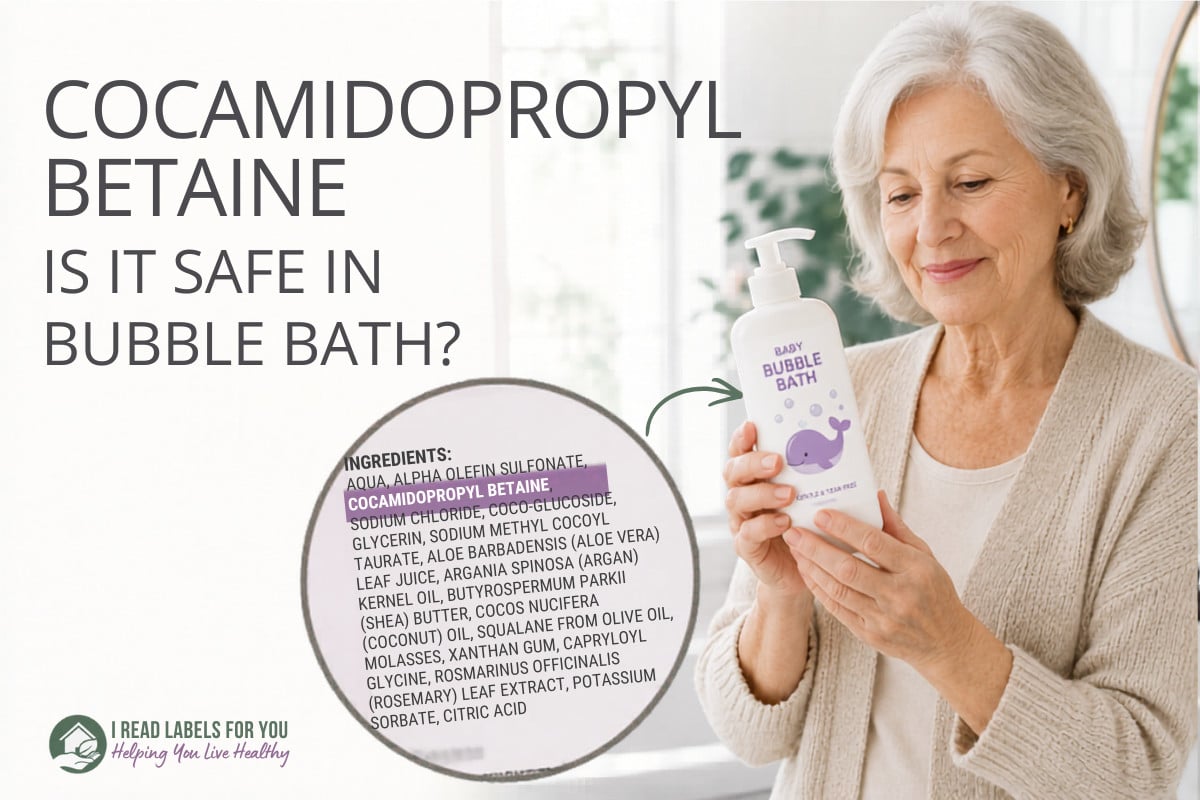
Yes, Cocamidopropyl Betaine is safe for most people. Found in a huge share of shampoos and body washes, this mild, coconut-derived cleanser does not absorb into your body and carries no cancer or hormone concerns. Its one real drawback is allergy, so I rate it Better (Not In My Top Picks).
Find out why mild and coconut-derived Cocamidopropyl Betaine keeps turning up on allergy lists, whether reaction to this ingredient means you are allergic to coconut, and if Cocamidopropyl Betaine is the same as Coco-Betaine.
What Is Cocamidopropyl Betaine?
Cocamidopropyl Betaine, often shortened to CAPB, is an amphoteric surfactant, i.e. a cleansing agent that carries both a positive and a negative charge. Chemists make it from coconut fatty acids, which is why it’s described as coconut-derived. In chemistry terms, it’s a betaine, a kind of inner-salt molecule.
Among surfactants, CAPB is one of the gentlest, which is why it shows up almost everywhere. Formulators often pair it with stronger cleansers to make them gentler on your skin and build a richer lather.
What Does Cocamidopropyl Betaine Do In Cosmetics?
Mild cleansing and foam are CAPB’s main jobs. It lifts away oil and dirt while creating the creamy lather people link with feeling clean. Because it’s gentle, it also tames the harshness of stronger detergents such as Sodium Lauryl Sulfate.
Cocamidopropyl Betaine handles a few smaller tasks too: thickening a formula, cutting static, and light conditioning. These are minor roles compared to its cleansing.
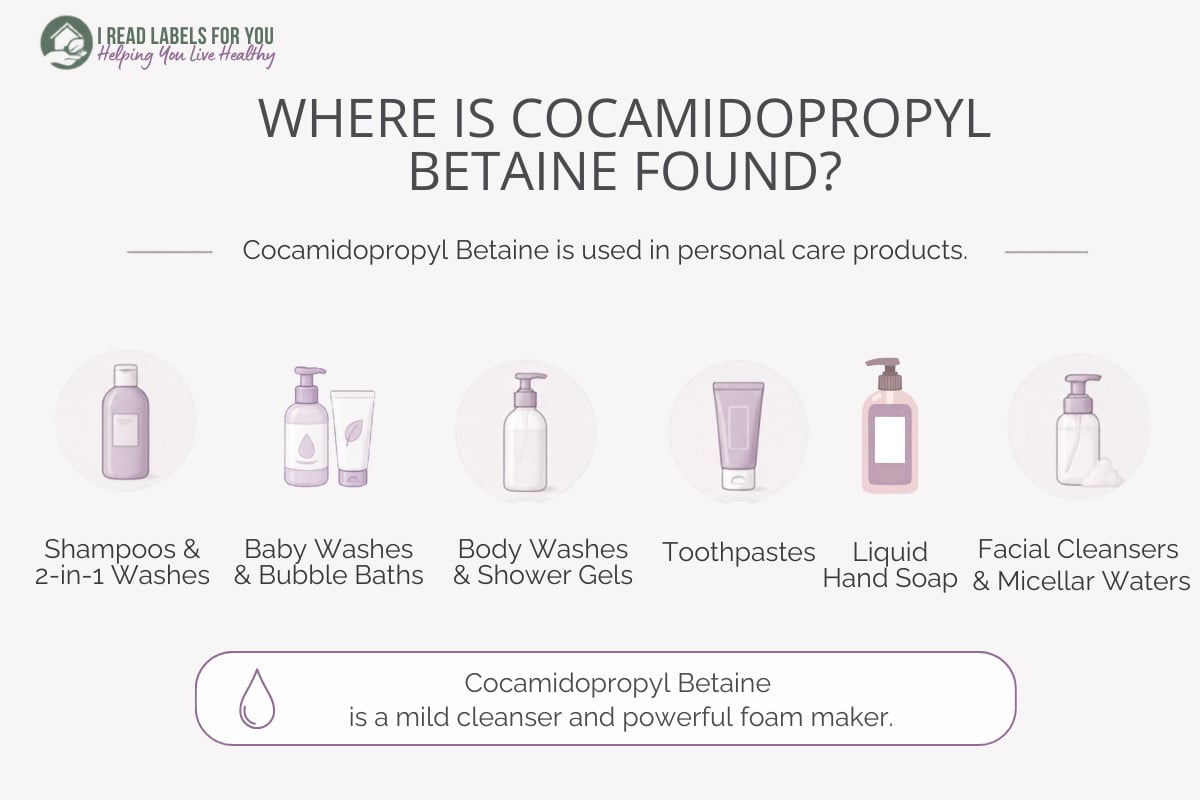
You’ll find Cocamidopropyl Betaine most often in:
- shampoos and 2-in-1 washes
- body washes and shower gels
- facial cleansers and micellar waters
- liquid hand soaps
- baby washes and bubble baths
- some toothpastes
Cocamidopropyl Betaine isn’t used in food. It’s a cosmetic and household-cleaning surfactant only.
How Is Cocamidopropyl Betaine Made?
Cocamidopropyl Betaine’s production starts with coconut fatty acids joined to a compound called 3-dimethylaminopropylamine (DMAPA). That step forms an intermediate known as amidoamine. A final reaction with sodium monochloroacetate, the manufacturing chemical, turns it into the finished betaine.
Here’s the catch worth knowing: small amounts of DMAPA and amidoamine can linger in the finished material. Those leftover impurities, rather than Cocamidopropyl Betaine itself, are what set off most allergic reactions. Well-purified grades keep them low.
There is one more manufacturing note. Cocamidopropyl Betaine is a secondary amide, so with certain preservatives it can form trace nitrosamides. These come from the nitrosamine family, are also carcinogens, and are more reactive. The CIR found no detectable nitrosamines in commercial samples, but careful manufacturing is meant to keep them from forming. This reaction happens only when Cocamidopropyl Betaine sits in the same product as a nitrosating ingredient, such as the preservative bronopol, and it can build up slowly during storage. Keeping the two apart prevents it.
Does Cocamidopropyl Betaine Penetrate The Skin?
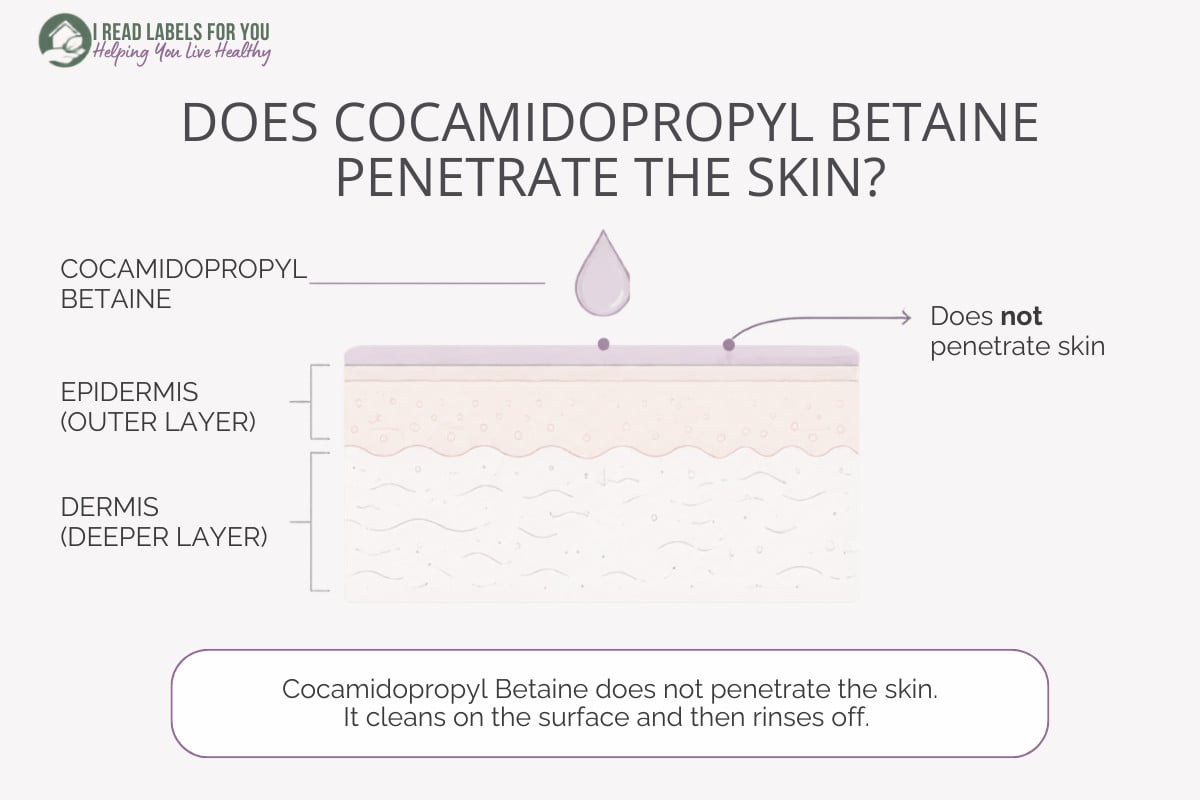
No. Cocamidopropyl Betaine stays on the surface of your skin, and two things keep it there. First, it carries a permanent electric charge and it loves water. Your skin’s outer layer is oily, and that oily layer turns away charged, water-loving molecules like this one. This is the main reason it does not get in.
Second, it is a large molecule, which makes it even harder to slip through the skin. Because it stays charged, it has no normal LogP, the score that shows whether an ingredient is oily or watery. Safety reviewers reached the same conclusion, finding that large, water-soluble structures like this are not readily absorbed into the skin. It cleans on the surface and then rinses off, with almost none of it reaching your bloodstream.
What Is Cocamidopropyl Betaine Called On Labels?
On a label, Cocamidopropyl Betaine can appear as:
- Cocamidopropyl Betaine
- CAPB
- Cocoamidopropyl Betaine
- Cocamidopropyl Dimethyl Glycine
- Amides, Coco, N-[3-(Dimethylamino)propyl], Betaines
Does The U.S. FDA Restrict Cocamidopropyl Betaine In Food And Cosmetics?
Cocamidopropyl Betaine is not a food ingredient. The U.S. Food and Drug Administration (FDA) permits it in cosmetics and sets no specific limit on it.
I don’t read that clearance as a strong endorsement. The agency reviews few cosmetic ingredients before they reach shelves and leans on companies to vouch for their own safety. For a recognized allergen, I’d rather see firmer oversight.
Europe leans more cautious by default. Its precautionary principle lets regulators restrict an ingredient on reasonable doubt, before harm is proven. With Cocamidopropyl Betaine, though, they have not set limits.
EU Regulations About Cocamidopropyl Betaine
The European Union (EU) allows Cocamidopropyl Betaine and places no specific restriction on it. The ingredient isn’t named in the EU’s restricted-ingredient annexes, and no Scientific Committee on Consumer Safety (SCCS) opinion has singled it out. In practice, it’s treated as a permitted cosmetic surfactant.
Canadian Regulations About Cocamidopropyl Betaine
Canada permits Cocamidopropyl Betaine in cosmetics. It isn’t on the Health Canada Cosmetic Ingredient Hotlist of banned or restricted ingredients.
Can Cocamidopropyl Betaine Cause Skin Allergy And Sensitization?
This is Cocamidopropyl Betaine’s headline issue. In 2004, the American Contact Dermatitis Society (ACDS) named it Allergen of the Year, and it sits on the ACDS core allergen series. Reactions tend to appear as red, itchy patches on the eyelids, face, scalp, or neck, the areas a shampoo or cleanser runs over.
The twist is that Cocamidopropyl Betaine itself may not be the true culprit. A patch-test study found the leftover manufacturing impurities, amidoamine and DMAPA, are the actual sensitizers in most cases. Better-purified grades, with those impurities kept low, are much less likely to cause trouble.
How common is a true allergy? Likely less than patch-test numbers suggest. A network analysis of nearly 84,000 patch-tested patients concluded that most positive reactions to Cocamidopropyl Betaine are probably false positives driven by irritation, not genuine allergy. The clearest risk is heavy, repeated exposure: hairdressers show roughly a 1.7-fold higher rate of CAPB contact allergy.
Is Cocamidopropyl Betaine A Hormone (Endocrine) Disruptor?
No. Cocamidopropyl Betaine is not a hormone disruptor. It’s absent from the European Chemicals Agency (ECHA) endocrine list, and no study has tied it to hormonal effects.
The chemistry explains why. A large molecule that rests on the skin’s surface and doesn’t get into the body has no way to reach hormone receptors.
Is Cocamidopropyl Betaine Safe To Use While Pregnant?
Cocamidopropyl Betaine looks low-risk during pregnancy. Because it doesn’t penetrate skin and washes away, normal use should reach a developing baby in negligible amounts.
The main thing to watch is your own skin: if a wash with Cocamidopropyl Betaine leaves your skin irritated, switching products is an easy fix. When in doubt during pregnancy, your medical provider is the best person to ask.
Are There Any Cancer Concerns Linked To Cocamidopropyl Betaine?
No. Cocamidopropyl Betaine is not classified as a carcinogen. No cancer authority lists it: not the U.S. National Toxicology Program (NTP), not the International Agency for Research on Cancer (IARC), not California’s Proposition 65. It also came back negative for DNA damage in the Ames test, and a long-term skin study in mice found no increase in tumors.
One mix-up is worth clearing up. The coconut-based ingredient on California’s Proposition 65 list is Cocamide DEA, a different chemical. Cocamidopropyl Betaine is not the same and is not on that list.
Is Cocamidopropyl Betaine Bad For The Environment?
Cocamidopropyl Betaine has a relatively gentle environmental profile. As a coconut-derived surfactant, it breaks down readily and isn’t known to build up in the environment. Like any detergent, large amounts are hard on aquatic life. Its ready biodegradability softens that concern compared with more persistent surfactants.
Common Claims About Cocamidopropyl Betaine: What’s True And What’s Not
Claim: Cocamidopropyl Betaine Is A Harsh Chemical To Avoid
This gets it backwards. Cocamidopropyl Betaine is one of the milder surfactants, and formulators add it specifically to make stronger cleansers gentler. The “harsh chemical” label doesn’t match how it actually behaves.
Claim: Cocamidopropyl Betaine Causes Allergic Reactions
This one holds real truth. Cocamidopropyl Betaine is a recognized contact allergen and was named Allergen of the Year. The nuance: the reactions trace mostly to its impurities, not the ingredient itself, and well-purified versions are far gentler.
Claim: Coconut-Derived Means Cocamidopropyl Betaine Is Natural And Safe
Not quite. Cocamidopropyl Betaine starts with coconut oil, but it’s chemically transformed into a synthetic surfactant. A natural starting point doesn’t make it allergy-proof. In fact, it’s a leading cause of cosmetic contact allergy.
What I Think About Cocamidopropyl Betaine — And What You Should Do
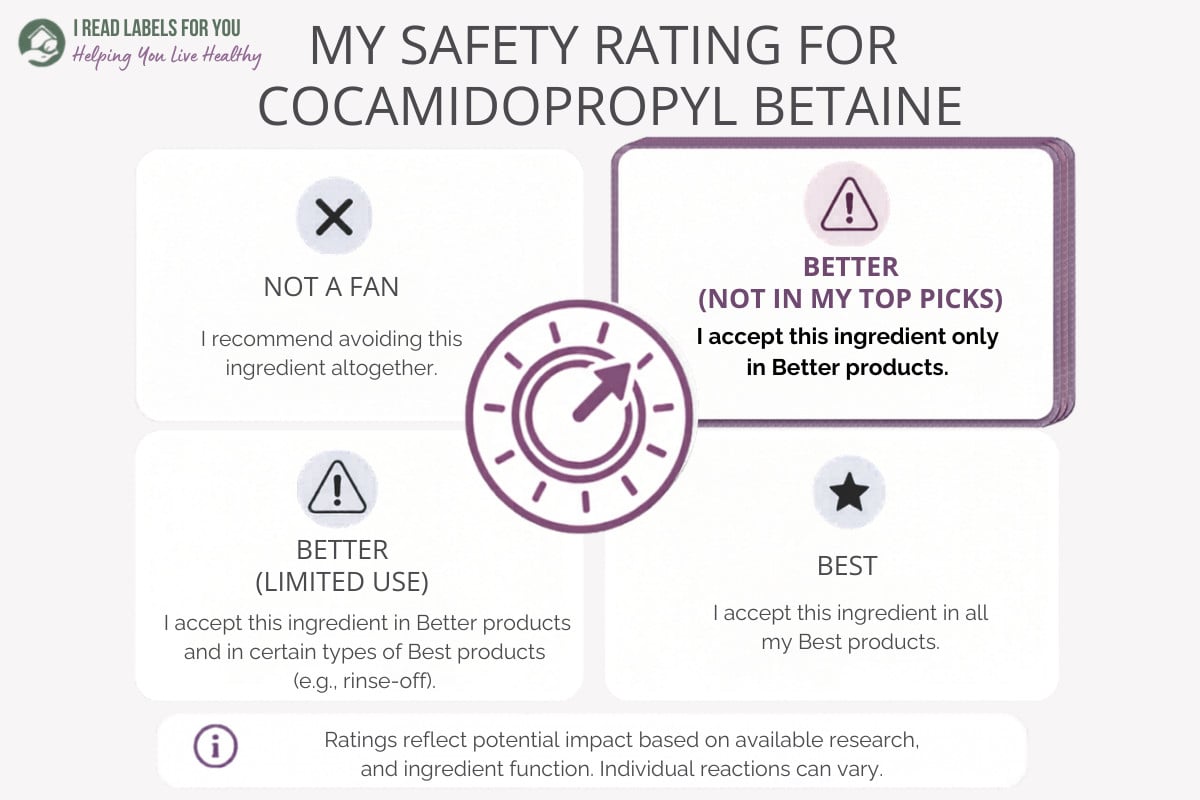
My verdict on Cocamidopropyl Betaine is Better (Not In My Top Picks). On most measures it’s reassuring: it’s a mild cleanser, it doesn’t penetrate skin, and it carries no cancer, hormone, or reproductive concerns.
What keeps it out of my best category is potential allergy. Cocamidopropyl Betaine is a recognized contact sensitizer, even if the blame falls mostly on its manufacturing impurities. That’s a concern I’d rather sidestep than manage. Another reason is that as a secondary amide, Cocamidopropyl Betaine can form trace nitrosamides if it is not made carefully. Nitrosamides are carcinogens from the nitrosamine family, and that is also why I keep it out of my best products.
In practice, it’s fine for most people, especially in a quick rinse-off wash. If your skin is sensitive or eczema-prone, or a cleanser has bothered you before, I’d pick a product without it. And if you already know you react to Cocamidopropyl Betaine, read labels closely because it hides in many gentle-looking products.
Frequently Asked Questions About Cocamidopropyl Betaine
Is Cocamidopropyl Betaine Bad For Your Skin?
For most people, Cocamidopropyl Betaine is not bad skin. It’s a mild cleanser that the majority tolerate well. A minority develop an allergy, which usually shows up as an itchy rash on the eyelids, face, or neck.
Is Cocamidopropyl Betaine Natural?
Partly. Cocamidopropyl Betaine begins with coconut oil but is chemically processed into a synthetic surfactant. That makes it coconut-derived rather than truly natural.
Why Is Cocamidopropyl Betaine A Common Allergen?
The culprit is mostly Cocamidopropyl Betaine’s impurities. Leftover amidoamine and DMAPA from manufacturing are the real sensitizers, and they cling to the finished ingredient. Purer grades cause far fewer reactions.
Is Cocamidopropyl Betaine Safe For Babies And Sensitive Skin?
Cocamidopropyl Betaine is common in baby washes, bubble baths, and gentle cleansers, and most babies tolerate it. Even so, because it’s a known allergen, I’d choose an alternative for very sensitive or eczema-prone skin.
Does Cocamidopropyl Betaine Cause Cancer?
No. Cocamidopropyl Betaine isn’t classified as a carcinogen by any major body and tested negative for DNA damage. The coconut-based ingredient tied to cancer warnings is Cocamide DEA, which is a different chemical.
Is Coco-Betaine The Same As Cocamidopropyl Betaine?
No. Coco-Betaine and Cocamidopropyl Betaine are related but not the same. Both come from coconut, but Coco-Betaine has a simpler structure and is made without the DMAPA step. That means it does not carry the amidoamine and DMAPA impurities behind most Cocamidopropyl Betaine allergies. The two are not interchangeable, so it is worth checking which one is on the label if you react to either.
Does A Cocamidopropyl Betaine Allergy Mean I’m Allergic To Coconut?
No, a Cocamidopropyl Betaine allergy doesn’t mean you’re allergic to coconuts. The reaction comes from the manufacturing impurities, not from coconut itself. A Cocamidopropyl Betaine contact allergy is different from coconut food allergy, so most people who react to it can still eat coconut without trouble.
Sources
EU SCCS / SCCP Opinions:
No SCCS or SCCP opinion on Cocamidopropyl Betaine (checked; not individually assessed): SCCS opinions portal
Cosmetic Ingredient Review (CIR) Reports:
Cosmetic Ingredient Review (CIR). Elder RL (ed.). (1991). Final Report on the Safety Assessment of Cocamidopropyl Betaine. Journal of the American College of Toxicology 10(1): cir-reports.cir-safety.org
Cosmetic Ingredient Review (CIR). Burnett CL, et al. (2012). Final Report of the CIR Expert Panel: Safety Assessment of Cocamidopropyl Betaine (CAPB). International Journal of Toxicology 31(Suppl. 1): 77S-111S: cir-reports.cir-safety.org
European Union Regulatory Databases:
EU CosIng entry for Cocamidopropyl Betaine (functions: surfactant – cleansing/foam booster, antistatic, viscosity controlling; not listed in Annexes II-V, no restriction): ec.europa.eu CosIng
CLP Annex VI Harmonised Classifications / ECHA C&L (no harmonised classification for Cocamidopropyl Betaine): echa.europa.eu Annex VI to CLP
Other Regulators:
U.S. FDA: cosmetic cleansing/surfactant ingredient with no special restriction; not an approved food substance: fda.gov/cosmetics
Health Canada Cosmetic Ingredient Hotlist (Cocamidopropyl Betaine not listed): canada.ca Hotlist
Environment and Climate Change Canada: CEPA Schedule 1 List of Toxic Substances (Cocamidopropyl Betaine not listed): canada.ca CEPA Schedule 1
IARC List of Classifications (Cocamidopropyl Betaine not classified): monographs.iarc.who.int
NTP 15th Report on Carcinogens (Cocamidopropyl Betaine not listed): ntp.niehs.nih.gov
California Proposition 65 List (Cocamidopropyl Betaine not listed; Cocamide DEA is the listed coconut-based ingredient): oehha.ca.gov Prop 65 list
PubChem Records (Chemistry, Identifiers, Skin Penetration, Hazard Codes):
Cocamidopropyl Betaine: CAS 61789-40-0 (coco-acyl mixture); representative component Lauramidopropyl Betaine, PubChem CID 20280: pubchem.ncbi.nlm.nih.gov/compound/20280
Peer-Reviewed Studies:
Allergy to cocamidopropyl betaine may be due to amidoamine: a patch test and product use test study (1997). PMID 9455630: pubmed.ncbi.nlm.nih.gov/9455630
Is cocamidopropyl betaine a contact allergen? Analysis of network data and short review of the literature. Contact Dermatitis (2011); ~84,000 patch-tested patients – most CAPB positives judged likely irritant false-positives. PMID 21392028: pubmed.ncbi.nlm.nih.gov/21392028
Skin Toxicity of Selected Hair Cosmetic Ingredients: A Review Focusing on Hairdressers. Int J Environ Res Public Health (2022) 19(13): 7588; hairdressers ~1.7x higher rate of CAPB contact allergy. PMID 35805241: pubmed.ncbi.nlm.nih.gov/35805241
Iijima S, et al. Two Cases of Allergic Contact Dermatitis Caused by Coco Betaine in Clobetasol Propionate Shampoo. Case Reports in Dermatological Medicine (2026); coco betaine and cocamidopropyl betaine patch-tested in the same patients gave different reactions, confirming they are distinct allergens. PMC12759260: pmc.ncbi.nlm.nih.gov/articles/PMC12759260
Natural Cosmetic Standards:
COSMOS-standard databases (Cocamidopropyl Betaine: derived-natural surfactant; check approved-raw-materials list): cosmos-standard.org
NATRUE certified/approved raw materials: natrue.org
Skin Allergy Resource:
American Contact Dermatitis Society (ACDS): Helpful References, Core Allergen Series 2020 (Cocamidopropyl Betaine listed, 1% aq.) and ACDS Allergen of the Year 2004: contactderm.org
Last verified: 2026-06-25
Download The Free Guide!
5 Powerful Steps To A Non-Toxic Home
Join our informed consumer community and get our free guide the “5 Powerful Steps To A Non-Toxic Home”.
Before commenting, please read our Comment Policy.