
Is Coco-Betaine Safe? A Simple Answer You Can Trust
 Written by Irina Webb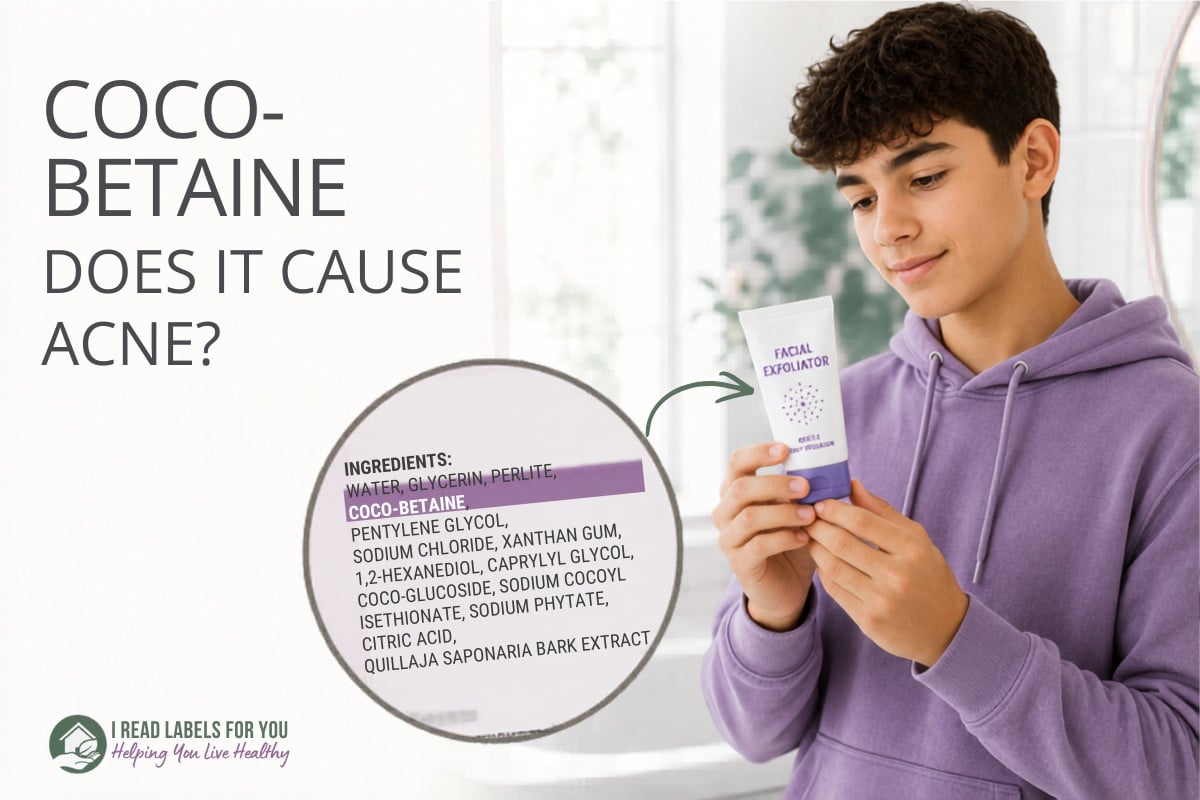
Yes, Coco-Betaine is safe. It’s a mild, coconut-based cleanser that stays out of your bloodstream and raises no cancer or hormone flags. Despite the similar name, it’s not the same as Cocamidopropyl Betaine, and that difference is why true allergy to it is rare. I rate it Best.
Below, you’ll learn how one small change in how Coco-Betaine is made sets it apart from Cocamidopropyl Betaine, whether it’s harsh on skin, and if it has any link to hair loss or breakouts.
What Is Coco-Betaine?
Coco-Betaine, sometimes written Coco Betaine, is a gentle cleansing agent made from coconut oil. It belongs to a group of surfactants called amphoteric betaines, which carry both a positive and a negative charge. That balanced charge keeps Coco-Betaine mild on skin and hair.
Here is the point that often gets confused. Coco-Betaine is a simpler molecule than Cocamidopropyl Betaine, even though the two names look alike. That single difference shapes almost everything good about Coco-Betaine, as you will see below.
What Does Coco-Betaine Do In Cosmetics?
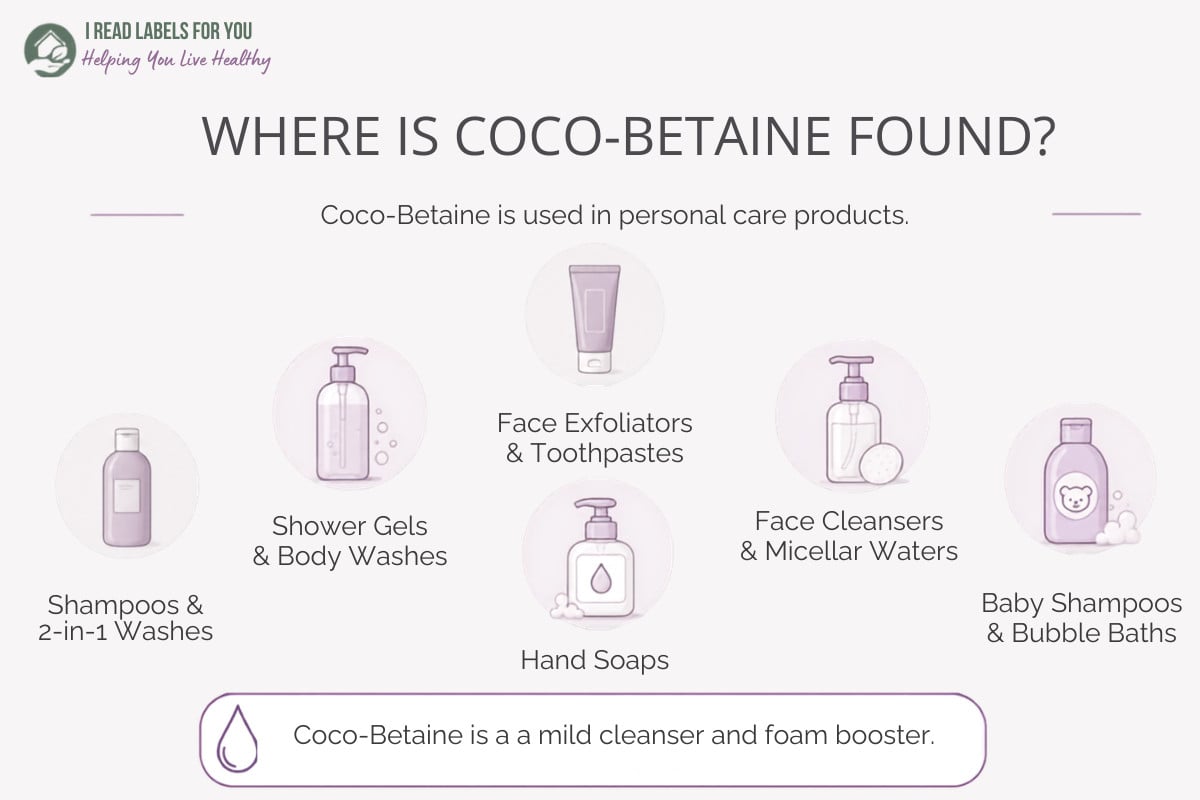
Coco-Betaine works mainly as a mild cleanser and foam booster. It lifts away oil and dirt while building a soft, creamy lather. Because it is gentle, formulators add it to soften harsh cleansers like Sodium Lauryl Sulfate.
Here is a practical point: Coco-Betaine is a helper, not a solo cleanser. You will not find a wash built on Coco-Betaine alone. It always works next to a main surfactant, boosting foam and softening the harsher one.
Coco-Betaine also handles a few smaller jobs. It can thicken a formula, cut static, and lightly condition hair and skin. These roles stay minor next to its cleansing.
You will find Coco-Betaine most often in:
- shampoos and gentle 2-in-1 washes
- shower gels and foaming body washes
- micellar waters and face cleansers
- face exfoliators and some toothpastes
- hand soaps and foaming pumps
- baby shampoos and bubble baths
Coco-Betaine never turns up in food. It lives strictly in cosmetics and household cleaners.
How Is Coco-Betaine Made?
Coco-Betaine starts with fatty acids from coconut oil. Makers turn those into a coconut alkyl dimethylamine, then react it with chloroacetic acid to form the finished betaine.
One detail sets Coco-Betaine apart. It skips the amidopropyl step that Cocamidopropyl Betaine uses, which relies on a chemical called dimethylaminopropylamine (DMAPA). Therefore, Coco-Betaine does not carry the leftover DMAPA and amidoamine impurities that can trigger allergic reactions.
A second bonus hides in that chemistry. Coco-Betaine is not a secondary amide, which means it cannot form the trace nitrosamides that concern me with Cocamidopropyl Betaine. In short, its cleaner recipe removes two worries at once.
Does Coco-Betaine Penetrate The Skin?
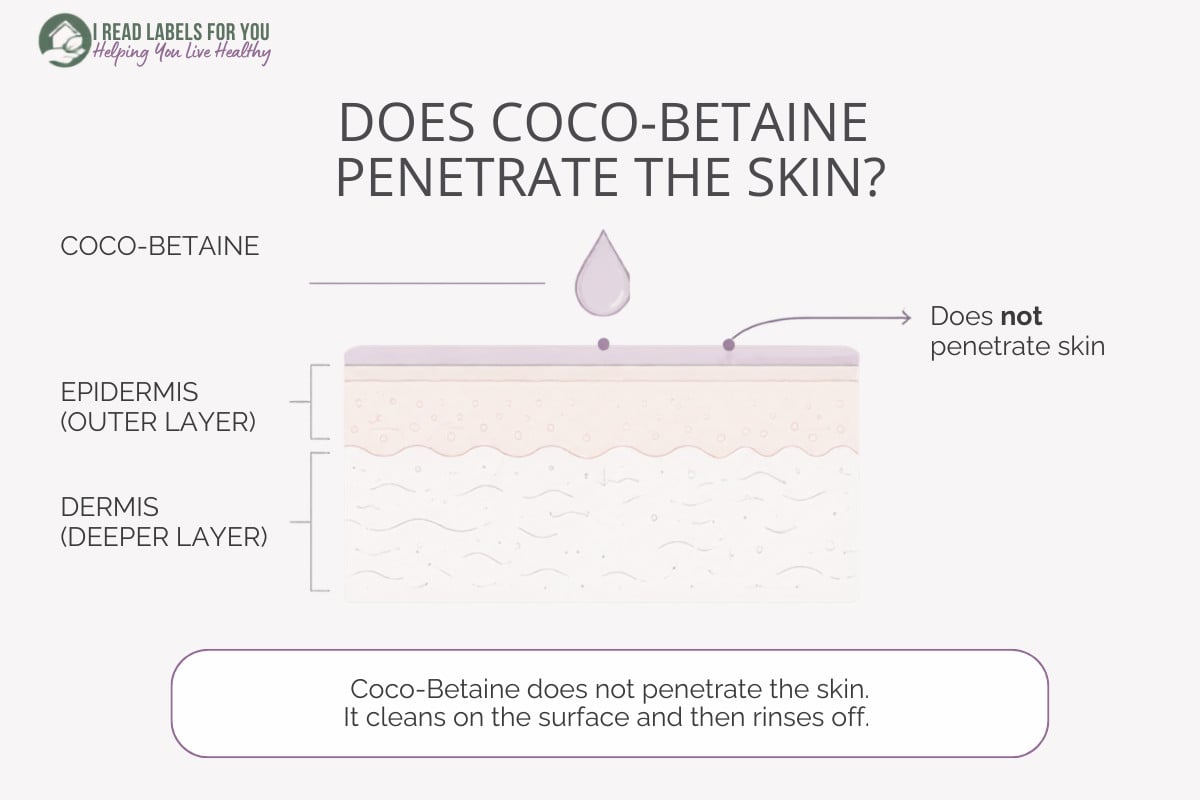
No. Coco-Betaine rests on top of the skin and never travels deeper, for two reasons. To begin with, it carries a fixed electrical charge and dissolves in water, while the skin’s oily outer layer repels charged, water-loving molecules. On top of that, its molecule is fairly bulky, which blocks it further.
Since Coco-Betaine keeps that charge, chemists cannot assign it a standard LogP, the oily-versus-watery rating.
In sum, Coco-Betaine does its cleaning at the surface and leaves with the rinse water, barely reaching your bloodstream.
What Is Coco-Betaine Called On Labels?
On a label, Coco-Betaine may appear as:
- Coco-Betaine
- Coco Betaine
- Coco Alkyldimethyl Betaine
- Coconut Betaine
- Cocobetaine
Does The U.S. FDA Restrict Coco-Betaine In Food And Cosmetics?
No. The U.S. Food and Drug Administration (FDA) places no restriction on Coco-Betaine in cosmetics. Because Coco-Betaine is a cleanser and not a food, it also holds no food-additive approval.
Remember, though, that FDA silence means little for cosmetics. The agency has stepped in on only a tiny number of cosmetic ingredients across its whole history. A clean regulatory record for Coco-Betaine reflects very light oversight more than a full safety endorsement.
For a stricter view on Coco-Betaine, Europe is the place to look. Its regulators follow the precautionary principle, which lets them limit an ingredient on reasonable doubt rather than waiting for proof of harm.
EU Regulations About Coco-Betaine
The European Union (EU) clears Coco-Betaine without any special cap. Its CosIng database, which catalogs cosmetic ingredients, files Coco-Betaine as a cleansing and conditioning surfactant and attaches no Annex restriction.
On top of that, the EU’s expert panel has never singled it out. There is no Scientific Committee on Consumer Safety (SCCS) opinion on Coco-Betaine. In practice, Europe treats it as a routine, gentle surfactant.
Canadian Regulations About Coco-Betaine
Canada also clears Coco-Betaine for cosmetic use. It does not sit on the Health Canada Cosmetic Ingredient Hotlist, the country’s roster of prohibited and limited ingredients. Canada’s CEPA list of toxic substances leaves it off as well.
Can Coco-Betaine Cause Skin Allergy And Sensitization?
Coco-Betaine doesn’t cause skin allergies and sensitization for the vast majority of people. No study reports allergic reactions to Coco-Betaine in any significant number of users. Standard laboratory sensitization tests also found Coco-Betaine not sensitizing. On top of that, it does not appear on the American Contact Dermatitis Society (ACDS) core allergen list, and it was never named an Allergen of the Year.
The real-world reports are few. A 2024 case described allergy to Coco-Betaine in a beard cleanser, and a 2026 report described two cases from a medicated shampoo. In both reports, patch testing pointed to Coco-Betaine, not to Cocamidopropyl Betaine.
This matters if you already react to Cocamidopropyl Betaine. Because Coco-Betaine skips the shared DMAPA impurity, it may suit your skin better. Even then, any surfactant can irritate at high, undiluted levels, while finished products keep Coco-Betaine at gentle amounts.
Is Coco-Betaine A Hormone (Endocrine) Disruptor?
No, Coco-Betaine does not disrupt hormones. No hormone effect has ever been tied to Coco-Betaine, and the European Chemicals Agency (ECHA) leaves it off its endocrine list. Its plain structure sits on the skin surface and never reaches hormone receptors. You can comfortably cross this concern off your list.
Is Coco-Betaine Safe To Use While Pregnant?
Coco-Betaine looks safe to use while pregnant. Since it barely touches the skin surface and washes down the drain, very little could ever reach a developing baby. No research ties everyday Coco-Betaine use to pregnancy problems.
Still, comfort levels vary from person to person. Whenever a product with Coco-Betaine gives you pause during pregnancy, you should consult with your medical provider first.
Are There Any Cancer Concerns Linked To Coco-Betaine?
No, nothing ties Coco-Betaine to cancer. It is missing from every major cancer roster, from the International Agency for Research on Cancer (IARC) to the U.S. National Toxicology Program (NTP) to California Proposition 65.
The lab record agrees. Coco-Betaine and related betaines showed no deoxyribonucleic acid (DNA) damage in genetic tests, while long-term feeding studies of the parent betaine produced no tumors.
Is Coco-Betaine Bad For The Environment?
Coco-Betaine carries a light environmental footprint. Drawn from coconut oil, it degrades quickly and does not accumulate in waterways. Any surfactant can burden aquatic life in bulk, yet fast breakdown keeps Coco-Betaine on the gentler end.
The sourcing question is the bigger one. Growing coconut and palm can pressure tropical land, so a responsibly sourced grade of Coco-Betaine is the wiser choice.
Common Claims About Coco-Betaine: What’s True And What’s Not
Claim: Coco-Betaine Is Harsher And More Irritating Than Cocamidopropyl Betaine
This claim is mostly a myth. Coco-Betaine and Cocamidopropyl Betaine are both mild amphoteric surfactants, and each one is added to soften harsher cleansers. In testing, Coco-Betaine was less irritating than Sodium Lauryl Sulfate and left no lasting irritation on skin.
Like every surfactant, Coco-Betaine can sting at high, undiluted levels. At the low amounts used in finished products, though, it stays gentle. If anything, Coco-Betaine sidesteps the allergy-causing impurities that Cocamidopropyl Betaine can carry.
What I Think About Coco-Betaine — And What You Should Do
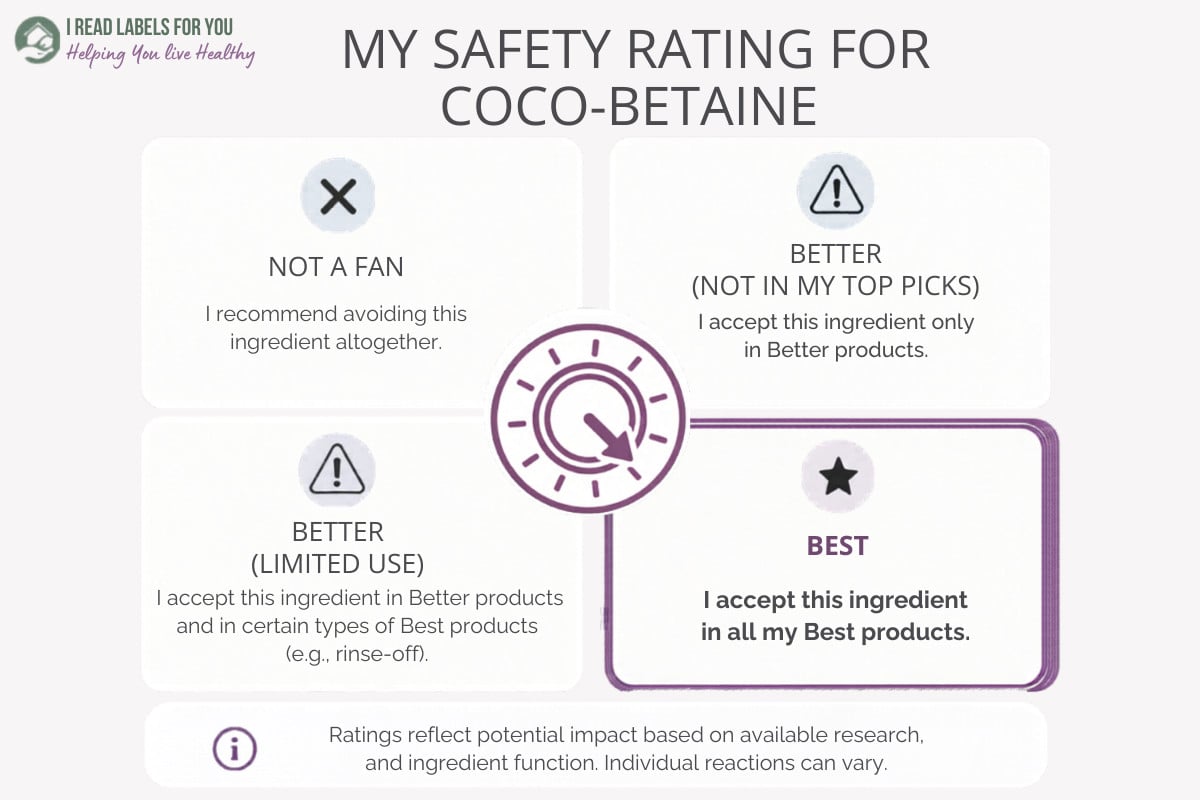
I place Coco-Betaine in my Best tier. It is a mild, coconut-derived cleanser that stays on the skin surface and shows no cancer, hormone, or reproductive concerns. Its cleaner recipe skips both the DMAPA allergy impurities and the trace nitrosamides tied to Cocamidopropyl Betaine.
True allergy to Coco-Betaine is rare, limited to a few case reports, and standard tests find it not sensitizing. That clean profile is why Coco-Betaine earns my top tier, even for gentle and baby products.
One honest note remains. Coco-Betaine is still a surfactant, which means its mildness depends on how a product is formulated. For most skin, including sensitive skin, a well-made wash with Coco-Betaine is a reassuring choice. If you already react to Cocamidopropyl Betaine, Coco-Betaine is often a smart swap.
Frequently Asked Questions About Coco-Betaine
Is Coco-Betaine The Same As Cocamidopropyl Betaine?
Not quite, though they are close relatives. Coco-Betaine has a simpler, single-part structure, while Cocamidopropyl Betaine adds an amidopropyl section during manufacture. That extra section is what saddles Cocamidopropyl Betaine with DMAPA and amidoamine leftovers, which Coco-Betaine avoids. That is actually good news if Cocamidopropyl Betaine has bothered your skin: because Coco-Betaine skips that impurity, reacting to one does not mean you will react to the other.
Is Coco-Betaine Natural?
Partly. Coco-Betaine begins as coconut oil, a genuine plant material. Chemists then convert that oil into a foaming surfactant through several reactions. That processing makes Coco-Betaine coconut-derived, not something you would find growing in nature.
Is Coco-Betaine Bad For Hair?
No, Coco-Betaine is generally good for hair. It cleans gently, boosts lather, and cuts static, which leaves hair soft and easy to manage. For dry or curly hair, a Coco-Betaine wash is milder than a strong sulfate shampoo.
Is Coco-Betaine Bad For Hair Loss?
No, Coco-Betaine is not known to cause hair loss. No study links Coco-Betaine to shedding or thinning hair. It cleans the scalp at the surface and rinses away, which means it does not reach the roots that drive hair growth.
Can Coco-Betaine Cause Acne?
Coco-Betaine is unlikely to cause acne for most skin. It is a water-soluble, rinse-off cleanser that does not clog pores or leave an oily film. If a cleanser ever irritates your skin, that irritation, rather than Coco-Betaine itself, may lead to breakouts.
Sources
EU SCCS / SCCP Opinions:
No SCCS or SCCP opinion on Coco-Betaine (checked; the EU Scientific Committee has issued no opinion on this ingredient): https://health.ec.europa.eu/scientific-committees/scientific-committee-consumer-safety-sccs/sccs-opinions_en
Cosmetic Ingredient Review (CIR) Reports:
Burnett CL, Bergfeld WF, Belsito DV, et al. (2018). Safety Assessment of Alkyl Betaines as Used in Cosmetics (covers Coco-Betaine). International Journal of Toxicology 37 (Suppl 1): 28S-46S: https://cir-reports.cir-safety.org
European Union Regulatory Databases:
EU CosIng entry for Coco-Betaine (record details/75265; functions antistatic, cleansing, foam boosting, hair/skin conditioning, viscosity controlling; no Annex restriction): https://ec.europa.eu/growth/tools-databases/cosing/details/75265
EU CosIng Annexes (II, III, IV, V, and VI checked; Coco-Betaine not listed): https://ec.europa.eu/growth/tools-databases/cosing/reference/annexes
CLP Annex VI Harmonised Classifications (no harmonised classification for Coco-Betaine; industry self-classifies skin and eye irritation for the concentrate): https://echa.europa.eu/information-on-chemicals/annex-vi-to-clp
ECHA CHEM substance record for Coco-Betaine (CAS 68424-94-2, EC 270-329-4): https://chem.echa.europa.eu/
Other Regulators:
U.S. FDA – Coco-Betaine is not an approved food additive and is not on the Prohibited & Restricted cosmetic ingredients list: https://www.fda.gov/cosmetics/cosmetics-laws-regulations/prohibited-restricted-ingredients-cosmetics
Health Canada Cosmetic Ingredient Hotlist (Coco-Betaine not listed): https://www.canada.ca/en/health-canada/services/consumer-product-safety/cosmetics/cosmetic-ingredient-hotlist-prohibited-restricted-ingredients/hotlist.html
Environment and Climate Change Canada – CEPA Schedule 1 List of Toxic Substances (Coco-Betaine not listed): https://www.canada.ca/en/environment-climate-change/services/canadian-environmental-protection-act-registry/substances-list/toxic/schedule-1.html
IARC List of Classifications (Coco-Betaine / alkyl betaines not classified): https://monographs.iarc.who.int/list-of-classifications
NTP 15th Report on Carcinogens (Coco-Betaine not listed): https://ntp.niehs.nih.gov/whatwestudy/assessments/cancer/roc
California Proposition 65 List (Coco-Betaine not listed): https://oehha.ca.gov/proposition-65/proposition-65-list
PubChem Records (Chemistry, Identifiers, Skin Penetration, Hazard Codes):
Coco-Betaine – PubChem Substance record SID 481153812 (no single compound CID; a coconut-derived UVCB mixture of coco alkyldimethyl betaines, CAS 68424-94-2): https://pubchem.ncbi.nlm.nih.gov/#query=68424-94-2
Peer-Reviewed Studies:
Badaoui A. (2024). Allergic contact dermatitis to coco betaine in a beard cleanser. Contact Dermatitis 90(6): 632-633. DOI 10.1111/cod.14536. PMID 38448283: https://pubmed.ncbi.nlm.nih.gov/38448283/
Iijima S, et al. (2026). Two Cases of Allergic Contact Dermatitis Caused by Coco Betaine in Clobetasol Propionate Shampoo. Case Reports in Dermatological Medicine. DOI 10.1155/crdm/9953943; PMC12759260: https://onlinelibrary.wiley.com/doi/10.1155/crdm/9953943
Natural Cosmetic Standards:
COSMOS-standard approved raw materials (Coco-Betaine appears as an ECOCERT-approved surfactant): https://www.cosmos-standard.org/en/databases/approved-raw-materials/
NATRUE certified/approved raw materials (checked): https://natrue.org/natrue-certified-world/
Skin Allergy Resource:
American Contact Dermatitis Society (ACDS) – Helpful References (including Core Allergen Series 2020; Coco-Betaine not listed as a core allergen): https://www.contactderm.org/resources/helpful-references
Last verified: 2026-07-06
Download The Free Guide!
5 Powerful Steps To A Non-Toxic Home
Join our informed consumer community and get our free guide the “5 Powerful Steps To A Non-Toxic Home”.
Before commenting, please read our Comment Policy.