
Is Sodium Lauryl Sulfate Safe? A Simple Answer You Can Trust
 Written by Irina Webb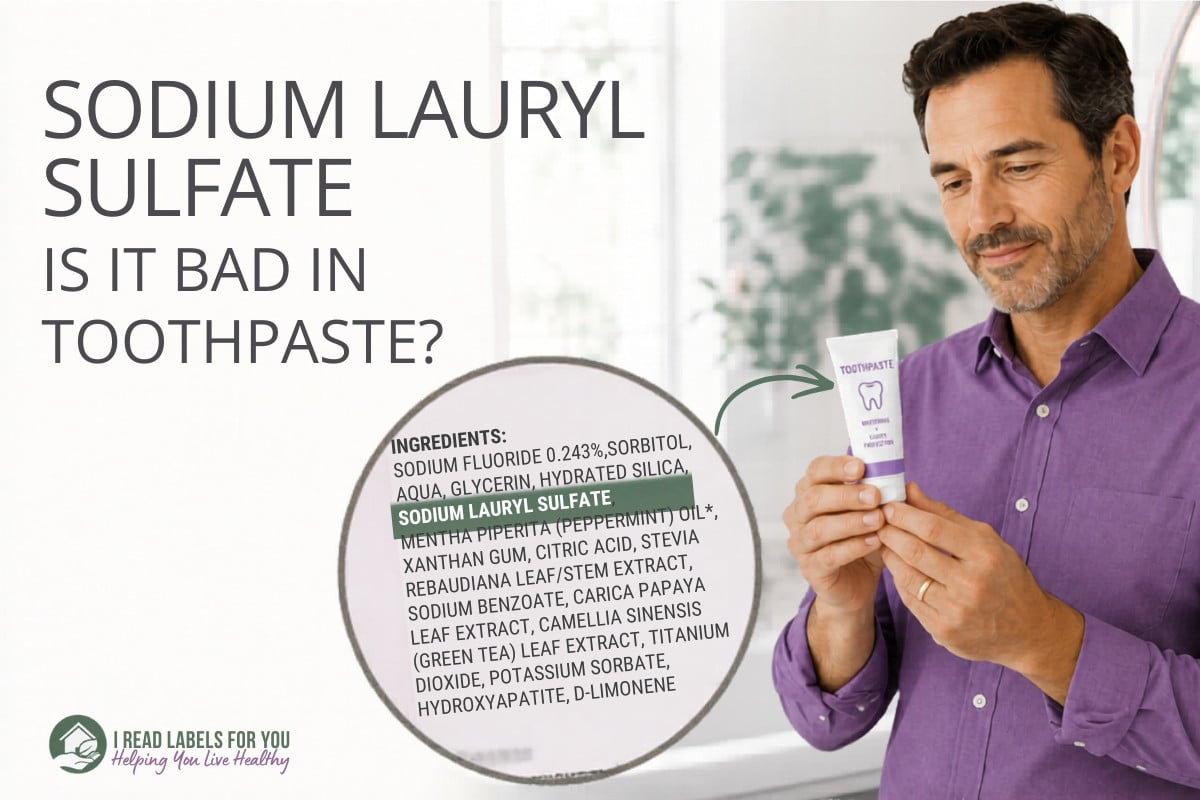
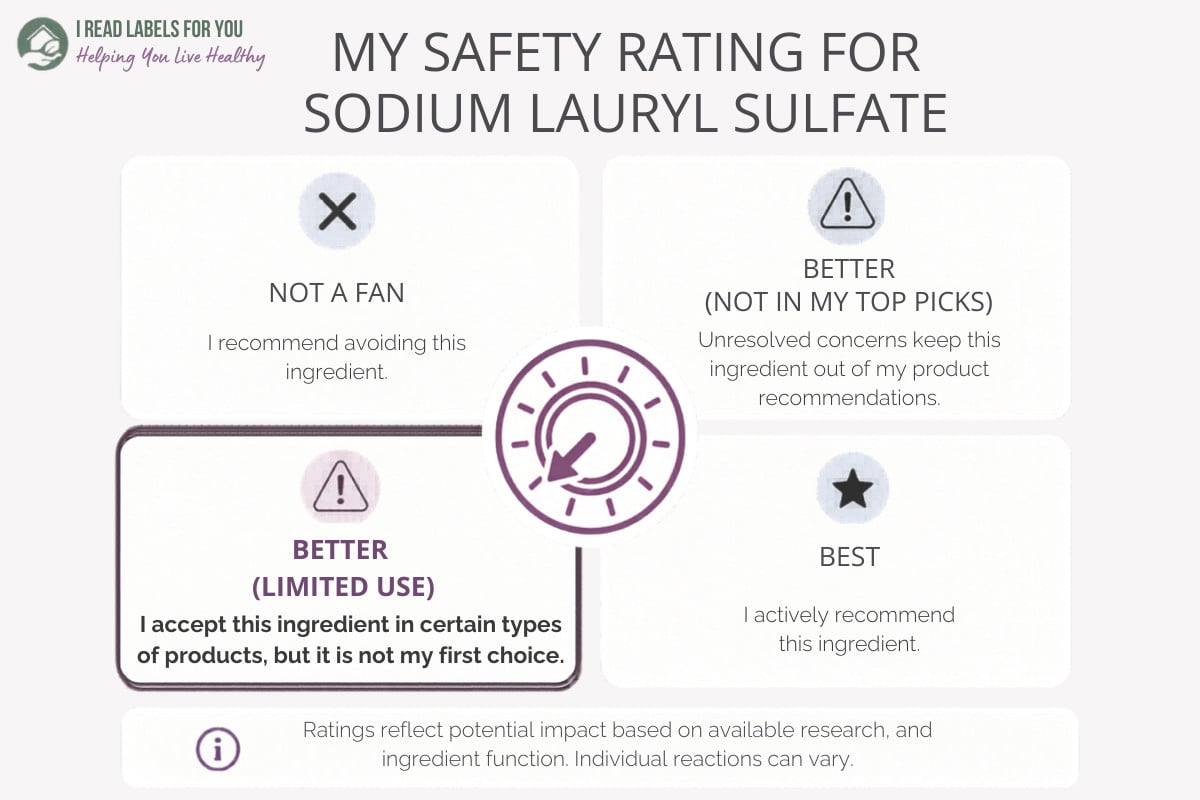
Yes, Sodium Lauryl Sulfate is safe for most people with normal skin in a well-formulated product. It’s not toxic, it doesn’t build up in your body, and the claim that it causes cancer is a myth. However, it’s a powerful cleanser that can strip, dry, and irritate the skin. That’s why I keep it out of my Best products for sensitive, dry, or eczema-prone skin and all baby products. My overall rating for Sodium Lauryl Sulfate is Better (Limited Use).
Below, you’ll find out if Sodium Lauryl Sulfate is bad for hair, if you want it in your toothpaste, and what you should do if you have eosinophilic esophagitis (EoE).
What Is Sodium Lauryl Sulfate?
Sodium Lauryl Sulfate, often shortened to SLS, is one of the most common cleansing ingredients in personal care. It belongs to a family of detergents called anionic surfactants. Scientists also know it as Sodium Dodecyl Sulfate (SDS).
You’ll spot it in all kinds of rinse-off products, and even in some foods. As a food additive, it carries the number E487, used in a few limited categories.
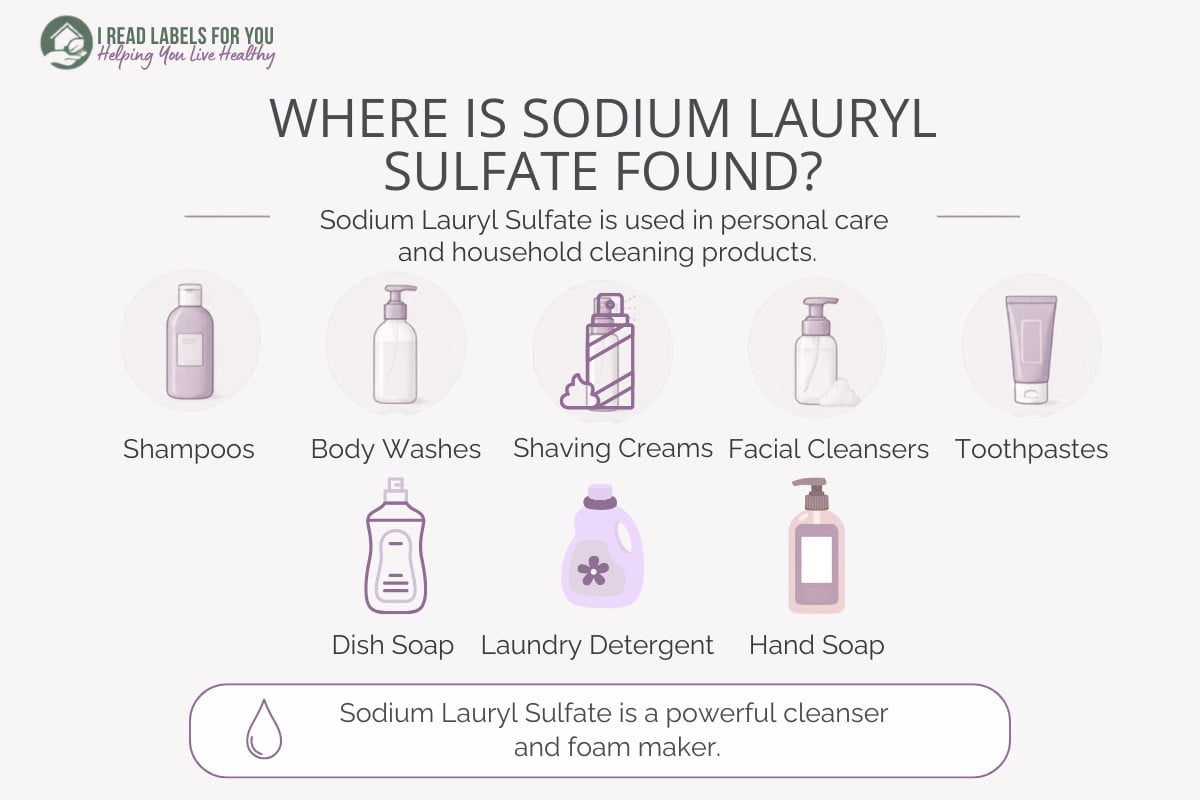
In cosmetics, you’ll find Sodium Lauryl Sulfate most often in:
- shampoos
- body washes
- facial cleansers
- hand soaps
- toothpaste
- shaving creams
- bubble baths and bath products
Beyond personal care, it’s also a common detergent in household and industrial cleaners, from dish soaps to degreasers. That heavy-duty role is part of why it has a “harsh” reputation.
What Does Sodium Lauryl Sulfate Do In Cosmetics?
Its job is cleansing, and it’s a powerful one. One end of the molecule grabs oil while the other grabs water, so grime rinses away. It also makes the rich foam many people link with “getting clean.”
That strength has a downside, though. Because it cleanses so aggressively, it can strip natural oils and leave skin tight or dry. It’s also cheap to make, which is why brands reach for it so often.
That said, formulation matters as much as the ingredient. How stripping it feels depends on its concentration and what it’s paired with. Milder co-surfactants, added moisturizers, and short contact time all soften its effect.
How Is Sodium Lauryl Sulfate Made?
Sodium Lauryl Sulfate starts with one fat, called lauric acid. It usually comes from coconut or palm oil. Makers turn that fat into an alcohol, add sulfur, then add sodium. That turns it into a cleanser.
This recipe skips a step called ethoxylation. That step is behind a common myth about sulfates, which I clear up further down.
Does Sodium Lauryl Sulfate Penetrate The Skin?
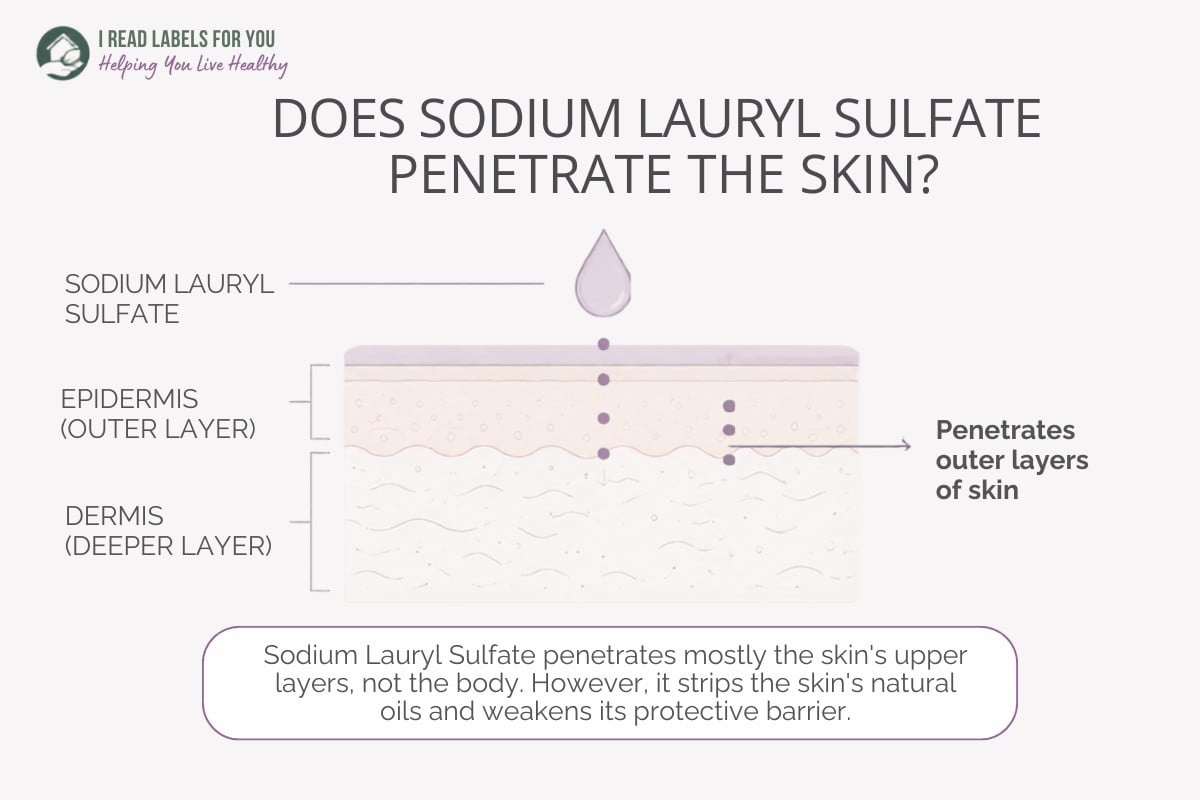
Yes, into the top layers of skin but not into your body. Sodium Lauryl Sulfate sinks into the skin’s surface, where it can cause irritation. Almost none of it reaches your blood.
Sodium Lauryl Sulfate gets into the surface because it’s small. At about 288 daltons, it sits well under 500, the size where skin starts to block molecules. But it can’t go deeper. Its water-loving, charged side won’t cross the skin’s deeper, oily layers. That keeps it near the surface, well short of your blood.
At the surface, Sodium Lauryl Sulfate acts as a detergent. It grabs both water and oil, which lets it wash away the skin’s natural oils. That mix is also why it has no clear LogP, the oily-or-watery score.
Once those oils are gone, the skin’s barrier gets weaker. A study in human skin measured this as more water escaping through the surface. A weaker barrier also lets other ingredients get in more easily.
What Is Sodium Lauryl Sulfate Called On Labels?
You may see it under several names:
- Sodium Lauryl Sulfate
- SLS
- Sodium Dodecyl Sulfate (SDS)
- E487 (on food labels)
Does The U.S. FDA Restrict Sodium Lauryl Sulfate In Food And Cosmetics?
No. The U.S. Food and Drug Administration (FDA) allows Sodium Lauryl Sulfate in both. In food, it’s a permitted additive under 21 CFR 172.822, with limits by category. For cosmetics, the FDA sets no restriction on it.
As I always note, the FDA’s bar is low. To date, it has banned or restricted only 11 ingredients in cosmetics. Still, decades of study back the basic safety of this one.
EU Regulations About Sodium Lauryl Sulfate
The European Union (EU) also allows Sodium Lauryl Sulfate. It carries no restriction in the EU cosmetic ingredient database (CosIng). As the food additive E487, it’s permitted in a few limited categories.
The EU leans on the precautionary principle, yet it has flagged no concern for this ingredient. There is also no Scientific Committee on Consumer Safety (SCCS) opinion on it.
Canadian Regulations About Sodium Lauryl Sulfate
Canada allows Sodium Lauryl Sulfate in cosmetics. It is not on the Health Canada Cosmetic Ingredient Hotlist. Furthermore, it does not appear on Canada’s CEPA list of toxic substances.
Can Sodium Lauryl Sulfate Cause Skin Allergy And Sensitization?
Here’s a surprise: Sodium Lauryl Sulfate is an irritant, not a true allergen. In fact, dermatologists use it as the standard irritant in patch tests, to tell irritant reactions apart from allergic ones. In lab studies, its reaction looks different from a true allergic response. That’s why it rarely triggers a real allergy.
What it does cause is irritation. It can leave skin red, dry, tight, or stinging, especially with frequent use. People with sensitive, dry, or eczema-prone skin feel this most. Fittingly, it does not appear on the American Contact Dermatitis Society (ACDS) allergen list.
Is Sodium Lauryl Sulfate A Hormone (Endocrine) Disruptor?
No. Sodium Lauryl Sulfate is not a hormone disruptor. No study has flagged it, and it is not on the European Chemicals Agency (ECHA) endocrine list. Its simple structure does not act on hormone receptors. Therefore, this is not a concern.
Is Sodium Lauryl Sulfate Safe To Use While Pregnant?
Yes, it’s considered safe to use during pregnancy. It barely penetrates the skin, and most products are rinsed away. Animal studies showed harm only at very high doses that caused stress to the mother.
As always, if you have any concerns, you should consult with your medical provider.
Are There Any Cancer Concerns Linked To Sodium Lauryl Sulfate?
No. This is the biggest myth about Sodium Lauryl Sulfate, and the science is clear.
It is not listed by the International Agency for Research on Cancer (IARC), the U.S. National Toxicology Program (NTP), or California Proposition 65. In short, no major body links it to cancer.
Is Sodium Lauryl Sulfate Bad For The Environment?
It’s a mixed picture. As a surfactant, Sodium Lauryl Sulfate is harmful to aquatic life at high levels. The good news is that it breaks down readily in the environment and does not build up.
Its raw material often comes from palm oil, which raises sustainability questions. For that reason, coconut-based or responsibly sourced versions are a better choice.
Common Claims About Sodium Lauryl Sulfate: What’s True And What’s Not
Claim: Sodium Lauryl Sulfate Causes Cancer
This is false, and it’s the most stubborn myth out there. The claim spread through chain emails years ago, with no science behind it.
No major health body lists Sodium Lauryl Sulfate as a carcinogen. Animal feeding studies also found no tumors. In short, you can retire this worry.
Claim: It’s The Same As SLES And Contains 1,4-Dioxane
This one mixes up two different ingredients. Sodium Lauryl Sulfate (SLS) and Sodium Laureth Sulfate (SLES) are not the same. SLES is made with a step called ethoxylation, which can leave a trace contaminant called 1,4-dioxane.
Sodium Lauryl Sulfate skips that step entirely. Therefore, it is not a source of 1,4-dioxane. Ironically, people who switch to SLES for a “gentler” option are choosing the one with the dioxane question.
What I Think About Sodium Lauryl Sulfate — And What You Should Do
I rate Sodium Lauryl Sulfate Better (Limited Use). It is not toxic, and the cancer fear is a myth. The real downside is plain irritation: it’s a strong cleanser that can strip and dry the skin.
Sodium Lauryl Sulfate is almost always used in wash-off products like shampoo, body wash, and toothpaste. Hence, the “limited use” here refers to skin. Thus, for most people with normal skin, a well-formulated SLS wash is fine. If your skin is sensitive, dry, or eczema-prone, it’s more likely to sting, tighten, or flare, so I would choose a gentler, SLS-free product.
For babies, with their more delicate skin, an SLS baby wash stays out of my Best products. And if you have eosinophilic esophagitis (EoE) or a strong allergic history, emerging research is a reason to choose SLS-free toothpaste and oral care.
Frequently Asked Questions
Is Sodium Lauryl Sulfate Bad For Skin?
It depends on your skin and product formulation. For most skin types, it’s okay in rinse-off products. However, if your skin is sensitive, dry, or eczema-prone, it’s best to avoid it even in wash-off cleansers. At any contact time, it can strip natural oils and weaken the skin barrier.
Is Sodium Lauryl Sulfate Bad For Hair?
It cleans hair well but can be stripping. For dry, curly, or color-treated hair, it may leave strands rough or faded. Oily hair usually tolerates it better, though gentler shampoos are an easy swap.
Is Sodium Lauryl Sulfate Bad In Toothpaste?
For most people, it’s safe. In toothpaste, SLS only adds foam; it doesn’t do the cleaning, so an SLS-free paste works just as well. Two groups have a clear reason to switch. People prone to canker sores often get fewer of them without SLS. In a small crossover study, ulcers dropped from about 14 to 5 on SLS-free toothpaste. People with eosinophilic esophagitis (EoE) or a strong allergic history may also prefer SLS-free options, based on newer, still-early research (more below).
Is Sodium Lauryl Sulfate Linked To Eosinophilic Esophagitis (EoE)?
Possibly, but the research is still early. Eosinophilic esophagitis (EoE) is an allergic condition of the esophagus, the tube that carries food from the mouth to the stomach. In EoE, allergy-related white blood cells called eosinophils build up there and inflame the lining, which can make swallowing hard over time.
In a 2023 laboratory and mouse study, Sodium Lauryl Sulfate weakened the esophageal barrier. It also triggered IL-33, an alarm signal that cells release when a barrier is damaged, which helps switch on allergic inflammation. A follow-up mouse study from the same group also found that detergent exposure stripped protective Lactobacillus bacteria from the esophagus.
The authors proposed that everyday detergents may be one environmental contributor to EoE. Importantly, this has not been shown to cause EoE in people, and the doses used were high. This concern is also specific to swallowed products like toothpaste, not SLS used on the skin.
If you have EoE, or a strong personal or family history of allergies and atopy, an SLS-free toothpaste is a sensible precaution while the science develops.
Is Sodium Lauryl Sulfate Natural?
While Sodium Lauryl Sulfate is plant-derived, it’s not strictly natural. Its starting material, lauryl alcohol, usually comes from coconut or palm oil. However, that material is then chemically processed into a surfactant that does not exist in nature. That makes it naturally derived rather than natural.
Sources
EU SCCS / SCCP Opinions:
No SCCS or SCCP opinion on Sodium Lauryl Sulfate (checked; the EU Scientific Committee has not issued an opinion on this ingredient): https://health.ec.europa.eu/scientific-committees/scientific-committee-consumer-safety-sccs/sccs-opinions_en
Cosmetic Ingredient Review (CIR) Reports:
Cosmetic Ingredient Review (CIR). (1983). Elder RL (ed.). Final Report on the Safety Assessment of Sodium Lauryl Sulfate and Ammonium Lauryl Sulfate. Journal of the American College of Toxicology 2(7): 127-181: https://cir-reports.cir-safety.org
Cosmetic Ingredient Review (CIR). (2005). Annual Review of Cosmetic Ingredient Safety Assessments 2002/2003 (Sodium Lauryl Sulfate re-review). International Journal of Toxicology 24(Suppl. 1): 1-102: https://cir-reports.cir-safety.org
CIR safety assessments index: https://cir-reports.cir-safety.org
European Union Regulatory Databases:
EU CosIng entry for Sodium Lauryl Sulfate (entry 37946; functions Cleansing, Denaturant, Foaming, Surfactant; no Annex restriction): https://ec.europa.eu/growth/tools-databases/cosing/details/37946
EU CosIng Annexes (II, III, V — Sodium Lauryl Sulfate not listed): https://ec.europa.eu/growth/tools-databases/cosing/reference/annexes
CLP Annex VI Harmonised Classifications (no harmonised classification for Sodium Lauryl Sulfate; ECHA C&L notifications self-classify H315 skin irritation and H318/H319 eye effects): https://echa.europa.eu/information-on-chemicals/annex-vi-to-clp
ECHA registration dossier, Sodium dodecyl sulphate (CAS 151-21-3, EC 205-788-1): https://echa.europa.eu/registration-dossier/-/registered-dossier/2126
Other Regulators:
U.S. FDA, 21 CFR 172.822, Sodium Lauryl Sulfate permitted as a food additive (use limits by category): https://www.ecfr.gov/current/title-21/chapter-I/subchapter-B/part-172/subpart-I/section-172.822
U.S. FDA, Prohibited & Restricted cosmetic ingredients (Sodium Lauryl Sulfate not listed): https://www.fda.gov/cosmetics/cosmetics-laws-regulations/prohibited-restricted-ingredients-cosmetics
Health Canada Cosmetic Ingredient Hotlist (Sodium Lauryl Sulfate not listed): https://www.canada.ca/en/health-canada/services/consumer-product-safety/cosmetics/cosmetic-ingredient-hotlist-prohibited-restricted-ingredients/hotlist.html
Environment and Climate Change Canada, CEPA Schedule 1 List of Toxic Substances (Sodium Lauryl Sulfate not listed): https://www.canada.ca/en/environment-climate-change/services/canadian-environmental-protection-act-registry/substances-list/toxic/schedule-1.html
IARC List of Classifications (Sodium Lauryl Sulfate not classified): https://monographs.iarc.who.int/list-of-classifications
NTP 15th Report on Carcinogens (Sodium Lauryl Sulfate not listed): https://ntp.niehs.nih.gov/whatwestudy/assessments/cancer/roc
California Proposition 65 List (Sodium Lauryl Sulfate not listed): https://oehha.ca.gov/proposition-65/proposition-65-list
PubChem Records (Chemistry, Identifiers, Skin Penetration, Hazard Codes):
Sodium Lauryl Sulfate (Sodium Dodecyl Sulfate), PubChem CID 3423265: https://pubchem.ncbi.nlm.nih.gov/compound/3423265
Peer-Reviewed Studies:
Doyle AD, Masuda MY, Pyon GC, et al. (2023). Detergent exposure induces epithelial barrier dysfunction and eosinophilic inflammation in the esophagus. Allergy 78(1): 192-201. PMID 35899466: pmc.ncbi.nlm.nih.gov/articles/PMC9797443
Wright B, Masuda M, Flashner S, et al. (2023). Oral detergent exposure alters the esophageal microbiome and induces eosinophilic inflammation. J Allergy Clin Immunol 151(2 Suppl): AB89 (AAAAI 2023 meeting abstract #275): jacionline.org
Herlofson BB, Barkvoll P. (1994). Sodium lauryl sulfate and recurrent aphthous ulcers: a preliminary study. Acta Odontologica Scandinavica 52(5): 257-259: tandfonline.com
Alli BY, et al. (2019). Effect of sodium lauryl sulfate on recurrent aphthous stomatitis: a systematic review. Journal of Oral Pathology & Medicine 48(5): 358-364: onlinelibrary.wiley.com
Forkel S, Matzke SS, Hollstein MM, et al. (2026). Strengths and Limitations of Sodium Lauryl Sulfate as an Irritant Control in Patch Testing. Contact Dermatitis 94(4): 338-346. PMID 41429426: https://pubmed.ncbi.nlm.nih.gov/41429426/
Nüsken F, et al. (2024). Immune response to topical Sodium Lauryl Sulfate differs from classical irritant and allergic contact dermatitis. European Journal of Immunology. PMID 39498726: https://pubmed.ncbi.nlm.nih.gov/39498726/
Heetfeld AB, et al. (2020). Challenging a paradigm: skin sensitivity to Sodium Lauryl Sulfate is independent of atopic diathesis. British Journal of Dermatology 183(1): 139-145. PMID 31562780: https://pubmed.ncbi.nlm.nih.gov/31562780/
Lévêque JL, de Rigal J, Saint-Léger D, Billy D. (1993). How does sodium lauryl sulfate alter the skin barrier function in man? A multiparametric approach. Skin Pharmacol 6(2): 111-115. PMID 8352948: https://pubmed.ncbi.nlm.nih.gov/8352948/
Natural Cosmetic Standards:
COSMOS-standard approved raw materials (Sodium Lauryl Sulfate appears; commonly restricted to rinse-off use): https://www.cosmos-standard.org/en/databases/approved-raw-materials/
NATRUE certified/approved raw materials (derived-natural SLS grades are approved): https://natrue.org/natrue-certified-world/
Skin Allergy Resource:
American Contact Dermatitis Society (ACDS), Helpful References (including Core Allergen Series 2020): https://www.contactderm.org/resources/helpful-references
Last verified: 2026-06-10
Download The Free Guide!
5 Powerful Steps To A Non-Toxic Home
Join our informed consumer community and get our free guide the “5 Powerful Steps To A Non-Toxic Home”.
Before commenting, please read our Comment Policy.