
Is Sodium Coco Sulfate Safe? A Simple Answer You Can Trust
 Written by Irina Webb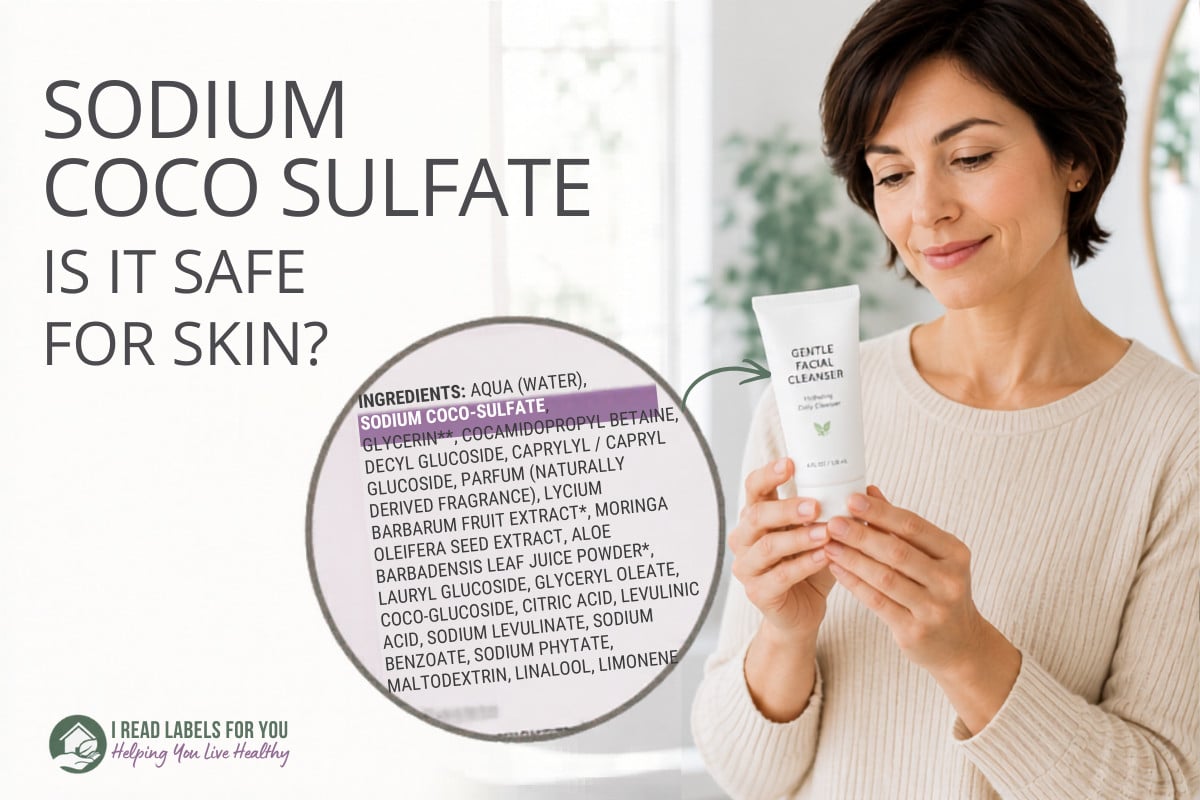
Yes, Sodium Coco Sulfate is safe for most people with normal skin in a well-formulated product. While it’s not linked to cancer, and very little reaches your bloodstream, it can irritate and dry the skin. For that reason, I keep it out of my Best products for sensitive, dry, or eczema-prone skin as well as out of baby products. All in all, I rate Sodium Coco Sulfate Better (Limited Use).
Find out below, if Sodium Coco Sulfate can cause allergy, how it affects your hair, and whether it’s the same as Sodium Lauryl Sulfate.
What Is Sodium Coco Sulfate?
Sodium Coco Sulfate, often shortened to SCS, is a coconut-based cleansing agent. It sits in the sulfate group of cleansers, known as anionic surfactants. Makers build it from the whole fatty part of coconut oil.
Coconut oil is mostly one fat, called lauric acid. When makers turn that fat into a cleanser, they get Sodium Lauryl Sulfate. That is why about half of Sodium Coco Sulfate is Sodium Lauryl Sulfate under a friendlier name. The rest is a mix of other coconut fats, which is the one thing that sets the two apart.
What Does Sodium Coco Sulfate Do In Cosmetics?
Sodium Coco Sulfate’s main job is cleansing, and it foams well. One part of the molecule holds onto oil while another part holds onto water. Consequently, dirt and extra oil lift off and rinse down the drain.
Brands like Sodium Coco Sulfate for another reason too. It arrives as a solid flake, which makes it ideal for shampoo bars and solid cleansers. It’s also cheap, which keeps it common in budget and “natural” lines.
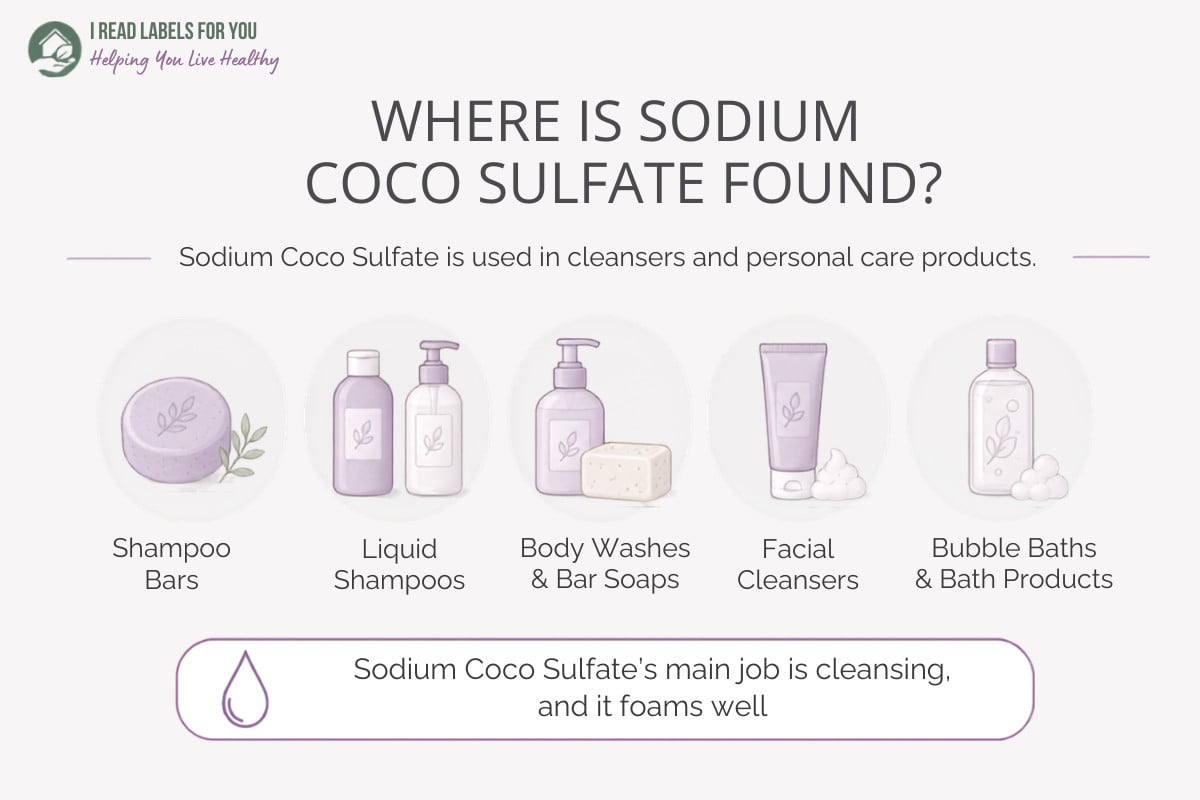
You’ll find Sodium Coco Sulfate most often in:
- shampoo bars
- liquid shampoos
- body washes and bar soaps
- facial cleansers
- bubble baths and bath products
Unlike Sodium Lauryl Sulfate, which some foods use as additive E487, Sodium Coco Sulfate never appears in food. It stays in the world of cleansers and personal care.
How Is Sodium Coco Sulfate Made?
Sodium Coco Sulfate starts with all the fats in coconut oil, not just one. Makers turn those fats into alcohols, add sulfur, then add sodium. That is the whole process, done in one step without an ethoxylation step.
The main fat in coconut oil is lauric acid, making up about 45 to 53% of it. Sodium Lauryl Sulfate is made from that one fat alone. The fat comes from coconut or palm oil, though the alcohol can also be made from petroleum. That is why about half of Sodium Coco Sulfate is the same as Sodium Lauryl Sulfate.
Does Sodium Coco Sulfate Penetrate The Skin?
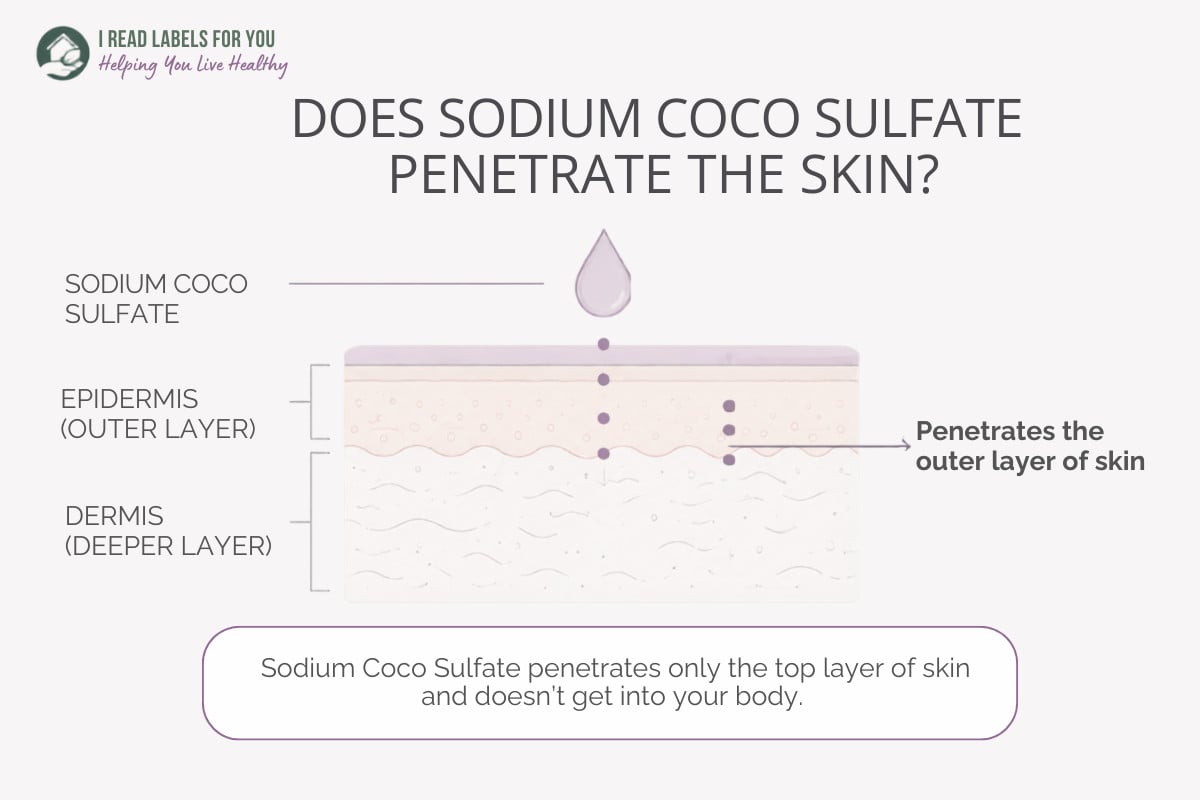
Only into the top layer of skin, not into your body. The marketing line that Sodium Coco Sulfate is “too big to soak in” is only half true.
Here is why. Sodium Coco Sulfate is a blend of different sizes. Its largest pieces really are big, yet its main piece is the small Sodium Lauryl Sulfate molecule, near 288 daltons. That size sits under 500 daltons, the point where skin starts blocking molecules. Thus, the small part still reaches the surface, where it can irritate.
What truly keeps Sodium Coco Sulfate from going deeper is charge, not size. Its water-loving, charged end cannot cross the skin’s oily lower layers. For that same reason, it has no clear LogP, the score that ranks oily versus watery. Simply put, it works on the surface and strips skin oils, while almost none reaches your blood.
What Is Sodium Coco Sulfate Called On Labels?
You may see Sodium Coco Sulfate written as:
- Sodium Coco Sulfate
- Sodium Coco-Sulfate
- SCS
- Sulfuric Acid, Monococo Alkyl Esters, Sodium Salts
Does The U.S. FDA Restrict Sodium Coco Sulfate In Food And Cosmetics?
No. The U.S. Food and Drug Administration (FDA) sets no limit on Sodium Coco Sulfate in cosmetics. It is also not cleared as a food additive, since it is a cleanser rather than a food ingredient.
Keep in mind that the FDA rarely steps in on cosmetic ingredients like Sodium Coco Sulfate. Over the decades it has restricted only a small handful of them. Hence, “no FDA limit” tells you very little about how Sodium Coco Sulfate will treat your skin.
For a stricter view on Sodium Coco Sulfate, it helps to look at Europe, which leans on the precautionary principle. That approach asks makers to show an ingredient is safe before it spreads across products.
EU Regulations About Sodium Coco Sulfate
The European Union (EU) also allows Sodium Coco Sulfate with no special limits. It sits in the EU cosmetic database (CosIng) as a cleansing surfactant, with no Annex restriction.
On top of that, the EU’s expert panel has never flagged it. There is no Scientific Committee on Consumer Safety (SCCS) opinion on Sodium Coco Sulfate. In practice, Europe treats it as a routine cleanser.
Canadian Regulations About Sodium Coco Sulfate
Canada permits Sodium Coco Sulfate in cosmetics as well. It does not appear on the Health Canada Cosmetic Ingredient Hotlist. Moreover, it is absent from Canada’s CEPA list of toxic substances.
Can Sodium Coco Sulfate Cause Skin Allergy And Sensitization?
Sodium Coco Sulfate can irritate skin, yet it rarely sparks a true allergy. Like its cousin Sodium Lauryl Sulfate, it acts as a classic irritant. That means it can redden, dry, or sting skin without setting off the immune reaction behind real allergies.
That is why the American Contact Dermatitis Society (ACDS) leaves Sodium Coco Sulfate off its allergen list. Frequent washing makes the sting worse. If your skin is sensitive, dry, or eczema-prone, you will notice it first.
Is Sodium Coco Sulfate A Hormone (Endocrine) Disruptor?
No, Sodium Coco Sulfate does not disrupt hormones. No study has tied it to hormone effects, and it is missing from the European Chemicals Agency (ECHA) endocrine list. Its plain detergent structure does not lock onto hormone receptors. Therefore, you can set this worry aside.
Is Sodium Coco Sulfate Safe To Use While Pregnant?
Yes, Sodium Coco Sulfate is considered safe during pregnancy. It barely crosses the skin, and rinse-off products wash away within seconds. No evidence links normal cosmetic use of Sodium Coco Sulfate to harm in pregnancy.
Every pregnancy is different, though. If a product with Sodium Coco Sulfate worries you, you should consult with your medical provider before using it.
Are There Any Cancer Concerns Linked To Sodium Coco Sulfate?
No, Sodium Coco Sulfate is not linked to cancer. The old sulfate-cancer scare came from chain emails, not from science.
No major agency lists Sodium Coco Sulfate as a carcinogen. It is absent from the International Agency for Research on Cancer (IARC), the U.S. National Toxicology Program (NTP), and California Proposition 65. A long-term rodent feeding study on a related alkyl sulfate also found no tumors.
Is Sodium Coco Sulfate Bad For The Environment?
The picture is mixed. As a surfactant, Sodium Coco Sulfate can harm fish and other water life at high levels. The upside is that it breaks down quickly and does not build up in nature.
Sodium Coco Sulfate’s coconut source raises a separate question. Coconut and palm crops can strain land and forests, which makes responsibly sourced Sodium Coco Sulfate the better pick.
Common Claims About Sodium Coco Sulfate: What’s True And What’s Not
Claim: Sodium Coco Sulfate Is Gentler Than Sodium Lauryl Sulfate
This is partly true, but oversold. Sodium Coco Sulfate holds a mix of molecule sizes, and the larger ones are milder. That mix can make it feel a little less stripping than pure Sodium Lauryl Sulfate. A head-to-head study rated Sodium Coco Sulfate about 15% less irritating than Sodium Lauryl Sulfate. Even so, it stripped skin lipids more strongly.
Still, the difference is small. Most of Sodium Coco Sulfate is Sodium Lauryl Sulfate, and it cleanses nearly as hard. For sensitive or dry skin, treat the two as about equal.
Claim: Sodium Coco Sulfate Is Just Hidden SLS
There is real truth to that. Because coconut oil is rich in lauric acid, a large share of Sodium Coco Sulfate is Sodium Lauryl Sulfate (SLS). Some brands use the “coco” name to look SLS-free while using much of the same cleanser.
That said, it is not identical. Sodium Coco Sulfate also holds longer-chain sulfates that pure Sodium Lauryl Sulfate lacks. In other words, it is SLS-heavy, not a completely different ingredient.
What I Think About Sodium Coco Sulfate — And What You Should Do
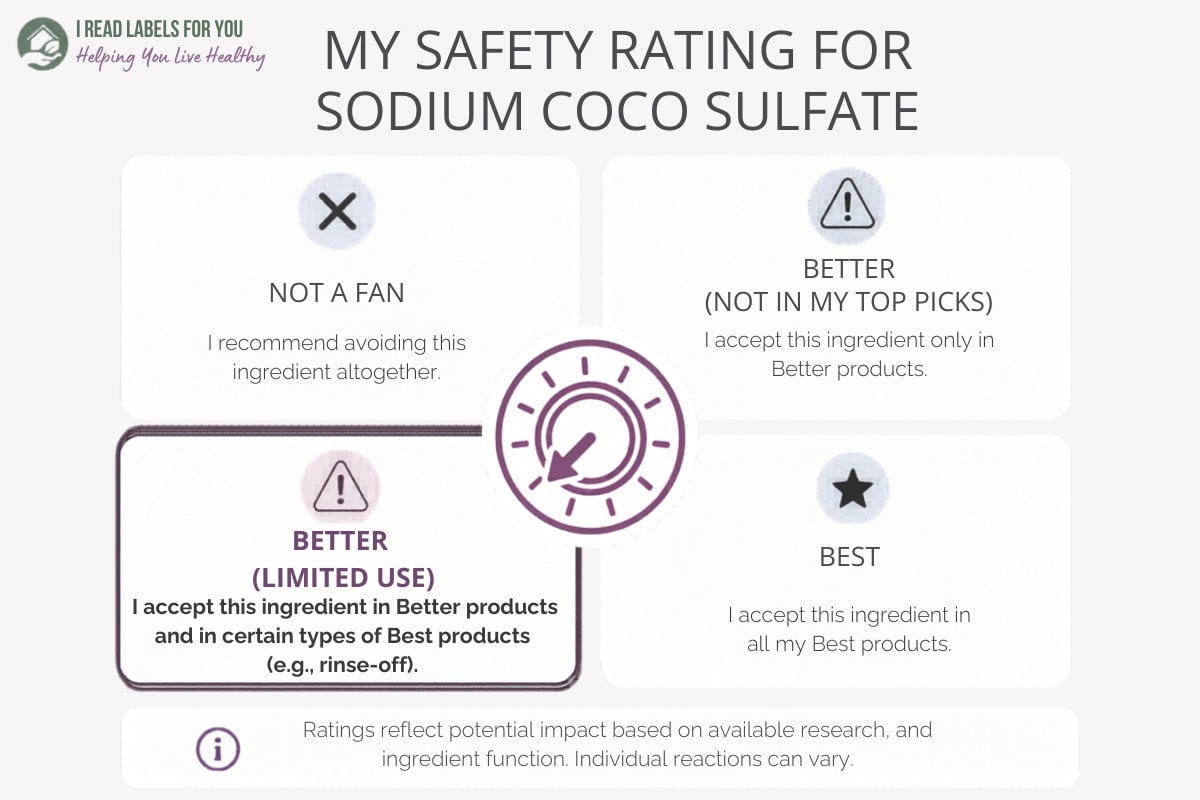
My verdict on Sodium Coco Sulfate is Better (Limited Use). It is neither toxic nor a cancer risk. Its real weakness is simple: a powerful cleanser that can leave skin tight and dry.
Sodium Coco Sulfate shows up almost only in rinse-off products, which means the “limited use” points to your skin type. A well-made Sodium Coco Sulfate wash can suit normal skin. When skin is sensitive, dry, or eczema-prone, I would reach for a gentler, sulfate-free cleanser instead.
For babies, whose skin is thinner and more delicate, I keep a Sodium Coco Sulfate wash out of my Best products, even rinse-off ones. I accept it only in my Better products. Finally, do not assume the “natural coconut” label means milder. Sodium Coco Sulfate is mostly Sodium Lauryl Sulfate, and it deserves the same consideration.
Frequently Asked Questions about sodium coco sulfate
Is Sodium Coco Sulfate Bad For Your Hair?
It cleans well but can be drying. For dry, curly, or color-treated hair, Sodium Coco Sulfate may leave strands rough or dull. Oily or sturdy hair usually handles it fine, though a gentler shampoo bar is an easy swap.
Is Sodium Coco Sulfate Safe For Skin?
For most skin types, yes, in rinse-off products. With heavy use, Sodium Coco Sulfate can still strip oils and leave the skin barrier weaker. If your skin is dry, sensitive, or eczema-prone, a milder cleanser is the safer choice.
Is Sodium Coco Sulfate Safer Than Sodium Lauryl Sulfate?
Only a little, and not enough to rely on. Both are strong sulfate cleansers with the same core chemistry. Sodium Coco Sulfate is largely made of Sodium Lauryl Sulfate, which keeps any edge in mildness small.
Is Sodium Coco Sulfate Natural?
Sort of. Sodium Coco Sulfate is plant-derived but not truly natural. Its base comes from coconut oil, a real plant source. However, turning that oil into a foaming detergent takes heavy chemical processing. The end result is best called plant-derived, since nothing like Sodium Coco Sulfate grows on its own.
Is Sodium Coco Sulfate The Same As Cocamidopropyl Betaine?
No, they are different cleansers. Sodium Coco Sulfate is a strong, deep-cleaning sulfate. Cocamidopropyl Betaine is a milder surfactant often added to soften harsher ones. Brands frequently pair the two in one formula.
Why Does EWG Rate Sodium Coco Sulfate Differently?
The Environmental Working Group (EWG) gives Sodium Coco Sulfate an overall score of 1, its lowest hazard rating, though it notes the data are limited. That top-line number reflects low cancer, allergy, and developmental risk.
Look closer, though, and EWG’s own detail rates Sodium Coco Sulfate’s irritation to skin, eyes, or lungs as moderate, citing strong human-irritant evidence from the Cosmetic Ingredient Review. That irritation is exactly what drives my Better (Limited Use) rating. Put simply, EWG and I largely agree, and its single headline score just does not carry that irritation detail forward.
Sources
EU SCCS / SCCP Opinions:
No SCCS or SCCP opinion on Sodium Coco Sulfate (checked; the EU Scientific Committee has issued no opinion on this ingredient): https://health.ec.europa.eu/scientific-committees/scientific-committee-consumer-safety-sccs/sccs-opinions_en
Cosmetic Ingredient Review (CIR) Reports:
Fiume MM, Bergfeld WF, Belsito DV, et al. (2010). Final Report on the Safety Assessment of Sodium Cetearyl Sulfate and Related Alkyl Sulfates as Used in Cosmetics (covers Sodium Coco-Sulfate). International Journal of Toxicology 29(3 Suppl): 115S-132S: https://cir-reports.cir-safety.org
CIR safety assessments index: https://cir-reports.cir-safety.org
European Union Regulatory Databases:
EU CosIng entry for Sodium Coco-Sulfate (entry 37829; function Surfactant / Cleansing; no Annex restriction): https://ec.europa.eu/growth/tools-databases/cosing/details/37829
EU CosIng Annexes (II, III, IV, V, and VI checked; Sodium Coco-Sulfate not listed): https://ec.europa.eu/growth/tools-databases/cosing/reference/annexes
CLP Annex VI Harmonised Classifications (no harmonised classification for Sodium Coco-Sulfate; industry self-classifies skin and eye irritation): https://echa.europa.eu/information-on-chemicals/annex-vi-to-clp
ECHA CHEM substance record for Sodium Coco-Sulfate (CAS 97375-27-4, EC 306-683-4; no active REACH registration): https://chem.echa.europa.eu/
Other Regulators:
U.S. FDA — Sodium Coco-Sulfate is not an approved food additive and is not on the Prohibited & Restricted cosmetic ingredients list: https://www.fda.gov/cosmetics/cosmetics-laws-regulations/prohibited-restricted-ingredients-cosmetics
Health Canada Cosmetic Ingredient Hotlist (Sodium Coco-Sulfate not listed): https://www.canada.ca/en/health-canada/services/consumer-product-safety/cosmetics/cosmetic-ingredient-hotlist-prohibited-restricted-ingredients/hotlist.html
Environment and Climate Change Canada — CEPA Schedule 1 List of Toxic Substances (Sodium Coco-Sulfate not listed): https://www.canada.ca/en/environment-climate-change/services/canadian-environmental-protection-act-registry/substances-list/toxic/schedule-1.html
IARC List of Classifications (Sodium Coco-Sulfate / alkyl sulfates not classified): https://monographs.iarc.who.int/list-of-classifications
NTP 15th Report on Carcinogens (Sodium Coco-Sulfate not listed): https://ntp.niehs.nih.gov/whatwestudy/assessments/cancer/roc
California Proposition 65 List (Sodium Coco-Sulfate not listed): https://oehha.ca.gov/proposition-65/proposition-65-list
PubChem Records (Chemistry, Identifiers, Skin Penetration, Hazard Codes):
Sodium Coco-Sulfate — PubChem Substance record SID 135311386 (no single compound CID; a coconut-derived mixture of C8-C18 alkyl sulfate sodium salts): https://pubchem.ncbi.nlm.nih.gov/substance/135311386
Peer-Reviewed Studies:
Bujak T, Nizioł-Łukaszewska Z, Wasilewski T. (2019). Sodium Lauryl Sulfate vs. Sodium Coco Sulfate. Study of the Safety of Use Anionic Surfactants with Respect to Their Interaction with the Skin. Tenside Surfactants Detergents 56(2): 126-133 (peer-reviewed; not PubMed/MEDLINE-indexed): https://www.degruyterbrill.com/document/doi/10.3139/113.110599/html
Natural Cosmetic Standards:
COSMOS-standard approved raw materials (Sodium Coco-Sulfate appears; commonly restricted to rinse-off use): https://www.cosmos-standard.org/en/databases/approved-raw-materials/
NATRUE certified/approved raw materials (derived-natural Sodium Coco-Sulfate grades are approved): https://natrue.org/natrue-certified-world/
Skin Allergy Resource:
American Contact Dermatitis Society (ACDS) — Helpful References (including Core Allergen Series 2020; Sodium Coco-Sulfate not listed as an allergen): https://www.contactderm.org/resources/helpful-references
Advocacy groups:
Environmental Working Group (EWG) Skin Deep entry for Sodium Coco-Sulfate (overall hazard LOW, score ~1): https://www.ewg.org/skindeep/ingredients/706033-SODIUM_COCOSULFATE/
Last verified: 2026-07-06
Download The Free Guide!
5 Powerful Steps To A Non-Toxic Home
Join our informed consumer community and get our free guide the “5 Powerful Steps To A Non-Toxic Home”.

Before commenting, please read our Comment Policy.