
Are Polyquaterniums Safe? A Simple Answer You Can Trust
 Written by Irina Webb
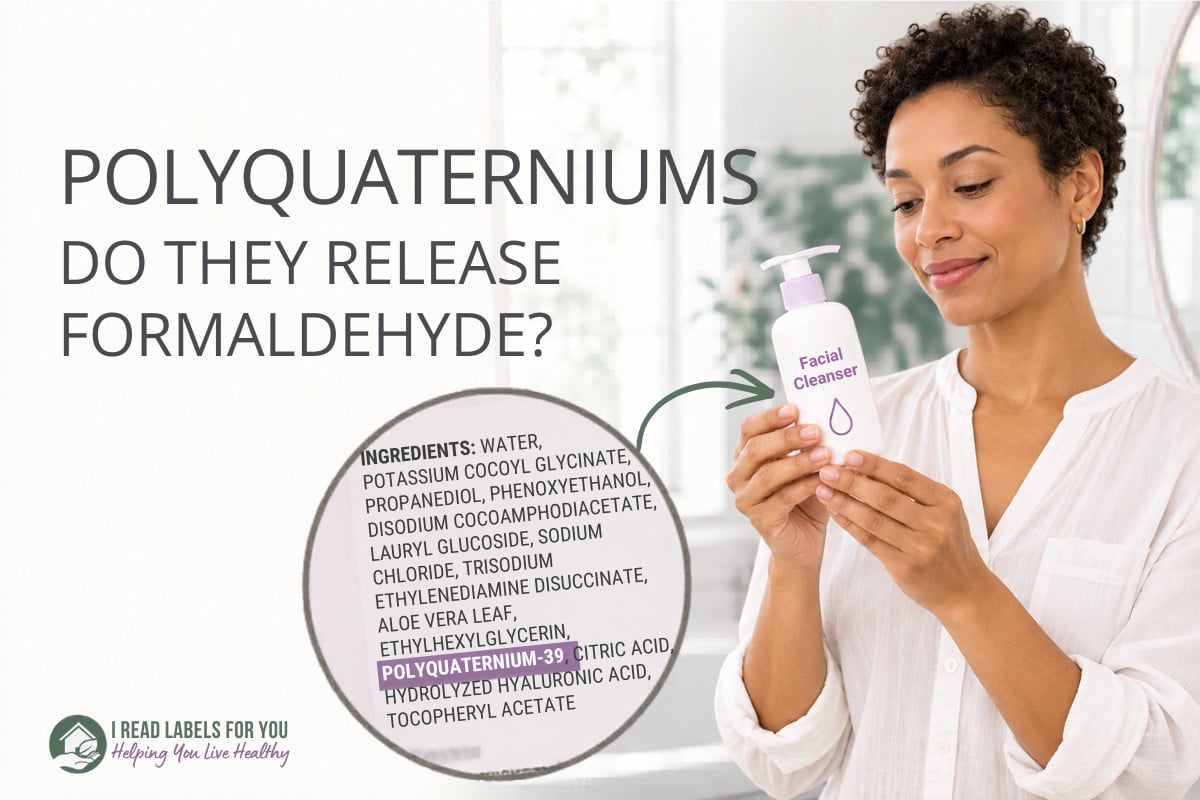
Polyquaterniums are mostly safe in rinse-off hair care, but the full answer depends on the number after the name. They’re positively charged conditioning polymers that stay out of healthy skin, yet the chemistry behind each number differs. My ratings for the three I review here range from Better (Limited Use) to Better (Not In My Top Picks).
This post covers three polyquaterniums, with my rating for each:
- Polyquaternium-6: Better (Limited Use)
- Polyquaternium-22: Better (Limited Use)
- Polyquaternium-39: Better (Not In My Top Picks)
Polyquaterniums are legal in European Union cosmetics, and Europe puts no cap on the polymers themselves. However, Polyquaternium-39 is made with acrylamide, a chemical linked to cancer. Europe caps how much leftover acrylamide a product made with it can contain. The U.S. and Canada restrict none of the three.
Read on for three things a label will not tell you. First, which chemicals are used to make each of these three polyquaterniums, and what traces of them may stay behind. Second, why acrylamide keeps Polyquaternium-39 out of my Best products. Third, whether polyquaterniums release formaldehyde, count as silicones or build up on hair.
What Are Polyquaterniums?
Polyquaterniums are a family of man-made polymers, which are long chains of repeating units. Each chain carries many positive charges on nitrogen atoms, the “quaternium” part of the name.
In spite of the shared name, they are separate ingredients. All three are built entirely from synthetic building blocks, but each follows a different recipe.
See individual reviews for:
What Does The Number In A Polyquaternium Name Mean?
The number works like a name tag. It tells you which recipe you’re looking at, not how strong, gentle or concentrated the polymer is.
A small change in the recipe matters. For instance, Polyquaternium-6 is made from one building block, while Polyquaternium-39 adds acrylic acid and acrylamide to that same block. Acrylamide alone changes the safety picture, which is why I rate every number on its own.
What Do Polyquaterniums Do In Cosmetics?
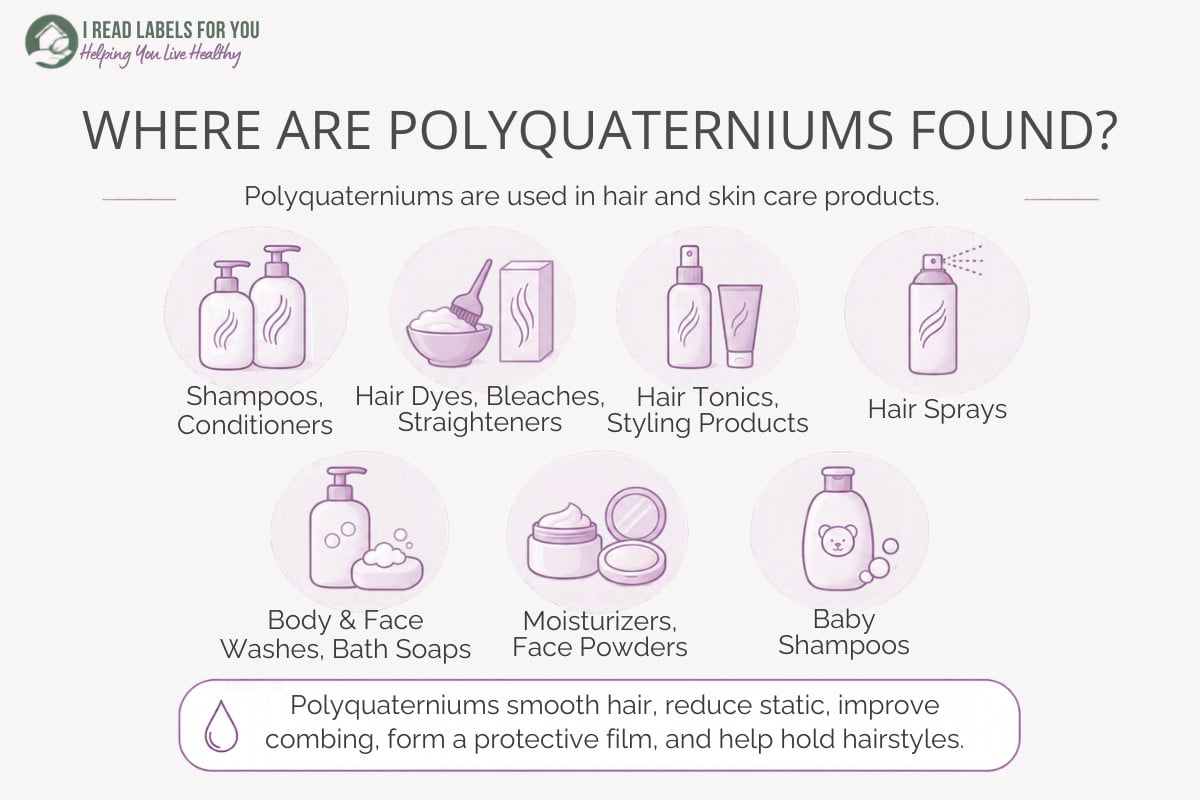
Opposite charges attract. Freshly washed hair carries a small negative charge, and a polyquaternium grabs onto it, smoothing the cuticle, calming static and helping a comb glide.
CosIng, the European Union’s cosmetic ingredient database, lists antistatic and film-forming as their main jobs. In addition, Polyquaternium-6, Polyquaternium-22, and Polyquaternium-39 work as hair fixatives that help hold a style.
You’ll find polyquaterniums most often in:
- shampoos and rinse-out conditioners
- hair dyes, bleaches and straighteners
- leave-in conditioners, hair tonics and styling products
- pump hair sprays
- body & face washes and bath soaps
- moisturizers and face powders
- baby shampoos
Polyquaterniums are not food ingredients. Even so, U.S. food rules allow Polyquaternium-6 and a Polyquaternium-39-type polymer in paper and paperboard that touches food.
How Are Polyquaterniums Made?
Most polyquaterniums are made by linking small building blocks, called monomers, into chains. The workhorse block is diallyldimethylammonium chloride (DADMAC).
Polyquaternium-6 is DADMAC alone. Polyquaternium-22 pairs it with acrylic acid, and Polyquaternium-39 adds acrylamide as a third block.
Chain-building rarely uses up every block. Leftover monomers and side products can stay in the finished ingredient, and that’s where most of my concerns sit.
Do Polyquaterniums Penetrate The Skin?
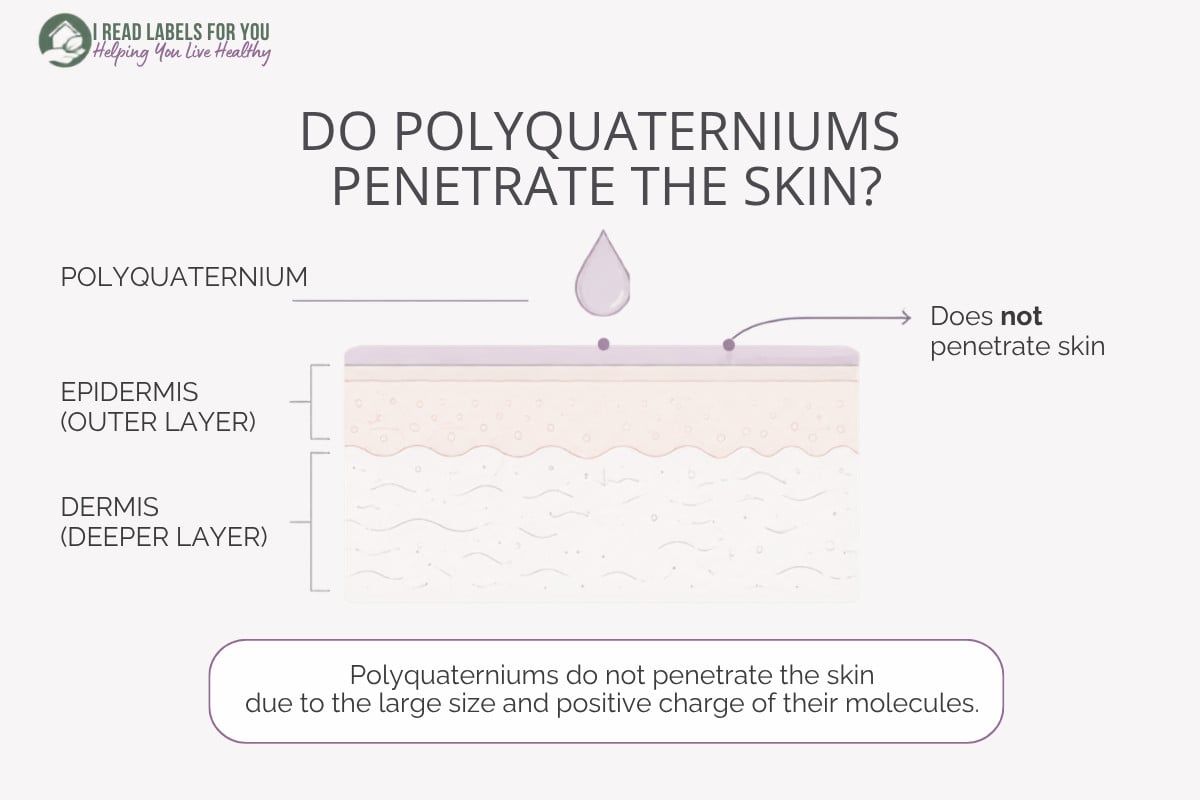
No, the polymers themselves do not cross healthy skin in any meaningful amount. Size decides it. Daltons measure molecular weight, and skin keeps out most molecules heavier than about 500 of them.
These chains are hundreds to thousands of times heavier. Polyquaternium-22 trade materials weigh roughly 190,000 and 450,000 daltons, and Polyquaternium-6 averages 294,000. Polyquaternium-39 reaches about 1.5 million.
Their positive charge adds a second barrier, because charged molecules love water and avoid the fatty top layer of skin. That’s also why none of them has a LogP, the score for how oil-loving a molecule is.
The leftovers are another matter. DADMAC and acrylamide are tiny molecules, and no study has measured how much of either crosses skin from a finished product.
What Are Polyquaterniums Called On Labels?
Labels show the word Polyquaternium with its number, sometimes without the hyphen. These are the three I review here, with other names you may spot:
- Polyquaternium-6 (Polydiallyldimethylammonium Chloride, PolyDADMAC)
- Polyquaternium-22 (Acrylic Acid-DADMAC Polymer)
- Polyquaternium-39
Why Do My Ratings Differ From One Polyquaternium To Another?
As finished polymers, all three look mild. My ratings split because of the chemicals used to make them and what may stay behind in the bottle.
Europe sorts cancer-causing chemicals into tiers. Category 1B covers chemicals presumed to cause cancer in humans, mostly from animal studies, while category 2 covers suspected ones.
Only one of the three involves a category 1B chemical in its production. Here’s how they compare:
| Polyquaternium | Manufacturing chemical of concern | Europe’s hazard class | What testing found |
| Polyquaternium-39 | acrylamide | cancer 1B and gene damage 1B, meaning presumed to cause cancer and gene damage, mostly from animal studies | acrylamide typically under 1 ppm |
| Polyquaternium-6 | allyl chloride; methyl chloride | cancer 2 for both, meaning suspected of causing cancer on limited evidence | up to 50 ppm allyl chloride in one supplier’s ingredient; nitrosamines never tested |
| Polyquaternium-22 | acrylic acid; DADMAC | not classified as carcinogens | acrylic acid under 1,000 ppm; DADMAC under 1% |
The figures come from safety reviews by the Cosmetic Ingredient Review (CIR), a U.S. panel funded by the cosmetics industry. Most of the testing inside them is unpublished data that ingredient suppliers handed in.
Why Does Acrylamide Matter Most?
Acrylamide can damage genes, and for chemicals like that, regulators do not assume any dose is completely safe. Europe bans it outright as a cosmetic ingredient.
Yet acrylamide is one of the building blocks of Polyquaternium-39, and traces stay behind. Consequently, I keep it out of every Best product, whatever the product type.
What About Nitrosamines?
Nitrosamines are cancer-causing compounds that can form when certain nitrogen chemicals meet nitrites. The 2025 CIR review of Polyquaternium-6 warns that “polyquaternium compounds can be N-nitrosated” and that its nitrosamine content “has not been determined.”
None of the other reports tested for nitrosamines either.
My Ratings For Three Polyquaterniums
Here’s where each number lands, and which products I accept it in.
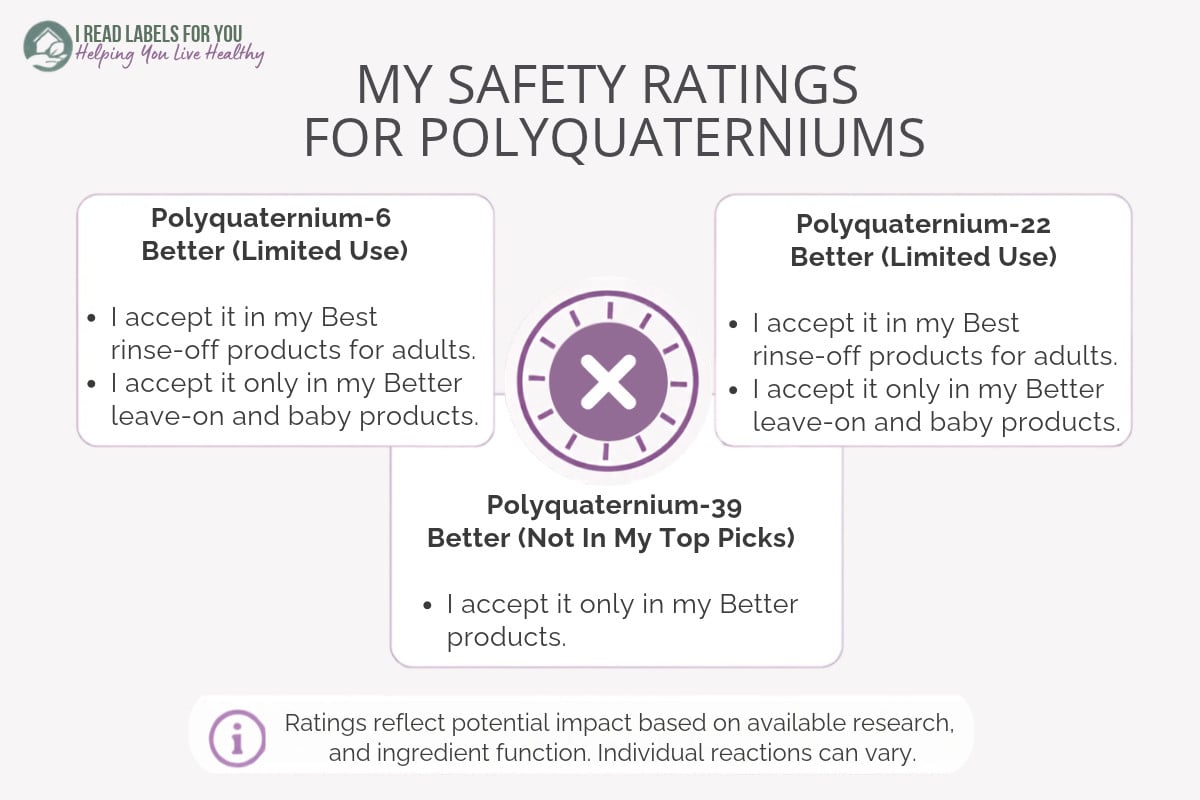
| Polyquaternium | My rating | Where I accept it |
| Polyquaternium-6 | Better (Limited Use) | Best rinse-off products for adults; Better leave-on and baby products |
| Polyquaternium-22 | Better (Limited Use) | Best rinse-off products for adults; Better leave-on and baby products |
| Polyquaternium-39 | Better (Not In My Top Picks) | Better products only |
In short, Better (Limited Use) numbers can appear in my Best shampoos and rinse-out conditioners for adults. Better (Not In My Top Picks) numbers stay in my Better products, regardless of how you use them.
Does The U.S. FDA Restrict Polyquaterniums In Food And Cosmetics?
No, the U.S. Food and Drug Administration (FDA) restricts none of the three. Not one appears on its list of prohibited and restricted cosmetic ingredients.
I would not read much into that. American cosmetic makers do not need FDA sign-off before selling a formula, and the agency tends to act only once harm has been reported.
Interestingly, FDA food-packaging rules cap leftover monomer at 1% of the polymer when Polyquaternium-6 goes into food-contact paper. No such cap exists for the same polymer in your shampoo.
Europe starts from the opposite end. Its precautionary principle allows officials to step in on a believable warning sign, without waiting for proof of injury.
EU Regulations On Polyquaterniums
The European Union allows all three polyquaterniums in cosmetics with no limit on the polymer. However, CosIng links Polyquaternium-39 to Annex III entry 66, the rule for polyacrylamides.
That rule caps leftover acrylamide at 0.1 milligrams per kilogram in body leave-on products and 0.5 in everything else. Put simply, a leave-on lotion may hold no more than 0.1 parts per million.
The rule traces back to the Scientific Committee on Cosmetic Products and Non-Food Products (SCCNFP), an earlier EU expert panel. In 1999, its opinion on acrylamide residues warned that lifelong use of polyacrylamide products “may represent an unacceptable high lifetime risk of cancer.”
Europe also bans many of these manufacturing chemicals as cosmetic ingredients, including acrylamide, allyl chloride, methyl chloride and nitrosamines. Still, it sets no residue limit for any of them inside a polymer, except acrylamide.
Finally, the Scientific Committee on Consumer Safety (SCCS), which advises the European Commission on cosmetics, has never issued an opinion on any of the three.
U.S. And EU Disagreements On Polyquaterniums
The two sides disagree most on acrylamide. The CIR panel uses its own limit of 5 parts per million in finished products, 50 times higher than the EU leave-on cap.
Moreover, the U.S. has no legal acrylamide limit in cosmetics at all. You cannot tell from a U.S. label how much any product contains.
Canadian Regulations On Polyquaterniums
Canada does not restrict any of the three polyquaterniums. None appears on Health Canada’s Cosmetic Ingredient Hotlist, which names the cosmetic ingredients Canada forbids or limits.
Even so, the Hotlist bans acrylamide monomer as an ingredient. In addition, Canada’s toxic substances list, Schedule 1 of the Canadian Environmental Protection Act, includes none of the three polymers.
Polyquaternium-6: My Full Review
What Is Polyquaternium-6?
Polyquaternium-6 is a chain made entirely of DADMAC units, and you may see it called polyDADMAC. It conditions hair, reduces static, forms a film and helps hold styles.
Most of its use is rinse-off. The 2025 CIR review counted 149 U.S. products, and 138 of them were rinse-off, mainly shampoos, conditioners and hair color.
Use levels reach 3% in hair straighteners and 1.2% in hair tonics. It also appears in pump hair sprays at up to 0.5%, and in baby products at 0.13%.
How Is Polyquaternium-6 Made?
Manufacturers link DADMAC units together in water. DADMAC itself is made from allyl chloride, a chemical Europe classifies as a suspected carcinogen and suspected gene-damaging agent.
One supplier reported traces in its ingredient: up to 50 ppm allyl chloride, under 2 ppm methyl chloride and up to 250 ppm allyl alcohol. Methyl chloride is also a suspected carcinogen in Europe, and a second supplier did not report these figures.
The most-tested grade also carried up to 6.5% free DADMAC in a 42% solution. By my math, that’s roughly 15% of the polymer, versus the 1% U.S. limit for food-contact paper.
On the positive side, the review states that ethylene oxide, 1,4-dioxane and residual solvents are “not expected” from this process. Nitrosamines were never measured, as noted above.
Does Polyquaternium-6 Penetrate The Skin?
No, Polyquaternium-6 is far too large to enter healthy skin. Its weight-average size is about 294,000 daltons, and its permanent charge keeps it in the surface layer.
No absorption study exists, though. A 90-day study on rabbit skin found no signs of whole-body harm. Meanwhile, skin entry of the small leftover DADMAC has never been measured.
Can Polyquaternium-6 Cause Skin Allergy?
No, Polyquaternium-6 has not caused skin allergy in the few tests on record. A guinea pig test was negative, and so were patch tests in 50 volunteers and in 29 volunteers exposed to light.
Those were unpublished supplier studies, and the CIR itself called the data “limited.” Furthermore, the 90-day rabbit study irritated scraped skin but not intact skin, which matters for broken diaper skin.
What Do Regulators Say About Polyquaternium-6?
No regulator restricts Polyquaternium-6. CosIng lists it without any annex entry, and the European Chemicals Agency (ECHA) has given it no harmonized hazard classification.
The “safe as used” verdict in the 2025 CIR review comes with a caution to formulate products “to avoid the formation of nitrosamines.” Health Canada and the FDA do not list it.
What I Think About Polyquaternium-6
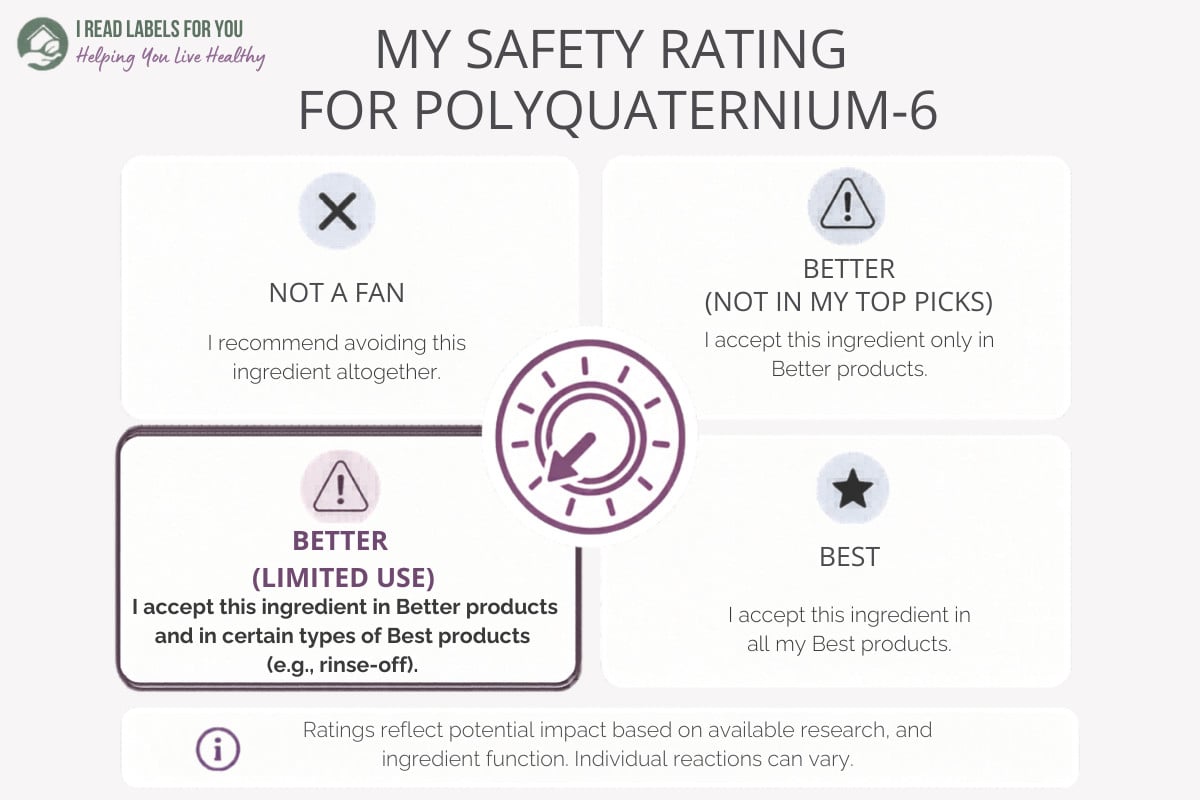
I rate Polyquaternium-6 Better (Limited Use). The polymer looks gentle, but suspected carcinogen traces, a high free monomer level and the untested nitrosamine question make me cautious about long contact.
For adults, shampoo, rinse-out conditioner and hair color containing it can still make my Best list. Hair tonics, leave-in sprays and other leave-on products qualify only for my Better list, and the same goes for anything made for babies.
Polyquaternium-22: My Full Review
What Is Polyquaternium-22?
Polyquaternium-22 is a copolymer of DADMAC and acrylic acid, the same acid behind many thickeners. It acts as an antistatic agent, film former and hair fixative.
Its home is hair dye. The 2016 CIR review, which covers it together with Polyquaternium-39, counted 544 U.S. uses, and 487 were hair coloring products.
Rinse-off products use up to 2%, while the 14 leave-on uses stay at 0.4 to 0.5%. The review recorded no baby, eye-area, spray or powder products.
How Is Polyquaternium-22 Made?
Manufacturers join acrylic acid and DADMAC into one chain. Neither building block is classified in Europe as a carcinogen, and acrylamide plays no part in this recipe.
Typical leftovers are acrylic acid under 1,000 ppm and DADMAC under 1%. Those are “typical” values from one industry submission, not a guaranteed specification.
The 2016 review says nothing about allyl chloride, methyl chloride or nitrosamines in Polyquaternium-22. The CIR documented those questions for Polyquaternium-6, which is also built from DADMAC, but never checked them here.
Does Polyquaternium-22 Penetrate The Skin?
No, Polyquaternium-22 does not get through healthy skin. Its two trade materials weigh about 190,000 and 450,000 daltons, and its charge adds another barrier.
Nobody has measured absorption directly, though. The small leftover molecules, DADMAC and acrylic acid, have no skin-entry data either.
Can Polyquaternium-22 Cause Skin Allergy?
Nobody knows for sure whether Polyquaternium-22 can cause skin allergy, because it has never been tested for that. The CIR panel admitted the gap and leaned on a patch test of Polyquaternium-39 instead.
The only human data are irritation tests of a hair dye in 30 people, and the dye held a tiny 0.016% of the polymer. No irritation showed up, but that dose is far below the 2% used in products.
In a rabbit test, the undiluted ingredient caused redness that ranged up to severe by 72 hours, worst on scraped skin. In addition, Sweden has told ECHA it plans to propose classifying acrylic acid as a skin sensitizer, meaning a chemical that can trigger skin allergy.
What Do Regulators Say About Polyquaternium-22?
No regulator restricts Polyquaternium-22. CosIng lists it with no annex entry, and the acrylamide limit for polyacrylamides does not apply to it.
ECHA gives it no harmonized classification, and neither the FDA nor Health Canada lists it. The 2016 CIR review found it “safe in the present practices of use” without conditions.
What I Think About Polyquaternium-22
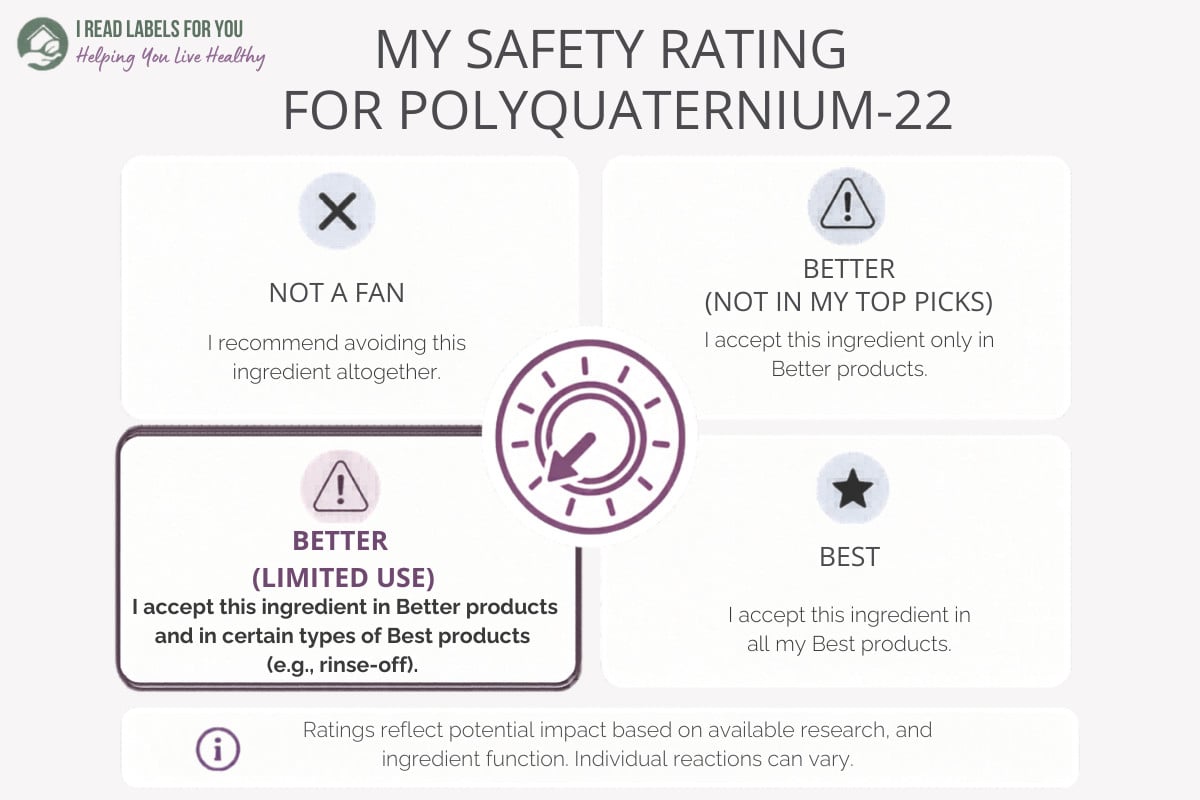
My rating for Polyquaternium-22 is Better (Limited Use). It’s one of the cleaner numbers chemically, with no acrylamide, yet it has never had an allergy test of its own.
For adults, it can sit in my Best hair dyes, shampoos and rinse-out conditioners. Leave-on products and baby products with it go only on my Better list until someone tests it properly.
Polyquaternium-39: My Full Review
What Is Polyquaternium-39?
Polyquaternium-39 is a three-part polymer of acrylic acid, acrylamide and DADMAC. Like its relatives, it reduces static, forms a film and helps hold hair in place.
It reaches more of your body than most polyquaterniums. The 2016 CIR review found it in 83 U.S. products at up to 3%, including face and neck powders, eye-area products and two baby products.
How Is Polyquaternium-39 Made?
Manufacturers combine acrylic acid, DADMAC and acrylamide. Acrylamide is the problem: Europe classifies it as a presumed carcinogen, a presumed gene-damaging agent and a skin sensitizer.
The review lists typical leftovers of acrylamide under 1 ppm, acrylic acid under 50 ppm and DADMAC under 2%. It does not say whether the acrylamide figure refers to the liquid as sold or to the dry polymer.
No heavy metal, nitrosamine or chlorinated residue data appear in the report. All of its test data came from one supplier’s trade material.
Does Polyquaternium-39 Penetrate The Skin?
No, Polyquaternium-39 itself cannot get into healthy skin. One trade version weighs about 1.5 million daltons, roughly 3,000 times the size skin normally lets through.
Its leftovers are the open question. Acrylamide and DADMAC are small, and nobody has checked whether they pass from a lotion or powder into your skin.
Can Polyquaternium-39 Cause Skin Allergy?
No, Polyquaternium-39 did not cause skin allergy in its one human test. In a 1994 patch study, 150 adults completed the test, and none reacted at the final challenge.
The report does not state the concentration tested, and the study was unpublished industry data. Rabbit skin showed no irritation at all.
Keep in mind that acrylamide itself is a recognized skin sensitizer in Europe. Leftovers under 1 ppm are small, but no one has tested whether that amount matters for skin allergy.
What Do Regulators Say About Polyquaternium-39?
Europe restricts Polyquaternium-39 through its acrylamide residue rule, Annex III entry 66, according to its CosIng record. Body leave-on products may contain no more than 0.1 mg/kg of acrylamide.
By my math, under 1 ppm in the ingredient at a 3% use level falls inside that cap. Still, ECHA shows no harmonized classification for the polymer, and the U.S. and Canada set no limit.
What I Think About Polyquaternium-39
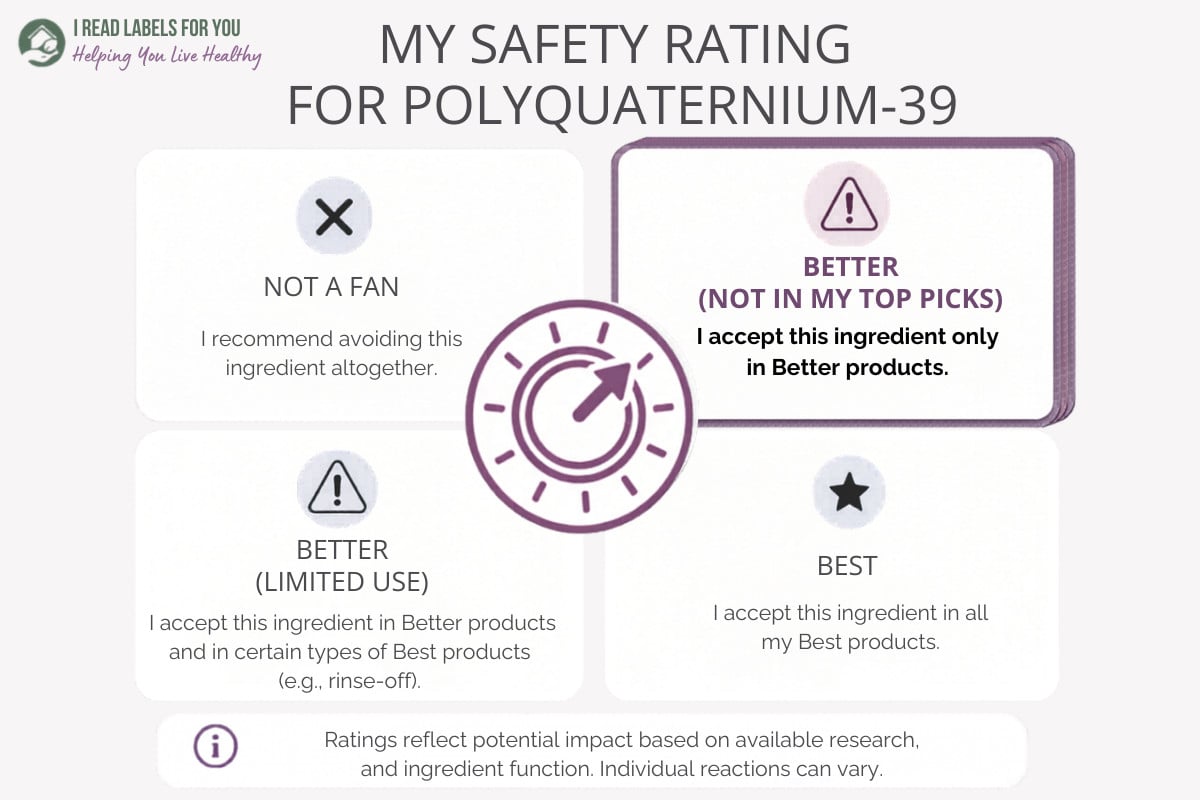
Polyquaternium-39 earns a Better (Not In My Top Picks) rating from me. A presumed carcinogen is one of its three building blocks, and you have no way to check the leftover level on a label.
It can appear in my Better products, never in my Best ones, and that holds for shampoo and lotion alike.
Can Polyquaterniums Cause Skin Allergy And Sensitization?
Polyquaterniums rarely cause skin allergy, although the evidence is thin and uneven across numbers. Dermatologists patch test first with the Core Allergen Series of the American Contact Dermatitis Society (ACDS), and none of the three is on it.
Polyquaternium-22 has never been tested on its own. For the other two, the evidence rests on a handful of mostly unpublished patch tests.
Are Polyquaterniums Hormone (Endocrine) Disruptors?
No, polyquaterniums are not known hormone disruptors, but none of the three has ever been tested for hormone effects. They also appear on no EU endocrine disruptor list.
Are Polyquaterniums Safe To Use While Pregnant?
Polyquaterniums are probably low risk during pregnancy, since the polymers stay on the skin surface, but no pregnancy study exists for any of the three. No regulator lists them as harmful to fertility or to a developing baby.
If you want to play it safe, choose rinse-off products and skip leave-on ones made with Polyquaternium-39. If you’re pregnant and unsure about a product, you should consult with your medical provider.
Are There Any Cancer Concerns Linked To Polyquaterniums?
No polyquaternium is a listed carcinogen, but several are made with chemicals that are. None of the three appears on the cancer lists kept by the International Agency for Research on Cancer (IARC), the U.S. National Toxicology Program or California’s Proposition 65.
By contrast, acrylamide appears on all three lists. The real issue is how much of it remains in the finished ingredient.
Testing on the polymers is thin. All three came back clean in the Ames test, which checks whether a chemical mutates bacteria. Even so, none of them has a long-term cancer study.
Are Polyquaterniums Bad For The Environment?
Polyquaterniums may harm water life, although cosmetic-specific data are scarce. A 2023 study on algae linked the toxic effects of charged polymers, including polyDADMAC, to the polymers clinging to the surfaces of organisms.
Water treatment shows another side. Plants use polyDADMAC to clean drinking water, and a 2019 study traced nitrosamine formation during disinfection to its smaller chain fractions. That setting differs from cosmetics, however.
Neither COSMOS nor NATRUE, the two largest natural cosmetics certifiers, approves any of the three.
Common Claims About Polyquaterniums: What’s True And What’s Not
Claim: Polyquaterniums Build Up On Hair
There’s some truth to this one. Film forming is one of their listed jobs, so a thin coating is meant to stay on hair after rinsing.
That coating is the point of a conditioner. If your hair starts to feel heavy or limp, an occasional clarifying shampoo will usually strip it away.
Claim: Polyquaterniums Release Formaldehyde
This claim is false. None of the three is a formaldehyde releaser, and the main CIR safety reports on them never mention formaldehyde.
Quaternium-15 is likely the source of the confusion: unlike any polyquaternium, that preservative gives off formaldehyde, and dermatologists test for it routinely. The two names differ by four letters, therefore read the full name on the label.
Claim: Polyquaterniums Are Silicones
This claim is false. Silicones such as dimethicone have a backbone of silicon and oxygen, whereas the three polyquaterniums here are carbon chains carrying nitrogen.
They do share one trait: both coat hair and make it feel smoother. However, most of these polymers are sold dissolved in water, which silicones like dimethicone are not.
What I Think About Polyquaterniums — And What You Should Do
My ratings for polyquaterniums run from Better (Limited Use) to Better (Not In My Top Picks), and the number decides which. None of the three earns Best, because each one has either a manufacturing concern or a data gap.
Polyquaternium-6 and Polyquaternium-22 are Better (Limited Use). For adults, they can appear in my Best rinse-off products, but in leave-on and baby products they stay on my Better list.
Polyquaternium-39 is Better (Not In My Top Picks), which keeps it in my Better products only. Acrylamide, a presumed carcinogen, is one of its building blocks.
My practical suggestions:
- read the number after Polyquaternium, not just the word
- favor polyquaterniums in shampoo and rinse-out conditioner over leave-in products
- skip Polyquaternium-39 in leave-on lotions, powders and makeup
- choose baby products without polyquaterniums when you have the option
- clarify your hair now and then if it feels coated
Frequently Asked Questions About Polyquaterniums
Is Polyquaternium Safe?
It depends on which one. In rinse-off hair products, the three I review here pose little risk to your skin. Still, one is made with a presumed carcinogen, and none has complete safety data.
Is Polyquaternium A Silicone?
No. Polyquaterniums contain no silicon; they’re positively charged, carbon-based polymers. If a product is silicone-free, it can still contain a polyquaternium.
Which Polyquaterniums Are Best For Babies?
None of the three makes my Best list for baby products, and I accept them only in my Better ones.
For your baby, a product with no polyquaternium at all is the simplest choice.
Why Does EWG Rate Polyquaterniums Differently?
The Environmental Working Group (EWG) gives Polyquaternium-22 a hazard score of 1 and Polyquaternium-6 a 2, both in its low-hazard range. Its score for Polyquaternium-39 runs from 1 to 4, depending on how it’s used.
My ratings are stricter because I weigh what may be left over from manufacturing and the tests nobody has done. Polyquaternium-6 can carry traces of allyl chloride and methyl chloride, both suspected carcinogens, and its nitrosamine content has never been measured.
Polyquaternium-39 is made with acrylamide, a presumed carcinogen, and Polyquaternium-22 has never had an allergy test of its own. EWG’s own Verified program is closer to my view: it restricts Polyquaternium-6 and Polyquaternium-39, but not Polyquaternium-22.
Sources
EU SCCS / SCCP Opinions:
No SCCS or SCCP opinion on Polyquaternium-6, -22 or -39 (checked). SCCS opinions portal: SCCS opinions
SCCNFP, Opinion concerning acrylamide residues in cosmetics, adopted September 30, 1999. Applies to polyacrylamide preparations, not to any single polyquaternium: SCCNFP opinion
Cosmetic Ingredient Review (CIR) Reports:
All CIR reports are funded by the Personal Care Products Council, the cosmetics industry trade group.
Johnson W Jr, Bergfeld WF, Belsito DV, Cohen DE, Klaassen CD, Liebler DC, Peterson LA, Shank RC, Slaga TJ, Snyder PW, Fiume MM, Heldreth B, 2025. Safety Assessment of Polyquaternium-6 as Used in Cosmetics. International Journal of Toxicology 44(Suppl 3):80S to 90S. PMID 40932359. Manufacture, impurities, use levels, sensitization and the nitrosamine caution: cir-reports.cir-safety.org; PubMed 40932359
Johnson W Jr, Heldreth B, Bergfeld WF, Belsito DV, Hill RA, Klaassen CD, Liebler DC, Marks JG Jr, Shank RC, Slaga TJ, Snyder PW, Andersen FA, 2016. Safety Assessment of Polyquaternium-22 and Polyquarternium-39 as Used in Cosmetics. International Journal of Toxicology 35(Suppl 3):47S to 53S. PMID 27913787. Group report; monomers, residues, use levels and patch test: cir-reports.cir-safety.org; PubMed 27913787
European Union Regulatory Databases:
CosIng entry 36881, POLYQUATERNIUM-6, no annex restrictions: CosIng 36881
CosIng entry 79119, POLYQUATERNIUM-22, no annex restrictions: CosIng 79119
The CosIng entry 79207, POLYQUATERNIUM-39, linked to Annex III entry 66: CosIng 79207
CosIng substance Polyacrylamides, Annex III entry 66. Residual acrylamide maximum 0.1 mg/kg in body leave-on products and 0.5 mg/kg in other products: CosIng Polyacrylamides
CosIng Annexes II, III, IV, V and VI (2026 versions), checked. No polyquaternium listed by name. Annex II prohibits acrylamide (entry 681), allyl chloride (1172), chloromethane (1095) and nitrosamines (410).
CLP Annex VI harmonized classifications (2026 table), checked. No entry for any of the three polymers. Acrylamide 616-003-00-0: Carc. 1B, Muta. 1B, Repr. 2, Skin Sens. 1: ECHA CHEM, acrylamide
CLP Annex VI: allyl chloride 602-029-00-X, Carc. 2 and Muta; 2; chloromethane 602-001-00-7, Carc. 2: ECHA CHEM, allyl chloride
CLP Annex VI: acrylic acid 607-061-00-8, Skin Corr. 1A, no sensitizer class: ECHA CHEM, acrylic acid
ECHA registry of classification and labelling intentions. Sweden, acrylic acid, proposed Skin Sens. 1: ECHA CLH intention
ECHA CHEM substance pages, no harmonized classification: Polyquaternium-6; Polyquaternium-22; Polyquaternium-39
Other Regulators:
U.S. FDA, prohibited and restricted cosmetic ingredients. None of the three listed: FDA
U.S. Code of Federal Regulations, 21 CFR 176.170, components of paper and paperboard in contact with food. Covers Polyquaternium-6 (residual monomer up to 1% of polymer) and the Polyquaternium-39-type polymer: eCFR 21 CFR 176.170
Health Canada Cosmetic Ingredient Hotlist. None of the three listed; acrylamide monomer prohibited: Health Canada Hotlist
Environment Canada, CEPA Schedule 1. None of the three listed: CEPA Schedule 1
International Agency for Research on Cancer (IARC). None of the three classified; acrylamide Group 2A: IARC list
U.S. National Toxicology Program, Report on Carcinogens, 15th edition. None of the three listed; acrylamide reasonably anticipated to be a human carcinogen: NTP Report on Carcinogens
California Proposition 65 list. None of the three listed; acrylamide listed: OEHHA
U.S. EPA Integrated Risk Information System. No assessment of any of the three: IRIS A to Z list
PubChem Records (Chemistry, Identifiers, Skin Penetration, Hazard Codes):
Polyquaterniums are polymers, and PubChem has no true compound record (CID) for them. Substance records or building-block records used:
Polyquaternium-6, SID 134997405: PubChem SID 134997405
Polyquaternium-22, SID 381122237: PubChem SID 381122237
Polyquaternium-39, SID 135337975: PubChem SID 135337975
Peer-Reviewed Studies:
An et al., 2019. Water Research. Drinking water study linking lower molecular weight fractions of polyDADMAC to N-nitrosodimethylamine formation. Abstract only. PMID 30576897: PubMed 30576897
Hisar et al., 2023. PeerJ. Algae study of anionic and cationic polymers, including polyDADMAC. PMID 38025686: PubMed 38025686
Natural Cosmetic Standards:
COSMOS-standard approved raw materials. None of the three listed: COSMOS-standard approved raw materials
NATRUE certified and approved raw materials. No polyquaternium listed: NATRUE certified raw materials
Skin Allergy Resource:
American Contact Dermatitis Society (ACDS), Helpful References, including the Core Allergen Series 2020. No polyquaternium on the series; Quaternium-15 is a different, formaldehyde-releasing preservative: ACDS Helpful References
Advocacy groups:
Environmental Working Group (EWG) Skin Deep entries. Polyquaternium-6, score 2, restricted in EWG Verified: EWG Polyquaternium-6
Polyquaternium-22, score 1: EWG Polyquaternium-22
Polyquaternium-39, score 1 to 4 depending on use, restricted in EWG Verified: EWG Polyquaternium-39
Last verified: 10-21-2026
Download The Free Guide!
5 Powerful Steps To A Non-Toxic Home
Join our informed consumer community and get our free guide the “5 Powerful Steps To A Non-Toxic Home”.
Before commenting, please read our Comment Policy.