
Is Carbomer Safe? A Simple Answer You Can Trust
 Written by Irina Webb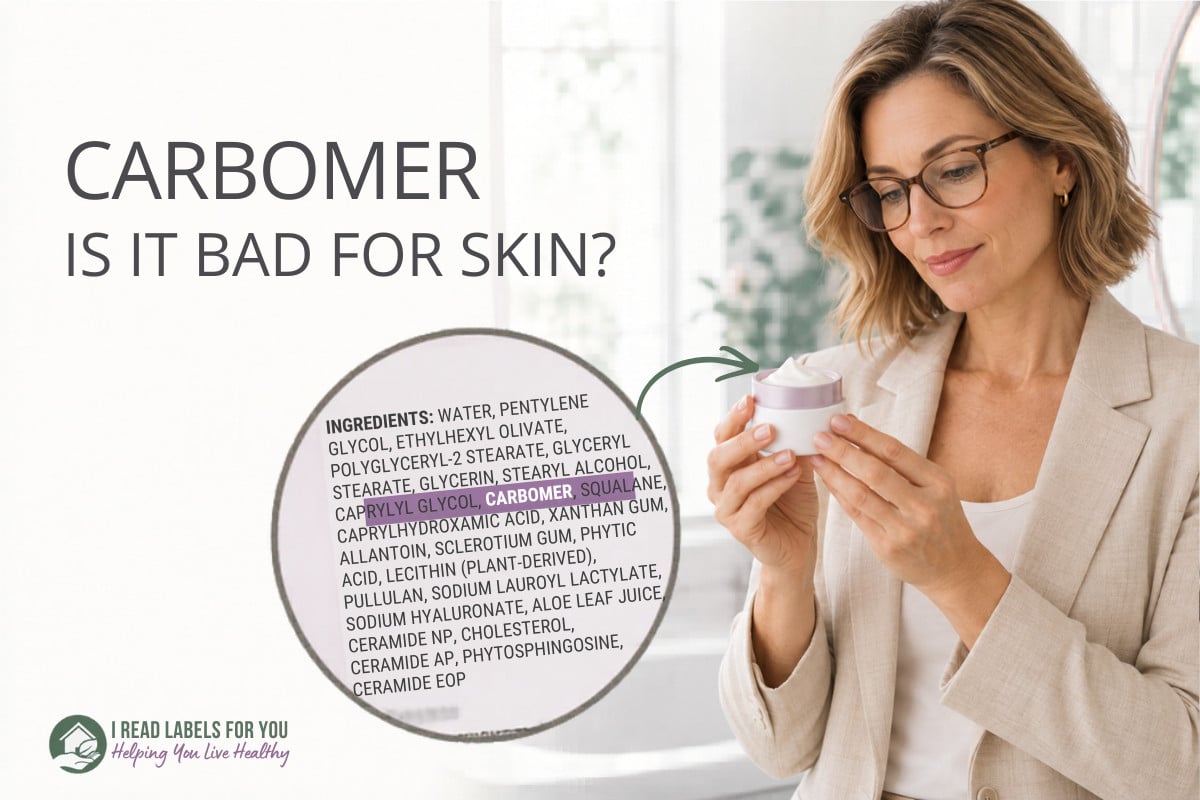
Yes, Carbomer is safe on skin, yet it still sits outside my top tier. It’s a laboratory-made polymer that turns thin liquids into smooth gels. My concern is not the polymer but a leftover chemical from making it. My verdict is Better (Not In My Top Picks).
European cosmetics law sets no limit on Carbomer. A search of all four annexes of the EU Cosmetics Regulation turns up nothing. No European committee has ever reviewed it, which is not the same as clearing it.
Ahead, you’ll learn which known carcinogen the industry’s own review names as a leftover in Carbomer. You’ll see what 1,302 patch-tested patients revealed about allergy risk. You’ll also learn why a 2023 European rule may change your moisturizer by 2029.
What Is Carbomer?
Carbomer is a synthetic thickener built from acrylic acid. A polymer is a long chain made from many copies of one small building block.
The 1982 review describes them as “synthetic, high molecular weight, nonlinear polymers of acrylic acid, cross-linked with a polyalkenyl polyether.” Cross-linked is the word that matters, because the chains are tied to each other.
That structure forms a three-dimensional net rather than loose strands. Drop the powder into water and it swells, trapping liquid inside the mesh. A thin liquid becomes a gel without turning greasy.
What Does Carbomer Do In Cosmetics?
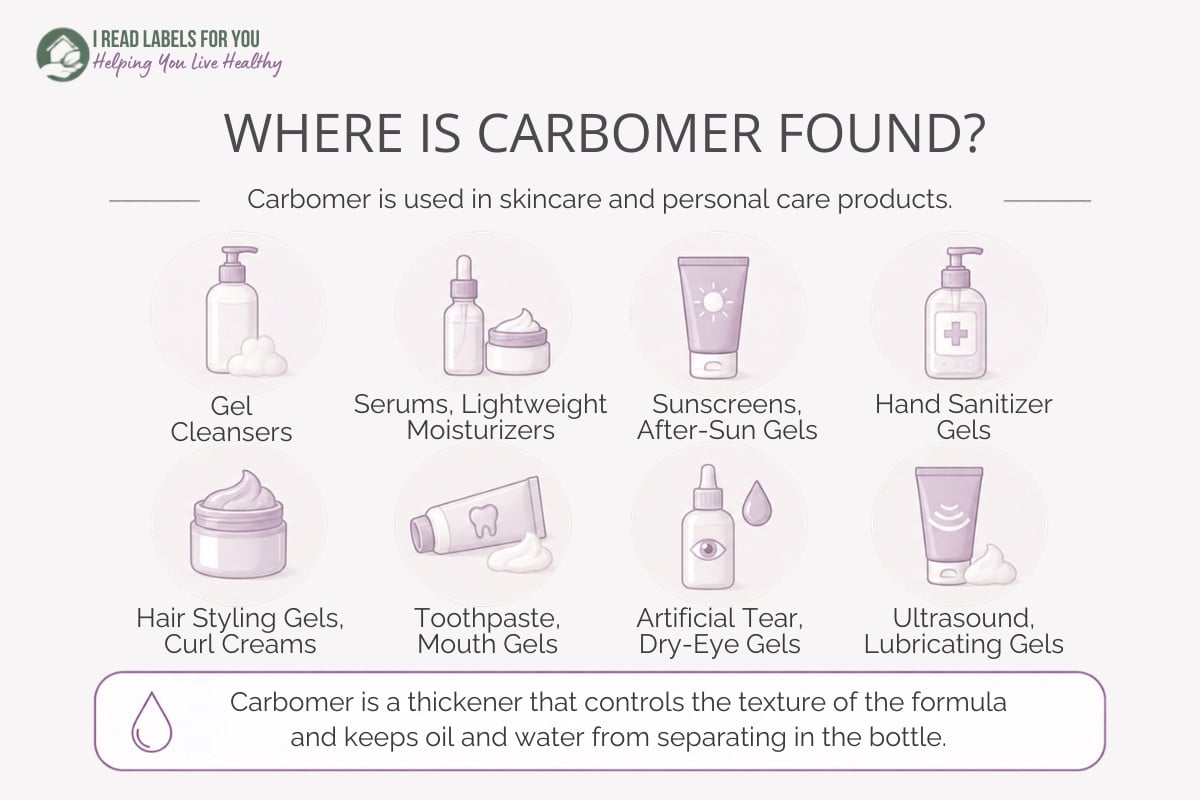
Carbomer earns its place by controlling texture. The EU ingredient database records three functions: emulsion stabilizing, gel forming, and viscosity controlling. It thickens, so a serum stays put instead of running off your hand. It also suspends particles evenly instead of letting them sink. Finally, it keeps oil and water from separating in the bottle.
The 2018 review counted 6,434 reported uses of Carbomer, up from 1,504 in 2001. Reported concentrations reached 15 percent in leave-on products. Toothpaste and lip products, which get swallowed incidentally, reached 9 percent.
You’ll find Carbomer most often in:
- gel cleansers and face washes
- serums and lightweight moisturizers
- sunscreens and after-sun gels
- hand sanitizer gels
- hair styling gels and curl creams
- toothpaste and mouth gels
- artificial tear and dry-eye gels
- ultrasound and lubricating gels
Carbomer is not a food ingredient, and I don’t recommend eating it. The same chemistry is cleared in the United States for food packaging contact. European food reviewers separately assessed it as a proposed supplement additive in 2021.
How Is Carbomer Made?
The 2018 review describes the process. Carbomer is manufactured by reflux polymerization of acrylic acid in an inert solvent in the presence of a catalyst. The identity of that solvent is the whole story of this ingredient.
Historically it was benzene. The chemistry record at PubChem states: “The polymerization solvent used previously was benzene.” It adds that “some of the newer commercially available grades” now use ethyl acetate or a cyclohexane blend.
Read the word “some” carefully. It tells you the industry moved. It does not tell you that all of it moved.
Does Carbomer Penetrate The Skin?
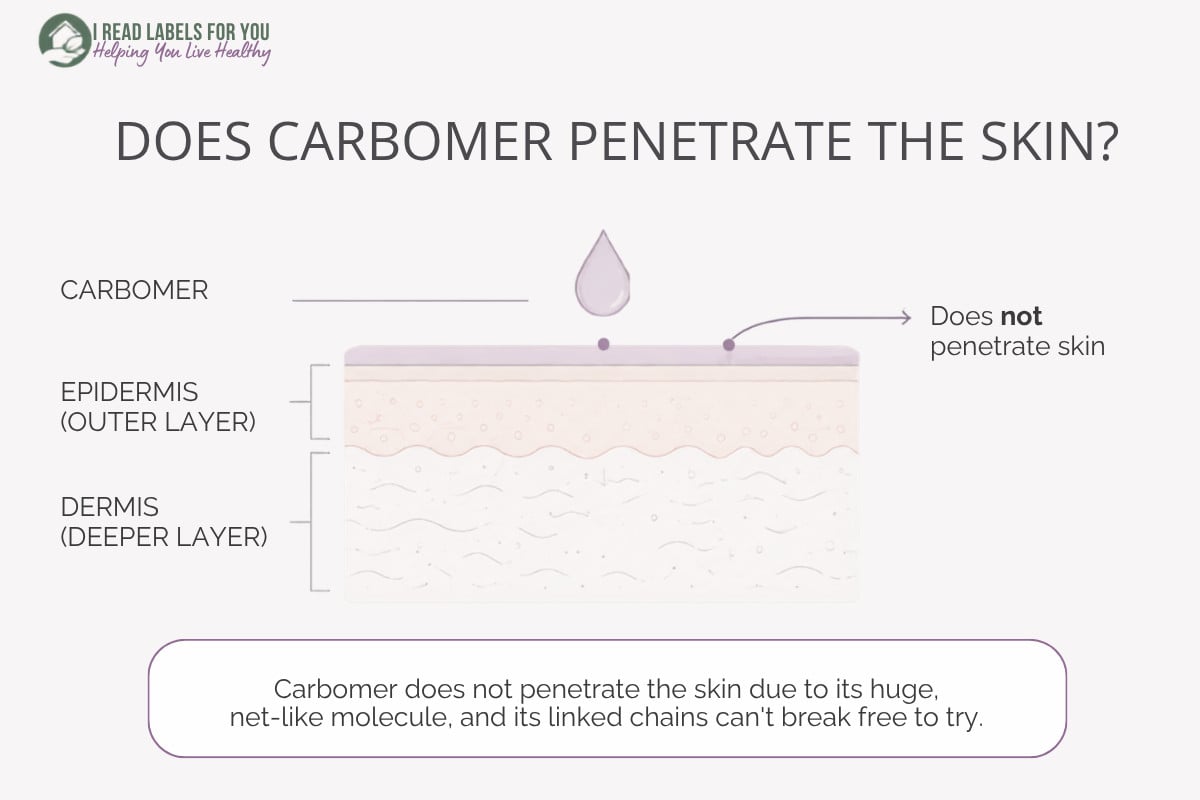
No. Carbomer does not get through your skin. Its size alone answers the question.
When I check whether an ingredient can soak into skin, I usually look at two things: how big the molecule is and whether it prefers oil or water. With Carbomer, only size matters, and that’s enough.
Scientists measure a molecule’s weight in daltons. As a rough rule, a molecule needs to be under about 500 daltons to pass through healthy skin. Carbomer isn’t a single small molecule. It’s a long chain made of many repeating pieces, so it doesn’t have one exact weight. The estimates run into the millions of daltons. That’s thousands of times over the limit.
The second test, called LogP, shows whether a molecule leans toward oil or water. That helps predict how easily it moves into skin. Carbomer doesn’t have a LogP. You can only measure it on a single, separate molecule, and Carbomer isn’t one. Its chains are also linked together, like a net. Because they’re tied to each other, they can’t break away and travel on their own. That makes the answer an even firmer no.
Bottom line: Carbomer stays on the surface of your skin. None of it reaches your bloodstream. If there’s anything worth thinking about, it’s not the Carbomer itself. It’s the other ingredients in the product, or small traces left over from how it was made.
What Is Carbomer Called On Labels?
One name now covers the whole family. The 2018 review notes the old, numbered names no longer exist as INCI names. They are now technical names for one ingredient, Carbomer.
Names and close relatives you may see on a label:
- Carbomer
- Sodium Carbomer
- Potassium Carbomer
- Calcium Potassium Carbomer
- Carbomer 934, 934P, 940, 941 And 980 (Supplier Grade Numbers)
- Carboxyvinyl Polymer
- Carboxypolymethylene
- Polyacrylic Acid
Carbopol is a trade name, not an INCI name, and it’s a trap. It covers Carbomer and also the acrylates crosspolymers, which are separate ingredients. A study naming Carbopol is not necessarily describing Carbomer.
Does The U.S. FDA Restrict Carbomer In Food And Cosmetics?
No, Carbomer faces no FDA restriction in American cosmetics. That statement carries less weight than you might hope. American law bars only a short list of substances, and no ingredient gets pre-reviewed.
For food, the picture splits. Carbomer’s own registry number appears in none of the four FDA food inventories. The same chemistry does sit in the indirect additives inventory for packaging contact.
I hold the agency’s food judgments loosely, and the GRAS system is why. A company may decide its own additive is safe, hire experts who agree, then sell it. Notifying the FDA is optional, and self-certification makes a weak foundation.
Europe works from the opposite instinct. Its precautionary principle lets regulators act while the science is still unsettled. Waiting for proof of harm is not the starting position there.
EU Regulations On Carbomer
Carbomer is unrestricted under the EU Cosmetics Regulation. I checked all four annexes directly, and it appears in none of them. Its CosIng entry lists no provisions and no conditions of use.
No European committee has assessed it. The Scientific Committee on Consumer Safety has published nothing on Carbomer since 1997. Neither have its two predecessor committees.
The chemicals side is equally quiet. Its ECHA record shows zero registrations and no harmonized hazard classification. Industry entries there read “Not classified.”
Put those together honestly. Europe has never restricted Carbomer, and Europe has also never examined it. I’d rather say that plainly than let silence sound like approval.
U.S. And EU Disagreements On Carbomer
One European rule does reach this ingredient. Commission Regulation (EU) 2023/2055, adopted September 25, 2023, restricts synthetic polymer microparticles. Most people call them microplastics, and the United States has no equivalent.
The rule names no substances and works from a definition. It covers solid synthetic polymer particles under 5 millimeters. Carbomer powder qualifies, because swelling in water is not dissolving in water.
The finished product is where it turns interesting. Commission guidance says “swellable polymers that form gels” and “that do not contain particles do not fulfil the SPM definition.” Carbomer in your moisturizer is a neutralized gel, so most formulas fall outside.
Where particles do remain, the deadlines are real. The Commission’s restriction page allows rinse-off sales until October 16, 2027. Leave-on products have until October 16, 2029, and makeup until October 16, 2035.
Two cautions before anyone panics. No standard test exists, so each manufacturer builds its own case. Also, the loudest voices calling Carbomer a microplastic are suppliers selling replacements.
Canadian Regulations On Carbomer
Canada permits Carbomer in cosmetics without conditions. It appears nowhere on the Cosmetic Ingredient Hotlist, prohibited or restricted. I searched the full list, including rows hidden behind the table’s paging.
The environmental side is equally clear. Carbomer does not appear on Schedule 1 of the Canadian Environmental Protection Act. No screening assessment has called it toxic.
Can Carbomer Cause Skin Allergy And Sensitization?
No, Carbomer very rarely causes skin allergy, though the direct evidence is thinner than I would like. The 1982 industry review tested it at full strength. It reported “low potential for skin irritation and sensitization at concentrations up to 100%.”
The largest study here tested Carbomer’s relatives, not Carbomer. A 2024 audit patch-tested 1,302 patients across 20 centers in Britain and Ireland. It covered three acrylate copolymers, and the authors concluded that sensitization to them “is rare.”
Rare is not never. Two small case reports exist, one on two carbomer patients and one on ultrasound gels. Both are single reports, and they are the only human reports naming Carbomer itself.
A clean reason explains the gap between polymers and their building blocks. Four acrylate monomers sit on the American Contact Dermatitis Society panel, and the family won Allergen of the Year twice. Those are small reactive molecules from nail products and adhesives.
A cross-linked net cannot behave that way, because it is far too large. That is precisely why Carbomer is absent from the panel. Size protects you here, just as it does with penetration.
Is Carbomer A Hormone (Endocrine) Disruptor?
No, Carbomer is not a hormone disruptor, though precision matters here. Nobody has actually tested it. It’s absent from the European Chemicals Agency’s endocrine disruptor assessment list.
The published literature is a mirage here. Pairing Carbomer with hormone terms returns 38 papers, all drug delivery studies. In each one the hormone is the active and the gel is the vehicle.
What remains is mechanism rather than measurement. A polymer that cannot be absorbed cannot reach a hormone receptor. European reviewers found “no evidence for systemic availability or biotransformation of carbomer.”
Is Carbomer Safe To Use While Pregnant?
Yes, Carbomer is reasonable to use during pregnancy, and absorption is the reason. An ingredient that never crosses skin never reaches a pregnancy. Nothing in the polymer’s size offers a route in.
I’ll be straight about the gap behind that. No reproductive or developmental study of Carbomer appears in any of the three reviews. My confidence rests on absorption, not on a study that looked and found nothing.
The benzene question matters more here than anywhere else in this post. Itэs the one part of this ingredient that could actually travel. For anything specific to your situation you should consult with your medical provider.
Are There Any Cancer Concerns Linked To Carbomer?
No, Carbomer itself carries no cancer finding. The concern attaches to an impurity instead. Online summaries routinely fuse the two, so let me separate them.
Take the polymer first. Carbomer appears nowhere on the IARC list of classified agents. It’s also absent from Proposition 65 and EPA IRIS.
A 2021 European food evaluation said Carbomer “does not raise a concern regarding genotoxicity.” A 2024 study of gelling agents tested a commercial grade “without mutagenicity.”
One misreading is worth heading off. Polyacrylic acid, a relative, is IARC Group 3, and its number appears on some Carbomer pages. Group 3 means not classifiable, resting on no data at all.
Now the impurity, which decides my rating. The 2018 review lists what turns up in these resins. Among them: water, benzene, propionic acid, acetic acid, acrylic acid, heavy metals, iron, arsenic, and lead.
Europe classifies benzene as a Category 1A carcinogen. That category means known to cause cancer in people. The United States Report on Carcinogens lists benzene as well.
The Panel singled it out. It calls attention to the presence of benzene as an impurity in Carbomer in its 2018 review. It recommends “that every effort be made to reduce it to the lowest possible value.”
The Panel also explained why a polymer is different. Some benzene may be trapped in the polymer matrix and may leach out during formulation and use.
In fairness, the counterweight is real. The 2003 review acknowledged the industry practice of removing benzene from Carbomers. The only numerical limit anywhere is pharmaceutical: grades above 2 parts per million fail.
Is Carbomer Bad For The Environment?
Carbomer is not a recognized environmental hazard, though it’s not clean either. No regulator has classified it as toxic to aquatic life. Canada has taken no action on persistence or bioaccumulation.
The microplastics rule described earlier is the live issue. A cross-linked polymer neither biodegrades nor dissolves. Whatever reaches a drain stays intact, which is exactly what the 2023 restriction targets.
A second finding deserves mention. The 2024 gelling-agent study detected residual cyclohexane in a commercial grade. Residual solvents are measurable in current material, not merely historical.
Neither COSMOS nor NATRUE admits it. That is a category exclusion, since no acrylate polymer counts as natural. The absence tells you about the standard rather than the hazard.
Common Claims About Carbomer: What’s True And What’s Not
Claim: Carbomer Is Toxic
Mostly false, with one grain of truth buried inside. Acute oral testing found “low toxicities when ingested” across five grades. European reviewers set a daily intake limit of 190 milligrams per kilogram of body weight.
That figure came from a no-effect level of 1,500 milligrams per kilogram. These are not the numbers of a toxic substance. People sensing something behind the word are usually circling benzene without naming it.
Claim: Carbomer Side Effects Are Serious
False for the finished product, and safety data sheets are usually the source. Those describe raw powder in a factory, where “Carbomer dust is irritating to the eyes, mucous membranes, and respiratory tract.” That warns workers about inhaling powder, not shoppers about a gel.
Animal testing on skin found minimal irritation. Eye testing in rabbits ranged from zero to moderate. That range is why the 2018 conclusion asks for products formulated to be non-irritating.
Claim: Carbomer Eye Drops Make Dry Eyes Worse
False, and the reverse is closer to true. Carbomer gels artificial tears precisely because it holds moisture against the eye. A clinical comparison of two carbomer gels tested it in dry eye patients.
Blurring is the usual source of this complaint. A gel is thicker than a drop, so vision clouds briefly after use. That’s a texture effect, and many people simply apply it at bedtime.
What I Think About Carbomer — And What You Should Do
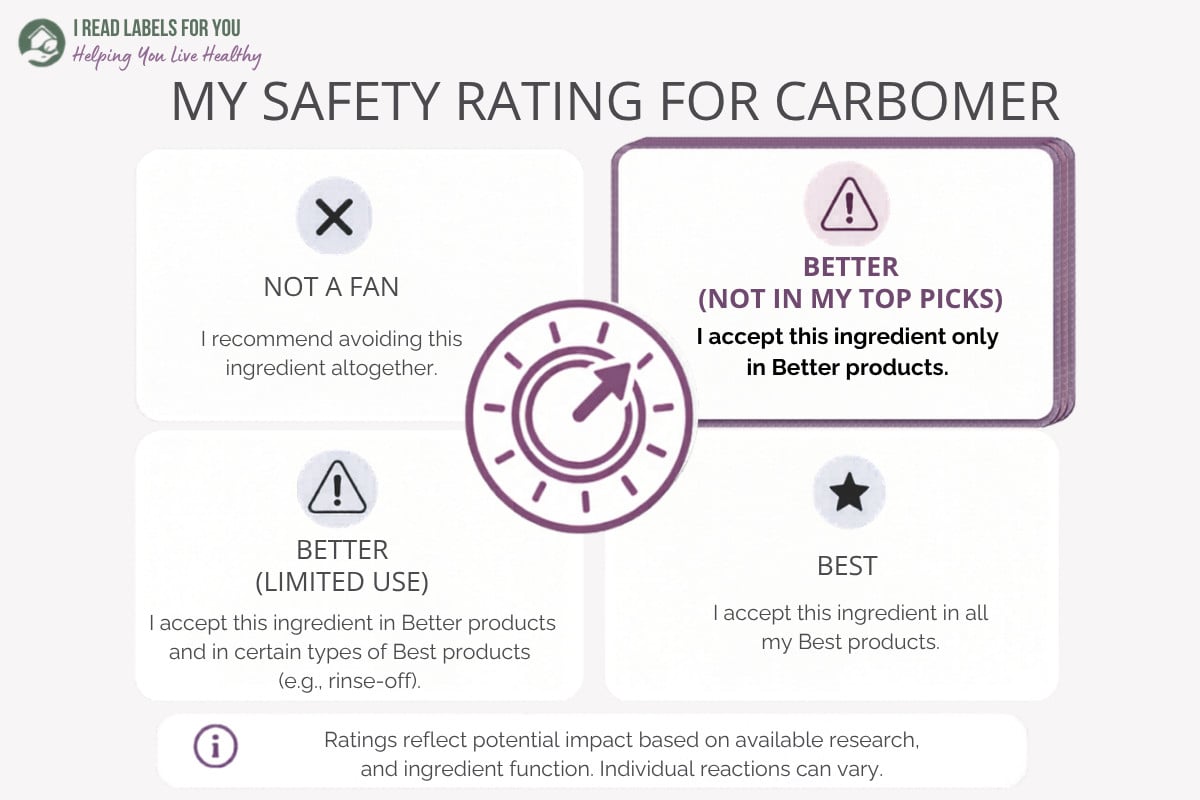
My rating for Carbomer is Better (Not In My Top Picks). That is lower than its safety record alone would earn. I want you to see why, rather than take my word for it.
On its own record, Carbomer would earn my top tier. It cannot enter skin, and full-strength human testing found low irritation potential. It appears on no cancer list anywhere.
Two close relatives, Sodium Polyacrylate and Sodium Acrylates Copolymer, do sit in my top tier. One fact separates Carbomer from them. The industry’s own review names benzene as a reported impurity in the finished ingredient.
What makes this unresolvable is the absence of a number. No document gives a measured residual benzene level for cosmetic grade. The Panel’s own instruction against benzene binds nobody.
A shopper cannot close that gap. The label reads “Carbomer” whether the supplier used benzene or ethyl acetate. That uncertainty keeps it outside my Best tier.
What you should do is smaller than any of that. Do not hunt through your bathroom, because the exposure is trivial and the polymer is inert. Between two equal products, take the one thickened with xanthan gum instead.
One thing would change my mind about Carbomer’s rating, and it’s not a new study. A measured benzene specification for cosmetic grade would do it. So would a supplier stating which solvent they use.
Frequently Asked Questions About Carbomer
Is Carbomer Eye Gel Safe?
Yes, Carbomer is used deliberately in artificial tear gels, and it’s been studied there. Pharmaceutical grades carry a 2 parts per million benzene limit that cosmetic grades do not. The brief blurring afterward is thickness, not irritation.
Is Carbomer Gel Safe?
Yes, for normal skin use. A carbomer gel is neutralized polymer holding water in a mesh, and none enters skin. Hand sanitizers, aloe gels, and styling gels all rely on it.
Is Carbomer For Hair Safe?
Yes, and in hair products Carbomer thickens rather than acts, at up to 2.5 percent. It does not penetrate scalp skin and does not build up in the hair shaft. A stiff film usually comes from a separate hold polymer.
Is Carbomer Bad For Skin?
No, Carbomer is among the better-tolerated ingredients in a typical formula. It doesn’t clog pores, since a molecule that cannot enter skin cannot lodge in a follicle. If a gel stings, suspect the alcohol, the fragrance or the active.
Is Carbomer In Toothpaste Safe?
Yes at the levels used, though this is where I watch closest. Reported concentrations reach 9 percent in products that get swallowed incidentally. The amount swallowed while brushing sits far below the European daily intake limit.
Why Does EWG Rate Carbomer Differently?
EWG scores Carbomer 1 to 2 in its low hazard band, more favorably than I do. Look closely and the gap narrows. EWG says the score “is higher if there is potential contamination from toxic impurities.”
Its Skin Deep entry flags contamination as the one high concern on the page. It names methacrylic acid, acrylic acid, and benzene behind that flag. We see the same problem and weigh it differently.
Sources
EU SCCS / SCCP Opinions:
No SCCS, SCCP or SCCNFP opinion on Carbomer exists, checked across the full opinion archive: SCCS opinions portal
Cosmetic Ingredient Review (CIR) Reports:
Elder, R.L. (ed.), 1982. Final Report on the Safety Assessment of Carbomers-910, -934, -934P, -940, -941, and -962. Journal of the American College of Toxicology, 1(2), pp.109-141: CIR reports
Cosmetic Ingredient Review, 2003. Carbomer re-review; the Panel determined not to reopen the 1982 safety assessment: CIR reports
Cosmetic Ingredient Review, 2018. Safety Assessment of Acrylates Copolymers as Used in Cosmetics, covering 126 ingredients including Carbomer: CIR reports
European Union Regulatory Databases:
CosIng entry for Carbomer; functions listed as emulsion stabilizing, gel forming and viscosity controlling, with no annex entry: CosIng
CosIng Annexes II, III, IV and V checked; Carbomer is not listed in any of them.
CLP Annex VI harmonized classifications: no entry for Carbomer. Benzene is classified Carc. 1A and Muta. 1B at index 601-020-00-8.
ECHA dossier: zero REACH registrations, no harmonized classification, not a substance of very high concern: ECHA
Commission Regulation (EU) 2023/2055, restriction of synthetic polymer microparticles, with the Commission’s Explanatory Guide: microplastics restriction
Other Regulators:
U.S. FDA Indirect Additives inventory; Carbomer’s registry number is absent from the four food inventories, while the same chemistry is cleared for food contact: FDA indirect additives
Health Canada Cosmetic Ingredient Hotlist: not listed, neither prohibited nor restricted: Hotlist
Environment and Climate Change Canada, CEPA Schedule 1 toxic substances list: not listed: Schedule 1
IARC Monographs list of classifications: Carbomer not evaluated; polyacrylic acid and acrylic acid are Group 3: IARC
NTP Report on Carcinogens, 15th Edition: Carbomer not listed: Report on Carcinogens
California Proposition 65 list: not listed on any of the four grounds: Proposition 65
U.S. EPA IRIS: no assessment exists for Carbomer: IRIS
PubChem Records (Chemistry, Identifiers, Skin Penetration, Hazard Codes):
PubChem record for Carbomer, an annotated substance record, SID 505570023; no compound CID exists because a cross-linked polymer has no discrete structure: PubChem
Peer-Reviewed Studies:
Marshall, A. et al., 2024. Sensitisation to the acrylate co-polymers glyceryl acrylate/acrylic acid co-polymer, sodium polyacrylate and acrylates/C10-30 alkyl acrylate cross-polymer (Carbopol) is rare. Contact Dermatitis, 91(6), pp.491-496. PMID 39187930: PubMed
Castelain, F. et al., 2020. Allergic contact dermatitis from carbomers: two case reports. Contact Dermatitis, 83(4), pp.326-328. PMID 32432362: PubMed
Two cases of allergic contact dermatitis to different elements in identical ultrasound gels, 2021. Contact Dermatitis, 85(4), pp.477-478. PMID 33991340: PubMed
EFSA Panel on Food Additives and Flavourings, 2021. Safety evaluation of crosslinked polyacrylic acid polymers (carbomer) as a new food additive. EFSA Journal, 19(8), e06693. PMID 34400972: PubMed
Chemical, ecotoxicological, cytotoxic, and mutagenic evaluation of gelling agents used in the production of 70% alcohol gel, 2024. Environmental Toxicology and Pharmacology, 105, 104322. PMID 37993075: PubMed
Efficacy and safety of a fluid carbomer gel versus a conventional carbomer gel in dry eye, 2004. PMID 15029039: PubMed
Natural Cosmetic Standards:
COSMOS-standard approved raw materials: Carbomer not listed, and no acrylate polymer qualifies: COSMOS
NATRUE certified and approved raw materials: Carbomer not listed: NATRUE
Skin Allergy Resource:
American Contact Dermatitis Society (ACDS), Helpful References including the Core Allergen Series 2020; Carbomer is not on the panel, while four acrylate monomers are: ACDS
Advocacy groups:
Environmental Working Group (EWG) Skin Deep entry for Carbomer, hazard score 1 to 2, with contamination flagged as a high concern: EWG Skin Deep
Last verified: 09-25-2026

Download The Free Guide!
5 Powerful Steps To A Non-Toxic Home
Join our informed consumer community and get our free guide the “5 Powerful Steps To A Non-Toxic Home”.

Before commenting, please read our Comment Policy.