
Is Butylated Hydroxyanisole Safe? A Simple Answer You Can Trust
 Written by Irina Webb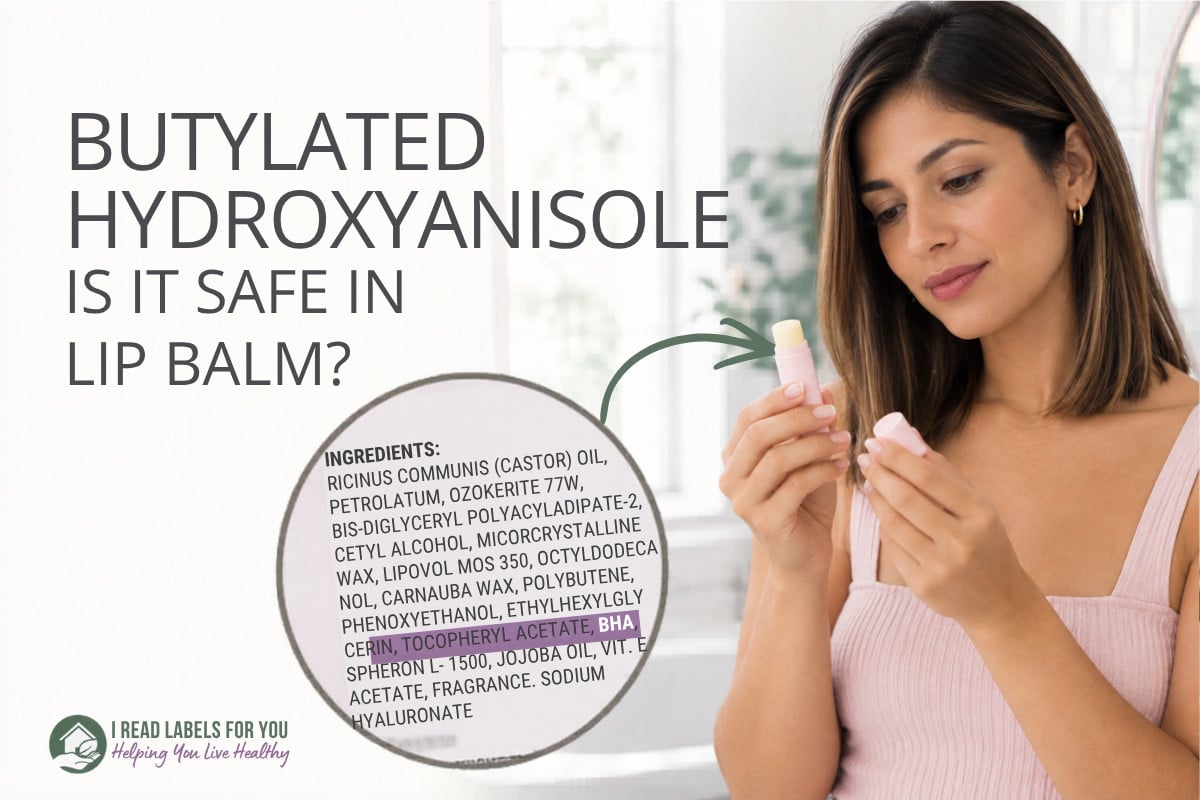
No, I keep Butylated Hydroxyanisole (BHA) out of my recommendations. It’s a laboratory-made antioxidant that stops a product’s oils from spoiling. Three cancer agencies list it, it absorbs through skin, and nothing it does is irreplaceable. I rate it Not A Fan.
BHA sits in an unusual regulatory position that surprises most people. Europe places no limit on it in cosmetics today, though its safety committee recommended one in March 2026. The United States permits it in both cosmetics and food, while reassessing the food use.
Below you will find why a European committee dismissed the animal cancer findings, and whether that argument holds. You will also see the measured figure for how much BHA crosses skin, which is higher than you might expect. Finally, you will learn why the BHA on a moisturizer label is not the BHA in your acne toner.
What Is Butylated Hydroxyanisole?
Butylated Hydroxyanisole (BHA) is a synthetic antioxidant made in a laboratory. Its job is to protect a product rather than your skin, by stopping the oils inside from reacting with air.
BHA is not one chemical but two, mixed together. The industry review describes it as a mixture of tertiary butyl-substituted 4-methoxyphenols. It consists chiefly of 3-t-butyl-4-hydroxyanisole (3-BHA) with lesser amounts of 2-t-butyl-4-hydroxyanisole (2-BHA).
The result is a waxy solid that dissolves in oil, not water. It weighs 180.2, which is small enough to move through skin.
The Name Causes Real Confusion
In skincare marketing, “BHA” almost always means something else entirely. There it stands for “Beta Hydroxy Acid,” which is salicylic acid, an exfoliant found in acne products.
On an ingredient list, “BHA” means “Butylated Hydroxyanisole,” the preservative discussed on this page. Two completely different chemicals share three letters, and the context tells you which one you have.
What Does Butylated Hydroxyanisole Do In Cosmetics?
In cosmetics, BHA keeps fats and oils from spoiling, and it’s used in tiny amounts. The highest concentration reported in 2023 was 0.15% in other manicuring preparations.
Its use is collapsing, which matters for the rating. Reported uses fell from 1,224 formulations in 2002 to just 70 in 2023.
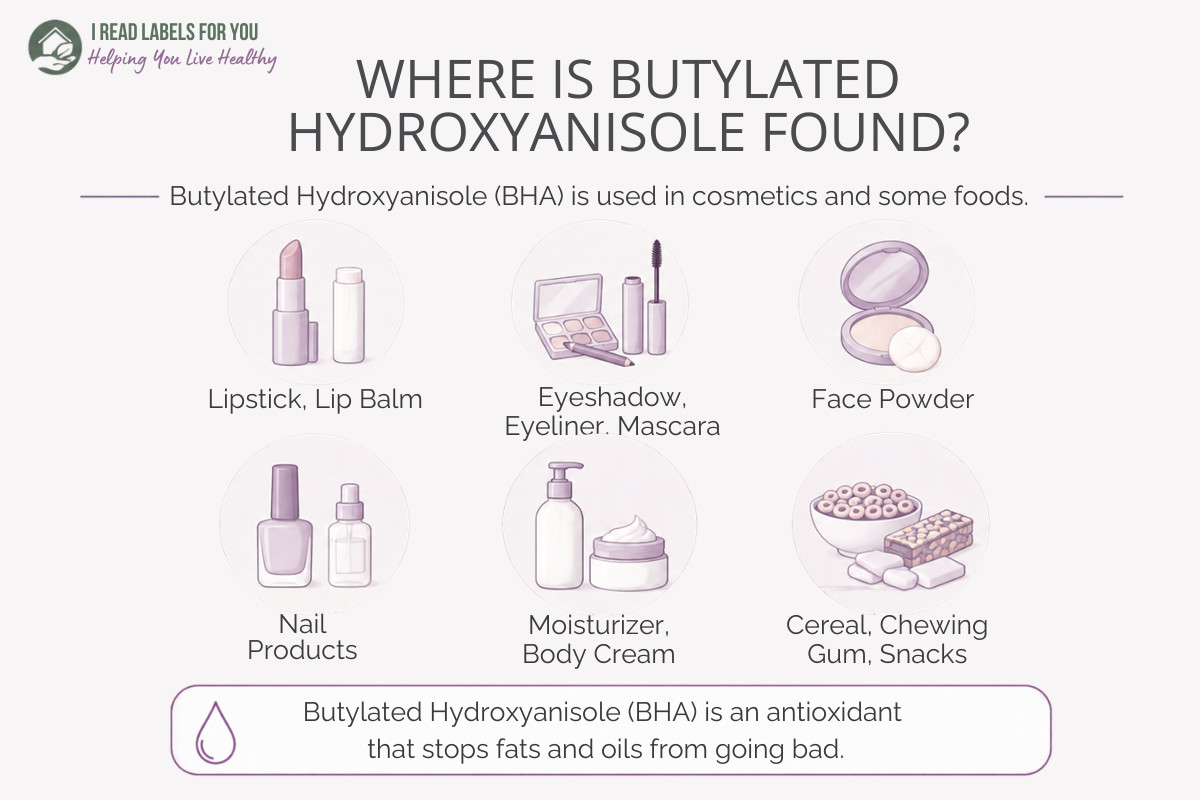
You may still find BHA in:
- lipstick and lip balm
- eyeshadow, eyeliner and mascara
- face powder
- nail products
- moisturizer and body cream
- cereal, chewing gum and snack foods, under the code E 320
How Is Butylated Hydroxyanisole Made?
BHA is built from petroleum-derived pieces, and the process explains the two-isomer mixture. The industry review states that BHA can be synthesized either by tert-butylation of p-methoxyphenol or by methylation of t-butylhydroquinone.
A second route exists too. BHA can also be prepared from p-methoxyphenol and isobutene, then purified by distillation.
Attaching the butyl group can happen at two positions on the ring. That’s why the finished ingredient is always a blend rather than a single molecule.
Does Butylated Hydroxyanisole Penetrate The Skin?
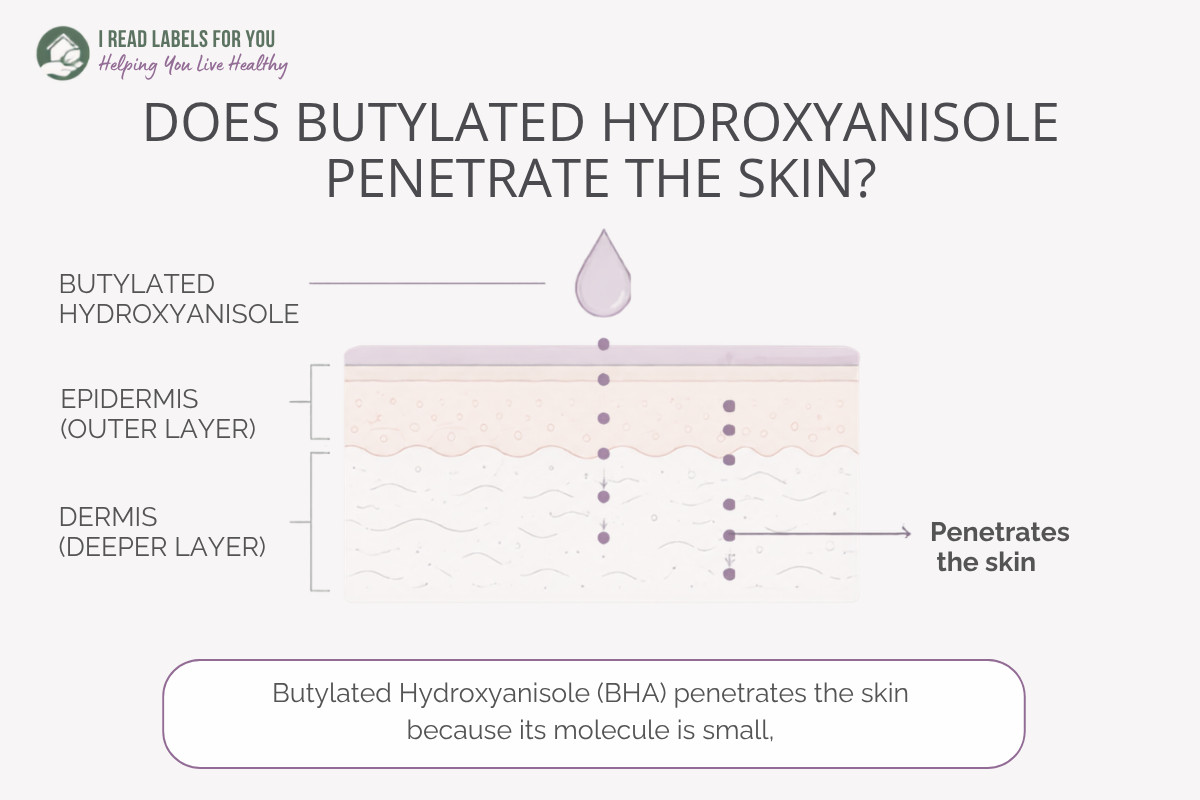
Yes, BHA penetrates the skin and considerably more than its cousin Butylated Hydroxytoluene (BHT) does.
Size allows it. BHA weighs 180.2 daltons, comfortably under the roughly 500 dalton ceiling for skin penetration.
A study on human skin measured where it goes. After 16 hours, 50% penetrated to the dermis and epidermis. A further 2.68% of the applied BHA penetrated to the receptor fluid.
Read those two numbers separately, because they say different things. Half the dose entered living skin, and roughly 2.7 percent passed all the way through.
European regulators went further still for safety purposes. They rejected that study as too variable. Instead, they will use a default of 50 % dermal absorption for the safety calculation.
What Is Butylated Hydroxyanisole Called On Labels?
Look for these:
- BHA
- Butylated Hydroxyanisole
- Tert-Butyl-4-Hydroxyanisole
- 2-Tert-Butyl-4-Hydroxyanisole
- 3-Tert-Butyl-4-Hydroxyanisole
- E 320, on food labels
Does The U.S. FDA Restrict Butylated Hydroxyanisole In Food And Cosmetics?
No, BHA faces no American cosmetic limit of any kind. The United States Food and Drug Administration (FDA) lets each brand decide for itself.
Food is where American regulators are actually moving. In February 2026, the FDA opened a full safety reassessment of BHA in food and asked for data. A reassessment is not a ban, and the ingredient remains legal while it runs. One state has gone further: West Virginia passed a 2025 law removing BHA from food sold there.
Notice which direction the food evidence has moved, though. European food authorities revised the acceptable daily intake (ADI) of BHA from 0.5 mg/kg bw/d to 1 mg/kg bw/d. They doubled the amount considered acceptable.
That’s my standing problem with reading regulators as a verdict. One agency doubles the acceptable intake while another opens a cancer reassessment, and both are looking at the same molecule.
EU Regulations On Butylated Hydroxyanisole
Europe currently imposes no cosmetic limit on BHA whatsoever. It appears in none of the annexes to the European cosmetics regulation, neither prohibited, restricted nor listed as a preservative.
That’s worth pausing on. BHA carries three cancer listings and no European restriction, while BHT carries none and is restricted by product type.
What The Safety Committee Decided In 2026
Europe’s cosmetics committee published its advice on March 26, 2026, and it was favorable. The committee found BHA safe up to a concentration of 0.07% in leave-on and rinse-off products.
The margins behind that are wide. Working from a safe dose of 50 milligrams per kilogram daily, it calculated margins of 610 and 632. The regulatory threshold is 100.
Read the scope limit that follows, because it’s unusually narrow. The advice considered only dermal use. It excludes oral care products or cosmetic products which may lead to exposure of the end-user’s lungs.
So lip products and face powders sit outside what was assessed. Those are the categories where BHA has been used. Lipstick historically carried up to 0.2 percent, face powders 0.05 percent.
Canadian Regulations On Butylated Hydroxyanisole
Canada places no restriction on BHA in cosmetics. It appears on neither the prohibited nor the restricted table of the Cosmetic Ingredient Hotlist.
It’s also absent from Canada’s national list of toxic substances. Among the countries covered on this site, no cosmetic regulator currently limits BHA in law.
Can Butylated Hydroxyanisole Cause Skin Allergy And Sensitization?
Rarely, though the evidence here is real rather than theoretical.
Europe’s committee acknowledges the reports directly. Published compilations provide clinical evidence that BHA can cause allergic contact dermatitis in humans.
Its judgment about everyday products is reassuring, though. The committee regards the risk of skin sensitisation from exposure to BHA in cosmetics “negligible.”
Testing on real formulations supports that. Shave creams with 0.1 percent BHA were patch tested on more than 150 adults. The reactions were not considered evidence of sensitization potential.
One gap is worth naming. BHA is absent from the American Contact Dermatitis Society Core Allergen Series. BHT is on that screening panel, and BHA is not.
Is Butylated Hydroxyanisole A Hormone (Endocrine) Disruptor?
Possibly, weakly, and this is the question two European bodies currently answer differently.
The cosmetics committee reviewed BHA in 2026 and was unconvinced. It found “weak anti-estrogenic activity” and, from studies of limited quality, some effects on sperm pointing to antiandrogenic modalities. Its conclusion was cautious rather than alarming. The evidence “is not robust enough to clearly suggest an endocrine mode of action of BHA.”
Europe’s chemicals agency has taken a different view of BHA. It’s been working through an endocrine disruptor assessment, and France submitted a classification proposal that remains unresolved.
An open disagreement between two regulators is not reassurance. It’s a question nobody has closed, and it sits underneath every clearance on this page.
Is Butylated Hydroxyanisole Safe To Use While Pregnant?
No, BHA is not one I would keep in a routine during pregnancy.
No study has looked at cosmetic BHA in pregnancy at all. What exists is animal work at doses far above anything a cosmetic delivers.
The reasoning is about what is unresolved rather than what is proven. Three cancer listings, an open endocrine dispute and measurable skin absorption make an unnecessary ingredient easy to set aside.
Because BHA also reaches you through food, the cosmetic source is the part you control. For products used daily over those months, you should consult with your medical provider.
Are There Any Cancer Concerns Linked To Butylated Hydroxyanisole?
Yes, there are cancer concerns linked to BHA, and three separate agencies have said so in writing.
California Proposition 65 entry reads “Butylated hydroxyanisole cancer 25013-16-5 January 1, 1990.”
America lists BHA too, as reasonably anticipated to be a human carcinogen in the Report on Carcinogens. World Health Organization scientists place it in Group 2B, possibly carcinogenic to humans.
Why Europe Disagrees, And Whether The Argument Holds
All three listings trace to one finding: tumors in the forestomach of rodents fed high doses. Europe’s committee accepted the finding and rejected its relevance.
Its reasoning is straightforward. BHA induced forestomach tumours in 3 different rodent species. That tumor type is not relevant for humans because of the absence of a forestomach.
On mechanism it went further. Tumor formation might be due to formation of radicals and/or reactive oxygen species at high doses causing local cytotoxicity.
Its conclusion was explicit. Based on low cosmetic concentrations, “carcinogenicity of BHA is not considered a concern for the consumer.”
That argument is scientifically respectable, and I want to be fair to it. People genuinely do not have a forestomach. A tumor caused by irritation at a site we lack is weak evidence about us.
What gives me pause is that the three agencies have not withdrawn their listings. They’ve had the forestomach argument in front of them for decades.
Is Butylated Hydroxyanisole Bad For The Environment?
Unclear, and the honest answer is that the cosmetics regulator did not look.
Its advice says so plainly. The committee’s mandate does not address environmental aspects. Its assessment has not covered the safety of BHA for the environment.
The chemicals agency work on environmental endocrine effects is still running. Until that closes, nobody has a settled answer.
Common Claims About Butylated Hydroxyanisole: What’s True And What’s Not
Claim: The BHA In My Acne Toner Is The Same Chemical As The Preservative
False, and this is the most common mix-up on the internet. In skincare marketing, BHA means beta hydroxy acid, which is salicylic acid.
The preservative on this page is Butylated Hydroxyanisole. Check the ingredient list rather than the marketing copy, because only one of the two appears there.
Claim: BHA And BHT Are The Same Thing
False, and the difference is larger than the names suggest. BHA and BHT are related antioxidants often used together, but their safety records diverge sharply.
BHT carries no cancer listing anywhere and absorbs at 0.4 percent through skin. BHA carries three cancer listings and delivers roughly seven times more through the same barrier.
Claim: BHA Is A Confirmed Hormone Disruptor
Overstated, and saying it this way weakens a reasonable case. No regulator has confirmed that BHA is a hormone disruptor.
Europe’s cosmetics committee found the evidence “not robust enough” to establish an endocrine mode of action. Suspected and unresolved is accurate; confirmed is not.
What I Think About Butylated Hydroxyanisole — And What You Should Do
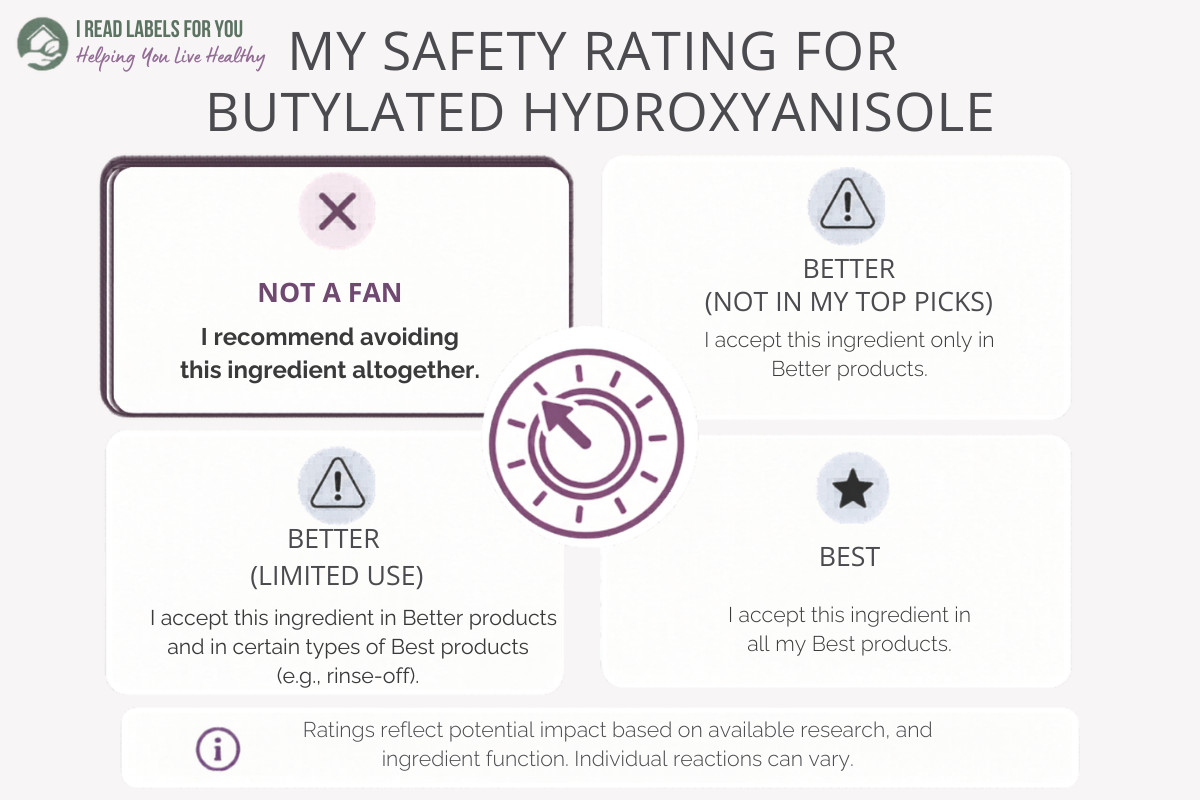
My rating for BHA is Not A Fan. In this case, I part company with the most recent and most relevant regulator. Let me be clear about why.
Europe’s cosmetics committee cleared BHA at 0.07 percent in March 2026. The industry panel has called it safe three times since 1984. Those conclusions are real, and I’m not going to pretend otherwise. However, I still avoid BHA for the following five reasons.
First, three cancer agencies list BHA and none has withdrawn. The forestomach argument is credible, but it hasn’t persuaded California, the American carcinogen program or the world cancer agency.
Second, BHA absorbs. Half the applied dose reaches living skin and about 2.7 percent passes through, which is where hazard stops being theoretical.
Third, the clearance on BHA does not cover the products people ask about. It excludes anything swallowed or inhaled, while BHA has been used in lipstick and face powder.
Fourth, two European regulators disagree about whether BHA disrupts hormones. An open dispute is not a clean bill of health.
Fifth, the impurity list includes hydroquinone compounds. Cosmetic grade BHA allows hydroquinone dimethyl ether at 0.1 percent, and food grade BHA allows hydroquinone itself at up to 0.6 percent.
What Should You Do?
The decisive point is that avoiding BHA costs you nothing. Its use fell from 1,224 formulations to 70, so the industry has already moved on.
Check labels for tocopherol instead, which is vitamin E doing the same antioxidant job. Where you do see BHA, it’s most often in an older lipstick or a face powder.
Do not confuse this with the salicylic acid in your acne routine. That’s a different chemical with a different rating.
Frequently Asked Questions About Butylated Hydroxyanisole
Is BHA The Same As Salicylic Acid?
In skincare advertising yes, BHA is usually “Beta Hydroxy Acid,” and that means salicylic acid.
On an ingredient list, no. There, BHA means “Butylated Hydroxyanisole,” the preservative this page is about.
Did The FDA Ban BHA?
No. In February 2026, the FDA opened a reassessment of BHA in food and requested data. It remains permitted in American food and cosmetics while that runs. West Virginia is the one state that’s removed it from food sold there.
Why Is BHA Banned In Europe?
It’s not banned in Europe. BHA is permitted in food as E 320 and carries no cosmetic restriction at all. European safety committee recommended a 0.07 percent cosmetic limit in March 2026. A recommendation becomes law only when the Commission writes it into the regulation.
Does BHA Cause Cancer?
It caused tumors in rodents at high doses, which is why three agencies list it. No study shows cancer in people from cosmetic use.
The tumors appeared in the animals’ forestomach, an organ humans do not have. That’s the heart of the disagreement, and reasonable scientists land on both sides of it.
Is BHA Safe In Lipstick And Lip Balm?
Lip products are the weakest case for BHA, because you swallow some of what you apply. Europe’s 2026 review covered skin only and explicitly excluded products taken into the mouth.
Historically BHA appeared in lipstick at up to 0.2 percent. Given the cancer listings and the gap in the assessment, this is the category I’d avoid most firmly.
Sources
EU SCCS / SCCP Opinions:
SCCS/1682/25, Scientific Advice on Butylated Hydroxyanisole (BHA) as a substance with potential endocrine disrupting properties in cosmetic products, adopted March 26, 2026; source of the 0.07 percent conclusion, the forestomach reasoning, the endocrine finding and the dermal absorption default: SCCS opinions portal
Cosmetic Ingredient Review (CIR) Reports:
Raj P (2025), Amended Safety Assessment of BHA as Used in Cosmetics, Final Amended Report released January 23, 2025; source of the impurity list, the use figures and the human skin absorption study: CIR reports
Final Report on the Safety Assessment of Butylated Hydroxyanisole (1984), Journal of the American College of Toxicology, 3(5): 83-146: CIR reports
Annual Review of Cosmetic Ingredient Safety Assessments 2004/2005 (2006), International Journal of Toxicology, 25(Supplement 2): 1-89; the re-review that reaffirmed the 1984 conclusion: CIR reports
European Union Regulatory Databases:
Regulation (EC) No 1223/2009; BHA, CAS 25013-16-5, appears in no annex, confirmed by searching Annex II, Annex III and Annex V: CosIng annexes
CLP Regulation Annex VI; BHA has no harmonized classification, confirmed by its absence from the Annex VI table: EU CLP Annex VI
ECHA substance record for 2-tert-butyl-4-methoxyphenol; REACH registered, with endocrine disruptor assessment activity and a French classification proposal: ECHA CHEM
Other Regulators:
International Agency for Research on Cancer, list of classifications; butylated hydroxyanisole is Group 2B, possibly carcinogenic to humans: IARC list of classifications
U.S. NTP, 15th Report on Carcinogens; butylated hydroxyanisole is listed, confirmed by its presence in the report’s CAS number index at 25013-16-5: NTP Report on Carcinogens
California OEHHA, Proposition 65 list; the entry reads Butylated hydroxyanisole, cancer, 25013-16-5, January 1, 1990: OEHHA Proposition 65 list
U.S. FDA, Substances Added to Food; BHA permitted as a food additive and as generally recognized as safe, with a safety reassessment opened in February 2026: FDA Substances Added to Food
Health Canada Cosmetic Ingredient Hotlist; BHA appears in neither the prohibited nor the restricted table: Cosmetic Ingredient Hotlist
Environment Canada, CEPA Schedule 1 List of Toxic Substances; BHA not listed: CEPA Schedule 1
U.S. EPA, Integrated Risk Information System; no assessment for BHA: EPA IRIS
PubChem Records (Chemistry, Identifiers, Skin Penetration, Hazard Codes):
PubChem CID 8456, butylated hydroxyanisole, CAS 25013-16-5, molecular weight 180.24: PubChem CID 8456
Peer-Reviewed Studies:
No standalone PubMed study is cited in this post. The human skin absorption study and the rodent carcinogenicity studies discussed here are those reviewed and weighed in the CIR and SCCS reports cited above.
Natural Cosmetic Standards:
COSMOS-standard approved raw materials; BHA not listed: COSMOS-standard approved raw materials
NATRUE certified and approved raw materials; BHA not listed: NATRUE certified world
Skin Allergy Resource:
American Contact Dermatitis Society (ACDS), Helpful References including the Core Allergen Series 2020; BHA is not among the screening allergens, while BHT is: ACDS Helpful References
Last verified: 09-22-2026
Download The Free Guide!
5 Powerful Steps To A Non-Toxic Home
Join our informed consumer community and get our free guide the “5 Powerful Steps To A Non-Toxic Home”.

Before commenting, please read our Comment Policy.