
Is Sodium Polyacrylate Safe? A Simple Answer You Can Trust
 Written by Irina Webb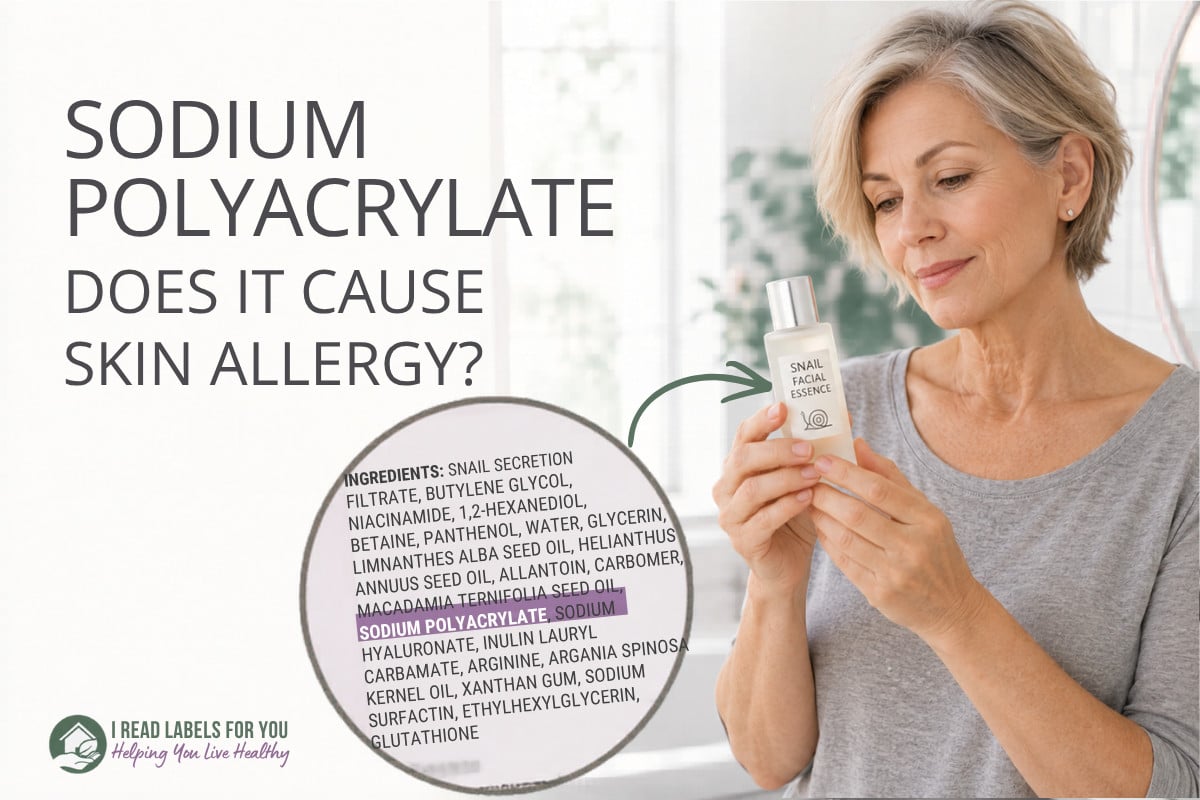
Yes, Sodium Polyacrylate is safe on skin, and it sits in my top tier. It’s a large laboratory-made polymer that thickens products and soaks up water. Its size is the whole reason it’s safe because nothing that big gets through skin. My verdict is Best.
Sodium Polyacrylate carries no restriction anywhere in European cosmetics law. It appears in none of the four annexes, so Europe sets no limit and requires no warning. Canada and the United States take the same view.
Ahead, you’ll see why the same ingredient is both a gentle thickener and a genuine hazard to toddlers. You’ll find what 1,302 patch-tested patients showed about allergy risk. You’ll also learn which product to keep away from small children and why.
What Is Sodium Polyacrylate?
Sodium Polyacrylate is a superabsorbent polymer. A polymer is a long chain built from many copies of one small molecule, linked end to end.
The industry safety review defines it as the sodium salt of polyacrylic acid. Its defining trick is water. It can hold hundreds of times its own weight without dissolving.
That single property explains everything else about Sodium Polyacrylate. In a lotion, it thickens. In a diaper, it locks fluid away from skin.
The Same Ingredient Lives Two Very Different Lives
This is the point that resolves most of the confusion online, so let me put it early. Sodium Polyacrylate shows up in two completely different places.
In skincare, Sodium Polyacrylate appears as a small amount of thickener, usually well under one percent. It sits on the surface, and the safety questions are the ordinary ones about skin.
In diapers, ice packs, and water bead toys, Sodium Polyacrylate appears as the absorbent gel itself. There the question is not about skin at all. It’s about what happens if a child swallows a bead that then swells.
Those are separate questions with separate answers. Most articles blur them. That’s why the ingredient reads as harmless in one place and alarming in another.
What Does Sodium Polyacrylate Do In Cosmetics?
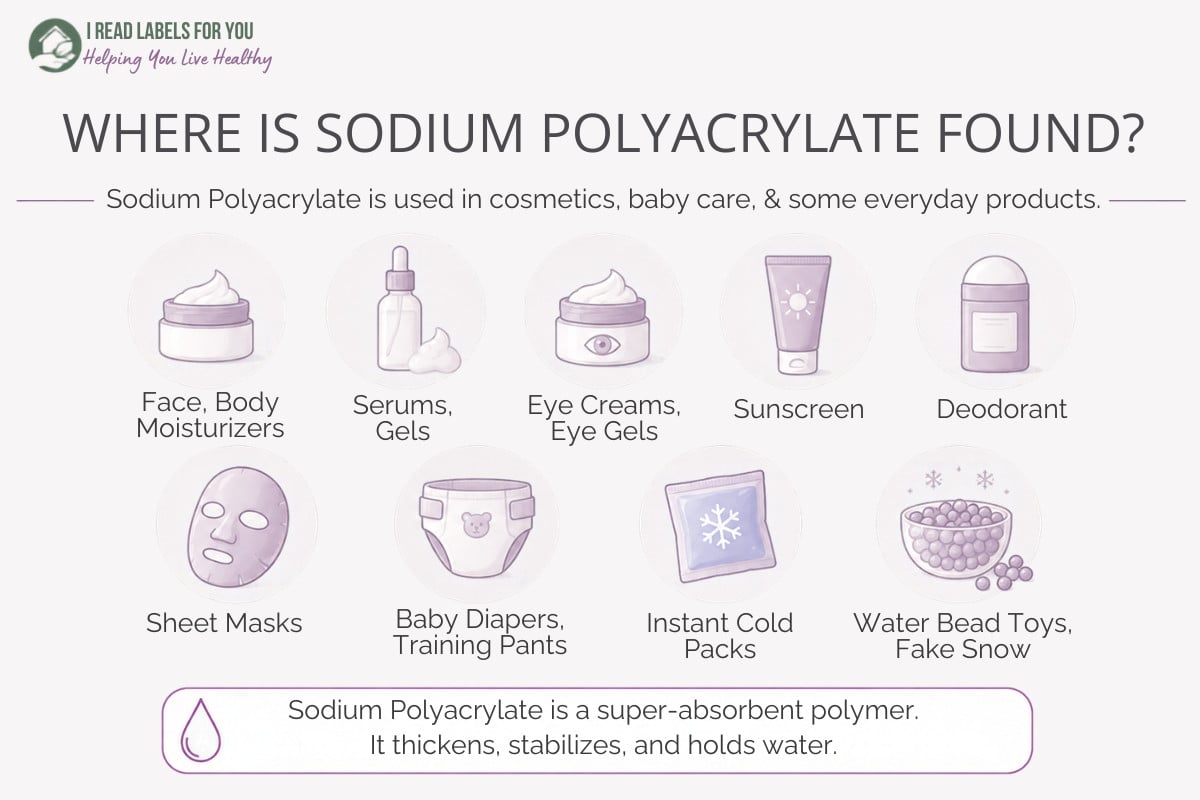
It thickens, stabilizes, and holds water. The 2018 industry review lists six functions for Sodium Polyacrylate, including absorbent, emulsion stabilizer, film former, and viscosity increasing agent.
Practically, it gives a gel or cream its body. A brand can reach the texture it wants using very little of the ingredient.
You’ll find Sodium Polyacrylate most often in:
- face and body moisturizers
- serums and gels
- eye creams and eye gels
- sunscreen
- deodorant
- sheet masks
- baby diapers and training pants
- instant cold packs
- water bead toys and fake snow
It has no place in food as something you eat. The U.S. Food and Drug Administration (FDA) clears Sodium Polyacrylate only as a boiler water additive and for food packaging contact.
How Is Sodium Polyacrylate Made?
It starts from acrylic acid, a petroleum-derived chemical. The 2002 industry review states that Sodium Polyacrylate is produced by polymerizing acrylic acid, then neutralizing the result with sodium hydroxide.
Leftover acrylic acid is the impurity worth asking about. The same report gives the numbers: typical levels run 10 to 1000 parts per million, with 1500 as the ceiling.
Producers have a practical reason to keep it low. The report notes there’s enough odor from leftover monomer that manufacturers minimize it.
Does Sodium Polyacrylate Penetrate The Skin?
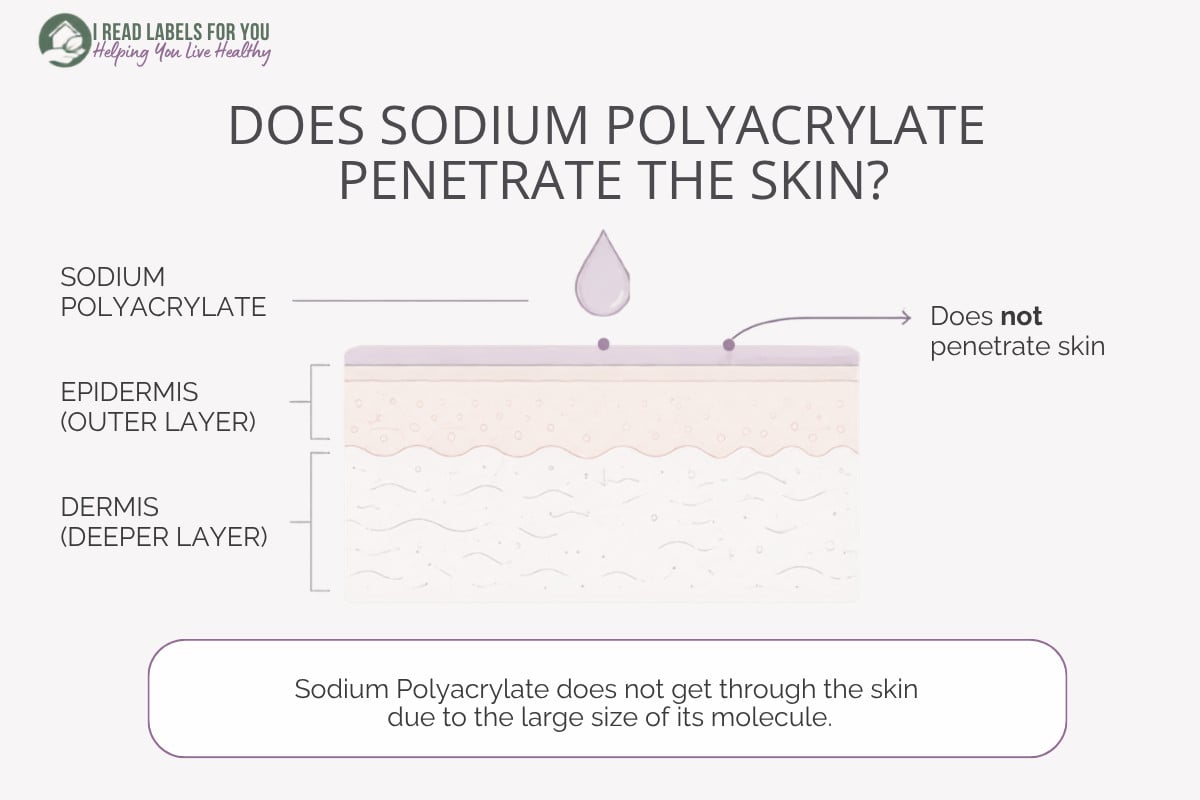
No, Sodium Polyacrylate does not penetrate the skin, and this is one of the clearest answers in ingredient science. Size settles it on its own.
Molecules generally need to be under about 500 daltons to cross intact skin. The grades described in the industry reports run from 2,000 daltons to 90,000 daltons. One study used a grade of 13.1 million daltons.
The usual second marker, LogP, does not apply here. A polymer has no single structure, so it has no partition coefficient to calculate. Anyone quoting one for this ingredient is describing a different substance.
The 2018 review reaches the same conclusion. It states that significant dermal absorption is not expected, so topical use of Sodium Polyacrylate should not cause systemic effects.
What Is Sodium Polyacrylate Called On Labels?
Labels spell it out in full as Sodium Polyacrylate. Its registry number is 9003-04-7.
Related names describe genuinely different ingredients:
- Acrylates Copolymer
- Sodium Acrylates Copolymer
- Polyacrylic Acid
- Polyacrylamide
Watch the last one especially. Polyacrylamide is built from a different monomer and carries its own separate questions.
Does The U.S. FDA Restrict Sodium Polyacrylate In Food And Cosmetics?
No. The FDA places no limit on Sodium Polyacrylate in cosmetics and does not prohibit it. That tells you very little, because the agency restricts only eleven cosmetic ingredients in total.
American cosmetic oversight is light by design. Products reach shelves without any pre-market review of their ingredients.
The food side is narrower than it first appears. The FDA inventory lists polyacrylic acid, sodium salt as a boiler water additive, and a surface removal agent. Those are processing uses, not permission to eat it.
Europe works from the opposite starting point, called the precautionary principle. There, a company proves an ingredient is safe first. Nobody waits for evidence of harm to accumulate.
EU Regulations On Sodium Polyacrylate
Europe places no restriction on Sodium Polyacrylate at all. It appears in none of the four annexes to the Cosmetics Regulation.
Being absent from all four means something specific. It’s not prohibited, not restricted, not a permitted colorant, and not a permitted preservative. Sodium Polyacrylate simply sits in the inventory as an ingredient with no conditions attached.
Read that carefully, though. No restriction means no regulator found a reason to act, not that a regulator examined it and cleared it. No European safety committee has ever published an opinion on this ingredient.
The only condition attached to Sodium Polyacrylate anywhere comes from the American industry panel, not a regulator. That panel requires products be formulated to be non-irritating, which has no legal force.
Canadian Regulations On Sodium Polyacrylate
Health Canada neither prohibits nor restricts Sodium Polyacrylate. It appears on neither list of the Cosmetic Ingredient Hotlist. Nor does it appear under Canadian environmental law as a toxic substance. No Canadian rule touches it in any product category.
Can Sodium Polyacrylate Cause Skin Allergy And Sensitization?
No, allergy to Sodium Polyacrylate is rare, and a recent audit puts a number on it. This is the best evidence available on the question.
British and Irish dermatology centers ran a prospective audit across 20 clinics. In total 1,302 patients were patch tested, including people already suspected of acrylate allergy.
The result for Sodium Polyacrylate at 2 percent was four irritant reactions, one doubtful, and one positive. Relevance was unknown in every case. The authors concluded that sensitization to these concentrations is rare.
They went further, and the second finding matters more. Even in patients already allergic to acrylates, triggering dermatitis with these polymers appeared unlikely.
Animal data point the same way. Undiluted Sodium Polyacrylate applied to rabbit skin daily for four weeks produced no signs of irritation.
Why Acrylate Allergy Is Real But Not About This Ingredient
Acrylate allergy has a genuine reputation, and it’s earned. Four acrylate monomers sit on the standard American screening panel that dermatologists use.
Those are small, reactive molecules found in nail products, adhesives, and medical devices. Your immune system can recognize and react to something that size.
A polymer is thousands of times larger and chemically quiet. That’s why the screening panel lists the monomers and leaves the finished polymers off.
Is Sodium Polyacrylate A Hormone (Endocrine) Disruptor?
No, and the reason deserves stating precisely. Nobody has ever studied Sodium Polyacrylate for hormone activity.
Europe’s chemicals agency has never put it before the expert group that assesses hormone disruptors. Neither industry review looks at it either. A literature search turns up one paper, and that one is about insulin chemistry.
An untested endpoint is different from a cleared one. That said, a molecule that cannot enter the body has no route to a hormone receptor.
Is Sodium Polyacrylate Safe To Use While Pregnant?
Yes, and the pregnancy testing on this ingredient is fuller than on most I review. Two different grades went through developmental studies in pregnant animals.
Rats received Sodium Polyacrylate by feeding tube during the key window of pregnancy. Doses ran up to 3,000 milligrams per kilogram per day for the lower molecular weight grade.
The review records no effects on embryo survival or fetal growth. It found no meaningful differences in soft tissue or skeletal development against controls.
Skin exposure adds almost nothing to that picture, since the polymer stays on the surface. For daily choices while expecting, you should consult with your medical provider.
Are There Any Cancer Concerns Linked To Sodium Polyacrylate?
No, no agency anywhere classifies Sodium Polyacrylate as a cancer risk. The genetic testing behind that is unusually thorough for a cosmetic ingredient.
A study of a commercial superabsorbent grade ran five separate assays. Those covered bacterial mutation, two mouse lymphoma tests, an animal micronucleus test, and a DNA synthesis assay. The material tested negative throughout.
The industry reviews add three more negative mutagenicity results on this ingredient. No agency has classified it: not the international cancer agency, not California, not the American carcinogen report.
The Look-Alike Names That Cause The Worry
Three similar names do carry cancer classifications, and none of them is this ingredient. Acrylamide, acrylonitrile, and ethyl acrylate are all small reactive monomers.
Polyacrylic acid, the free acid form, sits in the international agency’s Group 3. Group 3 means the evidence does not support classifying it either way.
Sodium Polyacrylate itself appears on no such list. If a search result seems to say otherwise, check which chemical the page is actually describing.
Is Sodium Polyacrylate Bad For The Environment?
No regulator has flagged it, though the honest answer is that nobody has looked closely. Sodium Polyacrylate carries no European hazard classification and sits on no Canadian toxic substances list.
The industry panel says plainly that environmental questions fall outside what it reviews. So the reassurance available comes from safety regulators, not environmental ones.
One useful observation comes from Poison Control, which notes that superabsorbent polymers break down over time in the environment. It considers them unlikely to contaminate soil.
My own reservation is about volume rather than toxicity. Sodium Polyacrylate is a petroleum-derived polymer that went from 8 cosmetic products in 1998 to 900 in 2018.
Common Claims About Sodium Polyacrylate: What’s True And What’s Not
Claim: Sodium Polyacrylate Is Toxic
False as a blanket statement, and the animal data are striking. The oral dose that kills half of test rats is above 40 grams per kilogram, which is close to unmeasurable.
A 32-day feeding study put it at up to 5 percent of the diet. The only changes seen were more drinking water and altered salt excretion. Researchers read those as the body adjusting to sodium, not as toxicity.
There’s a real hazard here, but it’s physical rather than chemical. Swallowed beads swell, and that’s covered below.
Claim: Sodium Polyacrylate In Diapers Is Harmful To Babies
Not supported for normal use. The gel sits inside the diaper core, away from skin, and it holds fluid there rather than releasing it.
Keeping urine off skin is the point of the design. Wetness against skin is what drives diaper rash, so the absorbent gel reduces that risk rather than adding to it.
The reasonable caution concerns a torn diaper. If gel beads escape, clean them up and keep them away from your baby’s mouth. Poison Control advises discarding any product once beads start coming out.
Claim: Sodium Polyacrylate In Ice Packs Is Poisonous
Mostly false, with one thing worth checking. Gel packs that use Sodium Polyacrylate contain a low-toxicity polymer, and licking a leak is not a poisoning emergency.
Not every gel pack uses it, though. Some contain propylene glycol, and some instant cold packs contain ammonium nitrate, which is a different matter.
Consequently the honest answer is to read the pack rather than trust a general rule. If a child swallows contents from any cold pack, call Poison Control at 1-800-222-1222.
What I Think About Sodium Polyacrylate
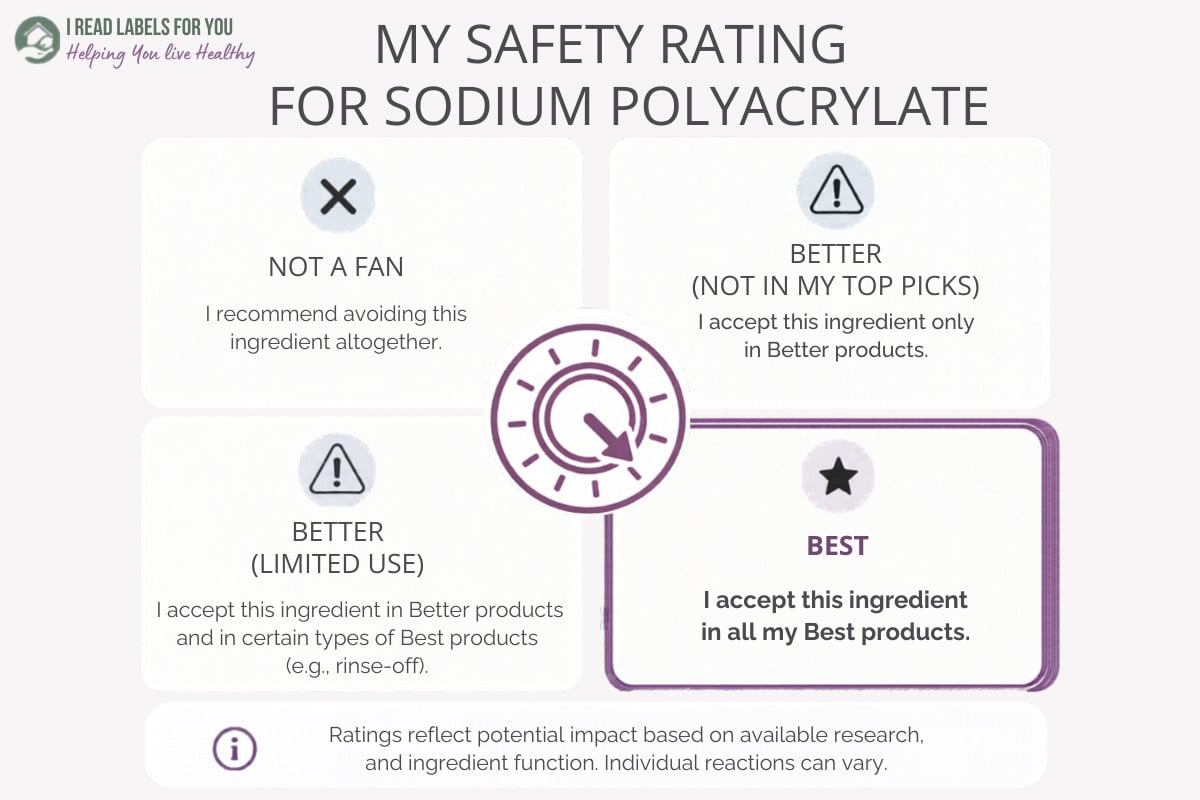
My rating for Sodium Polyacrylate is Best. It earns that on the simplest possible grounds: it cannot get into you.
Why It Reaches My Top Tier
First, size rules out absorption. A molecule running from 2,000 to millions of daltons has no route through skin.
Second, Sodium Polyacrylate has its own testing rather than borrowed conclusions. Negative in multiple mutagenicity assays, clean in a full developmental study, and no irritation from undiluted material over four weeks.
Third, allergy is rare and now quantified. One positive reaction among 1,302 patch-tested patients, with relevance unknown.
Fourth, no regulator on any continent restricts Sodium Polyacrylate.
The Two Things I Still Watch
Eye-area products use Sodium Polyacrylate at up to 29.7 percent, the highest figure recorded for this ingredient. Rabbit testing found 2 percent as the highest concentration causing no eye irritation.
Rabbit eyes are more sensitive than ours, and eye creams never go in the eye. I’d still prefer a smaller gap.
The second is environmental. No safety body assesses Sodium Polyacrylate’s persistence, and this is a synthetic polymer now in hundreds of products.
What Should You Do?
On a skincare label, Sodium Polyacrylate needs no thought. It does its job well, and I accept it in my Best products.
The care belongs elsewhere in your house, and this is the part I’d act on:
- keep water bead toys away from children under three
- store loose beads out of reach, including from pets
- throw away any toy once beads start escaping
- never put beads in ears or noses
- check that water bead toys were made after March 12, 2026
That last point reflects a real change. New American safety rules took effect on that date, capping how far toy beads may swell.
Frequently Asked Questions About Sodium Polyacrylate
Are Sodium Polyacrylate Beads Safe?
Not for young children, and the reason is mechanical rather than chemical. Poison Control reports that beads expand 150 to 1,500 times after contact with liquid. The resulting blockages can be life-threatening, and at least three children have died after swallowing them.
New American safety rules took effect on March 12, 2026. They cap toy bead expansion at 5 millimeters and set limits on acrylamide. Beads sold for other purposes fall outside those rules.
Is Sodium Polyacrylate Fake Snow Safe For Kids?
Treat it like water beads, because it’s the same polymer. The powder swells into a gel, and the risks are swallowing, choking, and pushing it into ears or noses.
Older children under supervision are a different case from toddlers. Wash hands afterward, and keep it away from anyone who still puts things in their mouth.
Is Sodium Polyacrylate Ingestion Dangerous?
The chemistry is harmless; the swelling is not. A tiny amount licked off a finger is not a poisoning.
A whole bead or sachet is a different matter. Doctors reported a fatal airway obstruction in a woman with dementia. Her vomit bag held a 9 gram sachet of the polymer.
If someone swallows a bead or sachet, call Poison Control at 1-800-222-1222.
Is Sodium Polyacrylate Toxic To Dogs?
Not toxic in the poisoning sense, but genuinely risky to swallow. A dog that eats a diaper, a bead or a sachet faces the same blockage problem a child does.
Dogs also tend to swallow more at once. Call your veterinarian rather than waiting for symptoms, because a blockage may not show for hours.
Does Sodium Polyacrylate Stain?
No. It’s colorless and doesn’t bind to fabric fibers the way a dye does. Any color you see comes from dyes added to toy beads, not from the polymer itself.
Spilled gel is a mopping problem rather than a laundry one. Let it dry out and it shrinks back to a powder you can vacuum.
Sources
EU SCCS / SCCP Opinions:
No SCCS or SCCP opinion on Sodium Polyacrylate (checked, all opinion listings from 1997 to 2026). The ingredient appears in none of the four annexes to the Cosmetics Regulation: SCCS opinions portal
Cosmetic Ingredient Review (CIR) Reports:
Andersen FA, ed. Final Report on the Safety Assessment of Acrylates Copolymer and 33 Related Cosmetic Ingredients. International Journal of Toxicology. 2002;21(Suppl 3):1 to 50. Source of the manufacturing route, residual monomer levels, and the irritation, ocular and developmental data: cir-reports.cir-safety.org
Fiume MM. Amended Safety Assessment of Acrylates Copolymers as Used in Cosmetics. Cosmetic Ingredient Review, final amended report January 23, 2019. Covers 126 acrylates copolymers including Sodium Polyacrylate; source of the 2018 use figures: cir-reports.cir-safety.org
European Union Regulatory Databases:
CosIng entry for Sodium Polyacrylate, listed with no Cosmetics Regulation provisions and no restrictions: CosIng database
COSING Annexes II, III, IV and V, all checked; Sodium Polyacrylate appears in none of them: CosIng annexes
CLP Annex VI harmonized classifications, checked; Sodium Polyacrylate has no harmonized classification: ECHA CLP Annex VI
ECHA substance records for CAS 9003-04-7, showing zero REACH registrations and no associated obligations or regulatory activities: ECHA substance search
Other Regulators:
U.S. FDA, prohibited and restricted ingredients in cosmetics, checked; Sodium Polyacrylate not listed: FDA cosmetics ingredient restrictions
U.S. FDA, Substances Added to Food inventory, listing polyacrylic acid, sodium salt as a boiler water additive and washing or surface removal agent: FDA Substances Added to Food
Health Canada Cosmetic Ingredient Hotlist, checked; not listed as prohibited or restricted: Health Canada Hotlist
Environment Canada, CEPA Schedule 1 toxic substances list, checked; not listed: CEPA Schedule 1
IARC Monographs classifications, checked; Sodium Polyacrylate has no classification. Polyacrylic acid, CAS 9003-01-4, is Group 3: IARC classifications
California Proposition 65 list, checked; Sodium Polyacrylate not listed: Proposition 65 list
U.S. Consumer Product Safety Commission, Safety Standard for Toys: Requirements for Water Beads, effective March 12, 2026: Federal Register, water bead standard
National Capital Poison Center, Are water beads dangerous?, reviewed by medical toxicologists; source of the expansion range, the death reports and the disposal guidance: Poison Control, water beads
PubChem Records (Chemistry, Identifiers, Skin Penetration, Hazard Codes):
Sodium Polyacrylate, CAS 9003-04-7. No molecular weight or LogP is published, because a polymer has no single discrete structure: PubChem, Sodium Polyacrylate
Peer-Reviewed Studies:
Soriano LF, Chowdhury MMU, Cousen P, et al. Sensitisation to the acrylate co-polymers glyceryl acrylate/acrylic acid co-polymer, sodium polyacrylate and acrylates/C10-30 alkyl acrylate cross-polymer (Carbopol) is rare. Contact Dermatitis. 2024;91(6):491 to 496. PMID 39187930: PubMed 39187930
Haselbach J, Sanner A, Fontaine C, et al. Short-term oral toxicity study of FAVOR PAC in rats. Regulatory Toxicology and Pharmacology. 2000;32(3):310 to 316. PMID 11162724: PubMed 11162724
Haselbach J, Sanner A, Fontaine C, et al. Mutagenicity studies of FAVOR PAC. Regulatory Toxicology and Pharmacology. 2000;32(3):317 to 325. PMID 11162725: PubMed 11162725
Stalder A, Guechi Y, Bonnemain CL, Schmutz T. Airway obstruction due to ingestion of sodium polyacrylate: a case report. International Journal of Emergency Medicine. 2024;17(1):137. PMID 39367315: PubMed 39367315
Natural Cosmetic Standards:
COSMOS-standard approved raw materials, checked; Sodium Polyacrylate not listed: COSMOS-standard approved raw materials
NATRUE certified and approved raw materials, checked; not listed: NATRUE certified world
Skin Allergy Resource:
American Contact Dermatitis Society (ACDS), Helpful References including the Core Allergen Series 2020, checked; Sodium Polyacrylate is not on the panel, while four acrylate monomers are: ACDS Helpful References
Last verified: 09-24-2026
Download The Free Guide!
5 Powerful Steps To A Non-Toxic Home
Join our informed consumer community and get our free guide the “5 Powerful Steps To A Non-Toxic Home”.


Before commenting, please read our Comment Policy.