
Is Polyquaternium-37 Safe? A Simple Answer You Can Trust
 Written by Irina Webb
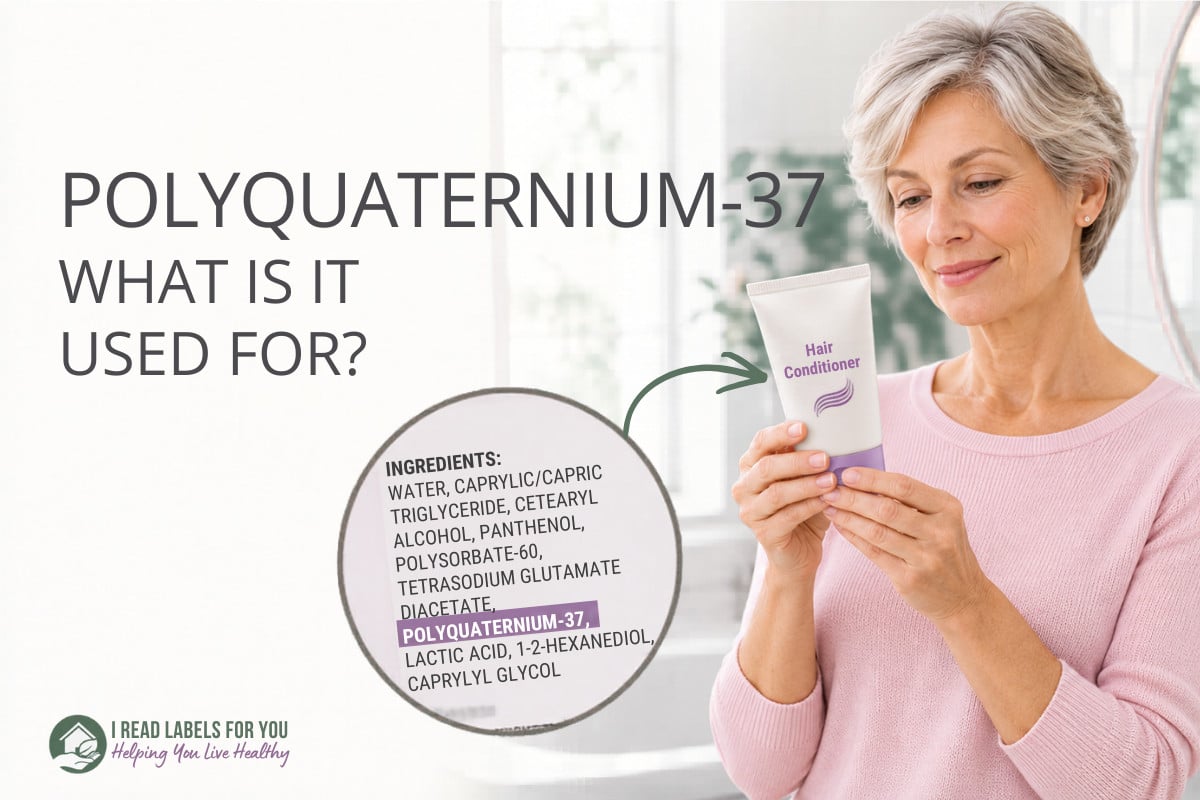
Yes, Polyquaternium-37 is safe in rinse-off hair products for adults, even though no one has ever tested it on its own. It’s a man-made conditioning polymer that smooths hair and thickens gels, and its size keeps it on the surface of your skin. Still, its safety file borrows every test from chemical relatives and never measures leftover building blocks, which places it in my Better (Limited Use) tier.
In the European Union, Polyquaternium-37 faces no restrictions and is listed simply as an antistatic and film-forming ingredient. No European expert opinion on it exists, and U.S. and Canadian rules leave it alone too. Whether the EU microplastics rule covers some grades remains an open question.
Keep reading to find out:
- why every safety test in its file was run on a different polymer
- which leftover building block many companies flag as a possible skin allergen
- what else to look for on the label when it comes premixed with mineral oil
What Is Polyquaternium-37?
Polyquaternium-37 is a synthetic polymer, meaning a very long chain built from one small repeating unit. That unit is a methacrylate, a close cousin of the molecules in acrylic plastics, carrying a permanent positive charge.
Chemists call it a homopolymer because it uses a single building block. Its chemical name is poly(methacryloyloxyethyl trimethylammonium chloride), which researchers shorten to PMETAC.
The 37 is only a catalog number in the ingredient naming system. In fact, Polyquaternium-37 shares little chemistry with Polyquaternium-10, which starts from plant cellulose.
What Does Polyquaternium-37 Do In Cosmetics?
First of all, it conditions. The Cosmetic Ingredient Review (CIR) gets its funding from the cosmetics industry trade group. Its 2012 report explains that charged chains like these are drawn to negative charges in hair and skin proteins.
Second, it thickens. BASF’s own technical sheet for Cosmedia Ultragel 300 describes a white powder that turns water into a clear, very thick gel at just 1%.
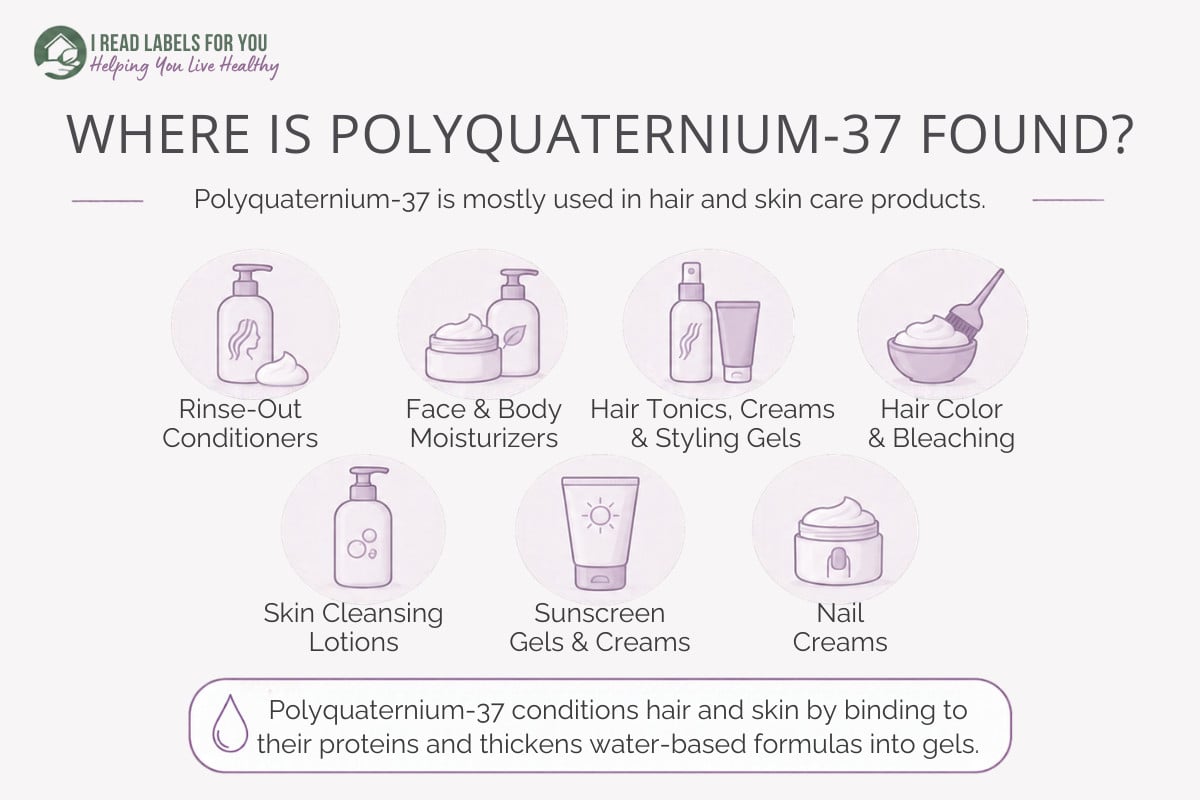
According to U.S. data from 2009 and 2010, brands used it at 0.2 to 3%. At that time, it appeared in 213 products, mostly hair conditioners and leave-in hair tonics.
You’ll find Polyquaternium-37 most often in:
- rinse-out conditioners
- face and body moisturizers
- leave-in hair tonics, creams and styling gels
- hair color and bleaching products
- skin cleansing lotions
- sunscreen gels and creams
- nail creams
It has no role in food. Federal food rules never mention it, and it carries no European food additive number.
How Is Polyquaternium-37 Made?
Manufacturers link a great many copies of the charged methacrylate unit into one long chain. The 2012 CIR report shows an example recipe that runs in water or watery alcohol, with a copper compound speeding up the reaction.
However, the report calls this only an example and never says which recipe companies actually use. It also gives no purity figure for Polyquaternium-37; its one number for leftover building block (monomer), under 1%, belongs to Polyquaternium-28.
Some grades go one step further and get cross-linked, meaning the chains are tied together into a net. Patents such as U.S. Patent 8,999,309 treat cross-linking as optional and name methylenebisacrylamide, a chemical related to acrylamide, as the preferred tie.
No supplier sheet or safety review reports how much of that cross-linker remains. On the plus side, its basic recipe uses no ethylene oxide, the cancer-causing gas used to make Polyquaternium-10.
Does Polyquaternium-37 Penetrate The Skin?
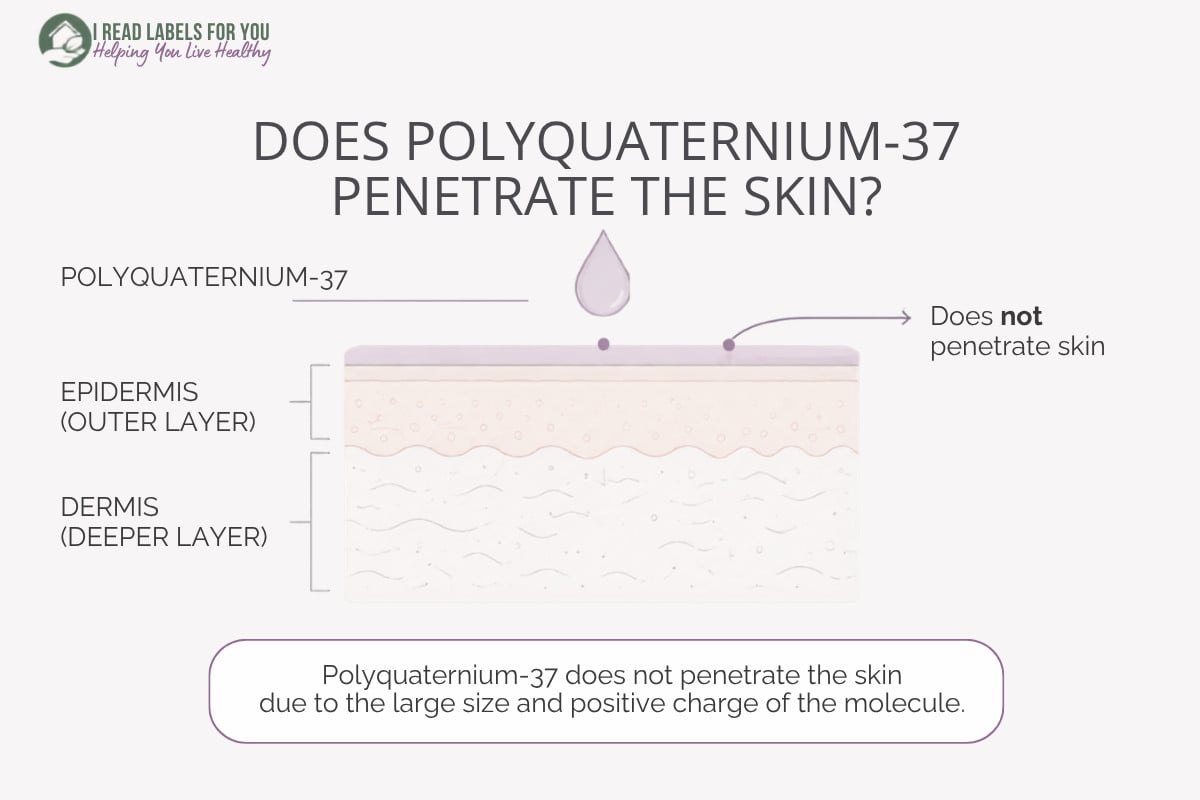
No, Polyquaternium-37 itself is very unlikely to penetrate the skin, although nobody has measured it. Size is the main reason. The CIR says polymers in its group usually weigh over 400,000 daltons, while skin mostly blocks molecules above about 500 daltons.
A dalton is simply a unit for the weight of a molecule. On top of its size, the permanent positive charge works as a second wall. The CIR notes that charged ingredients like these “are unlikely to cross the lipid bilayer,” the fatty layer that seals skin cells.
That charge also means it has no useful LogP, a number that shows whether a molecule leans toward fat or water. Notably, the only polymer skin study in the report tested Polyquaternium-10, not this ingredient.
The real open question is the leftover building block. At roughly 208 to 226 daltons, it’s small enough to enter skin, and nobody reports how much of it the finished ingredient contains.
What Is Polyquaternium-37 Called On Labels?
On a label, look for:
- Polyquaternium-37
- Polyquaternium 37
- Poly(Methacryloyloxyethyl Trimethylammonium Chloride)
- Trimethylaminoethyl Methacrylate Chloride Polymer
- Cosmedia Ultragel 300, Salcare SC 95, Synthalen CN, CR or CU, and Flocare ET 1037, which are supplier trade names
Premixed versions add their own lines to the ingredient list. For example, SNF’s Flocare ET 1037 pairs it with Paraffinum Liquidum (which is mineral oil), and Trideceth-6, an emulsifier made with ethylene oxide. I rate those partners on their own, since each one gets its own spot on the label.
Does The U.S. FDA Restrict Polyquaternium-37 In Food And Cosmetics?
No federal limits apply to Polyquaternium-37. The U.S. Food and Drug Administration (FDA) leaves it off its roll of banned and restricted cosmetic chemicals. Likewise, the Code of Federal Regulations has no entry for it.
Do not read too much into that silence. Apart from color additives, the FDA does not approve cosmetic ingredients before they go on sale. For food, it even lets companies declare their own additives safe through a shortcut called GRAS, short for Generally Recognized As Safe.
The European Union starts from a different place. Under its precautionary principle, regulators may act on credible warning signs instead of waiting for proof that people were harmed.
EU Regulations On Polyquaternium-37
The European Union does not restrict Polyquaternium-37 in cosmetics. Europe’s cosmetic ingredient database, CosIng, files it under antistatic and film-forming uses. None of the annexes that ban or cap ingredients mention it.
Likewise, ECHA, the European Chemicals Agency, holds no harmonized hazard classification for it. Europe’s independent cosmetic advisers have never weighed in on it either; that panel is the Scientific Committee on Consumer Safety (SCCS).
Its building block is drawing fresh attention, though. ECHA started a new evaluation of the building block’s registration file on August 6, 2026, and the outcome is not public yet.
Finally, the EU’s 2023 restriction on intentionally added microplastics may or may not apply. It targets tiny solid polymer particles that do not dissolve, and the answer depends on the grade. Regulators have not settled the question for Polyquaternium-37, and suppliers have not published the data that would.
Canadian Regulations On Polyquaternium-37
Canada places no limits on Polyquaternium-37 in cosmetics. Health Canada’s Cosmetic Ingredient Hotlist names neither the polymer nor its building block.
In addition, the Canadian Environmental Protection Act keeps a federal list of toxic substances, called Schedule 1, and neither one is on it.
Can Polyquaternium-37 Cause Skin Allergy And Sensitization?
No, Polyquaternium-37 has no record of causing skin allergy, but no one has ever patch-tested it directly. Instead, the 2012 CIR report borrows results from related polymers.
In those borrowed tests, Polyquaternium-28 at 5% caused no reactions in 104 volunteers. Similarly, Polyquaternium-10 did not cause allergy at up to 2%.
Polyquaternium-47 offers a warning sign. When 116 volunteers wore it at 20% during the first phase, 13 developed severe redness with small bumps. Even so, a later 5% challenge did not show true allergy.
Its leftover building block, methacryloyloxyethyl trimethylammonium chloride (METAC), raises a separate flag. On its ECHA record, about half of the companies that filed a hazard classification call it a possible skin allergen. Still, the EU has not made this official.
Furthermore, the American Contact Dermatitis Society (ACDS) leaves it off its Core Allergen Series, the list dermatologists use for patch testing. That panel does test two other methacrylates used in artificial nails, and no study has checked whether people allergic to them react to Polyquaternium-37.
Is Polyquaternium-37 A Hormone (Endocrine) Disruptor?
No, Polyquaternium-37 does not appear to disrupt hormones, though no hormone study on it exists. It’s missing from ECHA’s endocrine disruptor assessment list and from the European Commission’s endocrine disruptor page for cosmetics.
Its bulk works in its favor here. Hormone receptors sit inside your cells, and a chain this large and charged has very little chance of reaching them through skin.
Is Polyquaternium-37 Safe To Use While Pregnant?
Probably yes, because Polyquaternium-37 is too big to enter your body in meaningful amounts, but no pregnancy study exists for it. In fact, the 2012 CIR report contains no fertility or birth-defect data for any polymer in its group.
No regulator classifies the polymer or its building block as harmful to fertility or to an unborn baby. Still, while you’re expecting, a rinse-out conditioner is the more cautious pick than a leave-in cream or moisturizer.
If your pregnancy raises specific questions, you should consult with your medical provider before you change your routine.
Are There Any Cancer Concerns Linked To Polyquaternium-37?
No, no agency links Polyquaternium-37 to cancer, although no one has run a cancer study on it. Both the polymer and its building block are missing from the cancer lists kept by three bodies. Those are California’s Proposition 65, the International Agency for Research on Cancer (IARC) and America’s National Toxicology Program.
No one has tested Polyquaternium-37 itself for gene damage. Instead, the CIR relied on two related polymers, Polyquaternium-28 and Polyquaternium-47, which were negative in bacterial mutation tests.
The CIR cancer section is thinner still. It covers no polymer at all, only choline chloride, a form of choline, the essential nutrient found in eggs. Chemically, the building block of Polyquaternium-37 is choline joined to methacrylic acid.
Its chemistry also avoids the usual red flags. The recipe the CIR describes uses neither ethylene oxide nor acrylamide, although the acrylamide-related cross-linker in some grades remains an unanswered question.
Is Polyquaternium-37 Bad For The Environment?
Nobody knows yet, because no safety review has studied what happens to it in rivers or soil. Europe gives it no environmental hazard classification, but no company has filed data that would support one either way.
The microplastics question hinges on cross-linking. BASF’s sheet describes a powder that forms a clear, thick gel, which fits either a dissolved chain or a swollen net. Unfortunately, the sheet does not say which.
Until suppliers publish water-solubility data for each grade, the answer stays open. Meanwhile, it’s fully synthetic, and therefore it appears on neither the COSMOS nor the NATRUE approved lists, the two largest natural-beauty certifiers.
Common Claims About Polyquaternium-37: What’s True And What’s Not
Claim: Polyquaternium-37 Causes Buildup On Hair
Partly true. Its positive charge makes it grip hair proteins, and that grip is the whole point of a conditioner.
Moreover, many of its uses are leave-in tonics and styling creams, which are designed to stay put. When strands begin to feel weighed down or stiff, a clarifying shampoo every week or two usually lifts the film.
Claim: Polyquaternium-37 Is Not Curly Girl Approved
This one is about hair styling, not safety. The Curly Girl Method is a community routine, and no regulator or safety panel grades ingredients as “curly girl friendly.”
Curly hair can show buildup quickly, though. Therefore, watch how your curls respond, and switch to a product without it if they turn limp or crunchy.
Claim: Polyquaternium-37 Releases Formaldehyde
This claim is false. Polyquaternium-37 is not a formaldehyde releaser, and the word formaldehyde never appears in the 2012 CIR report on it.
The confusion likely comes from Quaternium-15, a preservative that does release formaldehyde and sits on the ACDS patch-test panel. Without the Poly prefix and with a different number, it’s a completely different chemical.
What I Think About Polyquaternium-37 — And What You Should Do
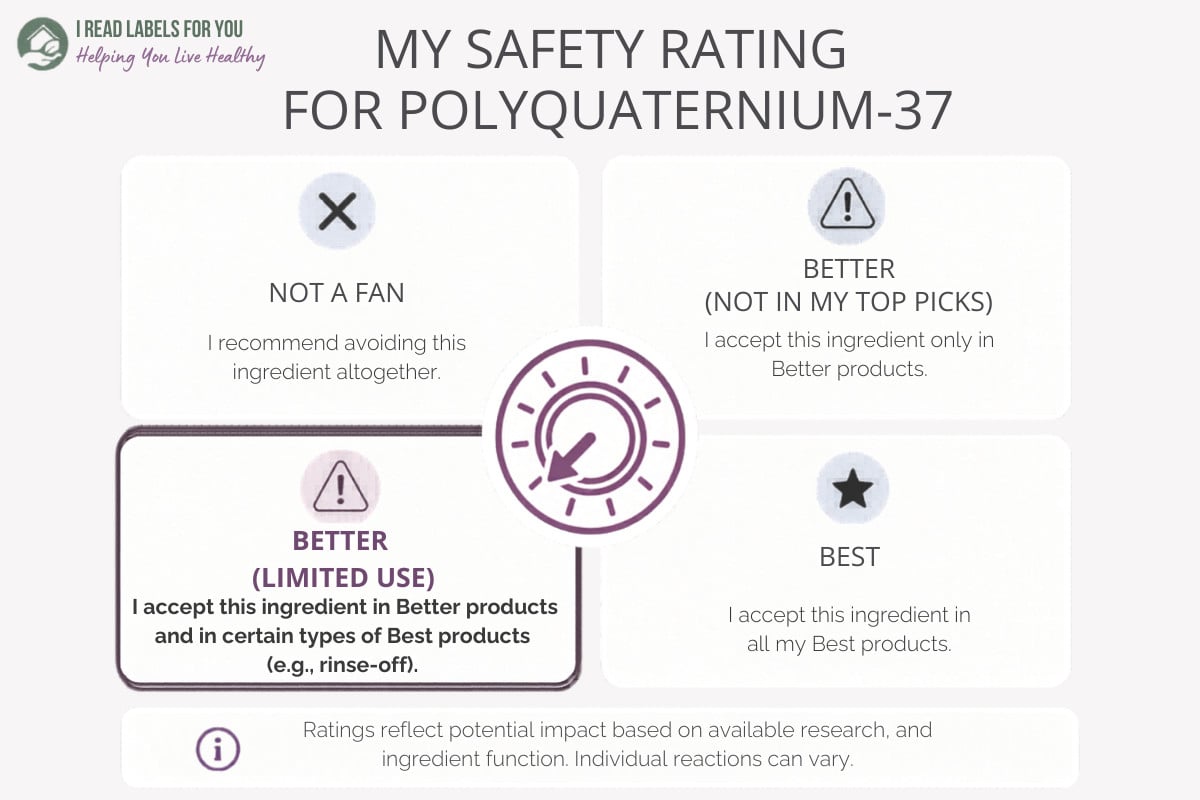
Better (Limited Use) is where I place Polyquaternium-37. Its size and charge should keep it out of your body. Yet every safety number in its file comes from other polymers, and nobody reports its leftover building block.
For adults, rinse-off hair products such as conditioners and rinses can contain Polyquaternium-37 and still qualify for my Best list. Leave-on products, including leave-in conditioners, styling gels, moisturizers and sunscreens, make only my Better list.
Baby products get stricter treatment. Any baby product with Polyquaternium-37, rinse-off or leave-on, stays in my Better tier. Notably, the 2012 CIR report recorded no baby-product use to learn from.
Here’s how to put that into practice:
- welcome it in conditioners you rinse out
- prefer leave-in stylers and face creams without it when you have a choice
- for babies, choose simpler formulas without polyquaterniums when you can
- check whether mineral oil and Trideceth-6 sit next to it on the label
- switch in a clarifying shampoo whenever buildup leaves strands coated
Data specific to this polymer, plus a published leftover-monomer limit, would be enough for me to move it up.
Frequently Asked Questions About Polyquaternium-37
What Is Polyquaternium-37 Used For?
Mostly hair care. It conditions and fights static in conditioners and leave-in tonics, and it thickens clear gels and creams.
Is Polyquaternium-37 Bad For Hair?
Not in the sense of harming it. The drawback people notice is a heavy, coated feel once layers pile up, and a clarifying shampoo strips that film away.
Is Polyquaternium-37 Safe For Skin?
Most likely, yes, especially in products you rinse off. Its tested relatives were gentle at normal strengths, but Polyquaternium-47 was a slight skin irritant in rabbits below 30%.
Leave-on use has no direct data, which is why I accept it there only in my Better products.
What Are The Side Effects Of Polyquaternium-37?
No side effects have been reported for it specifically. The 2012 CIR report notes that “the literature lacks clinical reports of irritation and/or sensitization” for this whole family. The likeliest issues are hair buildup and, at high strengths, the irritation seen with related polymers.
What Is A Good Alternative To Polyquaternium-37?
For conditioning, Behentrimonium Chloride is a member of the same chemical family that earns my Best rating. It’s an option if you want a leave-in conditioner without Polyquaternium-37.
Why Does EWG Rate Polyquaternium-37 Differently?
The Environmental Working Group (EWG) rates it 1 out of 10 for hazard yet labels the data behind that score as limited. I agree the polymer looks low risk. Still, that thin data is the reason leave-on and baby products with it stay out of my Best picks.
Sources
EU SCCS / SCCP Opinions:
No SCCS or SCCP opinion on Polyquaternium-37 or its building block (checked); no open SCCS mandate. SCCS opinions portal: SCCS opinions
Cosmetic Ingredient Review (CIR) Reports:
Becker LC, Bergfeld WF, Belsito DV, Hill RA, Klaassen CD, Liebler D, Marks JG Jr, Shank RC, Slaga TJ, Snyder PW, Andersen FA, 2012. Safety Assessment of Trimoniums as Used in Cosmetics. International Journal of Toxicology 31(Suppl 3):296S to 341S. Funded by the Personal Care Products Council. Group report with no toxicity test on Polyquaternium-37 itself; its data are read across from Polyquaternium-28, Polyquaternium-47 and Polyquaternium-10. Covers the example synthesis and use concentrations: cir-reports.cir-safety.org
European Union Regulatory Databases:
CosIng entry 79206, POLYQUATERNIUM-37, functions antistatic and film forming; no annex restrictions: CosIng 79206
CosIng Annexes II, III, IV, V and VI (2026 versions), checked; Polyquaternium-37 and its building block not listed. Annex III entry 66 (residual acrylamide in polyacrylamides) does not cover it.
CLP Annex VI harmonized classifications (2026 table): no entry for Polyquaternium-37 (CAS 26161-33-1) or its building block (CAS 5039-78-1).
ECHA CHEM, Polyquaternium-37, list number 607-876-9. No harmonized classification; no REACH registrations: ECHA CHEM, Polyquaternium-37
ECHA CHEM, building block [2-(methacryloyloxy)ethyl]trimethylammonium chloride, EC 225-733-5. No harmonized classification; self-classified as a skin sensitizer (H317) by about half of notifiers: ECHA CHEM, building block
ECHA CHEM, building block regulatory activities. Dossier evaluation started August 6, 2026: ECHA activities
ECHA endocrine disruptor assessment list. Not listed: ECHA ED assessment
European Commission, endocrine disruptors in cosmetics. Not listed: European Commission
REACH Annex XVII and the ECHA registry of restriction intentions. Not named; whether the 2023 synthetic polymer microparticle restriction (entry 78) covers a given grade is unresolved: ECHA registry of restriction intentions
Other Regulators:
U.S. FDA, prohibited and restricted cosmetic ingredients. Not listed: FDA
Electronic Code of Federal Regulations. No entry for Polyquaternium-37 or its building block: eCFR
Health Canada Cosmetic Ingredient Hotlist. Not listed: Health Canada Hotlist
Environment Canada, CEPA Schedule 1. Not listed: CEPA Schedule 1
International Agency for Research on Cancer (IARC). Not classified: IARC list
U.S. National Toxicology Program, Report on Carcinogens, 15th edition. Not listed: NTP listed substances
California Proposition 65 list. Not listed: OEHHA
U.S. EPA Integrated Risk Information System. No assessment: IRIS A to Z list
PubChem Records (Chemistry, Identifiers, Skin Penetration, Hazard Codes):
Polyquaternium-37 has no PubChem compound record (CID), because it’s a polymer. Substance record SID 135122890: PubChem SID 135122890
Building block record, CID 78738 (molecular weight 207.70). It also lists the polymer CAS 26161-33-1, but its data describe the building block only: PubChem CID 78738
Peer-Reviewed Studies:
No peer-reviewed study of Polyquaternium-37 in cosmetics, skin allergy, hormones or cancer found in PubMed (searched October 18, 2026, under its INCI and chemical names; hits were materials science): PubMed
Supplier Documents And Patents:
BASF, Cosmedia Ultragel 300 Technical Information, revision 3.0, valid since May 14, 2020. White powder, cationic acrylic homopolymer, clear thick gel at 1%; supplier document: BASF technical sheet
U.S. Patent 8,999,309. Describes Polyquaternium-37 as a homopolymer with optional cross-linking, methylenebisacrylamide preferred: USPTO full text
SpecialChem listing for Polyquaternium-37. SNF Flocare ET 1037 sold as Polyquaternium-37, Paraffinum Liquidum and Trideceth-6: SpecialChem
Natural Cosmetic Standards:
COSMOS-standard approved raw materials. Not listed: COSMOS-standard approved raw materials
COSMOS-standard certified raw materials. Not listed: COSMOS-standard certified raw materials
NATRUE certified and approved raw materials. Not listed: NATRUE certified raw materials
Skin Allergy Resource:
American Contact Dermatitis Society (ACDS), Helpful References, including the Core Allergen Series 2020. Polyquaternium-37 is not on the series; Quaternium-15, hydroxyethyl methacrylate and methyl methacrylate are different ingredients: ACDS Helpful References
Advocacy groups:
Environmental Working Group (EWG) Skin Deep entry for Polyquaternium-37. Hazard score 1, data limited: EWG Skin Deep
Last verified: 10-21-2026

Download The Free Guide!
5 Powerful Steps To A Non-Toxic Home
Join our informed consumer community and get our free guide the “5 Powerful Steps To A Non-Toxic Home”.
Before commenting, please read our Comment Policy.