
Is Cocamide MEA Safe? A Simple Answer You Can Trust
 Written by Irina Webb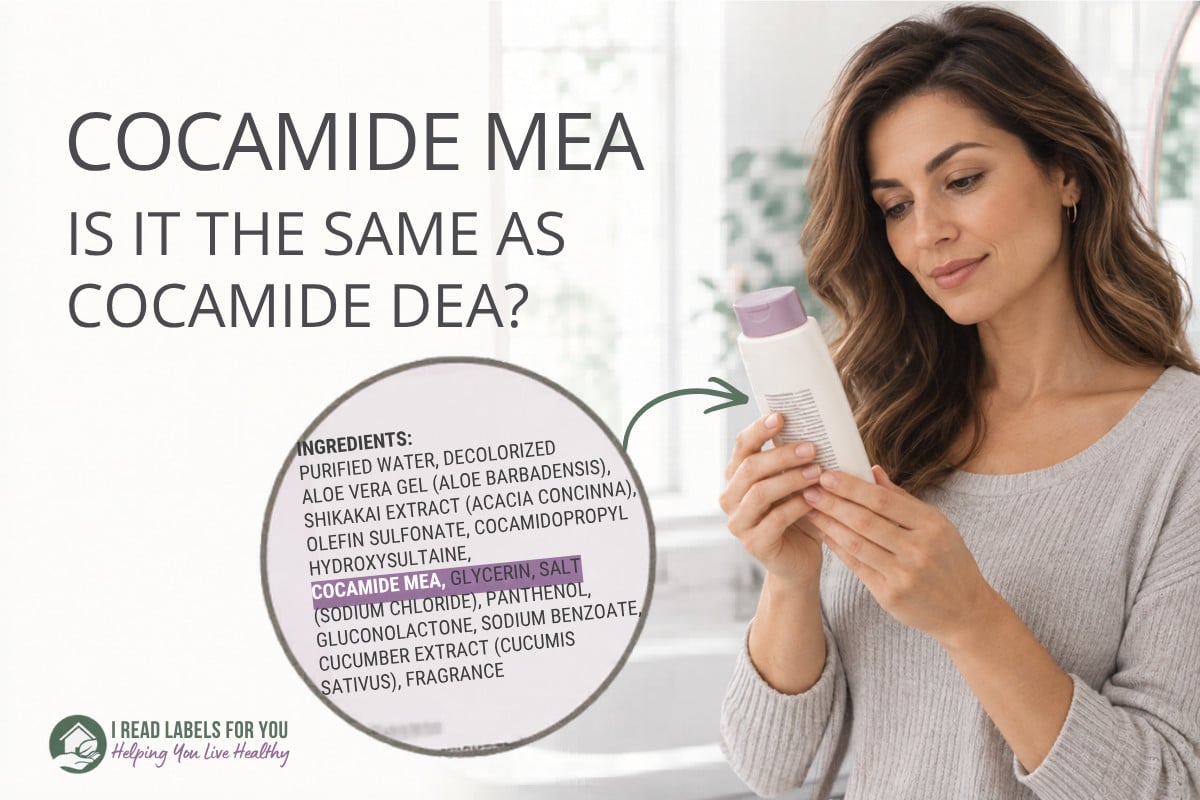
Yes, Cocamide MEA is safe on the evidence that exists, though much of the evidence was never gathered. It’s a coconut-derived foam booster used mainly in shampoo and body wash. No cancer agency classifies it, no European rule restricts it, and dermatologists do not screen for it. What keeps it out of my top tier is an empty file rather than a bad one. I rate it Better (Not In My Top Picks).
Cocamide MEA carries no entry on any European cosmetics annex, and no scientific committee has ever reviewed it. Europe’s chemicals agency records no regulatory activity and no legal obligation of any kind for this substance. In the United States it holds no food approval, no restriction and no state cancer listing.
First, you’ll see why one letter separates this ingredient from one of the most heavily litigated chemicals in cosmetics. Second, you’ll learn which three categories of testing were never done. Third, I’ll explain where I draw the line and why.
What Is Cocamide MEA?
Cocamide MEA is a synthetic ingredient made from coconut fatty acids and monoethanolamine. The industry definition is short: “A mixture of ethanolamides of Cocos nucifera (coconut) acid.” Like most coconut-derived ingredients, it’s a family of related molecules rather than one single compound.
The name has two halves, and both tell you something. “Cocamide” points to the coconut fatty acid. “MEA” stands for monoethanolamine, the lab-made part attached to it. That second half is the one to pay attention to.
A couple of physical details explain how it behaves in a product. Cocamide MEA melts at around 72 degrees Celsius (162 degrees Fahrenheit), and it does not dissolve in water. That waxy solidity is part of why it thickens liquids so well.
What Does Cocamide MEA Do In Cosmetics?
Cocamide MEA earns its place by improving lather and body. It stabilizes foam so bubbles last through a wash, and it thickens thin formulas into something that feels substantial. Europe’s ingredient database credits it with exactly two functions: foam boosting and viscosity control.
Cocamide MEA is a texture ingredient, not a cleanser. Its use is heavy and overwhelmingly rinse-off. Industry reporting counted 1,122 cosmetic uses in 2011, and only 33 of those were leave-on products. Reported maximums reach 18 percent in rinse-off formulas and 5 percent in leave-on ones.
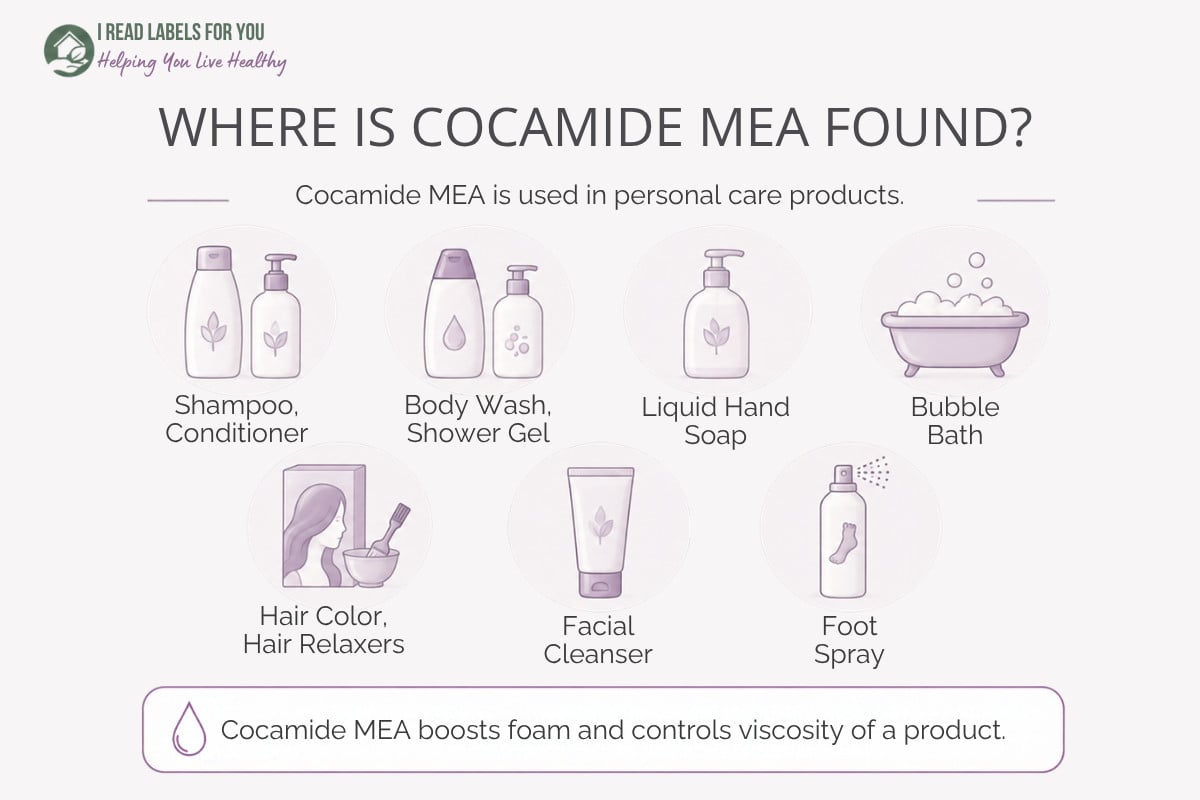
You’ll find Cocamide MEA most often in:
- shampoo and conditioner
- body wash and shower gel
- liquid hand soap
- bubble bath
- hair color and hair relaxer
- facial cleanser
- foot spray
It has no food role whatsoever. Cocamide MEA holds no E number in Europe, and the FDA lists it on no food inventory. This is a cosmetics and cleaning ingredient only.
What Is The Difference Between Cocamide MEA And Cocamide DEA?
One letter, and it changes the entire regulatory picture. MEA means monoethanolamine, with a single alcohol arm. DEA means diethanolamine, with two.
That second arm makes diethanolamine a secondary amine. A secondary amine can react with nitrites and turn into a nitrosamine. The one diethanolamine yields is a recognized animal carcinogen.
The industry review states the difference in a single sentence. Diethanolamine “is readily nitrosated to form N-nitrosodiethanolamine, a known animal carcinogen.” Monoethanolamine “has not been found to form a stable nitrosamine.”
The consequences show up in every register. Cocamide DEA is classified as possibly carcinogenic, listed by California as causing cancer, and restricted under European Annex III. Cocamide MEA carries none of those.
Irritation differs too, and the review compares them directly. Dermal application of Cocamide MEA at concentrations of 50% was nonirritating to mildly irritating in animal tests. For comparison, Cocamide DEA at a concentration of 30% was a moderate irritant.
How Is Cocamide MEA Made?
Manufacturers join coconut fatty acids to monoethanolamine in a single step. The review says ethanolamine reacts with long-chain fatty acid esters in a 1:1 mole ratio. The result is a 90+% pure, crystalline ethanolamide mixture.
Notice that ratio, because it does quiet work. One part amine to one part acid leaves little unreacted amine behind. Its cousin Cocamide DEA is made at 1:1 or 1:2, and the surplus at 1:2 is where its trouble starts.
Two production routes are common. The review names direct acylation with free fatty acids and transacylation using fatty acid esters (often enzymatically).
One line in the older review deserves attention. It records that MEA contains a small amount of DEA. The monoethanolamine feedstock therefore carries some diethanolamine into the product. Neither review says how much. No supplier specification for this ingredient appears anywhere in the record.
Does Cocamide MEA Penetrate The Skin?
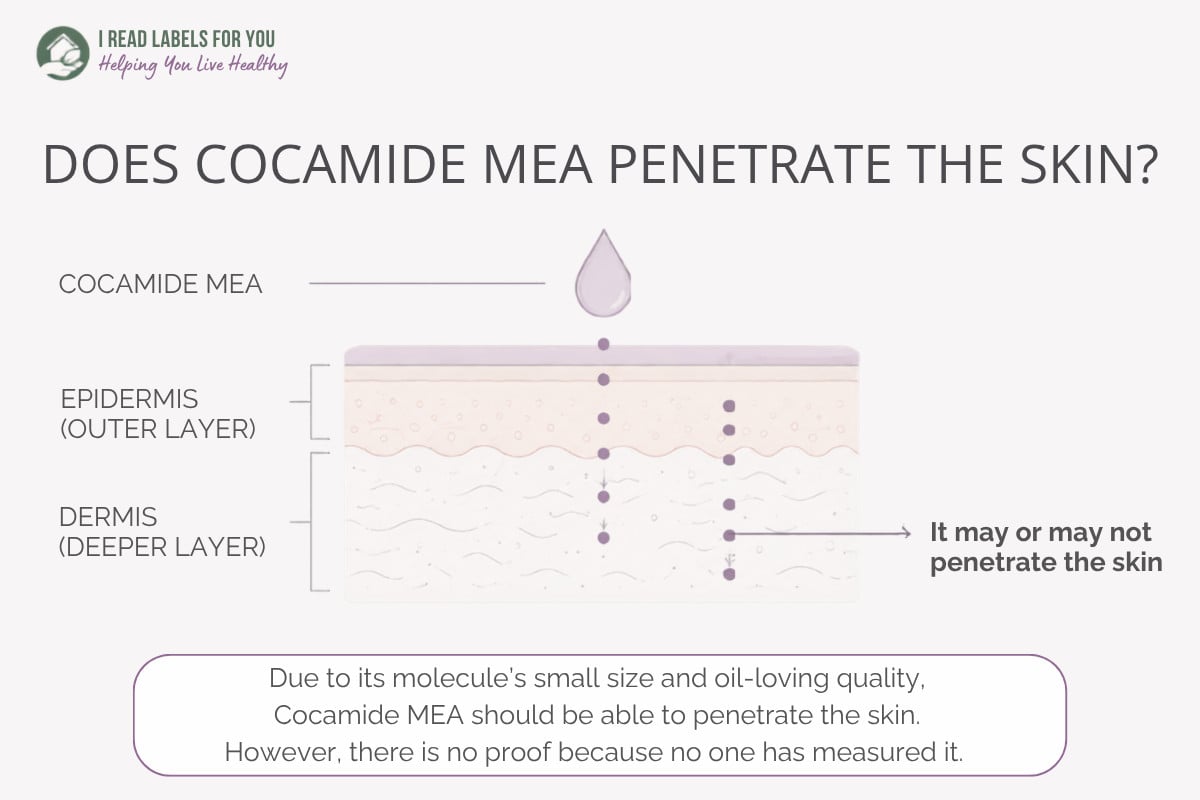
No one knows. That’s unsatisfying, but I’d rather say it than invent a better answer.
The safety review is blunt. Its section on how the body handles this ingredient reads, in full: “No published toxicokinetic data were discovered, and no unpublished data were submitted.” No one has tested whether cocamide MEA passes through skin, or whether it shows up in blood afterward.
What we do have is the shape of the molecule. Two things usually predict whether an ingredient can slip through:
- Size. Skin blocks big molecules well, and researchers often use 500 daltons (a way of weighing molecules) as a rough cutoff. Europe’s chemicals agency puts cocamide MEA at about 243 daltons, well under that line.
- Oil or water. Skin’s outer layer is rich in fats, so oil-loving ingredients pass through more easily. The review scores this one at log P 3.89, a measure of oil preference. That range crosses skin most easily.
Small and oil-loving is the profile of a molecule that tends to get in. That is not proof this one does. But no one has measured it, on an ingredient used in more than a thousand products.
One more unknown: your skin makes enzymes that could split this molecule and release free ethanolamine, which an older report calls “irritating and corrosive.” Whether that happens on skin has not been measured either.
Bottom line: there is no evidence that cocamide MEA gets into your skin, and no evidence that it does not.
What Is Cocamide MEA Called On Labels?
Cocamide MEA appears under these names:
- Cocamide MEA
- Cocamide Monoethanolamine
- Coconut Oil Monoethanolamide
- Coco Monoethanolamide
The label skill here is reading two letters rather than three. MEA and DEA look alike at a glance, and only one of them carries a cancer listing.
These related names belong to different ingredients:
- Cocamide DEA
- Lauramide MEA
- Acetamide MEA
- Stearamide MEA
- Cocamide Methyl MEA
- Cocamidopropyl Betaine
Does The U.S. FDA Restrict Cocamide MEA In Food And Cosmetics?
The FDA restricts Cocamide MEA in neither, because it has never assessed it in either. There is no food approval and no cosmetic rule.
On food, the record is simply blank. Cocamide MEA appears on no FDA list of substances added to food and on no food-contact inventory. It holds no approval to withdraw and no limit to exceed.
On cosmetics, the position is the familiar American one. The agency sets no concentration limit, requires no warning, and demands no safety testing before a product ships. Companies decide for themselves, and the FDA reacts only after harm surfaces.
California adds nothing here either. Filtering the Proposition 65 list for cocamide returns only its diethanolamine cousin, listed in 2012. Cocamide MEA appears nowhere on that list.
Europe works from the opposite instinct. Under its precautionary principle a regulator may act while evidence is still incomplete, instead of waiting for a body count. That difference explains much of what follows.
EU Regulations On Cocamide MEA
Europe has left this ingredient entirely alone, and the silence is unusually complete. Cocamide MEA appears on none of the cosmetics annexes. It’s not prohibited, not restricted, and not listed as a preservative, colorant or UV filter.
No scientific committee has reviewed it. There is no opinion from the current committee, none from its predecessors, and no mandate pending.
The chemicals agency file is emptier still. Its record for Cocamide MEA reads “No associated activities” for regulatory work and “No associated obligations” for legal duties. That’s a cleaner slate than most cosmetic ingredients manage.
One European rule does reach the raw material, though not the ingredient. Annex III restricts monoalkylamines, monoalkanolamines and their salts. That entry caps secondary amine content at 0.5 percent and nitrosamines at 50 micrograms per kilogram. It binds the monoethanolamine feedstock rather than the finished amide.
Read the silence carefully, because it cuts two ways. Europe has raised no concern about Cocamide MEA, and Europe has also never examined it.
Canadian Regulations On Cocamide MEA
Canada takes the same view as Europe, which is to say no view at all. Cocamide MEA appears nowhere on the Cosmetic Ingredient Hotlist, Health Canada’s roster of banned and capped cosmetic ingredients.
Its environmental law is equally quiet. Cocamide MEA is absent from the list of toxic substances under the Canadian Environmental Protection Act.
One neighboring entry is worth noting. The Hotlist does prohibit secondary alkyl- and alkanolamines and their salts. That entry reaches diethanolamine and leaves monoethanolamine alone.
The distinction Canada draws is the same one this whole post turns on.
Can Cocamide MEA Cause Skin Allergy And Sensitization?
No, Cocamide MEA is not a recognized allergen, and the strongest evidence for that is what dermatologists choose to test.
It’s absent from the standard screening panel. The American Contact Dermatitis Society lists Cocamide DEA in its Core Allergen Series for 2020. It includes no entry for the MEA version.
Animal testing supports the same conclusion, briefly. The review reports that Cocamide MEA was not a sensitizer in a guinea pig maximization study. It adds that details were not provided.
Human sensitization testing is missing entirely. Neither review contains a repeat insult patch test on Cocamide MEA, though both contain such tests for related ethanolamides.
Irritation is mild where it has been measured. At 50 percent in petrolatum, Cocamide MEA was slightly irritating to rabbits. The same test found it not irritating to guinea pigs and hairless mice. In people, 50% Cocamide MEA in petrolatum was not irritating.
Put those together and a fair summary emerges. Nothing suggests Cocamide MEA sensitizes, and the human testing that would confirm it was never run.
Is Cocamide MEA A Hormone (Endocrine) Disruptor?
No, Cocamide MEA is not a hormone disruptor, and here the absence of evidence is unusually total. No regulator has looked. Europe’s chemicals agency has opened no endocrine assessment and placed it on no watch list. No researcher has published either. Searching the literature for hormone or estrogen activity in this ingredient returns nothing at all. Neither review raises the question. The 1999 and 2015 assessments contain no endocrine endpoint, no hormone study and no discussion of the topic.
I call that untested rather than cleared. It belongs on the list of gaps below rather than in the reassurance column.
Is Cocamide MEA Safe To Use While Pregnant?
Cocamide MEA raises no known pregnancy concern, though no study has examined the question directly. The review says so in its own words. It found no data on the reproductive and developmental toxicity or carcinogenicity of this ingredient.
The panel filled that hole by looking sideways. It reviewed older assessments of ethanolamine and the coconut acids, then concluded that no relevant toxic effects were noted. Read-across is a reasonable method, and it remains a substitute for testing.
My practical reading is measured. A rinse-off shampoo containing Cocamide MEA gives little reason for alarm during pregnancy. A leave-on product is where I would rather choose an ingredient whose file is complete.
Pregnancy also raises questions this article cannot answer for you. You should consult with your medical provider about the products you use daily.
Are There Any Cancer Concerns Linked To Cocamide MEA?
No cancer agency has linked Cocamide MEA to cancer, and no one has tested it for cancer either.
The listings are clear. It carries no classification from the international cancer agency. There is no place in the American Report on Carcinogens and no California listing.
The testing record is blank. The review states outright that no carcinogenicity data on these ethanolamides were found. No chronic study appears in the published literature either.
Gene damage testing is mostly reassuring, with one exception worth recording. Cocamide MEA was not mutagenic at doses up to 2,500 micrograms per plate. The 1999 report concluded that Cocamide MEA was negative in the Ames Test.
The exception is narrow. One assay found it mutagenic in Salmonella typhimurium TA100 with metabolic activation. Every other strain, and a second assay, came back clean.
Why does the cancer question follow this ingredient at all? Because its cousin Cocamide DEA was classified, litigated, and reformulated out of hundreds of products, and the names differ by one letter.
Is Cocamide MEA Bad For The Environment?
There is no environmental case against Cocamide MEA, and equally no environmental file worth the name. Regulators record nothing. Canada does not list it as a toxic substance, and Europe’s chemicals agency holds no persistence or bioaccumulation determination.
Chemistry offers mild reassurance. An amide built from coconut fatty acids and a small amine is an easily degraded structure. Silicones and fluorinated compounds are the persistent ones.
I would rather flag the gap than fill it with speculation. Where the data are missing, saying so is the honest option.
Common Claims About Cocamide MEA: What’s True And What’s Not
Claim: Cocamide MEA Is Just As Dangerous As Cocamide DEA
False, and the regulatory record makes that unusually easy to show. Cocamide DEA holds a cancer classification, a California listing, and a European restriction. Cocamide MEA holds none of the three.
The chemistry behind the gap is real rather than technical. Diethanolamine forms a carcinogenic nitrosamine and monoethanolamine does not, which is why one was litigated and the other was ignored.
Claim: Cocamide MEA Causes Cancer
Unsupported, and inherited from the wrong molecule. No agency classifies Cocamide MEA, and no chronic cancer study of it exists anywhere in the record.
The honest caveat belongs here too. Untested is not the same as cleared, and Cocamide MEA has never been through a cancer bioassay of its own.
Claim: Cocamide MEA Is A “DEA” Ingredient
False. The shared word “cocamide” describes the coconut half, which both ingredients have. The letters after it describe the half that differs.
Reading those letters is the whole skill. DEA marks diethanolamine; MEA marks monoethanolamine, which carries no comparable record.
Claim: Cocamide MEA Can Form Nitrosamines
Mostly false, with one technical qualification I would rather state than hide. The review is explicit that monoethanolamine has not been found to form a stable nitrosamine.
That qualification concerns a different reaction. The 2015 review notes that secondary amides do tend to react with nitrosating agents to form nitrosamides. That’s why its conclusion still cautions against nitrosating systems.
Nitrosamides and nitrosamines are not the same class, and no nitrosamide has been measured in this ingredient. The caution is precautionary rather than evidence-driven.
Claim: Cocamide MEA Is Automatically Safe Because It’s Coconut-Derived
False, and I apply this test to every plant-derived ingredient. Coconut accounts for one half of the molecule, and industrially made monoethanolamine accounts for the other.
Plant origin describes a starting material, not a finished substance. What counts is the reaction partner, the leftovers, and whether anyone ran the tests.
In this case the reaction partner is benign enough. The unfinished testing, rather than the chemistry, is what keeps this ingredient out of my top tier.
What I Think About Cocamide MEA — And What You Should Do
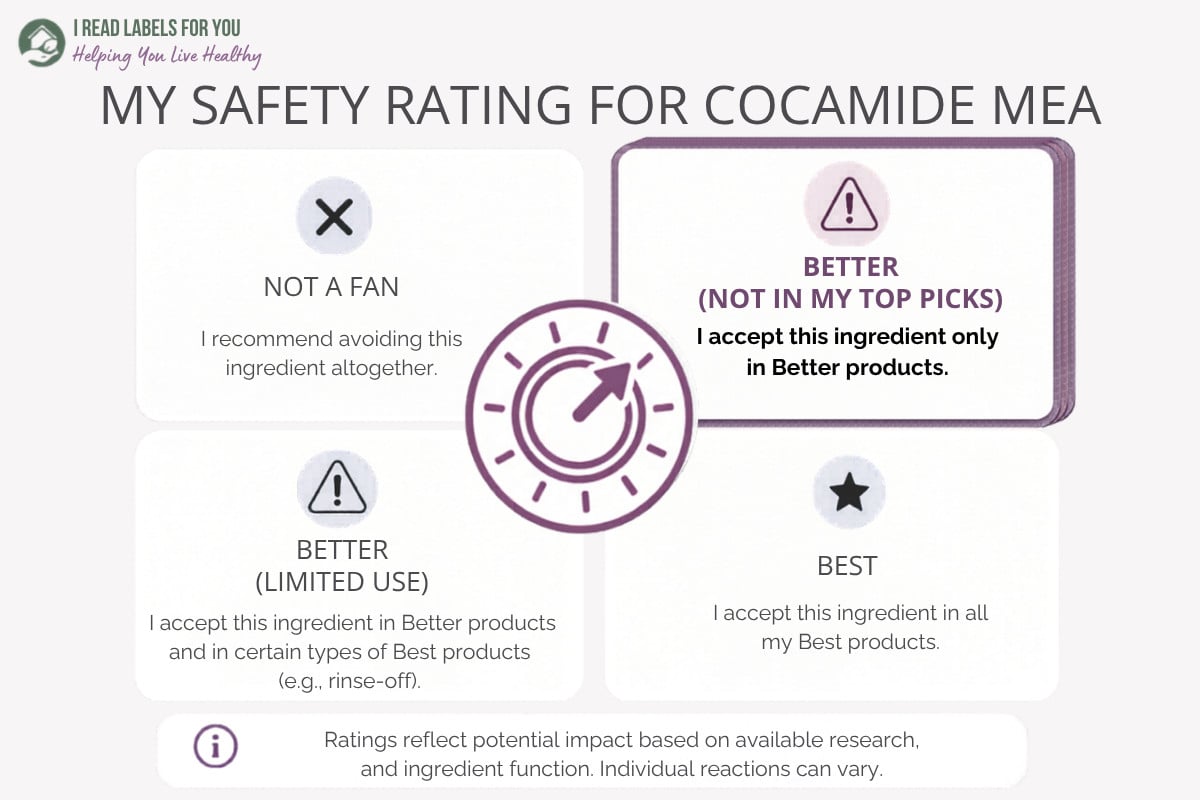
My rating for Cocamide MEA is Better (Not In My Top Picks).
On the evidence that exists, Cocamide MEA behaves well. No health agency flags it, and no European rule limits it. Skin doctors do not test for it in allergy patches, and animal studies found it did not cause allergic reactions.
What holds Cocamide MEA back is everything we do not know. The industry review found no studies on cancer risk, fertility, or effects on a developing baby. It found nothing on whether the body absorbs it. And it sets no purity limit for cocamide MEA, even though it sets one for three similar, less-used ingredients.
One old line makes those gaps matter. The 1999 report notes that “MEA contains a small amount of DEA.” So, the raw material carries a little DEA, and no one has published how much.
Absorption is the other blank. A molecule this small (243 daltons) and this oil-loving (log P 3.89) is built to cross skin. No one has checked whether it does, in more than a thousand products.
That’s why it sits in this tier. The gap runs across every product type. Rinsing shortens contact time and answers none of the open questions.
What should you do? Do not treat it as the same thing as Cocamide DEA. Yet, for a foaming cleanser, I still reach first for Coco-Betaine or a glucoside.
Frequently Asked Questions About Cocamide MEA
Is Cocamide MEA Derived From Coconut?
Partly. Coconut oil supplies the fatty acids, and the monoethanolamine bolted to them is made industrially. Half-plant origin is the norm for this ingredient class. It tells you where the molecule started, not how it behaves on skin.
Is Cocamide MEA Natural Or Synthetic?
Cocamide MEA is synthetic. The finished molecule exists nowhere in nature, even though one half of it begins in a coconut.
Synthetic by itself decides nothing for me. I judge an ingredient on how it’s made, what rides along with it, and what has been measured.
Why Is Cocamide MEA Used In Shampoo?
In shampoo, Cocamide MEA is used for lather and thickness. It holds foam together so bubbles last, and it turns a watery formula into something that pours well.
It’s inexpensive and effective, which explains its reach. Industry reporting counted it in 1,122 cosmetic products, the overwhelming majority of them rinse-off.
Is Cocamide MEA Vegan?
Yes, Cocamide MEA is vegan. Neither half involves an animal: coconut oil is plant material, and monoethanolamine comes from industrial chemistry.
Vegan and well-studied are separate questions, though. This ingredient is fully vegan and still has three empty categories in its safety file.
Is Cocamide MEA On California’s Proposition 65 List?
No, Cocamide MEA is not on California’s Proposition 65 List. Searching the Proposition 65 list for cocamide returns only Cocamide DEA, added in June 2012.
That single listing is the source of most confusion about this ingredient. One coconut surfactant is listed and the other is not, and they sit one letter apart on a label.
Is Cocamide MEA Safe For Babies?
Probably, and I would still choose differently. Nothing in the record suggests harm, and the review itself records four baby products using it at 2 percent.
My hesitation is the missing data rather than any finding. Infant skin is thinner, and the absorption question has never been answered. I prefer a cleanser with a fuller file.
What Is A Safer Alternative To Cocamide MEA?
Coco-Betaine and the glucosides do the same work with more published behind them. I rate Decyl Glucoside and Coco Glucoside Best, and both lather well.
Cocamide MEA is genuinely a better choice than its diethanolamine cousin. Better than the worst option and best available are different standards, and I reserve my top tier for the second.
Sources
EU SCCS / SCCP Opinions:
No SCCS or SCCP opinion on Cocamide MEA (checked); a search of the current opinions index and the archived collection returns no opinion on cocamide, ethanolamide or monoethanolamide, and the 2015 industry review cites none: SCCS Opinions portal
Cosmetic Ingredient Review (CIR) Reports:
Fiume MM, Heldreth BA, Bergfeld WF, et al. (2015), Safety Assessment of Ethanolamides as Used in Cosmetics, International Journal of Toxicology, 34(Supplement 1): 18S-34S; source of the use figures, the manufacturing route, the log P value, the amidase statement and the missing-data statements quoted above: CIR Reports
Andersen FA, ed. (1999), Final Report on the Safety Assessment of Cocamide MEA, International Journal of Toxicology, 18(Supplement 2): 9-16; source of the nitrosamine comparison, the irritation comparison with Cocamide DEA and the statement that MEA contains a small amount of DEA: CIR Reports
European Union Regulatory Databases:
CosIng ingredient record 32919 for COCAMIDE MEA, functions surfactant foam boosting and viscosity controlling, with no Cosmetics Regulation provisions and no restrictions recorded: CosIng record 32919
CosIng Annexes checked and Cocamide MEA absent from all of them, covering Annex II (prohibited), Annex III (restricted), Annex IV (colorants), Annex V (preservatives) and Annex VI (UV filters); Annex III entry 61 restricts “Monoalkylamines, monoalkanolamines and their salts”, which binds the amine feedstock rather than this ingredient: CosIng Annexes
ECHA CHEM substance 100.062.500, Amides, coco, N-(hydroxyethyl), EC 268-770-2, CAS 68140-00-1; regulatory activities recorded as “No associated activities” and legal obligations as “No associated obligations”; not a Substance of Very High Concern, not on Annex XIV, not on REACH Annex XVII: ECHA CHEM 100.062.500
Other Regulators:
International Agency for Research on Cancer, List of Classifications, Cocamide MEA not classified; a search on the CAS number and on monoethanolamine returns no matching records: IARC List of Classifications
California OEHHA, Proposition 65 list, Cocamide MEA not listed; filtering the list on cocamide returns only Cocamide DEA, listed 06/22/2012: OEHHA Proposition 65 list
U.S. NTP, 15th Report on Carcinogens, Cocamide MEA not listed among the 256 entries: NTP Report on Carcinogens
U.S. EPA, Integrated Risk Information System, no assessment for Cocamide MEA or for ethanolamine: EPA IRIS
U.S. FDA, no food status; Cocamide MEA appears on no list of substances added to food and on no food-contact substance inventory: FDA Substances Added to Food
Health Canada Cosmetic Ingredient Hotlist, Cocamide MEA not listed, neither prohibited nor restricted; the prohibited entry “Secondary alkyl- and alkanolamines and their salts” covers diethanolamine rather than monoethanolamine: Cosmetic Ingredient Hotlist
Environment Canada, CEPA Schedule 1 List of Toxic Substances, Cocamide MEA not listed: CEPA Schedule 1
PubChem Records (Chemistry, Identifiers, Skin Penetration, Hazard Codes):
PubChem record for Amides, coco, N-(hydroxyethyl), CAS 68140-00-1, EC 268-770-2; held as a reference record rather than a single compound because the substance is a variable mixture: PubChem: Cocamide MEA
Peer-Reviewed Studies:
No peer-reviewed study specific to Cocamide MEA was found (checked). Literature searches for allergic contact dermatitis, endocrine activity, carcinogenicity and toxicity on Cocamide MEA, coco monoethanolamide and coconut oil monoethanolamide return no study of this ingredient; the single related record is a Cocamide DEA investigation in which Cocamide MEA was also tested: PubMed
Natural Cosmetic Standards:
COSMOS-standard approved raw materials, Cocamide MEA not found on either the approved or the certified list, since the ethanolamine half is petrochemical: COSMOS-standard approved raw materials
NATRUE certified and approved raw materials, Cocamide MEA not listed: NATRUE certified world
Skin Allergy Resource:
American Contact Dermatitis Society (ACDS), Helpful References including the Core Allergen Series 2020, in which Cocamide MEA does not appear while Cocamide DEA is listed at 0.5% in petrolatum: ACDS Helpful References
Last verified: 09-11-2026

Download The Free Guide!
5 Powerful Steps To A Non-Toxic Home
Join our informed consumer community and get our free guide the “5 Powerful Steps To A Non-Toxic Home”.


Before commenting, please read our Comment Policy.