
Is Iodopropynyl Butylcarbamate Safe? A Simple Answer You Can Trust
 Written by Irina Webb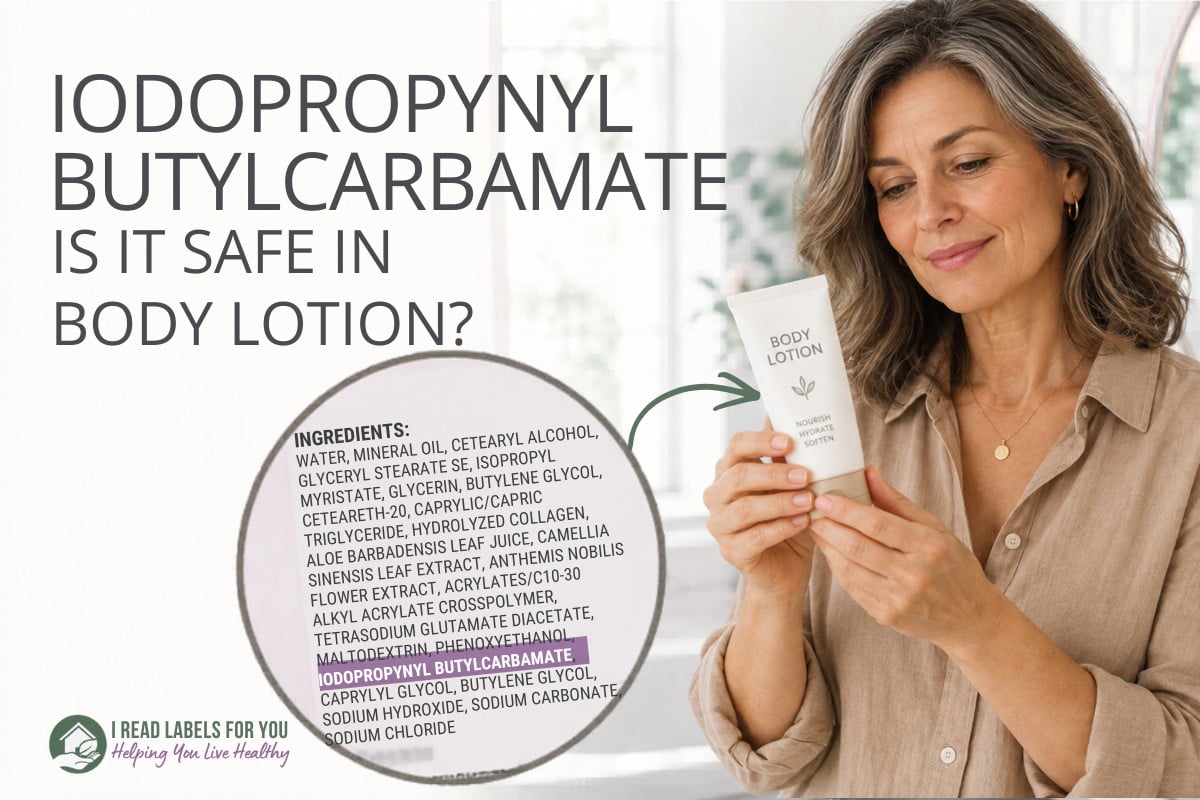
No, Iodopropynyl Butylcarbamate is a preservative I avoid in every product type. It’s an iodine-based preservative used in tiny amounts to stop mold and bacteria from growing in a formula. Most of its lab testing came back clean, and you’ll see those results in this post. What decides my rating is how much of it goes through skin, and the measured figure is more than half. I rate it Not A Fan.
Iodopropynyl Butylcarbamate is restricted across Europe in a way few cosmetic ingredients are. The rules cap it at three levels by product type and ban it outright in several categories. The United States allows it at five to thirteen times the European concentration.
First, you’ll see the skin measurement that made up my mind about the Iodopropynyl Butylcarbamate rating. Second, you’ll learn why two safety panels reviewed the same ingredient and disagreed twice. Third, I’ll explain the one thing they both agree on.
What Is Iodopropynyl Butylcarbamate?
Iodopropynyl Butylcarbamate is a synthetic preservative, usually shortened to IPBC. It’s a single defined chemical rather than a blend, which makes it easier to study than most cosmetic ingredients. Its job is to stop mold, yeast, and bacteria spoiling a product.
Three parts of the name describe three parts of the molecule. “Iodo” means it carries an iodine atom, and “propynyl” describes a short carbon chain. “Butylcarbamate” is the rest, and that iodine atom drives most of the debate here.
Iodopropynyl Butylcarbamate is a small molecule by cosmetic standards. The industry review describes it as “a white or slightly off-white crystalline powder of molecular weight 281.” Anything near that size crosses skin easily, which the section below confirms with a measurement.
What Does Iodopropynyl Butylcarbamate Do In Cosmetics?
IPBC preserves, and it does so at remarkably low doses. The industry review records that “approximately 50 ppm (0.005%) IPBC controlled fungal growth, and 250-1000 ppm provided bactericidal protection.” Against common molds its minimum effective levels ran “from 0.6 ppm (Aspergillus niger) to 10 ppm (Trichoderma viride).”
It’s particularly good against mold rather than bacteria. Formulators tend to pair it with another preservative that covers the bacterial side.
Use has grown sharply. Industry reporting counted IPBC in 122 cosmetic formulations in 1996 and 942 by 2013. The top of the reported concentration range rose over the same period, from 0.0125 percent to 0.05 percent.
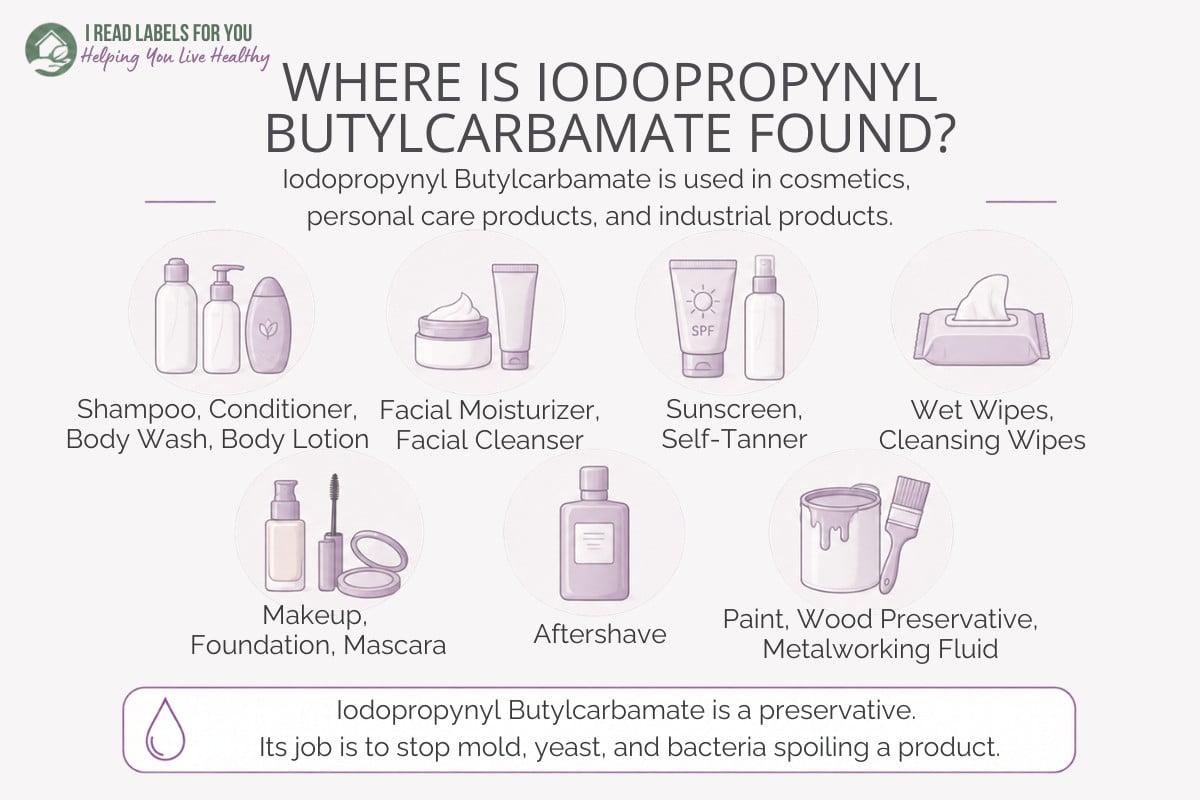
You’ll find Iodopropynyl Butylcarbamate most often in:
- shampoo, conditioner, body wash, and body lotion
- facial moisturizer and facial cleanser
- sunscreen and self-tanner
- wet wipes and cleansing wipes
- makeup, including foundation and mascara
- aftershave
- paint, wood preservative, and metalworking fluid
That last line is not a mistake. IPBC began as an industrial fungicide for timber and paint, and it still is one. The industry review lists vinyl wallpapers, wallpaper adhesives and cordage among its uses. It holds no food approval anywhere.
How Is Iodopropynyl Butylcarbamate Made?
The route is short and the industry review states it plainly. IPBC is prepared by the iodination of terminal acetylenes (1-iodoalkynes). Two commercial methods exist. Manufacturers use elemental iodine in a cold, aqueous hydroxide solution, or they add sodium hypochlorite to an alkali iodide solution.
This is a clean manufacturing story, and I want to say so. No carcinogen is used as a starting material for Iodopropynyl Butylcarbamate, unlike the ethoxylated ingredients I avoid. Process refinements make it possible to reach purities well above 98%.
The review records that technical grade IPBC is 97-99% pure. Its primary impurities are sodium chloride (table salt; 0.9% maximum) and triiodoallylbutylcarbamate (<0.1%).
Does Iodopropynyl Butylcarbamate Penetrate The Skin?
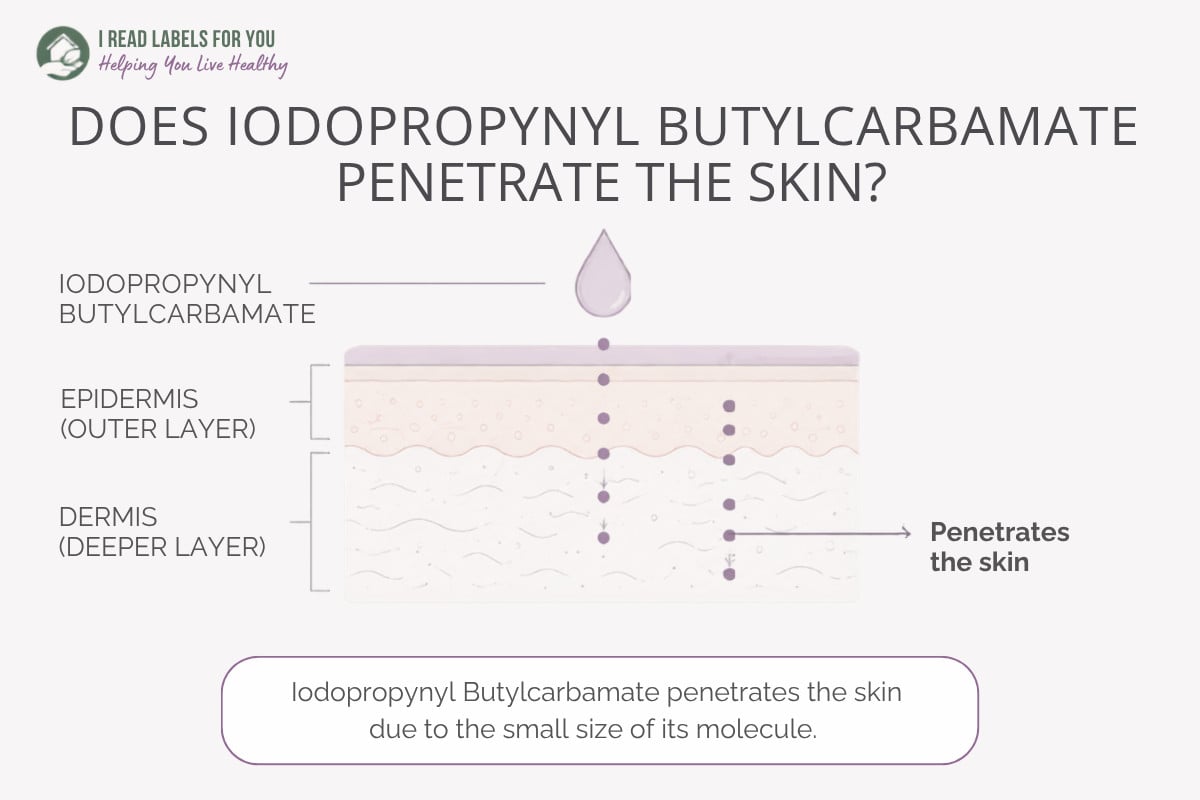
Yes, Iodopropynyl Butylcarbamate readily penetrates the skin, and this is the finding that decides my rating.
Researchers applied radiolabelled IPBC to human skin samples taken from four donors, then tracked how much crossed over 24 hours. More than half (53%) of Iodopropynyl Butylcarbamate went through. Peak penetration occurred within 8 hours of the application.
Put that beside other ingredients I’ve reviewed. Dimethicone measured a fraction of a nanogram per square centimeter per hour, being far too large to get in. IPBC is small, and it behaves accordingly.
One detail makes this sharper still. When Europe calculated its concentration limits, it assumed a percutaneous absorption rate of 20%. The measured human figure is more than twice that assumption.
Where it goes afterward is also on record. In animals the compound was quickly absorbed and rapidly eliminated, with most leaving in urine and exhaled air. Some lingered, though, and radioactivity in fat tissue and skin remained relatively constant from 12 hours to 240 hours.
What Is Iodopropynyl Butylcarbamate Called On Labels?
Look for these names:
- Iodopropynyl Butylcarbamate
- IPBC
- 3-Iodo-2-Propynyl Butylcarbamate
- Butyl-3-Iodo-2-Propynylcarbamate
- Glycacil
- Troysan Polyphase
One habit helps on any label. The letters iodo at the start of a name mean the molecule carries iodine. That matters if you react to iodine antiseptics.
Does The U.S. FDA Restrict Iodopropynyl Butylcarbamate In Food And Cosmetics?
The FDA restricts Iodopropynyl Butylcarbamate neither in food nor in cosmetics. The gap with Europe here is the widest I’ve found for any preservative.
There’s no food approval. IPBC was petitioned for use as an antifungal preservative in foods in October 1988, and no approval followed. It appears on no list of substances added to food. For cosmetics, the agency doesn’t set anything at all. No concentration limit, no product-type restriction, no warning, and no requirement to test before selling.
The American number comes from an industry panel instead. The Cosmetic Ingredient Review concluded that IPBC is safe “at concentrations [less than or equal to] 0.1%.” Europe permits 0.01 percent in a leave-on product, ten times lower.
My usual reservation about industry panels applies, and it’s not a general complaint. That panel reviewed the ingredient again in 2013 and chose not to reopen it. It did so while noting that European regulators had set limits five to thirteen times stricter.
Europe reasons from a different starting point. Its precautionary principle allows a regulator to restrict a substance while the science is still unsettled. The American approach waits for harm to be demonstrated first.
EU Regulations On Iodopropynyl Butylcarbamate
Europe permits IPBC as a preservative and then fences it in on every side. It sits at entry 56 of Annex V, the positive list of preservatives allowed in cosmetics.
Three concentration caps apply, by product type. The limits are:
- 0.02% in rinse-off products
- 0.01% in leave-on products
- 0.0075% in deodorants and antiperspirants.
Then come the outright bans. IPBC is “not to be used in oral and lip products.” Leave-on products carry a second ban: “Not to be used in body lotion and body cream”.
The reason for that second ban is worth knowing. The accompanying note explains that the ban covers any product applied over a large part of the body. Europe is limiting the total dose across your skin, not just the strength in the bottle.
Children get a separate rule. IPBC is barred from products for children under three. The only exemption is bath products, shower gels, and shampoos. Affected products must carry a warning. The required wording is “Not to be used for children under three years of age”.
The limits have tightened steadily. Europe first cleared IPBC at 0.05 percent in 1999. A “Contains Iodine” label was required above 0.02 percent in leave-on products. Leave-on is now capped at 0.01 percent, a fivefold reduction.
Why Are The European Limits About Iodine?
Because the committee that set them was asked about thyroids, not about allergies. Norway and Denmark raised the question. They asked whether IPBC increases the risk of attracting thyroid hormonal disturbances, including auto-immune thyroid disease.
The resulting opinion reasoned from total iodine intake. It held that cosmetic iodine intake should not exceed 20 % of the recommended daily intake of 150 [micrograms].
The committee even showed its arithmetic. That limit, it wrote, is “equivalent to approximately 0.002% IPBC in all cosmetic products.” The calculation assumed a daily use of 18 g and at a percutaneous absorption rate of 20%.
Notice the assumption buried in that sentence. The whole calculation rests on 20 percent absorption, and the measured human figure was 53 percent.
Canadian Regulations On Iodopropynyl Butylcarbamate
Canada neither bans nor restricts it. The Hotlist is where Health Canada sets cosmetic bans and caps, and IPBC sits on neither part of it.
Canada’s toxic substances register leaves it out as well. Canada did register IPBC as an antimicrobial. It set an acceptable daily intake of 2.80 mg/day for a 70-kg person. One neighboring entry is worth noting. Free iodine is itself prohibited on the Hotlist, which matters for the cross-reaction question later in this post.
Can Iodopropynyl Butylcarbamate Cause Skin Allergy And Sensitization?
Yes. This is the one question where two safety bodies looked at the same ingredient and reached opposite conclusions.
Europe classifies it as an allergen, in binding law. The EU assigns IPBC Skin Sens. 1 with hazard statement H317, the code for an allergic skin reaction.
This is a harmonized classification, agreed across all member states rather than declared by a company.
Dermatologists screen for it routinely. The American Contact Dermatitis Society includes IPBC on its Core Allergen Series at 0.1 percent in petrolatum.
The industry panel disagreed, and said so twice. Its 1998 review states that IPBC “was found to be mildly irritating but not sensitizing in clinical testing.” A guinea pig test produced “no evidence of delayed contact hypersensitivity.”
In 2017, the panel held its position. The data, it said, “do not suggest that IPBC is unsafe for use in cosmetic products.”
So, which do you believe? I follow the later evidence, and the dates explain why.
The panel’s finding rests on testing from the 1990s. A German patch test study of 4,883 patients found 0.3 percent allergic to IPBC. North American testing of 25,321 patients found 0.9 percent weak and 0.3 percent strong reactors.
Both papers urge caution. IPBC is a mild irritant, so weak reactions can be misread as allergy.
One honest caveat belongs here. The dermatology society marks its own IPBC entry with a footnote. It reads “Interpret reactions with caution, mild irritant, and/or low clinical relevance.” Most entries carry no such marker.
Is Iodopropynyl Butylcarbamate A Hormone (Endocrine) Disruptor?
No, Iodopropynyl Butylcarbamate is not a hormone disruptor, and unusually this was formally investigated rather than assumed.
Denmark raised the question with Europe’s chemicals agency in 2020. The referral went to the endocrine expert group precisely because of the iodine and thyroid concern.
That strand closed with a clear answer. The recorded outcome is “Conclusive data – no ED HH”, meaning conclusive data showing no endocrine disruption for human health.
The industry panel reached the same place by a different road. It found that “effects on the thyroid gland were not reported in a 104-week, chronic oral toxicity study.” Those rats were dosed up to 80 milligrams per kilogram daily. It also questioned the premise. The panel cited “the absence of evidence that this ingredient can be dehalogenated to produce free iodine.”
This is a genuine clearance, not a gap, and I count it in the ingredient’s favor. The environmental side of that assessment is still open.
Is Iodopropynyl Butylcarbamate Safe To Use While Pregnant?
No, Iodopropynyl Butylcarbamate is not an ingredient I would use during pregnancy, though the reproductive testing itself came back clean.
The studies found nothing. In rats and mice, IPBC had no significant effect on fertility, reproductive performance, or on the incidence of fetal malformations. No European classification for reproductive toxicity exists either.
My reasoning rests on exposure instead. More than half of the IPBC applied dose crosses human skin. This is an iodine-carrying molecule whose limits assumed far less absorption.
Iodine matters more in pregnancy than at other times, in both directions. Too little and too much are both recognized concerns. That is reason enough to keep an avoidable source off the list.
These are months for asking rather than guessing. For anything you put on your skin daily, you should consult with your medical provider.
Are There Any Cancer Concerns Linked To Iodopropynyl Butylcarbamate?
No, Iodopropynyl Butylcarbamate has no established cancer link, and the testing here is better than the internet suggests.
The long study came back negative. Rats were fed IPBC for 104 weeks at up to 80 milligrams per kilogram daily. No evidence of carcinogenic potential was detected.
Gene damage testing was clean too. The review states that IPBC “was not genotoxic, with or without metabolic activation.”
No cancer authority lists Iodopropynyl Butylcarbamate anywhere. The international cancer agency, the American Report on Carcinogens, California and the EPA all omit it.
The same study did find other effects at higher IPBC doses. Rats on the two top doses showed stomach lesions and salivary gland changes. The no-effect level was set at 20 milligrams per kilogram daily.
I say this plainly for a reason. The fear attached to this ingredient is mostly about cancer, and cancer is what the evidence clears.
Is Iodopropynyl Butylcarbamate Bad For The Environment?
Yes, Iodopropynyl Butylcarbamate is bad for the environment. This is the one hazard rated at the top of its scale.
The EU classification places IPBC in the highest categories for both short-term and long-term harm to water life. It carries a multiplying factor of ten, applied to substances that are toxic to aquatic organisms at very low concentrations.
That fits its other career. IPBC is a wood and paint biocide, designed to kill fungi. Far more of it enters the environment from timber treatment than from shampoo. Breakdown in water is slow at neutral pH. The review records a half-life of 139 days at pH 7, with the molecule gradually losing its iodine atom. The environmental strand of Europe’s endocrine review remains open, which is worth watching.
Common Claims About Iodopropynyl Butylcarbamate: What’s True And What’s Not
Claim: Iodopropynyl Butylcarbamate Releases Formaldehyde
False, and this one is a straightforward mix-up. IPBC is an iodine-based carbamate, and it contains no formaldehyde and no group that could release any.
Its breakdown products are on record and formaldehyde is not among them. Heated to 100 degrees Celsius, it decomposes to gases including hydrogen iodide. In water at neutral pH it slowly loses its iodine atom.
The confusion comes from shelf position rather than chemistry. IPBC appears on the same avoid-lists as the genuine formaldehyde-releasing preservatives, which are a different family altogether.
Claim: The Iodine In Iodopropynyl Butylcarbamate Disrupts Your Thyroid
Not supported, and this one has been properly tested rather than argued about. Denmark referred IPBC to Europe’s endocrine expert group, which concluded with “Conclusive data – no ED HH”.
The animal evidence agrees. A 104-week rat study found no thyroid effects. The industry panel cited “the absence of evidence that this ingredient can be dehalogenated to produce free iodine.”
The claim is not baseless, though, and that is worth saying. Europe’s entire limit structure Iodopropynyl Butylcarbamate for was built on exactly this worry. People reacting to iodine restrictions are reacting to something real.
Claim: Iodopropynyl Butylcarbamate Is Banned
False in both places, and the truth is more interesting. Europe restricts Iodopropynyl Butylcarbamate heavily rather than banning it, and the United States sets no cosmetic limit at all.
What Europe does ban is specific. No Iodopropynyl Butylcarbamate in oral or lip products, body lotion or body cream. No Iodopropynyl Butylcarbamate for children under three outside bath products, shower gels, and shampoos.
Claim: A Preservative This Strong Must Be Harmful
False as a rule, and Iodopropynyl Butylcarbamate shows why. It stops fungal growth at around 50 parts per million, which is a tiny amount. Effectiveness at low doses counts in a preservative’s favor.
A product without adequate preservation grows mold and bacteria, which is a real hazard rather than a theoretical one. The question is never whether to preserve, but which preservative to choose.
My objection to IPBC has nothing to do with its strength. It rests on how much of it crosses skin and on a binding allergen classification.
Claim: Iodopropynyl Butylcarbamate Is A Toxic Preservative To Avoid At All Costs
Overstated, even though I do avoid it. The phrase “at all costs” implies acute danger at cosmetic levels, and the evidence does not show that.
Here’s the fair version. IPBC is not genotoxic, not carcinogenic in a two-year study, not toxic to reproduction, and not comedogenic. Its impurities are table salt and a trace carbamate.
What’s true is narrower and still enough for me. Iodopropynyl Butylcarbamate is a classified skin allergen, and more than half an applied dose crosses human skin. Europe bans it for babies and for large-area products.
What I Think About Iodopropynyl Butylcarbamate — And What You Should Do
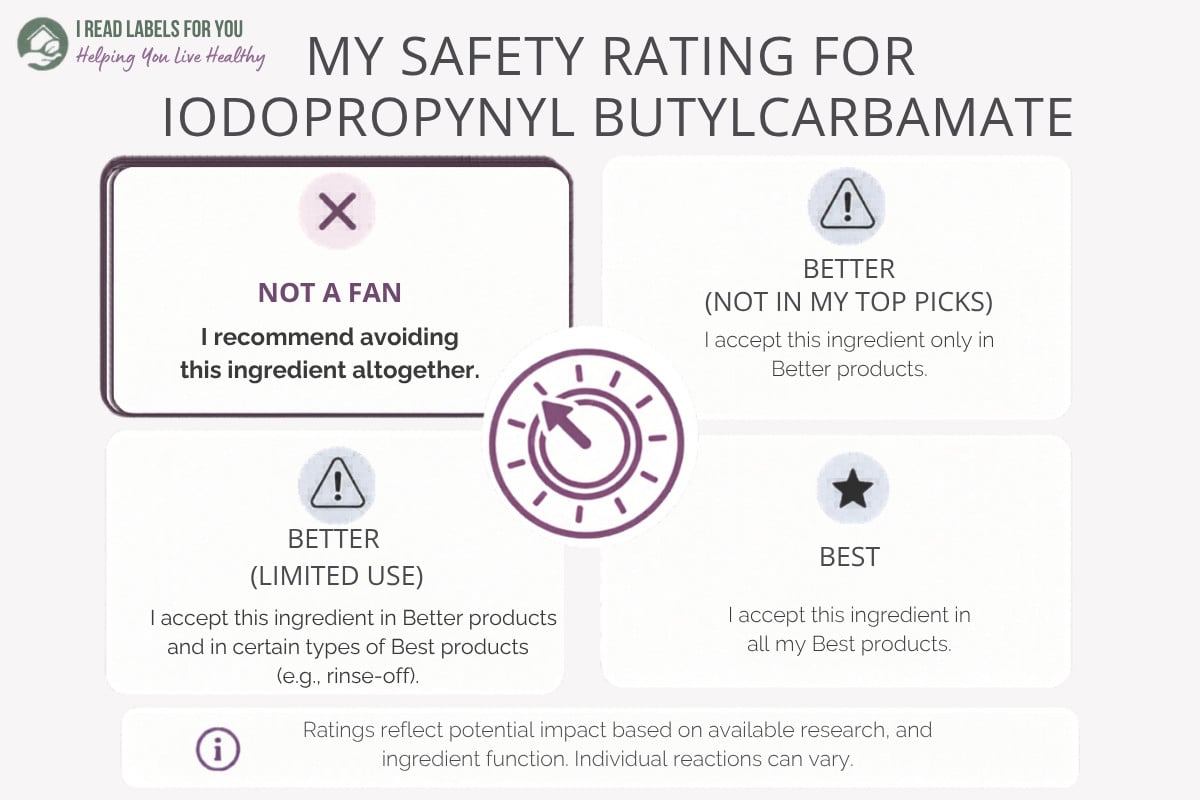
I rate Iodopropynyl Butylcarbamate Not A Fan. It has a better safety file than its reputation suggests, and a worse exposure profile than its regulators assumed.
Take the good part first, because it’s real. IPBC is not genotoxic and produced no cancer in a 104-week rat study. It showed no effect on fertility, and Europe’s endocrine experts cleared the thyroid question. Manufacturing is clean too, with no carcinogenic starting material and purity above 98 percent.
Then comes the number that changes everything. Applied to human skin in the laboratory, 53 percent of the dose crossed within 24 hours. The review’s own summary runs four words: IPBC readily penetrates through the skin. Europe set its limits assuming 20 percent. Every cap in the European rulebook rests on less than half the absorption that was measured.
The second reason is allergy, and the dates decide it for me. The EU assigns Iodopropynyl Butylcarbamate a binding allergen classification, and dermatologists screen for it. That industry finding of no sensitization dates from 1998.
Look at how Europe permits Iodopropynyl Butylcarbamate, and the picture completes itself. Banned in lip and oral products, and in body lotion and body cream. Barred for children under three outside the bath.
One agreement between the two panels is worth acting on. Both say IPBC has no business in anything you can breathe. Treat aerosols, pump mists, and dry shampoos as a firm no.
What should you do? Check the label, and pick a product preserved with Sodium Benzoate or Pentylene Glycol instead. I rate both Best.
Frequently Asked Questions About Iodopropynyl Butylcarbamate
Is Iodopropynyl Butylcarbamate Safe If I Have An Iodine Allergy?
Probably not, and this is the question I would most want answered in your position. IPBC carries an iodine atom, and a Belgian and French case series found seven iodine-allergic patients also reacting to IPBC.
The overlap shows up in people sensitized by iodine antiseptics. If povidone-iodine has ever given you a rash, treat iodopropynyl butylcarbamate as one to avoid and tell your dermatologist.
Is Iodopropynyl Butylcarbamate Safe For Babies And Children?
No, and Europe has already said so in law. IPBC is barred from products for children under three, with an exemption only for bath products, shower gels, and shampoos. Products that can reach young children must carry a warning. The required wording is “Not to be used for children under three years of age”.
I would go further than the rule. Half an applied IPBC dose crosses skin, and infant skin is thinner. A wipe or lotion covers a lot of a small body.
Why Is Iodopropynyl Butylcarbamate Used In Cosmetics?
Iodopropynyl Butylcarbamate is used in cosmetics because it’s an unusually efficient mold killer. It works at around 50 parts per million against fungi, so a formulator needs very little of it.
It also fills a specific gap. Many gentle preservatives handle bacteria well and mold poorly, and IPBC is usually added to cover the fungal side.
How Is Iodopropynyl Butylcarbamate Restricted In The EU?
In the EU, Iodopropynyl Butylcarbamate is restricted by product type, with three different caps. Rinse-off products may contain up to 0.02 percent, leave-on products up to 0.01 percent, and deodorants up to 0.0075 percent. Four bans sit on top of those caps. No oral products, no lip products, no body lotion, and no body cream. Nothing for under-threes except bath products, shower gels and shampoos.
Does Iodopropynyl Butylcarbamate Contain Iodine I Can Absorb?
Iodopropynyl Butylcarbamate contains iodine, and some of it does come off the molecule. Ultraviolet light breaks the carbon to iodine bond. In water at neutral pH, the molecule slowly loses that atom over months.
Whether enough IPBC reaches you to matter is the disputed part. Europe built its limits on the assumption that it does. The industry panel and Europe’s own endocrine experts concluded that it does not.
What Is A Natural Alternative To Iodopropynyl Butylcarbamate?
For the antibacterial side, Sodium Benzoate does the job, which I rate Best. Pentylene Glycol, also Best, boosts a preservative system while doubling as a humectant.
Mold is the harder half to replace, and honesty helps here. No single gentle preservative matches IPBC against fungi. Well-formulated clean products use a combination rather than a substitute.
Gentle cleansing helps too. A simple formula built on Glucosides needs less preservative work than a complex one.
Sources
EU SCCS / SCCP Opinions:
SCCNFP/0826/04, Opinion concerning Iodopropynyl Butylcarbamate, COLIPA n P91, adopted by the SCCNFP on 1 July 2004; source of the iodine intake limit, the worked example assuming 20 percent percutaneous absorption, and the ban on oral hygiene and lip care products: SCCS Opinions portal
SCCNFP/0193/99, the earlier opinion adopted 23 June 1999, which permitted 0.05 percent and required a Contains Iodine label above 0.02 percent in leave-on products; quoted within the 2004 opinion: SCCS Opinions portal
Cosmetic Ingredient Review (CIR) Reports:
Andersen FA, ed. (1998), Final Report on the Safety Assessment of Iodopropynyl Butylcarbamate (IPBC), International Journal of Toxicology, 17(5): 1-37; source of the human skin penetration figure, the manufacturing route, the impurity profile, the 104-week rat study and the aerosol prohibition: CIR Reports
Johnson W Jr (2017), Iodopropynyl Butylcarbamate, re-review summary, International Journal of Toxicology, 36(Supplement 2): 37S-38S; source of the 2013 use figures and of the panel’s response to the European iodine reasoning: CIR Reports
European Union Regulatory Databases:
Regulation (EC) No 1223/2009, Annex V entry 56, Iodopropynyl Butylcarbamate, CAS 55406-53-6, EC 259-627-5; maximum concentrations 0.02 percent rinse-off, 0.01 percent leave-on and 0.0075 percent in deodorants, with bans on oral, lip, body lotion and body cream use and restrictions for children under three: CosIng Annex V
CLP Regulation Annex VI harmonized classification, Index No 616-212-00-7: Skin Sens. 1 H317, Eye Dam. 1 H318, Acute Tox. 4 H302, STOT RE 1 H372 (larynx), Aquatic Acute 1 H400 and Aquatic Chronic 1 H410, with the inhalation category rising from Acute Tox. 3 to Acute Tox. 2 from 1 February 2027: EUR-Lex CLP Annex VI
ECHA CHEM substance 100.054.188, 3-iodo-2-propynyl butylcarbamate; endocrine disruptor assessment submitted by Denmark, outcome recorded as Conclusive data, no ED HH, at the assessment conclusion stage dated 12 May 2025: ECHA CHEM 100.054.188
Other Regulators:
International Agency for Research on Cancer, List of Classifications, iodopropynyl butylcarbamate not classified: IARC List of Classifications
U.S. NTP, 15th Report on Carcinogens, iodopropynyl butylcarbamate not listed: NTP Report on Carcinogens
California OEHHA, Proposition 65 list, iodopropynyl butylcarbamate not listed: OEHHA Proposition 65 list
U.S. EPA, Integrated Risk Information System, no assessment for iodopropynyl butylcarbamate: EPA IRIS
Health Canada Cosmetic Ingredient Hotlist, iodopropynyl butylcarbamate not listed, neither prohibited nor restricted; free iodine is prohibited: Cosmetic Ingredient Hotlist
Environment Canada, CEPA Schedule 1 List of Toxic Substances, iodopropynyl butylcarbamate not listed: CEPA Schedule 1
U.S. FDA, no food additive or food contact approval; IPBC was petitioned for food preservative use in 1988 and not approved: FDA Substances Added to Food
PubChem Records (Chemistry, Identifiers, Skin Penetration, Hazard Codes):
PubChem CID 62097, 3-Iodo-2-propynyl butylcarbamate, CAS 55406-53-6, EC 259-627-5, molecular weight 281.09, molecular formula C8H12INO2: PubChem CID 62097
Peer-Reviewed Studies:
Vanhoutte C, Goossens A, Gilissen L, et al. (2019), Concomitant contact-allergic reactions to iodopropynyl butylcarbamate and iodine, Contact Dermatitis 81(1): 17-23, PMID 30663063: PubMed 30663063
Warshaw EM, Ratnayake DB, Maibach HI, et al. (2010), Positive patch-test reactions to iodopropynyl butylcarbamate, retrospective analysis of North American Contact Dermatitis Group data 1998 to 2008, Dermatitis 21(6): 303-310, PMID 21144341: PubMed 21144341
Schnuch A, Geier J, Brasch J, Uter W (2002), The preservative iodopropynyl butylcarbamate, frequency of allergic reactions and diagnostic considerations, Contact Dermatitis 46(3): 153-156, PMID 12000324: PubMed 12000324
Natural Cosmetic Standards:
COSMOS-standard approved raw materials, iodopropynyl butylcarbamate not found on either list, and absent from the COSMOS standard document: COSMOS-standard approved raw materials
NATRUE certified and approved raw materials, iodopropynyl butylcarbamate not listed: NATRUE certified world
Skin Allergy Resource:
American Contact Dermatitis Society (ACDS), Helpful References including the Core Allergen Series 2020, which lists Iodopropynyl butylcarbamate at 0.1 percent in petrolatum in Panel IV with a footnote advising caution in interpreting reactions: ACDS Helpful References
Last verified: 09-11-2026
Download The Free Guide!
5 Powerful Steps To A Non-Toxic Home
Join our informed consumer community and get our free guide the “5 Powerful Steps To A Non-Toxic Home”.

Before commenting, please read our Comment Policy.