
Is Cocamide DEA Safe? A Simple Answer You Can Trust
 Written by Irina Webb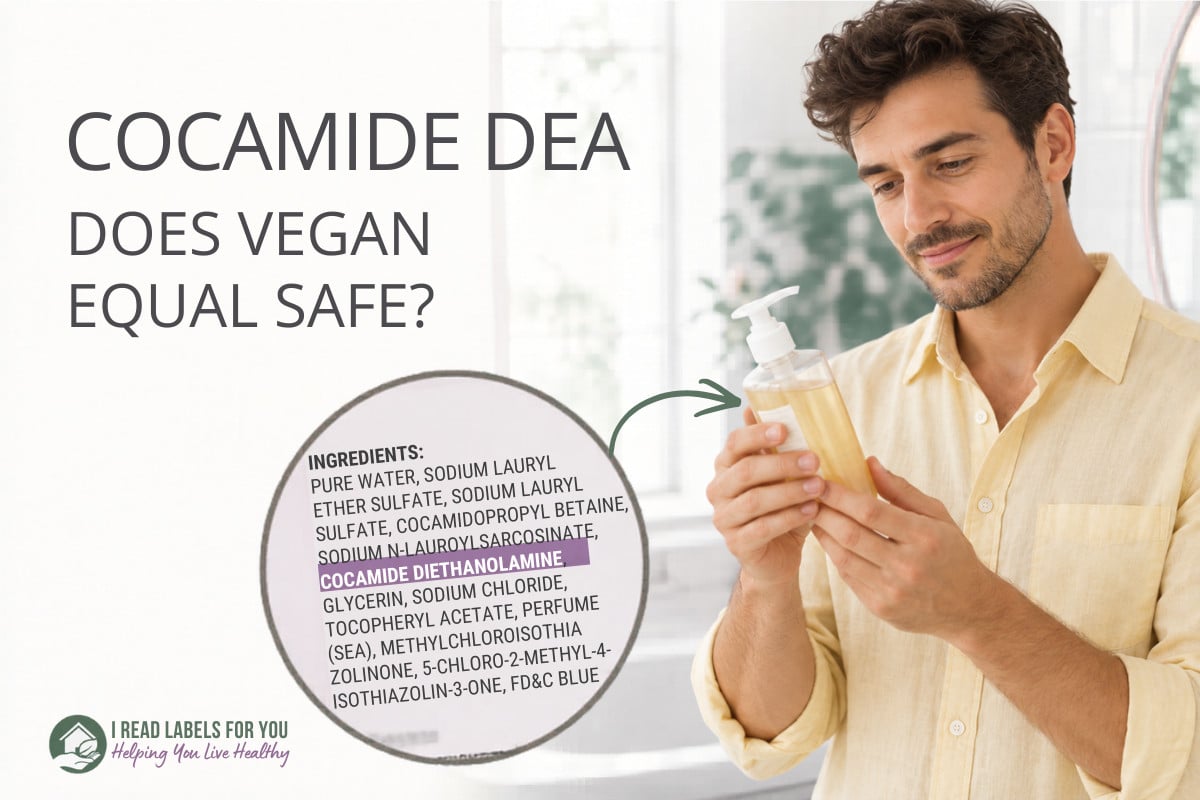
No, Cocamide DEA is not an ingredient I accept, in any product type. It’s a coconut-derived foam booster and thickener used mostly in shampoo and liquid soap. California lists it as a cancer-causing chemical, and the world’s cancer agency calls it possibly carcinogenic. The cancer risk comes from a leftover chemical mixed into it, rather than from the ingredient itself. I rate it Not A Fan.
Cocamide DEA is restricted in the European Union, which is where the regulatory picture gets interesting. Annex III of the Cosmetics Regulation caps the contaminant rather than the ingredient, and bans its use alongside nitrosating agents. The United States has no federal ban, though California lawsuits pushed it off most shelves.
First, you’ll see the single number that decides whether this ingredient causes tumors or not. Second, you’ll learn why coconut origin settles nothing about safety. Third, I’ll show you what to reach for instead.
What Is Cocamide DEA?
Cocamide DEA is a synthetic ingredient built from two halves. One half is fatty acid from coconut oil. The other is diethanolamine, a petrochemical usually shortened to DEA.
Joining them creates a mixture rather than a single molecule. Coconut oil supplies fatty acids of several chain lengths, so the finished material is a family of related compounds. Its industry review lists a molecular weight range of 280 to 290 rather than one figure.
The full chemical name explains the label. Cocamide is the coconut fatty acid amide, and DEA names the diethanolamine attached to it. That second half is where every concern in this post begins.
What Does Cocamide DEA Do In Cosmetics?
Cocamide DEA does two jobs, and both are about texture rather than cleaning. It boosts foam, making a shampoo lather richer and more stable. It also thickens, turning a watery formula into something that pours properly.
Neither job is essential. Plenty of shampoos foam and thicken without it, which matters when you weigh the trade-off later.
Use was widespread and heavily rinse-off. Industry reporting counted Cocamide DEA in 710 cosmetic formulations in 2011, most of them rinse-off. Reported concentrations ran from 0.2 percent to 12 percent, with a leave-on maximum of 9 percent.
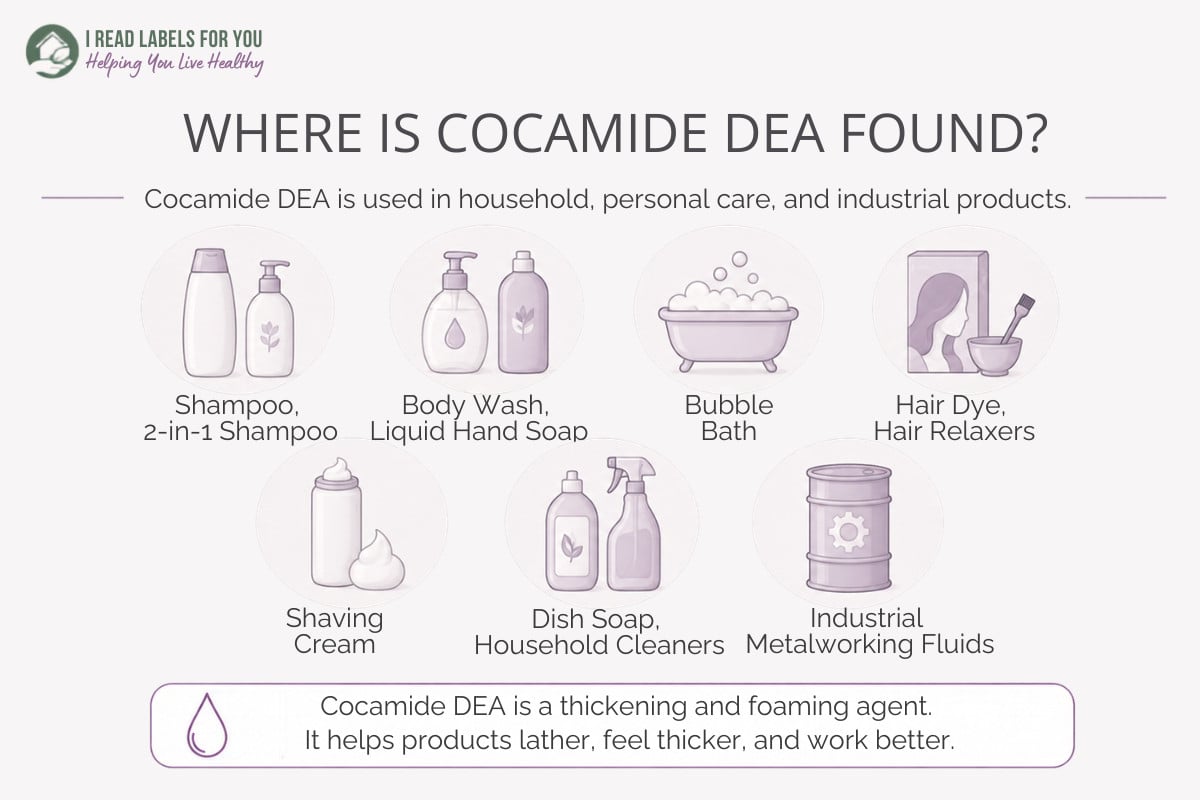
You’ll find Cocamide DEA most often in:
- shampoo and 2-in-1 shampoo
- liquid hand soap and body wash
- bubble bath
- hair dye and hair relaxer
- shaving cream
- dish soap and household cleaners
- industrial metalworking fluids
Food use is limited and indirect. The FDA permits it as a processing aid and as a food-contact substance, not as a direct food additive. Europe authorizes no food use at all, and it holds no E number.
How Is Cocamide DEA Made?
The route is a straightforward condensation. Manufacturers react coconut fatty acids, or their methyl esters, with diethanolamine. The industry review describes it as produced by a condensation reaction at a 1:1 or 1:2 molar ratio.
That ratio is the whole story. Two parts diethanolamine to one part acid leaves a large surplus of unreacted DEA in the finished material. The surplus is not a trace, and nobody removes it.
Diethanolamine carries hazards of its own. It’s classified by the cancer agency as “possibly carcinogenic to humans,” and California lists it as causing cancer. It was added to that list on the same day as Cocamide DEA itself.
There is a second problem downstream. Diethanolamine is a secondary amine, and secondary amines react with nitrites to form nitrosamines. The nitrosamine it forms, NDELA, is a possible carcinogen and appears in the American Report on Carcinogens.
Does Cocamide DEA Penetrate The Skin?
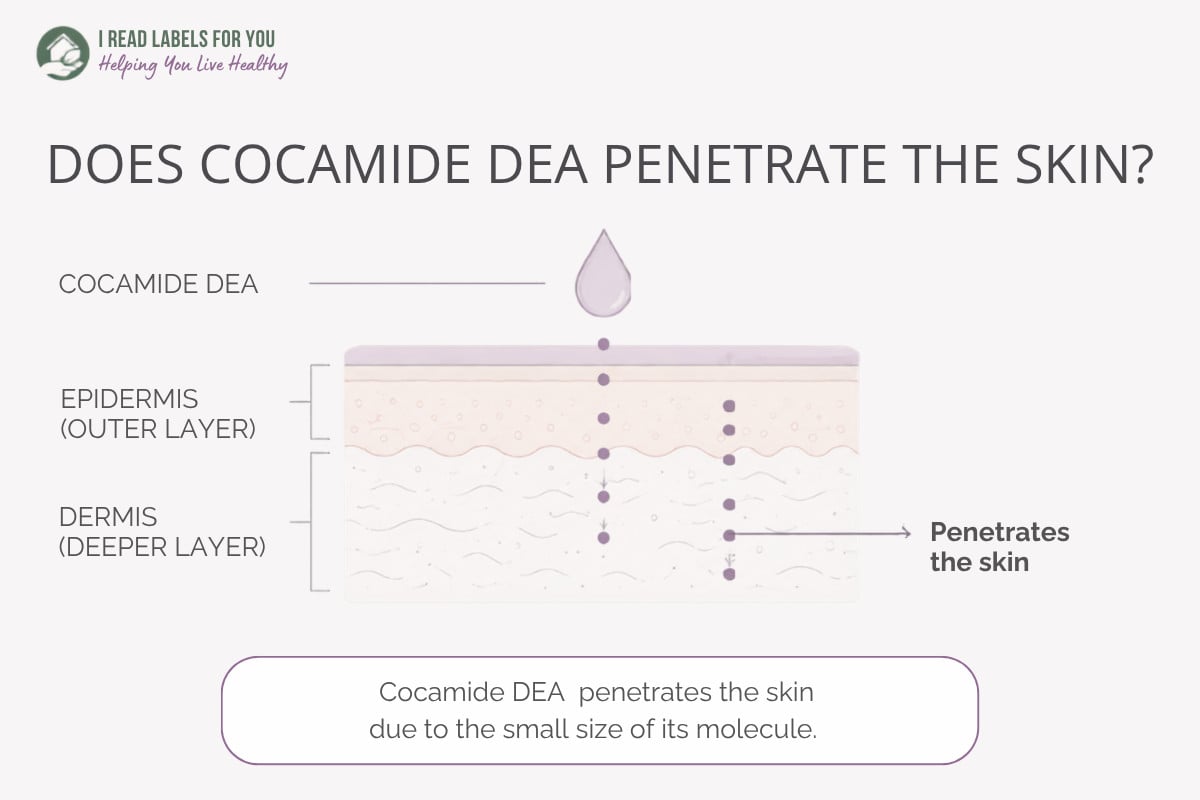
Yes, Cocamide DEA penetrates the skin, and this is where Cocamide DEA parts company with most surfactants I review. Many cleansers are too large or too charged to cross skin. This one is neither.
Size is no obstacle. At 280 to 290 daltons, it sits well under the roughly 500-dalton threshold where size stops blocking absorption. Measured absorption confirms it. Radiolabelled testing on a close relative found 20 to 24 percent of a skin dose absorbed in rats. In mice the figure reached 50 to 70 percent, with parent compound and metabolites recovered in blood plasma.
A second route is stranger and less measured. The industry panel notes that enzymes in human skin, called amidases, may split Cocamide DEA apart. Doing so releases free diethanolamine directly into the skin. How much, nobody knows. The review states plainly that the yield of DEA from this reaction in human skin is unknown. Skin may therefore absorb the contaminant and manufacture more of it at once.
What Is Cocamide DEA Called On Labels?
Cocamide DEA appears under several names:
- Cocamide DEA
- Cocamide Diethanolamine
- Coconut Diethanolamide
- Coconut Oil Acid Diethanolamine Condensate
One label habit does most of the work here. The letters DEA after any ingredient name mark a diethanolamine compound, and I avoid all of them.
Other DEA ingredients follow the same pattern:
- Lauramide DEA
- Oleamide DEA
- Linoleamide DEA
- Myristamide DEA
- DEA-Cetyl Phosphate
- Diethanolamine
Does The U.S. FDA Restrict Cocamide DEA In Food And Cosmetics?
The FDA restricts Cocamide DEA in food. It does not restrict it in cosmetics at all. That gap tells you a lot about how thin U.S. cosmetic oversight really is.
In food, the agency wrote actual rules. Cocamide DEA is allowed only as a processing aid and as a food-contact substance, never as a direct food additive. The rules are 21 CFR 173.322, 176.180, 176.210, and 177.2800.
In cosmetics, there are no rules. The FDA has never set a limit on Cocamide DEA, never required a warning, and never restricted it in a personal care product. It also cannot require safety testing before a shampoo reaches the shelf.
California stepped in instead. The state added Cocamide DEA to its Proposition 65 list of cancer-causing chemicals in June 2012. A year later, products sold in California that contained it had to carry a warning label.
Then came the lawsuits. In August 2013, a nonprofit group called the Center for Environmental Health filed legal claims against about 100 companies. It said they sold shampoos, soaps, and other personal care products with Cocamide DEA in California without the warning label the state required. The group’s own lab testing had found the ingredient in 98 products. One shampoo tested at more than 200,000 parts per million, or about 20 percent of the bottle.
The pressure worked. More than 120 companies reformulated between 2013 and 2016. A state cancer listing and private lawsuits did what the FDA never attempted.
Europe handles this differently. Its precautionary principle lets regulators act on a credible risk before the evidence is complete. U.S. rules generally wait for proof of harm.
EU Regulations On Cocamide DEA
Europe restricts Cocamide DEA, and the way it does so is unusually precise. The rule targets the contaminant rather than the ingredient.
The governing rule is Annex III entry 60 of the Cosmetics Regulation. It covers the whole class of fatty acid dialkylamides and dialkanolamides, which is where Cocamide DEA sits.
Four conditions apply, quoted from the regulation. The maximum secondary amine content is “0.5%” in the ready for use preparation and “5% (applies to raw materials)”. The maximum nitrosamine content is “50 microgram/kg”.
Two further conditions are instructions rather than numbers. The regulation says “Do not use with nitrosating systems” and “Keep in nitrite-free containers”. Europe is regulating a reaction that has yet to happen.
Read what that structure admits. The molecule is allowed, the leftover diethanolamine inside it is capped, and the nitrosamine it can become is capped separately. Nothing on a label tells you which supplier met those caps.
Canadian Regulations About Cocamide DEA
Canada does not regulate Cocamide DEA by name. It regulates the impurities that can come along with it. The result is a little odd, but it still works in your favor.
Cocamide DEA itself appears nowhere on Canada’s Cosmetic Ingredient Hotlist, the country’s list of substances restricted or banned in cosmetics.
Two banned entries reach it anyway. The Hotlist prohibits “Secondary alkyl- and alkanolamines and their salts,” and that entry names diethanolamine directly. It also prohibits “Nitrosamines,” and that entry names NDELA, a nitrosamine that can form in products containing DEA compounds.
So the effect is real. A raw material that carries free diethanolamine or NDELA runs into both prohibitions, even though the amide itself is unlisted. A Canadian manufacturer has to keep those impurities out.
Cocamide DEA does not appear on Canada’s CEPA list of toxic substances either. That list comes from environmental law rather than cosmetic law, so it covers different ground.
Can Cocamide DEA Cause Skin Allergy And Sensitization?
Yes, Cocamide DEA can cause allergic contact dermatitis, and dermatologists screen for it routinely. This is the one concern here that is well documented in people rather than animals.
It sits on the standard North American test panel. The American Contact Dermatitis Society includes it in its Core Allergen Series for 2020. The entry reads “Cocamide DEA (Coconut diethanolamide) 0.5% pet.”
Published cases come largely from workplaces. Cocamide DEA goes into metalworking fluids as well as cosmetics. Hairdressers and machinists show up repeatedly in the case literature.
Reaction rates in testing are low but real. Among 215 metalworkers with dermatitis, one reacted on day three. Among 35 people already allergic to cocamidopropyl betaine or amidoamine, two reacted to Cocamide DEA as well.
The industry panel and the dermatologists disagree here, and I want to flag that openly. Reviewing eight positive occupational studies, the panel set them aside as not relevant to cosmetics. Its wording was “cosmetic use does not present the same concerns.” The dermatology society kept Cocamide DEA on the routine screening panel anyway.
Irritation is a separate and clearer problem. A material of more than 64 percent Cocamide DEA was a severe ocular irritant in rabbits. At 30 percent in propylene glycol, it was a moderate skin irritant.
Is Cocamide DEA A Hormone (Endocrine) Disruptor?
No, Cocamide DEA is not a hormone disruptor, and I want to be accurate about the strength of that answer.
No regulator has assessed Cocamide DEA for endocrine activity. Europe’s chemicals agency records no assessment and no place on its Endocrine Disruptor Assessment List. No published study reports it either. A search for endocrine or estrogenic activity in Cocamide DEA returns nothing at all.
Call this untested rather than proven clean. The distinction cuts both ways. No evidence of hormone activity exists for Cocamide DEA, and nobody has looked hard for any.
It also matters less than usual here. The cancer and contamination questions below are documented rather than hypothetical, and they decide Cocamide DEA’s rating on their own.
Is Cocamide DEA Safe To Use While Pregnant?
No, Cocamide DEA is not an ingredient I would use during pregnancy, though not because of pregnancy-specific evidence.
The reproductive data on Cocamide DEA are reassuring as far as they go. One rat study found no maternal or developmental effects at 1,000 milligrams per kilogram daily, the highest dose tested. The panel found no other reproductive study on this ingredient.
Diethanolamine has its own numbers. Applied to skin, its no-effect level for fetal toxicity was 380 milligrams per kilogram daily in rats. The rabbit figure was 350.
My reasoning is simpler than any of those figures. Cocamide DEA absorbs through skin and carries a substance California calls a carcinogen.
There are other ingredients that do the same job without either problem. Pregnancy is a poor time to accept an avoidable exposure.
Pregnancy also raises questions no article can settle for you. You should consult with your medical provider about anything you use regularly.
Are There Any Cancer Concerns Linked To Cocamide DEA?
Yes, and they are the most substantial cancer concerns of any ingredient I’ve reviewed so far.
Two authorities have acted. The International Agency for Research on Cancer classifies Cocamide DEA Group 2B, evaluated in 2011. California listed it as a chemical known to cause cancer in June 2012.
The animal evidence behind those listings is strong. In a two-year skin-painting study, mice showed clear evidence of carcinogenic activity in both sexes. The basis was liver and kidney tumors, and female rats showed equivocal evidence too.
Now the twist that decides this post. Those tumors came from the free diethanolamine inside the tested batch, not from Cocamide DEA.
The industry’s own table proves it. The material that caused clear evidence of cancer contained 18.2 percent free DEA.
Lower contamination produced less cancer, in order. A related ingredient at 0.83 percent free DEA produced only “some evidence” in female mice and none in males. Another at 0.19 percent free DEA produced no evidence in either sex of either species.
Pure diethanolamine closes the loop. Tested alone, it produced “clear evidence of carcinogenic activity” in mice.
The panel drew the obvious conclusion. It wrote that the carcinogenic activity corresponded to the amount of free DEA found in the test substance. The hazard scales with the contamination, not with the ingredient.
Gene damage testing was mostly clean. Cocamide DEA was not mutagenic in Ames tests, mouse lymphoma cells or hamster ovary cells. One live-animal test was positive after 14 weeks.
Is Cocamide DEA Bad For The Environment?
The honest answer is that the environmental file is thin, and I will not inflate it.
Canada does not list Cocamide DEA as a toxic substance. Europe’s chemicals agency records no activity on it whatsoever. There’s no persistence or bioaccumulation determination either way.
One indirect point is worth making. This ingredient goes into industrial metalworking fluids as well as shampoo. Workplace and wastewater exposure therefore extend well beyond bathrooms.
My concern here is human rather than ecological. I would rather judge this ingredient on what is documented than borrow an environmental argument the data cannot support.
Common Claims About Cocamide DEA: What’s True And What’s Not
Claim: Cocamide DEA Causes Cancer
Largely true, with one important correction. California lists it as causing cancer, and the cancer agency calls it possibly carcinogenic. Mice developed liver and kidney tumors in a two-year study.
The correction is about the culprit. The tumor response tracked the free diethanolamine contaminating the test material, not the amide molecule itself. A clean batch might behave very differently, and no label tells you which you have.
Claim: Cocamide DEA Is Safe Because It Comes From Coconut
False, and this is the claim I most want to dismantle. Only half the molecule comes from coconut; the other half is diethanolamine, a petrochemical.
Diethanolamine is the half that carries the problem. It’s classified as possibly carcinogenic, sits on California’s cancer list, and forms carcinogenic nitrosamines with nitrites.
Plant origin never settles a safety question on its own. What matters is what the plant material was reacted with, and what came along afterward.
Claim: Cocamide DEA Is Contaminated With Cancer-Causing Nitrosamines
Sometimes true, and the measurements are worth seeing. The material used in the U.S. government cancer study contained NDELA at 219 parts per billion.
Nine commercial samples told a better story. Analysis found free diethanolamine ranging from 3.2 percent to 14.0 percent, but no NDELA in any of them.
Europe treats it as a live risk regardless. Annex III caps nitrosamines at 50 micrograms per kilogram, bans nitrosating systems, and requires nitrite-free containers.
Claim: Cocamide DEA Has Been Banned
False in the United States, and misleading everywhere else. No federal ban exists, and Europe restricts the ingredient rather than prohibiting it.
What happened was commercial rather than legislative. California’s cancer listing triggered warning requirements, lawsuits followed, and more than 120 companies reformulated between 2013 and 2016.
Claim: Anything Still On The Shelf Is Free Of Cocamide DEA
False, and the evidence is specific. Independent testing in 2013 found Cocamide DEA in 98 shampoos, soaps and other personal care products already on sale. Concentrations were not trivial. Many products held more than 10,000 parts per million, and one shampoo exceeded 200,000 parts per million, or 20 percent. Reformulation has been broad but never total. Reading the label remains the only reliable check.
Claim: All Coconut-Derived Surfactants Are The Same
False, and the differences are large enough to change a rating. Cocamide DEA, Cocamide MEA, and Cocamidopropyl Betaine share a coconut origin and almost nothing else.
The second half of each molecule is what differs. Cocamide MEA uses monoethanolamine, which the industry review says “has not been found to form a stable nitrosamine.” Cocamidopropyl Betaine uses a different chemistry again.
The regulatory record follows those differences. Only Cocamide DEA carries a cancer classification and a California listing.
What I Think About Cocamide DEA — And What You Should Do
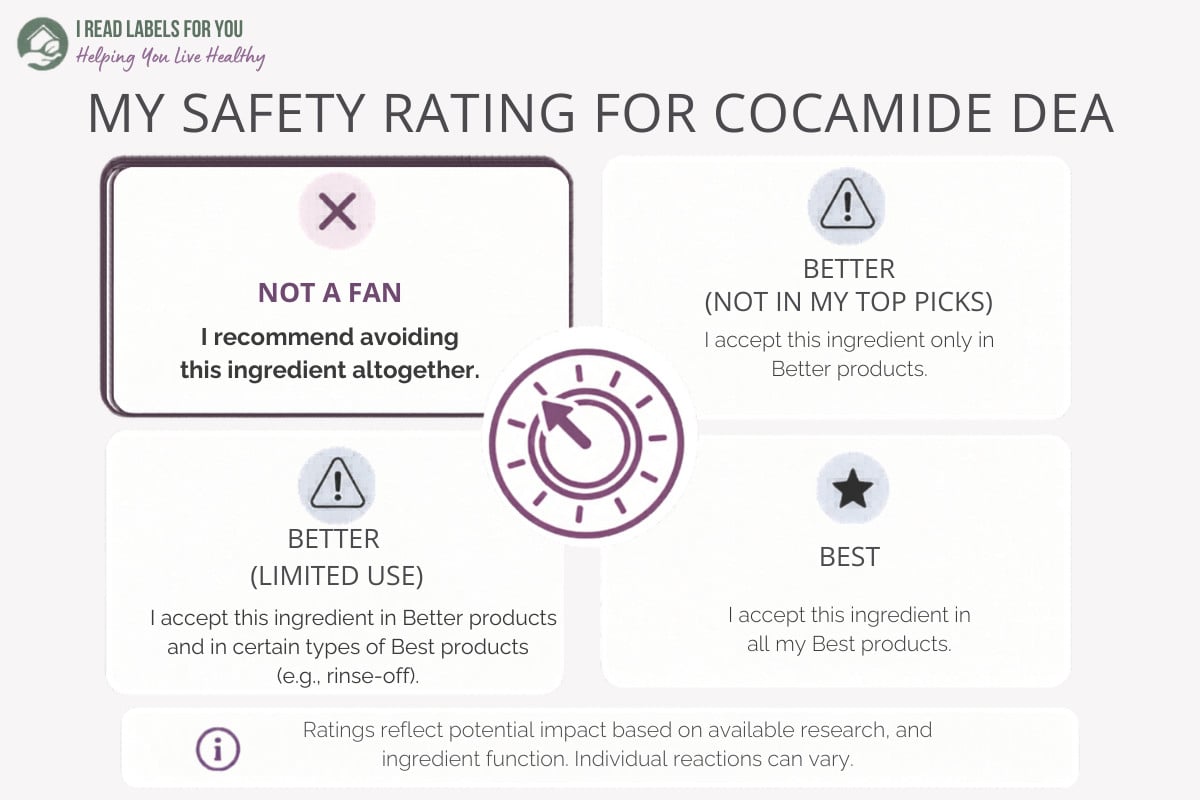
My rating for Cocamide DEA is Not A Fan. It’s classified as possibly carcinogenic under its own name. California has been listing it as a carcinogen since 2012. The tumors came from free diethanolamine riding inside the ingredient. That contaminant sits at percent level, not parts per billion.
Nine commercial samples ranged from 3.2 to 14.0 percent free diethanolamine. Safety here depends entirely on how carefully one supplier controlled a carcinogenic impurity. That’s not something I can vouch for.
Further, Cocamide DEA absorbs through skin, and enzymes in skin may release still more diethanolamine once it gets there. It’s also a routine screening allergen on the standard dermatology panel.
In its function, Cocamide DEA boosts foam and thickens liquid. I believe gentler ingredients exist, like Coco-Betaine or Glucosides, that do the job without a cancer listing attached. So, if you see DEA on a product’s ingredient labels, put the bottle back.
Frequently Asked Questions About Cocamide DEA
Is Cocamide DEA Natural Or Synthetic?
Cocamide DEA is synthetic, despite the “coconut” in its name. Coconut oil supplies the fatty acid half, and a factory reaction attaches a petrochemical to it. The resulting molecule exists nowhere in nature. Half-natural origin is a marketing fact rather than a safety fact.
Is Cocamide DEA Derived From Coconut?
Partly, and the word partly is doing real work. The fatty acids come from coconut oil, and the diethanolamine comes from petroleum chemistry. The coconut half has never been the concern. Every hazard in this post belongs to the other half.
Why Is Cocamide DEA Used In Shampoo And Soap?
In shampoo and soap, Cocamide DEA is used for lather and thickness, not for cleaning. It boosts foam and turns a thin liquid into something that pours and feels substantial. Manufacturers liked it because it’s cheap and effective at both. It’s also entirely replaceable, which explains how quickly companies dropped it under legal pressure.
Is Cocamide DEA Vegan?
Yes, Cocamide DEA is vegan by origin. Coconut oil is a plant source and diethanolamine is a petrochemical, so neither half involves animals.
Vegan and safe are different questions, though. Cocamide DEA is one of the clearest cases where a product can be fully vegan and still worth avoiding.
Is Cocamide DEA The Same As Cocamide MEA?
No, Cocamide DEA is not the same as Cocamide MEA, and confusing the two is the most common mistake with this ingredient. Cocamide DEA uses diethanolamine, while Cocamide MEA uses monoethanolamine.
That one difference changes the regulatory picture completely. Cocamide MEA carries no cancer classification, no California listing and no EU annex restriction of its own.
The chemistry explains why. The industry review says diethanolamine “is readily nitrosated to form N-nitrosodiethanolamine, a known animal carcinogen.” Monoethanolamine, it adds, “has not been found to form a stable nitrosamine.”
Is Cocamide DEA The Same As Cocamidopropyl Betaine?
No, Cocamide DEA is not the same as Cocamidopropyl Betaine. Despite the shared coconut origin, these two behave nothing alike. Cocamidopropyl Betaine is a mild amphoteric surfactant that cleans, while Cocamide DEA mainly boosts foam.
Their concerns differ too. Cocamidopropyl Betaine’s issue is allergy, and it was named Allergen of the Year in 2004. It carries no cancer classification.
Is Cocamide DEA Restricted Or Banned In The EU Or U.S.?
Cocamide DEA is restricted in Europe and unrestricted federally in the United States. Annex III entry 60 caps the secondary amine content, caps nitrosamines, and forbids use with nitrosating systems.
The American picture is state-level. No federal cosmetic restriction exists. California’s Proposition 65 listing, and the lawsuits that followed, removed Cocamide DEA from most products.
What Is A Safer Alternative To Cocamide DEA?
For foam and mildness together, I reach for Coco-Betaine or the glucosides, both of which I rate Best. Decyl Glucoside and Coco Glucoside foam well and come with far cleaner safety files.
Cocamide MEA is the closest structural swap and a genuine improvement, though not a favorite of mine. I rate it Better (Not In My Top Picks), because its own data on absorption, cancer, and impurities is largely missing.
Sources
EU SCCS / SCCP Opinions:
SCCNFP opinion SCCP_OUT144, adopted at the 17th plenary meeting on 12 June 2001, “Opinion concerning Dialkyl- and Dialkanolamines and their salts in cosmetic products”; this is the opinion behind Annex III entry 60, and it addresses nitrosamine formation rather than the amide itself: SCCS Opinions portal
Cosmetic Ingredient Review (CIR) Reports:
Fiume MM, Heldreth B, Bergfeld WF, et al. (2013), Safety Assessment of Diethanolamides as Used in Cosmetics, International Journal of Toxicology, 32(Supplement 1): 36S-58S; source of the free DEA figures, the carcinogenicity table, the absorption data and the amidase statement quoted above: CIR Reports
Andersen FA, ed. (1996), Amended Final Report on the Safety Assessment of Cocamide DEA, Journal of the American College of Toxicology, 15(6): 527-542; the earlier conclusion permitting rinse-off use and leave-on use up to 10 percent: CIR Reports
Elder RL, ed. (1986), Final Report on the Safety Assessment of Cocamide DEA, Lauramide DEA, Linoleamide DEA, and Oleamide DEA, Journal of the American College of Toxicology, 5(5): 415-454: CIR Reports
European Union Regulatory Databases:
Regulation (EC) No 1223/2009, Annex III entry 60, “Fatty acid dialkylamides and dialkanolamides”, maximum secondary amine content 0.5 percent in the ready for use preparation and 5 percent in raw materials, maximum nitrosamine content 50 microgram/kg, do not use with nitrosating systems, keep in nitrite-free containers; update date 20/01/2023: CosIng Annex III
CosIng ingredient record 32918 for COCAMIDE DEA, functions surfactant emulsifying, emulsion stabilising, surfactant foam boosting, surfactant cleansing and viscosity controlling, with Cosmetics Regulation provisions III/60: CosIng record 32918
ECHA CHEM substance 100.065.123, Amides, coco, N,N-bis(hydroxyethyl), EC 271-657-0, CAS 68603-42-9, zero REACH registrations and “No associated activities” under regulatory activities; not a Substance of Very High Concern, not on Annex XIV, not on REACH Annex XVII: ECHA CHEM 100.065.123
Other Regulators:
International Agency for Research on Cancer, List of Classifications, agent “Coconut oil diethanolamine condensate”, CAS 68603-42-9, Group 2B, Volume 101, evaluated 2011; diethanolamine and N-nitrosodiethanolamine are also Group 2B: IARC List of Classifications
California OEHHA, Proposition 65 list, “Coconut oil diethanolamine condensate (cocamide diethanolamine)”, listed as causing cancer on 06/22/2012 under the Labor Code mechanism, with no safe harbour level adopted: OEHHA Proposition 65 list
U.S. National Toxicology Program, Technical Report TR-479, toxicology and carcinogenesis studies of coconut oil acid diethanolamine condensate in F344/N rats and B6C3F1 mice, dermal studies, published 2001, PMID 12571684: PubMed 12571684
U.S. NTP, 15th Report on Carcinogens, cocamide DEA not listed; its nitrosation product N-nitrosodiethanolamine is listed among the N-nitrosamine entries: NTP Report on Carcinogens
U.S. FDA, permitted uses as a processing aid and food-contact substance under 21 CFR 173.322, 176.180, 176.210 and 177.2800, with no direct food additive approval: eCFR Title 21
Health Canada Cosmetic Ingredient Hotlist, cocamide DEA not listed; the prohibited entries “Secondary alkyl- and alkanolamines and their salts” and “Nitrosamines” name diethanolamine and N-nitrosodiethanolamine respectively: Cosmetic Ingredient Hotlist
Environment Canada, CEPA Schedule 1 List of Toxic Substances, cocamide DEA and diethanolamine not listed: CEPA Schedule 1
U.S. EPA, Integrated Risk Information System, no assessment for cocamide DEA or diethanolamine; N-nitrosodiethanolamine does carry an IRIS record: EPA IRIS
PubChem Records (Chemistry, Identifiers, Skin Penetration, Hazard Codes):
PubChem record for Amides, coco, N,N-bis(hydroxyethyl), CAS 68603-42-9, EC 271-657-0, held as a reference record because the substance is a variable mixture rather than a discrete structure: PubChem: Cocamide DEA
Peer-Reviewed Studies:
Pinola A, Estlander T, Jolanki R, Tarvainen K, Kanerva L (1993), Occupational allergic contact dermatitis due to coconut diethanolamide (cocamide DEA), Contact Dermatitis 29(5): 262-265, PMID 8112067: PubMed 8112067
Aalto-Korte K, Pesonen M, Kuuliala O, Suuronen K (2014), Occupational allergic contact dermatitis caused by coconut fatty acids diethanolamide, Contact Dermatitis 70(3): 169-174, PMID 24588369: PubMed 24588369
Chou HJ (1998), Determination of diethanolamine and N-nitrosodiethanolamine in fatty acid diethanolamides, Journal of AOAC International 81(5): 943-947, PMID 9772735: PubMed 9772735
Natural Cosmetic Standards:
COSMOS-standard approved raw materials, cocamide DEA not found on either the approved or the certified list: COSMOS-standard approved raw materials
NATRUE certified and approved raw materials, cocamide DEA not listed: NATRUE certified world
Skin Allergy Resource:
American Contact Dermatitis Society (ACDS), Helpful References including the Core Allergen Series 2020, which lists “Cocamide DEA (Coconut diethanolamide) 0.5% pet.” in Panel V: ACDS Helpful References
Consumer Testing And Enforcement:
Center for Environmental Health, Proposition 65 enforcement on cocamide DEA; independent testing found the ingredient in 98 shampoos, soaps and other personal care products in 2013, and more than 120 companies agreed to remove it between 2013 and 2016: Center for Environmental Health
Last verified: 09-10-2026

Download The Free Guide!
5 Powerful Steps To A Non-Toxic Home
Join our informed consumer community and get our free guide the “5 Powerful Steps To A Non-Toxic Home”.



Before commenting, please read our Comment Policy.