
Is Polyquaternium-7 Safe? A Simple Answer You Can Trust
 Written by Irina Webb
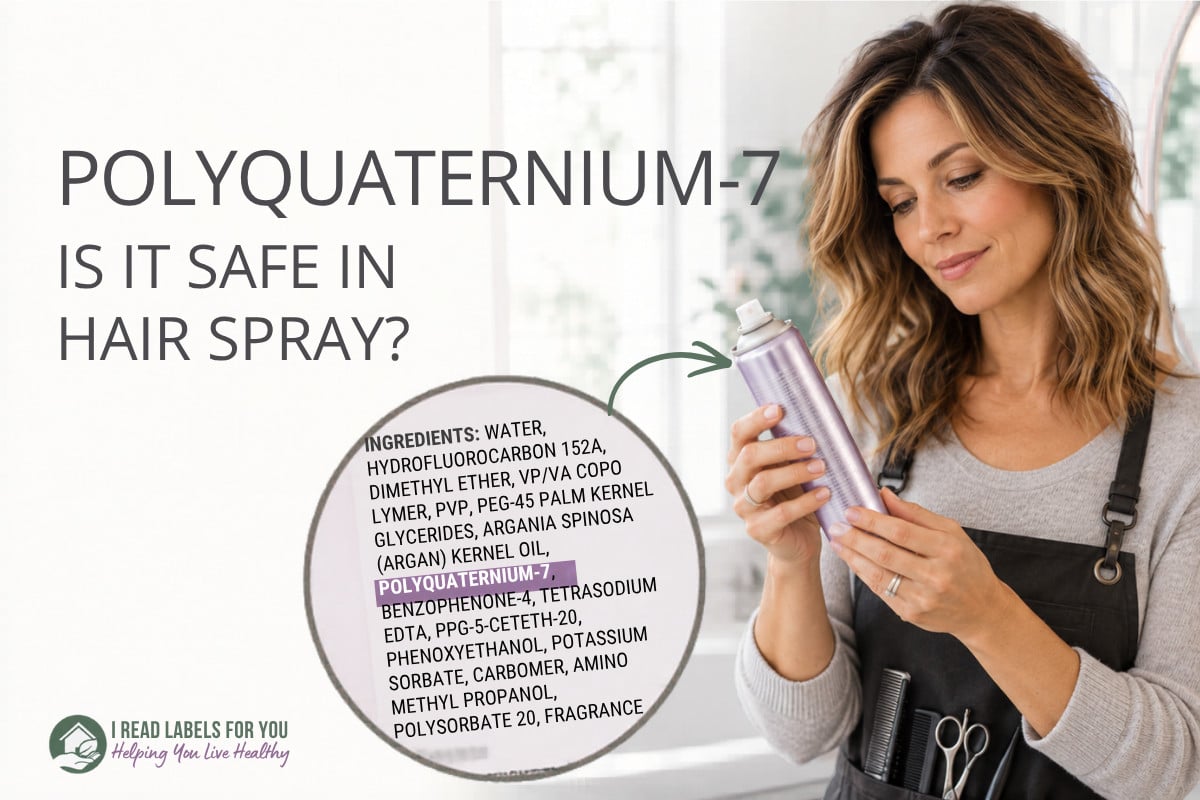
Yes, Polyquaternium-7 is low risk in rinse-off and leave-on products, but it can carry traces of the cancer-causing acrylamide used to make it. It’s a synthetic hair-conditioning polymer that is far too large to enter skin. Those acrylamide traces earn it my Better (Not In My Top Picks) rating.
The European Union allows Polyquaternium-7 in cosmetics, yet Europe caps leftover acrylamide in polyacrylamide-type ingredients, a group its ingredient database links to this one. In contrast, neither the U.S. nor Canada limits those traces.
Keep reading to learn:
- how much acrylamide the safety files found in it
- why five volunteers reacted in a test that still called it “not a sensitizer”
- whether it really counts as a microplastic
What Is Polyquaternium-7?
Polyquaternium-7 is a synthetic polymer, a long chain of repeating units, with a permanent positive charge. Chemists build it from two small molecules: acrylamide and diallyldimethylammonium chloride (DADMAC).
The number 7 only marks its place in the industry naming list. Every polyquaternium has its own chemistry; therefore, facts about one do not carry over to another.
What Does Polyquaternium-7 Do In Cosmetics?
Freshly washed hair carries a faint negative charge. Because opposite charges attract, Polyquaternium-7 settles onto each strand, calming static, adding slip and helping a comb glide.
The Cosmetic Ingredient Review (CIR), an American safety panel bankrolled by the cosmetics industry, lists three jobs for it. They are antistatic agent, film former and hair fixative; in other words, its thin coating also helps hold a style.
According to a 2010 industry survey reported by the CIR, brands use it at 0.009% to 5%. Most shampoos fall between 0.04% and 1%.
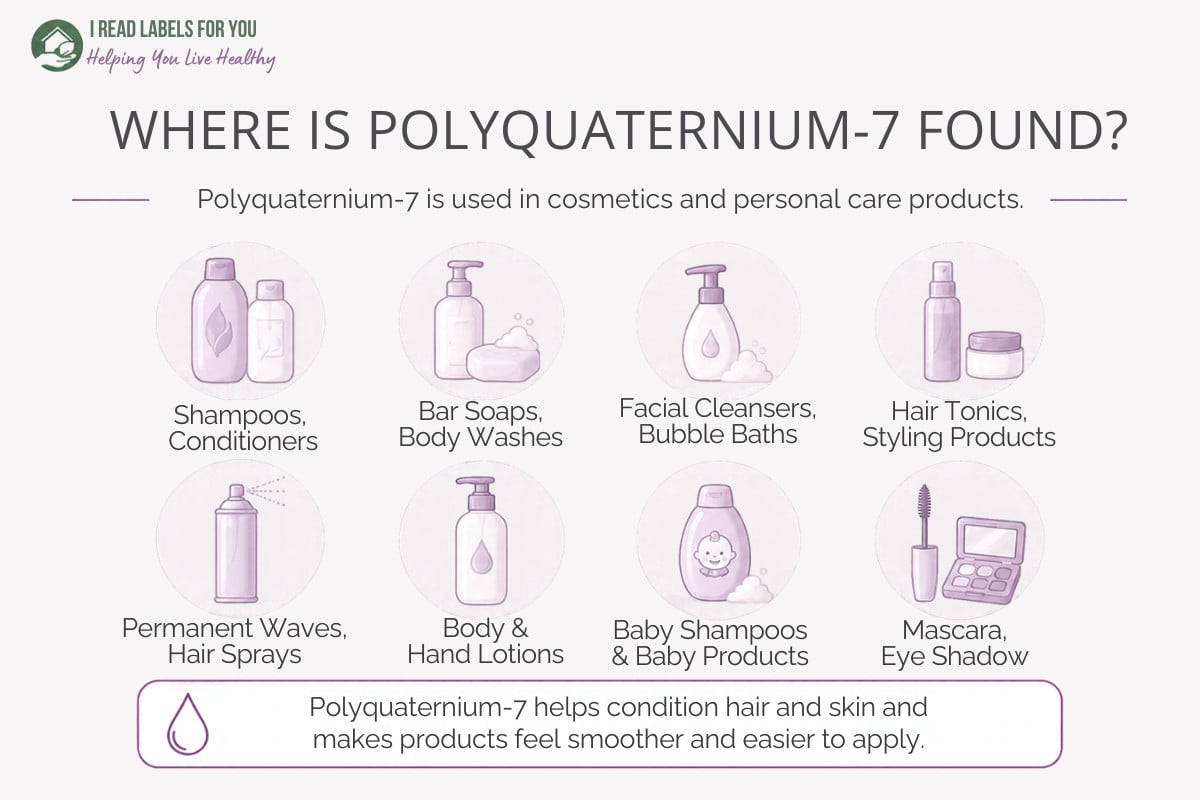
You’ll find Polyquaternium-7 most often in:
- shampoos
- bar soaps and body washes
- rinse-out conditioners
- facial cleansers
- bubble baths
- hair tonics and styling products
- permanent waves
- aerosol hair sprays
- body and hand lotions
- baby shampoos and other baby products
- mascara and eye shadow
Food makers do not add it to food. That said, U.S. Food and Drug Administration (FDA) rules approve it as a drainage aid in making food-contact paper. The cap is 0.05% of the finished paper or paperboard.
How Is Polyquaternium-7 Made?
According to the 1995 CIR report, the supplier Calgon makes Polyquaternium-7 by joining equal amounts of acrylamide and DADMAC into long chains. Under EU law, acrylamide sits in category 1B as both a carcinogen and a mutagen, meaning regulators presume it causes cancer and gene changes.
The reaction never uses up every molecule. Calgon’s own unpublished data put leftover acrylamide below 5 parts per million (ppm). Meanwhile, an industry trade group reported up to 10 ppm for one company.
Other leftovers include up to 1.42% unreacted DADMAC, 0.6% catalyst residue and 0.04% sodium salicylate. Europe gives DADMAC no official hazard classification.
Two gaps stand out. First, the CIR never says whether the 10 ppm figure applies to the 8% solution sold to brands or to the dry polymer. Second, it admits that Polyquaternium-7 from different makers can differ in structure, yet nearly all its data come from Calgon.
Does Polyquaternium-7 Penetrate The Skin?
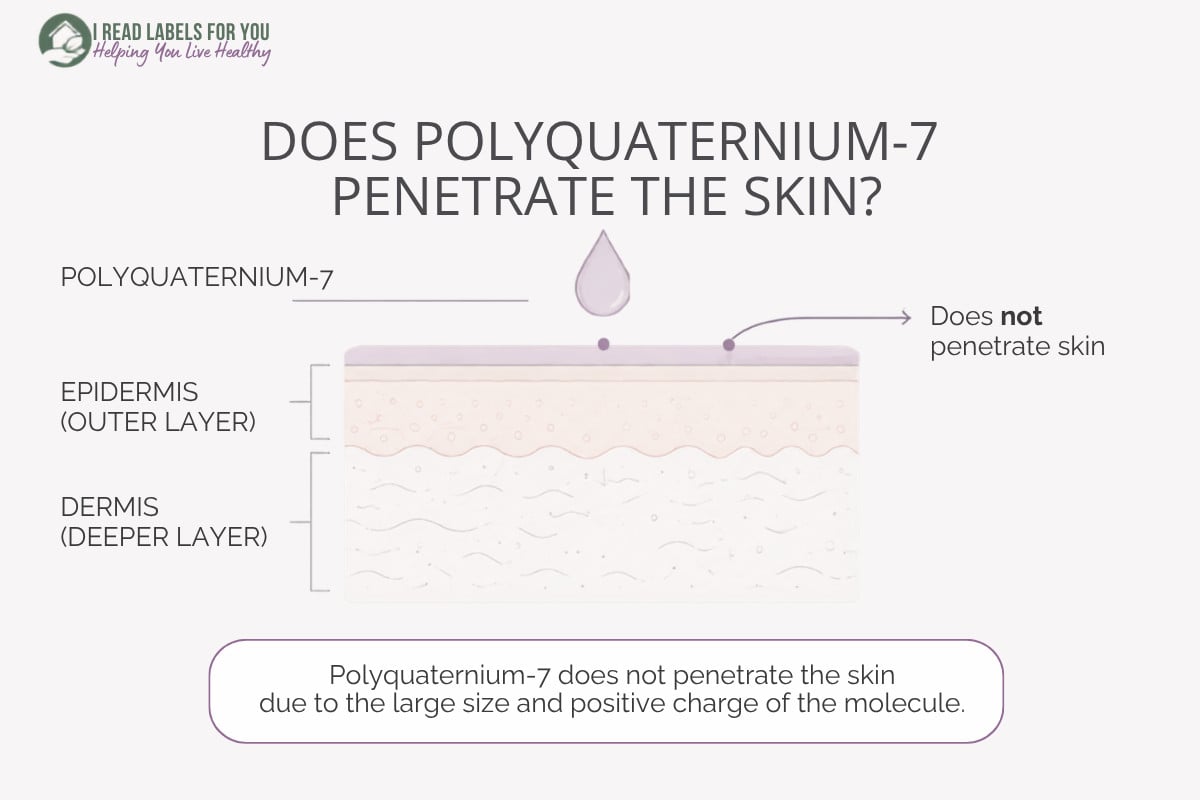
No, Polyquaternium-7 does not meaningfully enter the skin, and its size is the main reason. The 1995 CIR report puts it at roughly 1 million to 10 million daltons, a unit of molecular mass.
Skin rarely admits molecules above about 500 daltons. On top of that, its permanent positive charge keeps it out of the oily outer skin layer. For the same reason, it has no meaningful LogP, the standard score for whether a molecule prefers oil or water.
No one measured its absorption directly. Instead, the CIR leaned on a 14-week rabbit study, also unpublished and submitted by Calgon, which found it “inert on intact epidermis.”
Leftover acrylamide is a different story. It’s a tiny molecule that dissolves in water, and neither CIR report measures how much of it crosses skin from a finished product.
What Is Polyquaternium-7 Called On Labels?
Check ingredient lists for these names:
- Polyquaternium-7
- Polyquaternium 7
- Quaternium-41
- Acrylamide/Diallyldimethylammonium Chloride Copolymer
- Poly(Acrylamide-co-Diallyldimethylammonium Chloride)
- Merquat 550 (a supplier name)
Does The U.S. FDA Restrict Polyquaternium-7 In Food And Cosmetics?
No, the FDA puts no cap on Polyquaternium-7 in cosmetics. Neither it nor acrylamide shows up on the agency’s short list of cosmetic ingredients it bans or limits.
That silence tells you little. U.S. law lets brands judge the safety of their own formulas, and the FDA has set no cap on acrylamide traces in any cosmetic.
The food-contact approval under 21 CFR 176.170 covers paper-making only, and it says nothing about skin. Europe, by comparison, works under the precautionary principle. Its regulators may tighten the rules once a plausible danger appears, rather than holding off until injuries are documented.
EU Regulations On Polyquaternium-7
The European Union allows Polyquaternium-7 in cosmetics, with conditions on what it carries. CosIng, the EU ingredient database, lists it as antistatic and film forming and ties it to Annex III entry 66, “Polyacrylamides.”
That entry caps leftover acrylamide in the finished product at 0.1 milligrams per kilogram (mg/kg) for body leave-on products and 0.5 mg/kg for other products. Notably, the legal text names no specific ingredient; the link comes from the CosIng polyacrylamides record.
The caps trace back to a 1999 opinion on acrylamide residues from Europe’s former cosmetics safety committee. It warned that lifelong use of polyacrylamide cosmetics “may represent an unacceptable high lifetime risk of cancer.”
Europe bans acrylamide itself as a cosmetic ingredient, and the European Chemicals Agency (ECHA) lists it as a substance of very high concern. Meanwhile, ECHA gives Polyquaternium-7 no hazard classification.
Finally, the Scientific Committee on Consumer Safety (SCCS), successor to that 1999 committee, has published nothing on Polyquaternium-7 itself.
U.S. And EU Disagreements On Polyquaternium-7
The two systems split on residue. Europe sets numeric acrylamide caps, while the U.S. sets none, and the CIR attached no residue limit to its approval.
Even the CIR’s numbers do not line up. In a separate 2005 review of polyacrylamide, a related polymer, the panel suggested a 5 ppm acrylamide limit in cosmetics. That’s 10 to 50 times Europe’s caps.
My rough math shows why the details matter. At 10 ppm in the ingredient and 5% use, a product would hold about 0.5 mg/kg, right at Europe’s rinse-off ceiling. At 0.3%, a common lotion level, it would land well under the leave-on cap.
Canadian Regulations On Polyquaternium-7
Canada does not restrict Polyquaternium-7. Health Canada’s Cosmetic Ingredient Hotlist prohibits acrylamide monomer as an ingredient, yet it sets no limit on traces left inside this polymer.
Likewise, neither the polymer nor acrylamide is named in the Canadian Environmental Protection Act’s Schedule 1, which is Canada’s roster of toxic substances.
Can Polyquaternium-7 Cause Skin Allergy And Sensitization?
No, most people will never develop a skin allergy to Polyquaternium-7, though one volunteer test and one case report show it can happen. Notably, the American Contact Dermatitis Society (ACDS) leaves it out of its Core Allergen Series, which dermatologists use for routine patch testing.
In a 1981 patch test done for Calgon, 106 volunteers wore an 8% solution repeatedly. In the final phase, “five panelists had sensitization reactions,” and the strongest reactor reacted again on retesting.
Despite that, the CIR summary called it “not a sensitizer.” A 1994 repeat with 150 volunteers found no reactions, and a 1982 sunlight test on 29 people found none either.
Outside the lab, a 2001 case report described allergic contact dermatitis from a skin-care product, traced to Laureth-9 and Polyquaternium-7. The 2010 CIR update listed that report but never discussed it.
Newer evidence points the same way. In a 2025 study using human immune cells, Polyquaternium-7 activated dendritic cells, the immune system’s lookout cells. It also set off a T-cell response aimed at it, and the authors concluded it can be classed as a chemical sensitizer.
Cells in a dish are not skin, but the signal matches the 1981 result. Moreover, acrylamide, the leftover chemical, carries its own EU skin-sensitizer classification.
Is Polyquaternium-7 A Hormone (Endocrine) Disruptor?
No, Polyquaternium-7 has never been shown to disrupt hormones, although nobody has checked it for that either. It’s absent from the ECHA endocrine assessment list, and PubMed holds no endocrine study on it.
One older result deserves a mention. In a 30-day feeding study, male rats on the two highest doses had thyroid glands 20% and 26% lighter than normal.
The CIR judged those changes unrelated to dose, and the rats ate large amounts rather than touching it. Still, without proper hormone testing, the finding remains unexplained.
Is Polyquaternium-7 Safe To Use While Pregnant?
Polyquaternium-7 is probably low risk during pregnancy because the polymer stays on the skin surface, although no pregnancy or developmental studies exist.
The residue adds a caveat. Europe lists acrylamide as suspected of harming fertility, and California’s Proposition 65 lists it for developmental and male reproductive harm.
During pregnancy, choosing rinse-off products such as shampoo over leave-on ones shortens the time any acrylamide residue sits on your skin. For advice on a specific product or routine, you should consult with your medical provider.
Are There Any Cancer Concerns Linked To Polyquaternium-7?
Yes, but the concern is acrylamide, its leftover building block, not Polyquaternium-7 itself. The International Agency for Research on Cancer (IARC) rates acrylamide as probably carcinogenic to humans, Group 2A.
Likewise, the U.S. National Toxicology Program lists acrylamide as reasonably anticipated to cause cancer in people, and California’s Proposition 65 lists it for cancer. None of these lists names the polymer.
Testing on the polymer is thin. Calgon submitted a single Ames test, a bacterial screen for gene damage, which came back negative, and no long-term cancer study exists.
In 2010, the CIR said an extrapolation showed the residue was “not of concern.” Yet the report shows none of the math, and nobody reported new residue testing.
Is Polyquaternium-7 Bad For The Environment?
There’s too little data to judge. ECHA gives Polyquaternium-7 no environmental hazard classification, and neither CIR report studied what happens to it in water.
As a lab-made polymer, it’s absent from the approved ingredient lists of COSMOS and NATRUE, the two leading natural-cosmetics certifiers.
Common Claims About Polyquaternium-7: What’s True And What’s Not
Claim: Polyquaternium-7 Contains A Cancer-Causing Chemical
There’s real truth here. Polyquaternium-7 is not classified as a carcinogen, but the CIR documents acrylamide traces of up to 10 ppm in the ingredient.
That residue is why Europe caps acrylamide in finished products. However, no label shows the level, and U.S. brands face no limit.
Claim: Polyquaternium-7 Builds Up On Hair
There’s some truth to it. Film forming is one of its official jobs, and a coating that survives rinsing can layer up over repeated washes.
Whether you notice depends on your hair and the formula. When strands begin to look limp or dull, an occasional clarifying wash usually lifts the coating.
Claim: Polyquaternium-7 Is A Microplastic
This claim is mostly false under EU law. It’s a synthetic polymer, but suppliers sell it dissolved in water; the 1995 CIR report describes a clear 8% solution.
Europe’s 2023 microplastics restriction targets solid polymer particles that do not dissolve. Consequently, Polyquaternium-7 likely falls outside it, although only a supplier’s test can confirm that for each grade.
What I Think About Polyquaternium-7 — And What You Should Do
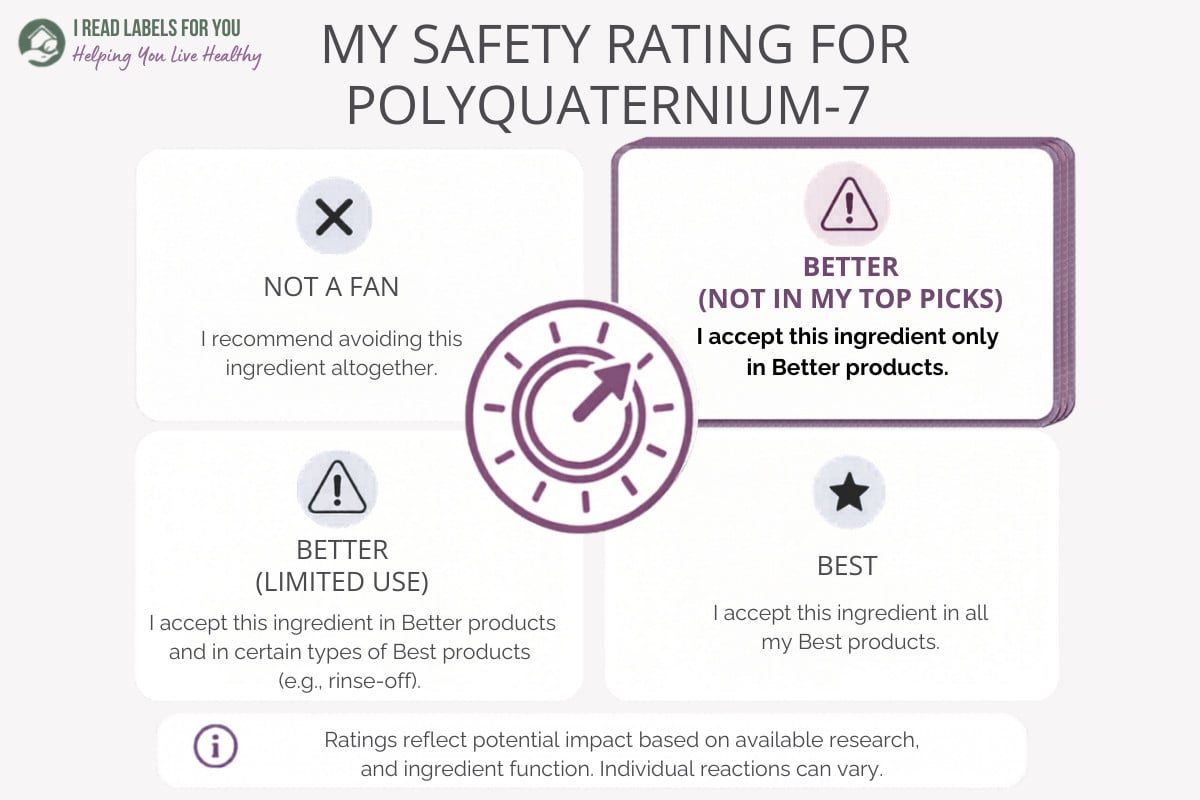
For Polyquaternium-7, Better (Not In My Top Picks) is my verdict. The polymer itself looks harmless enough, yet half of its recipe is a carcinogen that damages genes, and traces can remain.
My Better products are the only place I accept it, whether in shampoo, lotion or a baby product. It never makes my Best list, because the concern is the residue itself, not how long a product stays on.
What would change my mind? A supplier specification showing leftover acrylamide below 0.1 mg/kg in the ingredient itself would do it.
Here’s what I suggest:
- when you use it, favor rinse-off products over leave-on ones
- choose baby wipes and baby lotions made without it
- ask brands whether their Polyquaternium-7 meets the EU acrylamide caps
- reach for a clarifying wash when strands feel weighed down
Frequently Asked Questions About Polyquaternium-7
Is Polyquaternium-7 The Same As Polyquaternium-10?
No. Polyquaternium-7 is built from acrylamide and DADMAC, while Polyquaternium-10 starts from plant cellulose. Their safety data are separate, and one cannot vouch for the other.
Does Polyquaternium-7 Contain Parabens?
It can. The supplier solution described in the 1995 CIR report carried 0.1% methylparaben and 0.02% propylparaben as preservatives.
Neither CIR report describes today’s commercial grades. If parabens matter to you, ask the brand directly.
Is Polyquaternium-7 Safe In Hair Spray?
In 2010, the CIR noted that no inhalation toxicity data exist for it. Nevertheless, the panel accepted hair sprays, because aerosol droplets of about 38 micrometers are too large to reach deep into the lungs.
For comparison, particles you can breathe deeply measure about 10 micrometers. Pump sprays make droplets above 80 micrometers.
Is Polyquaternium-7 Used In Baby Products?
Yes. The 2010 survey counted 7 baby shampoos and 8 other baby products, the latter at 0.04%.
Baby products with it can sit only in my Better tier. Wipes and lotions stay on the skin, where any leftover acrylamide falls under Europe’s strictest cap.
Why Does EWG Rate Polyquaternium-7 Differently?
The Environmental Working Group (EWG) scores it anywhere from 1 to 5, depending on the product. Like me, EWG flags contamination from toxic impurities as a high concern.
The gap is in the low end. EWG’s score drops when a product meets industry guidelines, whereas I cannot check residue levels from a label. Thus, I keep it out of my Best list everywhere.
Sources
EU SCCS / SCCP Opinions:
No SCCS or SCCP opinion on Polyquaternium-7 (checked). SCCS opinions portal: SCCS opinions
Scientific Committee on Cosmetic Products and Non-Food Products intended for Consumers (SCCNFP), opinion concerning acrylamide residues in cosmetics, adopted September 30, 1999. Basis of the EU residual acrylamide caps for polyacrylamides: SCCNFP acrylamide residues opinion
Cosmetic Ingredient Review (CIR) Reports:
Cosmetic Ingredient Review Expert Panel (prepared by Nair B), 1995. Final Report on the Safety Assessment of Polyquaternium-7. Journal of the American College of Toxicology 14(6):476 to 484. Funded by the Personal Care Products Council. Manufacture, acrylamide impurity, animal and patch-test data: cir-reports.cir-safety.org
Andersen FA (ed.), 2011. Annual Review of Cosmetic Ingredient Safety Assessments: 2007 to 2010. International Journal of Toxicology 30(Suppl 2):73S to 127S; Polyquaternium-7 re-review at 119S to 120S. Use counts, concentrations, hair spray and residue comments: cir-reports.cir-safety.org
Cosmetic Ingredient Review, 2005. Amended final report on the safety assessment of polyacrylamide and acrylamide residues in cosmetics. International Journal of Toxicology. Suggested limit of 5 ppm acrylamide in cosmetic formulations. PMID 16154914: PubMed 16154914
European Union Regulatory Databases:
CosIng entry 36882, POLYQUATERNIUM-7, functions antistatic and film forming; provisions III/66: CosIng 36882
CosIng substance record, Polyacrylamides, Annex III entry 66. Maximum residual acrylamide 0.1 mg/kg (body leave-on) and 0.5 mg/kg (other products): CosIng 28111
CosIng Annexes II, III, IV, V and VI (2026 versions), checked. Polyquaternium-7 not named in any annex; acrylamide prohibited as Annex II entry 681: CosIng acrylamide
CLP Annex VI harmonized classifications (2026 table): no entry for Polyquaternium-7 or DADMAC; acrylamide (Index 616-003-00-0) classified Carc. 1B, Muta. 1B, Repr. 2, Skin Sens. 1: ECHA CHEM, acrylamide
ECHA CHEM, Polyquaternium-7, List numbers 607-965-2 and 687-477-4. No harmonized classification and no REACH registrations: ECHA CHEM 607-965-2, ECHA CHEM 687-477-4
ECHA endocrine disruptor assessment list. Polyquaternium-7 not listed: ECHA ED assessment list
Other Regulators:
U.S. FDA, prohibited and restricted cosmetic ingredients. Polyquaternium-7 and acrylamide not listed: FDA
U.S. Code of Federal Regulations, 21 CFR 176.170. Copolymer permitted as a drainage and retention aid in food-contact paper, up to 0.05%: eCFR 21 CFR 176.170
Health Canada Cosmetic Ingredient Hotlist. Polyquaternium-7 not listed; acrylamide monomer prohibited: Health Canada Hotlist
Environment Canada, CEPA Schedule 1. Polyquaternium-7 and acrylamide not listed: CEPA Schedule 1
International Agency for Research on Cancer (IARC). Polyquaternium-7 not classified; acrylamide Group 2A: IARC list
U.S. National Toxicology Program, Report on Carcinogens, 15th edition. Polyquaternium-7 not listed; acrylamide reasonably anticipated to be a human carcinogen: NTP listed substances
California Proposition 65 list. Polyquaternium-7 not listed; acrylamide listed for cancer and for developmental and male reproductive toxicity: OEHHA
U.S. EPA Integrated Risk Information System. No assessment of Polyquaternium-7; acrylamide assessed: IRIS A to Z list
PubChem Records (Chemistry, Identifiers, Skin Penetration, Hazard Codes):
Polyquaternium-7, PubChem CID 168563 (a record of its repeat units, not the full polymer); no GHS classification: PubChem CID 168563
Acrylamide, PubChem CID 6579, hazard codes H340, H350, H361f and H317: PubChem CID 6579
Peer-Reviewed Studies:
Gallo R, Basso M, Voltolini S, Guarrera M, 2001. Allergic contact dermatitis from laureth-9 and polyquaternium-7 in a skin-care product. Contact Dermatitis 45(6):356 to 357. Letter, no abstract. PMID 11846753: PubMed 11846753
Peyneau M, Zeller M, Paulet V, et al., 2025. Quaternary ammoniums activate human dendritic cells and induce a specific T-cell response in vitro. Allergology International 74(1):105 to 114. PMID 39237430: PubMed 39237430
Natural Cosmetic Standards:
COSMOS-standard approved raw materials. Not listed: COSMOS-standard approved raw materials
NATRUE certified and approved raw materials. Not listed: NATRUE certified raw materials
Skin Allergy Resource:
American Contact Dermatitis Society (ACDS), Helpful References, including the Core Allergen Series 2020. Polyquaternium-7 and acrylamide are not on the series: ACDS Helpful References
Advocacy groups:
Environmental Working Group (EWG) Skin Deep entry for Polyquaternium-7. Hazard score 1 to 5 depending on usage, data limited; contamination concerns high; restricted in EWG Verified: EWG Skin Deep
Last verified: 10-21-2026
Download The Free Guide!
5 Powerful Steps To A Non-Toxic Home
Join our informed consumer community and get our free guide the “5 Powerful Steps To A Non-Toxic Home”.


Before commenting, please read our Comment Policy.