
Is Polyquaternium-10 Safe? A Simple Answer You Can Trust
 Written by Irina Webb
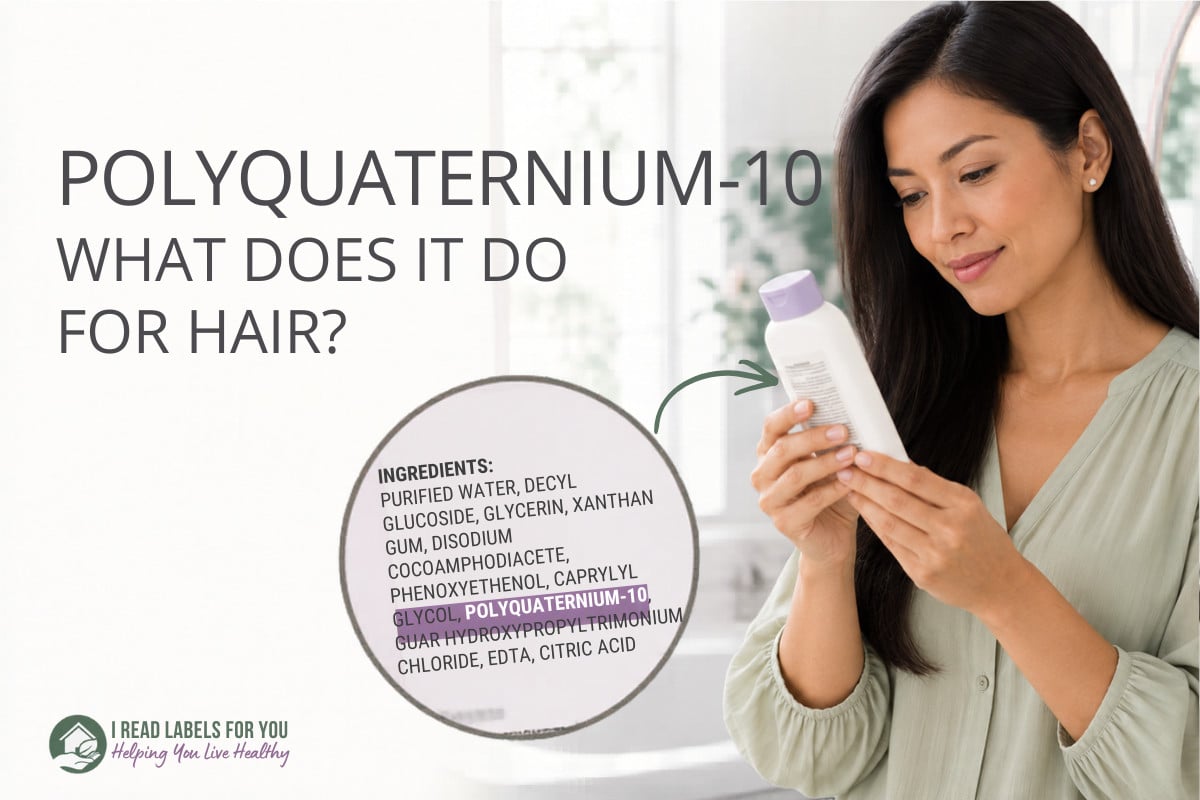
Yes, Polyquaternium-10 is safe in rinse-off hair and body products for adults. It’s a conditioning polymer made from cellulose, the fiber in plant cell walls, and it barely enters skin. Its manufacturing chemistry and decades-old safety data keep it in my Better (Limited Use) tier.
Polyquaternium-10 is allowed in European Union cosmetics with no limit, no warning and no product-type rule. Europe’s safety committee has never reviewed it, and the U.S. and Canada do not restrict it either.
Keep reading to learn:
- which two cancer-causing chemicals sit in its production chain
- why your conditioner can leave it on your hair for days
- whether it really releases formaldehyde
What Is Polyquaternium-10?
Polyquaternium-10 is a man-made conditioning ingredient built on cellulose. Chemists attach positively charged groups to the cellulose chain, which turns a plain plant fiber into a hair-smoothing polymer.
The number 10 is simply a label in the industry naming system, not a strength. Each polyquaternium number is a different chemical, so the safety of one tells you little about another.
What Does Polyquaternium-10 Do In Cosmetics?
Hair and skin carry a slight negative charge, especially after shampooing. Polyquaternium-10’s positive charge makes it cling to them, smoothing the hair surface, cutting static and making wet hair easier to comb.
It also thickens products and leaves a light film on skin.
The Cosmetic Ingredient Review (CIR) is a U.S. safety panel paid for by the cosmetics industry. Interestingly, studies in its review found it softened the sting of harsh cleansing agents. Brands use Polyquaternium-10 at about 0.004 to 1.5%, according to a 2005 industry survey.
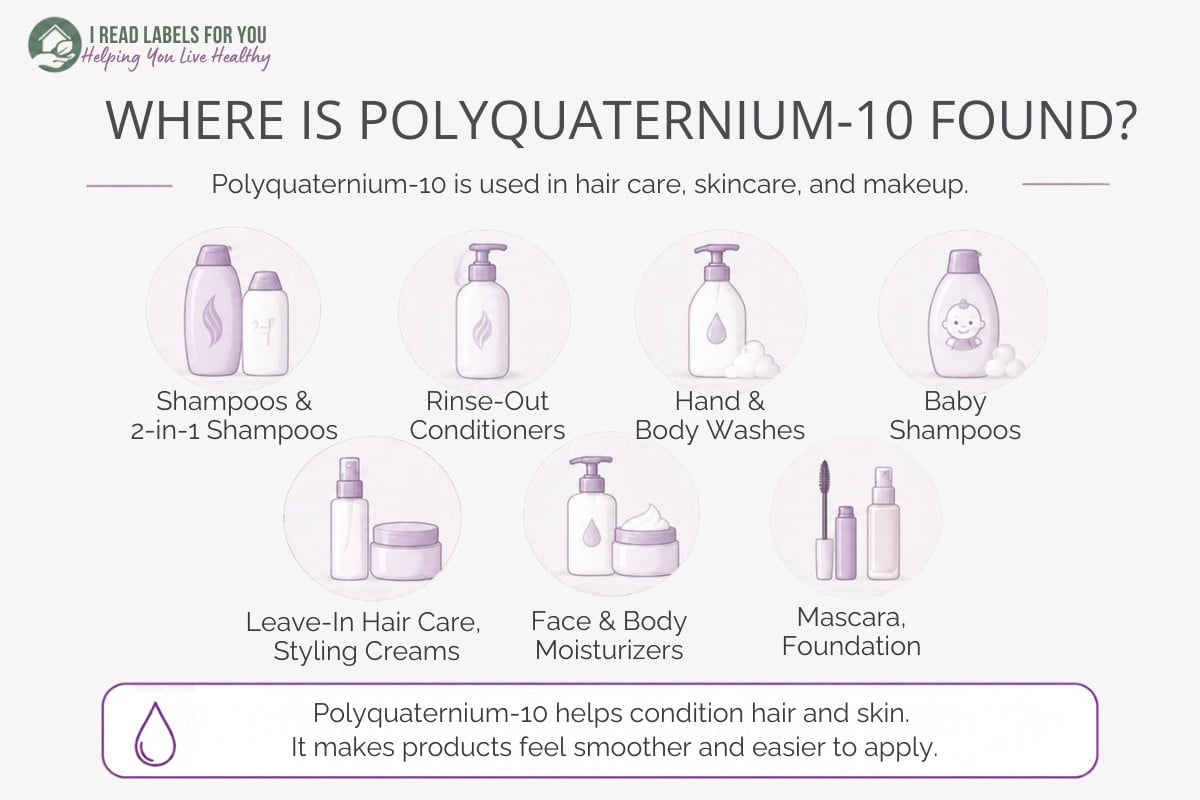
You’ll find Polyquaternium-10 most often in:
- shampoos and 2-in-1 shampoos
- rinse-out conditioners
- body washes and hand washes
- baby shampoos
- leave-in hair products and styling creams
- face and body moisturizers
- mascara and foundation
Polyquaternium-10 is not used in food. The U.S. Code of Federal Regulations, the official book of federal rules, does not list it as a food ingredient.
How Is Polyquaternium-10 Made?
First, manufacturers react cellulose with ethylene oxide to make hydroxyethylcellulose, a common thickener. Ethylene oxide is a gas that Europe classifies as a carcinogen and mutagen, category 1B.
Next, according to the 1988 CIR report, they react that thickener “with epichlorhydrin, followed by quaternization using trimethylamine.” Epichlorohydrin is also an EU category 1B carcinogen. The CIR also describes the reaction as going “via an epoxide,” which is likely another category 1B chemical, although the report does not name it.
Residue testing is thin and old. The only data shows no epichlorohydrin in six samples tested before 1988, at a detection limit of about 0.5 parts per million. Notably, nobody reported testing for leftover ethylene oxide or 1,4-dioxane, its common by-product.
Does Polyquaternium-10 Penetrate The Skin?
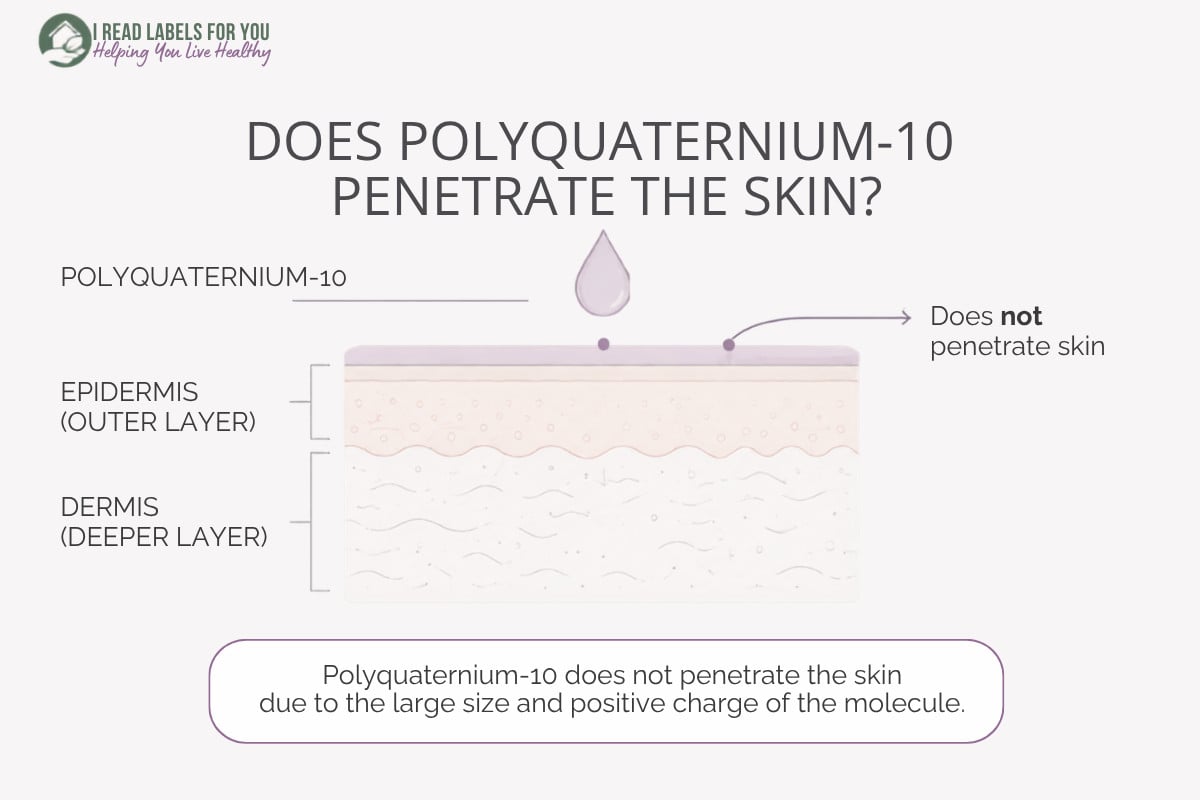
No, Polyquaternium-10 does not meaningfully penetrate the skin. Size is the deciding factor. Its chains weigh 250,000 to 600,000 daltons, a unit of molecular size, and skin blocks most molecules above about 500 daltons.
Its permanent positive charge adds a second barrier. Charged, water-loving molecules cannot slip through the oily outer layer of skin. For that reason, the polymer has no LogP value, a measure of oil-loving behavior.
A rat study confirmed this. Under 1.5% of a 5% solution passed into the skin, and no radioactive tracer turned up in blood or nine tissues. Lab tests on isolated skin showed it settling only into the outermost layer.
Ethylene oxide, the chemical used to make its cellulose base, is a different story. It’s tiny, about 44 daltons, and the U.S. Agency for Toxic Substances and Disease Registry (ATSDR) notes that its solutions can pass through human skin. Because it turns into a gas above about 51°F, traces tend to evaporate from products, but no one has reported measuring them in this ingredient.
What Is Polyquaternium-10 Called On Labels?
On a label, it can appear as:
- Polyquaternium-10
- Polyquaternium 10
- Quaternium-19
- Cationic Hydroxyethyl Cellulose
- Quaternized Hydroxyethyl Cellulose
- Polymer JR-400, JR-30M or JR-125 (supplier names)
Does The U.S. FDA Restrict Polyquaternium-10 In Food And Cosmetics?
No, Polyquaternium-10 faces no federal limits. Its name is missing from the U.S. Food and Drug Administration’s (FDA) short roster of banned and restricted cosmetic ingredients.
That list is short, and a missing name proves little. In the U.S., companies vouch for their own ingredients, and the FDA usually steps in only after problems surface.
Europe works differently. Its precautionary principle lets regulators restrict an ingredient when there are reasonable grounds for concern, even before harm is proven.
EU Regulations On Polyquaternium-10
The European Union does not restrict Polyquaternium-10. CosIng, the EU cosmetic ingredient database, lists it only as an antistatic and film-forming agent, outside every annex that bans or limits ingredients.
Moreover, the European Chemicals Agency (ECHA) shows no official hazard classification for it. Nor has the Scientific Committee on Consumer Safety (SCCS), the expert group advising Brussels on cosmetics, ever issued an opinion on it.
Here’s the irony: Europe bans ethylene oxide and epichlorohydrin themselves as cosmetic ingredients. Still, it sets no limit on traces of them left inside Polyquaternium-10.
Finally, the EU microplastics restriction of 2023 does not cover it. That rule targets polymer particles that do not dissolve, and Polyquaternium-10 dissolves in water.
Canadian Regulations On Polyquaternium-10
Canada does not restrict Polyquaternium-10 in cosmetics. Health Canada’s Cosmetic Ingredient Hotlist does not mention it, although it prohibits ethylene oxide.
Similarly, Polyquaternium-10 is absent from Schedule 1 of the Canadian Environmental Protection Act. Ethylene oxide, by contrast, appears on that list.
Can Polyquaternium-10 Cause Skin Allergy And Sensitization?
No, Polyquaternium-10 rarely causes skin allergy, and human patch tests have come back clean. In the 1988 CIR review, 2% and 5% solutions caused neither irritation nor allergy in panels of 50 and 203 people.
Products tested well too. A shampoo with 0.5% and a conditioner with 1% did not irritate or sensitize volunteers. Furthermore, the American Contact Dermatitis Society (ACDS) does not include it in its Core Allergen Series, the standard patch-test panel.
Two newer studies add some caution. A 2013 French study of hairdressing apprentices found antibodies to quaternary ammonium compounds, which also recognized Polyquaternium-10. Likewise, a 2025 lab study on human immune cells classified it as a possible chemical sensitizer.
Neither study shows rashes in shoppers using shampoo. Still, both suggest that heavy, repeated exposure, as in salons, deserves attention.
Is Polyquaternium-10 A Hormone (Endocrine) Disruptor?
No, Polyquaternium-10 is not a known hormone disruptor, though it has never been tested for hormone effects. Neither the CIR reports nor Europe’s endocrine disruptor lists include any such study.
Its size makes hormone activity unlikely. A polymer that stays in the outer skin cannot easily reach the hormone receptors inside your body.
Is Polyquaternium-10 Safe To Use While Pregnant?
Most likely yes, mainly because Polyquaternium-10 barely enters the body, although no pregnancy studies exist. No regulator classifies it as harmful to fertility or a developing baby.
Since the residue question stays open, rinse-off products are the more cautious choice while expecting. For any personal concern during pregnancy, you should consult with your medical provider.
Are There Any Cancer Concerns Linked To Polyquaternium-10?
Not for the polymer itself, but its production chain uses known carcinogens. The International Agency for Research on Cancer (IARC), the U.S. National Toxicology Program and California’s Proposition 65 do not list Polyquaternium-10.
Gene-damage testing was mostly reassuring. The Ames bacterial test and a mouse blood-cell test were negative. However, one rat liver-cell test showed DNA damage at three of six doses, which the CIR set aside as inconclusive and never repeated.
Nobody has run a long-term cancer study on Polyquaternium-10. The real question is residue: ethylene oxide is a known human carcinogen, and testing for its traces in this ingredient has never been reported.
Is Polyquaternium-10 Bad For The Environment?
The data is too thin to say. Europe gives Polyquaternium-10 no environmental hazard label, and the safety reviews did not study what happens to it in water.
Its cellulose backbone comes from plants, yet the added chemistry makes it fully synthetic. Consequently, it has no place on the approved lists of COSMOS or NATRUE, the two leading natural-beauty certifiers.
Common Claims About Polyquaternium-10: What’s True And What’s Not
Claim: Polyquaternium-10 Builds Up On Hair
This claim is partly true. The CIR notes that, although rinse-off products touch hair only briefly, Polyquaternium-10 “would be expected to remain in contact with the hair between treatments.”
That clinging is exactly how it conditions. Fine or low-porosity hair can feel weighed down over time, and a clarifying wash every few weeks usually fixes it.
Claim: Polyquaternium-10 Releases Formaldehyde
This claim is false. Polyquaternium-10 is not a formaldehyde releaser, and neither CIR review of it links it to formaldehyde. The mix-up likely comes from Quaternium-15, a different preservative that does release formaldehyde.
The names are confusingly close, especially because Polyquaternium-10’s old synonym is Quaternium-19. Always check the exact name and number on the label.
Claim: Polyquaternium-10 Has Serious Side Effects
This claim is not supported. In volunteer tests it did not irritate or sensitize skin, and rats breathing its dust for eight hours showed no signs of toxicity.
Its weak spots are missing data and manufacturing residues, not observed side effects.
What I Think About Polyquaternium-10 — And What You Should Do
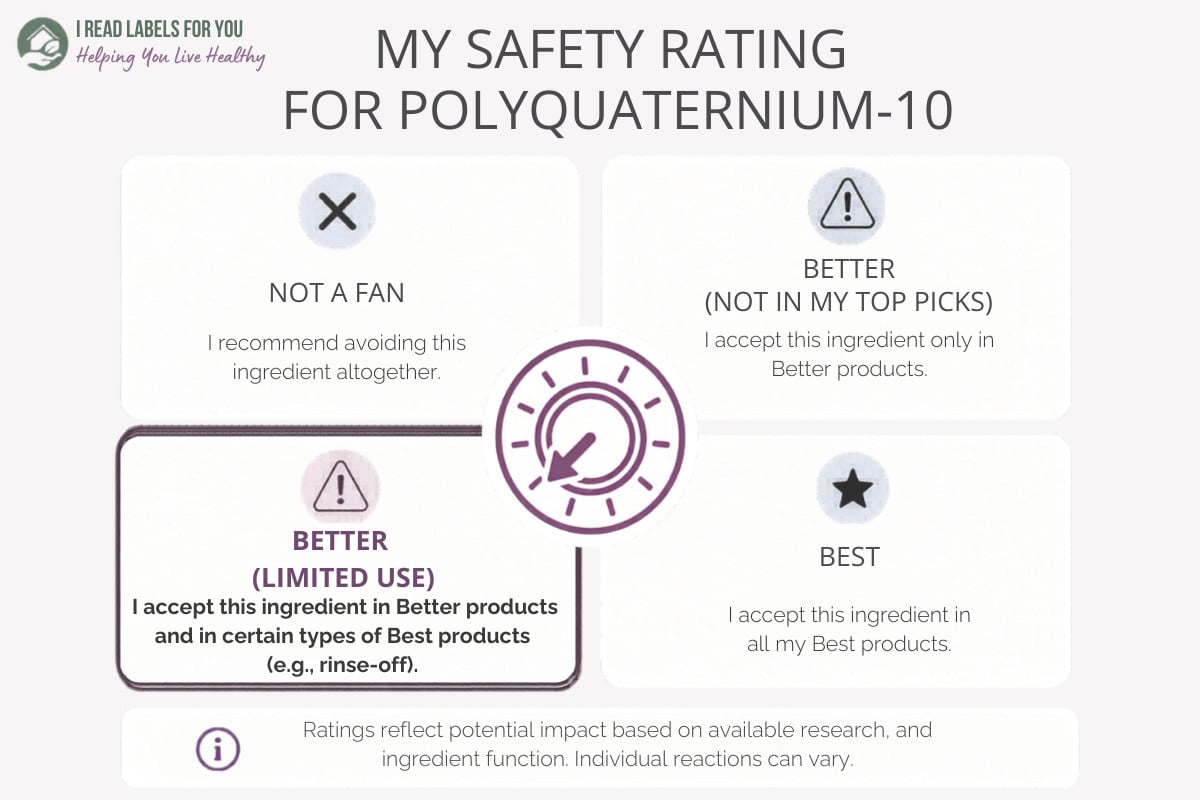
I give Polyquaternium-10 a Better (Limited Use) rating. The polymer looks gentle and stays on the surface, yet two carcinogens help make it and residue testing has never caught up.
For adults, rinse-off products such as shampoo, rinse-out conditioner, and body wash can carry it and still make my Best list. Leave-on products, such as leave-in conditioners, moisturizers, and makeup, qualify only for my Better list.
For babies, I go further. Even rinse-off baby shampoo with Polyquaternium-10 sits only in my Better tier.
Here’s what I suggest:
- favor Polyquaternium-10 in shampoos and conditioners you rinse out
- choose leave-in products and moisturizers without it
- pick baby shampoos without polyquaterniums when you can
- use a clarifying wash if your hair starts to feel coated
Frequently Asked Questions About Polyquaternium-10
What Does Polyquaternium-10 Do For Hair?
It conditions. Its positive charge makes it stick to hair, which smooths the surface, reduces static and frizz, and helps a comb glide through wet hair.
Is Polyquaternium-10 Bad For Hair?
No. It does not damage hair, and its main downside is a coated feeling if it builds up. A clarifying shampoo removes it.
Is Polyquaternium-10 Natural?
No. It starts from plant cellulose, but heavy chemical changes make it synthetic. That’s why natural certifiers such as COSMOS and NATRUE do not approve it.
Is Polyquaternium-10 Safe In Baby Shampoo?
Brands use it in baby shampoos at about 0.02 to 0.4%.
It’s unlikely to harm your baby. Still, no one has reported testing it for ethylene oxide residues, so it stays out of my Best baby products.
Why Does EWG Rate Polyquaternium-10 Differently?
The Environmental Working Group (EWG) gives it a low hazard score of 2, while I limit where I accept it. Interestingly, EWG’s own Verified program restricts it, and neither of us can see residue data from manufacturers.
Sources
EU SCCS / SCCP Opinions:
No SCCS or SCCP opinion on Polyquaternium-10 (checked). SCCS opinions portal: SCCS opinions
Cosmetic Ingredient Review (CIR) Reports:
Elder RL (ed.), 1988. Final Report on the Safety Assessment of Polyquaternium-10. Journal of the American College of Toxicology 7(3):335 to 351. Funded by the Personal Care Products Council. Covers manufacture, impurities, skin penetration and patch tests: cir-reports.cir-safety.org
Andersen FA (correspondence), 2008. Annual Review of Cosmetic Ingredient Safety Assessments: 2005/2006, Polyquaternium-10 re-review. International Journal of Toxicology 27(Suppl 1):77 to 142. Use concentrations, including baby products: cir-reports.cir-safety.org
Becker LC, Bergfeld WF, et al., 2012. Safety Assessment of Trimoniums as Used in Cosmetics. International Journal of Toxicology 31(Suppl 3):296S to 341S. Describes the epoxide synthesis route: cir-reports.cir-safety.org
European Union Regulatory Databases:
CosIng entry 79107, POLYQUATERNIUM-10, functions antistatic and film forming; no annex restrictions: CosIng 79107
CosIng Annexes II, III, IV, V and VI (2026 versions), checked; Polyquaternium-10 not listed. Ethylene oxide (Annex II entry 182) and epichlorohydrin (entry 657) are prohibited as cosmetic ingredients.
CLP Annex VI harmonized classifications (2026 table): no entry for Polyquaternium-10; ethylene oxide (Index 603-023-00-X) and epichlorohydrin (Index 603-026-00-6) classified Carc. 1B: ECHA CHEM, ethylene oxide
ECHA CHEM, Polyquaternium-10, EC 611-015-2. No harmonized classification: ECHA CHEM
Other Regulators:
U.S. FDA, prohibited and restricted cosmetic ingredients. Not listed: FDA
Health Canada Cosmetic Ingredient Hotlist. Polyquaternium-10 not listed; ethylene oxide prohibited: Health Canada Hotlist
Environment Canada, CEPA Schedule 1. Polyquaternium-10 not listed; ethylene oxide listed: CEPA Schedule 1
U.S. Agency for Toxic Substances and Disease Registry (ATSDR), ToxGuide for Ethylene Oxide, August 2022. Ethylene oxide solutions can penetrate human skin: ATSDR ToxGuide
International Agency for Research on Cancer (IARC). Polyquaternium-10 not classified; ethylene oxide Group 1: IARC list
U.S. National Toxicology Program, Report on Carcinogens. Polyquaternium-10 not listed: NTP Report on Carcinogens
California Proposition 65 list. Polyquaternium-10 not listed; ethylene oxide listed: OEHHA
U.S. EPA Integrated Risk Information System. No assessment of Polyquaternium-10: IRIS A to Z list
PubChem Records (Chemistry, Identifiers, Skin Penetration, Hazard Codes):
Polyquaternium-10 has no PubChem compound record (CID), because it’s a polymer. Substance record SID 135284311: PubChem SID 135284311
Peer-Reviewed Studies:
Dong S, Acouetey DS, Guéant-Rodriguez RM, et al., 2013. Prevalence of IgE against neuromuscular blocking agents in hairdressers and bakers. Clinical and Experimental Allergy 43(11):1256 to 1262. Abstract only. PMID 24152158: PubMed 24152158
Peyneau M, Zeller M, Paulet V, et al., 2025. Quaternary ammoniums activate human dendritic cells and induce a specific T-cell response in vitro. Allergology International 74(1):105 to 114. PMID 39237430: PubMed 39237430
Natural Cosmetic Standards:
COSMOS-standard approved raw materials. Not listed: COSMOS-standard approved raw materials
NATRUE certified and approved raw materials. Not listed: NATRUE certified raw materials
Skin Allergy Resource:
American Contact Dermatitis Society (ACDS), Helpful References, including the Core Allergen Series 2020. Polyquaternium-10 is not on the series; Quaternium-15 is a different ingredient: ACDS Helpful References
Advocacy groups:
Environmental Working Group (EWG) Skin Deep entry for Polyquaternium-10. Hazard score 2, data limited; restricted in EWG Verified: EWG Skin Deep
Last verified: 10-21-2026
Download The Free Guide!
5 Powerful Steps To A Non-Toxic Home
Join our informed consumer community and get our free guide the “5 Powerful Steps To A Non-Toxic Home”.
Before commenting, please read our Comment Policy.