
Are Isododecane, Isohexadecane And Isoeicosane Safe? A Simple Answer You Can Trust
 Written by Irina Webb
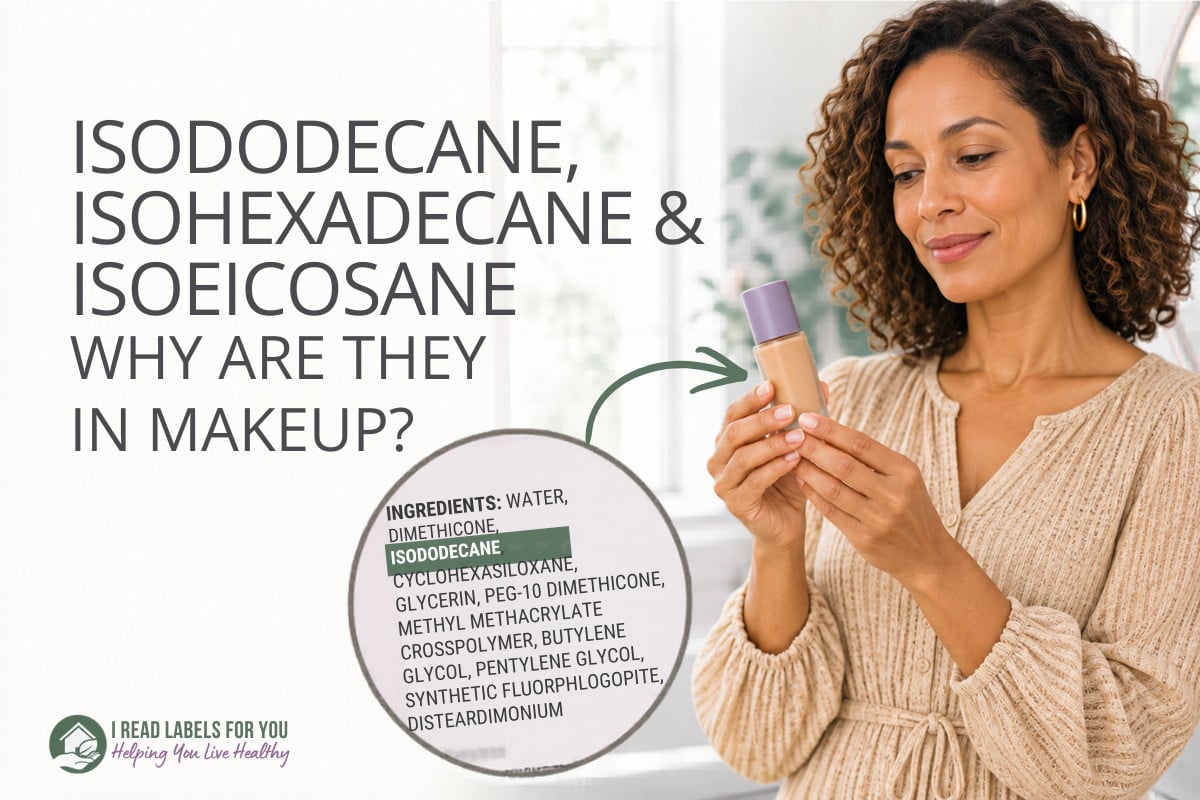
Yes, Isododecane, Isohexadecane and Isoeicosane are safe in skin care, sunscreen, rinse-off products and most makeup. I am more cautious with lip products, sprays and baby products. Each one is a synthetic oil assembled from isobutylene, a gas supplied by the petrochemical industry. Patch tests on finished products found almost no allergy, and the main supplier publishes tight purity limits for two of them. My rating for all three is Better (Limited Use).
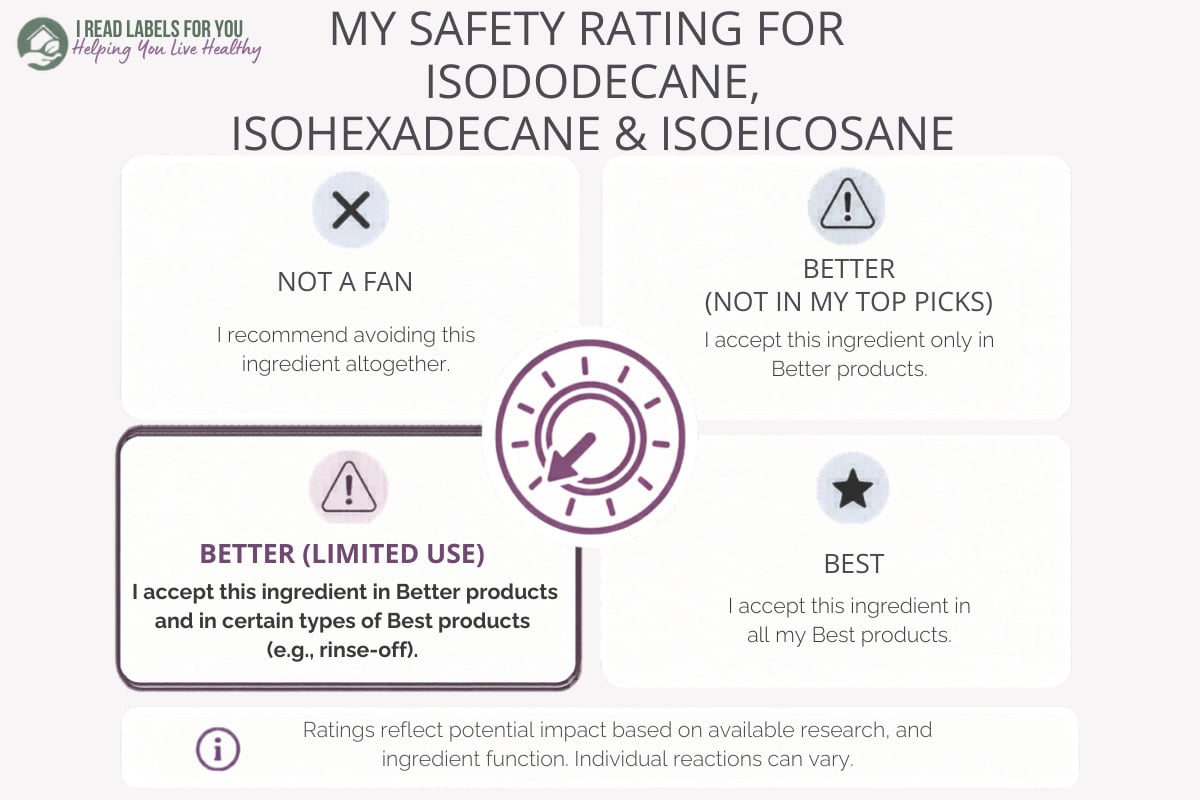
My Rating For Each Synthetic Isoalkane
Each rating below repeats the short description that appears in my Label Verdict. Their petroleum-refined cousins, such as C13-14 Isoalkane, are covered in my Isoparaffins and Isoalkanes Review.
Isododecane – Better (Limited Use)
A lab-made, lightweight oil that helps makeup glide on and then evaporates. It’s made in a lab to a high purity, so it’s fine in most products. Only one small lab test has measured how much passes through skin, and it found almost none. But no one has checked how much you breathe in from sprays, and lip products get swallowed. Best: rinse-off products, leave-on skin care, sunscreen, makeup other than lip products, and hair products that are not sprays. Better: lip products, sprays and baby products.
Isohexadecane – Better (Limited Use)
A lab-made, lightweight oil that gives skin care and makeup a silky, non-greasy feel. It’s made in a lab to a high purity, so it’s fine in most products. But no one has tested how much passes through skin or what happens when you breathe it in, and lip products get swallowed. Best: rinse-off products, leave-on skin care, sunscreen, makeup other than lip products, and hair products that are not sprays. Better: lip products, sprays and baby products.
Isoeicosane – Better (Limited Use)
A lab-made oil, a little heavier than Isododecane, that softens skin and helps makeup spread. It’s made in a lab to a high purity, so it’s fine in most products. But no one has tested how much passes through skin or what happens when you breathe it in, and lip products get swallowed. Its longer molecules may also build up in the body. Best: rinse-off products, leave-on skin care, sunscreen, makeup other than lip products, and hair products that are not sprays. Better: lip products, sprays and baby products.
What Regulators Say About Isododecane, Isohexadecane And Isoeicosane
Isododecane, Isohexadecane and Isoeicosane carry no restriction in the European Union (EU) Cosmetics Regulation. Europe’s Scientific Committee on Consumer Safety (SCCS) has never reviewed them, and none has an official EU hazard classification. The U.S. Food and Drug Administration (FDA) and Health Canada set no cosmetic limits either.
Keep reading to discover:
- which of the three has no published limit for aromatic hydrocarbons, a group that includes benzene,
- what a 2009 lab test found when it measured how much isododecane passed through skin, and
- why the industry’s own lip-care purity guide says these oils need a separate safety check.
What Are Isododecane, Isohexadecane And Isoeicosane?
These three are synthetic isoalkanes, meaning branched chains of carbon and hydrogen made in a factory rather than refined out of crude oil. Each one is a set number of isobutylene units joined together. Three units give Isododecane, with 12 carbons. Four give Isohexadecane, with 16, and five give Isoeicosane, with 20.
Chemically, they are close cousins of Hydrogenated Polyisobutene, which is made the same way from longer chains. The shorter the chain, the thinner the oil and the faster it evaporates.
What Do These Synthetic Isoalkanes Do In Cosmetics?
CosIng, the EU ingredient database, lists all three as skin-softening emollients and solvents. Isododecane is the thinnest. It helps long-wear foundation and mascara spread evenly, then flashes off and leaves color behind.
Isohexadecane gives creams and sunscreens a silky, non-greasy finish. Isoeicosane is heavier and stays on the skin, which suits lipsticks and balms.
Amounts can be very high. The Cosmetic Ingredient Review (CIR), a safety panel paid for by U.S. cosmetic makers, reported 2010 survey data. Isododecane then appeared in 518 products at up to 90%. Isohexadecane reached 42%, and Isoeicosane 37%.
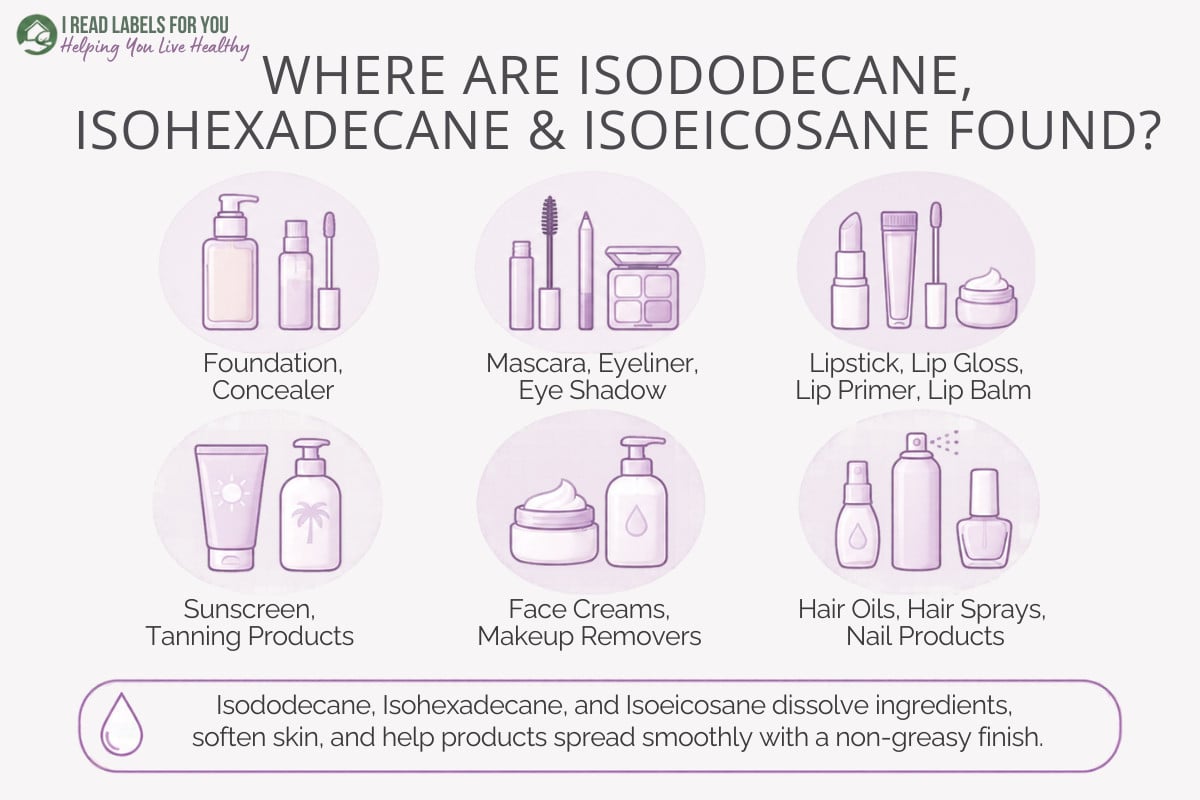
You’ll find these three most often in:
- long-wear foundation and concealer
- mascara, eyeliner and eye shadow
- lipstick, lip gloss, lip primer and lip balm
- sunscreen and tanning products
- face creams and makeup removers
- hair oils, hair sprays and nail products
None of the three is approved as a food additive in the EU or the United States. The FDA does allow a related group, synthetic isoparaffinic petroleum hydrocarbons, in some food processing uses, but that rule names no cosmetic ingredient.
How Are These Synthetic Isoalkanes Made?
The CIR report describes the route. Makers start from “a pure C4 stream rich in isobutylene,” link the isobutylene units into short chains, then add hydrogen to make them stable. Finally, distillation separates the 12-, 16- and 20-carbon fractions.
That process explains why purity can be tightly specified. INEOS, a major supplier, caps aromatic hydrocarbons at 1 milligram per kilogram in its Isododecane and Isohexadecane. Its sheets also require at least 98% and 99% purity, respectively.
Isoeicosane is the gap. Its INEOS sheet, dated March 2016, lists no aromatics limit at all, and it allows far more leftover unsaturated hydrocarbons than the other two. In addition, no sheet names the hydrogenation catalyst or sets a limit for nickel, a common catalyst metal.
The CosIng chemical names add one reassurance: the starting stream is “1,3-butadiene-free.” That matters, because 1,3-butadiene is a known human carcinogen. Still, all these figures come from one supplier, and your label never says whose grade a brand bought.
Do Isododecane, Isohexadecane And Isoeicosane Penetrate The Skin?
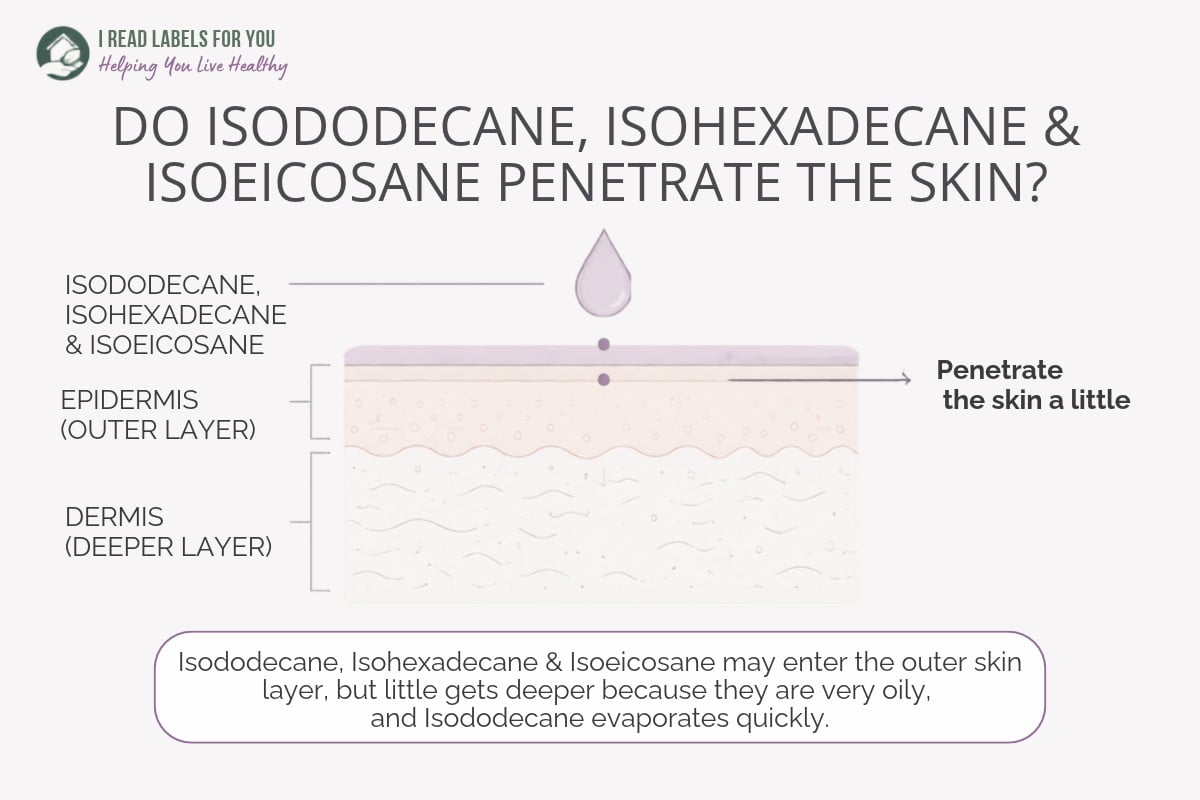
Yes, but only a tiny amount, based on the one measurement that exists, which covers Isododecane alone. Size does not keep them out. At about 170, 226 and 282 daltons, all three sit well under the roughly 500-dalton mark where skin starts to block molecules by size.
Oiliness and evaporation are what limit them instead. Their calculated LogP values, a measure of oil preference, run from about 6 to 10, which means they lodge in the outer skin layer. Isododecane also evaporates quickly, since it boils at about 178°C.
A 2009 laboratory study on pig skin used neat Isododecane as a reference substance. Only 0.09% of the applied dose passed through, and the authors wrote that it “was lost almost exclusively from the skin surface by evaporation.” No one has measured Isohexadecane or Isoeicosane this way.
What Are These Synthetic Isoalkanes Called On Labels?
These are the names you may see:
- Isododecane, also called 2,2,4,6,6-Pentamethylheptane or Permethyl 99A
- Isohexadecane, also called 2,2,4,4,6,8,8-Heptamethylnonane, Permethyl 101A or Arlamol HD
- Isoeicosane, also called Permethyl 102A
Do not confuse them with the petroleum-refined isoalkanes, whose names carry carbon ranges, such as C13-14 Isoalkane. Those are refinery mixtures with different purity questions.
Does The U.S. FDA Restrict Isododecane, Isohexadecane And Isoeicosane In Food And Cosmetics?
No, these three face no FDA cosmetic limit, and they are missing from the agency’s banned and restricted cosmetic ingredient list. In food, none has its own approval.
That silence tells you little. U.S. cosmetics reach shelves without any FDA safety review of their ingredients. Meanwhile, the Generally Recognized As Safe (GRAS) system for food lets a company’s own experts decide that a substance is safe.
European regulators take another approach. Under their precautionary principle, a credible risk can justify action before the science is settled.
EU Regulations On Isododecane, Isohexadecane And Isoeicosane
The banned and restricted lists of the EU Cosmetics Regulation name none of the three. Their CosIng entries for Isododecane, Isohexadecane and Isoeicosane show no conditions of use.
Under EU chemical law, known as CLP, no official hazard classification exists for any of them. Instead, companies classify them themselves. For all three, the main warning in company filings is aspiration, meaning the liquid could be fatal if swallowed and drawn into the lungs.
For Isododecane, most filings also call it flammable and say it may harm water life over the long term. Separately, ECHA, the European Chemicals Agency, adopted a decision on a testing proposal for Isohexadecane on May 8, 2025. According to the companies’ registration file, the proposals cover one reproduction study and two pregnancy studies, though the decision itself is not public.
Lip Products Fall Through A Gap
Cosmetics Europe, the industry trade group, has a purity recommendation for lip care that covers mineral oils and waxes. It states that it “does not apply to synthetic hydrocarbons,” naming isododecane as an example. For those, it says, “a specific safety evaluation needs to be performed.”
I could not find that evaluation for any of the three. This gap is the main reason I keep them out of my Best lip products.
Canadian Regulations On Isododecane, Isohexadecane And Isoeicosane
Canada places no limit on these three. Health Canada’s Cosmetic Ingredient Hotlist does not name them, and they are absent from Schedule 1, Canada’s list of toxic substances.
Can Isododecane, Isohexadecane And Isoeicosane Cause Skin Allergy And Sensitization?
No, these three rarely cause skin allergy, but Isododecane can irritate skin when it is trapped under a patch. The CIR report summarizes repeated patch tests on finished products at very high strengths.
For example, a lip primer with 80.74% Isododecane was tested on 108 people, and a lip balm with 27.15% Isoeicosane on 106. Neither caused irritation or allergy. A hair oil mist with 90.3% Isododecane was also well tolerated in 65 people over six weeks.
There are exceptions. A 64-year-old woman developed eczema from a sunscreen and reacted to Isohexadecane on patch testing. Meanwhile, Isododecane in petrolatum irritated some volunteers under closed patches at 10% to 50%, though not when the skin was left open.
Dermatologists do not patch test for them routinely. The American Contact Dermatitis Society (ACDS) leaves all three out of its Core Allergen Series, and none has been its Allergen of the Year.
Are Isododecane, Isohexadecane And Isoeicosane Hormone (Endocrine) Disruptors?
No, there is no evidence that these three disrupt hormones, but no published or registered study has tested them for it. Neither the CIR report nor the companies’ EU registration files contain a hormone-related study for any of the three.
Likewise, none of the three is on the EU Candidate List of substances of very high concern. That list includes chemicals the European Chemicals Agency has officially identified as hormone disruptors. None carries an official EU hormone-disruptor classification either. ECHA also has no hormone-disruptor assessment open for Isododecane, Isohexadecane or Isoeicosane.
One loose end exists. In a 13-week study, rats breathing 1,800 parts per million of Isododecane had heavier reproductive organs. Nobody followed that finding up.
Are Isododecane, Isohexadecane And Isoeicosane Safe To Use While Pregnant?
No one can say for certain, because none of these oils has a pregnancy study that the CIR panel accepted. The companies’ EU registration files borrow every reproduction and pregnancy result from other hydrocarbon mixtures, data the CIR panel declined to use. New studies on Isohexadecane are proposed, and a screening study on Isoeicosane itself is planned.
Low skin uptake is reassuring for creams. Lip products are different, since you swallow part of them. While you are expecting or breastfeeding, you should consult with your medical provider. Meanwhile, choosing lip products without these oils is an easy precaution.
Are There Any Cancer Concerns Linked To Isododecane, Isohexadecane And Isoeicosane?
No, none of the three is classified as a carcinogen, though no long-term cancer study has tested them. Isododecane passed the Ames test, a standard bacterial screen for gene damage. According to the companies’ EU registration file, Isohexadecane passed an Ames test too. Isoeicosane has no gene-damage test of its own.
Neither the International Agency for Research on Cancer nor the National Toxicology Program lists them, and California’s Proposition 65 does not either. The realistic cancer question is impurity, not the oil itself. That is why the missing aromatics limit for Isoeicosane matters.
What Happens When You Swallow Them
Lip products are mostly swallowed. A 2016 test of 175 Swiss lip products found that 68% held at least 5% mineral or synthetic hydrocarbons. The authors concluded that “material applied to the lips largely ends up being ingested.”
The European Food Safety Authority (EFSA) reviewed mineral oil hydrocarbons in 2023. It reports that rat and human liver cells did not break down the branched alkanes tested. EFSA also describes branched chains from 20 carbons up building up in rat livers. Isoeicosane sits at the start of that range.
Animal feeding data add one more signal. In a 1988 rat feeding study, a diet with 1% of the main Isohexadecane molecule multiplied peroxisomes, tiny structures inside liver cells, within two weeks. Human livers respond far less to this kind of effect, but it shows the body does not treat these oils as inert.
Are Isododecane, Isohexadecane And Isoeicosane Bad For The Environment?
All three come from petrochemical gas, a non-renewable source. For that reason, the COSMOS and NATRUE natural standards leave them off their approved ingredient lists.
Isododecane is the one with a water warning. Most company filings warn that it may damage aquatic life over the long term. By contrast, the filings for Isohexadecane and Isoeicosane carry no water classification.
Common Claims About Isododecane, Isohexadecane And Isoeicosane: What’s True And What’s Not
Claim: They Are Non-Comedogenic
Partly true. The CIR report records rabbit-ear tests that found Permethyl 99A (Isododecane) and Permethyl 101A (Isohexadecane) “noncomedogenic.” However, rabbit ears are more sensitive than human faces, and no human pore-clogging study exists.
There are no tests for Isoeicosane. If you break out easily, judge the whole product on your own skin rather than one ingredient.
Claim: They Contain 1,4-Dioxane
False. The FDA explains on its 1,4-dioxane page that this contaminant comes from ethoxylation, a step these oils never go through. Their controlled impurities are different: leftover unsaturated chains, carbonyls, peroxides and sulfur.
Claim: They Are Petroleum Ingredients
Half true. They are not refined out of crude oil like mineral oil or the C13-14 type isoalkanes. Yet their building block, isobutylene, comes from the petrochemical industry. In short, they are synthetic, but not natural.
What I Think About Isododecane, Isohexadecane And Isoeicosane, And What You Should Do
I rate Isododecane, Isohexadecane and Isoeicosane Better (Limited Use). I accept them in my Best products for rinse-off products, leave-on skin care, sunscreen, non-lip makeup and non-spray hair products. For lip products, sprays and baby products, they stay out of my Best tier and appear only in Better ones.
Purity is the reason they rank above their petroleum cousins. A defined synthetic grade with a published aromatics limit is easier to trust than a refinery stream. Their patch-test record on skin is also clean.
The limits follow how you meet them. You swallow lip products, and no lip-care safety check exists for these oils. You breathe Isododecane vapor from sprays, and the CIR cleared sprays on droplet size alone. Baby skin, especially under a diaper, is thinner and often covered.
In practice, a foundation, mascara or sunscreen with these oils is a reasonable choice. For lipsticks, I favor formulas built on plant oils and waxes. For hair sprays, use them in a ventilated room and don’t inhale them.
Frequently Asked Questions About Isododecane, Isohexadecane And Isoeicosane
Is Isododecane The Same As Isohexadecane?
No. Both are made from isobutylene, but Isododecane has 12 carbons and Isohexadecane has 16. As a result, Isododecane is thinner and evaporates quickly, while Isohexadecane stays on the skin longer and feels silkier.
Is Isododecane The Same As Mineral Oil?
No. Mineral Oil is a refined petroleum mixture of many chain types, while Isododecane is one defined synthetic fraction. Both are hydrocarbons, though, and you can swallow from lip products.
Why Is Isododecane In Long-Wear Makeup?
It spreads pigments evenly and then evaporates within minutes. Consequently, the color film sets and resists smudging. That same evaporation is why sprays and large-area use bring a breathing question.
Why Does EWG Rate Isododecane, Isohexadecane And Isoeicosane Differently?
The Environmental Working Group (EWG) gives all three a score of 1, its lowest concern, with “Limited” data. Its pages for Isododecane and Isohexadecane raise no use restriction. For Isoeicosane, however, EWG VERIFIED products need “adequate substantiation” to include it.
I am a little stricter than EWG on lips, sprays and baby products. EWG’s score does not weigh that you swallow lip products, or that no lip-care safety evaluation exists. It also gives no weight to the missing aromatics limit for Isoeicosane.
Sources
EU SCCS / SCCP Opinions:
No SCCS, SCCP or SCCNFP opinion on Isododecane, Isohexadecane or Isoeicosane (checked): SCCS opinions portal
Cosmetic Ingredient Review (CIR) Reports:
CIR Expert Panel, 2012. Johnson W Jr, Bergfeld WF, Belsito DV, et al. Safety Assessment of Isoparaffins as Used in Cosmetics. International Journal of Toxicology 31(Suppl 3):269S-295S. Covers Isododecane, Isohexadecane and Isoeicosane: manufacturing, use levels, patch tests, the Isododecane inhalation study and the Ames test: CIR reports database; PubMed 23283704
CIR, 2010. Draft Final Report on Isoparaffins, Expert Panel meeting of December 13 to 14, 2010: CIR 2010 draft final report
European Union Regulatory Databases:
CosIng, Isododecane, emollient, solvent and perfuming, no Annex entry: CosIng Isododecane
CosIng, Isohexadecane, emollient and solvent, no Annex entry: CosIng Isohexadecane
The CosIng, Isoeicosane, emollient, skin conditioning and solvent, described as a hydrogenated pentaisobutylene fraction from a 1,3-butadiene-free C4 stream, no Annex entry: CosIng Isoeicosane
EU Cosmetics Regulation (EC) No 1223/2009, consolidated text of May 18, 2026, Annexes II to VI; none of the three named: EUR-Lex Regulation 1223/2009
CLP Annex VI harmonised classifications; no entry for any of the three (checked).
ECHA CHEM, industry classifications for Isododecane (EC 236-757-0), mainly flammable, aspiration hazard and long-lasting harm to aquatic life: ECHA Isododecane
ECHA CHEM, industry classifications for Isohexadecane (EC 224-506-8), mainly aspiration hazard: ECHA Isohexadecane; regulatory activities, testing proposal decision of May 8, 2025: ECHA Isohexadecane activities
The ECHA CHEM, industry classifications for Isoeicosane (EC 297-627-7), aspiration hazard or not classified: ECHA Isoeicosane
ECHA CHEM, REACH registration dossiers (lead joint submissions). All reproduction, pregnancy, cancer, skin allergy and skin absorption entries are read-across or waivers; no endocrine section data; Isohexadecane has its own Ames test (1990); OECD 443 and OECD 414 proposed for Isohexadecane; OECD 422 planned for Isoeicosane: Isododecane dossier, Isohexadecane dossier, Isoeicosane dossier
ECHA Candidate List of substances of very high concern, which includes substances identified for endocrine-disrupting properties under REACH Article 57(f); none of the three listed, and no ECHA endocrine disruptor assessment for any of them (checked): ECHA Candidate List; Commission Delegated Regulation (EU) 2023/707, which added endocrine disruptor hazard classes to CLP; no classification for any of the three: Regulation (EU) 2023/707; ECHA CHEM regulatory activities, no endocrine disruptor assessment open: Isododecane activities, Isohexadecane activities, Isoeicosane activities
Cosmetics Europe Recommendation No. 14, Mineral Hydrocarbons in Cosmetic Lip Care Products, September 17, 2018; excludes synthetic hydrocarbons such as isododecane and calls for a specific safety evaluation: Cosmetics Europe Recommendation 14
EFSA CONTAM Panel, 2023. Update of the risk assessment of mineral oil hydrocarbons in food. EFSA Journal 21(9):8215; branched alkanes and retention in the body: EFSA 2023 full text
German Federal Institute for Risk Assessment (BfR) Opinion No. 008/2018, highly refined mineral oils in cosmetics: BfR Opinion 008/2018
Other Regulators:
U.S. FDA, Prohibited and Restricted Ingredients in Cosmetics; none of the three listed: FDA prohibited and restricted ingredients
21 CFR 172.882, synthetic isoparaffinic petroleum hydrocarbons in food; names no cosmetic ingredient: 21 CFR 172.882
U.S. FDA, 1,4-Dioxane in Cosmetics, a byproduct of ethoxylation: FDA 1,4-dioxane page
Health Canada, Cosmetic Ingredient Hotlist; not listed: Health Canada Hotlist
Environment and Climate Change Canada, CEPA Schedule 1; not listed: CEPA Schedule 1
IARC List of Classifications; not listed: IARC classifications
NTP, Report on Carcinogens, Fifteenth Edition; not listed: NTP Report on Carcinogens
California Proposition 65 list; not listed: Proposition 65 list
INEOS sales specifications for Isododecane (September 2022), Isohexadecane (Rev. 1, September 2024) and Isoeicosane (March 2016). Supplier documents, not measurements of products you can buy.
PubChem Records (Chemistry, Identifiers, Skin Penetration, Hazard Codes):
Isododecane (2,2,4,6,6-Pentamethylheptane), PubChem CID 26058, 170.33 g/mol: PubChem CID 26058
Isohexadecane (2,2,4,4,6,8,8-Heptamethylnonane), PubChem CID 20414, 226.44 g/mol: PubChem CID 20414
Isoeicosane, a branched C20 representative, PubChem CID 13956397, about 282.5 g/mol; the ingredient itself is a mixture: PubChem CID 13956397
Peer-Reviewed Studies:
Percutaneous absorption of an insect repellent p-menthane-3,8-diol: a model for human dermal absorption, 2009. Journal of Toxicology and Environmental Health, Part A. PMID 19557607. Neat Isododecane used as a reference compound; abstract only, cited as an exception: PubMed 19557607
Niederer M, Stebler T, Grob K, 2016. Mineral oil and synthetic hydrocarbons in cosmetic lip products. International Journal of Cosmetic Science 38(2):194-200. PMID 26352930: PubMed 26352930
Ikeda T, Ida-Enomoto M, Mori I, et al, 1988. Peroxisome proliferation in rat liver from 2,2,4,4,6,8,8-heptamethylnonane. Xenobiotica. PMID 3245225; abstract only, cited as an exception: PubMed 3245225
Natural Cosmetic Standards:
COSMOS-standard approved raw materials; none of the three found: COSMOS-standard approved raw materials
NATRUE certified and approved raw materials; none of the three found: NATRUE certified raw materials
Skin Allergy Resource:
American Contact Dermatitis Society (ACDS), Helpful References, including the Core Allergen Series 2020; none of the three listed: ACDS Helpful References
Advocacy groups:
Environmental Working Group (EWG) Skin Deep entries, each score 1 with data “Limited”; Isoeicosane restricted in EWG VERIFIED products: EWG Isododecane; EWG Isohexadecane; EWG Isoeicosane
Last verified: 11-17-2026

Download The Free Guide!
5 Powerful Steps To A Non-Toxic Home
Join our informed consumer community and get our free guide the “5 Powerful Steps To A Non-Toxic Home”.
Before commenting, please read our Comment Policy.