
Is Butyloctyl Salicylate Safe? A Simple Answer You Can Trust
 Written by Irina Webb
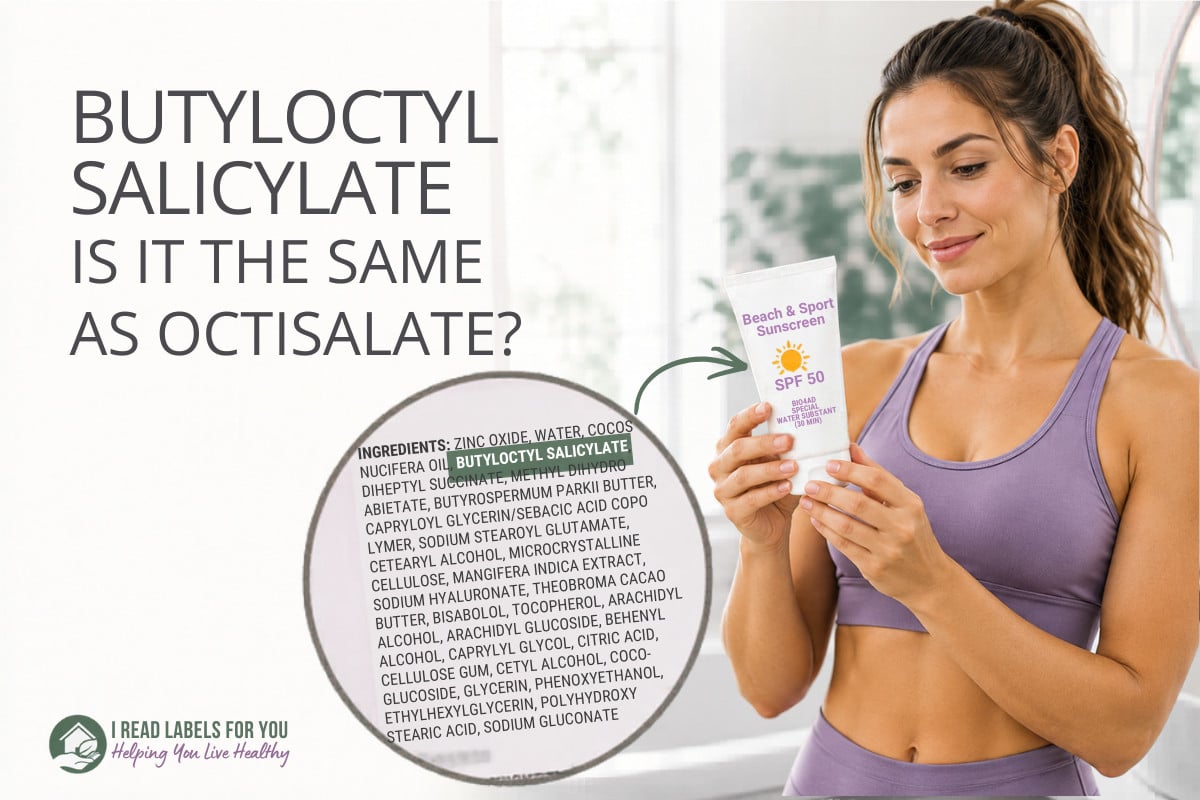
Yes, Butyloctyl Salicylate appears safe at the amounts used in cosmetics, though one question about it stays open. It’s a clear, oily liquid found in sunscreens, moisturizers and foundations. No study has ever shown Butyloctyl Salicylate harming anyone, and no case report exists. My rating is Better (Not In My Top Picks).
No regulator anywhere restricts Butyloctyl Salicylate. So there is no ceiling on how much of it a product may contain. By contrast, Europe has capped six of its chemical relatives by name and approved a seventh as a sunscreen filter. That gap is where most of the confusion begins.
In this post, you will learn why a 100 percent mineral sunscreen can contain Butyloctyl Salicylate. Next, you will see how one missing minus sign created a hormone disruption scare around it. Finally, you will find out which question about Butyloctyl Salicylate remains unanswered, and why it moved my rating.
What Is Butyloctyl Salicylate?
Butyloctyl Salicylate is an ester, which means an acid joined to an alcohol. The acid here is salicylic acid, the compound behind acne treatments and aspirin. The alcohol is 2 butyloctanol, a fatty alcohol with twelve carbons. That pairing gives Butyloctyl Salicylate an oily character that matters for penetration rate.
It’s a niche ingredient rather than a bulk chemical. Companies make or import 100 to 1,000 tonnes a year in Europe, according to the European Chemicals Agency (ECHA). That registration covers every use, not only cosmetics.
What Does Butyloctyl Salicylate Do In Cosmetics?
The Cosmetic Ingredient Review (CIR) is the safety panel that the United States cosmetics industry funds and runs. It has assessed the salicylates twice, in 2003 and again in 2025. Both reports call Butyloctyl Salicylate a hair conditioner, a skin conditioner and a solvent, with no ultraviolet function in either one. That omission matters, because the marketing says something different.
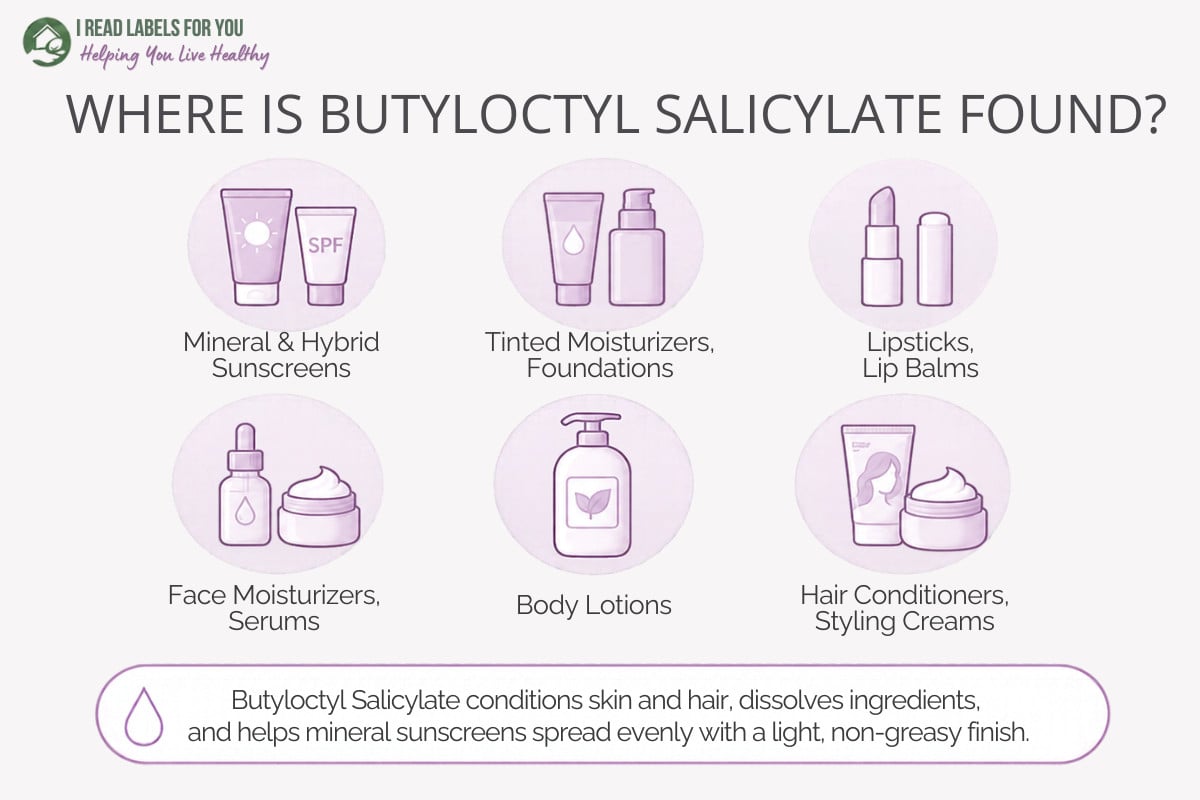
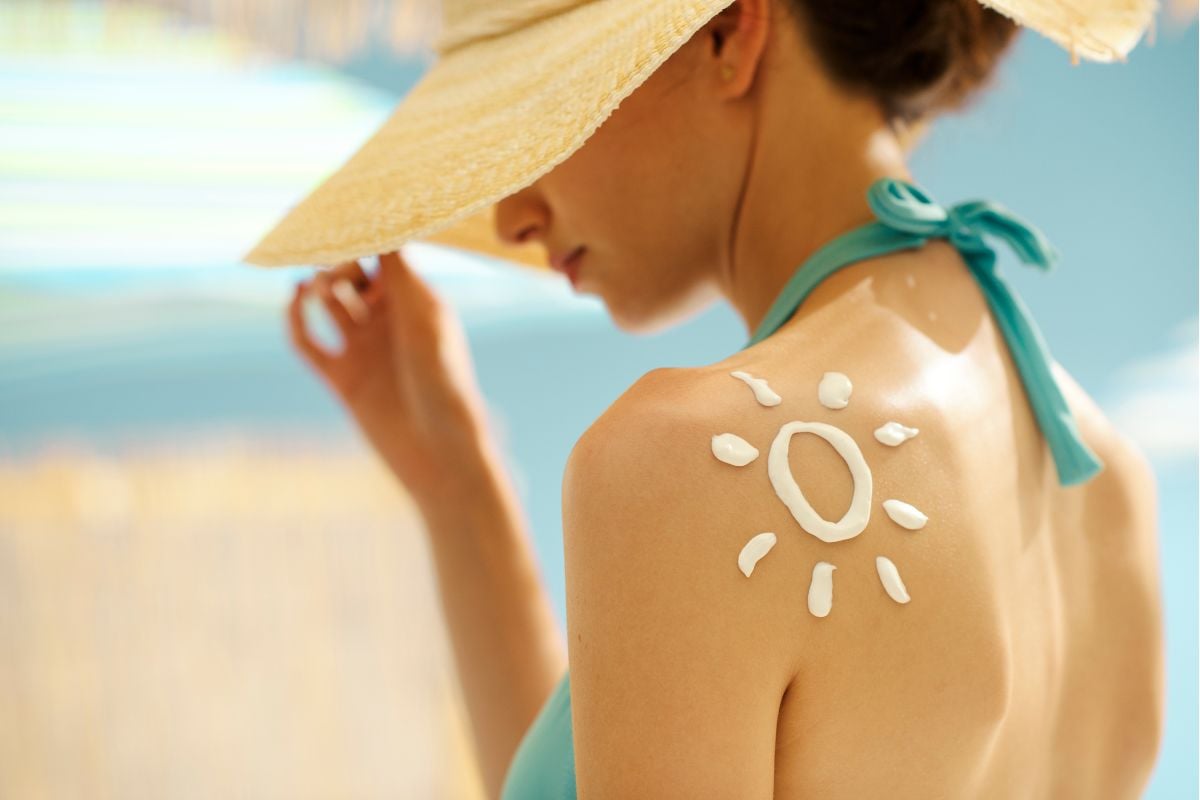
In practice, formulators value two things about Butyloctyl Salicylate. To begin with, it keeps mineral powders like zinc oxide and titanium dioxide from clumping. Spreading them evenly is why it sits high on the ingredient list of many mineral sunscreens. Clumped minerals cover less skin, so that spreading does real work.
Moreover, Butyloctyl Salicylate leaves a light, non-greasy finish. That finish helps those minerals go on without a white cast. It also softens the heavy feel that a high mineral load gives a cream. Those are cosmetic jobs for Butyloctyl Salicylate rather than protective ones.
One laboratory has measured whether Butyloctyl Salicylate absorbs ultraviolet light. A team at Massachusetts General Hospital and Harvard Medical School put Butyloctyl Salicylate at 5 percent into a cream with no other sun filters. It absorbed the sun wavelengths that burn skin, but the laboratory did not say how much. Interestingly, a sunscreen company funded that test, and the paper names thirteen rival sunscreens, calling eight of them mislabelled.
Hallstar makes Butyloctyl Salicylate and sells it as HallBrite BHB, and it explains the boost differently. Hallstar credits spreadability, saying Butyloctyl Salicylate separates the mineral powders so they cover more skin. On its own numbers that buys about two points of SPF at 5 percent.
You’ll find Butyloctyl Salicylate most often in:
- mineral and hybrid sunscreens
- tinted moisturizers and foundations
- lipsticks and lip balms
- face moisturizers and serums
- body lotions
- hair conditioners and styling creams
Butyloctyl Salicylate has no food use at all. Its parent salicylic acid turns up naturally in willow bark and in some fruits. The ester itself exists only because a factory makes it.
How Is Butyloctyl Salicylate Made?
Butyloctyl Salicylate is made in a factory rather than harvested. It joins salicylic acid to a 12-carbon alcohol. Hallstar describes it as “a unique cosmetic ester patented in 1998.” Beyond that line, the maker says little about the process.
The public record on how Butyloctyl Salicylate is made is scarce. Neither CIR report says how this ester is manufactured. The 2025 CIR report does have a method of manufacture section, and it covers one relative only, Amyl Salicylate. So anyone describing the process for this one is guessing.
The US Cosmetic Ingredient Review publishes no impurity data for Butyloctyl Salicylate. Both its reports have an impurities section, and both fill it in for several relatives. Neither says anything about this one.
Europe has the numbers for Butyloctyl Salicylate, and they are not public. The companies that registered it listed two impurities in their safety filing, and both are marked “Not publishable.” The purity figure is withheld as well. So the full composition stays hidden from shoppers.
Companies routinely keep this part of a filing private, because composition reveals how a product is made. That makes the privacy around Butyloctyl Salicylate ordinary rather than suspicious. It also means neither you nor I can see what else is in it.
Does Butyloctyl Salicylate Penetrate The Skin?
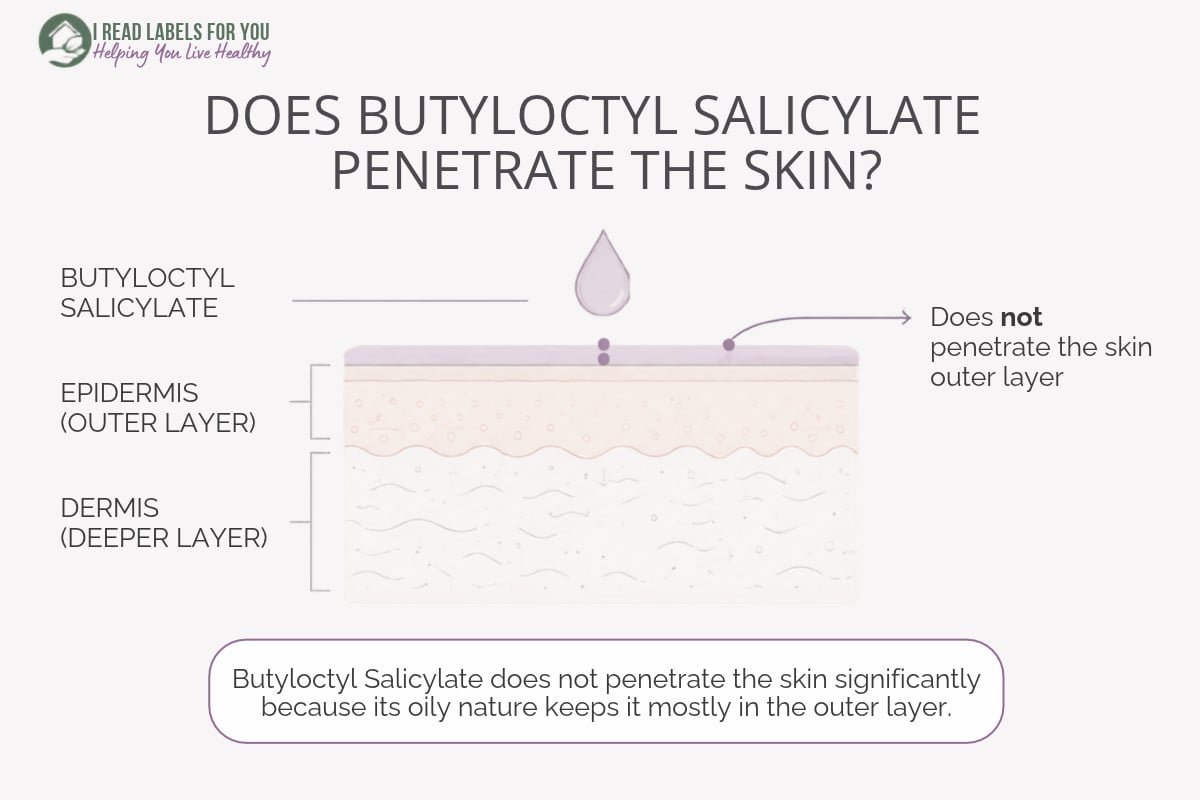
No, Butyloctyl Salicylate mostly stays in the outer layer of your skin. Its oil loving character is the reason. Two markers govern skin penetration, and they matter unequally for this ester.
The first marker is size. Molecules under roughly 500 daltons are small enough that the skin stops blocking them. At 306.4 daltons, Butyloctyl Salicylate clears that bar easily.
The second marker is oil and water balance, and that marker does the work. Above a LogP of about 6, a molecule dissolves so readily in skin lipids that it stalls there. Both published values for Butyloctyl Salicylate, 6.03 and 7.9, sit above that line.
A 2025 paper in Archives of Toxicology settled this with a measurement on human skin. Applied in a body lotion, only 0.871 percent of the Butyloctyl Salicylate dose got past the surface. And only 0.034 percent passed all the way through, and almost all of it washed off.
What Is Butyloctyl Salicylate Called On Labels?
On a label you will see one of these:
- Butyloctyl Salicylate
- Salicylic Acid, 2-Butyloctyl Ester
- 2-Butyloctyl 2-Hydroxybenzoate
- Hallbrite BHB
One name causes real confusion with Butyloctyl Salicylate. Ethylhexyl Salicylate, sold as octisalate, is a separate ingredient. Its registry number is 118-60-5, against 190085-41-7 for this one.
For some reason, Ethylhexyl Salicylate and Butyloctyl Salicylate get treated as interchangeable very often. One sunscreen retailer headlines a post saying this ingredient simply is octisalate. They are not the same ingredient, and Butyloctyl Salicylate carries four extra carbon atoms. Europe approves octisalate as a sunscreen filter and has never listed this one. You can learn more about it in my Chemical Sunscreen Filters Safety review.
Does The U.S. FDA Restrict Butyloctyl Salicylate In Food And Cosmetics?
No, the Food and Drug Administration (FDA) sets no limit on Butyloctyl Salicylate in cosmetics. It’s absent from the agency’s list of prohibited and restricted cosmetic ingredients. It also has no food clearance, because nobody eats it deliberately. That silence is weaker evidence than it sounds.
I hold the FDA to a low standard on Butyloctyl Salicylate, and the reason is structural. The agency reviews cosmetic ingredients after products reach shelves. Hence a US silence means very little.
Its Generally Recognized As Safe (GRAS) route for food compounds the problem. Under that route, a company’s own hired experts may declare an ingredient fine. Nobody outside the company has to agree. That route never touched Butyloctyl Salicylate, but it shows how little US silence proves.
The sunscreen side is more interesting. The agency’s list of sunscreen actives sits at 21 CFR 352.10. It includes “Octyl salicylate up to 5 percent,” which is octisalate. Butyloctyl Salicylate appears nowhere on that list.
Europe works from the opposite instinct, the precautionary principle. Simply put, an ingredient there earns its place before sale. Doubt counts against the manufacturer rather than the shopper. That makes European silence about Butyloctyl Salicylate more interesting than American silence.
EU Regulations On Butyloctyl Salicylate
The European Union places no restriction whatsoever on Butyloctyl Salicylate. I searched all five annexes of the cosmetics regulation directly. The word butyloctyl returns nothing in any of them.
The same searches find the salicylate relatives of Butyloctyl Salicylate. Annex III is the restricted list, and six other salicylates carry limits there. They are Benzyl Salicylate, Salicylic Acid, Methyl Salicylate, Amyl Salicylate, Salicylaldehyde and Hexyl Salicylate.
Annex VI is the approved sunscreen filter list. Octisalate sits there as entry 20, capped at 5 percent since March 2011. Butyloctyl Salicylate appears on no filter list, so no ceiling applies to it anywhere.
No Scientific Committee on Consumer Safety (SCCS) opinion on Butyloctyl Salicylate exists either. The committee assessed its parent, salicylic acid, in 2018. That opinion covers a different molecule with different behavior on skin.
U.S. And EU Disagreements On Butyloctyl Salicylate
On Butyloctyl Salicylate the two systems agree. Neither has put it on any restricted or banned list. Both have named its relatives instead.
Canadian Regulations On Butyloctyl Salicylate
Health Canada takes the same position on Butyloctyl Salicylate. It returns zero hits on the Cosmetic Ingredient Hotlist. That list names the country’s prohibited and restricted cosmetic ingredients.
Once again, the salicylate relatives are named. Three regulators have now looked hard at this chemical family. Furthermore, all three named the relatives and none named Butyloctyl Salicylate.
Can Butyloctyl Salicylate Cause Skin Allergy And Sensitization?
No, Butyloctyl Salicylate has never been shown to cause allergy in people. Even so, the testing behind that answer is thin. The clearest result is a guinea pig maximization test in the 2003 CIR report.
In that test, animals got 5 percent Butyloctyl Salicylate under the skin and 100 percent on top. A 100 percent challenge followed. None of them reacted.
Human testing exists, but only in the companies’ EU registration file. Repeated patch tests on HallBrite BHB in 2008 and 2009 found no irritation and no allergic reaction. Moreover, it’s absent from the American Contact Dermatitis Society’s Core Allergen Series 2020.
No case report about Butyloctyl Salicylate appears anywhere in the medical literature. A full text search returns twenty papers that mention it. Not one describes an allergic reaction.
Is Butyloctyl Salicylate A Hormone (Endocrine) Disruptor?
No, Butyloctyl Salicylate has never been tested for hormone activity in any cell, animal or person. What circulates online as an endocrine finding is a computer prediction. That prediction gets reported incorrectly almost everywhere it appears. The companies’ EU registration file contains no hormone study either.
The prediction about Butyloctyl Salicylate came from the United States Food and Drug Administration. Its scientists ran a computer model over sunscreen ingredients in 2016. The 2025 CIR report quotes that work rather than testing anything itself.
Here is the actual sentence from the 2025 CIR report. Butyloctyl Salicylate “was classified as having binding activity to the ER (prediction confidence value = 0.827; log RBA = -0.853).” ER means estrogen receptor, and RBA means relative binding affinity. Two numbers in that sentence get misread constantly.
The minus sign carries the whole meaning. On the report’s own scale, estradiol sits at 2 and Butyloctyl Salicylate at minus 0.853. That gap makes it roughly 700 times weaker than estradiol.
Drop the minus sign and the same figure looks fifty times stronger than it is. That is how Butyloctyl Salicylate, a molecule barely touching the receptor, became an endocrine scare. The error travels faster than the correction.
The 0.827 is misread the same way. The report defines prediction confidence as “a number between 0 and 1.” A high number means the model feels sure of itself, not that the effect is strong. Nobody has tested that prediction about Butyloctyl Salicylate since.
Is Butyloctyl Salicylate Safe To Use While Pregnant?
No study has ever tested Butyloctyl Salicylate in pregnancy, so no direct evidence exists either way. What exists instead is a calculation, and it looks reassuring. This is also the question that keeps Butyloctyl Salicylate out of my Best tier.
One thing is worth knowing. The European Chemicals Agency ordered the makers to run a reproductive screening study in rats, due July 2025. The makers never ran it. Instead, they sent data borrowed from related salicylates, and the agency is still reviewing that answer. So the answer about Butyloctyl Salicylate is unknown rather than negative.
The registration file shows what that borrowed data says. Its summary reads “adverse effect observed” for unborn rats, with no harm seen at 25 milligrams per kilogram of body weight a day. That borrowed result is the basis of the makers’ own warning.
Here is the part that moved my rating. Salicylic acid carries an official European classification as suspected of damaging the unborn child, and Butyloctyl Salicylate can turn into it. Nobody has measured how much converts inside skin. What we do know is how much gets through: in a 2025 human skin study, only 0.034 percent passed all the way through.
A 2021 European assessment applies the same unborn-child label to Butyloctyl Salicylate, by family rather than by testing it. Its makers now use that label too, as their own self-classification.
The 2025 CIR report borrowed a safety threshold from rat studies on salicylic acid, 75 milligrams per kilogram per day. It then modeled a lipstick with 35.9 percent Butyloctyl Salicylate, worn daily and absorbed completely. That produced a margin of safety of 220.
A margin of 100 is the usual comfort threshold, so 220 clears it with room to spare. The model also assumed total absorption, while the measured figure for Butyloctyl Salicylate is under 1 percent. Real exposure therefore sits far below what the calculation allowed.
Even so, you should consult with your medical provider about the products you use while pregnant or nursing. That advice holds for Butyloctyl Salicylate and for anything else you apply daily.
Are There Any Cancer Concerns Linked To Butyloctyl Salicylate?
No, Butyloctyl Salicylate has no cancer signal, and no cancer study either. No cancer authority lists it, and neither CIR report contains a carcinogenicity experiment on it. It’s absent from the International Agency for Research on Cancer monographs, the National Toxicology Program’s Report on Carcinogens and California’s Proposition 65 list.
Two gene-damage tests on Butyloctyl Salicylate itself came back clean in 1998. In the Ames test, it caused no mutations in any of the bacterial strains tested. In a chromosome test on mammalian cells, it caused no chromosome breaks.
Is Butyloctyl Salicylate Bad For The Environment?
Butyloctyl Salicylate carries one official environmental classification under European chemical law. The code is H413, “May cause long lasting harmful effects to aquatic life.”
Europe sorts its water warnings into four levels of seriousness, and Butyloctyl Salicylate sits on the lowest one. The warning comes from the chemistry of the ingredient, not from anything measured in a lake or a reef.
European chemical regulators have asked for more, and the paperwork is public. The European Chemicals Agency (ECHA) adopted a compliance check decision on April 18, 2023. It ordered the registrants to run a long-term toxicity test on aquatic invertebrates with Butyloctyl Salicylate.
The trigger was the chemistry of Butyloctyl Salicylate itself. The decision notes that its saturation concentration in water measures 0.0284 milligrams per liter. In ECHA’s words, it’s “poorly water soluble and information on long-term toxicity on aquatic invertebrates must be provided.”
The makers delivered that test on the deadline day, July 24, 2025. Over 21 days, water fleas had about 10 percent fewer young at 0.056 milligrams per liter. At 0.040 milligrams per liter, they showed no effect. The makers now label Butyloctyl Salicylate themselves as “Toxic to aquatic life with long lasting effects.” That is two levels stricter than the official EU warning, and ECHA has not finished its review.
Common Claims About Butyloctyl Salicylate: What’s True And What’s Not
Claim: It Acts As A Chemical Sunscreen Filter And Boosts SPF
This claim about Butyloctyl Salicylate is half right. It does raise a sunscreen’s SPF a little, but no regulator anywhere calls it a filter.
Hallstar, the maker of Butyloctyl Salicylate is open about the boosting part. Hallstar sells Butyloctyl Salicylate as HallBrite BHB, and its own data sheet calls it an SPF booster.
How much of the boost comes from absorbing light is disputed. Hallstar says Butyloctyl Salicylate works by breaking up clumps of mineral powder, so the minerals cover more skin. The Harvard measurement above contradicts that, because its test cream contained no mineral to spread. So Butyloctyl Salicylate was absorbing the light itself.
However, the sunscreen company that funded it has a stake in the result. Its chief executive helped run the experiments, and the paper names rival products as badly labelled. No independent laboratory has repeated it. So Butyloctyl Salicylate seems to absorb the UV light, but how much is unsettled.
Claim: It Causes Birth Defects Because It Resembles Aspirin
This claim has no study behind it, in either direction. No reproductive or developmental experiment on Butyloctyl Salicylate has ever been published. Europe ordered one in 2023, but the makers never ran it.
The resemblance to aspirin is weaker than a diagram suggests. One team measured how these esters behave in the body and found that “no hydrolysis to salicylic occurred” in gastrointestinal fluids. In plain terms, swallowing Butyloctyl Salicylate does not release salicylic acid in your stomach.
Some rating apps still list an effect on fetal weight for Butyloctyl Salicylate. That finding belongs to its relatives, chiefly methyl salicylate and plain salicylic acid. It was never measured on this one.
The borrowing has some logic, because all of them can release the same acid. A European regulator rejected that logic for Butyloctyl Salicylate in 2023. The makers answered with the same borrowed data instead of running the study. The agency’s case file still read ongoing in November 2026.
What I Think About Butyloctyl Salicylate — And What You Should Do
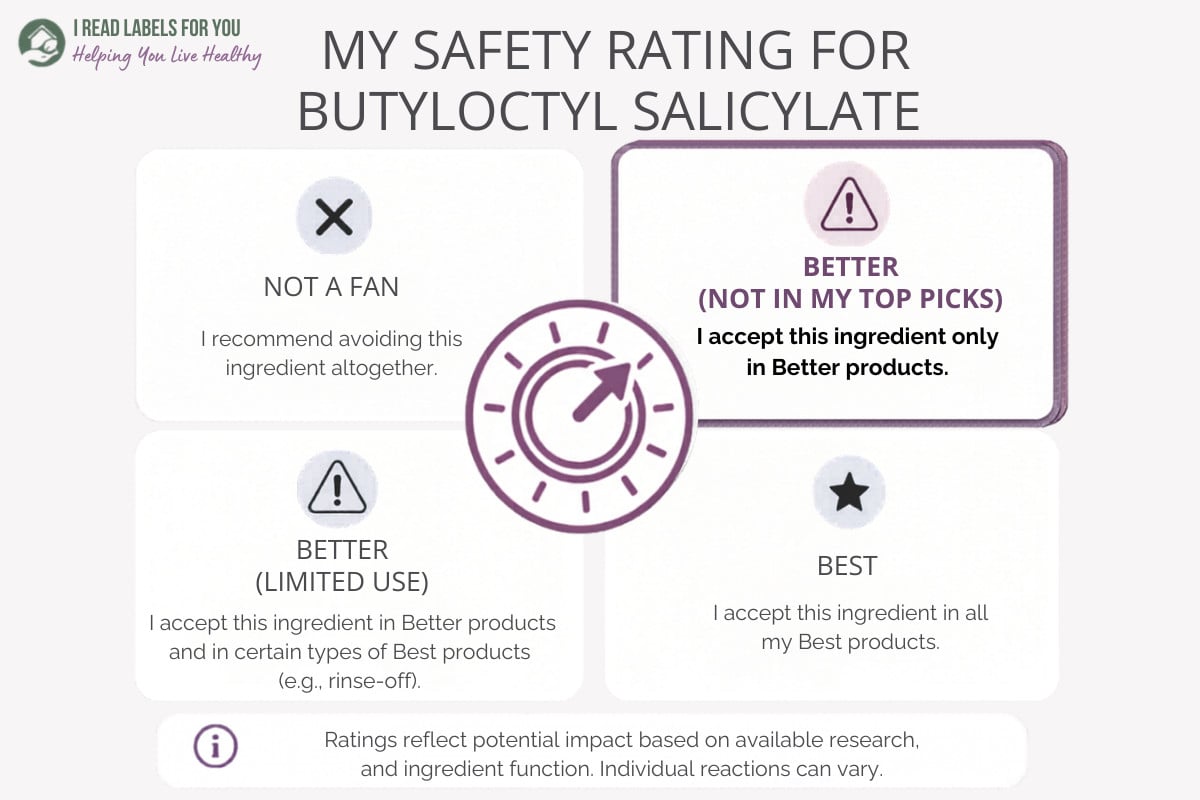
My rating for Butyloctyl Salicylate is Better (Not In My Top Picks). The main reason is a study the European Chemicals Agency ordered in 2023 that the makers never ran. They sent data borrowed from related salicylates instead. It would have been a rat test of fertility and pregnancy, showing whether Butyloctyl Salicylate harms an unborn baby. Until someone tests it directly, I cannot put Butyloctyl Salicylate in my Best tier. When that happens, I will re-consider.
It does not mean Butyloctyl Salicylate is dangerous by any means. No case report of harm exists anywhere in the medical literature. No regulator has restricted it, and no study has found an effect in people.
If you have been using a sunscreen that contains Butyloctyl Salicylate, I believe you do not need to be concerned. Keep using it and finish the bottle. Sun damage is real and measured, while this concern is neither.
Here is the reason I’m not alarmed. Only 0.034 percent of Butyloctyl Salicylate passes all the way through, when we apply it to the surface of our skin.
So why move the rating at all? Because a recommendation should rest on a settled question, and the one about Butyloctyl Salicylate is not settled. That is a different standard from safety.
Frequently Asked Questions About Butyloctyl Salicylate
Is Butyloctyl Salicylate The Same As Octisalate?
No, they’re separate ingredients with separate registry numbers. Octisalate is Ethylhexyl Salicylate, PubChem 8364, weighing 250.33 daltons. Butyloctyl Salicylate is PubChem 18319150, weighing 306.4 daltons.
They share the ultraviolet absorbing ring and differ by four carbons on the tail. Yet they do different jobs. Octisalate is an approved sunscreen filter in the EU and the U.S., while Butyloctyl Salicylate is approved as a UV filter in neither. Your skin also lets through about twice as much Octisalate.
Can I Use It If I’m Allergic To Aspirin?
Ask your doctor before using Butyloctyl Salicylate, because aspirin reactions come in two different kinds. Some are true allergies. Others are a sensitivity to how salicylates affect breathing, which concerns swallowing rather than skin contact.
The measured evidence on Butyloctyl Salicylate is reassuring. This ester released no salicylic acid in digestive fluids. On human skin, under 1 percent of a dose got past the surface.
Does It Clog Pores?
No published comedogenicity test on Butyloctyl Salicylate exists. Consequently, any pore rating you see online is a guess. Nobody has measured whether it blocks pores.
If a product breaks you out, stop using it rather than hunting for a comedogenicity number. Your own skin is better evidence than a rating table. That holds for Butyloctyl Salicylate and for every other ingredient.
Why Does Yuka Rate Butyloctyl Salicylate Differently?
Yuka rates Butyloctyl Salicylate poorly and advises avoiding it, especially in pregnancy. Some of its facts are right. Its two main concerns are a computer prediction and a label borrowed from relatives.
Yuka is right that no regulator caps Butyloctyl Salicylate, that reported use reaches 35.9 percent, and that it carries a European environmental warning. On the environment, Yuka names harm to small invertebrates and algae. The makers’ own 2025 test on water fleas, tiny crustaceans commonly used to check water safety, supports Yuka on invertebrates. Over 21 days, the fleas had about 10 percent fewer young at 0.056 milligrams per liter of water.
The hormone concern is a computer prediction from 2016, never tested in a cell or an animal. The model scored Butyloctyl Salicylate about 700 times weaker than the body’s own estrogen. A prediction is a reason to test, not a finding.
The fetal weight concern comes from a European group document covering every salicylate ester. I read it, and it does call Butyloctyl Salicylate “reprotoxic”, so Yuka is not inventing anything. But the whole group gets that label because its members share one breakdown chemical, salicylic acid.
The developmental data behind it belongs to methyl salicylate. The phrase “fetal weight” appears nowhere in the document, so whatever study Yuka means is not described there. The European Chemicals Agency then ordered a reproductive study on Butyloctyl Salicylate in 2023, but the makers never ran it.
Why Does EWG Rate Butyloctyl Salicylate Differently?
The Environmental Working Group (EWG) is harsher on Butyloctyl Salicylate than I am, which happens rarely. Its Skin Deep entry gives the ingredient a hazard score of 6. It also bars Butyloctyl Salicylate from EWG VERIFIED products entirely.
Its reasoning has a problem I find hard to get past. EWG rates developmental and reproductive toxicity HIGH, although no reproductive study on Butyloctyl Salicylate exists. Simultaneously, it rates the data availability “Robust.”
Those two calls cannot both hold. Data cannot be robust when the whole file on Butyloctyl Salicylate runs to a handful of industry funded papers. Nor can a developmental hazard be rated high on an experiment nobody has run.
I read EWG as an opinion, never as evidence. From the same thin file I reach a milder conclusion about Butyloctyl Salicylate. The open questions keep it out of my Best tier, yet they do not let me assert a hazard nobody measured.
Sources
EU SCCS / SCCP Opinions:
No SCCS or SCCP opinion on Butyloctyl Salicylate exists (checked). The committee’s 2018 opinion covers salicylic acid, the parent compound, not this ester: Scientific Committee on Consumer Safety opinions portal
Cosmetic Ingredient Review (CIR) Reports:
Andersen FA (ed.), 2003. Safety Assessment of Salicylic Acid and Salicylates as Used in Cosmetics. International Journal of Toxicology 22(Suppl 3):1-108. PMID 14617432. Contains the guinea pig maximization test, the eye irritation results and the ingredient function table: CIR reports database
Johnson W Jr et al., 2025. Amended Safety Assessment of Salicylic Acid and Salicylates as Used in Cosmetics. International Journal of Toxicology 44(Supplement 4):5S-57S. PMID 41243163. Contains the estrogen receptor prediction, the reported use concentration of 35.9 percent in lipstick, and the lipstick margin of safety of 220: CIR reports database
European Union Regulatory Databases:
CosIng, the European Commission cosmetic ingredient database. Butyloctyl Salicylate is listed as a cosmetic ingredient with no Annex restriction, and a direct search of Annexes II, III, IV, V and VI returned no entry: CosIng database
European Chemicals Agency, Assessment of regulatory needs, Group Name: Salicylate esters, dated August 12, 2021, read in full. It covers 29 pages and every salicylate ester. Page 14 calls Butyloctyl Salicylate “reprotoxic but unlikely to be a skin sensitiser based on available data and only used as cosmetic emollient”. Page 11 gives the basis, that “a group-wide pattern emerges around the formation of the same metabolite, salicylic acid, thus classification as Repr. 2 seems warranted for all substances in the group”. The word weight appears nowhere in the document. Note that the address Yuka gives for it no longer opens; this is the working one: ECHA assessment of regulatory needs, salicylate esters
CosIng Annex VI, approved ultraviolet filters. Butyloctyl Salicylate is not listed, while Ethylhexyl Salicylate (octisalate) is entry 20, limited to 5 percent, dated March 8, 2011: CosIng database
CosIng Annex III, restricted substances. Butyloctyl Salicylate is not listed, while Benzyl Salicylate (75), Salicylic Acid (98), Methyl Salicylate (324), Amyl Salicylate (328), Salicylaldehyde (340) and Hexyl Salicylate (380) are: CosIng database
CosIng Annex II, prohibited substances. Butyloctyl Salicylate is not listed: CosIng database
Classification, Labelling and Packaging Regulation (EC) No 1272/2008. Harmonized classification H413, Aquatic Chronic 4, “May cause long lasting harmful effects to aquatic life.” This is the only official EU classification. Separately, the registrants self-classify the ingredient as Repr. 2, H361d, “Suspected of damaging the unborn child,” and Aquatic Chronic 2, H411, “Toxic to aquatic life with long lasting effects,” in the “REACH Joint” notification (36.36 percent of notifications, updated July 24, 2025). A self-classification does not trigger the EU cosmetics ban on CMR substances.
European Chemicals Agency (ECHA) substance record, listed as 2-hydroxybenzoic acid 2-butyloctyl ester, EC 431-090-3. Carries CLP index number 607-638-00-4 and a registered tonnage band of 100 to 1000 tonnes a year: ECHA CHEM substance record
ECHA dossier evaluation, a comprehensive compliance check. Evaluation started September 14, 2021; decision adopted April 18, 2023; deadline July 24, 2025; follow up evaluation started July 24, 2025 and remains ongoing as of November 2026. The registrants did not run the rat screening study and relied on read across instead. They did deliver the aquatic study: an OECD TG 211 Daphnia magna 21-day reproduction test on Butyloctyl Salicylate itself, GLP, run November 14, 2024 to March 6, 2025, reliability 1, NOEC 0.040 mg/L and EC10 0.056 mg/L (reproduction), added to the lead dossier July 24, 2025. The decision ordered long term aquatic invertebrate testing to OECD TG 211, plus a reproductive and developmental screening study in rats, and it rejected the registrants’ read across to methyl salicylate and ethylhexyl salicylate: ECHA regulatory activities and decision
ECHA CHEM, REACH registration dossier for 2-hydroxybenzoic acid 2-butyloctyl ester (lead joint submission, updated July 24, 2025). Studies on the substance itself: Ames and chromosome aberration tests (1998), human repeat insult patch tests (2008 to 2009) and a guinea pig maximization test (1998), all negative. Reproduction and developmental entries are read-across from other salicylates, with a developmental conclusion of “adverse effect observed” and a NOAEL of 25 mg/kg bw/day; no carcinogenicity, endocrine or dermal absorption section data: ECHA registration dossier
ECHA lists. Butyloctyl Salicylate is not on the Candidate List of substances of very high concern, not on REACH Annex XIV and not on REACH Annex XVII.
Other Regulators:
U.S. FDA, 21 CFR 352.10, sunscreen active ingredients. Butyloctyl Salicylate is not listed, while octyl salicylate is permitted up to 5 percent. Note that Part 352 is marked stayed indefinitely, effective June 4, 2004: 21 CFR 352.10 on the eCFR
U.S. FDA prohibited and restricted cosmetic ingredients. Butyloctyl Salicylate is not listed, and it has no food additive clearance.
Health Canada Cosmetic Ingredient Hotlist. Butyloctyl Salicylate is not listed, while methyl salicylate is restricted to 1 percent and salicylic acid to 2 percent: Cosmetic Ingredient Hotlist
Environment Canada, Canadian Environmental Protection Act Schedule 1. Butyloctyl Salicylate is not listed.
International Agency for Research on Cancer (IARC) Monographs. Butyloctyl Salicylate is not classified.
National Toxicology Program Report on Carcinogens, 15th edition. Butyloctyl Salicylate is not listed.
California Proposition 65 list. Butyloctyl Salicylate is not listed.
PubChem Records (Chemistry, Identifiers, Skin Penetration, Hazard Codes):
Butyloctyl Salicylate, PubChem CID 18319150. Molecular formula C19H30O3, molecular weight 306.4, XLogP 7.9: PubChem CID 18319150
Ethylhexyl Salicylate (octisalate), PubChem CID 8364, given for comparison. Molecular formula C15H22O3, molecular weight 250.33, XLogP 5.7: PubChem CID 8364
Peer-Reviewed Studies:
Gregoire S, Moustie A, Lereaux G, Roussel-Berlier L, Hewitt N, 2024. Use of in vitro ADME methods to identify suitable analogs of homosalate and octisalate for use in a read-across safety assessment. Journal of Applied Toxicology 44(7):1067-1083. PMID 38539266. Authors at L’Oréal Research and Innovation and at Cosmetics Europe, so this is industry research: PubMed 38539266
Moradi Tuchayi S, Wang Z, Yan J, Garibyan L, Bai X, Gilchrest BA, 2023. Sunscreens: Misconceptions and Misinformation. Journal of Investigative Dermatology 143(8):1406-1411. PMID 37054947. Peer reviewed, but an invited Perspective rather than an original research paper. Measured Butyloctyl Salicylate at 5 percent in a sunscreen base and found it absorbs ultraviolet B and ultraviolet A II. NOT INDEPENDENT: verbatim, “This study was funded by B.A.I. Biosciences”, a company marketing sunscreen products, whose founder and chief executive is an author and “performed or supervised some of the experiments”. A second author is a paid consultant to the same company: Sunscreens: Misconceptions and Misinformation
A PubMed search for “butyloctyl salicylate” returns three records, because PubMed indexes titles and abstracts only. A full text search of PubMed Central returns twenty: PubMed Central full text search
Najjar A, Gregoire S, Nicol B, et al, 2025. Grouping of chemicals for safety assessment: the importance of toxicokinetic properties of salicylate esters. Archives of Toxicology 99(3):995-1010. PMID 39755907. Measured 0.871 percent skin absorption in human skin to Organisation for Economic Co-operation and Development Test Guideline 428. Every author works for a cosmetics or fragrance company, so this is industry research. A correction to one of its equations was published in March 2025: Archives of Toxicology 2025
Hong H, Rua D, Sakkiah S, Selvaraj C, Ge W, Tong W, 2016. Consensus Modeling for Prediction of Estrogenic Activity of Ingredients Commonly Used in Sunscreen Products. International Journal of Environmental Research and Public Health 13(10):958. PMID 27690075. Authors at the United States Food and Drug Administration, who declare no conflict of interest. This is the original source of the estrogen receptor prediction: Consensus Modeling for Prediction of Estrogenic Activity
Hallstar, HallBrite BHB technical data sheet, 2018. Manufacturer literature, not peer reviewed. Calls the ingredient a sun protection factor booster and reports dispersion tests, at concentrations far above sunscreen use levels, measuring SPF 18 with it against SPF 7 with another ester: HallBrite BHB technical data sheet
Hallstar, HallBrite BHB frequently asked questions, read October 2, 2026. Manufacturer literature, not peer reviewed. States that at 5 percent the ingredient is “responsible for no more than 2 SPF units,” and that this is why it has not been registered as a sunscreen active: HallBrite BHB questions and answers
Natural Cosmetic Standards:
COSMOS-standard approved raw materials. Butyloctyl Salicylate is not listed: COSMOS-standard approved raw materials
NATRUE certified and approved raw materials. Butyloctyl Salicylate is not listed: NATRUE certified raw materials
Skin Allergy Resource:
American Contact Dermatitis Society (ACDS), Helpful References, including the Core Allergen Series 2020. Butyloctyl Salicylate is not on the series, and it has never been named Allergen of the Year: ACDS Helpful References
Advocacy groups:
Environmental Working Group (EWG) Skin Deep entry for Butyloctyl Salicylate. Hazard score 6, data availability Robust, developmental and reproductive toxicity rated HIGH, and unacceptable for EWG VERIFIED products: EWG Skin Deep, Butyloctyl Salicylate
Last verified: 11-16-2026
Download The Free Guide!
5 Powerful Steps To A Non-Toxic Home
Join our informed consumer community and get our free guide the “5 Powerful Steps To A Non-Toxic Home”.
Before commenting, please read our Comment Policy.