
Are Petroleum-Based Dyes In Makeup Safe? A Simple Answer You Can Trust
 Written by I Read Labels For You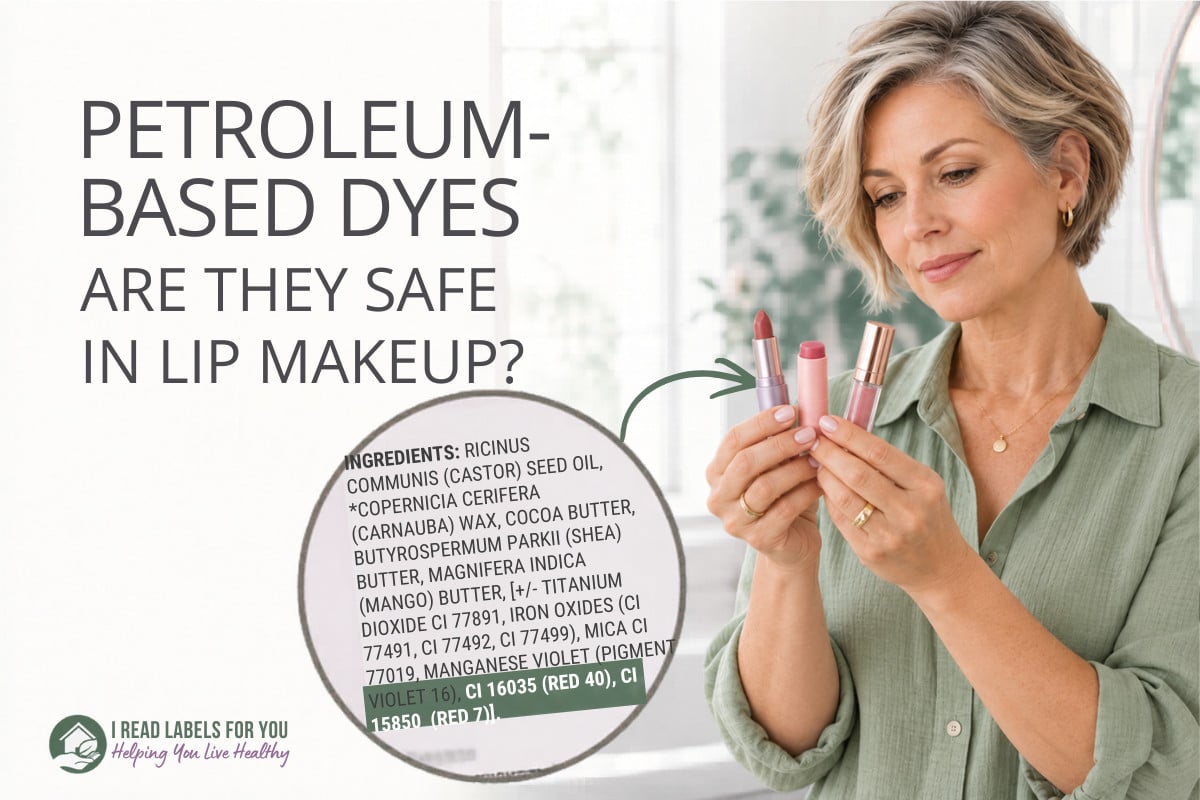
No, I do not consider petroleum-based dyes safe enough for everyday makeup. They are the synthetic colors labeled FD&C, D&C or with a Color Index (CI) number from 10000 to 74999, plus their lakes. Many of their legal specifications allow traces of cancer-linked chemicals left over from manufacturing, including benzidine, 4-aminobiphenyl, aniline and p-toluidine. I rate petroleum-based dyes Not A Fan.
Petroleum-based dyes must be on an approved list before they can be used in cosmetics in both Europe and the United States. Yet the two disagree on which ones are safe. Europe permits 107 of them in cosmetics and restricts 56 by product type, such as rinse-off only or no eye use. Since 2022, Europe has also barred many of them from tattoo and permanent makeup inks.
In this post, you’ll learn which carcinogens FDA chemists have measured inside real certified color batches. Next, you’ll see that Canada bans these dyes near your eyes, while the United States approves two of them there. Finally, you’ll find out which makeup colors are not petroleum-based, and which of those I rate Best.
What Are Petroleum-Based Dyes?
Petroleum-based dyes are synthetic colors built from chemicals refined out of crude oil. The U.S. Food and Drug Administration (FDA) calls them certifiable color additives, and its color additive fact sheet says they are derived primarily from petroleum. You may also see these dyes called “coal-tar dyes” or “synthetic organic colors.”
My rule covers two groups of petroleum-based dyes. First, every color with a CI number from 10000 to 74999, the synthetic organic range. Second, their lakes, which are the same dyes fixed onto a powder base such as alumina.
What Do Petroleum-Based Dyes Do In Cosmetics?
Petroleum-based dyes have one job in makeup: bright, cheap, and consistent color. Water-soluble versions tint liquids and gels, while lakes stay put in oily products because they do not dissolve. The FDA notes that lakes keep a color from “bleeding,” as in lipstick.
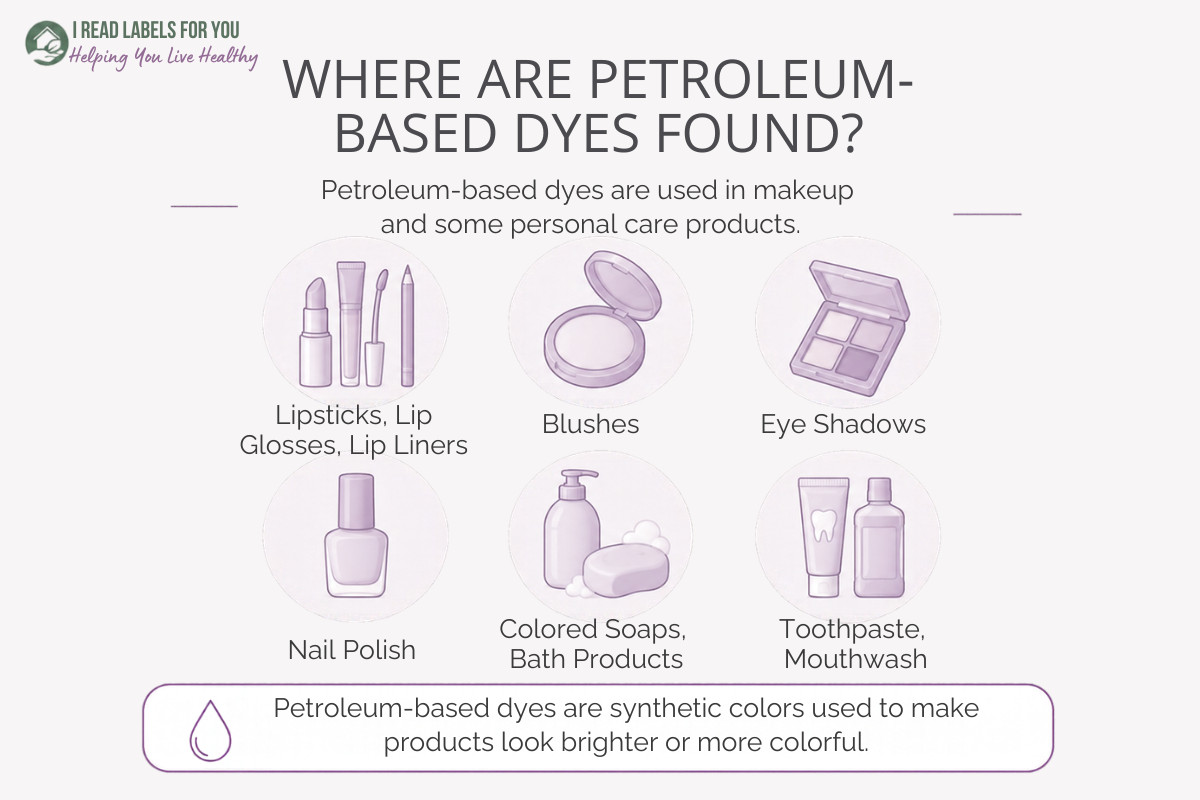
You’ll find petroleum-based dyes most often in:
- lipsticks, lip glosses, lip liners
- blushes
- eye shadows
- nail polish
- colored soaps, bath products
- toothpaste, mouthwash
The volume behind petroleum-based dyes is enormous. In its 2025 certification report, the FDA certified about 22.6 million pounds of these colors for food, drugs and cosmetics combined. FD&C Red No. 40 alone accounted for about 5.4 million pounds.
How Are Petroleum-Based Dyes Made?
Petroleum-based dyes are built step by step from small ring-shaped chemicals called aromatic compounds. Most reds, oranges, and yellows are azo dyes, made by joining aromatic amines through a nitrogen bridge. Some of those starting chemicals and their leftovers are carcinogens, which is why each color’s specification caps named impurities.
Those caps are the rule, not the exception, for petroleum-based dyes. In my review of the 36 colors the FDA certifies for cosmetics, 35 carry at least one named organic impurity limit. The FDA’s history page admits that the starting materials could be “toxins, irritants, sensitizers, or carcinogens.”
Some petroleum-based dyes could never be made clean. The FDA found that External D&C Yellow Nos. 9 and 10 “cannot be produced with any assurance” of being free of β-naphthylamine, and removed them. It called β-naphthylamine “a known carcinogen” and found no safe level for products touching skin.
Do Petroleum-Based Dyes Penetrate The Skin?
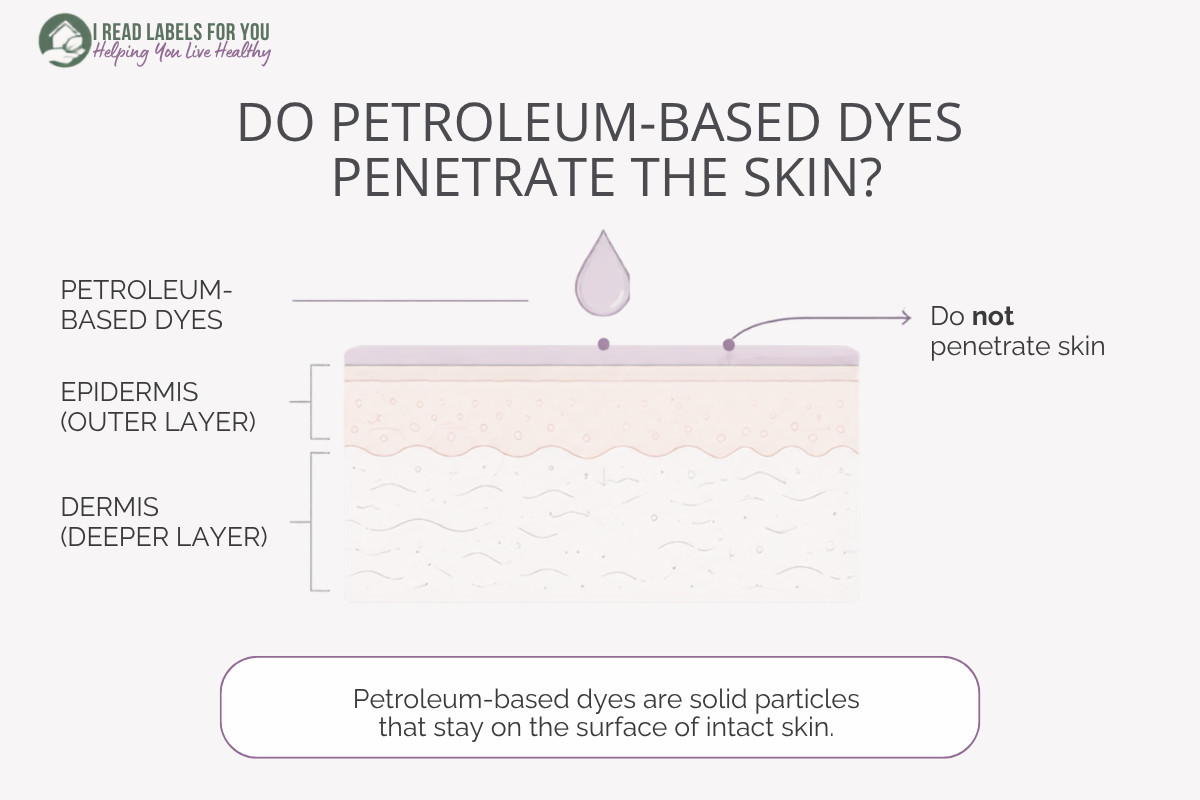
Mostly no for the dyes themselves, but some of their impurities do. Water-soluble petroleum-based dyes, such as FD&C Red No. 40, carry electrically charged groups, and charge blocks passage through skin’s oily outer layer. Lakes are solid particles, which mostly sit on the surface.
The impurities of petroleum-based dyes are smaller and carry no charge. In an FDA laboratory study on human skin, skin absorbed 26.4 percent of a dose of Sudan I within 24 hours. Sudan I is an orange impurity capped in several cosmetic colors, and the skin partly broke it down on the way through.
Germany’s Federal Institute for Risk Assessment (BfR) describes a second route. Its review of cosmetic colorants reports that four permitted azo dyes, including D&C Red No. 17 (CI 26100), split into carcinogenic aromatic amines. For three of them, bacteria living on human skin did the splitting in laboratory tests.
What Are Petroleum-Based Dyes Called On Labels?
On a label, petroleum-based dyes appear in a few predictable forms:
- FD&C Red No. 40 or Red 40
- D&C Red No. 7 Calcium Lake or Red 7 Lake
- Ext. D&C Violet No. 2
- CI 15850 (D&C Red No. 6 and D&C Red No. 7)
- CI 19140 (FD&C Yellow No. 5)
- CI 42090 (FD&C Blue No. 1)
The FDA lets brands shorten a certified name to color and number, such as Yellow 5. Europe uses CI numbers instead, and mineral and natural colors have CI numbers too. Numbers from 10000 to 74999 are petroleum-based dyes, 75000s are natural colors like carmine, and 77000s are inorganic pigments. Most 77000s are minerals like iron oxides, but CI 77266 is carbon black made from petroleum.
Shade ranges add one more wrinkle for petroleum-based dyes. Under U.S. labeling rules, a “may contain” list can cover colors used across a whole range of shades, and Europe also accepts “+/-“. In other words, a label can name dyes that are not in your exact shade.
Does The U.S. FDA Restrict Petroleum-Based Dyes In Food And Cosmetics?
Yes, the FDA restricts petroleum-based dyes more tightly than almost any other cosmetic ingredient. Every color must be listed for a named use, and a federal rule bars any color near the eye unless its listing allows it. On top of that, FDA chemists test a sample from every batch before sale.
Batch testing of petroleum-based dyes exists because of the chemistry. The FDA explains that some colors in their uncertified forms might contain impurities at levels that pose a health concern. Its chemists check each batch for unreacted intermediates, stray colors and lead, arsenic and mercury.
Certification checks petroleum-based dyes against their limits, but the limits themselves allow carcinogens. The cosmetic specification for FD&C Yellow No. 5 permits up to 1 part per billion of benzidine and 5 parts per billion of 4-aminobiphenyl. D&C Red No. 17 may contain 0.1 percent 4-aminoazobenzene, which equals 1 million parts per billion.
Which Petroleum-Based Dyes Has The FDA Already Banned?
The FDA has removed petroleum-based dyes over cancer findings several times. Its list of terminated colors records External D&C Yellow No. 1, contaminated with 4-aminobiphenyl, and D&C Red Nos. 10 to 13, possibly contaminated with β-naphthylamine. It also lists D&C Red No. 19 and D&C Orange No. 17, which caused cancer in rats and mice when swallowed.
FD&C Red No. 3 is the best-known case among petroleum-based dyes. In 1990, the FDA ended its use in cosmetics after “having concluded that FD&C Red No. 3 causes cancer in rats.” In January 2025, it revoked Red No. 3 in food and ingested drugs under the Delaney Clause, a law banning color additives shown to cause cancer.
Fairness matters here, because the FDA calls the Red No. 3 rat tumors “of limited relevance to humans.” The bans follow the law rather than proof of harm in people. In July 2026, the agency described an effort to “phase out petroleum-based color additives from the U.S. food supply,” although cosmetics are not included.
EU Regulations On Petroleum-Based Dyes
Europe allows petroleum-based dyes only from a positive list, Annex IV of the Cosmetics Regulation. Entries 1 to 107 cover the synthetic organic range, and 56 carry product-type limits. Of those, 34 are rinse-off only, 18 are kept off mucous membranes such as the lips, and 4 are kept out of eye products.
Europe goes much further when petroleum-based dyes enter the skin. Since January 4, 2022, entry 75 of REACH, Europe’s chemicals law, has kept many of these colors out of tattoo and permanent makeup inks. It covers any color that cosmetics law limits to rinse-off products or keeps away from eyes or lips. The same rule caps benzidine, aniline and other aromatic amines in those inks at 0.0005 percent.
Clothing gets similar protection from petroleum-based dyes. Entry 43 of REACH bans azo dyes that release listed carcinogenic amines from textiles and leather in “direct and prolonged contact with the human skin.” Makeup falls under the Cosmetics Regulation instead, which relies on each color’s purity limits.
U.S. And EU Disagreements On Petroleum-Based Dyes
Europe and the United States disagree on petroleum-based dyes in both directions. Europe still permits FD&C Red No. 3 as CI 45430 and amaranth as CI 16185, two colors the FDA removed. Meanwhile, the United States certifies every batch, a step Europe does not require.
Europe is stricter on one contaminant group in petroleum-based dyes. Its cosmetics list points colors such as Allura Red (CI 16035) to its food purity rules, which cap “Unsulfonated primary aromatic amines” at 0.01 percent. The U.S. limits for FD&C Red No. 40, FD&C Blue No. 1 and D&C Yellow No. 10 contain no such line.
Canadian Regulations On Petroleum-Based Dyes
Canada takes the strictest line on petroleum-based dyes near the eyes. Its Cosmetic Regulations forbid selling an eye-area cosmetic that contains any coal tar dye, coal tar dye base or coal tar dye intermediate. By contrast, the FDA approves FD&C Blue No. 1 and D&C Green No. 5 for eye-area use. The Health Canada Cosmetic Ingredient Hotlist also bans older dyes outright, including Rhodamine B (CI 45170).
What Contaminants Do Petroleum-Based Dyes Carry?
Petroleum-based dyes carry measurable carcinogenic impurities, and FDA chemists have found them in real batches. In an FDA study of FD&C Yellow No. 6, 34 of 67 batches from 1991 and 1992 held over 10 parts per billion of bound benzidine. One sample reached 941 parts per billion.
Other petroleum-based dyes tell the same story. An FDA survey of FD&C Yellow No. 5 found benzidine, aniline, 4-aminobiphenyl and 4-aminoazobenzene in commercial colors. FDA chemists also found p-cresidine, a possible carcinogen, in commercial batches of FD&C Red No. 40, whose specification sets no limit for it.
Sudan I turns up in petroleum-based dyes too. A 2007 FDA survey found it in 13 of 28 samples of FD&C Yellow No. 6 from 17 manufacturers. More recently, a 2026 FDA survey found 2 of 24 batches of D&C Red No. 36 above federal limits for colored impurities.
Tests of finished makeup containing petroleum-based dyes are scarce and mixed. Taiwan’s Food and Drug Administration found no benzo[a]pyrene in more than 40 lipsticks. By contrast, Germany’s official laboratory in Karlsruhe found a banned red, D&C Red No. 9, in 40 percent of 42 face paints. I could not find any FDA count of rejected batches.
Which Contaminants Can Each Petroleum-Based Dye Carry?
Every petroleum-based dye certified for U.S. cosmetics has its own list of allowed contaminants. I checked each named contaminant against IARC and against Europe’s official hazard list, Annex VI of the CLP Regulation. The table shows only colors whose limits name at least one cancer-linked contaminant or skin sensitizer.
Known means proven to cause cancer in people. Probable or presumed means experts presume it can cause cancer in people, based mainly on strong animal studies. Possible or suspected means the evidence is weaker or limited.
| Color | Cancer-linked contaminants allowed | Skin sensitizers allowed |
| FD&C Yellow No. 5 (CI 19140) | benzidine (known), 4-aminobiphenyl (known), aniline (probable), 4-aminoazobenzene (presumed), azobenzene (presumed) | aniline, sulfanilic acid |
| FD&C Yellow No. 6 (CI 15985) | benzidine (known), 4-aminobiphenyl (known), aniline (probable), 4-aminoazobenzene (presumed), azobenzene (presumed), Sudan I (suspected) | aniline, sulfanilic acid, Sudan I |
| D&C Red No. 33 (CI 17200) | benzidine (known), 4-aminobiphenyl (known), aniline (probable), 4-aminoazobenzene (presumed), azobenzene (presumed) | aniline |
| D&C Red No. 17 (CI 26100) | aniline (probable), 4-aminoazobenzene (presumed), Sudan I (suspected) | aniline, Sudan I |
| D&C Red No. 6 and No. 7 (CI 15850) | p-toluidine (suspected), 4-methyl Sudan I (possible) | p-toluidine |
| D&C Red No. 31 (CI 15800) | aniline (probable) | aniline |
| D&C Green No. 5 (CI 61570) and No. 6 (CI 61565) | p-toluidine (suspected) | p-toluidine |
| D&C Violet No. 2 (CI 60725) and Ext. D&C Violet No. 2 (CI 60730) | p-toluidine (suspected), 1-hydroxyanthraquinone (possible) | p-toluidine |
| D&C Brown No. 1 (CI 20170) | xylidines (one form possible) | sulfanilic acid, resorcinol |
| D&C Orange No. 4 (CI 15510) | none named | sulfanilic acid |
| D&C Yellow No. 7 and No. 8 (CI 45350) | none named | resorcinol |
The limits for the remaining petroleum-based dyes name no cancer-linked contaminant or skin sensitizer. Those include FD&C Blue No. 1 (CI 42090), FD&C Red No. 40 (CI 16035) and FD&C Green No. 3 (CI 42053). D&C Red Nos. 21 and 22 (CI 45380) and 27 and 28 (CI 45410) are on that list too.
D&C Red Nos. 30 (CI 73360), 34 (CI 15880) and 36 (CI 12085) and D&C Yellow No. 11 (CI 47000) round out the list. However, FDA testing of real batches tells a different story for several of them.
What Have FDA Chemists Found That The Limits Do Not Name?
Not named does not mean absent for petroleum-based dyes. Nearly every FDA specification also allows other impurities “to the extent that such impurities may be avoided by current good manufacturing practice.” In other words, unavoidable traces of unlisted chemicals are legal.
FDA chemists found p-cresidine, a possible carcinogen, and aniline in commercial batches of FD&C Red No. 40, whose limits name neither. Azo colors like Red No. 40 are built from aromatic amines, so traces of those starting chemicals are likely in other azo dyes too.
FDA laboratories have found other unnamed contaminants in petroleum-based dyes too. The table draws on one FDA study and another of D&C Red No. 27 and No. 28. Further FDA studies covered D&C Red No. 21 and No. 22, D&C Red No. 30 and D&C Yellow No. 10. Each measured batches that manufacturers had submitted for certification.
| Color | Contaminant found but not named in its FDA limits | How often FDA chemists found it | Classification |
| D&C Red No. 27 and No. 28 (CI 45410) | hexachlorobenzene | all 30 certified batches tested, 0.2 to 244.3 ppm | presumed carcinogen (EU); possible (IARC) |
| D&C Red No. 27 and No. 28 (CI 45410) | 2-bromo-3,4,5,6-tetrachloroaniline | 22 of 35 certified lots, up to 435.7 ppm | not classified |
| D&C Red No. 21 and No. 22 (CI 45380) | 2,4,6-tribromoaniline | 12 of 23 certified lots, 19.9 to 638.9 ppm | not classified |
| D&C Red No. 30 (CI 73360) | BTZ, a chlorinated by-product | 37 certified batches tested, up to 0.84 percent | not classified |
| D&C Yellow No. 10 (CI 47005) | 1,5-naphthyridinophthalone | 18 of 26 certified batches, up to 169.94 ppm | not classified; related to a known allergen |
| FD&C Red No. 40 (CI 16035) | p-cresidine and aniline | commercial batches | possible carcinogen (p-cresidine); probable carcinogen and skin sensitizer (aniline) |
Hexachlorobenzene is the most striking finding among these petroleum-based dyes. Europe classifies it as a presumed human carcinogen, and FDA chemists found it in every batch of D&C Red No. 27 and No. 28 they tested. They suggested it could be reduced by avoiding starting material “heavily contaminated with HCB.”
The lake form of one petroleum-based dye has a gap of its own. For D&C Red No. 34 (CI 15880), FDA chemists write that there is no specified limit for subsidiary colors in the lakes. Several of these studies are more than 20 years old, and none tested finished makeup.
Do All Colorants Carry Heavy Metals?
Heavy metals are a separate issue, because every colorant can carry traces of lead, arsenic and mercury, mineral pigments included. The FDA notes that color additive limits for lead are typically 10 to 20 parts per million. However, the FDA estimates that skin absorbs only about 0.41 percent of the lead in makeup applied to the skin.
The U.S. Agency for Toxic Substances and Disease Registry names swallowing as the main route for most people. For lipstick, the FDA counts the lead you swallow, not what passes through your lips. I run the numbers in my post on heavy metals in food and cosmetics.
Metal residues also differ from organic contaminants in one more way. Europe’s official hazard list gives lead, arsenic and inorganic mercury compounds no skin sensitizer classification. By contrast, aniline, p-toluidine and Sudan I carry one, and Sudan I passes through human skin.
Can Petroleum-Based Dyes Cause Skin Allergy And Sensitization?
Yes, some petroleum-based dyes and their impurities can cause skin allergy, though far less often than fragrance or preservatives. In Japan, a 1977 study of 53 patients linked pigmented cosmetic dermatitis, a lasting darkening of facial skin, to coal tar dyes. A 1979 follow-up found the impurity Sudan I was “a strong allergen in all cases.”
Lipstick colors can inflame the lips as well. Case reports link lip dermatitis to D&C Red No. 7 and D&C Yellow No. 11. Even so, no makeup dye appears on the American Contact Dermatitis Society (ACDS) Core Allergen Series 2020, although carmine, a natural red, does.
A review of cosmetic allergy names fragrances and preservatives as “the most common allergens.” In other words, allergy to petroleum-based dyes is real but uncommon, and impurities are sometimes the true trigger.
Are Petroleum-Based Dyes Hormone (Endocrine) Disruptors?
No, petroleum-based dyes have not been identified as hormone disruptors, but they have not been checked either. As far as I could find, no regulator has run an endocrine assessment on any certified cosmetic color. The one hormone-related finding is FD&C Red No. 3, which disturbed thyroid hormones in male rats.
Are Petroleum-Based Dyes Safe To Use While Pregnant?
Nobody knows whether petroleum-based dyes in makeup are safe during pregnancy because I found no study on it. The concern is the same set of carcinogenic impurities, and lipstick adds a second route because you swallow part of it. If you’re pregnant or nursing, you should consult with your medical provider regarding the colors you wear. Switching to mineral colors is an easy precaution in the meantime.
Are There Any Cancer Concerns Linked To Petroleum-Based Dyes?
Yes, petroleum-based dyes raise cancer concerns, mainly through their impurities rather than the dyes themselves. The International Agency for Research on Cancer (IARC) classifies benzidine and 4-aminobiphenyl as carcinogenic to humans, both causing bladder cancer. Both are capped, not banned, in FD&C Yellow No. 5.
IARC also classifies dyes metabolized to benzidine as carcinogenic to humans, because the body splits them back into benzidine. Those are textile and leather dyes, not makeup colors. Still, the BfR has shown that permitted azo colors can split into other carcinogenic amines.
No study has shown that wearing approved petroleum-based dyes causes cancer in people. The impurity amounts are tiny, measured in parts per billion. My concern is daily, lifelong exposure to known carcinogens in products that offer nothing beyond color.
Are Petroleum-Based Dyes Bad For The Environment?
I could not find a regulatory environmental assessment of petroleum-based dyes as used in makeup. Individual dyes may carry their own classifications.
Which Makeup Colors Are Not Petroleum-Based?
Mineral pigments are the main alternative to petroleum-based dyes, and I rate them Best. They include iron oxides (CI 77491, CI 77492, CI 77499) and ultramarines (CI 77007). Manganese violet (CI 77742) and mica belong here too. Most cosmetic grades are synthesized for purity rather than mined, yet none of them begins with crude oil.
D&C Black No. 2 (CI 77266) is the trap here, because its CI number sits among the mineral pigments. Yet it is carbon black made by burning petroleum oil, and I explain why I rate it Not A Fan in my post on D&C Black No. 2. For black, look for iron oxide (CI 77499) instead.
Titanium dioxide (CI 77891) is a mineral pigment I rate Better (Limited Use). Europe limits its fine powder in cosmetics and bans uses that could reach your lungs. Therefore, I accept it in pressed and liquid makeup but not in loose powders or sprays.
Chromium oxide greens (CI 77288, CI 77289) are mineral pigments I rate Better (Not In My Top Picks). The pigment itself is the low-risk trivalent form of chromium, but chromium is one of the most common skin allergens. Europe’s colorant list requires these greens to be “free from chromate ion,” without a measured limit. The FDA caps the chromium that dissolves in a lab test at 0.075 percent and keeps the greens out of lip products.
Natural and nature-identical colors fall outside my petroleum-based dye rule, so I rate them one by one. I rate beta-carotene (CI 40800), annatto (CI 75120), and beetroot Best. Beta-carotene is often lab-made but matches the orange pigment in carrots, and annatto comes from the seeds of the achiote tree.
Carmine (CI 75470), a red made from the cochineal insect, is the exception. I rate carmine Better (Not In My Top Picks) because it is a recognized skin allergen. The American Contact Dermatitis Society added carmine to its Core Allergen Series in 2020, noting a 3.1 percent reaction rate in North American patch testing.
Common Claims About Petroleum-Based Dyes: What’s True And What’s Not
Claim: Petroleum-Based Dyes Are Made From Coal Tar
This claim about petroleum-based dyes is out of date rather than false. The coal-tar name stuck from history, and the FDA fact sheet states that today, most are made from petroleum. Both sources supply the same kind of aromatic chemistry, so the concern is unchanged.
Claim: Any CI Number On A Label Means A Coal Tar Dye
This claim is too broad. Iron oxides, mica, and carmine all carry CI numbers as well. Only numbers from 10000 to 74999 point to the petroleum-based dyes this post covers, plus CI 77266, a petroleum-made black pigment.
Claim: FD&C And D&C Colors Are Carcinogens
This claim overstates the evidence on petroleum-based dyes. Most certified colors have never been shown to cause cancer themselves, and Red No. 3 is the main exception, in male rats. The accurate statement is narrower: these colors are made with carcinogenic chemistry and may legally carry carcinogenic residues.
What I Think About Petroleum-Based Dyes — And What You Should Do
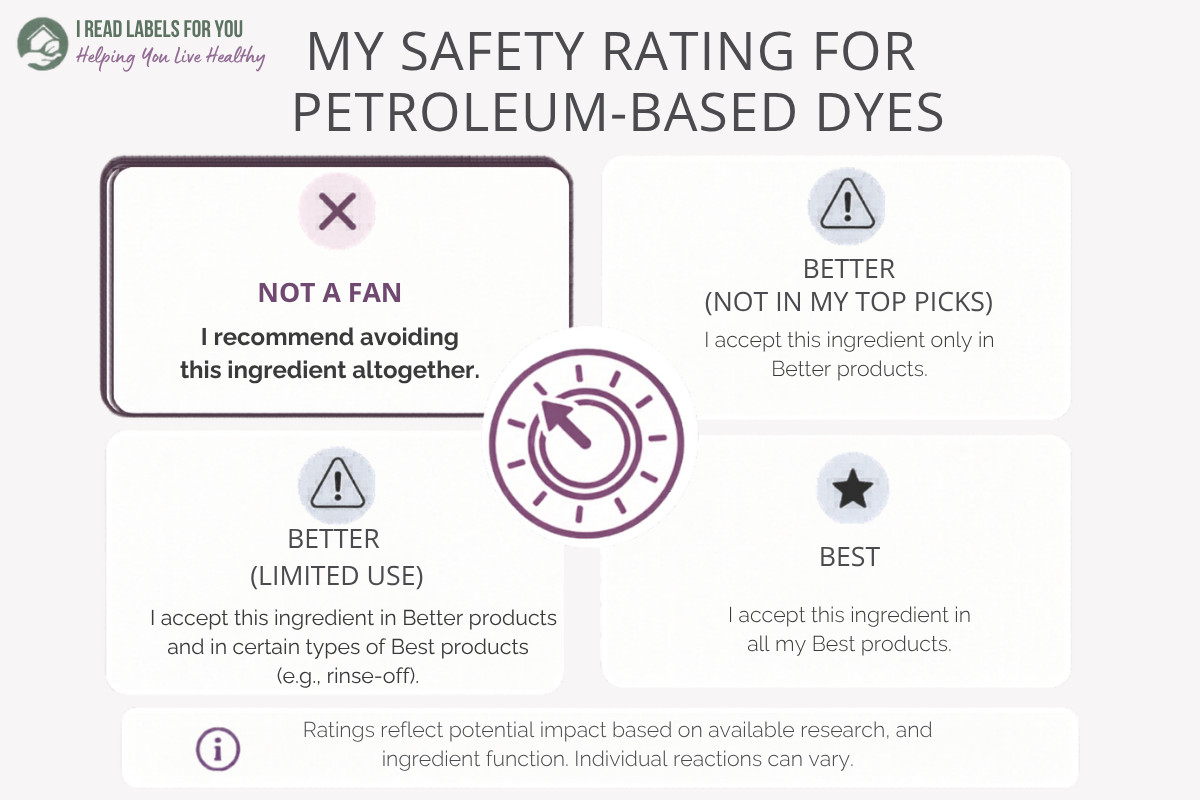
My rating for petroleum-based dyes is Not A Fan, and I recommend avoiding them in makeup. The concern is how they are made and what they may carry. Here are my reasons:
- They are made from petroleum chemistry whose starting materials and leftovers include known human carcinogens.
- Their legal limits allow traces of carcinogens, such as benzidine in FD&C Yellow No. 5.
- FDA chemists have found those impurities in real certified batches, plus unnamed ones such as hexachlorobenzene in D&C Red No. 27 and No. 28.
- Some impurities pass through skin, and skin bacteria can split certain azo dyes into carcinogenic amines.
- The FDA has already removed several of these colors over cancer findings, most recently Red No. 3.
- While still rare, high-performing makeup without petroleum-based dyes does exist.
To be fair, the amounts are tiny, and no study shows that wearing approved petroleum-based dyes causes cancer in people. Still, daily exposure from multiple products, especially where makeup gets swallowed, adds up.
Here is what I suggest instead of petroleum-based dyes. Check labels for FD&C, D&C, “Lake” and CI numbers from 10000 to 74999, plus CI 77266. Then choose makeup colored with iron oxides, manganese violet, and mica, starting with your lip products.
Frequently Asked Questions About Petroleum-Based Dyes
Are Lake Dyes Safer Than Regular Dyes?
No, a lake is the same petroleum-based dye fixed onto a powder base. Federal rules define a lake as “a straight color extended on a substratum.” It stays put better on your lips, but it carries the same dye.
What Do FD&C, D&C And Ext. D&C Mean?
These prefixes tell you where the FDA allows a petroleum-based dye. According to the FDA, FD&C means Food, Drugs and Cosmetics, D&C means Drugs and Cosmetics, and Ext. D&C means External Drugs and Cosmetics. None of these prefixes means a color is natural.
Does A Natural Certification Rule Out These Dyes?
Usually yes, which makes certification a helpful shortcut for avoiding petroleum-based dyes. NATRUE states that its certified products “contain only 100% natural, derived natural and nature-identical ingredients,” with only certain pigments allowed in lab-made form. Words like “clean” or “vegan” carry no such rule, so read the ingredient list.
Sources
EU SCCS / SCCP Opinions:
Scientific Committee on Consumer Safety opinions portal, for individual colorant opinions. No single opinion covers petroleum-based dyes as a class (checked): SCCS opinions portal
Cosmetic Ingredient Review (CIR) Reports:
CIR does not review FDA-certified color additives, which the FDA lists directly under 21 CFR (checked): CIR reports database
European Union Regulatory Databases:
Regulation (EC) No 1223/2009, Annex IV, list of colorants allowed in cosmetic products, with the preamble stating that a colorant includes its salts and lakes. Entries 1 to 107 cover the synthetic organic range: Annex IV
CosIng, the European Commission cosmetic ingredient database, used to check Annex IV entries including CI 45430 (entry 80) and CI 16185 (entry 33): CosIng database
Commission Regulation (EU) No 231/2012, purity criteria for food colors, consolidated text of April 23, 2024, including the 0.01 percent limit on unsulfonated primary aromatic amines for E 129, E 133, E 104, E 102, E 110 and E 124: EUR-Lex
CLP Regulation (EC) No 1272/2008, Annex VI harmonised classifications up to the 23rd adaptation (Regulation (EU) 2025/1222), used for every contaminant in the table. Lead, arsenic and inorganic mercury compounds carry no skin sensitizer classification: EUR-Lex
European Chemicals Agency (ECHA), REACH Annex XVII entry 43, azo dyes in textile and leather articles: ECHA entry 43
ECHA, REACH Annex XVII entry 50, eight PAHs in rubber and plastic parts touching skin: ECHA entry 50
ECHA, REACH Annex XVII entry 75, tattoo inks and permanent makeup, in force since January 4, 2022: ECHA entry 75
Other Regulators:
U.S. FDA, Color Additives and Cosmetics Fact Sheet, on certifiable colors, label names and lakes: FDA fact sheet
U.S. FDA, Color Certification FAQs, on why batch certification exists and what the lab checks: FDA certification FAQs
U.S. FDA, How Safe Are Color Additives?, on certifiable versus exempt colors and the FD&C, D&C and Ext. D&C prefixes: FDA consumer update
U.S. FDA, Color Additives History: FDA history page
U.S. FDA, Summary of Color Additives for Use in the United States, including eye-area approvals: FDA summary table
U.S. FDA, Regulatory Status of Color Additives database: FDA status list
21 CFR 81.10, termination of provisional listings, including External D&C Yellow Nos. 1, 9 and 10, D&C Red Nos. 10 to 13 and 19, D&C Orange No. 17 and FD&C Red No. 3: eCFR 81.10
21 CFR 70.3 (definition of a lake) and 21 CFR 70.5 (eye-area rule): eCFR 70.3, eCFR 70.5
21 CFR 701.3, cosmetic ingredient labeling, including “may contain” lists for shades: eCFR 701.3
The 21 CFR 74.2705, FD&C Yellow No. 5 for cosmetics, with limits on benzidine, 4-aminobiphenyl, 4-aminoazobenzene and aniline: eCFR 74.2705
21 CFR 74.1317, D&C Red No. 17 specifications, including 4-aminoazobenzene at 0.1 percent: eCFR 74.1317
21 CFR 73.1327 and 73.2327, chromium oxide greens: chromium in 2% NaOH extract capped at 0.075% as Cr2O3; externally applied cosmetics, including the eye area: eCFR 73.1327, eCFR 73.2327
Federal Register, January 16, 2025, FDA order revoking FD&C Red No. 3 in food and ingested drugs: Federal Register 2025
U.S. FDA, FD&C Red No. 3 page: FDA Red No. 3 page
U.S. FDA news release, July 22, 2026, on Orange B and Citrus Red No. 2, removed for abandoned use: FDA news release
U.S. FDA, Report on the Certification of Color Additives, fourth quarter of fiscal year 2025, pounds certified: FDA certification report
Dyestuffs and Chemicals, Inc. v. Flemming, U.S. Court of Appeals, on the 1957 delisting of FD&C Yellow Nos. 1 to 4: court opinion
Canada, Cosmetic Regulations, C.R.C., c. 869, section 14, coal tar dyes in the eye area: Cosmetic Regulations
Health Canada, Cosmetic Ingredient Hotlist, prohibited dyes including Rhodamine B and Pigment Red 53, and restrictions on D&C Red No. 17: Cosmetic Ingredient Hotlist
International Agency for Research on Cancer (IARC), Monographs Volume 100F, benzidine and 4-aminobiphenyl, Group 1: IARC benzidine, IARC 4-aminobiphenyl
IARC, Monographs Volume 99, dyes metabolized to benzidine, Group 1: IARC dyes metabolized to benzidine
IARC, Agents Classified by the IARC Monographs, Volumes 1 to 123, used for every contaminant in the table, including para-Cresidine (CAS 120-71-8), Group 2B (Volume 27 and Supplement 7, 1987). Aniline was moved to Group 2A in Volume 127 (2021): IARC classification list
U.S. FDA, Lead in Cosmetics, on lead limits in color additives: FDA lead page
U.S. FDA, Supporting Document for Recommended Maximum Lead Level in Cosmetic Lip Products and Externally Applied Cosmetics, December 2016, on lead absorbed through skin: FDA supporting document
Agency for Toxic Substances and Disease Registry, ToxGuide for Lead, August 2020, on routes of exposure: ATSDR ToxGuide
PubChem Records (Chemistry, Identifiers, Skin Penetration, Hazard Codes):
This post covers a class of colors rather than one chemical; individual PubChem records will appear in the post on each dye: PubChem
Peer-Reviewed Studies:
Peiperl MD, Prival MJ, Bell SJ, 1995. Determination of combined benzidine in FD&C Yellow No. 6. Food and Chemical Toxicology. FDA authors. PMID 7590527: PubMed 7590527
Bailey JE, Bailey CJ, 1985. Determination of aromatic amines in FD&C Yellow No. 5. Talanta. FDA authors. PMID 18963913: PubMed 18963913
Richfield-Fratz N, et al, 1989. Isolation, characterization and determination of trace organic impurities in FD&C Red No. 40. Journal of Chromatography. FDA authors. PMID 2753932: PubMed 2753932
Petigara BR, Scher AL, 2007. Direct method for determination of Sudan I in FD&C Yellow No. 6 and D&C Orange No. 4. Journal of AOAC International. FDA authors. PMID 17955981: PubMed 17955981
Weisz A, et al, 2026. Determination of subsidiary colors in D&C Red No. 36 (Pigment Red 4). Journal of AOAC International. FDA authors. PMID 41075170: PubMed 41075170
Collier SW, Storm JE, Bronaugh RL, 1993. Reduction of azo dyes during in vitro percutaneous absorption. Toxicology and Applied Pharmacology. FDA authors. PMID 8430426: PubMed 8430426
Platzek T, et al, 2005. Cosmetic colorants: toxicology and regulation (in German). Bundesgesundheitsblatt. BfR authors. PMID 15650909: PubMed 15650909
Wang SW, et al, 2019. Determination of PAHs in cosmetic products by gas chromatography-tandem mass spectrometry. Journal of Food and Drug Analysis. Taiwan FDA authors. PMID 31324297: PubMed 31324297
Keck-Wilhelm A, et al, 2015. Prohibited colouring agents in face paint, with special regard to CI 15585 (D&C Red No. 9). International Journal of Cosmetic Science. CVUA Karlsruhe. PMID 25393482: PubMed 25393482
Andrzejewski D, Weisz A, 1999. Rapid quantification of hexachlorobenzene in the color additives D&C Red Nos. 27 and 28 (phloxine B). Journal of Chromatography A. FDA authors. PMID 10591462: PubMed 10591462
Weisz A, Andrzejewski D, 2003. Identification of 2-bromo-3,4,5,6-tetrachloroaniline and its quantification in the color additives D&C Red Nos. 27 and 28. Journal of Chromatography A. FDA authors. PMID 12924789: PubMed 12924789
Weisz A, Andrzejewski D, Rasooly IR, 2004. Determination of 2,4,6-tribromoaniline in the color additives D&C Red Nos. 21 and 22 (Eosin Y). Journal of Chromatography A. FDA authors. PMID 15584238: PubMed 15584238
Weisz A, et al, 2021. Identification and quantification of 7-chloro-5-methyl-2H-1,4-benzothiazin-3(4H)-one (BTZ) in the color additive D&C Red No. 30. Journal of Chromatography A. FDA and NIH authors. PMID 33422799: PubMed 33422799
Weisz A, et al, 2018. Identification of 1′,5′-naphthyridinophthalone and its quantification in the color additive D&C Yellow No. 10. Food Additives and Contaminants Part A. FDA and NIH authors. PMID 29279012: PubMed 29279012
Belai N, Harp BP, Mazzola EP, et al, 2012. Subsidiary colors in D&C Red No. 34 and its lakes. Dyes and Pigments. FDA authors: Dyes and Pigments 2012
Sugai T, Takahashi Y, Takagi T, 1977. Pigmented cosmetic dermatitis and coal tar dyes. Contact Dermatitis. PMID 589997: PubMed 589997
Kozuka T, et al, 1979. Brilliant Lake Red R as a cause of pigmented contact dermatitis. Contact Dermatitis. PMID 509931: PubMed 509931
Ha JH, et al, 2003. Allergic contact cheilitis from D&C Red No. 7 in lipstick. Contact Dermatitis. Case report. PMID 12786738: PubMed 12786738
Sasseville D, Joncas V, 2009. Allergic contact cheilitis from D&C Yellow 11. Contact Dermatitis. Case report. PMID 19397626: PubMed 19397626
Alani JI, Davis MDP, Yiannias JA, 2013. Allergy to cosmetics: a literature review. Dermatitis. PMID 24201464: PubMed 24201464
Natural Cosmetic Standards:
COSMOS-standard approved raw materials: COSMOS database
NATRUE certified and approved raw materials, and NATRUE FAQ on natural and nature-identical ingredients: NATRUE certified world, NATRUE FAQ
Skin Allergy Resource:
American Contact Dermatitis Society (ACDS), Helpful References, including Core Allergen Series 2020. No FD&C or D&C makeup color is on the series; carmine is: ACDS Helpful References
Schalock PC, et al, 2020. American Contact Dermatitis Society Core Allergen Series: 2020 Update. Dermatitis. PMID 32947457: PubMed 32947457
Last verified: 10-09-2026

Download The Free Guide!
5 Powerful Steps To A Non-Toxic Home
Join our informed consumer community and get our free guide the “5 Powerful Steps To A Non-Toxic Home”.


Before commenting, please read our Comment Policy.