
Is Polyaminopropyl Biguanide Safe? A Simple Answer You Can Trust
 Written by Irina Webb
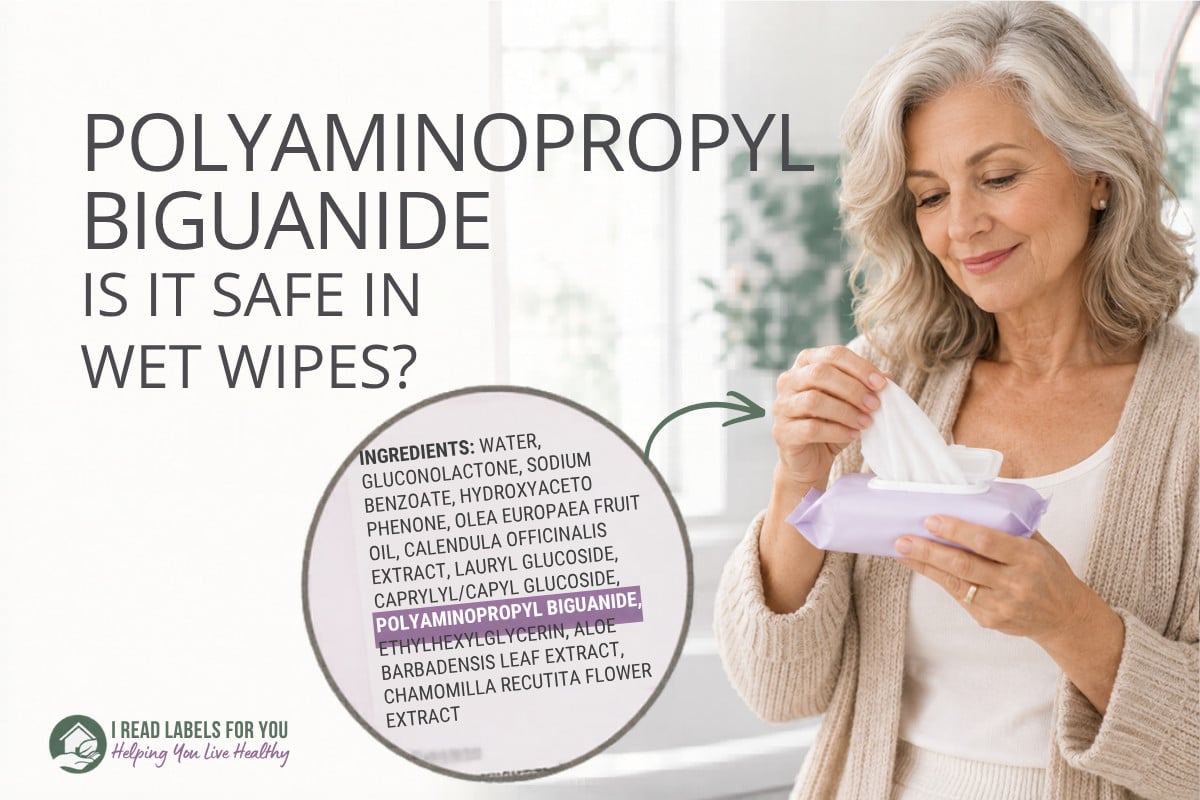
No, Polyaminopropyl Biguanide (PHMB) is not an ingredient I trust in cosmetics, and least of all in baby wipes. It’s a preservative that Europe officially lists as a suspected carcinogen and a skin allergen. That’s why it sits in my Not A Fan tier.
Polyaminopropyl Biguanide is allowed in European Union cosmetics only at 0.1% or less, and never in sprays you could breathe in. Europe actually treated it as prohibited from 2015 until its safety committee cleared the lower level. The U.S. and Canada set no limits on it at all.
Keep reading to learn:
- why the name on the label does not match the chemical in the bottle
- how a wound antiseptic ended up preserving baby wipes
- whether PHMB is the chemical behind the Korean humidifier deaths
What Is Polyaminopropyl Biguanide?
Polyaminopropyl Biguanide is a man-made germ killer. It’s a long chain, or polymer, built from repeating units called biguanides, the same chemical family as the hospital antiseptic chlorhexidine.
The name is misleading, though. The Cosmetic Ingredient Review (CIR), the industry-funded U.S. safety panel, explains that the label name refers to polyhexamethylene biguanide hydrochloride. In other words, the real chemical has a 6-carbon link in each unit, not the 3-carbon link the name suggests.
What Does Polyaminopropyl Biguanide Do In Cosmetics?
In cosmetics, PHMB works only as a preservative. It kills a wide range of bacteria, yeasts and molds, and it dissolves freely in water. Consequently, brands favor it for watery products, such as wipes and lotions, where germs grow fastest.
Outside cosmetics, it has a long list of jobs. Hospitals use it to clean wounds and preserve dressings, and it disinfects contact lenses, swimming pools, farm equipment, and food-handling surfaces. The CIR counted it in 147 U.S. cosmetic products in 2019, mostly leave-on ones.
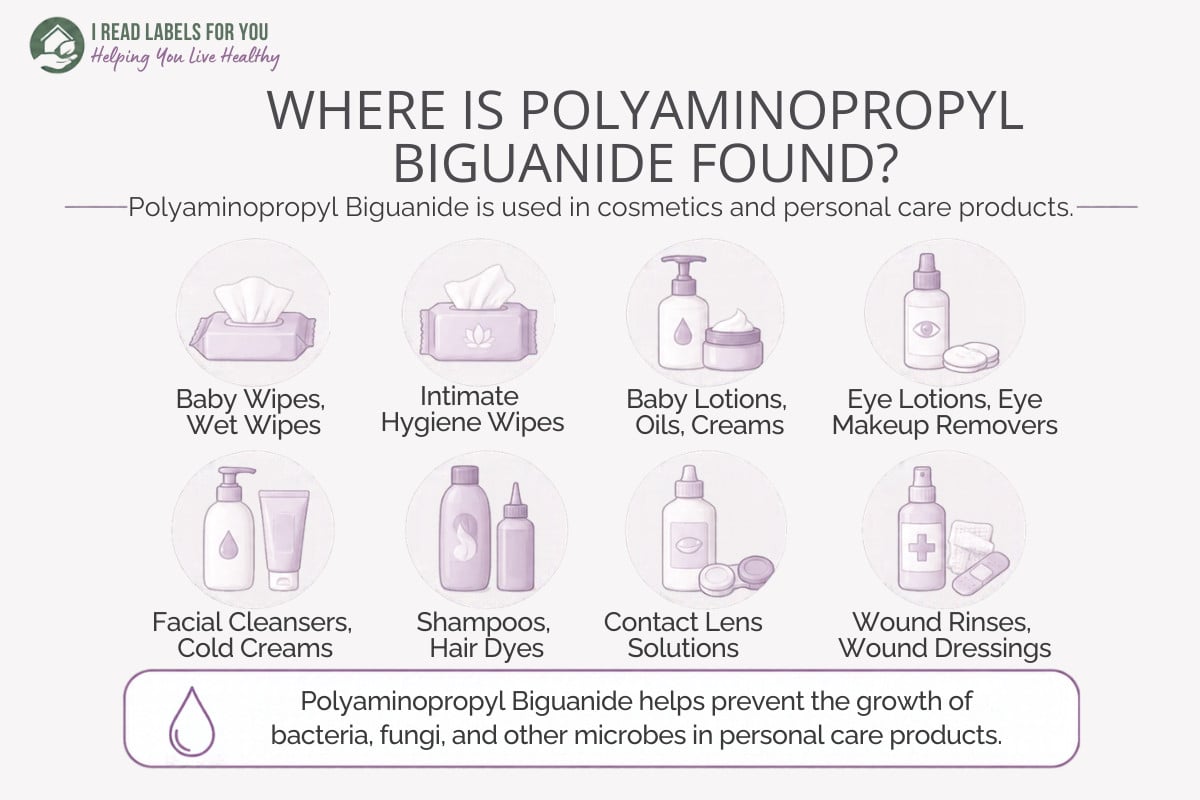
You’ll find Polyaminopropyl Biguanide most often in:
- baby wipes and wet wipes
- intimate hygiene wipes
- baby lotions, oils, and creams
- eye lotions and eye makeup removers
- facial cleansers and cold creams
- shampoos and hair dyes
- contact lens solutions
- wound rinses and wound dressings
It’s not a food ingredient. However, the U.S. Environmental Protection Agency allows tiny residues on food when it’s used as a food-contact surface sanitizer.
How Is Polyaminopropyl Biguanide Made?
Manufacturers link two building blocks into chains: hexamethylenediamine and hexamethylenebisdicyandiamide. Its finished chains vary in length, from 1 to about 40 repeating units, and the product is supplied as a salt. The final ingredient is more than 94% pure.
The Scientific Committee on Consumer Safety (SCCS) is Europe’s panel of cosmetic safety experts. Its 2017 opinion lists leftovers: both building blocks, several side products, and trace metals. Notably, the two building blocks are not considered gene-damaging.
Does Polyaminopropyl Biguanide Penetrate The Skin?
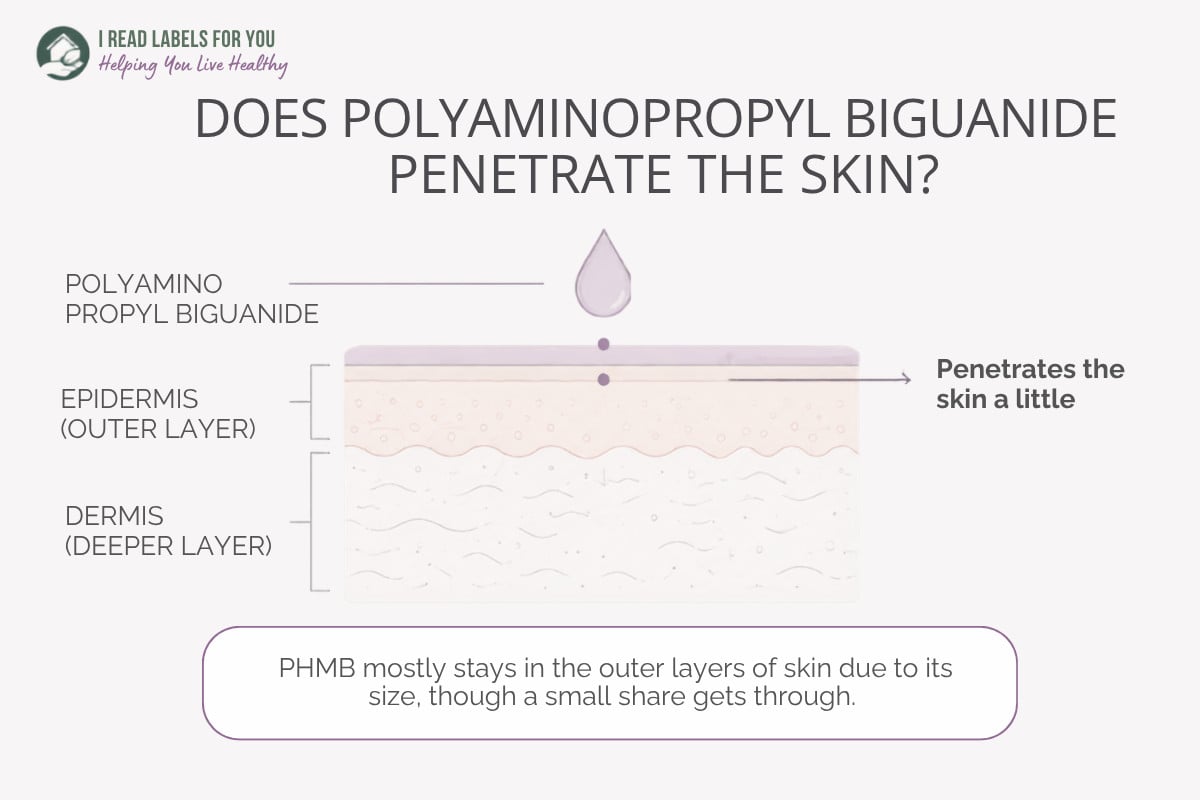
Only a little: PHMB mostly stays in the outer layers of skin, though a small share gets through. Size is the main barrier here.
Its average chain weighs 2,670 to 4,216 daltons, a unit of molecular size. Skin keeps out most molecules above about 500 daltons.
Its love of water adds a second barrier.
Its LogP, a score of how oily or watery a molecule is, sits at minus 2.3. That means it strongly prefers water over the oily outer skin layer.
Still, about 6% of the material consists of short pieces under 500 daltons, and those can slip in.
For its safety math, the SCCS counted 4.09% of a dose as absorbed. That figure is cautious by design. The committee noted the test setup could overestimate absorption, so the real amount may be lower.
What Is Polyaminopropyl Biguanide Called On Labels?
Look for these names in an ingredient list:
- Polyaminopropyl Biguanide
- PHMB
- Polyhexamethylene Biguanide
- Polyhexamethylene Biguanide Hydrochloride
- Polihexanide
- Polyhexanide
- Cosmocil CQ
- Vantocil IB
Cosmocil CQ and Vantocil IB are trade names that you might see on supplier sheets or in wound-care products rather than on cosmetic labels.
Does The U.S. FDA Restrict Polyaminopropyl Biguanide In Food And Cosmetics?
No, Polyaminopropyl Biguanide faces no cosmetic limit from the U.S. Food and Drug Administration (FDA). It’s missing from the agency’s prohibited and restricted ingredients list, which names only a handful of substances.
As a result, U.S. brands can use more than Europe permits. The CIR reported eye lotions at 0.2%, double the European ceiling. In fact, that level failed the CIR’s own allergy risk calculation.
Under U.S. law, companies largely judge their own ingredients safe before selling them. Europe works differently: its precautionary principle lets regulators limit a chemical as soon as a credible risk appears, before harm is proven.
EU Regulations On Polyaminopropyl Biguanide
The European Union officially classifies Polyaminopropyl Biguanide as a suspected carcinogen, category 2. Its harmonized label also lists “May cause an allergic skin reaction” and “Fatal if inhaled,” according to the European Chemicals Agency (ECHA).
Under EU cosmetics law, a category 2 suspected carcinogen is banned unless the SCCS finds a use safe. When the classification took effect on January 1, 2015, the SCCS had just judged PHMB “not safe” at the old 0.3% limit. Therefore, the committee wrote that PHMB was “considered prohibited” from that date.
Industry returned with new data, and the 2017 SCCS opinion found 0.1% safe in all cosmetic products. Even so, it added that “its use in sprayable formulations is not advised.”
In 2019, Regulation (EU) 2019/831 set the current rule. PHMB now sits in Annex V, entry 28, the list of approved preservatives, at a maximum of 0.1%. It must not be used in products that could reach your lungs.
U.S. And EU Disagreements On Polyaminopropyl Biguanide
Interestingly, Europe trusts PHMB less as a disinfectant than as a cosmetic preservative. Under its biocide rules, the EU refused to approve PHMB for human hygiene products or for preserving stored products. The reason given: exposure there may be significant.
The U.S. has no such limits. Here, the same chemical appears in wipes, lotions, and eye products with no cap, no spray restriction and no warning on the label.
Canadian Regulations On Polyaminopropyl Biguanide
Canada does not restrict Polyaminopropyl Biguanide in cosmetics. Health Canada’s Cosmetic Ingredient Hotlist, its list of banned and limited cosmetic ingredients, does not mention it under any name.
Likewise, Environment Canada leaves it off Schedule 1 of the Canadian Environmental Protection Act, which names the substances Canada treats as toxic.
Can Polyaminopropyl Biguanide Cause Skin Allergy And Sensitization?
Yes, Polyaminopropyl Biguanide can cause skin allergy, and Europe officially labels it a skin sensitizer. The SCCS called it a “moderate to strong sensitizer in animals.” In people, 2% can trigger a new allergy, and reactions can then appear at 0.2%.
Among patients tested for skin allergies, rates are low but climbing above earlier counts. A 2021 Swedish study of 1,760 patients found 1.1% reacted, a share its authors called “higher than that previously reported.” Most reactions appeared on the face, head, and neck.
Wipes keep showing up in case reports. Belgian dermatologists described PHMB as a relevant sensitizer in wet wipes in 2014. That same year, the same group reported hives and swelling from intimate hygiene wipes.
Rarely, PHMB causes severe, whole-body allergic reactions called anaphylaxis. The CIR describes two such cases after a surgical wound was cleaned with a 0.2% disinfectant. Moreover, a 2020 study of patients allergic to chlorhexidine found antibodies that also recognized PHMB in 5 of 32 people.
The American Contact Dermatitis Society (ACDS) does not include PHMB in its Core Allergen Series, the standard set dermatologists use for patch testing. Consequently, a PHMB allergy can go undetected unless your dermatologist adds it.
Is Polyaminopropyl Biguanide A Hormone (Endocrine) Disruptor?
No, Polyaminopropyl Biguanide has not been flagged as a hormone disruptor, although no one has studied that question. Neither the SCCS nor the CIR reviewed any hormone studies.
In addition, it’s absent from the European Commission’s list of potential endocrine disruptors in cosmetics and from ECHA’s hormone-disruptor assessments. A PubMed search turned up no hormone study on the polymer.
Is Polyaminopropyl Biguanide Safe To Use While Pregnant?
Animal data suggest Polyaminopropyl Biguanide does not harm fertility or a developing baby, and Europe has not classified it as a reproductive toxicant. In two- and three-generation rat studies, the SCCS saw no effects on reproduction.
Furthermore, the rat pups showed no harm beyond what came from making the mothers sick at high doses. No studies in pregnant women exist, however.
Since PHMB is still a suspected carcinogen and a skin allergen, pregnancy is a sensible time to choose gentler preservatives. If a product you use while pregnant contains PHMB, you should consult with your medical provider.
Are There Any Cancer Concerns Linked To Polyaminopropyl Biguanide?
Yes, there are cancer concerns: Europe officially classifies Polyaminopropyl Biguanide as a suspected human carcinogen. Its Committee for Risk Assessment chose that category after reviewing long-term animal studies.
In those studies, mice fed or painted with very high doses developed more blood-vessel tumors, mainly in the liver. The doses were above the highest amount the animals could tolerate. Rats fed PHMB showed a similar but not statistically significant increase.
The SCCS concluded that “PHMB is not a genotoxic carcinogen,” meaning it does not damage genes directly. It also called the cancer evidence weak, while noting that the risk committee still judged category 2 appropriate.
In contrast, the International Agency for Research on Cancer (IARC), the U.S. National Toxicology Program and California’s Proposition 65 do not list it.
Is Polyaminopropyl Biguanide Bad For The Environment?
Yes, Polyaminopropyl Biguanide is harmful to the environment, especially to water life. Its official EU hazard label warns that it’s highly poisonous to fish and other water creatures, and that the harm lasts.
That’s no surprise, because PHMB is designed to kill living cells. Wipes and rinse-off products send it down the drain. Neither COSMOS nor NATRUE, the two main natural-beauty certifiers, approves it.
Common Claims About Polyaminopropyl Biguanide: What’s True And What’s Not
Claim: PHMB Is Banned In Europe
This claim was true from 2015 to 2019, but it’s outdated now. In 2016, the European consumer group BEUC reported PHMB in products still on Danish shelves, calling it “banned by EU law.”
Today, Europe allows it again at up to 0.1%, outside of sprays. Many websites and even some recent studies still repeat the ban, which explains the confusion.
Claim: PHMB Causes Cancer
This claim goes too far. Europe lists PHMB as a suspected carcinogen, not a proven one, and the tumors appeared only in animals given extreme doses.
Still, “suspected” is an official label based on real tumor findings. For an ingredient you smear on skin every day, that’s reason enough for me to look elsewhere.
Claim: PHMB Is Gentle Because Hospitals Use It On Wounds
This claim is misleading. Medical use shows PHMB is effective, not that it’s harmless. In fact, several of the severe allergic reactions on record happened during wound care.
What I Think About Polyaminopropyl Biguanide — And What You Should Do
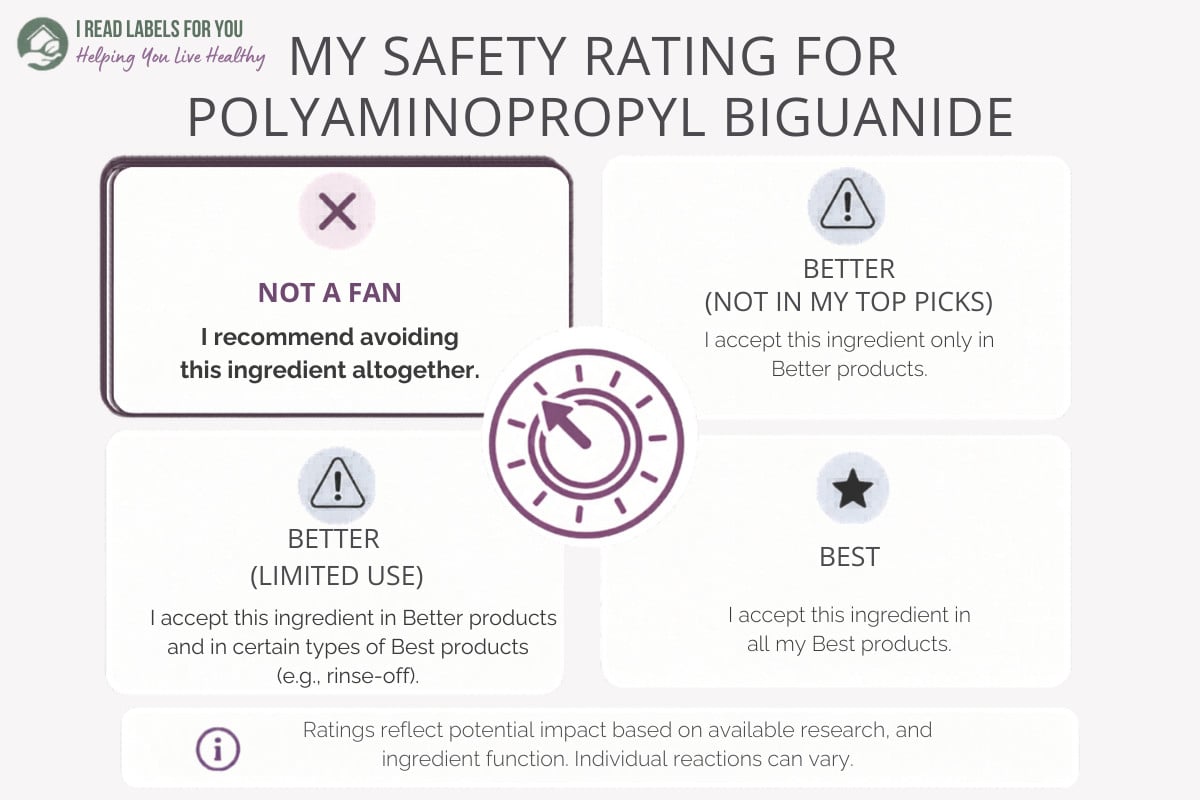
I rate Polyaminopropyl Biguanide Not A Fan. None of my Best or Better products contain it, and neither does any wipe I recommend.
To be fair, PHMB does not damage genes, and the European limit has a wide safety margin. Nonetheless, I will not accept an official suspected-carcinogen label plus a skin-allergy label, especially in products used on babies many times a day.
Here’s what I suggest:
- check wipe labels for Polyaminopropyl Biguanide, PHMB or Polyhexamethylene Biguanide
- use a soft cloth with warm water for diaper changes when you can
- skip PHMB sprays, mists, and spray-on cleansers entirely
- ask your dermatologist to test for PHMB if you have an unexplained rash on your face or diaper area
Frequently Asked Questions About Polyaminopropyl Biguanide
Is PHMB Safe In Baby Wipes?
I do not recommend it. The SCCS confirms that PHMB preserves wet wipes, and wipe residue stays on the skin like a lotion. Diaper skin is often irritated, which makes allergy more likely.
Is PHMB The Same As The Chemical In The Korean Humidifier Disinfectants?
No. The disinfectant blamed for most of the Korean lung-injury deaths was polyhexamethylene guanidine (PHMG), a related but different chemical. A 2017 lung-cell study notes that PHMG caused severe lung scarring, while PHMB also inflamed lung cells in the lab.
That lab finding is one more reason I avoid PHMB sprays.
Is PHMB The Same As Chlorhexidine?
No, but they’re chemical cousins from the biguanide family. If you’re allergic to chlorhexidine, tell your doctor before using PHMB products, since some patients react to both.
Is PHMB Allowed In Natural Or Organic Cosmetics?
No. Neither COSMOS nor NATRUE lists it among approved ingredients. A product preserved with PHMB cannot carry either seal.
Why Does EWG Rate Polyaminopropyl Biguanide Differently?
The Environmental Working Group (EWG) gives PHMB a moderate hazard score of 4, while I rate it Not A Fan. Oddly, the EWG Verified program bans it, and EWG’s page cites the outdated 2015 European opinion as if the ban still applied.
Sources
EU SCCS / SCCP Opinions:
SCCS/1581/16, Opinion on Polyaminopropyl Biguanide (PHMB), Submission III, final opinion adopted April 7, 2017. Safe up to 0.1% in all cosmetic products; sprays not advised. Based on a safety dossier submitted by Cosmetics Europe, the industry trade group: SCCS/1581/16
SCCS/1535/14, Opinion on the safety of poly(hexamethylene) biguanide hydrochloride (PHMB), revision of December 16, 2014, revised July 2015. Not safe up to 0.3%; superseded: SCCS/1535/14
Cosmetic Ingredient Review (CIR) Reports:
Johnson W Jr, Boyer I, Zhu J, Bergfeld WF, et al., 2020. Safety Assessment of Polyaminopropyl Biguanide (Polyhexamethylene Biguanide Hydrochloride) as Used in Cosmetics. International Journal of Toxicology 39(Suppl 3):26S to 73S. Funded by the Personal Care Products Council. Covers naming, impurities, use levels and allergy cases: cir-reports.cir-safety.org
European Union Regulatory Databases:
CosIng ingredient entry 36692, POLYAMINOPROPYL BIGUANIDE, function preservative: CosIng 36692
CosIng substance entry, Annex V entry 28, Polyhexamethylene biguanide hydrochloride, maximum 0.1%, not for uses that may expose the lungs; Carcinogen category 2. Annexes II, III, IV and VI checked; not listed: CosIng Annex V/28
Commission Regulation (EU) 2019/831, which lowered the limit from 0.3% to 0.1%: EUR-Lex 2019/831
CLP Annex VI harmonized classification, Index No. 616-207-00-X: Carc. 2, Skin Sens. 1B, Acute Tox. 2 (inhalation), STOT RE 1, Eye Dam. 1, Aquatic Acute 1, Aquatic Chronic 1: ECHA CHEM
ECHA CHEM regulatory activities. Classification opinions of 2011 and 2014; not REACH-registered; not on the SVHC Candidate List: ECHA CHEM activities
European Commission, potential endocrine disruptors in cosmetics. Not listed: Commission endocrine disruptor page
Other Regulators:
U.S. FDA, prohibited and restricted cosmetic ingredients. Not listed: FDA
U.S. EPA, 40 CFR 180.1280, tolerance exemption for residues from food-contact surface sanitizers: eCFR 180.1280
Health Canada Cosmetic Ingredient Hotlist. Not listed: Health Canada Hotlist
Environment Canada, CEPA Schedule 1. Not listed: CEPA Schedule 1
International Agency for Research on Cancer (IARC). Not classified: IARC list
U.S. National Toxicology Program, 15th Report on Carcinogens. Not listed: NTP Report on Carcinogens
California Proposition 65 list. Not listed: OEHHA
U.S. EPA Integrated Risk Information System. No assessment: IRIS A to Z list
PubChem Records (Chemistry, Identifiers, Skin Penetration, Hazard Codes):
Polyaminopropyl Biguanide has no PubChem compound record (CID), because it’s a polymer. Substance record SID 381123577, CAS 133029-32-0: PubChem SID 381123577
Peer-Reviewed Studies:
Sukakul T, Dahlin J, Pontén A, et al., 2021. Contact allergy to polyhexamethylene biguanide (polyaminopropyl biguanide). Contact Dermatitis 84(5):326 to 331. PMID 33098110: PubMed 33098110
Leysen J, Goossens A, Lambert J, Aerts O, 2014. Polyhexamethylene biguanide is a relevant sensitizer in wet wipes. Contact Dermatitis 70(5):323 to 325. Reviewed in the SCCS opinion. PMID 24731091: PubMed 24731091
Creytens K, Goossens A, Faber M, Ebo D, Aerts O, 2014. Contact urticaria syndrome caused by polyaminopropyl biguanide in wipes for intimate hygiene. Contact Dermatitis 71(5):307 to 309. Reviewed in the CIR report. PMID 25345793: PubMed 25345793
Mueller-Wirth N, Buenter A, Jörg L, et al., 2020. IgE-mediated chlorhexidine allergy: cross-reactivity with other biguanide disinfectants. Allergy 75(12):3237 to 3247. PMID 32678912: PubMed 32678912
Kim HR, Shin DY, Chung KH, 2017. In vitro inflammatory effects of polyhexamethylene biguanide through NF-kB activation in A549 cells. Toxicology In Vitro 38:1 to 7. PMID 27746371: PubMed 27746371
Natural Cosmetic Standards:
COSMOS-standard approved raw materials. Not listed: COSMOS-standard approved raw materials
NATRUE certified and approved raw materials. Not listed: NATRUE certified raw materials
Skin Allergy Resource:
American Contact Dermatitis Society (ACDS), Helpful References, including the Core Allergen Series 2020. PHMB is not on the series and has never been Allergen of the Year: ACDS Helpful References
Advocacy groups:
BEUC, the European consumer group, 2016 news release on PHMB in products after the 2015 ban: BEUC
Environmental Working Group (EWG) Skin Deep entry for Polyaminopropyl Biguanide. Hazard score 4, data limited; listed as unacceptable for EWG Verified: EWG Skin Deep
Last verified: 10-17-2026
Download The Free Guide!
5 Powerful Steps To A Non-Toxic Home
Join our informed consumer community and get our free guide the “5 Powerful Steps To A Non-Toxic Home”.

Before commenting, please read our Comment Policy.