
Is D&C Black No. 2 Safe? A Simple Answer You Can Trust
 Written by I Read Labels For You
No, I do not consider D&C Black No. 2 safe enough for everyday eye and lip makeup. It’s the black pigment in eyeliners and mascaras, made from petroleum, and its dust is a possible carcinogen when breathed in. On skin it stays on the surface, but it may legally carry carcinogenic polycyclic aromatic hydrocarbons (PAHs), such as benzo[a]pyrene. I rate D&C Black No. 2 Not A Fan.
D&C Black No. 2 is tightly controlled on both sides of the Atlantic. Europe allows it as a colorant, caps the nanoscale form at 10 percent, and bans any use that could reach your lungs. The Food and Drug Administration (FDA) goes further in one respect, because it certifies every single batch before sale. Most cosmetic ingredients never face a check like that.
Read on to find out why a pigment made by burning oil carries carcinogen limits measured in parts per billion. Next, you will see whether the FDA really banned D&C Black No. 2 from eye makeup, as several websites claim. Finally, you will see how the oils in eyeliner and lipstick can loosen the carcinogens stuck to this pigment.
What Is D&C Black No. 2?
D&C Black No. 2 is carbon black, a powder of almost pure elemental carbon in extremely small particles. On a European label it appears as CI 77266, where CI stands for Color Index, the international naming system for pigments. Its registry number is 1333-86-4, and its PubChem record is CID 172866199. Despite sitting beside mica and iron oxides in a palette, D&C Black No. 2 is not a mineral.
The particles of D&C Black No. 2 are tiny, and they travel in clumps rather than alone. Primary particles typically measure 10 to 100 nanometers, while the clumps they form run from 100 to 800 nanometers or larger. A nanometer is a millionth of a millimeter, far too small to see.
What Does D&C Black No. 2 Do In Cosmetics?
D&C Black No. 2 has exactly one job in cosmetics, and that job is color. It gives a denser, truer black than iron oxide reaches, which is why it dominates eye makeup. The Scientific Committee on Consumer Safety (SCCS), Europe’s cosmetic safety panel, says only nano-sized particles of carbon black work as color. So the D&C Black No. 2 in your makeup is the nano form.
SCCS reports use levels of D&C Black No. 2 ranging from 0.001 percent in skin products to 5 percent in mascaras and nail polish. Eyeliners, eye pencils and eye shadows reach up to 10 percent, which is also Europe’s legal ceiling.
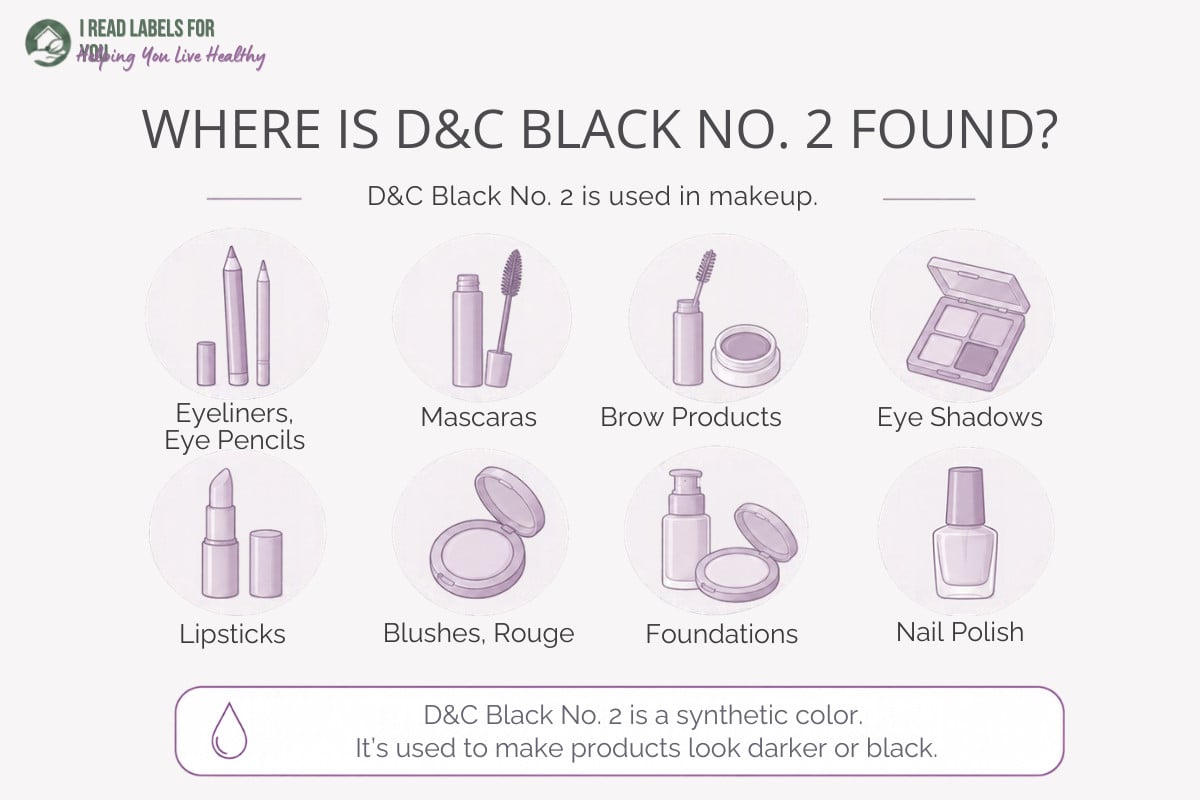
You’ll find D&C Black No. 2 most often in:
- eyeliners and eye pencils
- mascaras
- brow products
- eye shadows
- lipsticks
- blushes and rouge
- foundations and other makeup
- nail polish
How Is D&C Black No. 2 Made?
D&C Black No. 2 is made by burning oil on purpose, and burning it incompletely. The FDA’s own definition says it’s manufactured by the combustion of aromatic petroleum oil feedstock. What survives the flame gets collected on a fabric filter as D&C Black No. 2.
The starting oils belong to a worrying family, and that deserves saying out loud. The International Agency for Research on Cancer (IARC) lists the usual starting oils as heavy fuel oils, refinery leftovers and oils distilled from coal tar. Coal-tar pitch is classified as carcinogenic to humans, so the raw material for D&C Black No. 2 can be a known carcinogen. On top of that, partial burning of oil is precisely how carcinogenic byproducts form.
That chemistry is why the rules for D&C Black No. 2 look so unusual. Both regulators cap polycyclic aromatic hydrocarbons (PAHs), the byproducts of incomplete burning, at 500 parts per billion in the finished pigment. They also cap two of those PAHs at 5 parts per billion each: benzo[a]pyrene, a known human carcinogen, and dibenz[a,h]anthracene, a probable one. Simply put, burning oil creates these carcinogens, so the limits are there to keep them low.
Does D&C Black No. 2 Penetrate The Skin?
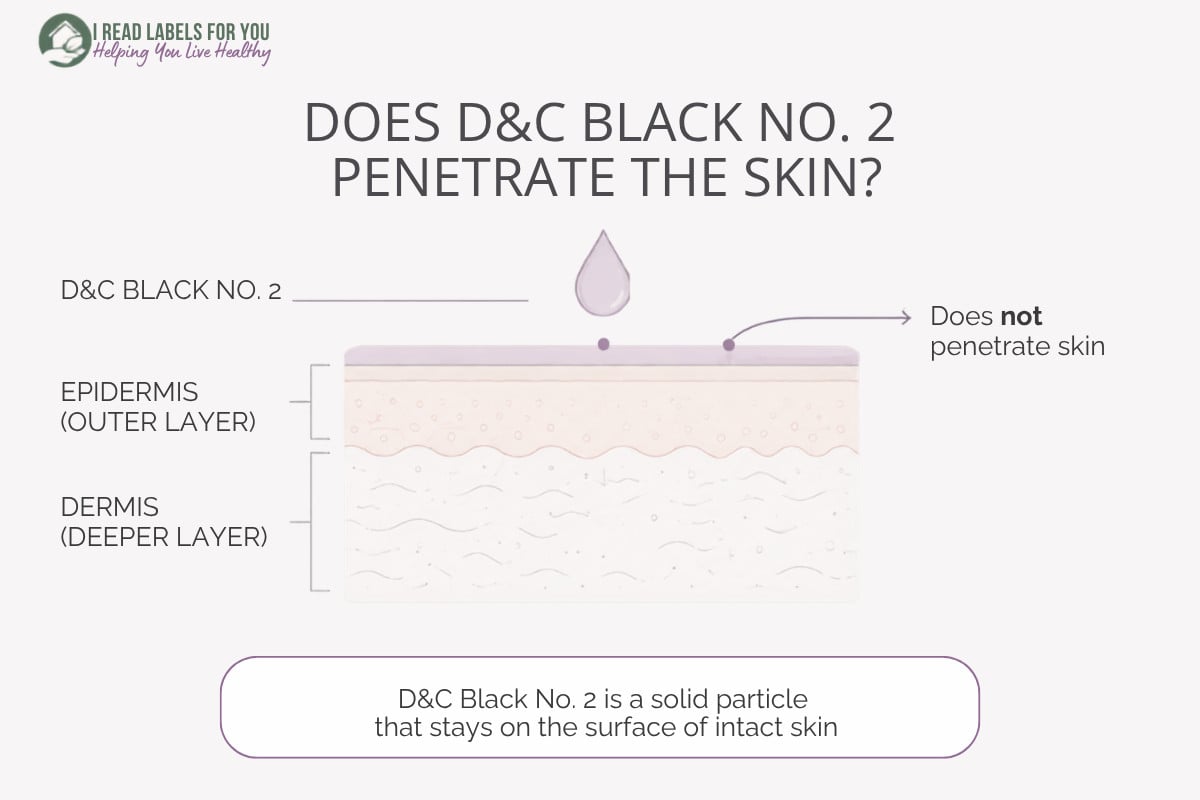
No, D&C Black No. 2 stays on the surface of intact skin. Two numbers usually predict whether an ingredient gets through skin: molecule size (molecular weight) and whether it prefers oil or water (LogP). Neither applies here, because D&C Black No. 2 is a solid particle, not a dissolved molecule.
One laboratory tested a real product rather than a raw powder. Researchers applied an eyeliner containing 6 percent D&C Black No. 2, with particles of 20 to 30 nanometers, to human skin for 24 hours. Under an electron microscope, the particles appeared only on the outermost surface. Their conclusion was that the pigment has no potential to penetrate into or cross through the skin.
SCCS agreed with that finding but did not call it settled. Weighing all the evidence, they concluded that there is no indication of carbon black particles (> 20 nm) being absorbed through the intact skin. Even so, no information exists for particles of D&C Black No. 2 below 20 nanometers.
Three limits travel with that answer. The only possible test was looking under a microscope, which cannot measure amounts precisely, and nobody has tested damaged or broken skin. SCCS also warned that the makers never checked whether the clumps of D&C Black No. 2 break apart in creamy formulas. The impurities are a different story: benzo[a]pyrene on its own does pass through skin.
What Is D&C Black No. 2 Called On Labels?
On a label, D&C Black No. 2 appears as one of these:
- CI 77266
- D&C Black No. 2
- Carbon Black
- Black 2
Two other blacks sit close by in the rules and get mixed up with D&C Black No. 2. CI 77267 is bone charcoal, made by burning animal bones, while CI 77268:1 is coke black. I rate both Not A Fan, because US rules allow bone charcoal ten times more total PAHs, and Europe sets no purity limits on either. Reading the number rather than the word is the only reliable way to tell them apart.
Does The U.S. FDA Restrict D&C Black No. 2 In Food And Cosmetics?
Yes, the FDA restricts D&C Black No. 2 more tightly than almost anything else in your makeup bag. The agency permits it in nine named product types only: eyeliner, brush-on-brow, eye shadow, mascara, lipstick, blushers and rouge, makeup and foundation, and nail enamel. On top of that, every batch must be certified by the FDA before it is sold for any of these uses. Its status page lists it as permanently listed, certification required.
Europe also requires colors to be approved before use, and it adds what it calls the precautionary principle. Both systems allow D&C Black No. 2 around the eyes, in eyeliner, mascara and eye shadow.
EU Regulations On D&C Black No. 2
The European Union allows D&C Black No. 2 as a cosmetic colorant, with conditions attached. It appears in Annex IV, the positive list of permitted colorants, as entry 126 for carbon black. A second entry, 126a, covers the nano form separately.
The nano entry is where Europe goes beyond the United States. Entry 126a caps the nano form at 10 percent and requires a primary particle size of at least 20 nanometers. It also states the pigment is not to be used in applications that may lead to exposure of the end user’s lungs by inhalation. That single line is a ban on inhalable powders and sprays of D&C Black No. 2, written into law.
One European process on D&C Black No. 2 is still running. The European Chemicals Agency (ECHA) has it under substance evaluation, led by France, with 2027 as the evaluation year. Carcinogenicity and reproductive toxicity are the recorded concerns, and no harmonized classification exists today.
U.S. And EU Disagreements On D&C Black No. 2
The two systems agree on the contaminant numbers for D&C Black No. 2 and part company on three details. Europe demands purity above 97 percent, while the FDA requires total color as carbon of at least 95 percent. A certified American batch may therefore hold slightly more non-carbon material than a European one. Europe also fixes a minimum particle size and bans inhalable uses, whereas the FDA certifies every batch instead.
Canadian Regulations On D&C Black No. 2
Canada takes no position on D&C Black No. 2 in cosmetics. The pigment returns no hits on the Cosmetic Ingredient Hotlist, Canada’s roster of banned and limited cosmetic ingredients. Environment Canada likewise leaves it off Schedule 1 of its environmental law.
Can D&C Black No. 2 Cause Skin Allergy And Sensitization?
No, D&C Black No. 2 has never been shown to cause skin allergy in people. A 2023 review of tattoo patients patch tested between 1997 and 2022 states it bluntly: “The pigment carbon black (C.I. 77266) is no skin sensitizer.” It also sits nowhere on the American Contact Dermatitis Society (ACDS) Core Allergen Series 2020. For a pigment worn on millions of eyelids daily, that record is reassuring.
SCCS still declined to call D&C Black No. 2 a non-sensitizer, and the reason is interesting. Animal tests came back negative, yet SCCS pointed out that the particles probably never reached the immune cells that would react. In its words, sensitization potential of carbon black cannot be ruled out, for example in damaged skin. Hence the honest phrasing is that no allergy has been demonstrated, rather than that none is possible.
Is D&C Black No. 2 A Hormone (Endocrine) Disruptor?
No, D&C Black No. 2 has never been assessed for hormone activity by any regulator. Neither European opinion on it contains an endocrine section, and ECHA has not placed it on any endocrine assessment list. So the honest answer is that nobody has checked, which is not the same as checked and cleared.
Laboratory signals do exist, and they come from routes that have nothing to do with wearing makeup. One study of cultured human ovarian cells reported that carbon black nanoparticles decrease estrogen production. Other work found effects on male fertility in mice after the particles were delivered into the airways. Those are direct-exposure and inhalation experiments, not skin contact with D&C Black No. 2.
Is D&C Black No. 2 Safe To Use While Pregnant?
No study has tested D&C Black No. 2 in pregnancy by the skin route, and SCCS considers that route low concern anyway. Its reasoning was direct: oral exposure is of little concern, and the same holds for skin due to lack of any significant dermal penetration. Where SCCS did draw a line, it said applications that may lead to inhalation should be avoided.
The bigger pregnancy question for D&C Black No. 2 is its impurity, not the pigment. Europe classifies benzo[a]pyrene as able to damage fertility and the unborn child. Unlike the pigment, benzo[a]pyrene does pass through human skin once it is released. Nobody has measured how much benzo[a]pyrene an eyeliner or lipstick releases onto your skin.
Even so, consult your medical provider before using D&C Black No. 2 or anything new during pregnancy or nursing.
Are There Any Cancer Concerns Linked To D&C Black No. 2?
Yes, D&C Black No. 2 carries cancer concerns, though no study has shown cancer from wearing it on skin. IARC classifies carbon black in Group 2B, possibly carcinogenic to humans, based mainly on malignant lung tumors in female rats exposed by inhalation. Mice injected under the skin with a PAH-rich furnace black also developed tumors where it was injected. California lists it under Proposition 65 as Carbon black (airborne, unbound particles of respirable size).
Put D&C Black No. 2 on skin, and the evidence is thin rather than reassuring. IARC reviewed mouse studies where three carbon blacks were painted on skin for up to 18 months, with no rise in skin tumors. However, SCCS calls those studies old and incompletely reported, and says no conclusion can be drawn from the studies. IARC also found no adequate study of swallowing D&C Black No. 2, which matters for lipstick.
The finding most relevant to makeup involves oil, since eyeliners and lipsticks are oily. Mice injected with a furnace black in oil developed tumors in 18 of 46 animals, but almost none once a solvent had washed out its PAHs. That black carried roughly 60,000 times more benzo[a]pyrene than D&C Black No. 2 may legally contain. In separate tests, oil soaked with a furnace black and then separated from the pigment still caused tumors on its own.
Is D&C Black No. 2 Bad For The Environment?
D&C Black No. 2 carries no official European environmental warning. Its ECHA record shows no agreed hazard classification, and a few registering companies label it themselves, only for suspected cancer. This pigment is insoluble elemental carbon, which does not dissolve into water the way a surfactant does. Canada leaves it off its toxic substances list as well.
Common Claims About D&C Black No. 2: What’s True And What’s Not
Claim: The FDA Banned D&C Black No. 2 From Eye Makeup
This claim about D&C Black No. 2 is out of date rather than invented. Carbon black from the older channel process really was taken off the American list for decades. The form sold today uses a different manufacturing route, relisted in 2004 with contaminant caps and batch certification attached.
The current rule says the opposite, and it says so specifically. Eyeliner, brush-on-brow, eye shadow and mascara are the first four uses named in the regulation. That specificity is required, because a color additive may not be used near the eye unless its own listing provides for it. Thus D&C Black No. 2 is not banned from eye makeup; it’s one of the few blacks expressly allowed there.
Claim: D&C Black No. 2 Is Contaminated With Carcinogens
This claim is true, and the detail is more interesting than the headline. D&C Black No. 2 may legally contain 5 parts per billion each of benzo[a]pyrene, which IARC calls carcinogenic to humans, and dibenz[a,h]anthracene, which it calls probably carcinogenic. The FDA said as much when approving the pigment, noting that it may contain low levels of potentially carcinogenic polynuclear aromatic hydrocarbon (PAH) contaminants. Consequently the real question is whether those carcinogens can reach you.
The answer turns on release, because benzo[a]pyrene on its own does pass through human skin. In laboratory tests on human skin, roughly a quarter to two fifths of a dose applied in acetone was absorbed within two days. In lab tests with lung cells, benzo[a]pyrene stuck to carbon black stayed stuck, even at nearly five times the legal limit. Oil may change that picture, which is why the caps matter for D&C Black No. 2 in eyeliner and lipstick.
Claim: D&C Black No. 2 Is A Mineral Pigment
No, D&C Black No. 2 is a petroleum product, and this one matters for shopping. Mineral in cosmetics means an inorganic pigment made without petroleum, such as iron oxides, mica, titanium dioxide and zinc oxide. Many are made in a lab for purity, but none starts from oil. D&C Black No. 2 is manufactured by burning oil, and the FDA definition names the feedstock outright.
Color chemists file D&C Black No. 2 among the inorganic pigments, and people hear inorganic and think mineral. A product calling itself all-mineral while listing CI 77266 is stretching the word.
What I Think About D&C Black No. 2 — And What You Should Do
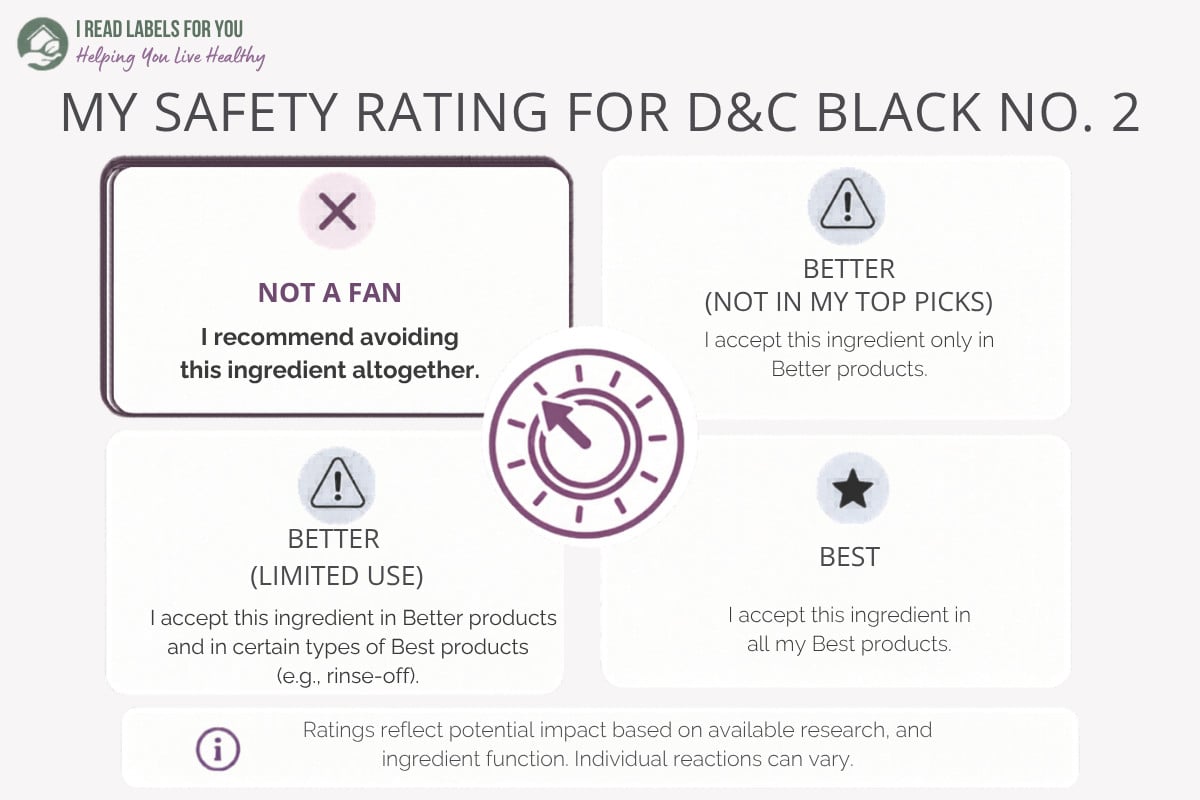
My verdict on D&C Black No. 2 is Not A Fan, which means I recommend avoiding it. The pigment stays on intact skin, so my concern is what it carries and how it’s made. Here are my reasons:
- It may legally carry benzo[a]pyrene, a known human carcinogen, and dibenz[a,h]anthracene, a probable one, at up to 5 parts per billion each.
- Free benzo[a]pyrene passed through human skin in laboratory tests.
- Europe classifies benzo[a]pyrene as damaging to fertility and the unborn child.
- In mice, oil stored with furnace black picked up cancer-causing compounds and caused tumors, and makeup is oily.
- Nobody has measured how much of these impurities a finished eyeliner or lipstick releases.
- As inhaled dust, the pigment itself is a possible human carcinogen.
- It is made by burning heavy petroleum oils, and Europe classifies a preferred one, catalytic cracker residue, as a presumed human carcinogen.
To be fair, the legal benzo[a]pyrene limit is about 60,000 times below the level in the furnace black that caused tumors in mice. Still, a daily eye and lip product needs a measured answer before I recommend D&C Black No. 2.
Skip D&C Black No. 2 first in loose powders and sprays, where inhalation adds the best-documented harm. Otherwise, switch at your next purchase, with black iron oxide (CI 77499) as the alternative. I will update this post if the European evaluation due in 2027 changes the picture.
Frequently Asked Questions About D&C Black No. 2
Can I Use D&C Black No. 2 If I Wear Contact Lenses Or Have Sensitive Eyes?
The FDA reviewed eye-area safety for D&C Black No. 2 specifically and reported no toxicity in the studies submitted. Mechanical irritation from any pigment near the lash line remains possible for sensitive eyes. If a product stings or your eyes water, stop using it and speak with your eye doctor.
Why Does EWG Rate D&C Black No. 2 Differently?
The Environmental Working Group (EWG) scores D&C Black No. 2 anywhere from 3 to 10, depending on the product. Its entry explains that the score “is higher if used in product forms that are inhalable (e.g., sprays, powders)” and lower in solids and liquids. On powders and sprays, EWG and I agree. On eyeliners, mascaras and lipsticks, I am stricter than EWG.
The difference comes from how we weigh the same problem. EWG itself lists contamination concerns for D&C Black No. 2 as high. Yet its low score for solids and liquids assumes that the pigment staying on skin settles the matter. My concern is the benzo[a]pyrene it may carry, which passes through skin once released, and oil can release it.
Sources
EU SCCS / SCCP Opinions:
Scientific Committee on Consumer Safety, SCCS/1515/13, Opinion on Carbon Black (nano-form), adopted December 12, 2013, second revision December 15, 2015. Contains the dermal penetration studies, the sensitization discussion, the carcinogenicity conclusion and the PAH bioavailability finding: SCCS opinions portal
Scientific Committee on Consumer Safety, SCCS/1539/14, Opinion for clarification of the meaning of the term “sprayable applications/products” for the nano forms of Carbon Black CI 77266, Titanium Oxide and Zinc Oxide, adopted September 23, 2014, second revision June 25, 2015: SCCS opinions portal
Cosmetic Ingredient Review (CIR) Reports:
No CIR report on D&C Black No. 2 or on carbon black exists (checked). CIR does not assess color additives whose safety the FDA sets under 21 CFR Part 71, and this pigment is an FDA-certified color additive. Its 2023 assessment of plant-derived charcoal ingredients does not cover carbon black: CIR reports database
European Union Regulatory Databases:
CosIng entry for CI 77266, function colorant, with Cosmetics Regulation provisions IV/126 and IV/126a: CosIng database
The CosIng Annex IV entry 126, carbon black, a permitted colorant with purity above 97 percent and the full impurity profile: CosIng database
CosIng Annex IV entry 126a, carbon black (nano), maximum 10 percent, primary particle size at or above 20 nanometers, and no uses that may expose the lungs by inhalation: CosIng database
European Chemicals Agency regulatory activities for EC 215-609-9, showing an ongoing substance evaluation led by France with carcinogenicity and reproductive toxicity as the stated concerns, evaluation year 2027: ECHA CHEM activities
European Chemicals Agency classification and labelling overview for carbon black, showing no harmonized classification and a minority self-classification for suspected cancer: ECHA CHEM overview
CLP Regulation (EC) No 1272/2008, Annex VI harmonized classification for benzo[a]pyrene, index 601-032-00-3: Carc. 1B, Muta. 1B, Repr. and 1B, Skin Sens. 1. Carbon black itself has no harmonized classification: EUR-Lex
CLP Regulation (EC) No 1272/2008, Annex VI harmonized classification for clarified oils (petroleum), catalytic cracked, index 649-011-00-8, CAS 64741-62-4: Carc. 1B. IARC Monograph 93 names catalytic cracker residue among the preferred feedstocks for oil-furnace carbon black: EUR-Lex
Other Regulators:
U.S. FDA, 21 CFR 74.2052, D&C Black No. 2. Gives the identity, the eleven specifications, the nine permitted cosmetic uses and the batch certification requirement: eCFR
U.S. FDA final rule listing D&C Black No. 2, 69 FR 44927, July 28, 2004. Contains the PAH risk assessment, the surface area reasoning and the eye-area review: Federal Register
U.S. FDA regulatory status of color additives, D&C Black No. 2, permanently listed with certification required: FDA status page
U.S. FDA list of prohibited and restricted cosmetic ingredients. D&C Black No. 2 is not listed: FDA prohibited and restricted ingredients
U.S. FDA, 21 CFR 81.10, termination of provisional listings of color additives. Records the removal of channel-process carbon black from food, drug and cosmetic use: eCFR
Health Canada Cosmetic Ingredient Hotlist. D&C Black No. 2 is not listed, while carbon disulfide and carbon tetrachloride are: Cosmetic Ingredient Hotlist
Environment Canada, Canadian Environmental Protection Act Schedule 1. D&C Black No. 2 is not listed: Schedule 1
International Agency for Research on Cancer, Monographs Volume 93 (2010), Carbon Black, pages 43 to 191. Group 2B, possibly carcinogenic to humans, with the dermal application studies and a separate finding on carbon black extracts: IARC list of classifications
National Toxicology Program, Report on Carcinogens, 15th edition. Carbon black is not listed: Report on Carcinogens
U.S. Environmental Protection Agency IRIS. No assessment exists for carbon black: IRIS A to Z list
California Proposition 65 list. Listed February 21, 2003 as “Carbon black (airborne, unbound particles of respirable size)” for cancer: OEHHA
PubChem Records (Chemistry, Identifiers, Skin Penetration, Hazard Codes):
Carbon Black, PubChem CID 172866199, EC 215-609-9, CAS 1333-86-4. Gives the manufacturing description, the use split between rubber and pigment, and the GHS self-classifications: PubChem CID 172866199
Peer-Reviewed Studies:
Patch testing of tattooed patients, 1997 to 2022, published 2023. Verbatim: “The pigment carbon black (C.I. 77266) is no skin sensitizer.” PMID 36772861: PubMed 36772861
Carbon black nanoparticles and steroid production in cultured human granulosa cells, 2017. Reports that the nanoparticles decrease estrogen production in vitro, by direct exposure of cells rather than through skin. PMID 28977593: PubMed 28977593
Simon K, Schneider L, Oberender G, et al, 2023. Migration of polycyclic aromatic hydrocarbons from a polymer surrogate through the stratum corneum layer of the skin. Ecotoxicology and Environmental Safety 262:115113. German Federal Institute for Risk Assessment (BfR). Measured benzo[a]pyrene and four other PAHs moving from squalane, a cosmetic oil, into pig skin. PMID 37315362: PubMed 37315362
Simon K, Bartsch N, Schneider L, et al, 2024. Polycyclic aromatic hydrocarbon skin permeation efficiency in vitro is lower through human than pigskin and decreases with lipophilicity. Environmental Research 255:119118. German Federal Institute for Risk Assessment (BfR). Tested 24 PAHs on human and pig skin; the larger PAHs did not fully pass through within 48 hours: Environmental Research 2024
In vivo and in vitro dermal absorption of benzo[a]pyrene in rat, guinea pig, human and tissue-cultured skin. Human skin in vitro absorbed roughly 23 to 43 percent of an applied dose in acetone over 48 hours. PMID 7727354: PubMed 7727354
Review of the human relevance of rat lung tumors after carbon black inhalation, 2022, noting that expert panel conclusions “directly conflict with IARC, ECHA and NIOSH”. PMID 35968415: PubMed 35968415
Natural Cosmetic Standards:
COSMOS-standard approved raw materials. D&C Black No. 2 is not listed: COSMOS-standard approved raw materials
NATRUE certified and approved raw materials. D&C Black No. 2 is not listed: NATRUE certified raw materials
Skin Allergy Resource:
American Contact Dermatitis Society (ACDS), Helpful References, including the Core Allergen Series 2020. D&C Black No. 2 is not on the series, and it has never been named Allergen of the Year: ACDS Helpful References
Advocacy groups:
Environmental Working Group (EWG) Skin Deep entry for D&C Black No. 2 / CI 77266. Hazard score 3 to 10 depending on product form, data availability robust, and restricted rather than barred in EWG VERIFIED: EWG Skin Deep
Last verified: 10-08-2026

Download The Free Guide!
5 Powerful Steps To A Non-Toxic Home
Join our informed consumer community and get our free guide the “5 Powerful Steps To A Non-Toxic Home”.
Before commenting, please read our Comment Policy.