
Is Glyceryl Rosinate Safe? A Simple Answer You Can Trust
 Written by Irina Webb
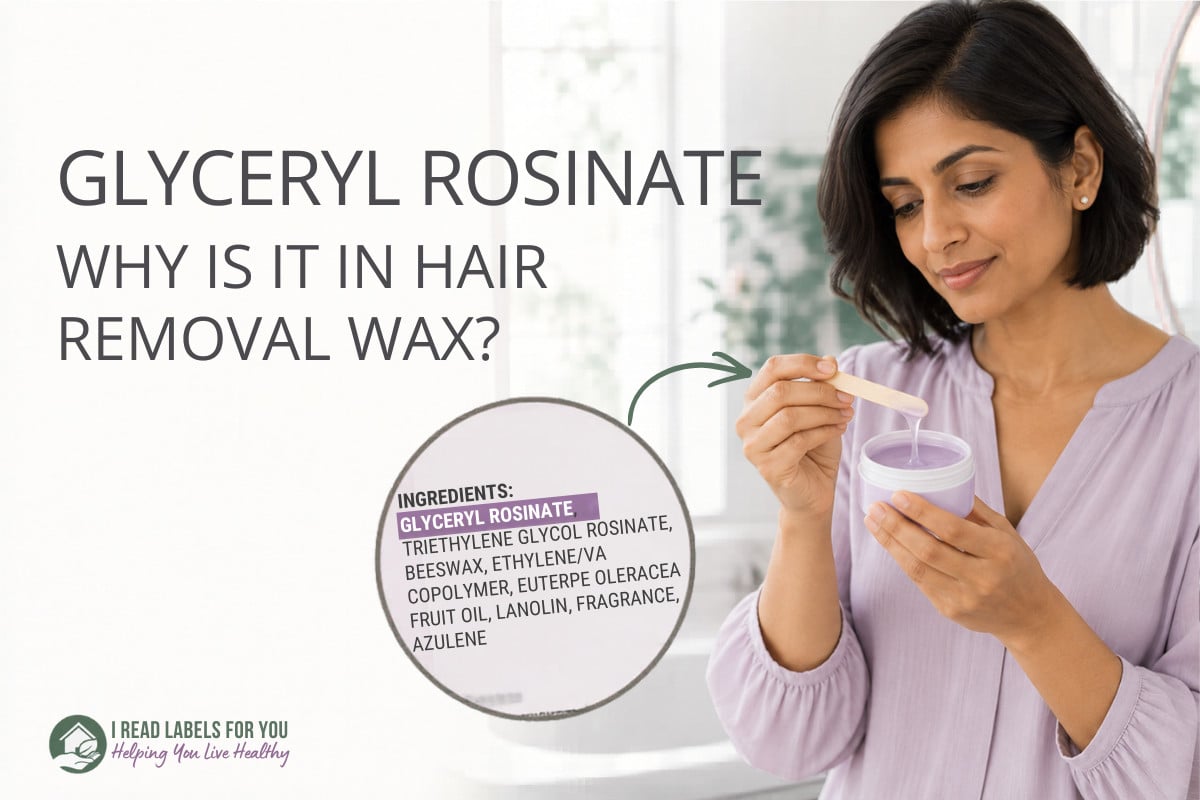
Yes, Glyceryl Rosinate is safe for most people, unless you already react to colophony, the pine resin it comes from. This sticky ester holds mascara, lip color and hair-removal wax together, and patch tests on it came back almost spotless. Still, its starting material is a well-known allergen, which places it in my Better (Not In My Top Picks) tier.
Glyceryl Rosinate carries no restriction in European Union cosmetics. However, Europe labels rosin, its starting material, a skin sensitizer, and a Norwegian proposal to also flag rosin as a reproductive toxicant awaits final publication.
Keep reading to discover:
- why some people allergic to pine resin still react to it
- what the pending European decision on rosin could change
- why waxing products can contain nearly 100% of it
What Is Glyceryl Rosinate?
Glyceryl Rosinate is a plant-derived resin ester, often called ester gum. Chemists build it from two parts: rosin, the solid resin left from pine sap, and glycerin.
Think of it as a mixture, not one pure compound. The Cosmetic Ingredient Review (CIR), an American panel paid for by cosmetic makers, describes commercial glyceryl esters as blends. Single, double and triple esters appear in roughly a 4:4:2 ratio.
What Does Glyceryl Rosinate Do In Cosmetics?
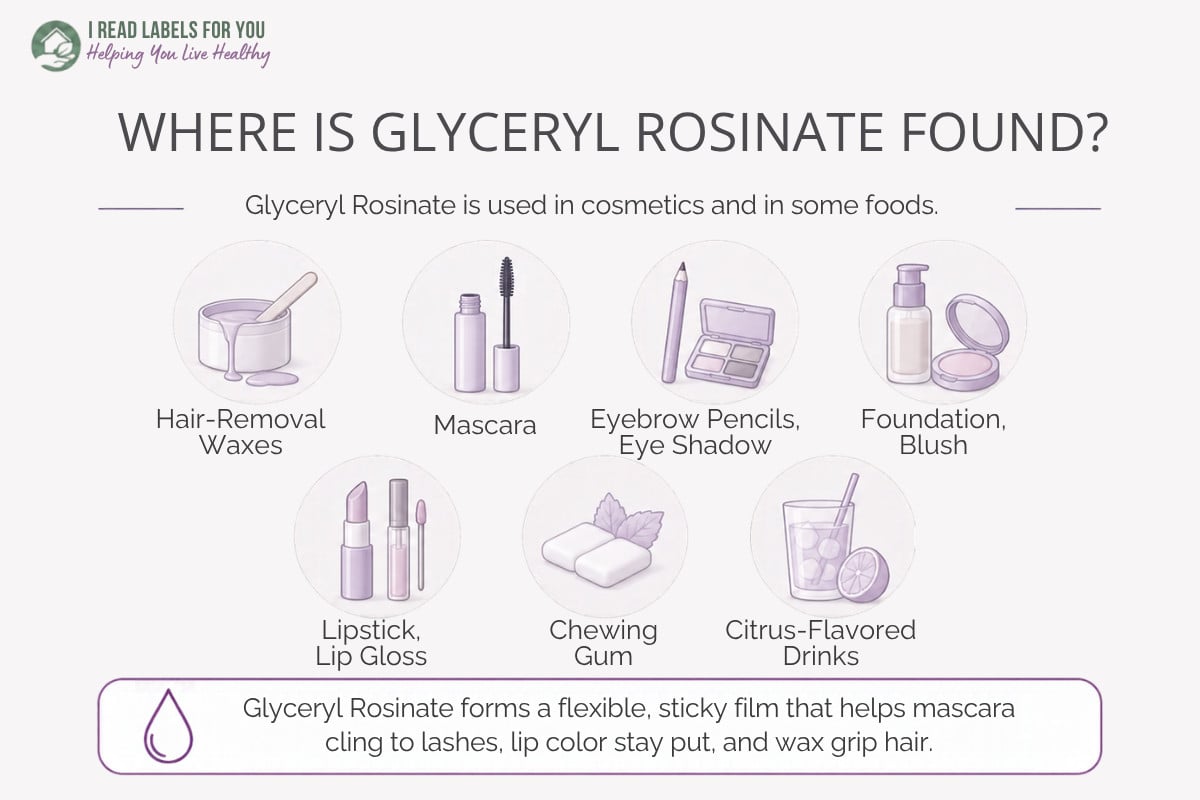
Its main job is to form a flexible, tacky film. That film helps mascara cling to lashes, keeps lip color in place and gives waxing products their grip on hair.
CosIng, the European Union cosmetic ingredient database, lists it as a film former and a perfuming ingredient. Other listed roles include emollient, emulsifier and hair-removal agent.
Brands voluntarily registered 4 products containing it with the U.S. Food and Drug Administration in 1998, and 50 in 2015. Those registrations cover only a small fraction of the products on shelves. Most were lip and eye products at 8% or less, while hair-removal waxes used up to 96%.
You’ll find Glyceryl Rosinate most often in:
- hair-removal waxes (72 to 96%)
- mascara (up to 8%)
- eyebrow pencils and eye shadow
- foundation and blush
- lipstick and lip gloss (about 0.5%)
- chewing gum, as part of the gum base
- citrus-flavored drinks, where it keeps flavor oils evenly mixed
How Is Glyceryl Rosinate Made?
First comes the rosin. An FDA review quoted by the CIR describes rosin as the residue left after distilling turpentine from pine sap. Some rosin is extracted from old pine stumps instead.
Next, manufacturers react rosin with glycerin. Its acids, mainly abietic acid, bond to glycerin and form esters. Beyond these two, the CIR names no other chemical used to make it.
The reaction is never complete. Research samples of glycerol-esterified rosin still held 0.3% to 3.7% free abietic acid, compared with 42% to 55% in plain rosin. Notably, no cosmetic specification limits that leftover rosin.
Does Glyceryl Rosinate Penetrate The Skin?
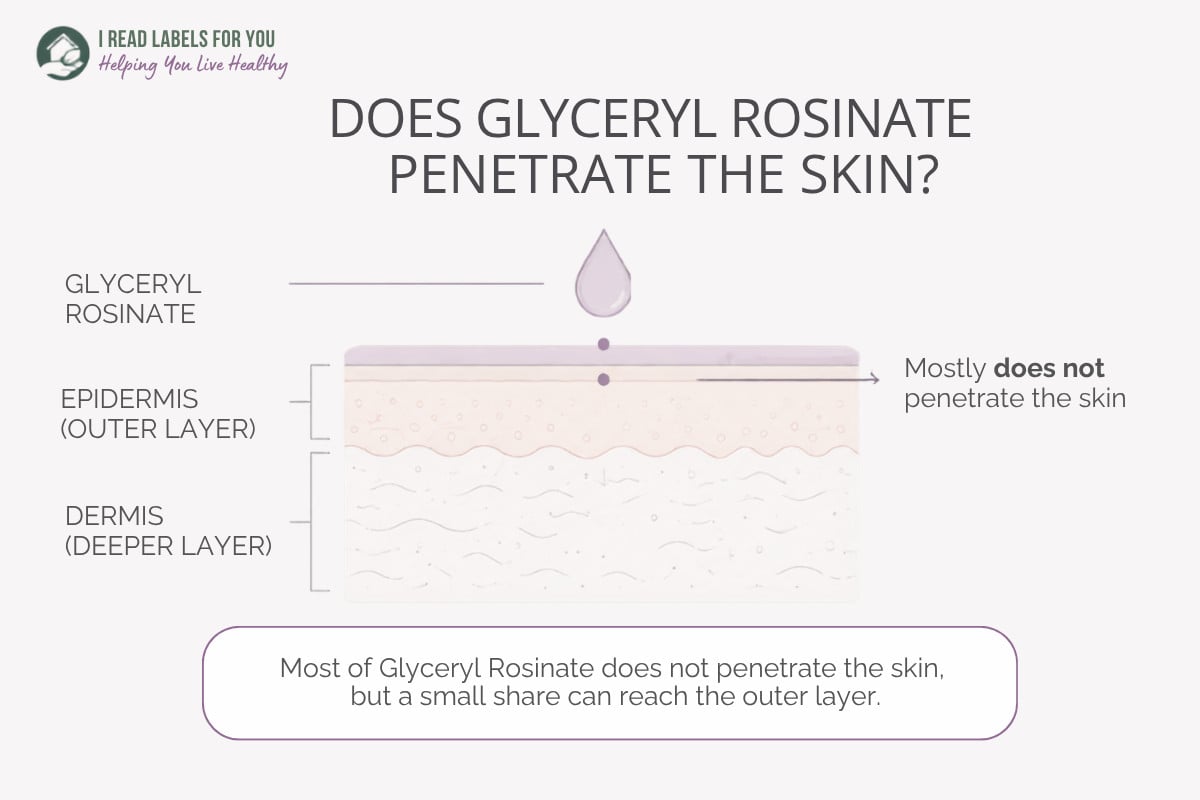
Most of it does not. Glyceryl Rosinate is a mix of molecules, and most of them are too big to get past the skin’s outer layer. A small share can reach that outer layer, which matters for allergy. It is unlikely to pass through your skin and into your body in any real amount. No study has measured this directly, so this answer comes from molecule size and related data.
Size is the main reason. Scientists measure molecule size in daltons. Molecules bigger than about 500 daltons rarely get through skin. Most of Glyceryl Rosinate is made of double and triple esters, which are well over that limit.
The single ester is smaller, about 375 daltons. Size alone would not stop it. It also mixes with oil, not water, and oil-loving molecules tend to settle into the skin’s fatty top layer instead of going deeper.
That top layer is where allergy starts. Small amounts of leftover rosin acids can be in the ingredient. They are small, and an allergen only needs to reach the upper skin to cause a reaction. So, for most people, the question is not “does it get into my body?” but “am I allergic to rosin?”
Data on swallowing it points the same way. In a rat feeding study using a radioactive tracer, most of the dose passed out in feces. Only 0.1 to 0.2% reached the liver.
What Is Glyceryl Rosinate Called On Labels?
Scan the ingredient panel for these names:
- Glyceryl Rosinate
- Glycerin Monorosinate
- Glyceryl Monorosinate
- Ester Gum
- Glycerol Ester Of Rosin
- Resin Acids And Rosin Acids, Esters With Glycerin
Glyceryl Hydrogenated Rosinate is a related but separate ingredient. Hydrogenation, a treatment with hydrogen, changes the rosin acids, and that version needs its own review.
Does The U.S. FDA Restrict Glyceryl Rosinate In Food And Cosmetics?
No, cosmetic use of Glyceryl Rosinate faces no federal cap from the Food and Drug Administration (FDA), the U.S. regulator. The ingredient is missing from the agency’s short list of banned or limited cosmetic chemicals.
In food, the FDA allows it as a chewing gum base ingredient. A separate food rule lets glycerol ester of rosin balance citrus oils in drinks, at up to 100 parts per million.
Neither fact settles much. The FDA list of banned cosmetic ingredients is short, and brands, not regulators, decide whether their formulas are safe before sale.
Europe starts from a more cautious place. Under its precautionary principle, officials may restrict a chemical once a plausible risk appears, rather than after damage is confirmed.
EU Regulations On Glyceryl Rosinate
The European Union does not restrict Glyceryl Rosinate. CosIng lists it outside every annex. Moreover, it has never come before the Scientific Committee on Consumer Safety (SCCS), whose independent scientists assess cosmetic risks for the EU.
Records at the European Chemicals Agency (ECHA) give the ester no legally binding hazard label. Rosin is different: EU law already labels it a category 1 skin sensitizer, a substance that can trigger contact allergy.
Now rosin may gain a second label. Norway proposed classifying rosin and rosin oligomers, rosin molecules joined together, as presumed reproductive toxicants, category 1B. Hydrogenated rosin would get the milder category 2.
The Norwegian report relies on rat feeding studies showing fewer pups surviving. Fertility effects were judged likely to stem from the mothers eating less.
ECHA’s Committee for Risk Assessment (RAC) adopted its opinion on September 11, 2026. As of October 28, 2026, its final classification is still unpublished.
Importantly, the proposal leaves out glycerol esters of rosin. It would classify the starting material, not Glyceryl Rosinate itself.
Canadian Regulations On Glyceryl Rosinate
Canada does not restrict Glyceryl Rosinate. Health Canada’s Cosmetic Ingredient Hotlist leaves it off, although it lists hydroabietyl alcohol, a different rosin-derived ingredient.
Nor does it appear on Schedule 1, the toxic substances roster under the Canadian Environmental Protection Act.
Can Glyceryl Rosinate Cause Skin Allergy And Sensitization?
Yes, Glyceryl Rosinate can cause skin allergy, mainly in people already allergic to colophony, while tests on healthy skin rarely show reactions. The risk comes mostly from leftover rosin, oxidized rosin acids and one minor ester, rather than the main ester.
What Patch Tests On Glyceryl Rosinate Show
Testing labs ran these studies for cosmetic companies, which then submitted them to the industry-funded CIR. A lipstick with 1% Glyceryl Rosinate caused no irritation or allergy in 78 volunteers.
Foundation, blush and lip gloss with 2 to 4% also passed tougher tests in about 25 people each. Two more studies from the European registration file found no allergy in 50 and 200 people.
The strongest test used an effective 10% under a patch. One of 49 volunteers developed redness and swelling, and the lab judged the reaction unique to that person.
What Happens If You Are Already Allergic To Rosin
Colophony is a classic patch-test allergen. The American Contact Dermatitis Society (ACDS) includes “Colophony 20% pet.” as number 7 in its Core Allergen Series, the standard panel dermatologists use.
Making the ester helps but does not erase the problem. In a 1993 patch-test study of eight colophony-allergic patients, 3 reacted to glycerol-esterified gum rosin and 4 to glycerol-esterified tall oil rosin.
Those were research samples, not cosmetic-grade Glyceryl Rosinate. Still, the CIR summarized that esterification “reduced the allergenicity of rosin” without removing it.
Moreover, a 1994 follow-up study found that glyceryl-1-monoabietate, a minor ester formed in the reaction, is itself a contact allergen. Rosin acids also oxidize during storage, creating stronger allergens.
Damaged skin raises the stakes. In a 2007 report on wound dressings, a woman with leg ulcers reacted to 20% Glyceryl Rosinate.
Is Glyceryl Rosinate A Hormone (Endocrine) Disruptor?
No, Glyceryl Rosinate has never been linked to hormone disruption, although that question has simply never been studied. None of the three CIR reports discusses hormones at all.
Similarly, it’s absent from ECHA’s endocrine disruptor assessment list. A PubMed search for hormone studies on it or its synonyms returned no results.
Is Glyceryl Rosinate Safe To Use While Pregnant?
There is no evidence that Glyceryl Rosinate harms pregnancy, but no one has tested it for that. The CIR found no reproductive or developmental study on the ingredient.
The open question concerns rosin, its starting material. Norway’s proposal to label rosin a presumed reproductive toxicant rests on rat feeding studies, and the ester itself falls outside that proposal.
Small amounts of free rosin acids can remain in the finished ingredient. If you are expecting and want extra caution, you should consult with your medical provider before picking long-wear makeup or waxes.
Are There Any Cancer Concerns Linked To Glyceryl Rosinate?
No, Glyceryl Rosinate has no known link to cancer, although no long-term cancer study exists. Neither it nor rosin appears on California’s Proposition 65 list or in the federal Report on Carcinogens. The International Agency for Research on Cancer (IARC) has not classified either one.
Gene-damage tests on the ingredient were negative. These included the Ames bacterial test, a chromosome test and a DNA-repair test.
Two caveats remain. Neoabietic acid, a minor rosin component, damaged genes in the Ames test, and nobody knows how much remains in the ester. Also, a 1992 study of mice fed ester gum found it “weakly clastogenic,” with slight chromosome breaks, yet no health hazard at those doses.
Is Glyceryl Rosinate Bad For The Environment?
Not as far as current data shows, although the evidence is limited. Europe gives Glyceryl Rosinate no environmental hazard label, and companies that registered it with ECHA self-classify it as not hazardous.
It comes from pine trees and is not a plastic polymer. Consequently, COSMOS and NATRUE, two leading natural-beauty certifiers, approve several grades of it.
One concern carries over from all plant ingredients. The CIR urged suppliers to limit pesticide residues and heavy metals, yet gives no limit specific to this ingredient.
Common Claims About Glyceryl Rosinate: What’s True And What’s Not
Claim: If You’re Allergic To Rosin, Glyceryl Rosinate Will Trigger It
This claim is partly true. Some patient guides, along with a French government answer to a lawmaker, list Glyceryl Rosinate among the names a rosin-allergic person should avoid.
The evidence supports caution, not certainty. In the 1993 study, 3 to 4 of 8 colophony-allergic patients reacted to rosin esters, while the rest did not.
Standard patch tests use plain colophony, and the 2007 leg-ulcer patient reacted to Glyceryl Rosinate while testing negative to colophony. If you know you’re allergic to colophony, treating this ingredient as off-limits is the sensible choice.
Claim: Glyceryl Rosinate Comes From Pine Trees, So It’s Gentle
This claim is misleading. The ingredient is indeed plant-derived, and natural certifiers approve some grades.
However, natural does not mean nonallergenic. Pine rosin is one of the classic contact allergens, and its acids form even stronger allergens when they oxidize during storage.
What I Think About Glyceryl Rosinate — And What You Should Do
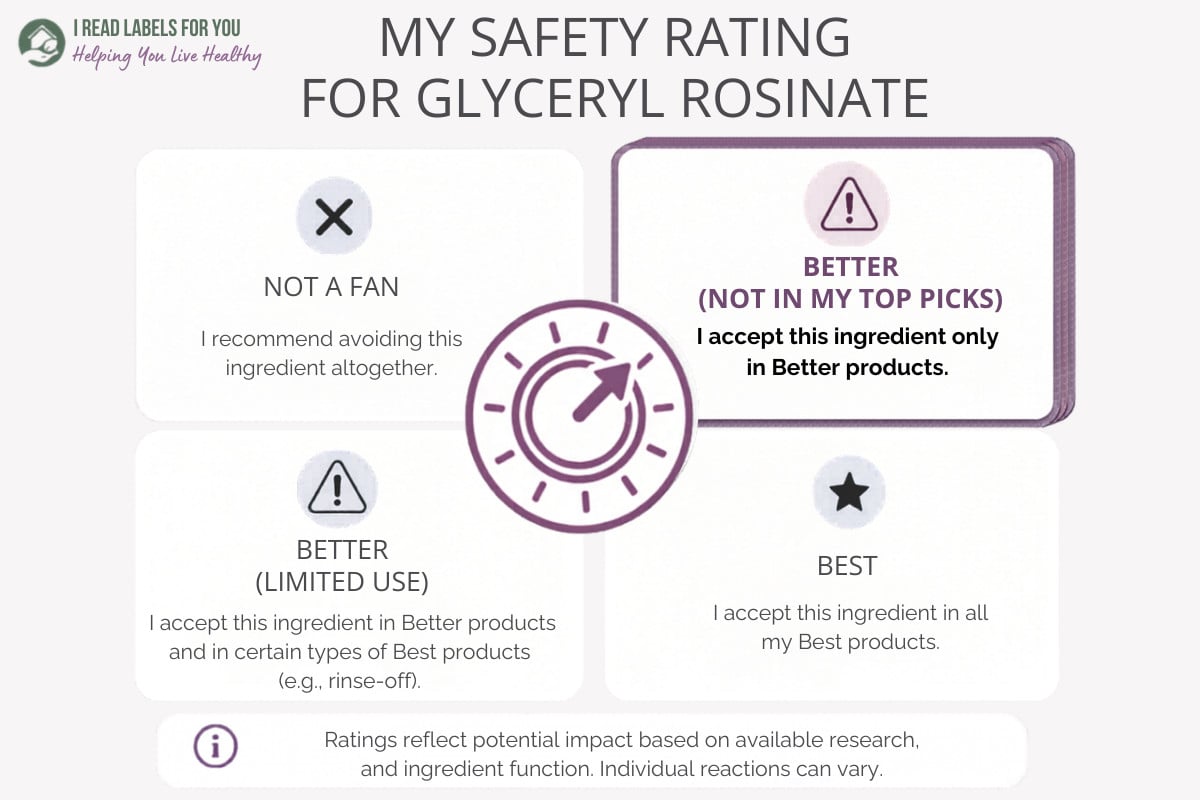
I rate Glyceryl Rosinate Better (Not In My Top Picks). The ester itself tested well, but it starts from a recognized allergen. Nothing on a label shows how much leftover rosin a batch holds.
Therefore, I accept it in my Better products, including makeup and waxes, but it never makes my Best list.
I’m also watching Europe. If RAC confirms rosin as a category 1B reproductive toxicant, I will review this rating.
Here’s what I suggest:
- skip it entirely if a dermatologist has confirmed a colophony allergy
- patch test a new wax on a small area first
- never apply hair-removal wax over broken or irritated skin
- replace mascara and lip products once they pass their use-by date
Frequently Asked Questions About Glyceryl Rosinate
Is Glyceryl Rosinate The Same As Colophony?
No. Colophony is raw pine rosin, while Glyceryl Rosinate is rosin chemically joined to glycerin. The ester is less allergenic, but it can still carry some free rosin.
Is Glyceryl Rosinate Safe In Lipstick?
In lip products, brands use it at about 0.5%, and you swallow a little with every application. Feeding studies in rats found it barely absorbed.
A lipstick with 1% passed allergy tests in 78 volunteers. If your lips react to a long-wear color, colophony allergy is worth discussing with a dermatologist.
Why Do Waxing Products Contain So Much Of It?
Its sticky film grips hair, which makes it ideal for hair removal. Waxes use 72 to 96%, far above the highest level tested on people, an effective 10%.
The CIR counts depilatory wax as a rinse-off product. Still, pulling wax off leaves the skin underneath irritated, and damaged skin is where rosin allergies tend to show up.
Does Glyceryl Rosinate Clog Pores?
There is no evidence that it does. In a rabbit ear test, a standard pore-clogging screen, the undiluted 50% trade mixture caused no blackheads, although only three rabbits were tested.
Is Glyceryl Rosinate Used In Baby Products?
Companies reported no baby-product uses to the CIR in 1999 or 2015. If a baby product did contain it, that product could only make my Better list, never my Best.
Sources
EU SCCS / SCCP Opinions:
No SCCS or SCCP opinion on Glyceryl Rosinate, rosin or colophony (checked). SCCS opinions portal: SCCS opinions
Cosmetic Ingredient Review (CIR) Reports:
Cosmetic Ingredient Review Expert Panel (prepared by Johnson W Jr), 2000. Final Report: Safety Assessment of Glyceryl Laurate, … Glyceryl Rosinate, … and Glyceryl Undecylenate. Unpublished final report, July 25, 2000. Funded by the Personal Care Products Council. Original review; set the 4% limit: cir-reports.cir-safety.org
Andersen FA (ed.), prepared by Johnson W Jr, 2004. Final Report of the Amended Safety Assessment of Glyceryl Laurate, … Glyceryl Rosinate, … and Glyceryl Undecylenate. International Journal of Toxicology 23(Suppl 2):55 to 94. Rosin source, residual rosin, patch tests and rosin-allergic patients; removed the 4% limit: cir-reports.cir-safety.org
Fiume MM, Bergfeld WF, Belsito DV, et al., 2020. Safety Assessment of Monoglyceryl Monoesters as Used in Cosmetics. International Journal of Toxicology 39(Suppl 3):93S to 126S. Use concentrations, food status, gene-damage tests and clinical case: cir-reports.cir-safety.org
European Union Regulatory Databases:
CosIng entry 34100, GLYCERYL ROSINATE, functions film forming and perfuming; no annex restrictions: CosIng 34100
CosIng Annexes II, III, IV, V and VI (2026 versions), checked; Glyceryl Rosinate, rosin and colophony not listed. Annex II entry 440 prohibits hydroabietyl alcohol as a fragrance ingredient, a different rosin derivative.
CLP Annex VI harmonized classifications (2026 table): no entry for Glyceryl Rosinate; rosin (Index 650-015-00-7) classified Skin Sens. 1, H317: ECHA CHEM, rosin
ECHA CHEM, resin acids and rosin acids, esters with glycerol, EC 232-482-5. No harmonized classification; industry self-classification not classified; not a substance of very high concern: ECHA CHEM
ECHA Registry of CLH intentions until outcome, rosin, submitted by Norway. Proposed Skin Sens. 1, H317 and Repr. 1B, H360Df; RAC opinion adopted September 11, 2026; adopted classification not yet published as of October 28, 2026: ECHA CLH registry, rosin
Norway CLH report on rosin, rosin hydrogenated and rosin oligomers. Based on rat oral studies; glycerol esters of rosin not covered: CLH report
ECHA endocrine disruptor assessment list. Glyceryl Rosinate and rosin not listed: ECHA ED assessment
Other Regulators:
U.S. FDA, prohibited and restricted cosmetic ingredients. Not listed: FDA
U.S. Code of Federal Regulations, 21 CFR 172.615, chewing gum base: eCFR 172.615
U.S. Code of Federal Regulations, 21 CFR 172.735, glycerol ester of rosin for citrus oils in beverages, up to 100 parts per million: eCFR 172.735
Health Canada Cosmetic Ingredient Hotlist. Glyceryl Rosinate not listed; hydroabietyl alcohol listed: Health Canada Hotlist
Environment Canada, CEPA Schedule 1. Not listed: CEPA Schedule 1
International Agency for Research on Cancer (IARC). Glyceryl Rosinate and rosin not classified: IARC classifications
U.S. National Toxicology Program, Report on Carcinogens. Not listed: NTP Report on Carcinogens
California Proposition 65 list. Not listed: OEHHA
U.S. EPA Integrated Risk Information System. No assessment: IRIS A to Z list
PubChem Records (Chemistry, Identifiers, Skin Penetration, Hazard Codes):
Glyceryl Rosinate has no PubChem compound record (CID), because it’s a mixture. Substance record SID 375083550: PubChem SID 375083550
Peer-Reviewed Studies:
Shao LP, Gäfvert E, Karlberg AT, Nilsson U, Nilsson JL, 1993. The allergenicity of glycerol esters and other esters of rosin (colophony). Contact Dermatitis 28(4):229 to 234. Reviewed in CIR 2004. PMID 8508634: PubMed 8508634
Gäfvert E, Shao LP, Karlberg AT, Nilsson U, Nilsson JL, 1994. Allergenicity of rosin (colophony) esters (II). Glyceryl monoabietate identified as contact allergen. Contact Dermatitis 31(1):11 to 17. Reviewed in CIR 2004. PMID 7924286: PubMed 7924286
Pereira TM, Flour M, Goossens A, 2007. Allergic contact dermatitis from modified colophonium in wound dressings. Contact Dermatitis 56(1):5 to 9. PMID 17177702: PubMed 17177702
Mukherjee A, Agarwal K, Chakrabarti J, 1992. Genotoxicity studies of the food additive ester gum. Food and Chemical Toxicology 30(7):627 to 630. Abstract only. PMID 1521837: PubMed 1521837
Natural Cosmetic Standards:
COSMOS-standard approved raw materials. Several Glyceryl Rosinate grades approved: COSMOS-standard approved raw materials
NATRUE certified and approved raw materials. Several Glyceryl Rosinate grades approved: NATRUE certified raw materials
Skin Allergy Resource:
American Contact Dermatitis Society (ACDS), Helpful References, including the Core Allergen Series 2020. Colophony 20% pet. is allergen number 7; Glyceryl Rosinate itself is not on the series: ACDS Helpful References
Last verified: 10-28-2026

Download The Free Guide!
5 Powerful Steps To A Non-Toxic Home
Join our informed consumer community and get our free guide the “5 Powerful Steps To A Non-Toxic Home”.

Before commenting, please read our Comment Policy.