
Is Sodium Laureth Sulfate Safe? A Simple Answer You Can Trust
 Written by Irina Webb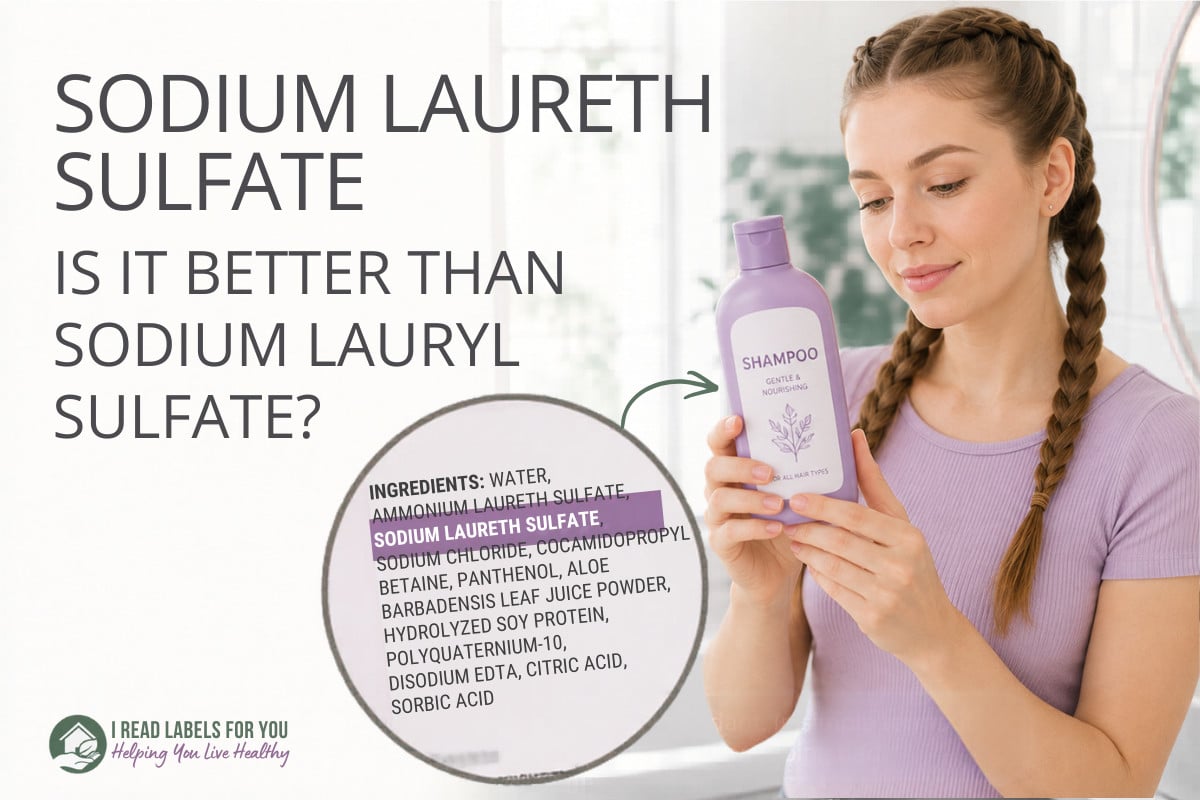
No, Sodium Laureth Sulfate is not an ingredient I accept, and my reason is not the one you might expect. It’s a foaming cleanser in shampoos and body washes. The molecule itself is mild, gentler than Sodium Lauryl Sulfate, and it’s not an allergen or a proven carcinogen. My objection is how it’s made: with ethylene oxide, a known human carcinogen, leaving traces of 1,4-dioxane, a probable carcinogen. I rate it Not A Fan, and the same rating covers every ethoxylated ingredient.
Sodium Laureth Sulfate carries no limit in any cosmetic regulation, and the rules target its manufacturing instead. The European Union bans ethylene oxide, the chemical used to make SLES, as a cosmetic ingredient outright. Europe also requires the manufacturing leftover 1,4-dioxane to be kept as low as technology allows. In 2023, New York State set the only American legal ceiling. Personal care products there may carry at most 1 part per million of 1,4-dioxane, which equals 1,000 parts per billion. Europe’s safety committee has never issued an opinion on the ingredient itself.
Three answers below repay the read. First, a three-letter trick that lets you spot every ethoxylated ingredient on any label in seconds. Second, what the safety panel’s own 1983 report admits it never measured. Third, why I avoid this whole family even though the cancer rumor about it is false.
What Is Sodium Laureth Sulfate?
Sodium Laureth Sulfate (SLES) is a cleansing agent, or surfactant, that makes products foam. It starts from lauryl alcohol, the same fatty alcohol behind Sodium Lauryl Sulfate (SLS). One extra processing step, called ethoxylation, separates the two.
That step is the whole story of this post. Ethoxylation means reacting an ingredient with ethylene oxide, a gas that regulators classify as a known human carcinogen. The finished SLES contains added chains of that gas, which soften the harsh sulfate and boost its foam.
In other words, SLES is not a lone ingredient with a quirk. It belongs to a large family, the ethoxylated ingredients. Every member shares the same birth chemistry and the same baggage.
What Does Sodium Laureth Sulfate Do In Cosmetics?
Sodium Laureth Sulfate’s job is foaming and cleansing. Ethoxylation makes it milder on skin than SLS, which is exactly why brands advertise it as the gentler sulfate. It also works as an emulsifier, a stabilizer, and a solubilizer that keeps fragrance mixed into water.
The last full count, reported to the U.S. Food and Drug Administration (FDA) in 2002, found Sodium Laureth Sulfate in 952 individual products. That put it near the top of all surveyed ingredients, close to Sodium Lauryl Sulfate at 1,018. The growth pattern says more than the total. It appeared in 282 products in 1976. By 2002 it had spread into 23 product categories, absent from the earlier data. Both numbers are floors, since registration was voluntary. No newer count exists, because the safety panel never updated its survey. The largest use sits in shampoos, at concentrations from 11% to 50% of the raw material.
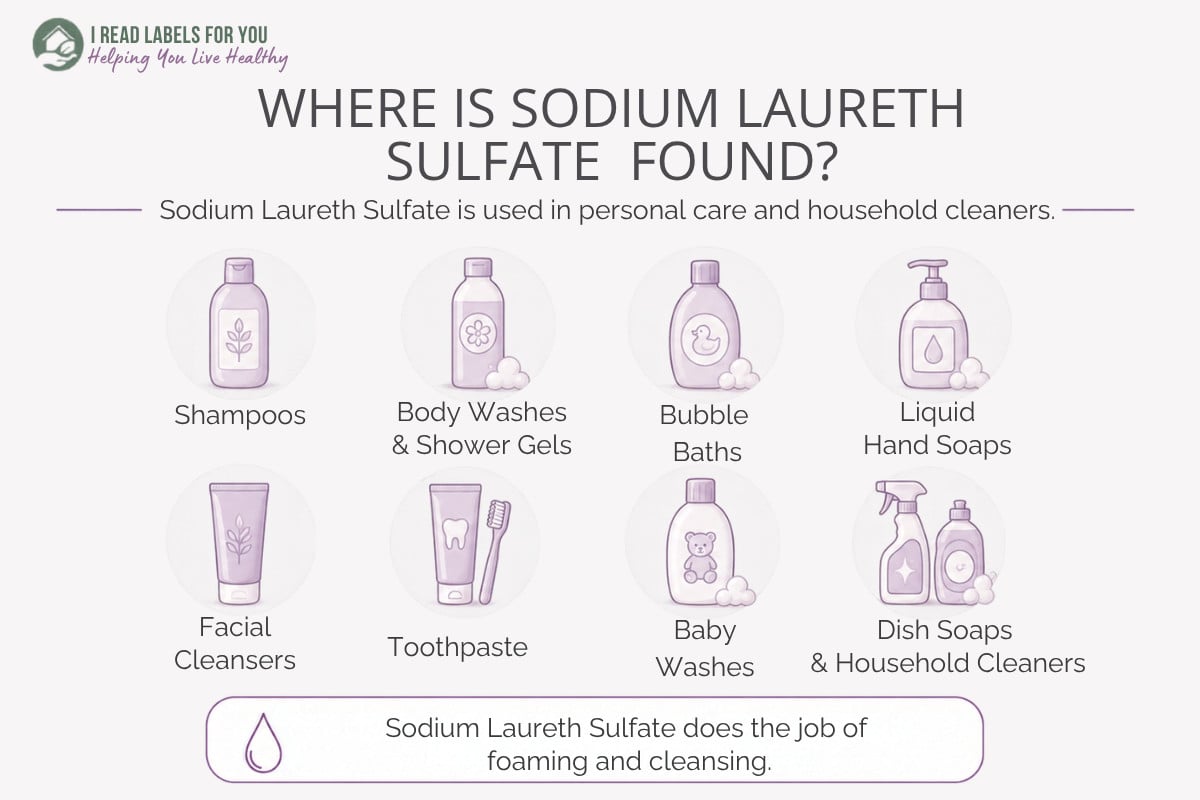
You’ll find Sodium Laureth Sulfate most often in:
- shampoos
- body washes and shower gels
- bubble baths
- liquid hand soaps
- facial cleansers
- toothpastes
- baby washes
- dish soaps and household cleaners
It has no food use. The FDA clears it only for food-contact materials, such as washing solutions for equipment.
What Are Ethoxylated Ingredients?
Ethoxylated ingredients are anything built by reacting a starting material with ethylene oxide. Chemists run that reaction to make harsh ingredients milder and oily ingredients water-friendly. It’s genuinely useful chemistry, which is why the family is enormous.
The family includes the cleansers like SLES and Ammonium Laureth Sulfate. It includes the PEGs, short for polyethylene glycol, which appear in creams as thickeners and carriers. It also includes the polysorbates that blend oil and water, and emulsifiers like Ceteareth-20 and Steareth-2.
Two problems ride along with every member. Ethylene oxide itself can remain as a trace, and the reaction creates 1,4-dioxane, a probable human carcinogen, as a by-product. Purification reduces both, and how well depends entirely on the supplier.
How Do I Recognize Ethoxylated Ingredients On A Label?
You can spot this entire family with a few letters, and no chemistry degree. Scan the ingredient list for any of these four patterns:
- Names Ending In -ETH: Sodium Laureth Sulfate, Laureth-4, Ceteareth-20, Steareth-2, Trideceth-12
- PEG Followed By A Number: PEG-40 Hydrogenated Castor Oil, PEG-100 Stearate, PEG-7 Glyceryl Cocoate
- The Polysorbates: Polysorbate 20, Polysorbate 60, Polysorbate 80
The number after the name tells you how many units of ethylene oxide were added. Laureth-4 carries four, PEG-100 Stearate carries about one hundred. More units mean more ethoxylation, though even one unit puts the ingredient in the family.
This suffix trick is the most useful label skill in this post. One scan of a bottle shows whether a brand uses ethoxylated ingredients at all. That answer tells you something about the brand.
How Is Sodium Laureth Sulfate Made?
The recorded route of how Sodium Laureth Sulfate is made has three steps. Lauryl alcohol, from coconut, palm, or petroleum, is reacted with ethylene oxide. The result is then sulfated and neutralized into the finished salt.
Ethylene oxide is the problem chemical here, and its record is unambiguous. The International Agency for Research on Cancer places it in Group 1, a known human carcinogen. The U.S. National Toxicology Program, California’s Proposition 65, and Canada’s toxic substances list all agree.
The reaction also creates 1,4-dioxane as a by-product, and that leftover can stay in the finished ingredient. 1,4-dioxane is a probable human carcinogen with its own Proposition 65 listing. Manufacturers strip it out with vacuum treatment, to a degree no label will ever tell you.
Here’s the detail that decided my rating. The safety panel’s own 1983 report lists the impurities, then admits that for 1,4-dioxane, data “were not available.” Neither the 2005 nor the 2010 review ever filled that gap.
Does Sodium Laureth Sulfate Penetrate The Skin?
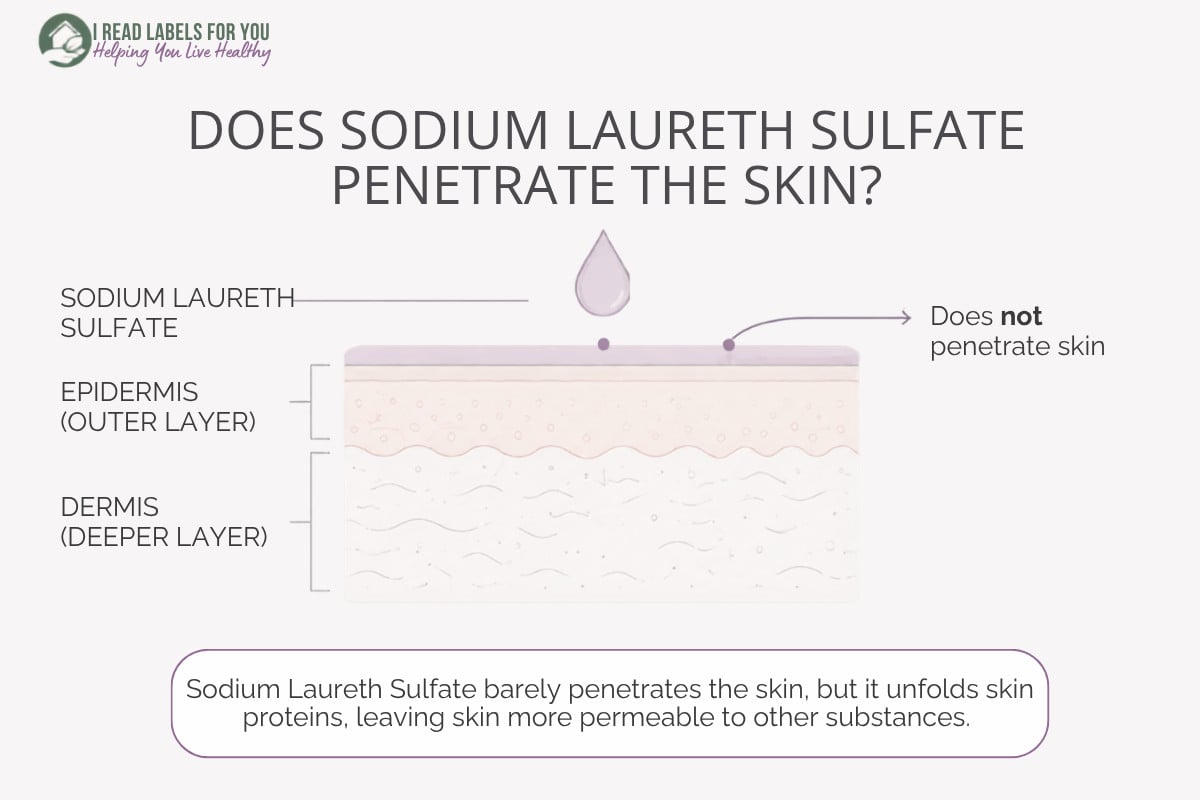
Barely, and that’s the wrong question for this ingredient. In a guinea pig study with radioactive labeling, about 2.4% of the applied dose passed through skin in 24 hours. The molecule is large, carries a permanent charge, and mostly stays on the surface.
What it does instead is open the door. The safety literature shows it unfolds skin proteins, leaving skin more permeable to other substances. That barrier effect is what dry and sensitive skin actually feels.
Size and charge decide penetration, and here charge does the blocking. Commercial SLES is a mixture of related molecules from roughly 330 daltons up. That sits under the 500-dalton mark, and its permanent negative charge is the real gatekeeper.
What Is Sodium Laureth Sulfate Called On Labels?
Watch for these names:
- Sodium Laureth Sulfate
- SLES
- Sodium Lauryl Ether Sulfate
- Sodium Laureth-2 Sulfate
- Sodium Laureth-3 Sulfate
The number in Sodium Laureth-2 Sulfate counts the ethylene oxide units, just as it does across the family. Related salts exist under their own names, such as Ammonium Laureth Sulfate, and my rating covers them too.
Do not confuse any of these with SODIUM LAURYL SULFATE, which has no -eth and no ethoxylation. The two are different ingredients with different concerns, and I rate them differently.
Does The U.S. FDA Restrict Sodium Laureth Sulfate In Food And Cosmetics?
No federal rule limits Sodium Laureth Sulfate in American cosmetics. The FDA restricts only about a dozen cosmetic ingredients in total, and no ethoxylated ingredient is among them. A list that short says little about safety.
The FDA has issued guidance encouraging manufacturers to minimize 1,4-dioxane, and guidance is a suggestion rather than a rule. No federal number exists for how much of that carcinogen a shampoo may contain.
New York State filled that hole at the end of 2023. Its law caps 1,4-dioxane in personal care products at 1 part per million, meaning 1,000 parts per billion. Makeup, counted as cosmetics, gets a looser 10 parts per million, or 10,000 parts per billion.
One comparison puts those numbers in scale. The U.S. Environmental Protection Agency’s drinking water screening level, set at a one-in-a-million lifetime cancer risk, is 0.35 parts per billion. The legal shampoo ceiling runs nearly 3,000 times higher.
To be fair, those are different exposures. You drink water every day for a lifetime, while a shampoo rinses off in seconds. The gap is still worth seeing, because it shows the ceiling was set for manufacturing practicality rather than water-grade purity.
EU Regulations About Sodium Laureth Sulfate
The European Union places no restriction on Sodium Laureth Sulfate itself. It sits in the EU cosmetic database with no limit, no warning label, and no product-type rule. No European safety opinion exists for it, and an unreviewed ingredient is not a cleared one.
Europe regulates the manufacturing instead, and firmly. Ethylene oxide is banned as a cosmetic ingredient under the prohibited-substances annex. The 1,4-dioxane leftover must be kept as low as technically achievable, a principle rather than a number.
One more European detail says a lot. The single open regulatory file on SLES is a compliance check about substance identity, referred to enforcement authorities in 2022. Every batch is a mixture, and even regulators struggle to pin down what commercial SLES is.
Canadian Regulations About Sodium Laureth Sulfate
Canada does not restrict Sodium Laureth Sulfate. It appears on neither the Cosmetic Ingredient Hotlist nor the toxic substances list of Canada’s environmental law.
Like Europe, Canada aims its rules at the manufacturing chemicals instead. Ethylene oxide and 1,4-dioxane are both prohibited as intentional cosmetic ingredients, and ethylene oxide sits on Canada’s toxic substances list.
Can Sodium Laureth Sulfate Cause Skin Allergy And Sensitization?
No, Sodium Laureth Sulfate does not cause true skin allergy, and that finding is unusually clean. The safety panel’s amended review states it plainly: a dermal and ocular irritant, but not a sensitizer.
The human testing supports that. A repeated-insult SLES patch test on 68 people produced moderate irritation in 16%, and not one person became sensitized. Sodium Laureth Sulfate is also absent from the American Contact Dermatitis Society’s core patch-test panel.
Irritation is the real skin issue caused by Sodium Laureth Sulfate, and it rises with concentration. An 18% solution under a sealed patch irritated skin, while diluted rinse-off formulas usually do not. If a wash leaves your skin tight or stinging, suspect this family as an irritant, never as an allergen.
Is Sodium Laureth Sulfate A Hormone (Endocrine) Disruptor?
No, Sodium Laureth Sulfate is not a hormone disruptor, though the honest answer carries a caveat. No regulator flags it for endocrine effects, and no endocrine assessment of it exists at the European chemicals agency.
The caveat is that nobody has looked. The medical literature contains no endocrine studies on Sodium Laureth Sulfate at all. Untested is weaker than tested-and-clean, and I refuse to round it up to proof of safety.
Is Sodium Laureth Sulfate Safe To Use While Pregnant?
The animal evidence here is reassuring. Rats ate Sodium Laureth Sulfate in their food for 14 weeks, then bred across two generations. Researchers found no effect on fertility, litter size, lactation, or survival of offspring.
Skin exposure adds a second layer of comfort. Only about 2.4% of a SLES dose crosses skin, and a shampoo rinses off in seconds. Pregnancy is not the reason I avoid this ingredient.
My rating rests on manufacturing, which no personal timing changes. If you are pregnant and weighing any specific product, you should consult with your medical provider.
Are There Any Cancer Concerns Linked To Sodium Laureth Sulfate?
No, Sodium Laureth Sulfate itself is not linked to cancer, and that claim has been checked and rejected. In 2005 the safety panel acknowledged “the Internet rumor that these ingredients are carcinogenic.” After reviewing it, the panel found no reason to reopen its assessment.
The long-term animal data back that up. Rats ate Sodium Laureth Sulfate in their diet for 105 weeks with no changes found. Mice had it painted on their skin twice weekly for 105 weeks and developed no skin tumors.
The genuine cancer question sits one step upstream, in the factory. Sodium Laureth Sulfate is made with ethylene oxide, a known human carcinogen. It carries 1,4-dioxane, a probable carcinogen, as a residue no label discloses and the panel’s record never measured.
Be precise about what that means. You will not get cancer from washing your hair, and the trace levels in a finished product are small. My concern is the manufacturing choice itself, and what accepting it says about a company’s standards.
Is Sodium Laureth Sulfate Bad For The Environment?
As a finished ingredient, Sodium Laureth Sulfate is not an environmental standout in either direction. Unlike the conditioning quats, it carries no very-toxic-to-aquatic-life classification. Surfactants of this class biodegrade in wastewater treatment.
The environmental cost concentrates at the factory. Ethylene oxide production and handling expose workers and surrounding communities to a known carcinogen. That footprint is part of how I judge an ingredient, even when the drain-side picture looks acceptable.
Common Claims About Sodium Laureth Sulfate: What’s True And What’s Not
Claim: Sodium Laureth Sulfate Causes Cancer
False as stated, and the false version does real damage. The Sodium Laureth Sulfate molecule shows no cancer signal in 105-week feeding and skin-painting studies, and no cancer agency lists it. Even the industry’s own panel took the rumor seriously enough to review it by name.
The kernel of truth got garbled in transmission. The legitimate issue is the Sodium Laureth Sulfate manufacturing route and its 1,4-dioxane residue. That is a contamination question, and stated accurately it remains a real reason for caution.
Claim: Sulfate-Free Means Ethoxylate-Free
Often false, and this one catches careful shoppers. While a sulfate-free shampoo may have removed sulfates like SLS and SLES, it may still contain ethoxylated ingredients like Laureth-4, PEG-40 Hydrogenated Castor Oil, or Polysorbate 20.
The suffix scan settles it in seconds. Check for -eth, PEG, and polysorbate. You’ll know whether the brand left the family or only dropped its most famous member.
Claim: Sodium Laureth Sulfate Comes From Coconut, So It’s Natural
The starting fat in the Sodium Laureth Sulfate manufacturing route can indeed come from coconut or palm. Everything after that is industrial chemistry, and ethoxylation is the least natural step in surfactant production.
The strict natural standards agree. COSMOS and NATRUE both exclude ethoxylated ingredients from certified products entirely, whatever is the source of the starting fat. A coconut origin story does not survive an ethylene oxide reactor.
What I Think About Sodium Laureth Sulfate — And What You Should Do
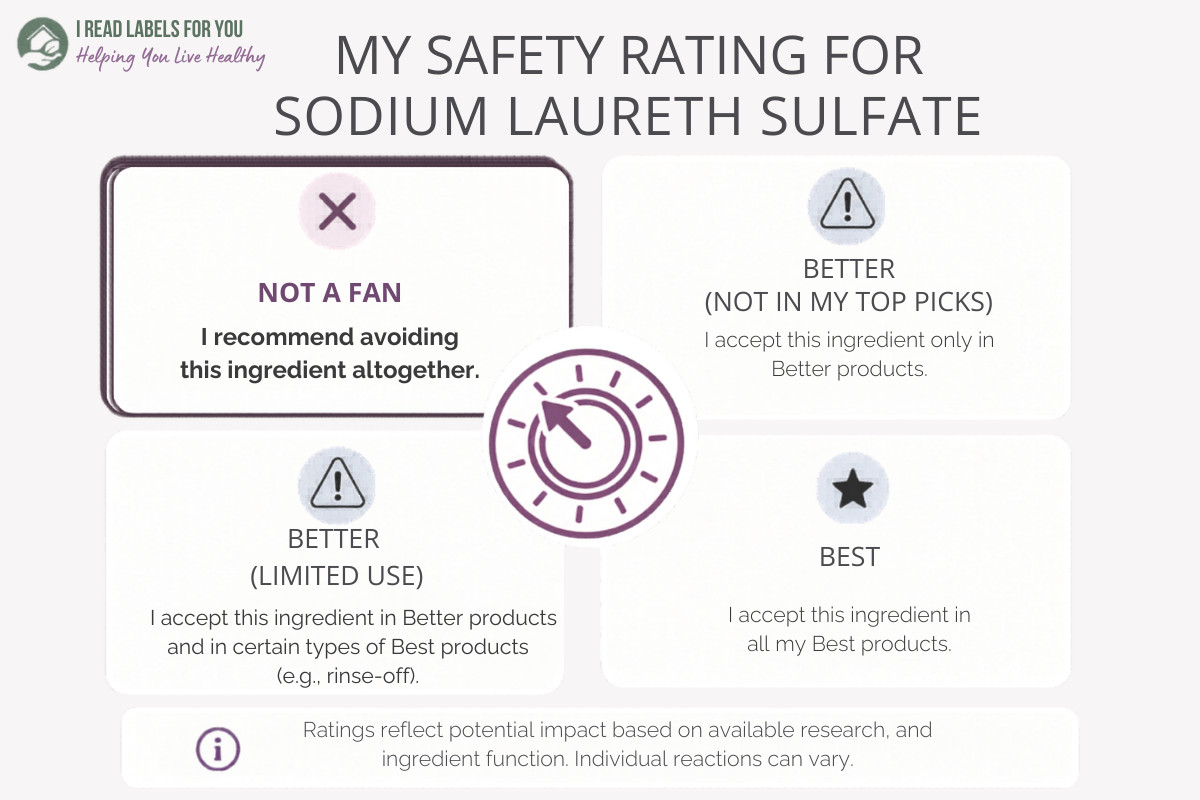
I rate Sodium Laureth Sulfate Not A Fan. The rating covers the whole ethoxylated family: every -eth ingredient, PEG, and polysorbate. For years I’ve been telling my readers to avoid ethoxylated ingredients, and here’s the reasoning in one place.
Let me be fair to the Sodium Laureth Sulfate molecule first. It’s mild, it’s not an allergen, it barely penetrates, and the reproductive and long-term studies are clean. Judged only by what touches your skin, it would earn a better rating.
My objection is upstream. Ethoxylated ingredients are made with a known human carcinogen ethylene oxide, and they carry the residue of a probable carcinogen 1,4-dioxane. The levels appear on no label, and the safety panel never measured them.
You won’t get cancer from the residue, and that was never the point. The point is trust. Clean alternatives exist for every job this family of ingredients does.
A company that accepts carcinogen-based manufacturing anyway is telling you something about its standards. I treat an ethoxylated ingredient on a label as information about the brand, not just the bottle.
Here’s what to do with thirty seconds and a bottle. Scan for -eth, PEG, and polysorbate, and if you find them, put the product aside. Know that there’re brands that manage without. For cleansing, Glucosides and Coco-Betaine do the same job with no ethoxylation anywhere in their history.
Frequently Asked Questions About Sodium Laureth Sulfate
What Is The Difference Between Sodium Laureth Sulfate And Sodium Lauryl Sulfate?
One processing step separates Sodium Laureth Sulfate (SLES) and Sodium Lauryl Sulfate (SLS). Specifically, Sodium Laureth Sulfate is Sodium Lauryl Sulfate after ethoxylation, which makes it milder on skin and foamier in water.
The trade is irritation for manufacturing baggage. SLS irritates more but involves no ethylene oxide and no 1,4-dioxane. SLES irritates less and carries both. That’s why I rate SLS Better (Limited Use), and I rate SLES Not A Fan. My framework weighs the factory, not just the skin.
Is Sodium Laureth Sulfate Good In Shampoo?
Sodium Laureth Sulfate cleans hair well, and hair itself is not living tissue that the ingredient can harm. The scalp is the real contact point. There, the story is irritation for some people rather than damage for everyone.
Good is a different question from acceptable. A shampoo is also a purchase, and mine go to brands that foam with glucosides or betaines instead.
Is It Better To Use Sulfate-Free Shampoo?
Usually, for sensitive, dry, or eczema-prone skin, it is better to use sulfate-free shampoo because sulfates strip and irritate. For normal skin, a well-formulated sulfate wash is not dangerous, as my Sodium Lauryl Sulfate review explains.
Read the whole label before paying the sulfate-free premium. A brand that replaces sulfates with Laureth-4 or a PEG blend swapped one ethoxylate for another. It kept exactly the part I object to.
Are Ethoxylated Ingredients Safe?
The finished molecules are mostly mild, poorly absorbed, and free of proven cancer or hormone effects. Judged as chemicals in a bottle, most of the family passes conventional review.
I still avoid all ethoxylated ingredients. They’re made with carcinogenic ethylene oxide and can carry carcinogenic 1,4-dioxane residue that no label reveals. COSMOS and NATRUE exclude the whole family, and clean substitutes exist for every function.
What Are The Health Concerns Of Ethoxylates?
There’re three health concerns of ethoxylates, in order of how well they’re proven. First, irritation: the cleansing members strip skin lipids, with severity rising with concentration. Second, contamination: residual 1,4-dioxane and ethylene oxide, at levels that vary by supplier and appear on no label. Third, the least discussed: worker and community exposure where ethylene oxide is used. The consumer dose is the smallest piece of the picture, which is exactly why a consumer-dose review misses it.
Sources
EU SCCS / SCCP Opinions:
No SCCS or SCCP opinion on Sodium Laureth Sulfate (checked; the CosIng record lists none and the SCCS opinions portal returns no result): SCCS opinions portal
Cosmetic Ingredient Review (CIR) Reports:
Robinson VC, Bergfeld WF, Belsito DV, et al. (2010). Final Report of the Amended Safety Assessment of Sodium Laureth Sulfate and Related Salts of Sulfated Ethoxylated Alcohols. International Journal of Toxicology 29(Suppl 3): 151S-161S: cir-reports.cir-safety.org
Cosmetic Ingredient Review (2005). Annual Review of Cosmetic Ingredient Safety Assessments 2003/2004: Sodium Laureth Sulfate and Ammonium Laureth Sulfate re-review. International Journal of Toxicology 24(Suppl 1), source of the use figures and the internet-rumor acknowledgement: cir-reports.cir-safety.org
Cosmetic Ingredient Review (1983). Final Report on the Safety Assessment of Sodium Laureth Sulfate and Ammonium Laureth Sulfate. Journal of the American College of Toxicology 2(5): 1-34, source of the impurity table and the 1,4-dioxane data gap: cir-reports.cir-safety.org
European Union Regulatory Databases:
CosIng entry for SODIUM LAURETH SULFATE (substance ID 79583), no Annex listing, no restrictions, no SCCS opinion: EU CosIng database
CosIng Annex II, Ethylene Oxide is a prohibited cosmetic ingredient in the EU: EU CosIng database
ECHA CHEM record for sodium 2-(2-dodecyloxyethoxy)ethyl sulphate (EC 221-416-0), one REACH registration; compliance check on substance identity referred to enforcement authorities, 2022: ECHA CHEM
Other Regulators:
U.S. FDA, Sodium Laureth Sulfate is not on the prohibited or restricted cosmetic ingredient list; cleared for indirect food-contact use only: FDA prohibited and restricted cosmetic ingredients
New York State DEC 1,4-dioxane limits: 1 ppm (1,000 ppb) in personal care and household cleansing products from December 31, 2023; 10 ppm (10,000 ppb) in cosmetics: NYSDEC 1,4-dioxane limits
U.S. EPA IRIS 1,4-dioxane assessment; drinking water screening level of 0.35 ppb for a one-in-a-million cancer risk: EPA IRIS 1,4-dioxane
Health Canada Cosmetic Ingredient Hotlist, Sodium Laureth Sulfate not listed; Ethylene Oxide and Dioxane are prohibited as ingredients: Cosmetic Ingredient Hotlist
IARC, Sodium Laureth Sulfate not classified; Ethylene Oxide is Group 1, carcinogenic to humans: IARC List of Classifications
U.S. NTP 15th Report on Carcinogens, Sodium Laureth Sulfate not listed; Ethylene Oxide listed as known to be a human carcinogen: NTP Report on Carcinogens
California Proposition 65, Sodium Laureth Sulfate not listed; Ethylene Oxide and 1,4-Dioxane both listed: OEHHA Proposition 65 list
Environment Canada CEPA Schedule 1, Sodium Laureth Sulfate not listed; Ethylene Oxide listed: CEPA Schedule 1
PubChem Records (Chemistry, Identifiers, Skin Penetration, Hazard Codes):
Sodium laureth sulfate, representative record CID 23665884, molecular weight 332.43 for the n=1 homolog; manufacturing route via ethylene oxide and sulfation: PubChem CID 23665884
Peer-Reviewed Studies:
No standalone peer-reviewed studies are cited in this post. The animal and human data, including the absorption, reproduction, and patch-test studies, come from the three CIR safety assessments listed above, which reviewed them.
Natural Cosmetic Standards:
COSMOS-standard approved and certified raw materials, no result for laureth sulfate; ethoxylated ingredients are excluded from the standard: COSMOS-standard database
NATRUE certified and approved raw materials, no result for laureth: NATRUE certified world
Skin Allergy Resource:
American Contact Dermatitis Society, Helpful References, including the Core Allergen Series 2020; Sodium Laureth Sulfate does not appear, consistent with irritant rather than allergen: ACDS Helpful References
Last verified: 08-15-2026
Download The Free Guide!
5 Powerful Steps To A Non-Toxic Home
Join our informed consumer community and get our free guide the “5 Powerful Steps To A Non-Toxic Home”.

Before commenting, please read our Comment Policy.