
Is Bemotrizinol Safe? A Simple Answer You Can Trust
 Written by Irina Webb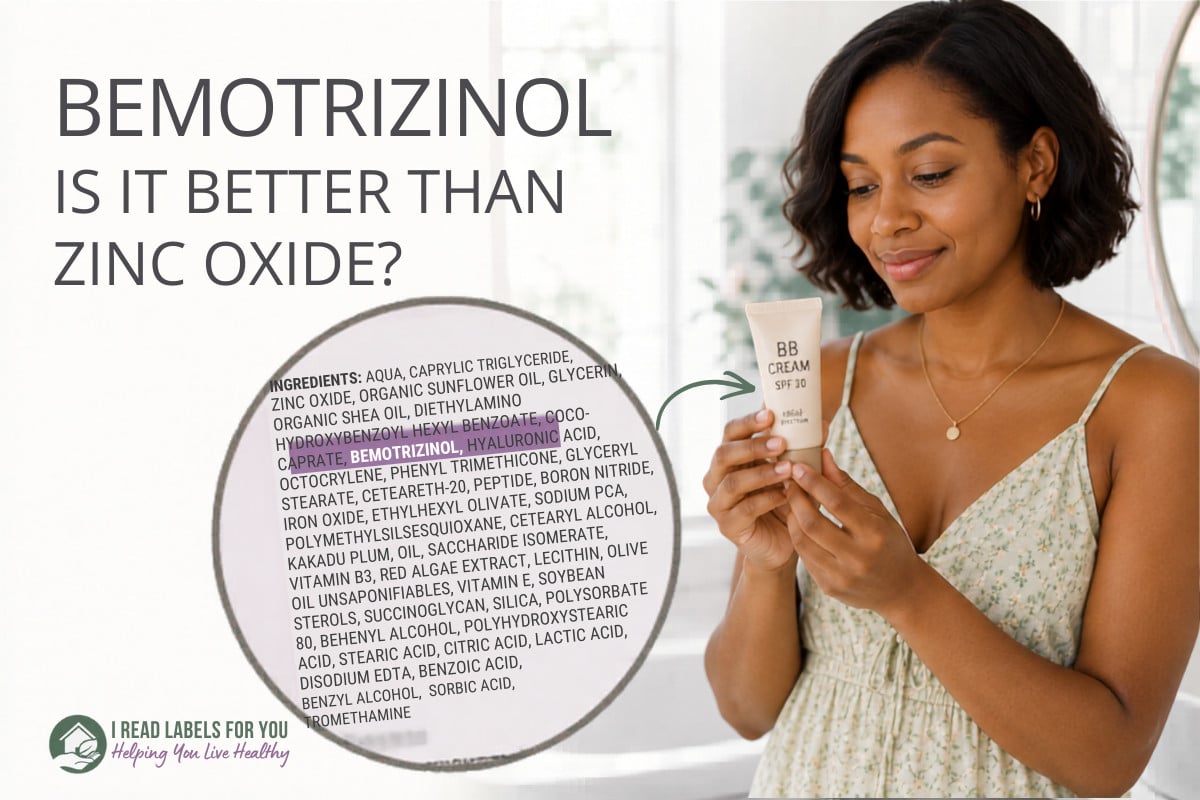
Yes, Bemotrizinol is safe. It’s a broad-spectrum sunscreen filter, also sold as Tinosorb S, that blocks both UVA and UVB rays. It barely penetrates the skin and is not linked to hormone concerns raised about older chemical filters like oxybenzone. Testing found no sensitization and no genetic damage. I rate it Best.
Europe allowed Bemotrizinol in 2000, at up to 10%. The U.S. FDA approved it on June 9, 2026, at up to 6%. That made it the first new American sunscreen filter in over 25 years.
Below, you’ll find out why Americans waited 25 years for Bemotrizinol to be approved, how to spot it on a label, and when to expect it on the shelves.
What Is Bemotrizinol?
Bemotrizinol is a synthetic sunscreen filter that shields your skin from the sun. Its full name on labels is Bis-Ethylhexyloxyphenol Methoxyphenyl Triazine (BEMT), and it also goes by the trade name Tinosorb S.
Chemically, Bemotrizinol belongs to the triazine family of carbon-based compounds. Europe has been using it in sunscreens since 2000, which makes it well established, even though it’s new to the United States.
What Does Bemotrizinol Do In Cosmetics?
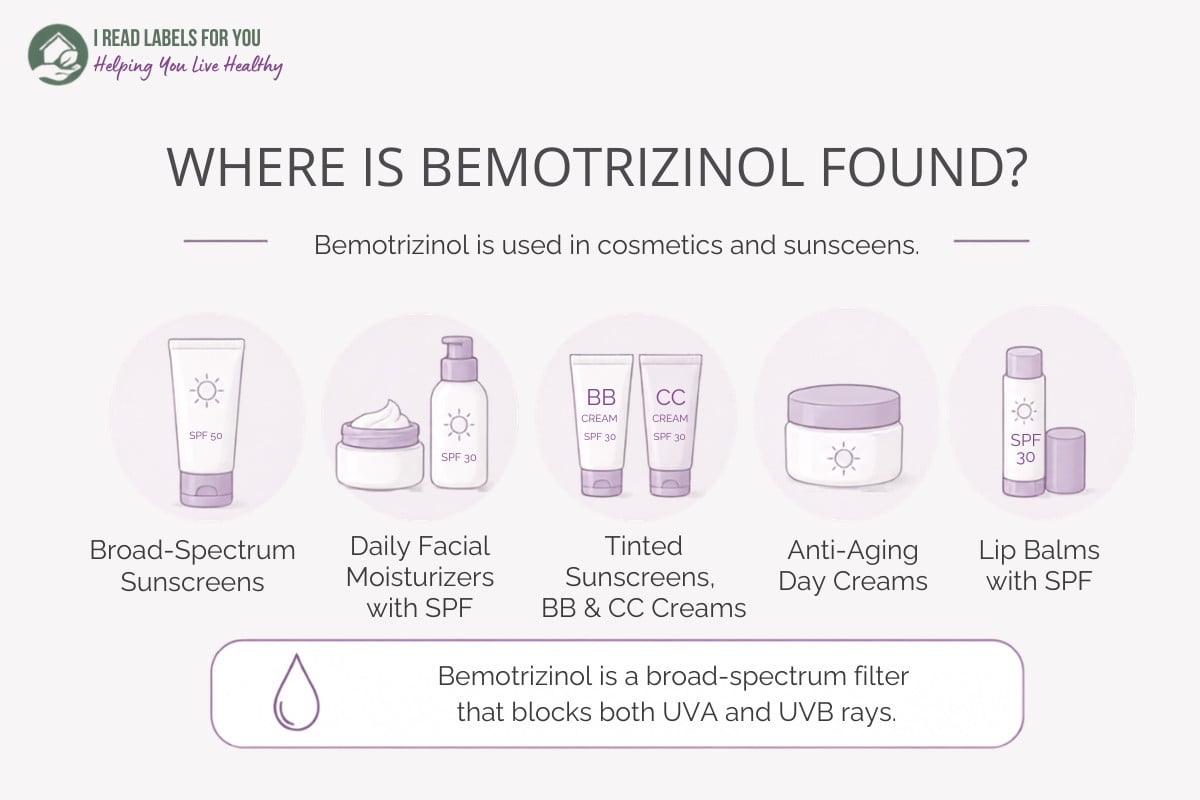
Bemotrizinol is a broad-spectrum filter, which means it blocks both UVA and UVB rays. It soaks up that ultraviolet energy and releases it as a tiny amount of heat, before the light can harm your skin.
On top of that, Bemotrizinol is unusually photostable. In other words, it does not break down in sunlight, and it even helps steady other filters in the same bottle. It also goes on clear, with no white cast.
One caution about labels. SPF and broad-spectrum protection come from the whole formula, not from any single filter. Bemotrizinol on the ingredient list is a good sign, but the front-label SPF tells you the real strength.
You’ll find Bemotrizinol most often in:
- broad-spectrum sunscreens
- daily facial moisturizers with SPF
- tinted sunscreens, BB and CC creams
- anti-aging day creams
- lip balms with SPF
Bemotrizinol is not a food ingredient. It has no E-number and no role in the food supply, since it exists only to filter sunlight in cosmetics.
How Is Bemotrizinol Made?
Bemotrizinol is fully synthetic, made in a lab rather than from a plant or a mineral. Chemists start with a small central ring, called a triazine, and attach phenol pieces to its sides. Neither the triazine nor the phenol is a known carcinogen. Together these form one large, stable molecule. The finished ingredient is a pale powder that blends into the oil part of a sunscreen.
Does Bemotrizinol Penetrate The Skin?
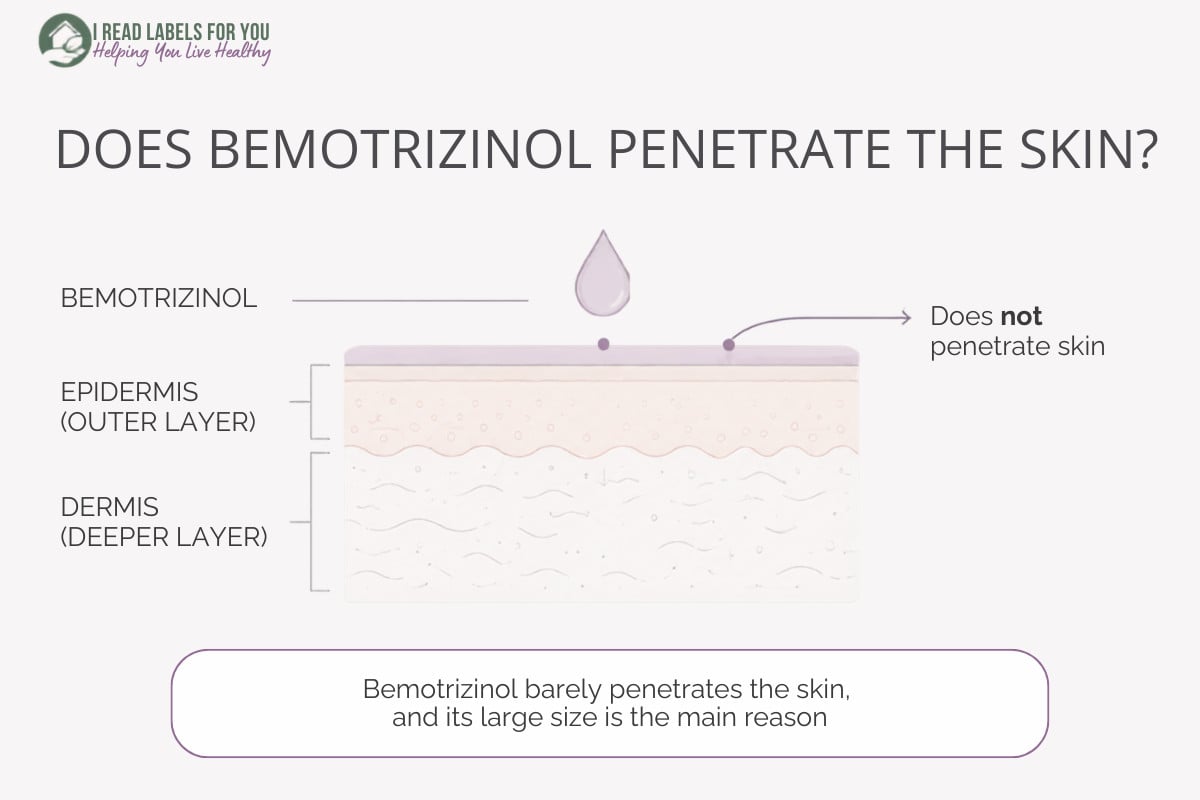
No, Bemotrizinol barely penetrates the skin, and its large size is the main reason. It weighs about 628 daltons, and molecules above roughly 500 daltons generally cannot pass through the skin’s outer layer.
Its oil-loving nature adds a second barrier. LogP measures how strongly a substance prefers oil over water, and Bemotrizinol’s is very high at 10.4. It therefore stays in the surface film, where Europe’s panel measured its absorption as very low.
What Is Bemotrizinol Called On Labels?
Bemotrizinol’s CAS number is 187393-00-6, and it can appear on labels as:
- Bemotrizinol
- Bis-Ethylhexyloxyphenol Methoxyphenyl Triazine
- Tinosorb S
- Escalol S
- Uvinul T 150
- Parsol Shield
On a U.S. sunscreen, the label simply says Bemotrizinol. Look in the Drug Facts box under Active Ingredients, where the percentage appears right beside it.
That percentage is worth knowing. Ordinary cosmetic labels rank ingredients by amount but never give you the actual numbers.
Does The U.S. FDA Restrict Bemotrizinol In Food And Cosmetics?
The big news is that the FDA approved Bemotrizinol on June 9, 2026. It became the first new sunscreen active the agency had added in more than 25 years. The FDA cleared it for adults and children 6 months and older.
The FDA labeled it GRASE, short for Generally Recognized As Safe and Effective, and allows Bemotrizinol at up to 6%. Companies can add it to U.S. sunscreens starting August 9, 2026, so you’ll begin seeing it on shelves soon. One catch: a single company holds exclusive U.S. rights at first. Dsm-firmenich earned 18 months of exclusivity by filing the application. That clock starts with its first commercial shipment, expected around September 2026.
BASF sells the same molecule in Europe as Tinosorb S, but rivals cannot reach U.S. shelves until early 2028. Until then, expect early Bemotrizinol sunscreens to cost more than familiar ones. Prices should ease once competitors can enter.
The order also limits which forms it can take. The FDA cleared Bemotrizinol for lotions, creams, gels, sticks, and pump sprays, but not for aerosol sprays or powders. That suits me, since I’m not a fan of aerosol propellants like butane, propane, and isobutane.
Still, this approval came painfully slowly. The FDA’s sunscreen rules are outdated and had not welcomed a new filter since the 1990s. That’s why Americans waited a generation for something Europe trusted back in 2000.
EU Regulations About Bemotrizinol
The European Union allows Bemotrizinol as a UV filter under Annex VI, entry 25, of its Cosmetics Regulation. The cap is a maximum of 10% in the finished product.
Europe’s expert panel reviewed it and proposed no restrictions. The panel’s verdict: Bemotrizinol is “safe for use in cosmetic products as a UV light absorber at a maximum concentration of 10%.”
Europe leans on the precautionary principle, which means a filter must be shown safe before it can be sold. Because of that cautious starting point, this clean verdict carries real weight.
U.S. And EU Disagreements On Bemotrizinol
For 25 years, the two regions flatly disagreed. Europe, Australia, and much of Asia used Bemotrizinol freely, while the United States kept it off the market.
The gap was not about safety worries. Because sunscreens count as drugs here, a new filter has to be added to the FDA’s official monograph. For decades that meant full federal rulemaking, which moved at a crawl. Congress tried to fix it in 2014 with the Sunscreen Innovation Act. That law set deadlines, yet not one new filter won approval under it, and eight applications stalled.
The real change came with the CARES Act in 2020, which replaced rulemaking with a faster order process. Bemotrizinol’s maker filed under that new pathway in September 2024, and approval followed in under two years.
The two regions still differ on amount, since the FDA caps Bemotrizinol at 6% while Europe allows up to 10%.
Canadian Regulations About Bemotrizinol
Canada has allowed Bemotrizinol for years. Health Canada permits it as a sunscreen filter and does not place it on its Cosmetic Ingredient Hotlist of banned or restricted substances.
That puts Canada alongside Europe rather than the old U.S. position. North of the border, you’ll already find it in some sunscreens.
Can Bemotrizinol Cause Skin Allergy And Sensitization?
No, Bemotrizinol rarely causes skin allergy or sensitization. Europe’s safety panel found no evidence of sensitization or photo-sensitization, and judged the ingredient non-irritating.
Reports of true allergy are very rare in the medical literature. If your skin reacts easily, you can patch-test a new product first, but responses to this filter are unusual.
Is Bemotrizinol A Hormone (Endocrine) Disruptor?
No, Bemotrizinol is not a hormone disruptor. This is one of its biggest advantages over older filters like oxybenzone, which raised estrogen concerns.
In a receptor-binding and rat uterotrophic study, Bemotrizinol showed no estrogen or androgen activity. It also does not appear on the European Union’s endocrine-disruptor list, and it barely enters the body.
Is Bemotrizinol Safe To Use While Pregnant?
Bemotrizinol looks safe to use while you’re pregnant. Because it sits on the skin’s surface, very little if any reaches the rest of your body. Europe’s panel also found no reproductive toxicity or birth-defect signals.
That said, pregnancy is personal, and you should consult with your medical provider about your sunscreen choices. Many expectant parents still prefer mineral zinc oxide, which is also an excellent option.
Are There Any Cancer Concerns Linked To Bemotrizinol?
No, Bemotrizinol is not linked to cancer. No health agency classifies it as a carcinogen, including the International Agency for Research on Cancer (IARC), the U.S. National Toxicology Program, and California’s Proposition 65 list. Europe’s panel also found no evidence of mutations or DNA damage. In fact, by blocking UV rays, a good sunscreen helps lower your risk of skin cancer.
Is Bemotrizinol Bad For The Environment?
No, no European regulator flags Bemotrizinol as harmful to the environment. Companies there must report any hazards a chemical carries, and all 144 reports filed for Bemotrizinol list none. Environment Canada also leaves it off its list of toxic substances.
Its chemistry helps too. Bemotrizinol is a large, oil-loving molecule that barely dissolves in water, hence it does not disperse easily through the ocean. Because it’s also highly photostable, it does not break down into other compounds in sunlight.
Common Claims About Bemotrizinol: What’s True And What’s Not
Claim: All Chemical Sunscreens Soak Into Your Blood
Some do, but Bemotrizinol does not. Studies on older, smaller filters found them in blood, which understandably worried people. Bemotrizinol is far larger and oilier, hence it stays on the surface. Europe’s review measured its skin absorption as very low.
Claim: Chemical Filters Disrupt Hormones
This is true for a few older filters, yet not for Bemotrizinol. As noted above, it showed no estrogen or androgen activity in testing. It’s also not on Europe’s endocrine-disruptor watch list. That marks a meaningful difference from filters like oxybenzone.
Claim: It’s Too New To Trust
It’s new to U.S. shelves, but it’s far from untested. Bemotrizinol has been protecting skin across Europe, Australia, and Asia since 2000. That adds up to about 25 years of real-world use and safety review. The FDA’s approval simply lets Americans catch up.
What I Think About Bemotrizinol — And What You Should Do
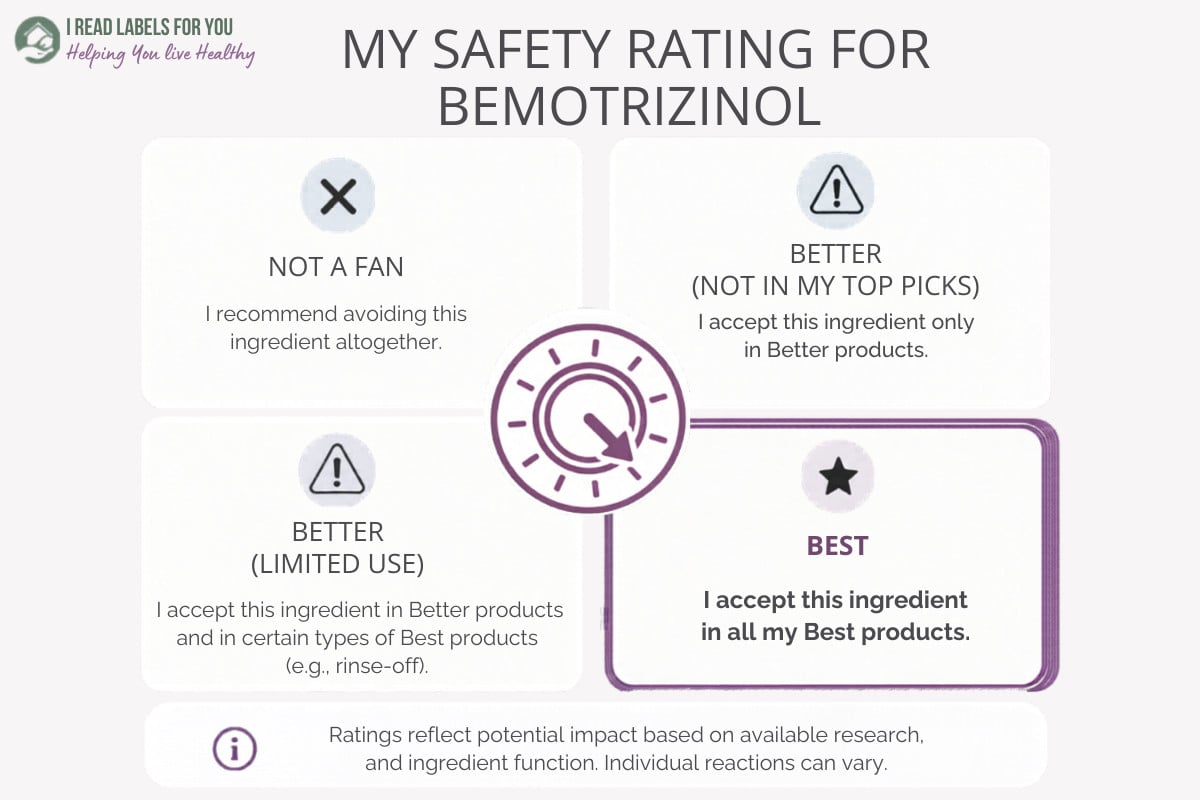
Bemotrizinol is one of the cleanest sunscreen filters available, which is why I rate it Best. It offers broad-spectrum protection, stays out of your bloodstream, does not disrupt hormones, and leaves no white cast.
I still love mineral zinc oxide, and it remains my first pick for babies and very sensitive skin. Even so, Bemotrizinol is a genuinely strong, well-studied choice for anyone who prefers a clear, lightweight sunscreen.
As it reaches U.S. shelves in late 2026, you’ll start spotting it on labels. When you do, you can feel confident about it.
Frequently Asked Questions About Bemotrizinol
Which U.S. Sunscreens Contain Bemotrizinol?
As of mid-2026, almost none yet, because the FDA approval is brand new. Companies can start adding it in August 2026, and U.S. products are just beginning to appear.
What Are The Benefits Of Bemotrizinol?
It guards against both UVA and UVB rays and holds up well in sunlight. Furthermore, it goes on clear, feels light, stays out of the body, and helps stabilize other filters.
What Are The Side Effects Of Bemotrizinol?
Side effects are uncommon. Mild irritation is possible now and then, as with any ingredient, but testing found no meaningful allergy or sensitization.
Is Bemotrizinol Better Than Zinc Oxide?
Neither is simply better, because both are excellent and now share the FDA’s top GRASE rating. Zinc oxide has the longest track record and the lowest irritation risk, while Bemotrizinol wins on a clear, elegant finish.
For babies and reactive skin, I lean towards mineral (zinc oxide). For an invisible daily sunscreen, Bemotrizinol is a great pick.
Can Bemotrizinol Be Used With Zinc Oxide?
Yes. The FDA’s 2026 order specifically permits combining Bemotrizinol with zinc oxide, and with titanium dioxide, in U.S. sunscreens.
That’s a real advantage. Avobenzone, the older chemical UVA filter, may not be paired with zinc oxide under U.S. rules, so Bemotrizinol opens up mineral-plus-modern-filter blends that were not possible before.
Is Bemotrizinol FDA Approved?
Yes. The FDA approved it on June 9, 2026, as an over-the-counter sunscreen active for adults and children 6 months and older.
The long wait reflected the FDA’s outdated sunscreen process, not any safety problem. Europe has already been using it safely since 2000.
Sources
EU SCCS / SCCP Opinions:
SCCNFP opinion SCCNFP/0082/98 on Bemotrizinol (Colipa S81), adopted 17 February 1999 — concluded it is safe as a UV absorber up to 10%, with no further restrictions. SCCS opinions library
Cosmetic Ingredient Review (CIR) Reports:
No CIR safety assessment on Bemotrizinol (checked); as a sunscreen UV filter it falls outside CIR’s usual scope. CIR reports
European Union Regulatory Databases:
EU CosIng entry — Bis-Ethylhexyloxyphenol Methoxyphenyl Triazine; UV filter and light stabilizer; Annex VI/25, maximum 10%. CosIng record
CLP Annex VI harmonised classifications — no harmonised classification for Bemotrizinol (checked): ECHA harmonised classification
ECHA REACH dossier — registered; not an SVHC and no harmonised CLP classification: ECHA dossier
REACH Annex XIV (Authorisation List) — Bemotrizinol not listed; ECHA shows no authorisation obligation. ECHA obligations
REACH Annex XVII (Restrictions) — Bemotrizinol not restricted; ECHA shows no restriction obligation. ECHA obligations
Other Regulators:
U.S. FDA — approved Bemotrizinol as an OTC sunscreen active (GRASE) on 2026-06-09; usable in products from 2026-08-09: FDA announcement
The FDA Final Administrative Order OTC000039 (published 2026-06-10) — the order adding Bemotrizinol to Monograph M020 at up to 6%, effective 2026-08-09: Order OTC000039
FDA OTC Monograph M020, Sunscreen Drug Products for OTC Human Use — the governing monograph, including permitted active ingredients and combinations (M020.20). Monograph M020
FDA Sunscreen Innovation Act (2014) — the earlier review pathway that produced no new filter approvals before the CARES Act replaced it. FDA SIA page
Health Canada Cosmetic Ingredient Hotlist — not listed; permitted as a sunscreen filter. Hotlist
Environment Canada CEPA Schedule 1 (List of Toxic Substances) — not listed (checked). CEPA Schedule 1
International Agency for Research on Cancer (IARC) — not classified (checked). IARC classifications
U.S. National Toxicology Program Report on Carcinogens — not listed (checked). NTP Report on Carcinogens
California Proposition 65 — not listed (checked). Proposition 65 list
U.S. EPA Integrated Risk Information System (IRIS) — no assessment for Bemotrizinol (checked). EPA IRIS
International Fragrance Association (IFRA) Transparency List and Standards — not listed; Bemotrizinol is a UV filter, not a fragrance material. IFRA standards library
PubChem Records (Chemistry, Identifiers, Skin Penetration, Hazard Codes):
PubChem CID 135487856 — molecular weight (628), LogP (10.4), identifiers, and hazard codes: PubChem record
Peer-Reviewed Studies:
Ashby J, Tinwell H, Plautz J, Twomey K, Lefevre PA. Lack of binding to isolated estrogen or androgen receptors, and inactivity in the immature rat uterotrophic assay, of the ultraviolet sunscreen filters Tinosorb M-active and Tinosorb S. Regul Toxicol Pharmacol. 2001;34(3):287-291. PMID 11754532. PubMed
Natural Cosmetic Standards:
COSMOS-standard approved raw materials — Bemotrizinol not listed (synthetic UV filter). COSMOS database
NATRUE certified/approved raw materials — Bemotrizinol not listed. NATRUE
Skin Allergy Resource:
American Contact Dermatitis Society (ACDS) Helpful References, including the Core Allergen Series 2020 — Bemotrizinol not listed. ACDS references
Last verified: 2026-07-17

Download The Free Guide!
5 Powerful Steps To A Non-Toxic Home
Join our informed consumer community and get our free guide the “5 Powerful Steps To A Non-Toxic Home”.

Before commenting, please read our Comment Policy.