
Is Mineral Oil Safe? A Simple Answer You Can Trust
 Written by Irina Webb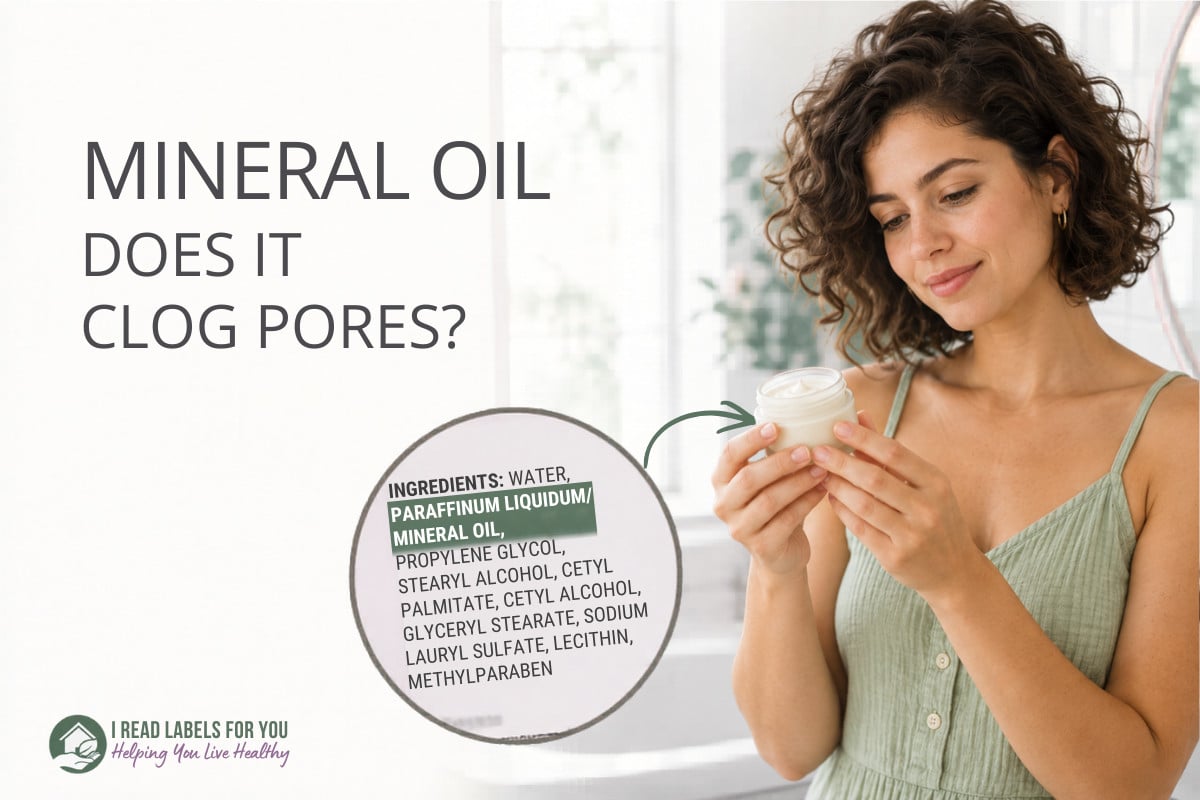
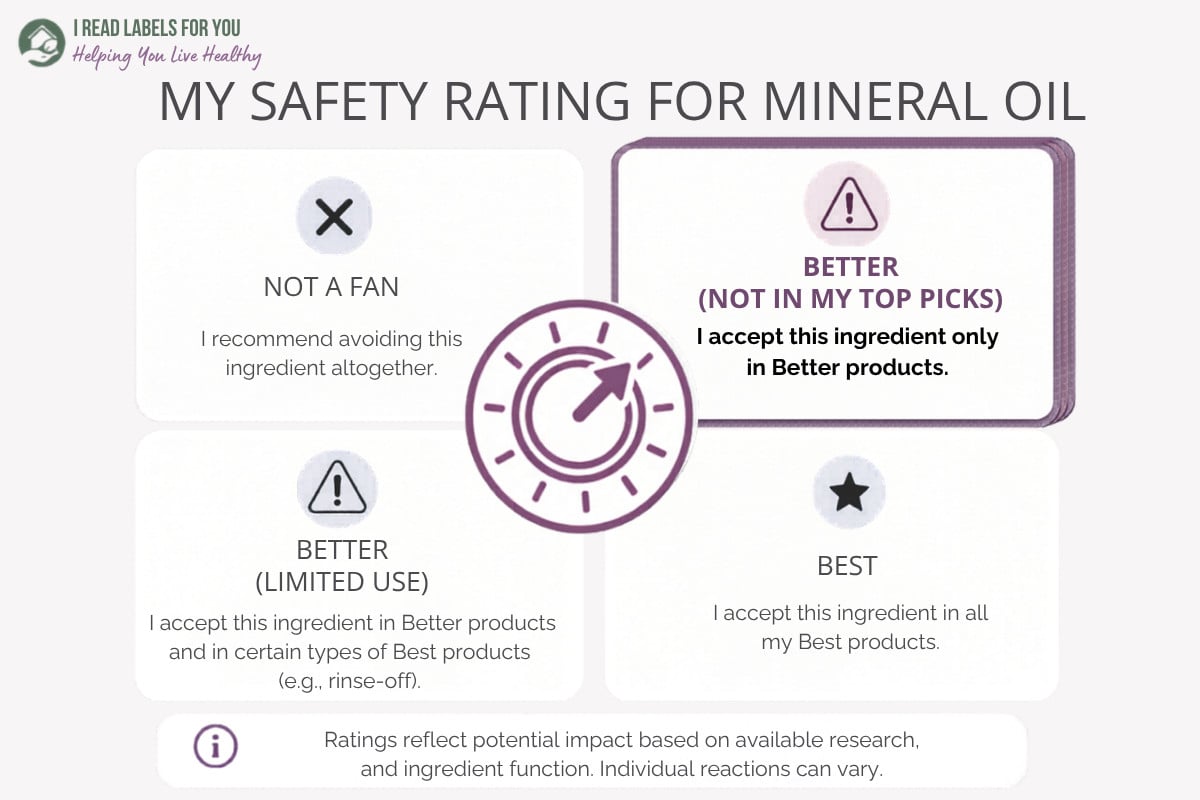
Yes, Mineral Oil is safe on skin. Few ingredients in your bathroom have a longer track record. It’s a clear, odorless liquid refined from petroleum, and it works by slowing the water that escapes from your skin. The version used in cosmetics is purified to the same grade allowed in food and eye ointments. I place it in Better (Not In My Top Picks).
Mineral Oil sits comfortably with regulators on both sides of the Atlantic, which surprises people. Europe places no restriction at all on the refined grade, blocking only badly refined oil above a measured level. The United States permits it in three drug categories.
Ahead, you’ll see what the skin-needs-to-breathe argument gets wrong. You’ll learn why only three studies exist on whether Mineral Oil clogs pores, and what they really say. Furthermore, you’ll find out why swallowing it carries a risk that putting it on your face does not.
What Is Mineral Oil?
Mineral Oil is a mixture of hydrocarbons, not one chemical. The European Union database calls the cosmetic grade “a highly refined petroleum mineral oil.” Makers produce it by treating a petroleum fraction with acid, with hydrogen, or both.
Mineral Oil’s size range matters later, so hold onto it. That entry says the mixture holds saturated hydrocarbons having carbon numbers predominantly in the range of C15 through C50.
Because it’s a mixture, there’s no single molecular weight and no published LogP value for it. Indeed, PubChem holds no compound record at all, only a concept entry.
What Does Mineral Oil Do In Cosmetics?
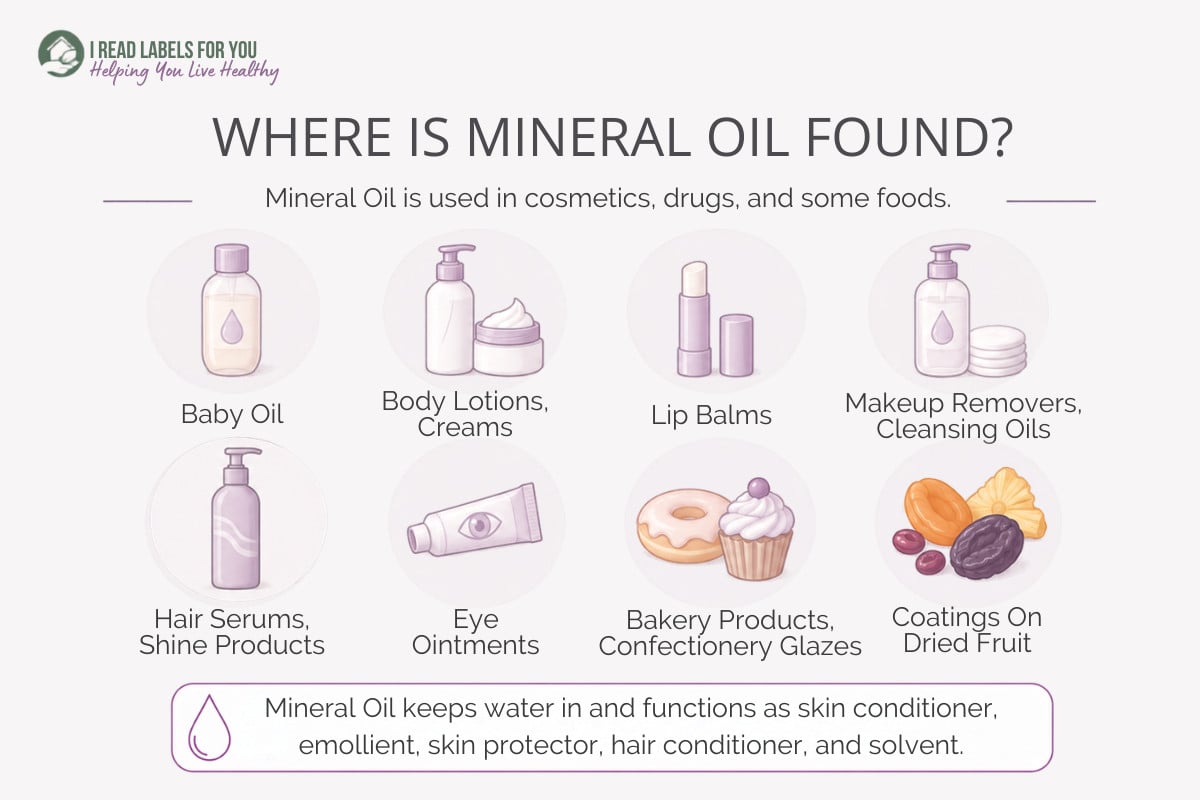
Mineral Oil keeps water in. The EU database lists seven functions for it, including skin conditioning as an emollient, skin protecting, hair conditioning, and solvent.
Formulators reach for it because it’s cheap, stable, and almost never irritating. It doesn’t go rancid the way plant oils can. Furthermore, it carries no proteins, so nut and seed oil allergies do not apply.
Mineral Oil is also the base of most baby oil. That single fact drives much of the worry attached to it. Worth knowing before we reach the evidence.
You’ll find Mineral Oil most often in:
- baby oil
- body lotions and creams
- lip balms
- makeup removers and cleansing oils
- hair serums and shine products
- eye ointments
- bakery products and confectionery glazes
- coatings on dried fruit
How Is Mineral Oil Made?
Mineral Oil comes from the middle of the refining process. After the light fractions are distilled off petroleum, what remains gets distilled again. Refiners then purify it with acid, alkali, and hydrogen.
That purification step decides everything about Mineral Oil’s safety. Crude petroleum fractions carry aromatic compounds, some of which cause cancer, and refining removes them.
Therefore, two products sharing the name “mineral oil” can be very different materials. Industrial cutting oil and the oil in a baby product are not the same thing, and regulators treat them differently.
Does Mineral Oil Penetrate The Skin?
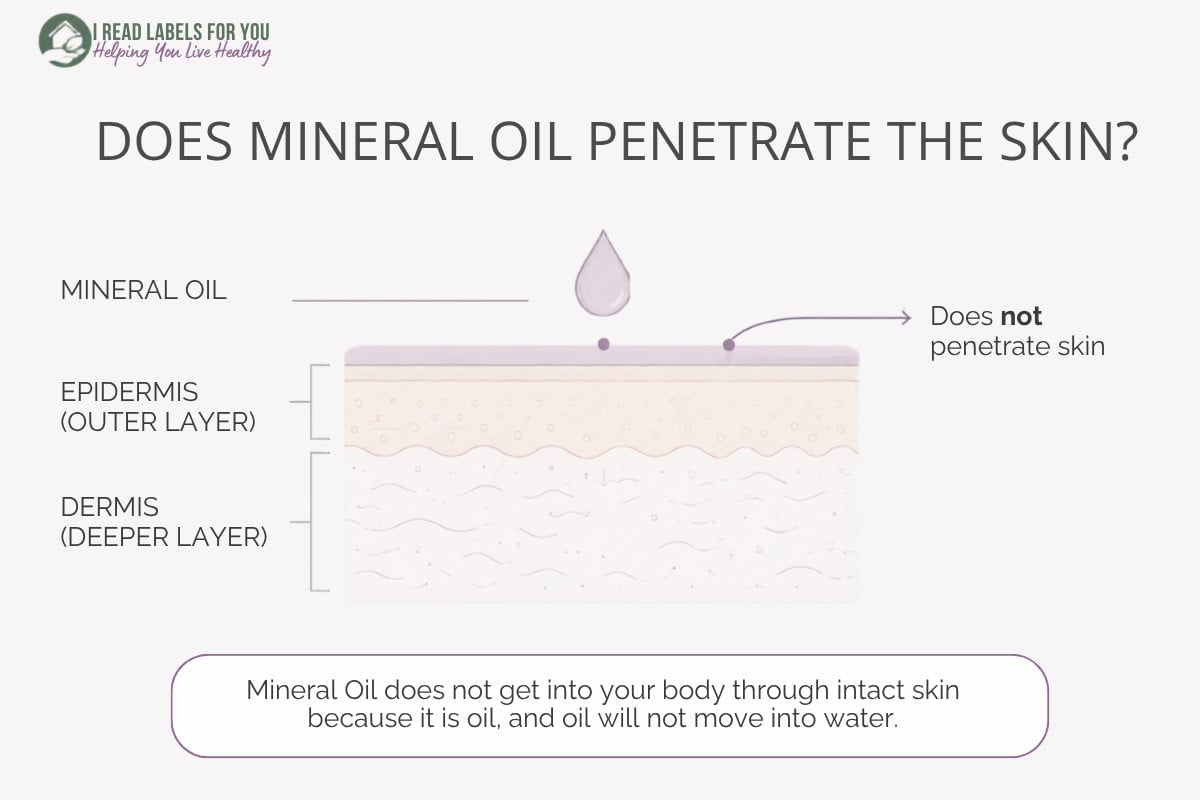
No, Mineral Oil does not get into your body through intact skin. The reason is solubility rather than size, and that distinction matters more here than for most ingredients.
Start with why size is the weaker argument. Molecules under roughly 500 daltons are small enough to slip through skin, and Mineral Oil runs from C15 upward. A C15 hydrocarbon weighs about 212 daltons, so the lightest part is not blocked by size at all.
What blocks it is that oil will not move into water. Beneath the dead outer layer, your skin is watery.
German government scientists point to “the unfavorable partitioning into aqueous epidermal and dermal tissues.” The oil has nowhere it wants to go.
Measurements in living people agree. Using fluorescence microscopy, researchers found “only a very weak fluorescence signal” from the surface and the uppermost cell layers.
Depth was measured too. Forearm skin has a dead outer layer “19.2 µm thick”, and the oil reached only “6-7 µm.”
In other words, it sits in roughly the outer third of skin that’s already dead.
The reviewers’ conclusion was blunt: “Overall, percutaneous absorption of MOSH is low, if not, extremely low.” MOSH stands for mineral oil saturated hydrocarbons, which is what this ingredient is.
One honest limit belongs here. On badly damaged skin in animals, hydrocarbons of this size did reach deeper tissue. Broken skin is, therefore, a different situation.
What Is Mineral Oil Called On Labels?
Mineral Oil appears under several names, and European labels usually use a different one entirely:
- Mineral Oil
- Paraffinum Liquidum
- Liquid Paraffin
- Paraffin Oil
- White Mineral Oil
Watch for one common mix-up. Petrolatum is a separate ingredient, and some well-known sources wrongly list it as another name for Mineral Oil. Petrolatum is a semi-solid jelly; Mineral Oil is a liquid.
Does The U.S. FDA Restrict Mineral Oil In Food And Cosmetics?
No, the Food and Drug Administration (FDA) places no restriction on Mineral Oil. Instead, it approves the ingredient in three separate drug categories and permits it in food.
The skin protectant monograph allows Mineral Oil, 50 to 100 percent. The anorectal monograph permits it as sole protectant at 50 percent or more by weight of the final product. The eye ointment monograph allows Mineral Oil up to 50 percent in combination with one or more other emollient agents.
On food, 21 CFR 172.878 defines it as a mixture of liquid hydrocarbons, essentially paraffinic and naphthenic in nature. That section ties it to pharmacopeial purity specifications.
I hold the FDA to a low bar on cosmetics generally. It clears very few ingredients before they reach shelves, and its Generally Recognized As Safe route lets companies self-certify.
Here, though, the agency went further and regulated Mineral Oil as a drug ingredient, which demands more.
Europe approaches the same question from the other end. Under what’s called the precautionary principle, the EU acts on a credible risk before it’s proven. It does not wait for harm.
EU Regulations On Mineral Oil
Europe places no restriction on refined Mineral Oil. Look up Paraffinum Liquidum in the EU ingredient database, and the restrictions field is simply empty.
What Europe does restrict is the badly refined material, and it does so with a number. Annex II entry 778 catches “Distillates (petroleum), hydrotreated heavy paraffinic, if they contain > 3 % w/w DMSO extract.”
That test deserves a moment, because it’s the heart of the matter. Dimethyl sulfoxide pulls the aromatic compounds out of an oil sample.
Weighing them shows how much of the worrying fraction remains. Refiners use the same method as their own safety check.
Consequently, Europe’s mineral oil rule is testable. A laboratory can run a sample and get an answer. That’s a stronger position than asking a company for paperwork.
U.S. And EU Disagreements On Mineral Oil
There really is no disagreement, which makes this ingredient unusual. Both regulators accept refined Mineral Oil, and both aim their rules at the unrefined kind.
The difference is method rather than verdict. Europe sets a threshold inside the cosmetics rules themselves. The United States handles purity through food specifications and pharmacopeial drug standards.
Canadian Regulations On Mineral Oil
Canada places no cosmetic restriction on Mineral Oil. It appears on neither the Cosmetic Ingredient Hotlist nor Schedule 1 of toxic substances under the country’s environmental law.
Notably, Canada has not published a screening assessment for cosmetic mineral oil. That’s a gap rather than a clearance.
Can Mineral Oil Cause Skin Allergy And Sensitization?
No, Mineral Oil rarely causes allergy, and dermatologists treat it as one of the least reactive things you can apply. A literature search on allergy and mineral oil returns mostly occupational cases involving industrial cutting oils, not cosmetics.
The professional evidence is telling. Mineral Oil is absent from the American Contact Dermatitis Society’s core allergen series, the panel of substances worth patch testing. It has also never been named Allergen of the Year in the 26 years that award has run.
Petrolatum, its closest relative, appears in that core allergen series only as the vehicle other allergens get dissolved in. Mineral Oil does not appear even in that role.
One group does disagree, and I’ll come back to it. The Environmental Working Group grades allergy concern as moderate, citing occupational sources rather than cosmetic ones.
Is Mineral Oil A Hormone (Endocrine) Disruptor?
No, Mineral Oil is not a hormone disruptor, and there’s a simple reason to expect that. Hormone effects need a molecule to reach living tissue, and this one stops in the dead surface layer.
The European Chemicals Agency keeps a working list of substances under assessment for hormone effects. I pulled the full list of 148 entries and filtered it against all three identity numbers.
Nothing came back. Bisphenol A, triclosan, and phenoxyethanol all appeared, so the check was working.
One study does report hormone-like activity, and it’s worth explaining rather than hiding. It tested printing-ink mineral oils, which are aromatic-rich industrial grades, not the purified oil in cosmetics.
Is Mineral Oil Safe To Use While Pregnant?
Yes, Mineral Oil is a sensible choice during pregnancy, for the same reason it’s unremarkable the rest of the time. Nothing measurable crosses intact skin, so nothing reaches a baby.
Pregnancy brings stretched, itchy, dry skin. A plain barrier oil handles that with no fragrance, no preservative, and no plant proteins. Many stretch-mark products are mostly this ingredient.
Swallowing it is a different question entirely, and the answer there is no. Mineral oil taken by mouth can interfere with absorbing fat-soluble vitamins. Still, pregnancy is individual, and you should consult with your medical provider about anything you use regularly.
Are There Any Cancer Concerns Linked To Mineral Oil?
No, refined Mineral Oil is not linked to cancer, although the unrefined kind genuinely is.
The International Agency for Research on Cancer splits the material in two. It classes “Mineral oils, untreated or mildly treated” in Group 1, its highest cancer category. Separately, it places “Mineral oils, highly-refined” in Group 3, meaning not classifiable as causing cancer.
United States bodies draw the same line. The Report on Carcinogens lists only untreated and mildly treated oils, calling them “known to be human carcinogens.”
Moreover, that report expressly excludes highly refined medicinal grades. California’s Proposition 65 list names only “soots, tars, and mineral oils (untreated and mildly treated oils and used engine oils).”
The human cancer evidence comes from factories, not bathrooms. Metalworkers exposed to unrefined cutting oils over decades showed raised skin cancer rates. That history is why the class carries a Group 1 entry.
On the refined grade, the German Federal Institute for Risk Assessment found “no indication of any carcinogenic effects” in animals. That covered both skin and oral exposure.
Is Mineral Oil Bad For The Environment?
Mineral Oil’s environmental problem is where it comes from. Petroleum is finite, which is a fair reason to prefer plant oils. On direct harm the picture is mild. It does not dissolve in water, so sewage treatment removes it.
Natural certifiers exclude it regardless. Mineral Oil is not an approved COSMOS raw material, and it appears nowhere in the NATRUE database. Both standards bar petrochemicals by policy rather than by hazard.
Common Claims About Mineral Oil: What’s True And What’s Not
Claim: Your Skin Needs To Breathe And Mineral Oil Suffocates It
This is the claim that belongs to Mineral Oil specifically, and it rests on a misunderstanding of how bodies work. Your skin does not take in oxygen from the air for your body to use; your lungs do that job.
The detox half is wrong too. Your liver and kidneys clear waste, and it leaves in urine. Sweating cools you down rather than draining toxins through your face.
The measurements settle it anyway. A film sitting 6 to 7 micrometres into a dead layer 19 micrometres thick is not sealing off living tissue.
Claim: Mineral Oil Clogs Pores
Here I want to be straight with you, because the confident answers on both sides are overstated. Search the medical literature for mineral oil and comedogenicity, and you’ll find exactly three papers.
The pore-clogging reputation traces to a test done on rabbit ears. A 1982 review in a dermatology journal examined that model. It reported “the absence of correlation with experience in the human.”
However, the picture is not one-sided. A 1990 German study found that “a strongly comedogenic mineral oil” produced changes in rabbit follicles. Its authors argued the model was useful.
A third paper, from 2005, is titled “Is mineral oil comedogenic?” and has no published abstract. Therefore, I cannot tell you what it concluded. Brands cite it constantly as proof of “no.”
Therefore, the honest answer is that nobody has properly tested Mineral Oil on human skin. If your face breaks out under a product containing it, believe your skin rather than either camp.
Claim: Mineral Oil In Food Is Harmful
Food-grade Mineral Oil is permitted deliberately, not by oversight. The FDA lists white mineral oil as a direct food additive. Europe permits high viscosity mineral oils under the additive number E 905a.
Food-grade Mineral Oil appears as a release agent in baking, a glaze on confectionery, and a coating on dried fruit. Food grade carries its own purity specifications which are stricter than anything applied to cosmetics.
What I Think About Mineral Oil
I rate Mineral Oil Better (Not In My Top Picks). It has better evidence behind it than most of what I review. It still does not reach my top tier. Let me explain that gap plainly.
Almost everything I rate in this tier, lands there because the data is missing. Mineral Oil is the opposite: measured in living skin, assessed by IARC, and permitted in eye ointments. Decades of use have produced very little allergy.
Three Reasons That Hold Mineral Oil Back
Three things hold Mineral Oil back, and none is a scare story. Its lightest fraction sits below the size threshold that blocks other ingredients, so the barrier argument rests entirely on solubility. On broken skin that argument weakens.
Second, Mineral Oil is the ingredient most named in the human accumulation research, though not in the harm research. One study of 142 women found mineral oil hydrocarbons in body fat and breast milk. Hand creams were among the predictors.
German regulators reviewed the accumulation evidence and judged the risk of liver effects low. Even so, this ingredient is the named suspect rather than a bystander.
Third, you cannot verify which grade of Mineral Oil you are buying. The label says Mineral Oil whether the supplier met pharmaceutical specifications or merely adequate ones.
What You Should Do
Here’s what I’d actually do. If Mineral Oil suits your skin, there’s no health reason to abandon it. It’s a reasonable pick for very dry or reactive skin.
If you’d rather avoid Mineral Oil as a petroleum-based ingredient, jojoba, squalane, and shea butter do comparable work. Squalane is the closest match in feel.
Frequently Asked Questions About Mineral Oil
Is Mineral Oil For Constipation Safe?
Mineral Oil works as a lubricant laxative, but this use carries a real risk that skin use does not. Swallowed oil can slip into the lungs and cause a lasting inflammation called lipoid pneumonia.
A 2022 review in a geriatrics journal puts it plainly. These laxatives “can cause serious adverse effects such as lipoid pneumonia,” especially where swallowing is impaired.
Children are the other vulnerable group. Mayo Clinic doctors described a five-year-old given oral mineral oil twice daily since birth who developed chronic lipoid pneumonia.
The oil is bland and goes down without triggering a cough, which is precisely the problem. Please treat this as a conversation for your doctor rather than a self-service decision.
Is Mineral Oil For Ear Wax Safe?
Mineral Oil probably softens ear wax, though the evidence is weaker than most people assume. A 2018 Cochrane review examined ten trials covering 900 ears. It reported “no evidence of a difference” between active drops and plain water.
Mineral Oil was not among the treatments those trials tested, so there’s no direct trial evidence for it specifically. Drops did beat doing nothing, clearing 22 percent of ears against 5 percent.
Some situations need a clinician rather than a bottle. Skip self-treatment if you have ear pain, discharge or sudden hearing loss.
The same goes for any chance of a perforated eardrum.
Is Mineral Oil For Hair Good?
Mineral Oil coats hair, adds shine and reduces the swelling that water causes inside the strand. That makes it genuinely useful on dry or textured hair.
Mineral Oil does not wash out with a gentle shampoo, so buildup is the usual complaint. Apply it to lengths and ends, and keep a clarifying wash in rotation.
Is Mineral Oil For Dogs Safe?
Vets do use Mineral Oil in animals, as a laxative and for some skin conditions. However, the same lung risk applies, and a dog cannot tell you. Dosing also differs enormously by size and species.
Ask your veterinarian rather than adapting a human product.
Mineral Oil Vs Petrolatum: Which Is Better?
Mineral Oil and Petrolatum are close relatives from the same refining stream, and I rate them the same. Petrolatum is a semi-solid with bigger molecules, so its barrier argument is a little stronger.
Mineral Oil is lighter, spreads more easily, and suits large areas better. Neither is a safety loser against the other.
Why Does EWG Rate Mineral Oil Differently?
The Environmental Working Group scores Mineral Oil 3 out of 10, with data quality marked fair. It grades allergy concern moderate, and that is where we part company.
EWG’s sources describe occupational exposure to industrial oils, which is a different material and a different dose. Meanwhile the dermatologists who patch test for a living leave Mineral Oil off their core allergen panel entirely.
Worth noting: EWG’s own entry lists petrolatum among Mineral Oil’s synonyms, which is incorrect. They’re separate ingredients with separate identity numbers.
Sources
EU SCCS / SCCP Opinions:
No SCCS or SCCP opinion on Mineral Oil or Paraffinum Liquidum exists; the EU restriction follows from an annex threshold rather than an ingredient assessment. Committee opinion lists checked: SCCS opinions portal
Cosmetic Ingredient Review (CIR) Reports:
No CIR safety assessment of Mineral Oil or Paraffinum Liquidum exists. Searches of CIR’s ingredient database return no entry, while “paraffin” returns 25 records including Paraffin itself: CIR ingredient status database
European Union Regulatory Databases:
CosIng entry for Paraffinum Liquidum, reference 35850, no Cosmetics Regulation provisions and no restrictions: CosIng Paraffinum Liquidum
CosIng entry for Mineral Oil, reference 105182, listing the Annex II/778 provision: CosIng Mineral Oil
A CosIng Annex II entry 778, prohibiting hydrotreated heavy paraffinic distillates above 3 percent DMSO extract: Annex II substance record
ECHA substance record for white mineral oil (petroleum), CAS 8042-47-5, no harmonized classification: ECHA CHEM record
Other Regulators:
U.S. FDA skin protectant monograph, 21 CFR Part 347, Mineral oil permitted at 50 to 100 percent: 21 CFR Part 347
U.S. FDA anorectal drug monograph, 21 CFR 346.14, Mineral oil permitted as sole protectant at 50 percent or more: 21 CFR Part 346 Subpart B
U.S. FDA ophthalmic monograph, 21 CFR 349.14, Mineral oil permitted up to 50 percent in combination: 21 CFR 349.14
U.S. FDA food additive rule for white mineral oil, 21 CFR 172.878: 21 CFR 172.878
U.S. FDA prohibited and restricted cosmetic ingredients; Mineral Oil not listed: FDA prohibited ingredients
Health Canada Cosmetic Ingredient Hotlist; Mineral Oil not listed: Health Canada Hotlist
CEPA Schedule 1 list of toxic substances; Mineral Oil not listed: CEPA Schedule 1
International Agency for Research on Cancer; highly-refined mineral oils in Group 3, untreated and mildly treated in Group 1: IARC list of classifications
National Toxicology Program Report on Carcinogens; untreated and mildly treated mineral oils listed, highly refined grades excluded: Report on Carcinogens
California Proposition 65 list; only untreated and mildly treated oils listed: Proposition 65 list
IFRA Standards, 51st Amendment; no standard applies to mineral oil: IFRA Standards documentation
PubChem Records (Chemistry, Identifiers, Skin Penetration, Hazard Codes):
PubChem record for Mineral Oil; no compound identifier exists because it’s a mixture rather than a single compound: PubChem Mineral Oil
Peer-Reviewed Studies:
Pirow R, Blume A, Hellwig N, Herzler M, Huhse B, Hutzler C, Pfaff K, Thierse HJ, Tralau T, Vieth B, Luch A. Mineral oil in food, cosmetic products, and in products regulated by other legislations. Critical Reviews in Toxicology. 2019;49(9):742-789. PMID 31939687: PubMed record
Frank SB. Is the rabbit ear model, in its present state, prophetic of acnegenicity? Journal of the American Academy of Dermatology. 1982;6(3):373-377. PMID 6461674: PubMed record
Zimmermann R. The rabbit ear model as comedogenic test. Dermatologische Monatsschrift. 1990;176(1):55-61. PMID 2138094: PubMed record
DiNardo JC. Is mineral oil comedogenic? Journal of Cosmetic Dermatology. 2005;4(1):2-3. No abstract published. PMID 17134413: PubMed record
Aaron K, Cooper TE, Warner L, Burton MJ. Ear drops for the removal of ear wax. Cochrane Database of Systematic Reviews. 2018;7(7):CD012171. PMID 30043448: PubMed record
Courtois-Amiot P, Levassort H, Santos Forjaz J, Raynaud-Simon A, Lacaille S. Lipid pneumonitis, a serious iatrogenic event with lubricating laxatives. Soins Gerontologie. 2022;27(154):43-45. PMID 35393035: PubMed record
Nelson AD, Fischer PR, Reed AM, Wylam ME. Mineral oil aspiration related juvenile idiopathic arthritis. Case Reports in Pulmonology. 2015;2015:403109. PMID 26171269: PubMed record
Concin N, Hofstetter G, Plattner B, et al. Evidence for cosmetics as a source of mineral oil contamination in women. Journal of Women’s Health. 2011;20(11):1713-1719. PMID 21970597: PubMed record
Natural Cosmetic Standards:
COSMOS-standard approved raw materials; Mineral Oil not approved and not permitted under the standard: COSMOS approved raw materials
NATRUE certified and approved raw materials; Mineral Oil not listed: NATRUE certified world
Skin Allergy Resource:
American Contact Dermatitis Society, Helpful References, including the Core Allergen Series 2020; Mineral Oil does not appear: ACDS Helpful References
Advocacy groups:
Environmental Working Group Skin Deep entry for Mineral Oil, hazard score 3, data quality fair: EWG Skin Deep, Mineral Oil
Last verified: 09-28-2026

Download The Free Guide!
5 Powerful Steps To A Non-Toxic Home
Join our informed consumer community and get our free guide the “5 Powerful Steps To A Non-Toxic Home”.




Before commenting, please read our Comment Policy.