
Is Benzyl Alcohol Safe? A Simple Answer You Can Trust
 Written by Irina Webb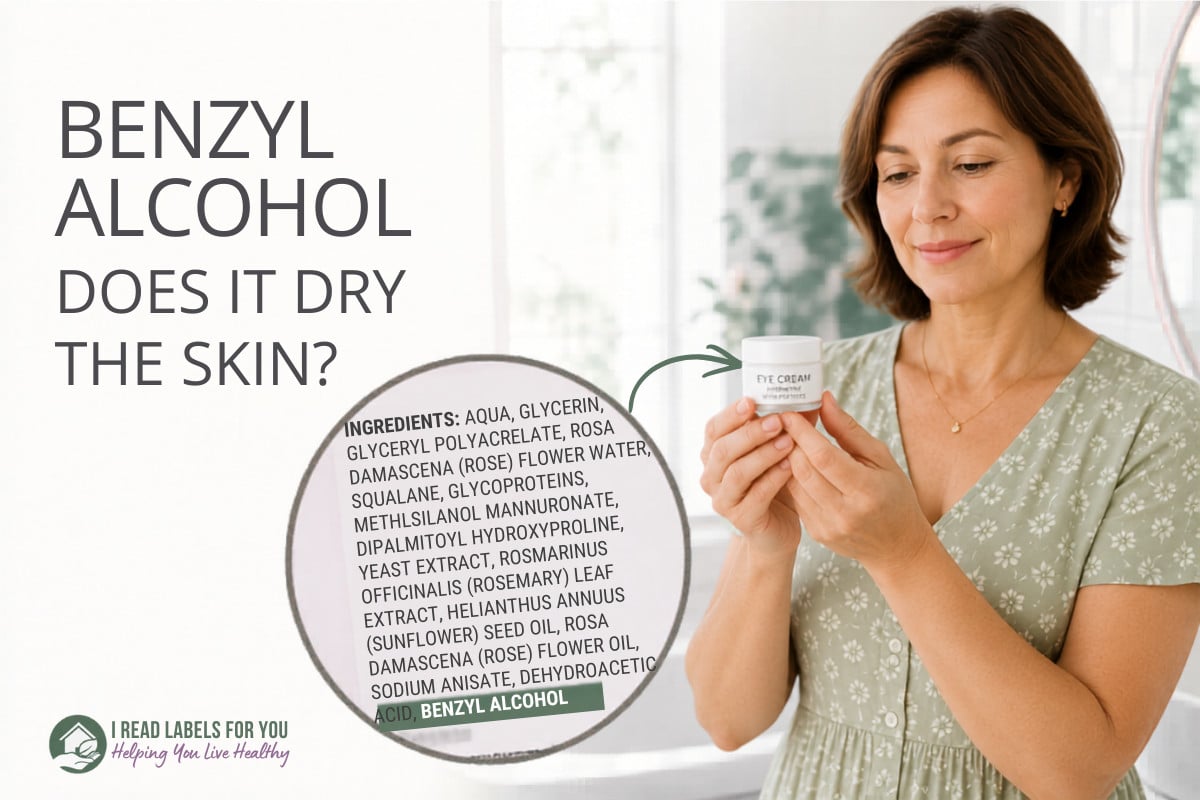
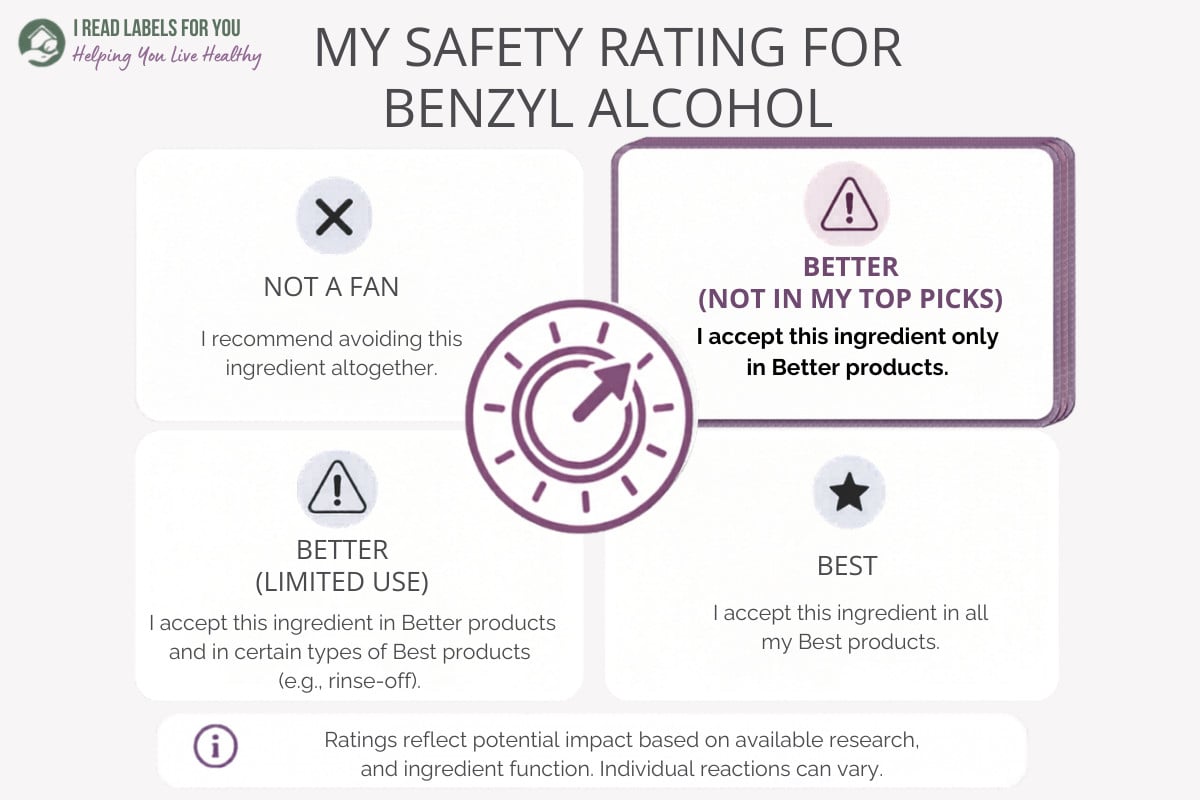
Yes, Benzyl Alcohol is safe for most people at the levels used in cosmetics. However, it’s the 2026 Allergen of the Year, and its production relies on benzyl chloride, a probable carcinogen. That is why my rating for Benzyl Alcohol is Better (Not In My Top Picks).
The EU caps Benzyl Alcohol at 1% as a preservative. It must also be named on the label as an allergen, when it hides inside a fragrance mix. In a monkey study, about 32% of it passed through skin. The body then turns it into benzoic acid and clears it within days.
Is Benzyl Alcohol a drying alcohol that irritates skin, and is it really unsafe for babies? Both worries are mostly mix-ups. I explain why it’s not the stripping kind of alcohol, and where the baby warning comes from.
What Is Benzyl Alcohol?
Benzyl Alcohol is an aromatic alcohol, which means it has a fragrant carbon ring in its structure. It is a clear liquid with a faint, sweet, floral smell. Nature makes it too, not just factories.
You will find Benzyl Alcohol naturally in foods and plants like cranberries, apricots, cocoa, and honey. It also appears in the essential oils of jasmine and ylang-ylang. Because of this, it is often called a nature-identical ingredient.
What Does Benzyl Alcohol Do In Cosmetics?
First, Benzyl Alcohol acts as a preservative that slows the growth of bacteria and mold. Consequently, it helps water-based products stay fresh and safe on your shelf. Many natural brands pick it for this job.
Beyond that, Benzyl Alcohol works as a solvent, mild fragrance, and texture helper. It can thin out thick formulas and blend other ingredients smoothly. Furthermore, it gives some products a light scent on its own.
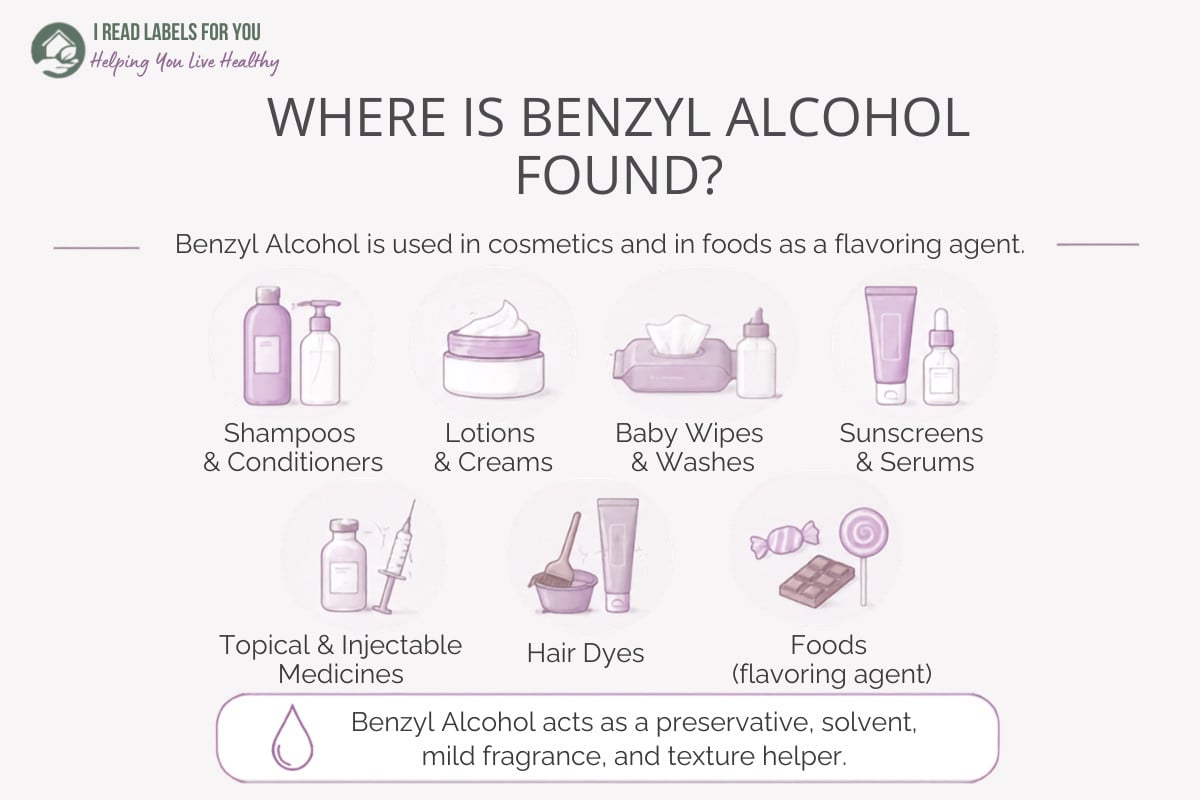
You will find Benzyl Alcohol most often in:
- shampoos and conditioners
- lotions and creams
- baby wipes and baby washes
- sunscreens and serums
- hair dyes
- topical and injectable medicines
- foods (as a flavoring agent)
How Is Benzyl Alcohol Made?
The Benzyl Alcohol in most products is made in a factory, even though the same molecule exists in nature. To begin with, makers usually start with benzyl chloride and treat it with an alkali like sodium carbonate. Another route builds it from benzaldehyde instead.
Here is a detail worth flagging. Benzyl chloride, the chemical used in the manufacturing of Benzyl Alcohol, is itself a known carcinogen. The International Agency for Research on Cancer lists it as a probable human carcinogen (Group 2A).
The finished ingredient is purified to strip out that leftover chemical. Still, I prefer ingredients whose making does not lean on a carcinogen. This is one reason Benzyl Alcohol sits outside my top picks.
Does Benzyl Alcohol Penetrate The Skin?
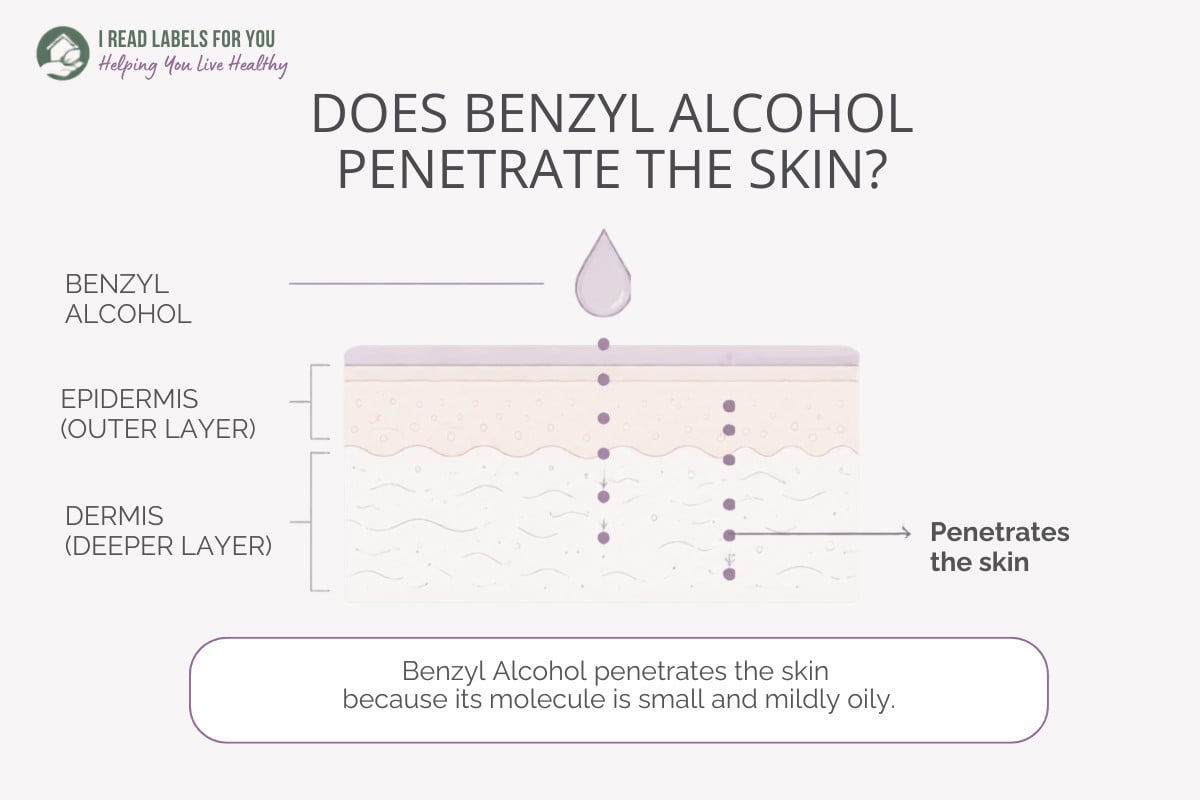
Yes, Benzyl Alcohol does pass into the skin, at least partly. Its small size is the reason. Let me explain the two markers I look at.
The first marker is molecular weight, a measure of size in units called daltons. A molecule under 500 daltons is small enough to slip through the skin barrier. Benzyl Alcohol is only 108 daltons, well under that line.
The second marker is LogP, which tells you how oily or water-loving a molecule is. Benzyl Alcohol has a LogP of 1.1, meaning it is mildly oily and mixes with skin fairly easily. Since it is both tiny and mildly oily, size is what drives its entry here.
In one monkey study, about a third of an applied dose was absorbed without a wrapping. Your body then turns it quickly into benzoic acid and clears it in urine. Therefore, it does not build up inside you.
What Is Benzyl Alcohol Called On Labels?
On an ingredient list, Benzyl Alcohol usually appears as:
- Benzyl Alcohol
- Benzenemethanol
- Phenylmethanol
- Phenylcarbinol
- Phenylmethyl Alcohol
It can also hide inside the single word Fragrance or Parfum. In the United States, brands may tuck it under that umbrella without naming it. The European Union, by contrast, makes them spell it out.
Does The U.S. FDA Restrict Benzyl Alcohol In Food And Cosmetics?
No, the U.S. Food and Drug Administration (FDA) does not restrict Benzyl Alcohol in cosmetics. The agency treats it as Generally Recognized As Safe (GRAS) for use as a food flavoring. It also allows it freely in personal care products.
I read GRAS status with a careful eye, though. Many GRAS calls rest on older data or on reviews the industry itself helped shape. In plain terms, a GRAS label tells you an ingredient is permitted, not that it is problem-free for every person.
The FDA also keeps a short list of ingredients it prohibits or restricts in cosmetics, and Benzyl Alcohol is not on it. That light touch is exactly why I also look to Europe, which leans on the precautionary principle. Under that mindset, regulators act on early warning signs instead of holding off until damage is proven.
EU Regulations About Benzyl Alcohol
The European Union allows Benzyl Alcohol but pins two clear conditions on it. As a preservative, it is capped at 1.0% in a finished product. This limit sits in Annex V of the EU Cosmetics Regulation.
On top of that, Benzyl Alcohol is one of 26 fragrance allergens the EU asks brands to declare. Whenever it passes 0.001% in a leave-on product or 0.01% in a rinse-off one, it must be named on the label. This rule helps allergy-prone shoppers spot it and avoid it.
The EU’s science panel, the Scientific Committee on Consumer Safety (SCCS), placed it on that allergen list for a reason. Its review counts Benzyl Alcohol among the fragrance chemicals most often reported by people with skin allergies.
Canadian Regulations About Benzyl Alcohol
Canada permits Benzyl Alcohol in cosmetics and does not single it out for special limits. It does not appear on the Health Canada Cosmetic Ingredient Hotlist, which flags the ingredients Canada bans or caps in beauty products.
It is also absent from Canada’s list of toxic substances under Schedule 1 of the Canadian Environmental Protection Act. On the regulatory front, then, Canada raises no red flags here.
Can Benzyl Alcohol Cause Skin Allergy And Sensitization?
Yes, Benzyl Alcohol can cause skin allergy in some people, though it is considered a weak trigger. This is the heart of its 2026 Allergen of the Year title. Let me put it in context.
That yearly pick is about awareness, not alarm. Doctors give it to an allergen that deserves more attention, often because standard patch tests skip it. The society that names it chose Benzyl Alcohol partly because it hides in so many products yet gets tested too rarely.
The strength of a sensitizer matters as much as the label. The 2026 review that crowned it still describes Benzyl Alcohol as a weak sensitizer. Older patch-test data put reactions at roughly 1% among tested skin-clinic patients, a small share.
It also earns a spot on the American Contact Dermatitis Society Core Allergen Series, a standard testing panel. Simply put, real reactions happen, but they are uncommon and usually mild. If your skin is sensitive or reactive, it is fair to steer clear.
For comparison, Cocamidopropyl Betaine won the same title back in 2004. Being named does not brand an ingredient as toxic, only as worth a closer look.
Is Benzyl Alcohol A Hormone (Endocrine) Disruptor?
No, Benzyl Alcohol is not a hormone disruptor based on the current evidence. Regulators have not flagged it as one, and no endocrine assessment has raised concern. Your body also breaks it down fast, which limits any lasting effect.
It converts to benzoic acid, a common substance your system handles routinely. Because of that quick turnover, it does not linger to meddle with hormones.
Is Benzyl Alcohol Safe To Use While Pregnant?
Yes, topical Benzyl Alcohol at normal cosmetic levels is widely viewed as low risk during pregnancy. It absorbs only a little, converts to benzoic acid, and clears quickly from the body. Animal studies found no harm to development except at very high oral doses.
Every pregnancy is different, though, and I am not a medical professional. If you feel unsure about any ingredient, you should consult with your medical provider before using it. That guidance beats any blanket rule from a blog.
Are There Any Cancer Concerns Linked To Benzyl Alcohol?
No, Benzyl Alcohol itself is not linked to cancer in the available research. Long feeding studies in rats and mice, reviewed by the National Toxicology Program, came back negative for cancer. It is not listed by IARC or on California’s Proposition 65 list either.
The only cancer thread involves benzyl chloride, the manufacturing chemical I mentioned earlier. That concern belongs to the Benzyl Alcohol making process, not to the purified ingredient in your bottle. Good manufacturing keeps any residue small.
Is Benzyl Alcohol Bad For The Environment?
Benzyl Alcohol is not considered a serious environmental problem. It breaks down readily in water and does not build up in fish or wildlife. Because it degrades quickly, it does not persist in rivers or soil.
Rating groups place its ecological concern on the low end. Natural standards like COSMOS and NATRUE also approve it, partly because it biodegrades well. In everyday rinse-off use, it poses little threat to aquatic life.
One caveat sits on the manufacturing side. The common way to make Benzyl Alcohol relies on benzyl chloride, a hazardous carcinogen, so the production route is not the greenest. The purified ingredient itself, though, breaks down cleanly once it washes down the drain.
Common Claims About Benzyl Alcohol: What’s True And What’s Not
Claim: Benzyl Alcohol Is A Drying Alcohol That Irritates Skin
This one is mostly a mix-up. Benzyl Alcohol is an aromatic alcohol, not a drying solvent alcohol like denatured or SD alcohol. The two behave very differently on skin.
At the tiny preservative levels used in most products, Benzyl Alcohol does not strip or dry your skin. At high concentrations, it can irritate, yet formulas rarely use it that way. In other words, dose is everything.
Claim: Benzyl Alcohol Is Unsafe For Babies
This claim comes from a real event, but it needs context. In the 1980s, the FDA warned that injectable medicines preserved with Benzyl Alcohol harmed premature newborns, a danger detailed in a 1982 New England Journal of Medicine report. That harm came from large amounts given directly into the bloodstream.
A dab of it in a baby wipe is a completely different situation, both in route and in dose. Even so, because it is a declarable allergen, I still favor gentler preservatives for products that stay on a baby’s skin.
Claim: The Word “Fragrance” Can Hide Benzyl Alcohol
This one is true, at least in the United States. Brands here can fold Benzyl Alcohol into the catch-all term Fragrance without naming it. The European Union, on the other hand, requires it on the label once it passes a set level.
If you react to fragrance and want certainty, choose fragrance-free products. That way you sidestep both Benzyl Alcohol and dozens of other scent chemicals a single word can conceal.
What I Think About Benzyl Alcohol — And What You Should Do
I see Benzyl Alcohol as a middle-ground ingredient, which is why it lands in Better (Not In My Top Picks) tier. It has real strengths worth naming. Specifically, it is low in toxicity, breaks down quickly in the body, and does not build up. It also gently preserves water-based products and wins approval from natural standards like COSMOS and NATRUE.
Two things hold me back from putting Benzyl Alcohol among my best picks. Its common recipe leans on a carcinogen, and it is a documented contact allergen with a fresh Allergen of the Year title. Neither point makes it dangerous, but together they keep it off my recommended list.
My practical take is this. If your skin is calm and happy, a rinse-off product with Benzyl Alcohol is unlikely to trouble you. If you have sensitive or reactive skin, or you are choosing for a baby, gentler options are worth seeking. Pick what fits your skin type and your comfort.
Frequently Asked Questions About Benzyl Alcohol
Should You Avoid Benzyl Alcohol?
For most people, there is no need to avoid Benzyl Alcohol at the low levels used in products. If you have very reactive skin or a known fragrance allergy, however, steering clear is reasonable. Let your own skin’s history guide the call.
Why Is Benzyl Alcohol The 2026 Allergen Of The Year?
Doctors chose it to raise awareness, not to sound an alarm. Benzyl Alcohol earned the title for the first time in 2026, purely to boost awareness. It appears in countless products but is often left off standard allergy patch tests. The title pushes clinics to test for it more, helping real allergies get caught.
Is Benzyl Alcohol Bad For You?
No, Benzyl Alcohol is not bad for you in the small amounts found in cosmetics. Your body breaks it down quickly into benzoic acid and clears it out. Its main drawback is that it can trigger allergy in a small share of people.
Is Benzyl Alcohol Safe For Skin?
For most skin types, Benzyl Alcohol is safe at the levels used as a preservative. It doesn’t dry or strip skin the way solvent alcohols can. Even so, a small share of people react to it, so a patch test helps if you are unsure.
Is Benzyl Alcohol Safe For Hair?
Yes, Benzyl Alcohol is safe for hair and does not damage the hair strand. It mainly works as a preservative in shampoos, conditioners, and dyes, then rinses away easily. Only your scalp skin might react if it is sensitive.
Sources
EU SCCS / SCCP Opinions:
SCCS Opinion on Fragrance Allergens in Cosmetic Products (SCCS/1459/11), adopted 26–27 June 2012 — lists Benzyl Alcohol among established human contact allergens. SCCS opinions portal
Cosmetic Ingredient Review (CIR) Reports:
Johnson W Jr, et al. Safety Assessment of Benzyl Alcohol, Benzoic Acid and Its Salts, and Benzyl Benzoate. International Journal of Toxicology. 2017;36(Suppl 3):5S–30S. cir-reports.cir-safety.org
European Union Regulatory Databases:
CosIng entry for Benzyl Alcohol — functions: preservative, solvent, viscosity controlling, perfuming. CosIng record
EU Cosmetics Regulation Annexes — Annex V/34 (preservative, max 1.0%) and Annex III/45 (declarable fragrance allergen). CosIng Annexes
CLP Annex VI harmonised classification (ECHA). Annex VI to CLP and ECHA CHEM
Other Regulators:
U.S. FDA — Benzyl Alcohol is GRAS as a flavoring and not on the prohibited/restricted cosmetics list. FDA prohibited & restricted ingredients
Health Canada Cosmetic Ingredient Hotlist — not listed. Hotlist
Environment Canada CEPA Schedule 1 — not listed. Schedule 1
IARC — Benzyl Alcohol not classified (benzyl chloride, a manufacturing precursor, is Group 2A). IARC classifications
NTP Report on Carcinogens — not listed; NTP bioassays negative. NTP RoC
California Proposition 65 — not listed. Prop 65 list
PubChem Records (Chemistry, Identifiers, Skin Penetration, Hazard Codes):
Benzyl Alcohol, PubChem CID 244 (CAS 100-51-6; molecular weight 108.14; LogP 1.1). PubChem CID 244
Peer-Reviewed Studies:
Le NT, Wu PA. Benzyl Alcohol: Allergen of the Year 2026. Dermatitis. 2026. PMID 41649135. PubMed 41649135
Gershanik J, Boecler B, Ensley H, McCloskey S, George W. The Gasping Syndrome and Benzyl Alcohol Poisoning. New England Journal of Medicine. 1982;307(22):1384–1388. PMID 7133084. PubMed 7133084
Natural Cosmetic Standards:
COSMOS-standard approved raw materials — Benzyl Alcohol is a permitted preservative. COSMOS approved raw materials
NATRUE — Benzyl Alcohol is listed among certified/approved raw materials. NATRUE certified world
Skin Allergy Resource:
American Contact Dermatitis Society — Helpful References, including the Core Allergen Series 2020 (Benzyl Alcohol is a panel allergen). ACDS Helpful References
Last verified: 2026-07-09
Download The Free Guide!
5 Powerful Steps To A Non-Toxic Home
Join our informed consumer community and get our free guide the “5 Powerful Steps To A Non-Toxic Home”.

Before commenting, please read our Comment Policy.