
Is Propyl Gallate Safe? A Simple Answer You Can Trust
 Written by Irina Webb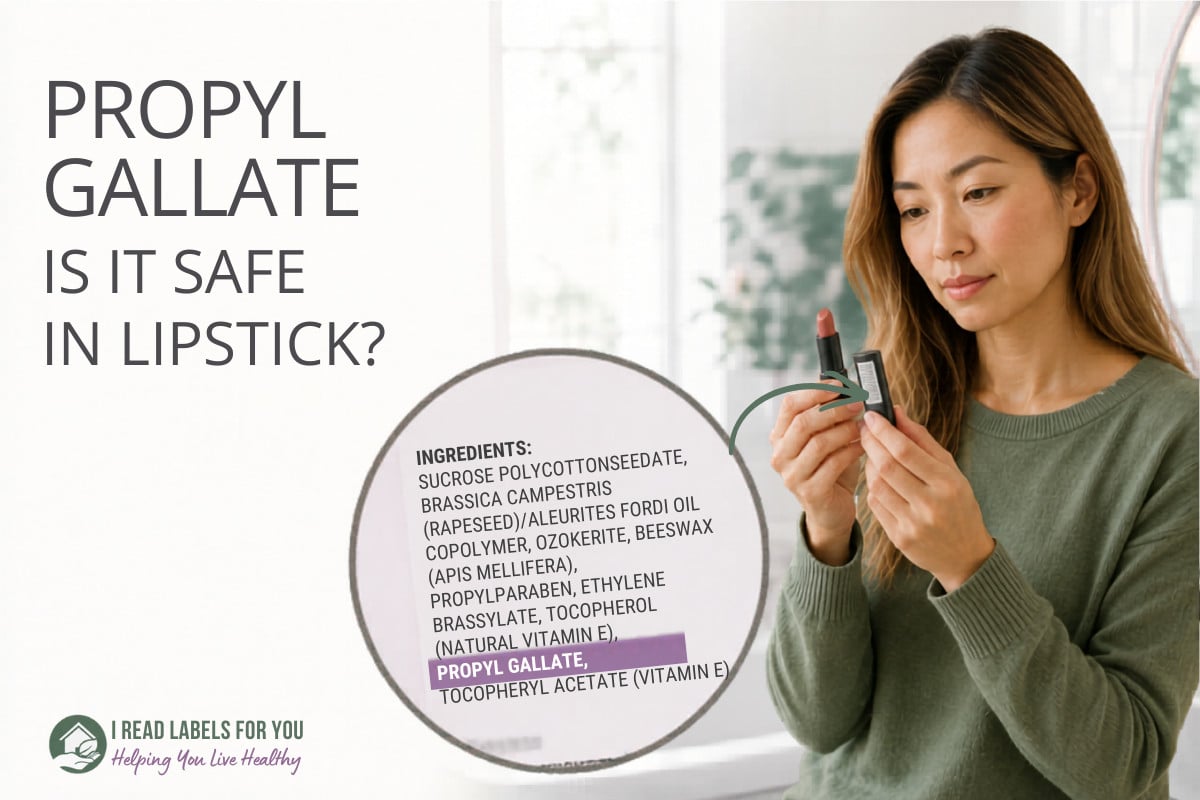
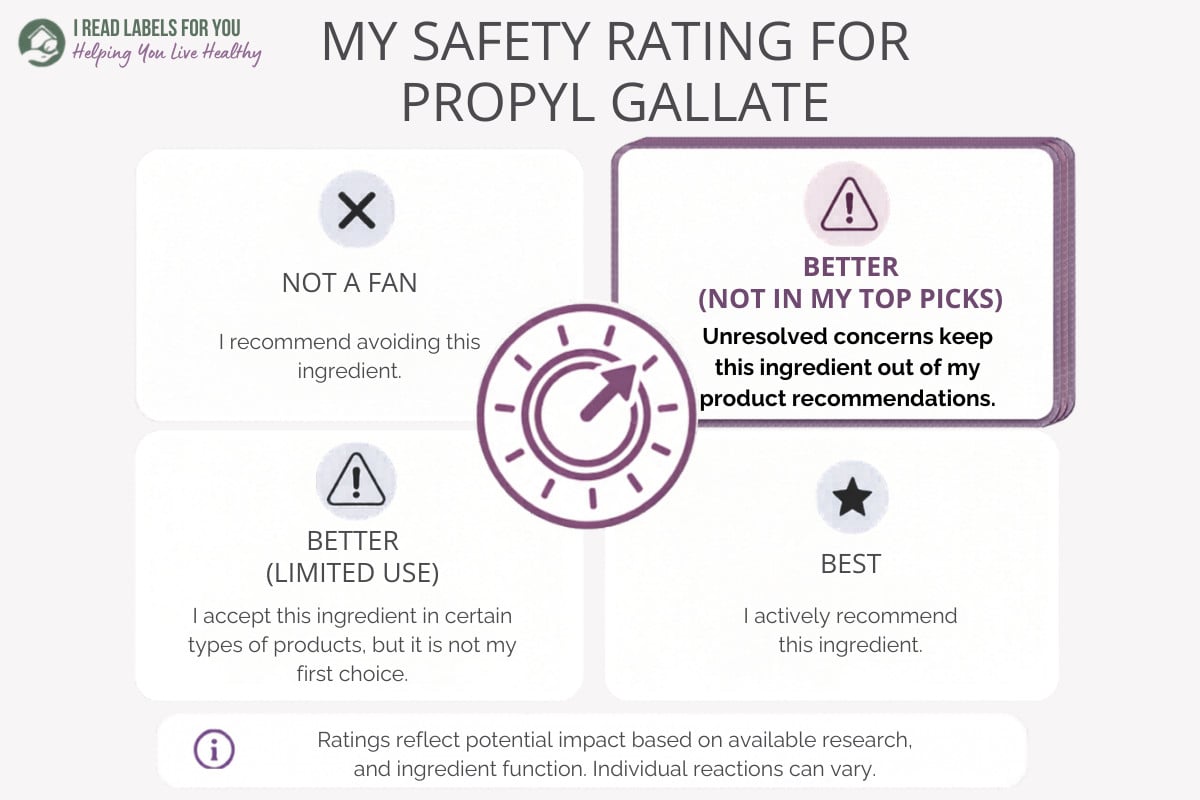
Yes, Propyl Gallate is safe for most people. It’s an antioxidant that keeps fats and oils in a product from going rancid. It’s made by a simple reaction between gallic acid and propanol, and it carries no cancer link. Three things hold it back. It’s a documented skin allergen, it penetrates the skin, and it shows hormone activity in lab studies. That last point stops short of proven endocrine disruption though. I rate it Better (Not In My Top Picks).
Propyl Gallate is permitted in Europe, in both cosmetics and food. It appears on no EU restricted list, which means a brand can use any amount it likes. Food is a different story. Europe’s food safety authority re-evaluated it in 2014 and set a daily limit of 0.5 milligrams per kilogram of body weight.
Keep reading for three things the safety reviews leave out. First, why an ingredient cleared for food still troubles me on skin. Second, what those hormone studies actually found. Third, which antioxidant to choose instead if your skin reacts.
What Is Propyl Gallate?
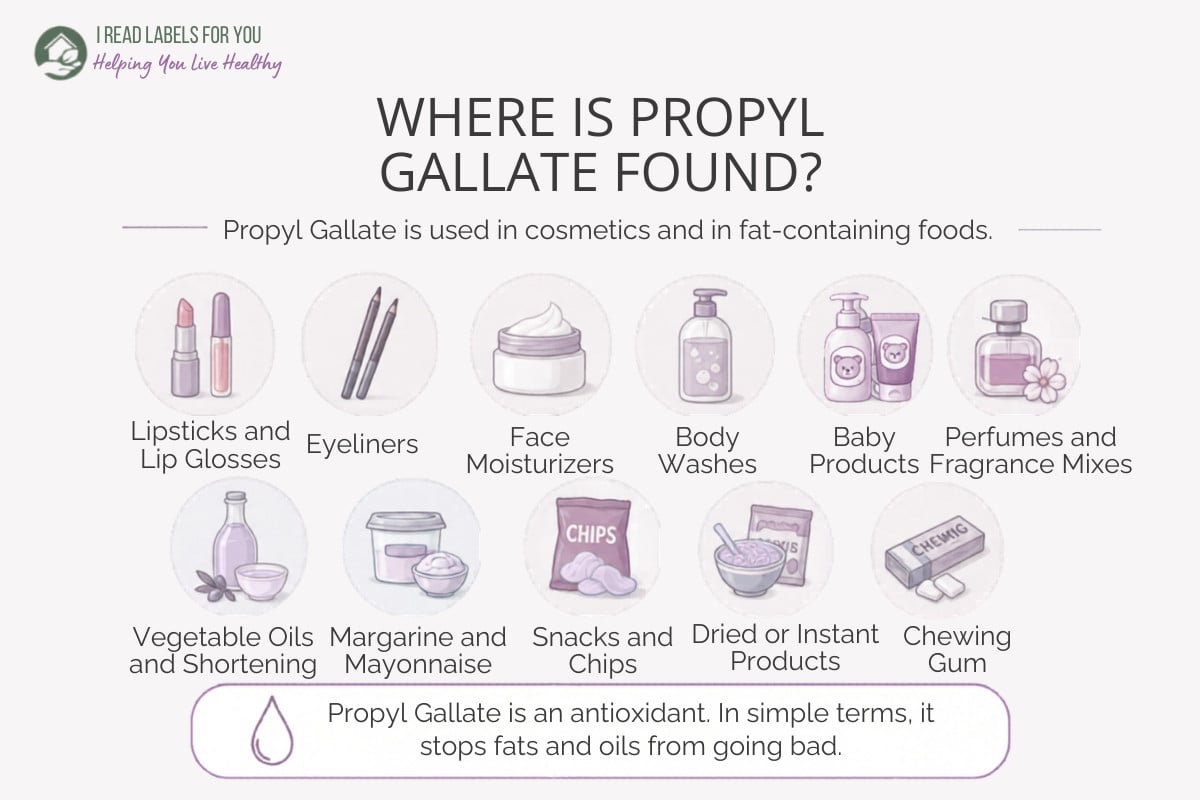
Propyl Gallate is an antioxidant. In simple terms, it stops fats and oils from going bad. The food world knows it as E310 (or INS-310).
Chemically, it’s the propyl ester of gallic acid. Gallic acid is a natural compound found in plants such as tea leaves and oak bark. So, the molecule has roots in nature, even when made in a factory.
In cosmetics, you’ll find Propyl Gallate most often in:
- lipsticks and lip glosses
- eyeliners
- face moisturizers
- body washes
- baby products
- perfumes and fragrance mixes
Beyond cosmetics, it’s also added to many fat-containing foods, such as:
- vegetable oils
- shortening
- margarine
- mayonnaise
- snacks
- chips
- dried or instant products
- chewing gum
What Does Propyl Gallate Do In Cosmetics?
In a product, Propyl Gallate protects the oils and fats in the formula. Without protection, those oils react with air and turn rancid. As a result, the product lasts longer and smells fresh.
Brands use it at very low levels, usually 0.1% or less. Occasionally it also appears as a fragrance ingredient. In short, it’s a helper ingredient, not an active one.
How Is Propyl Gallate Made?
Makers join gallic acid with a simple alcohol called 1-propanol. This reaction is called esterification. Gallic acid comes from plants, while the manufacturing chemical, 1-propanol, is a common industrial alcohol.
Importantly, neither starting material is a known cancer-causing chemical or skin allergen. Therefore, the manufacturing footprint here is fairly clean compared with many other cosmetic ingredients.
Does Propyl Gallate Penetrate The Skin?
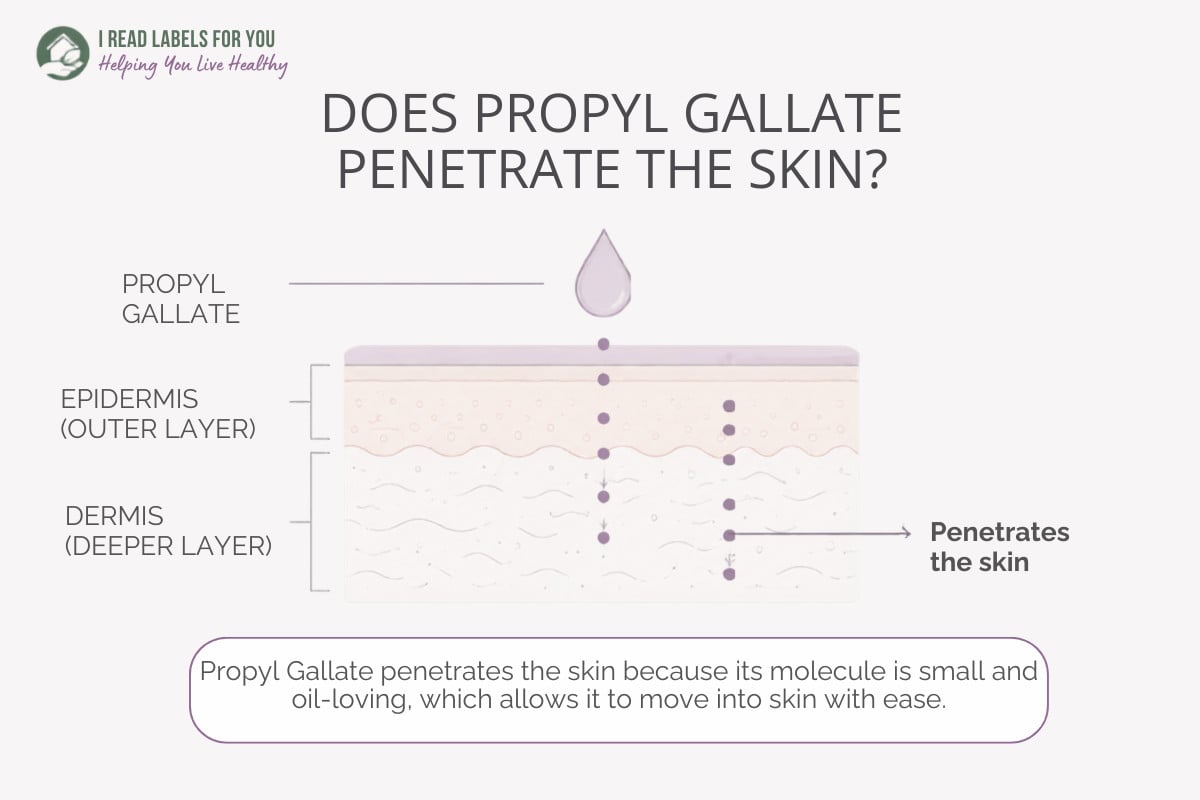
Yes, at least partly. Its molecular weight is 212 daltons, which sits well below the 500-dalton limit that big molecules struggle to cross. Its fat-loving score (log P) is 1.8, so it moves into skin with some ease.
We know it reaches living skin because it can cause allergy there. That said, the amount that enters the body at 0.1% use is small. In practice, systemic exposure from cosmetics stays low.
What Is Propyl Gallate Called On Labels?
You may see it under several names:
- Propyl Gallate
- n-Propyl Gallate
- Propyl 3,4,5-Trihydroxybenzoate
- Gallic Acid Propyl Ester
- E310 (on food labels)
Does The U.S. FDA Restrict Propyl Gallate In Food And Cosmetics?
Barely. The U.S. Food and Drug Administration (FDA) allows Propyl Gallate in both food and cosmetics. In food, it’s a generally recognized as safe (GRAS) antioxidant under 21 CFR 184.1660. For cosmetics, the FDA does not list it as prohibited or restricted.
Here’s the catch: I don’t lean on the FDA as much as you might think. To date, the FDA has banned or restricted only 11 ingredients in cosmetics. By contrast, the European Union (EU) restricts well over a thousand. Therefore, a “not banned” status tells you very little on its own.
The GRAS label has gaps, too. In many cases, a company can call its own ingredient safe, sometimes without even telling the FDA. Hence, a GRAS stamp doesn’t always mean an independent review actually happened.
EU Regulations About Propyl Gallate
The EU also allows Propyl Gallate. It appears in the EU cosmetic ingredient database (CosIng) with no Annex restriction. As a food additive, E310 is permitted in the EU as well.
That said, the EU works differently from the FDA. It leans on the precautionary principle, which means it tends to act earlier when the evidence is uncertain. In fact, that mindset is much closer to how I weigh ingredients myself.
For Propyl Gallate, the EU’s Scientific Committee on Consumer Safety (SCCS) has not published an opinion. Simply put, no EU cosmetic review sets a binding limit on it yet.
Europe has set a number for Propyl Gallate, but only for food. Its food safety agency (EFSA) re-evaluated the additive in 2014 and capped daily intake at 0.5 milligrams per kilogram of body weight. That works out to roughly 34 milligrams a day for a 150-pound adult. No matching figure exists for skin.
Canadian Regulations About Propyl Gallate
Canada allows Propyl Gallate in cosmetics. It is not on the Health Canada Cosmetic Ingredient Hotlist, so it is neither banned nor restricted there.
Furthermore, it does not appear on Canada’s CEPA Schedule 1 list of toxic substances. In other words, Canadian rules treat it much like the U.S. and EU do.
Can Propyl Gallate Cause Skin Allergy And Sensitization?
Yes, and real studies show it can. In fact, the Cosmetic Ingredient Review (CIR) panel lowered its safe limit because of them. In 1985, the panel allowed Propyl Gallate up to 1%. By 2007, new patch-test data at 0.5% led the panel to drop that limit to 0.1%.
Several studies back this up. In guinea pig tests, Propyl Gallate caused no allergy at 0.1%, but it did sensitize at 0.5% to 2%. It also tested positive in mouse skin-allergy assays. On top of that, the CIR panel called all the gallates “moderate to strong contact sensitizers.”
Human reports tell a similar story. A systematic review found 74 cases of gallate allergy, and Propyl Gallate was the most common trigger. It often showed up on the face or hands. That said, allergy is still uncommon. One patch-test study of 201 people found a 0% reaction rate at 1%.
This is also why Propyl Gallate carries the hazard code H317, meaning it “may cause an allergic skin reaction.” The CIR panel clears it only when products are formulated to be non-sensitizing. Notably, it does not appear on the American Contact Dermatitis Society (ACDS) Core Allergen Series. So, the risk is real but low, and it matters most for allergy-prone skin.
Is Propyl Gallate A Hormone (Endocrine) Disruptor?
Not a proven one, but it does show hormone activity in the lab. In one set of tests, Propyl Gallate attached to the estrogen receptor and blocked it instead of switching it on. Either way, that means it interferes with estrogen signaling. It did not, however, make breast cancer cells grow.
Animal data add one more flag. In a mouse study, injected Propyl Gallate changed the activity of hormone-related genes in the testes. That included the androgen receptor, which helps direct male hormones. Still, the dose was high and injected, not how anyone meets it in a cream.
Here’s the key distinction: these are signs of hormone activity in lab tests, not proof of harm in the body. The CIR panel called the findings “not considered relevant to cosmetic use, given the doses and routes of exposure.” Moreover, a multi-generation rat study found no harm to reproduction. It also does not appear on the ECHA endocrine disruptor assessment list.
Even so, I treat hormone signals with extra care since their effects don’t always follow a simple dose pattern. This caution is part of why I park this ingredient in the Better tier.
Is Propyl Gallate Safe To Use While Pregnant?
The animal evidence is reassuring. The same multi-generation rat study noted under hormone effects fed doses up to 0.5% of the diet. That is about 450 mg per kg of body weight each day, with no harm to growth or reproduction. Lab dish effects on egg and embryo cells appeared only at very high concentrations.
By comparison, the trace amount in a cream or lotion is tiny. Therefore, normal cosmetic use is very unlikely to reach those levels. But, if you are pregnant and have any concern, be sure to talk it out with your medical provider.
Are There Any Cancer Concerns Linked To Propyl Gallate?
No credible cancer concern exists at cosmetic levels. In two-year feeding studies, Propyl Gallate was “not considered to be carcinogenic” in either rats or mice. That long-term result is the kind regulators weigh most heavily.
On top of that, it is not listed by the International Agency for Research on Cancer (IARC), the U.S. National Toxicology Program (NTP) Report on Carcinogens, or California Proposition 65. Subsequently, no major body flags it as a cancer risk.
Is Propyl Gallate Bad For The Environment?
This is the one area where the hazard labels look stern. Propyl Gallate carries the codes H400 and H410, meaning it is “very toxic to aquatic life with long lasting effects.” In plain terms, it can harm fish and other water life and does not break down quickly.
To be fair, the amounts in any single product are small. However, many products rinse down many drains over time. For that reason, the water-life warning is worth knowing. Even so, it does not appear on Canada’s CEPA toxic substances list.
What I Think About Propyl Gallate — And What You Should Do
I rate Propyl Gallate Better (Not In My Top Picks). It is not an ingredient to fear, and it clears safety reviews around the world. Still, three things hold me back from recommending it.
First, it is a confirmed skin allergen, so it can bother allergy-prone skin. Second, its weak hormone activity and high-dose lab effects leave open questions. Third, it passes into living skin and shows up in both food and cosmetics. Therefore, exposure adds up over time.
Food clearance does not settle the skin question. When you eat Propyl Gallate, it passes through your liver first, and much of it breaks down before it reaches the rest of your body. When you rub it on, it enters the skin directly and skips that step. Contact allergy works only through skin, so no amount of food testing can rule it out. That’s why EFSA’s food limit does not answer the question I care about.
On the plus side, its manufacturing route is simple, with none of the ethylene oxide or nitrosamine chemistry that troubles me in other ingredients, and there is no cancer link.
Thus, here’s my practical take: you don’t need to panic if a product contains it. Conversely, if your skin reacts easily, you may prefer other antioxidants, such as vitamin E (tocopherol).
Frequently Asked Questions About Propyl Gallate
Is Propyl Gallate Safe In Food?
It’s safe in food according to the FDA, which lists it as a GRAS antioxidant under 21 CFR 184.1660. In Europe, the food safety agency (EFSA) set a daily limit of 0.5 milligrams per kilogram of body weight in 2014, far more than food use delivers. The long-term studies back that up, with no cancer and no reproductive harm.
Still, I don’t recommend eating it. Propyl Gallate shows hormone activity in lab studies, and eating it adds to your daily exposure on top of skincare. Until that hormone question is settled, I’d rather avoid it in food.
Is Propyl Gallate Banned In Europe?
No. The EU permits Propyl Gallate as the food additive E310. It also appears in the EU cosmetic database with no special restriction. So, it is allowed, not banned.
Why Is Propyl Gallate Added To Food?
Propyl Gallate is added to food to stop fats and oils from going rancid. Oils react with air over time, which ruins flavor and smell. As an antioxidant, Propyl Gallate slows that reaction and helps food last longer.
What Foods Contain Propyl Gallate?
You’ll mainly find it in fat-containing foods, where rancidity is a risk. Common examples include:
- vegetable oils and shortening
- margarine and mayonnaise
- snack foods and chips
- dried or instant products
- chewing gum
Food labels list it as Propyl Gallate or E310. Therefore, the ingredient panel is the easiest place to spot it.
What Are Propyl Gallate’s Harmful Effects?
The clearest concern is skin allergy (hazard code H317) in people who are sensitive to it. Propyl Gallate can also irritate the eyes, and concentrated forms harmed rabbit eyes in tests.
In addition, it is very toxic to aquatic life (hazard codes H400 and H410). Lab studies also show some hormone activity, though that’s an unsettled question, not proven harm. At the low levels used in food and cosmetics, it shows no cancer or reproductive harm.
Sources
EU SCCS / SCCP Opinions:
No SCCS or SCCP opinion on Propyl Gallate (checked; the EU Scientific Committee has not issued a cosmetics opinion, Propyl Gallate is evaluated as a food additive by EFSA, listed under Other Regulators): https://health.ec.europa.eu/scientific-committees/scientific-committee-consumer-safety-sccs/sccs-opinions_en
Cosmetic Ingredient Review (CIR) Reports:
Cosmetic Ingredient Review (CIR). (2026). Amended Safety Assessment of Alkyl Gallates as Used in Cosmetics (includes Propyl Gallate). Tentative Amended Report for Public Comment; prepared by Priya Ferguson; released April 14, 2026: https://cir-reports.cir-safety.org
Cosmetic Ingredient Review (CIR). (2007). Final Report on the Amended Safety Assessment of Propyl Gallate. International Journal of Toxicology 26(Suppl. 3): 89-118: https://cir-reports.cir-safety.org
Cosmetic Ingredient Review (CIR). (1985). Final Report on the Safety Assessment of Propyl Gallate. Journal of the American College of Toxicology: https://cir-reports.cir-safety.org
CIR safety assessments index: https://cir-reports.cir-safety.org
European Union Regulatory Databases:
EU CosIng entry for Propyl Gallate (entry 37267; functions Antioxidant, Perfuming; no Annex restriction): https://ec.europa.eu/growth/tools-databases/cosing/details/37267
EU CosIng Annexes II, III, V (Propyl Gallate not listed): https://ec.europa.eu/growth/tools-databases/cosing/reference/annexes
CLP Annex VI Harmonised Classifications (no harmonised classification for Propyl Gallate): https://echa.europa.eu/information-on-chemicals/annex-vi-to-clp
ECHA CHEM portal, Propyl Gallate (CAS 121-79-9, EC 204-498-2): https://chem.echa.europa.eu/100.004.090
Other Regulators:
U.S. FDA, 21 CFR 184.1660, Propyl Gallate affirmed GRAS as a food antioxidant: https://www.ecfr.gov/current/title-21/chapter-I/subchapter-B/part-184/subpart-B/section-184.1660
U.S. FDA, Prohibited & Restricted cosmetic ingredients (Propyl Gallate not listed): https://www.fda.gov/cosmetics/cosmetics-laws-regulations/prohibited-restricted-ingredients-cosmetics
EFSA, Scientific Opinion on the re-evaluation of Propyl Gallate (E 310) as a food additive. EFSA Journal 2014;12(4):3642: https://www.efsa.europa.eu/en/efsajournal/pub/3642
Health Canada Cosmetic Ingredient Hotlist (Propyl Gallate not listed): https://www.canada.ca/en/health-canada/services/consumer-product-safety/cosmetics/cosmetic-ingredient-hotlist-prohibited-restricted-ingredients/hotlist.html
Environment and Climate Change Canada, CEPA Schedule 1 List of Toxic Substances (Propyl Gallate not listed): https://www.canada.ca/en/environment-climate-change/services/canadian-environmental-protection-act-registry/substances-list/toxic/schedule-1.html
IARC List of Classifications (Propyl Gallate not classified): https://monographs.iarc.who.int/list-of-classifications
NTP 15th Report on Carcinogens (Propyl Gallate not listed): https://ntp.niehs.nih.gov/research/assessments/cancer/roc
California Proposition 65 List (Propyl Gallate not listed): https://oehha.ca.gov/proposition-65/proposition-65-list
PubChem Records (Chemistry, Identifiers, Skin Penetration, Hazard Codes):
Propyl Gallate, PubChem CID 4947: https://pubchem.ncbi.nlm.nih.gov/compound/4947
Peer-Reviewed Studies:
Holcomb ZE, Van Noord MG, Atwater AR. (2017). Gallate Contact Dermatitis: Product Update and Systematic Review. Dermatitis 28(2): 115-127. PMID 28169852: https://pubmed.ncbi.nlm.nih.gov/28169852/
Pop A, Berce C, Bolfa P, et al. (2018). Estrogenic and anti-estrogenic activity of butylparaben, BHA, BHT and Propyl Gallate (T47D-Kbluc, MCF-7). Journal of Applied Toxicology 38(7): 944-957. PMID 29460325 (reviewed in CIR 2026): https://pubmed.ncbi.nlm.nih.gov/29460325/
Ham J, Lim W, Park S, et al. (2019). Synthetic phenolic antioxidant Propyl Gallate induces male infertility through disruption of calcium homeostasis and mitochondrial function. Environmental Pollution 248: 845-856 (reviewed in CIR 2026): https://www.sciencedirect.com/science/article/abs/pii/S0269749118355866
Natural Cosmetic Standards:
COSMOS-standard approved and certified raw materials (Propyl Gallate not found): https://www.cosmos-standard.org/en/databases/approved-raw-materials/
NATRUE certified/approved raw materials (Propyl Gallate not found): https://natrue.org/our-standard/natrue-certified-world/
Skin Allergy Resource:
American Contact Dermatitis Society (ACDS): Helpful References (including Core Allergen Series 2020; Propyl Gallate not listed): https://www.contactderm.org/resources/helpful-references
Last verified: 06-10–2026
Download The Free Guide!
5 Powerful Steps To A Non-Toxic Home
Join our informed consumer community and get our free guide the “5 Powerful Steps To A Non-Toxic Home”.


Before commenting, please read our Comment Policy.