
Is Petrolatum Safe? A Simple Answer You Can Trust
 Written by Irina Webb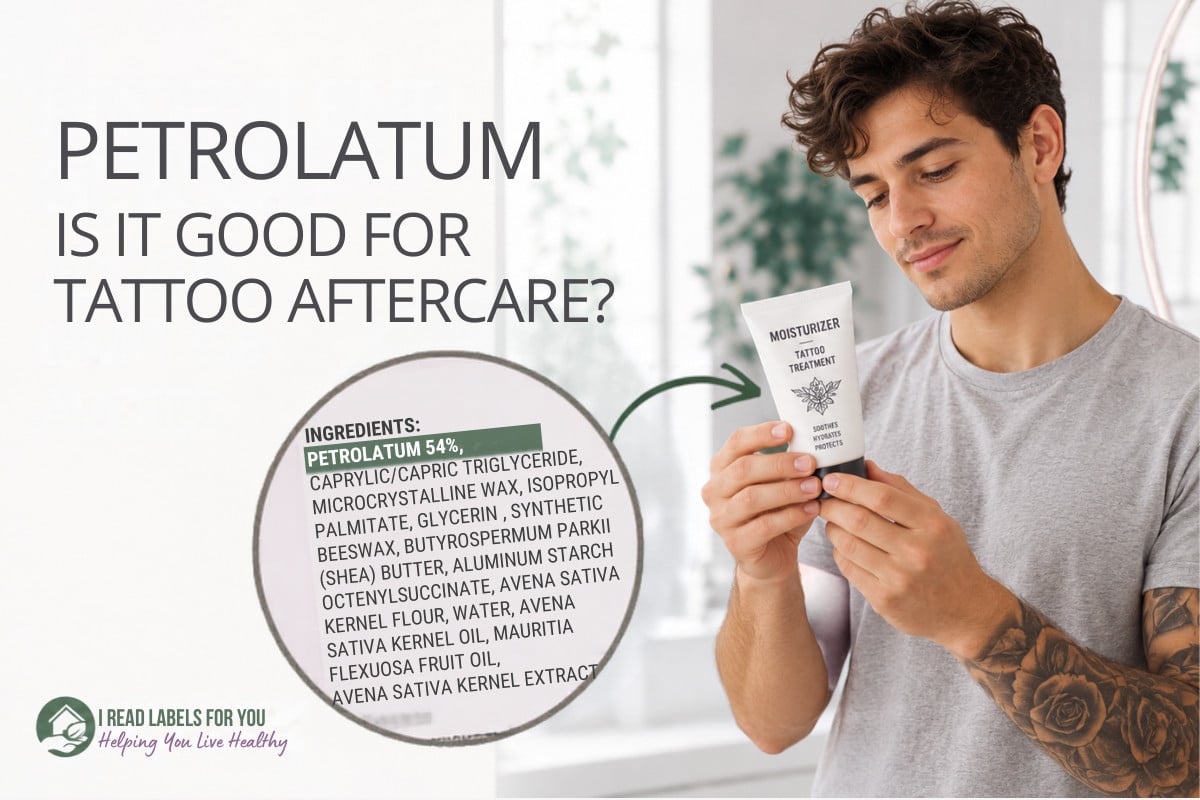
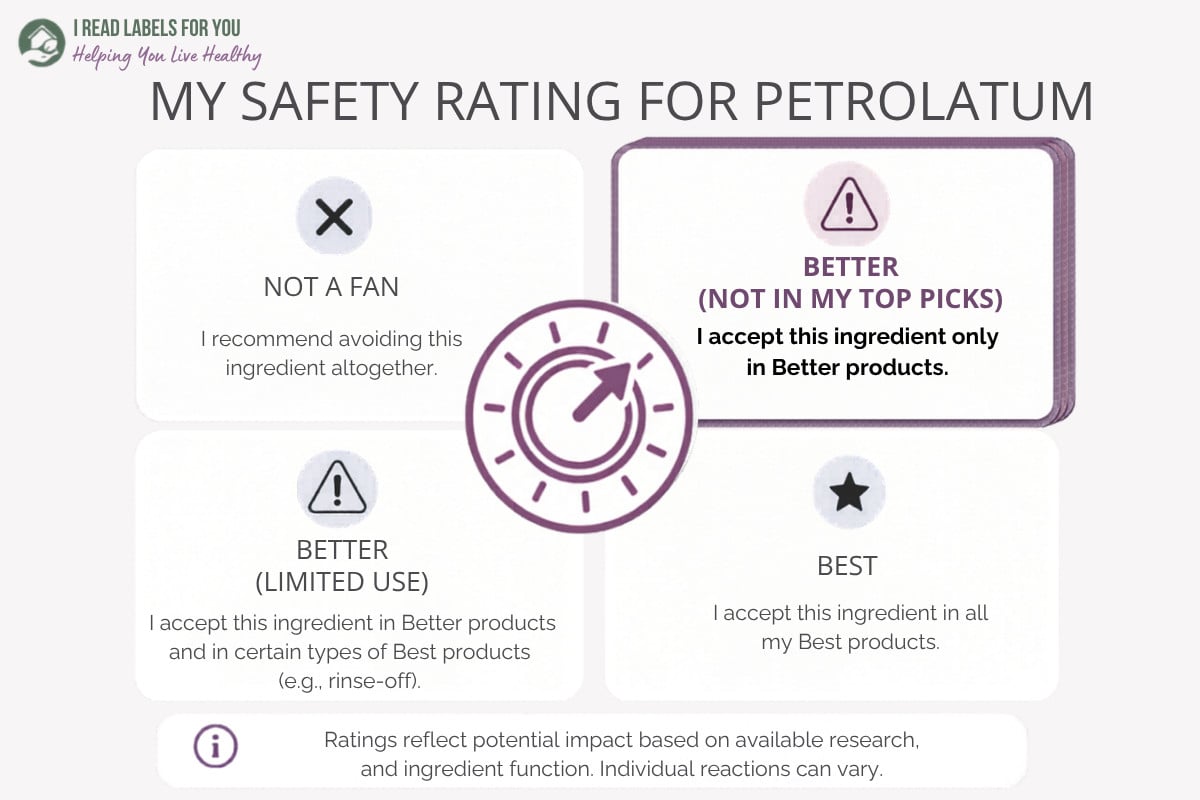
Yes, Petrolatum is safe to put on your skin, and the evidence behind that is unusually strong. It’s a semi-solid blend of oils refined from petroleum, and it works by sitting on skin and slowing water loss. Doctors patch-test other allergens in it, because it so rarely causes a reaction itself. My rating is Better (Not In My Top Picks).
Petrolatum sits in a strange regulatory gap. Europe prohibits it by default, then allows it back when a company can document how it was refined. Meanwhile, the United States treats it as an approved over-the-counter drug for protecting injured skin.
Ahead, you’ll see Petrolatum ranked ninth on a famous avoid list that calls it safe and non-allergenic. You’ll learn what a new purity test, official on August 1, 2026, now checks for. Furthermore, you’ll find out why Petrolatum stays put even on damaged skin.
What Is Petrolatum?
Petrolatum is a mixture, not a single chemical. The European Union database defines it as a complex combination of hydrocarbons. Refiners obtain it as a semi-solid from dewaxing paraffinic residual oil.
That same entry adds the detail that matters most later. Specifically, the mixture consists predominantly of saturated crystalline and liquid hydrocarbons having carbon numbers predominantly greater than C25. In plain terms, these are big, greasy, water-hating molecules.
Because it’s a mixture, its makeup shifts with the crude oil it came from. Indeed, the chemistry record at PubChem notes that color and consistency vary by source. Consequently, refining matters more than the name.
What Does Petrolatum Do In Cosmetics?
Petrolatum forms a barrier. The EU database lists two functions for it: antistatic and skin conditioning as an emollient. Its real job is holding water in. It slows the water that constantly escapes through your skin.
That’s why Petrolatum helps chapped lips, cracked hands and eczema-prone patches. In contrast to glycerin, it adds no water of its own; instead, it keeps what’s already there.
Interestingly, a 2019 review by German government scientists measured a second effect. Petrolatum had “a pronounced swelling effect,” thickening the outer layer by 32 percent. Simply put, the top layer plumps up with water.
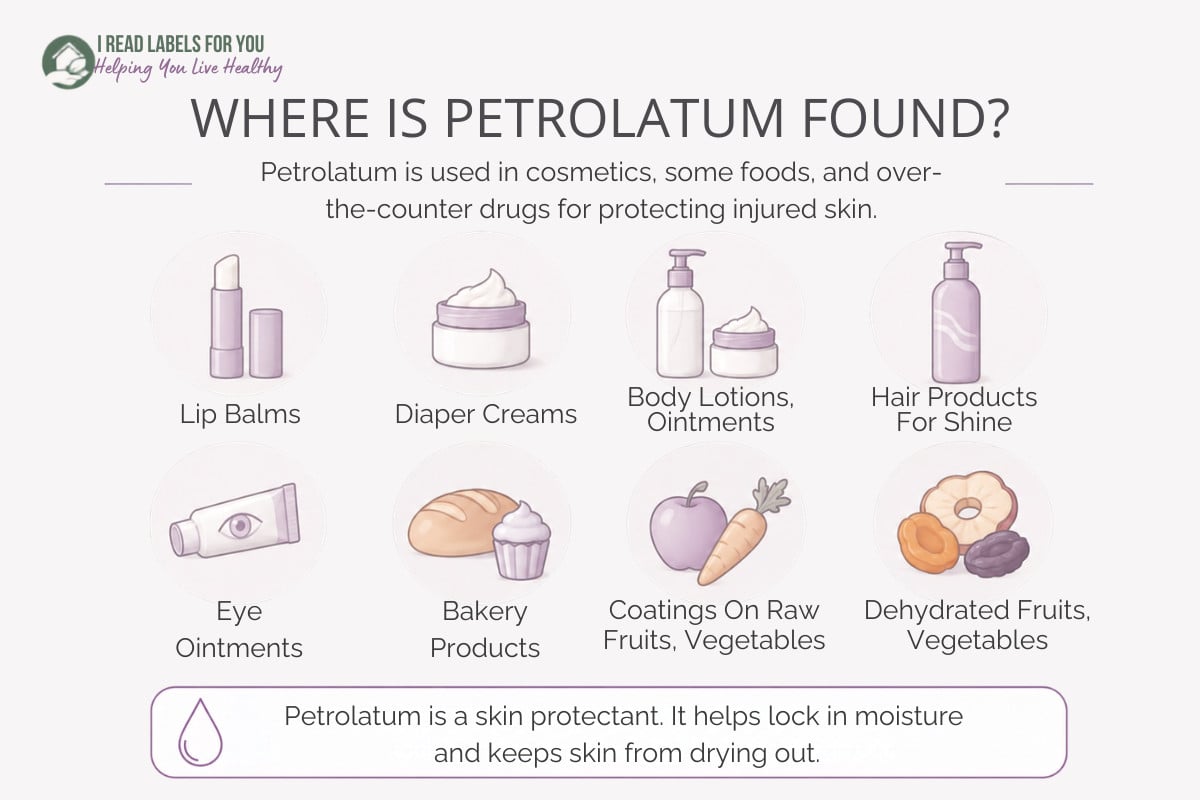
You’ll find Petrolatum most often in:
- lip balms
- diaper creams
- body lotions and ointments
- hair products for shine
- eye ointments
- bakery products
- coatings on raw fruits and vegetables
- dehydrated fruits and vegetables
How Is Petrolatum Made?
Petrolatum comes from the heavy leftovers of oil refining. The manufacturing record describes distilling still residues from paraffin-base petroleum, then purifying the result with solvents, settling, and centrifugation.
That purification step is the whole story of this ingredient. Crude petroleum fractions carry polycyclic aromatic hydrocarbons, a family of compounds that includes known carcinogens such as benzo[a]pyrene. Refining strips them out.
Therefore, the safety question was never really about Petrolatum itself. It was always about whether a given batch got refined enough.
Does Petrolatum Penetrate The Skin?
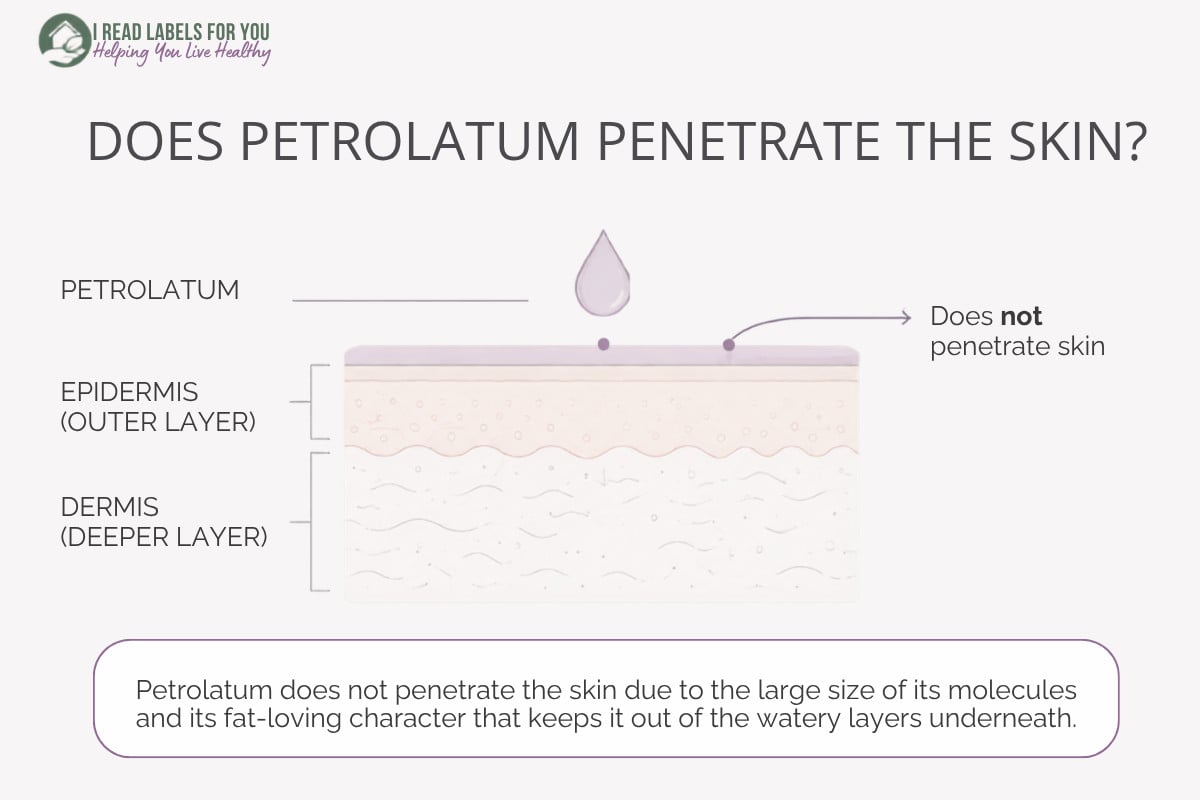
No, Petrolatum does not penetrate the skin in any meaningful amount, and we have human measurements rather than guesses. Its molecules are far above the roughly 500-dalton cutoff, below which size stops being a barrier. On top of that, it repels water completely, so it has nothing to move into.
Size is the factor that actually drives the answer here. Petrolatum’s hydrocarbons run above C25, which is many times the dalton threshold. Its fat-loving character, measured as a LogP above 6, keeps it out of the watery layers underneath.
The measurements agree. A 2019 review by the German Federal Institute for Risk Assessment gathered the studies. Its conclusion: absorption “is low, if not, extremely low.” That review covers mineral oil saturated hydrocarbons, the family Petrolatum belongs to.
In living people, imaging found Petrolatum exclusively detected on the skin surface. In human cadaver skin, a marker carried in Petrolatum stayed below the detection limit underneath. Testers checked at 1, 24 and 72 hours.
Most importantly, this holds on broken skin. In tissue deliberately damaged with acetone, Petrolatum remained restricted to the stratum corneum. To be fair, those same reviewers caution that some negative results may reflect short test times and insensitive methods.
What Is Petrolatum Called On Labels?
Petrolatum appears under several names, and two commonly listed “aliases” are actually different ingredients. The EU database records these as genuine variants:
- Petrolatum
- Petroleum Jelly
- White Petrolatum
- Soft Paraffin
- Red Petrolatum
By contrast, Mineral Oil and Paraffin are separate substances with their own identity numbers. Under Chemical Abstracts Service (CAS) numbering, Mineral Oil is 8042-47-5 and Paraffin is 8002-74-2.
Petrolatum is 8009-03-8. They start from the same crude oil; they’re not the same material.
Does The U.S. FDA Restrict Petrolatum In Food And Cosmetics?
No, the Food and Drug Administration (FDA) does not restrict Petrolatum. On the contrary, the agency approves it as an active drug ingredient and permits it in food.
The skin protectant monograph allows Petrolatum, 30 to 100 percent and the same range for White Petrolatum. Products meeting those conditions are generally recognized as safe and effective. Separately, the ophthalmic monograph permits Petrolatum in eye ointments up to 100 percent.
Read that second one carefully, because the comparison inside it is telling. Mineral oil is capped at 50 percent there, and paraffin at 5 percent, both only in blends. Petrolatum alone needs no cap and no partner.
I’m generally skeptical of FDA reassurance on cosmetics. The agency reviews very few ingredients before sale. Its Generally Recognized As Safe pathway also lets companies self-certify with little outside checking.
Here, though, the FDA went firmer and regulated Petrolatum as a drug. That’s a higher bar than cosmetic status.
Europe works from the opposite direction, using what’s called the precautionary principle. In short, where a hazard is plausible but unproven, the EU restricts first and asks for evidence afterward.
EU Regulations On Petrolatum
Europe prohibits Petrolatum in cosmetics, with one door left open. Annex II entry 904 bans Petrolatum “except if the full refining history is known.” A company must also show that the substance from which it’s produced is not a carcinogen.
Annex II is the banned list, not a limits list. Accordingly, there’s no permitted percentage, because the default position is no. A company gets to use it only by documenting where the oil came from and how it was purified.
The hazard classification behind that ban goes further than most people realize. The EU’s harmonized classification table carries seven separate Petrolatum entries.
Every one is “Carc. 1B” with hazard statement H350, meaning “may cause cancer.” Notably, that includes the hydrotreated, clay-treated, and carbon-treated grades.
Each of those seven entries carries a note releasing the classification when the refining history is known. Hence refining alone does not clear it; documenting the refining does.
U.S. And EU Disagreements On Petrolatum
This looks like a flat contradiction, and it really is not one. The two regulators are answering different questions.
The FDA asks whether the purified material works safely at a given strength on skin. Its answer is yes. Importantly, the skin protectant monograph sets no purity specification at all: no refining rule, no limit on polycyclic aromatic hydrocarbons.
Europe asks the question the FDA monograph skips. Namely, can you prove this batch started from oil that was properly cleaned up? Without paperwork, the answer is no.
Consequently, neither ruling contradicts the other. One covers performance and strength, the other covers provenance.
Even so, the United States does control purity, just through a different door. The food additive rule has long required food-grade Petrolatum to pass ultraviolet absorbance limits, which screen for aromatic impurities.
Moreover, on August 1, 2026, the United States Pharmacopeia added a new test. It sets a “UV Absorbance Limit for Polycyclic Aromatic Hydrocarbons,” replacing a vaguer impurities check.
Canadian Regulations On Petrolatum
Canada assessed Petrolatum directly and cleared it. Its 2016 screening assessment found that petrolatum and waxes do not meet any of the criteria in section 64. That section defines a toxic substance under Canadian law.
On health, the same assessment found no amounts that may constitute a danger in Canada to human life or health. Petrolatum appears on neither the Cosmetic Ingredient Hotlist nor Schedule 1.
Canada’s reasoning rests on grade. The assessment notes that products there use highly refined Petrolatum with very low residual aromatic impurities. In other words, Canada solved the same problem Europe did, by requiring purity rather than by banning the name.
Can Petrolatum Cause Skin Allergy And Sensitization?
No, Petrolatum very rarely causes skin allergy, and the evidence here is among the strongest for any cosmetic ingredient. Dermatologists rely on that reliability professionally because they dissolve other suspected allergens in it for patch testing.
A German patch-test study of 79,365 patients found 27 positive reactions to White Petrolatum, which is 0.03 percent. The authors wrote that true allergic patch test reactions to White Petrolatum are “extremely rare.”
A randomized trial published in JAMA compared it against an antibiotic ointment. The results showed that no patient in the group using White Petrolatum developed allergic contact dermatitis. Four patients on bacitracin did.
Reactions do exist, though they’re case reports rather than a pattern. Where investigators traced a cause, they pointed at impurities rather than the base. One 2004 paper states that the sensitizing impurities of Petrolatum are polycyclic aromatic hydrocarbons.
Petrolatum has never been named an American Contact Dermatitis Society Allergen of the Year. Likewise, it does not appear on that group’s core allergen series, except as the abbreviation “pet.” for the test vehicle.
Is Petrolatum A Hormone (Endocrine) Disruptor?
No, Petrolatum is not a hormone disruptor, and nothing in the record suggests otherwise. To begin with, a molecule must reach living tissue to affect hormones. This one stays in the dead outer layer.
The European Chemicals Agency keeps a list of substances under endocrine disruptor assessment. I retrieved the full list of 189 entries and filtered it; Petrolatum appears nowhere. Phenoxyethanol, bisphenol A, and triclosan all showed up, which tells me the search worked.
Searches of medical literature return nothing either. No study has tested Petrolatum for hormonal activity, because there’s no biological reason to expect any.
Is Petrolatum Safe To Use While Pregnant?
Yes, Petrolatum is a reasonable choice during pregnancy. It’s one of the few ingredients where I say that comfortably, because it does not reach your bloodstream.
The reassurance rests on the penetration evidence above. In animal work using Petrolatum as the vehicle, blood did not contain any detectable levels of radioactivity above background.
Pregnancy also brings itchy, stretched, dry skin, and a plain barrier ointment handles that without fragrance or preservatives. Nevertheless, pregnancy is personal. You should consult with your medical provider about anything you use often or over large areas.
Are There Any Cancer Concerns Linked To Petrolatum?
No, refined Petrolatum is not linked to cancer in people, although the concern has a real origin worth understanding. The worry attaches to impurities from poor refining, not to the ingredient itself.
No agency in the United States lists Petrolatum as a carcinogen. It’s absent from the International Agency for Research on Cancer classifications, the Report on Carcinogens, and California’s Proposition 65 list. What those bodies do list is untreated and mildly treated mineral oils, a different material.
The animal studies people cite are old and tested cruder grades. A 1966 paper reported tumors from “an extract of amber Petrolatum,” amber meaning “less refined.” None of that work used modern purified cosmetic material.
More recent measurements are reassuring. A German government control laboratory tested 27 samples, mostly raw materials for cosmetics and medicines.
Aromatic content ran between 0.02 and 1.10 percent, and older methods “may have overestimated” it. Read the top of that range carefully because the testers deliberately included industrial-grade products as dirty comparisons.
Moreover, that aromatic fraction is not a carcinogen count. Refining chemists point out that the toxic part is a narrow subset. The German reviewers found “no indication of any carcinogenic effects” from highly refined mineral oils and waxes.
Is Petrolatum Bad For The Environment?
Petrolatum’s environmental problem is its origin, not its toxicity. It comes from crude oil which is finite.
On direct harm, Canada’s assessment found Petrolatum does not pose a threat to the environment. Because it’s insoluble in water, wastewater treatment removes it rather than passing it downstream.
Certifiers still exclude it. Petrolatum is not an approved COSMOS raw material, and it’s absent from the NATRUE list. Those standards rule out petrochemicals by policy, regardless of the safety data.
Common Claims About Petrolatum: What’s True And What’s Not
Claim: Petrolatum And Mineral Oil Are The Same Thing
This one is false, and it’s repeated by sources that ought to know better. The David Suzuki Foundation’s avoid-list page lists “Mineral Oil” and “Paraffin Oil” as names for Petrolatum.
They’re separate ingredients with separate identity numbers. Petrolatum is CAS 8009-03-8; mineral oil is 8042-47-5; paraffin is 8002-74-2. Petrolatum is a semi-solid, while mineral oil is a liquid.
They are related, to be fair. Both come from the same refining stream and raise the same purity question. Even so, a study of one does not automatically describe the other.
Claim: Petrolatum Suffocates Skin And Traps Bacteria
This claim is not supported, and the versions circulating online trace to company blogs rather than studies. One widely copied line says Petrolatum “can trap bacteria under the skin.”
There’s no “under the skin” for it to reach. Imaging in living people found Petrolatum “exclusively detected on the skin surface.” It stayed in the outer layer even on deliberately damaged skin.
Suffocation misreads what a barrier does. Rather than sealing skin inertly, Petrolatum draws water into the outer cells, thickening that layer by about a third.
Claim: Petrolatum Is Banned In Europe
This is half right, and the half that’s right is the interesting half. Europe genuinely does prohibit Petrolatum, as Annex II entry 904 of its cosmetics regulation.
However, the same entry permits it when the full refining history is documented. Hence Petrolatum is both banned by default and legally sold across Europe, and both statements are true together.
What you cannot do is tell which you’re holding. The label reads “Petrolatum” whether the paperwork exists or not.
What I Think About Petrolatum — And What You Should Do
My rating for Petrolatum is Better (Not In My Top Picks). Almost every ingredient I place in this tier lands there because its data is thin. Petrolatum is the opposite.
Petrolatum’s allergy record covers nearly 80,000 patch-tested patients. Researchers measured its penetration in living people, and Canada assessed it and cleared it.
What holds Petrolatum back is not toxicology. It’s that Europe bans it unless a company documents the refining. You have no way to check whether that paperwork exists. The ingredient list looks identical either way.
That’s the same shape as Carbomer‘s benzene residue: a supply-chain question you cannot see from the shelf.
Here’s the honest irony. The page that ranks Petrolatum ninth of twelve ingredients to avoid calls it “a safe, non-allergenic product.” Its real objection is that crude oil is not renewable.
If you already use it on cracked hands or chapped lips, there’s no health reason to stop. Look for products naming USP or pharmaceutical grade, the version now covered by the new test.
If you’d rather avoid petroleum on principle, shea butter, cocoa butter, and beeswax do similar work. They’re not identical barriers, yet they’re reasonable swaps.
Frequently Asked Questions About Petrolatum
Petrolatum Vs Vaseline: Are They The Same?
Vaseline is a brand; Petrolatum is the ingredient inside it. Consequently, asking which is safer is like asking whether zinc oxide is safer than the sunscreen brand using it.
What varies between products is the grade and the refining documentation behind it, not the basic material.
Is Petrolatum For Lips Safe?
Yes, Petrolatum is safe on lips, and it’s one of its most sensible uses. Lips have a thin barrier and lose water quickly, which is exactly the problem Petrolatum solves.
One caveat is worth knowing. Because you inevitably swallow some lip product, impurity levels matter more here. Pharmaceutical-grade products are therefore the better pick.
Is Petrolatum For Hair Good?
Petrolatum coats hair and adds shine, and it seals moisture into dry or textured hair. However, it does not rinse out easily and usually needs a clarifying wash.
Heavy coating can also encourage buildup on the scalp. Use it on lengths and ends instead.
Does Petrolatum Clog Pores?
Probably not, although I want to be straight with you about the evidence. I found no study testing Petrolatum’s comedogenicity directly in human skin. Therefore, I cannot quote you a number.
What I can say is that it stays on the surface and does not enter skin. Furthermore, its extremely low irritation and allergy record fits poorly with a pore-blocking ingredient.
Is Petrolatum Tattoo Aftercare A Good Idea?
A fresh tattoo is a wound, so follow your artist’s or doctor’s instructions ahead of any general advice. The FDA monograph that permits Petrolatum on skin also warns against using it on “deep or puncture wounds.”
Many artists have moved toward lighter, breathable aftercare products for the first days. Later on, once skin has closed, a plain barrier ointment is unremarkable.
How Can You Tell If Petrolatum Was Refined Properly?
Look for a Drug Facts panel on the package. If Petrolatum appears there as an active ingredient, the product is regulated as a drug rather than a cosmetic.
That distinction matters, because drug standards carry a purity test. Diaper creams, ointments, and many lip balms carry that panel, while a plain moisturizer usually does not.
A product naming USP or pharmaceutical grade tells you the same thing. Otherwise, the label cannot answer the question for you.
Why Does EWG Rate Petrolatum Differently?
The Environmental Working Group scores Petrolatum from 2 to 5, described as “depends on usage.” Its data quality is marked fair. It flags contamination concerns as “high” and points at polycyclic aromatic hydrocarbons.
We’re looking at the same worry, and we weigh it differently. EWG scores the worst plausible case, whereas I look at what refined material measures at now and what regulators require.
Their use-restriction flag traces back to Europe’s Annex II entry which I’ve read directly. In other words, that part of their score is the EU rule I describe above rather than separate evidence.
Sources
EU SCCS / SCCP Opinions:
No SCCS or SCCP opinion on Petrolatum exists; the EU ban follows automatically from its hazard classification rather than from an ingredient assessment. Committee opinion lists checked: SCCS opinions portal
SCCNFP/0474/01, adopted September 25, 2001, general opinion on cosmetic ingredients classified as carcinogenic, mutagenic or toxic to reproduction; does not mention Petrolatum: SCCNFP/0474/01
SCCNFP/0825/04, adopted May 25, 2004, follow-up general CMR opinion recording the resulting prohibition; does not mention Petrolatum: SCCNFP/0825/04
Cosmetic Ingredient Review (CIR) Reports:
No CIR safety assessment of Petrolatum exists. A search of CIR’s ingredient database returns no entry, while Chlorphenesin and Petroleum Distillates both return records: CIR ingredient status database
European Union Regulatory Databases:
CosIng entry for Petrolatum, reference 79504, functions antistatic and skin conditioning emollient, CAS 8009-03-8, EC 232-373-2: CosIng ingredient record
CosIng Annex II entry 904, prohibited except where the full refining history is known: Annex II substance record
CLP Annex VI harmonized classification, seven Petrolatum entries, all Carc. 1B, H350, with the refining-history note; ECHA substance record: ECHA CHEM record
Other Regulators:
U.S. FDA skin protectant monograph, 21 CFR Part 347, Petrolatum permitted at 30 to 100 percent: 21 CFR Part 347
U.S. FDA ophthalmic monograph, 21 CFR 349.14, Petrolatum permitted up to 100 percent: 21 CFR 349.14
U.S. FDA food additive rule, 21 CFR 172.880, with ultraviolet absorbance limits screening for aromatic impurities: 21 CFR 172.880
U.S. Pharmacopeia, White Petrolatum monograph, new polycyclic aromatic hydrocarbon limit test official August 1, 2026: USP White Petrolatum
U.S. Pharmacopeia, Petrolatum monograph, same new test and date: USP Petrolatum
U.S. FDA prohibited and restricted cosmetic ingredients; Petrolatum not listed: FDA prohibited ingredients
Health Canada Cosmetic Ingredient Hotlist; Petrolatum not listed: Health Canada Hotlist
Environment and Climate Change Canada, Screening Assessment, Petroleum Sector Stream Approach, Petrolatum and Waxes, June 2016: Canadian screening assessment
CEPA Schedule 1 list of toxic substances; Petrolatum not listed: CEPA Schedule 1
International Agency for Research on Cancer classifications; Petrolatum not classified: IARC list of classifications
National Toxicology Program Report on Carcinogens; Petrolatum not listed: Report on Carcinogens
California Proposition 65 list; Petrolatum not listed: Proposition 65 list
PubChem Records (Chemistry, Identifiers, Skin Penetration, Hazard Codes):
PubChem record for Petrolatum, CAS 8009-03-8; no compound identifier exists because Petrolatum is a mixture rather than a single compound: PubChem Petrolatum
Peer-Reviewed Studies:
Pirow R, Blume A, Hellwig N, Herzler M, Huhse B, Hutzler C, Pfaff K, Thierse HJ, Tralau T, Vieth B, Luch A. Mineral oil in food, cosmetic products, and in products regulated by other legislations. Critical Reviews in Toxicology. 2019;49(9):742-789. PMID 31939687: PubMed record
Schnuch A, Lessmann H, Geier J, Uter W. White petrolatum (Ph. Eur.) is virtually non-sensitizing. Contact Dermatitis. 2006;54(6):338-343. PMID 16787456: PubMed record
Smack DP, Harrington AC, Dunn C, et al. Infection and allergy incidence in ambulatory surgery patients using white petrolatum vs bacitracin ointment. JAMA. 1996;276(12):972-977. PMID 8805732: PubMed record
Lachenmeier DW, Mildau G, Rullmann A, Marx G, Walch SG, Hartwig A, Kuballa T. Evaluation of mineral oil saturated hydrocarbons and mineral oil aromatic hydrocarbons in pure mineral hydrocarbon-based cosmetics and cosmetic raw materials using 1H NMR spectroscopy. F1000Research. 2017;6:682. PMID 28721203: PubMed record
Carrillo JC, Kamelia L, Romanuka J, Kral O, Isola A, Niemela H, Steneholm A. Comparison of PAC and MOAH for understanding the carcinogenic and developmental toxicity potential of mineral oils. Regulatory Toxicology and Pharmacology. 2022;132:105193. PMID 35618173. Industry-authored, published by CONCAWE: PubMed record
Concin N, Hofstetter G, Plattner B, et al. Evidence for cosmetics as a source of mineral oil contamination in women. Journal of Women’s Health. 2011;20(11):1713-1719. PMID 21970597: PubMed record
Ozcelik U, Yalcin E, Dogru D, et al. Lipoid pneumonia after external application of petrolatum to the face. PMID 14639399: PubMed record
Natural Cosmetic Standards:
COSMOS-standard approved raw materials; Petrolatum not approved and not permitted under the standard: COSMOS approved raw materials
NATRUE certified and approved raw materials; Petrolatum not listed: NATRUE certified world
Skin Allergy Resource:
American Contact Dermatitis Society, Helpful References, including the Core Allergen Series 2020; Petrolatum appears only as the patch-test vehicle abbreviation: ACDS Helpful References
Advocacy groups:
Environmental Working Group Skin Deep entry for Petrolatum, hazard score 2 to 5, described as depends on usage, data quality fair: EWG Skin Deep, Petrolatum
David Suzuki Foundation, Toxic ingredients to avoid, Petrolatum listed ninth of twelve, formerly known as the Dirty Dozen; the page describes Petrolatum as safe and non-allergenic in its own opening line: David Suzuki Foundation
Last verified: 09-26-2026

Download The Free Guide!
5 Powerful Steps To A Non-Toxic Home
Join our informed consumer community and get our free guide the “5 Powerful Steps To A Non-Toxic Home”.

Before commenting, please read our Comment Policy.