
Is Butylated Hydroxytoluene Safe? A Simple Answer You Can Trust
 Written by Irina Webb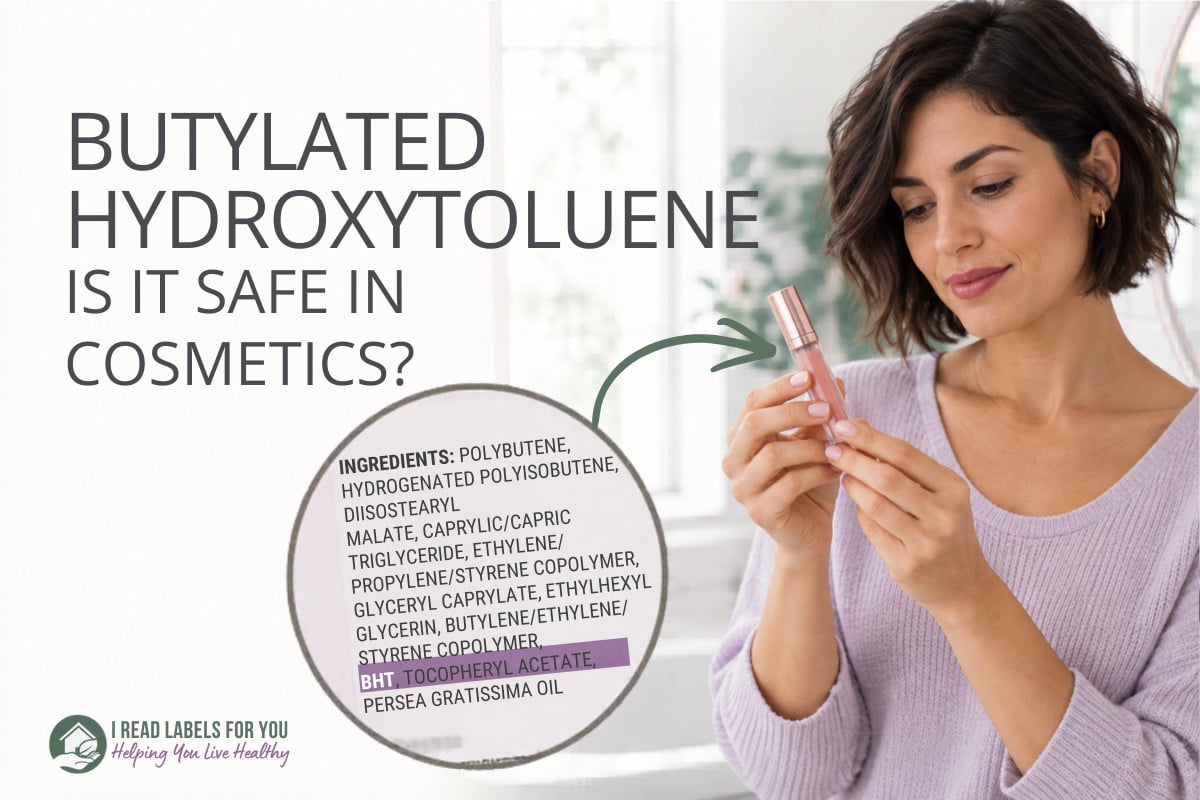
Yes, Butylated Hydroxytoluene is safe for your skin, though it’s not an ingredient I look for. Known as BHT, it’s a synthetic antioxidant that stops oils in a product from going rancid. Almost none of it gets into you, and the cancer story attached to it is weaker than the internet suggests. I rate it Better (Not In My Top Picks).
Butylated Hydroxytoluene is restricted in Europe by product type rather than banned. European regulators reviewed it in 2021 and set limits for mouthwash, toothpaste, and everything else. The United States allows it in both cosmetics and food.
Below you’ll find the measured figure for how much BHT crosses your skin. You’ll also see why the strongest concern here has nothing to do with your body. Finally, you’ll learn how to tell BHT apart from BHA.
What Is Butylated Hydroxytoluene?
Butylated Hydroxytoluene is a synthetic antioxidant built around a phenol ring. Chemists call it 2,6-di-tert-butyl-4-methylphenol, and its identifying number is CAS 128-37-0.
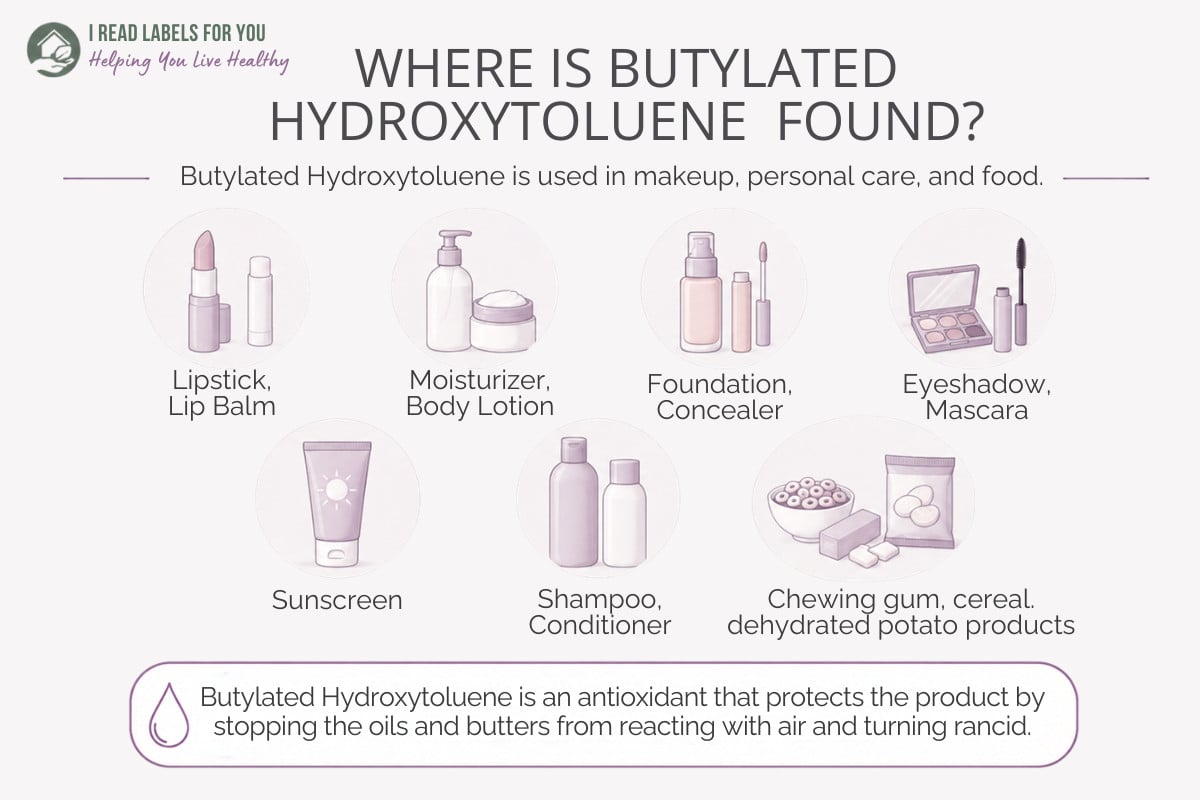
An antioxidant in a cosmetic is not there for your skin. It protects the product, by stopping the oils and butters inside it from reacting with air and turning rancid.
BHT is a white crystalline solid that dissolves in oil rather than water. That single property explains most of its behavior, including why so little of it reaches your bloodstream.
What Does Butylated Hydroxytoluene Do In Cosmetics?
Butylated Hydroxytoluene keeps a formula from spoiling, and it does that job at very small amounts. The industry review records the range at concentrations from 0.0002% to 0.5%.
Its use has grown dramatically while those amounts stayed flat. The 2023 update records BHT in 1709 formulations in 1998. By 2019 it was in 9485 formulations.
You’ll find Butylated Hydroxytoluene most often in:
- lipstick and lip balm
- moisturizer and body lotion
- foundation and concealer
- eyeshadow and mascara
- sunscreen
- shampoo and conditioner
- chewing gum, cereal and dehydrated potato products, as additive E 321
How Is Butylated Hydroxytoluene Made?
BHT is built from two petroleum-derived pieces. A chemical called p-cresol reacts with isobutene, using an acid catalyst to attach two bulky side groups.
Those bulky groups are the whole point. They shield the reactive part of the molecule. That is what lets BHT absorb damage meant for the oils around it.
None of the three safety reviews in front of me describes this process. That’s worth saying plainly. Manufacturing is one of the things I weigh, and the reviews do not cover it.
Does Butylated Hydroxytoluene Penetrate The Skin?
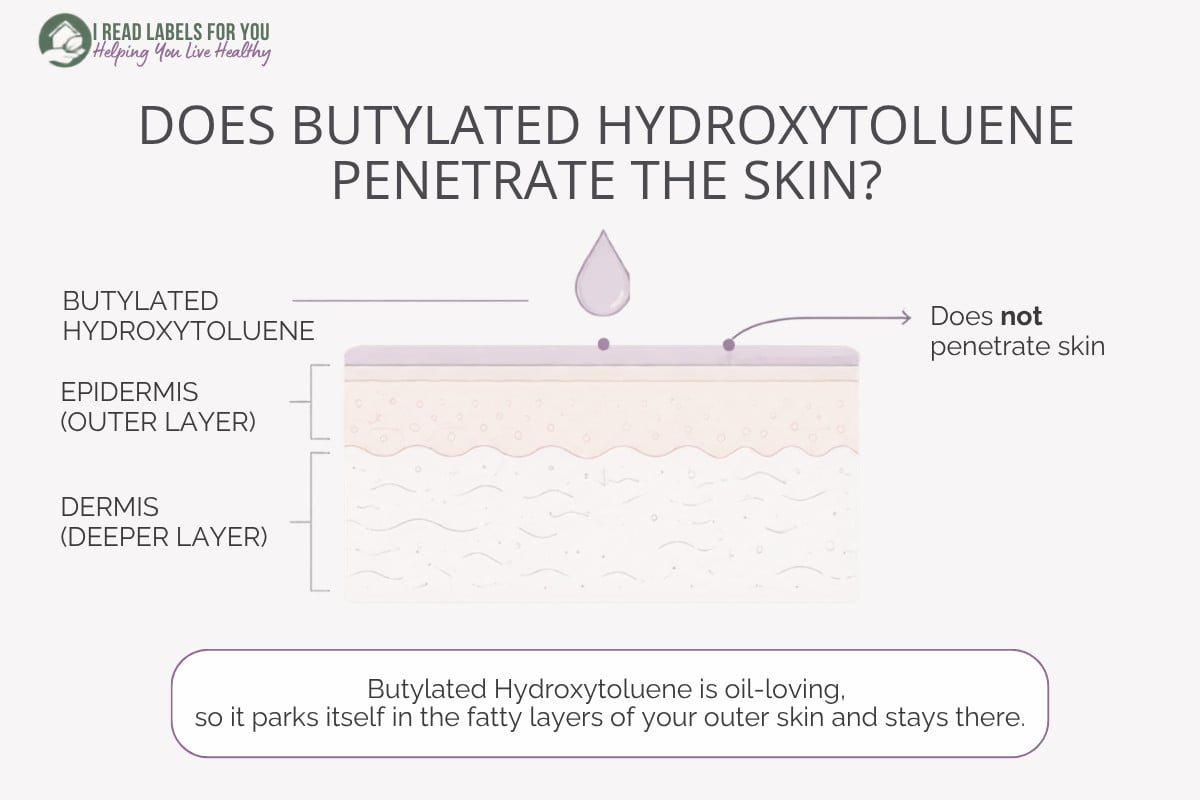
Barely, and the measured number is 0.4 percent of what you apply.
Size is not what stops it. BHT weighs about 220 daltons, comfortably under the roughly 500 dalton threshold where molecules usually cross skin.
Fat solubility is what stops it. BHT is strongly oil-loving, so it parks itself in the fatty layers of your outer skin and stays there.
The industry review puts it plainly. BHT appears to remain in the skin or pass through only slowly. It does not produce the systemic exposures seen with oral exposures.
European regulators measured this on human skin with a real cosmetic base. Their figure, verbatim: “a dermal absorption of 0.4%” over a 24 hour exposure.
What Is Butylated Hydroxytoluene Called On Labels?
One name dominates, but a few others turn up. Look for these:
- BHT
- Butylated Hydroxytoluene
- 2,6-Di-Tert-Butyl-4-Methylphenol
- 2,6-Di-Tert-Butyl-P-Cresol
- E 321, on food labels
One lookalike matters more than the rest. BHA, or Butylated Hydroxyanisole, is a different antioxidant with a different safety record. The section on cancer explains why the two should never be treated as interchangeable.
Does The U.S. FDA Restrict Butylated Hydroxytoluene In Food And Cosmetics?
No, American cosmetic rules place no limit on Butylated Hydroxytoluene whatsoever. The United States Food and Drug Administration (FDA) leaves that choice to whoever makes the product.
Food is regulated, and the rules there are specific. The rule sets a purity standard “Assay (total BHT) 99 percent minimum.”
Limits in food are set in parts per million and vary by product. Dry breakfast cereals allow 50 parts per million, potato granules only 10.
My usual caution about American oversight applies less here than elsewhere. The food rules are real. International food experts set an acceptable daily intake of 0 to 0.3 milligrams per kilogram.
Europe still starts from a different place, called the precautionary principle. It allows a regulator to set limits before the evidence is settled. That is what happened with BHT in 2022.
EU Regulations On Butylated Hydroxytoluene
Europe restricts Butylated Hydroxytoluene by product type, at entry 325 of Annex III. The three caps are 0.001 percent, 0.1 percent, and 0.8 percent.
Those numbers map onto specific products, and the safety committee spells out which. It found BHT safe as an ingredient up to a maximum concentration of 0.001% in mouthwash and 0.1% in toothpaste.
For everything else, the ceiling is higher. The committee found BHT safe up to a maximum concentration of 0.8% in other leave-on and rinse-off products.
Notice what the restriction is not. There’s no warning label, no ban on any product type, and no limit for children. Products that did not comply had to leave the market from July 1, 2023.
The Limits Sit Above Actual Use
Here’s a detail worth holding on to. Europe permits 0.8 percent in a face cream, while the highest concentration American manufacturers reported was 0.5 percent.
Regulators also allowed for using several products at once. Their 2021 opinion calculated a combined exposure across cosmetics and food, then found the margin still comfortable.
Canadian Regulations On Butylated Hydroxytoluene
Canada places no cosmetic restriction on Butylated Hydroxytoluene at all. It does not appear on the Cosmetic Ingredient Hotlist, in either the prohibited or the restricted table.
A near miss on the Canadian toxic substances list is worth knowing about, because it causes confusion. Schedule 1 contains a similar-sounding chemical: Phenol, 2,6-bis(1,1-dimethylethyl)-4-(1-methylpropyl)-, which has the molecular formula C18H30O.
That’s a different molecule with a different number. BHT itself is not on Schedule 1, though Canadian authorities have proposed adding it on environmental grounds.
Can Butylated Hydroxytoluene Cause Skin Allergy And Sensitization?
Rarely, and the largest study on record found nobody reacting at all.
Dermatologists do screen for it. BHT sits on the American Contact Dermatitis Society Core Allergen Series at 2 percent in petrolatum.
Screening is not the same as commonness, though. A 1990 study found no positive reactions among 1336 consecutive eczema patients patch tested with BHT.
European regulators reached the same view from the other direction. The SCCS agrees that the risk of skin sensitisation from current use levels is “negligible.”
One caveat belongs here for honesty. That large negative study is from 1990, and reported use has risen roughly fivefold since 1998. No modern study of similar size has been published.
Is Butylated Hydroxytoluene A Hormone (Endocrine) Disruptor?
Probably not, and this question has been examined more carefully than most on this site.
European regulators ran the question three ways. Their computer modeling came out as “inactive” for various endocrine activity related endpoints.
American screening data pointed the same way. BHT was considered active in only 4 of 26 estrogen-related tests. Each time it acted only at the top dose and at a higher dose than is cytotoxic.
For male hormones the result was cleaner still. The models indicate “0” (inactive) for “AR-antagonist” and “AR-agonist””.
Thyroid is the one loose thread. BHT was active in 5 of 11 thyroid tests. It also has been shown to increase the relative thyroid and adrenal weight in rats.
Why Regulators Are Still Looking
Despite all that, the European chemicals agency has two open processes on BHT. One is a substance evaluation led by France, the other an endocrine disruptor assessment, both still running.
Read the reason carefully, because it’s not what most people assume. The stated hazard class is endocrine disruption for the environment, not for people.
Is Butylated Hydroxytoluene Safe To Use While Pregnant?
Yes, as far as the animal evidence goes, and the reviews are unusually direct about it.
The industry review states that BHT was not a reproductive or developmental toxin in animals.
That said, the number Europe used to set its safety margin is a pregnancy number. That dose rests on effects on litter size and pup body weight gain during the lactation period. It’s far above anything a cosmetic delivers.
With absorption at 0.4 percent, the gap between cosmetic use and that dose is enormous. For anything you use daily through a pregnancy, you should consult with your medical provider.
Are There Any Cancer Concerns Linked To Butylated Hydroxytoluene?
No, and this is the claim most often made about BHT and least supported by the evidence.
The cancer agency of the World Health Organization places BHT in Group 3, “not classifiable as to its carcinogenicity to humans.” That’s the category for substances where the evidence does not support a conclusion either way.
It’s also not genotoxic, meaning it does not damage DNA. European regulators found BHT not of concern with regard to genotoxicity.
What The Animal Studies Show
High doses in feed can promote tumors that another substance started. Regulators note that BHT in high doses can exert tumour-promoting effects in some animal models.
The same body of research shows the opposite effect elsewhere. The industry review records that BHT has been shown to have tumor promotion effects, to be anticarcinogenic. Which one happens depends on the target organ, exposure parameters, the carcinogen, and the animal tested.
An ingredient that both promotes and prevents tumors depending on the setup is not a carcinogen. It is a reactive molecule whose effect depends entirely on dose and context.
Is Butylated Hydroxytoluene Bad For The Environment?
Yes, and the environmental file is the strongest concern attached to BHT. The European chemical hazard classification is aquatic, not human. Companies have notified it under hazard codes H400 and H410. Both flag serious harm to water life that persists rather than fading.
Canada has proposed adding BHT to its list of toxic substances on environmental grounds. The open European evaluation names the same concern, endocrine disruption in the environment.
Now notice the gap. The committee that declared BHT safe for your skin said this: “The SCCS mandates do not address environmental aspects. Therefore, this assessment did not cover the safety of BHT for the environment.”
So the regulator that cleared it never looked at the part that worries everyone else. That is no criticism of the committee, which stayed within its remit. It does mean nobody has weighed both halves together.
Common Claims About Butylated Hydroxytoluene: What’s True And What’s Not
Claim: BHT Causes Cancer
False, and this overstatement is the easiest way to lose an argument about BHT. The cancer agency of the World Health Organization rates it Group 3, not classifiable.
BHT is absent from the American Report on Carcinogens and from the California Proposition 65 list. It does not damage DNA, and the tumor findings run in both directions.
Claim: BHT And BHA Are The Same Thing
False, and this one is worth getting right because the difference is real. Butylated Hydroxyanisole, or BHA, is a separate antioxidant.
Their cancer classifications differ by a full category. BHT is Group 3, while BHA sits in Group 2B, “possibly carcinogenic to humans.”
If you are avoiding one of these two, BHA is the one with the stronger case against it. Check which letter the label actually shows.
Claim: BHT Is Banned In Europe
False, though something did change. Europe added concentration limits in 2022, and products above those limits left the market during 2023.
A limit is not a ban. BHT remains legal in European cosmetics at 0.8 percent in most products. That is above the highest level American brands report using.
What I Think About Butylated Hydroxytoluene — And What You Should Do
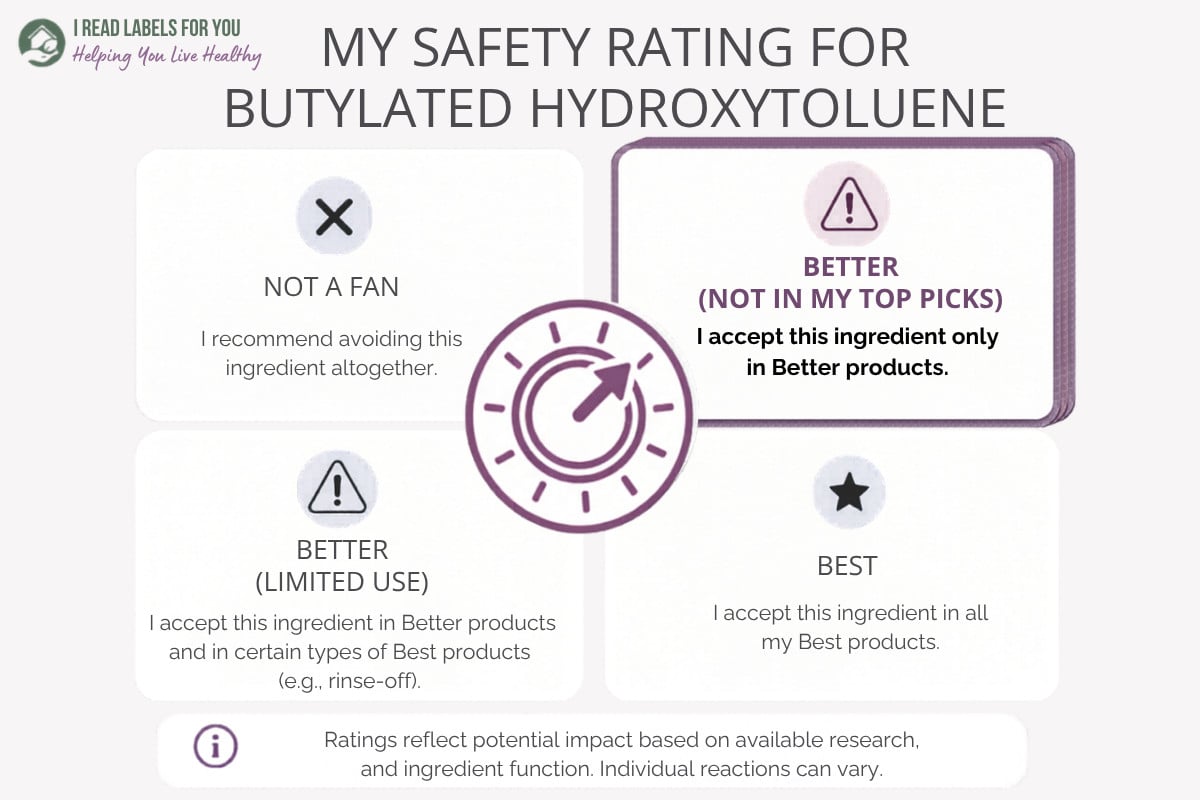
My rating for Butylated Hydroxytoluene is Better (Not In My Top Picks). It’s the rare ingredient where I part company with the loudest critics and the industry at the same time.
Start with what the evidence supports about BHT. Only 0.4 percent crosses skin, and what does cross mostly stays in the skin. It does not damage DNA, it’s not classifiable as a carcinogen, and it caused no reproductive harm in animals. Allergy is rare too. The largest study found no reactions in 1,336 patients, and regulators call the risk negligible at current use levels.
So why is BHT not in my top picks? Three things, and only one of them is about your body.
First, the environment. European hazard codes mark BHT as seriously harmful to water life, and Canada has proposed listing it. The committee that cleared it for skin openly declined to look at this.
Second, the regulatory question is still open. Two European processes are running. An ingredient under active evaluation for endocrine effects does not belong in a Best list.
Third, the sheer scale of use. Nearly 9,500 cosmetic formulations plus food additive E 321 means a lifetime of small doses that no single assessment measures.
What Should You Do?
Nothing urgent. If a product you love contains BHT, the evidence does not support throwing it away.
When you are choosing between two similar products, prefer the one using tocopherol instead. Tocopherol is vitamin E, it does the same antioxidant job, and it carries none of these questions.
Check the letters carefully while you are reading. BHA is the one with the stronger case against it, and the two sit side by side on many labels.
Frequently Asked Questions About Butylated Hydroxytoluene
Where Is BHT Banned?
Nowhere, as far as cosmetics go. Europe limits BHT by product type. The United States sets no cosmetic limit, and Canada does not list it at all. The confusion comes from the 2022 European rules. Those introduced maximum concentrations rather than a prohibition.
How Much BHT Is Harmful?
Far more than any cosmetic contains. The safe dose European regulators worked from is 25 milligrams per kilogram of body weight per day, taken by mouth.
Your actual exposure from a full routine plus food is about 0.0173 milligrams per kilogram per day. That leaves a margin in the thousands, where regulators require a margin of one hundred.
What Side Effects Does BHT Have On Skin?
Very few, and mild ones. Regulators describe BHT as slightly irritating based on rabbit skin and eye studies.
A predictive clinical test using undiluted BHT found it a mild irritant and a moderate sensitizer. At the concentrations used in real products, below 0.5 percent, neither effect shows up in practice.
What Does BHT Do To Humans?
Almost nothing at cosmetic exposures, because almost none of it gets in. What is swallowed in food is broken down and passed out, mainly as an acid form in urine.
At much higher oral doses in animals, the liver responds first. Those doses are hundreds of times what a person encounters.
What Does BHT Stand For In Medical Terms?
BHT stands for butylated hydroxytoluene, and the abbreviation means the same thing in medicine as on a label. You may also see it written as 2,6-di-tert-butyl-4-methylphenol.
In a medical context, BHT usually appears as a laboratory antioxidant or as an excipient. It’s not a drug and has no therapeutic use.
Sources
EU SCCS / SCCP Opinions:
SCCS/1636/21, Opinion on Butylated Hydroxytoluene (BHT), final version; source of the dermal absorption figure, the systemic exposure calculation, the endocrine assessment and the product-type concentration limits: SCCS Opinion on BHT
Cosmetic Ingredient Review (CIR) Reports:
Andersen FA, ed. (2002), Final Report on the Safety Assessment of BHT, International Journal of Toxicology, 21(Supplement 2): 19-94; source of the use concentration range, the skin retention finding and the tumor promotion and anticarcinogenic findings: CIR reports
Burnett C, Bergfeld WF, Belsito DV, et al. (2023), BHT, International Journal of Toxicology, 42(Supplement 3): 17S-19S; the re-review that reaffirmed the 2002 conclusion and recorded the rise to 9,485 formulations: CIR reports
European Union Regulatory Databases:
Regulation (EC) No 1223/2009, Annex III entry 325, 2,6-Di-Tert-Butyl-4-Methylphenol, CAS 128-37-0, EC 204-881-4; limits of 0,001 percent, 0,1 percent and 0,8 percent, applicable from July 1, 2023: CosIng annexes
CLP Regulation Annex VI; BHT has no harmonized classification, confirmed by its absence from the Annex VI table: EU CLP Annex VI
ECHA substance record 100.004.439, 2,6-di-tert-butyl-p-cresol; REACH registered, with an ongoing substance evaluation led by France and an ongoing endocrine disruptor assessment: ECHA CHEM
Other Regulators:
International Agency for Research on Cancer, list of classifications; butylated hydroxytoluene is Group 3, not classifiable, while butylated hydroxyanisole is Group 2B: IARC list of classifications
U.S. NTP, 15th Report on Carcinogens; BHT is not listed, confirmed by its absence from the report’s CAS number index: NTP Report on Carcinogens
California OEHHA, Proposition 65 list; BHT does not appear: OEHHA Proposition 65 list
U.S. FDA, 21 CFR 172.115, BHT as a food additive, with the 99 percent minimum assay and the parts-per-million limits by food type: 21 CFR 172.115
Health Canada Cosmetic Ingredient Hotlist; BHT appears in neither the prohibited nor the restricted table: Cosmetic Ingredient Hotlist
Environment Canada, CEPA Schedule 1 List of Toxic Substances; BHT is not listed, while the similar-sounding 4-sec-butyl analogue is: CEPA Schedule 1
U.S. EPA, Integrated Risk Information System; no assessment for BHT: EPA IRIS
PubChem Records (Chemistry, Identifiers, Skin Penetration, Hazard Codes):
PubChem CID 31404, butylated hydroxytoluene, CAS 128-37-0, formula C15H24O, molecular weight 220.35; also the source of the aquatic hazard statements H400 and H410: PubChem CID 31404
Peer-Reviewed Studies:
Flyvholm MA, Menne T (1990), Sensitizing risk of butylated hydroxytoluene based on exposure and effect data, Contact Dermatitis, 23(5): 341-345, PMID 2151374; the largest patch-test series retrieved, with no positive reactions: PubMed 2151374
Natural Cosmetic Standards:
COSMOS-standard approved raw materials; BHT not listed: COSMOS-standard approved raw materials
NATRUE certified and approved raw materials; BHT not listed: NATRUE certified world
Skin Allergy Resource:
American Contact Dermatitis Society (ACDS), Helpful References including the Core Allergen Series 2020; BHT is listed for patch testing at 2 percent in petrolatum: ACDS Helpful References
Last verified: 09-22-2026

Download The Free Guide!
5 Powerful Steps To A Non-Toxic Home
Join our informed consumer community and get our free guide the “5 Powerful Steps To A Non-Toxic Home”.

Before commenting, please read our Comment Policy.