
Is Triethanolamine Safe? A Simple Answer You Can Trust
 Written by Irina Webb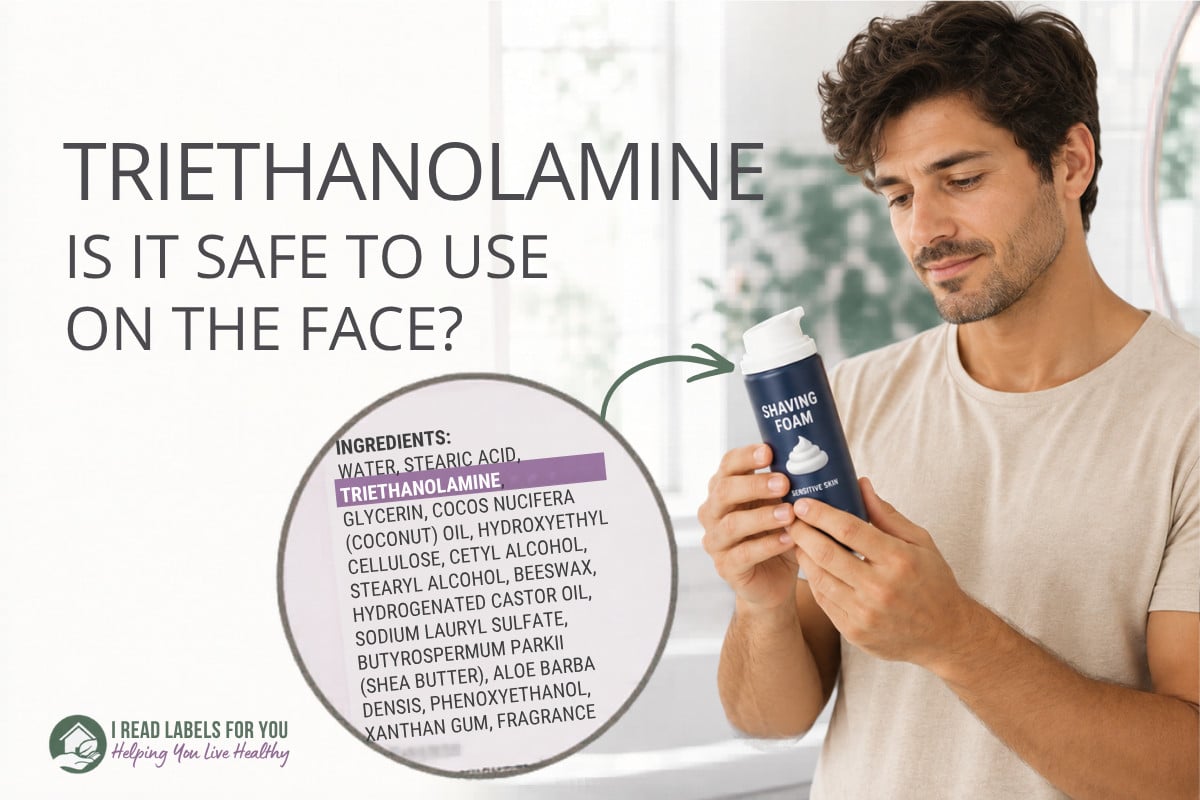
Yes, Triethanolamine is safe enough for most people in most products. It’s a laboratory-made liquid that adjusts a product’s pH and holds oil and water together. Its own safety record is clean, yet it’s built from a known carcinogen. My verdict lands at Better (Not In My Top Picks).
Triethanolamine is permitted in Europe at up to 2.5 percent in leave-on products. Strict purity conditions come attached, and they exist to keep it away from nitrite. The United States sets no equivalent rule, and that gap shapes my rating.
Ahead, you’ll see why every binding regulator clears this ingredient while every clean-beauty standard rejects it. You’ll find the patch test number that settles the allergy question, drawn from 85,098 people. You’ll also learn the one label combination worth avoiding, which takes seconds to spot.
What Is Triethanolamine?
Triethanolamine, shortened to TEA on labels, is a clear, thick, slightly oily liquid. The industry safety review calls it a tertiary amine with 3 ethanol functional groups.
The practical thing to know is that it’s alkaline. As supplied, it sits at a pH of 9 to 11, well above what skin prefers. That alkalinity explains most of what it does, and most of what goes wrong.
One more point matters more than any other here. It has two close relatives, monoethanolamine and diethanolamine, and they are not equally safe. Europe bans diethanolamine from cosmetics outright.
What Does Triethanolamine Do In Cosmetics?
Triethanolamine’s main job is raising pH. Many thickeners work only inside a narrow pH window. A small amount of TEA moves a formula into that window.
Second, Triethanolamine acts as an emulsifier. Meeting a fatty acid such as stearic acid, it forms a soap. That soap is what holds oil and water together.
Third, TEA can serve as a fragrance ingredient. The 2013 industry review confirms all three roles.
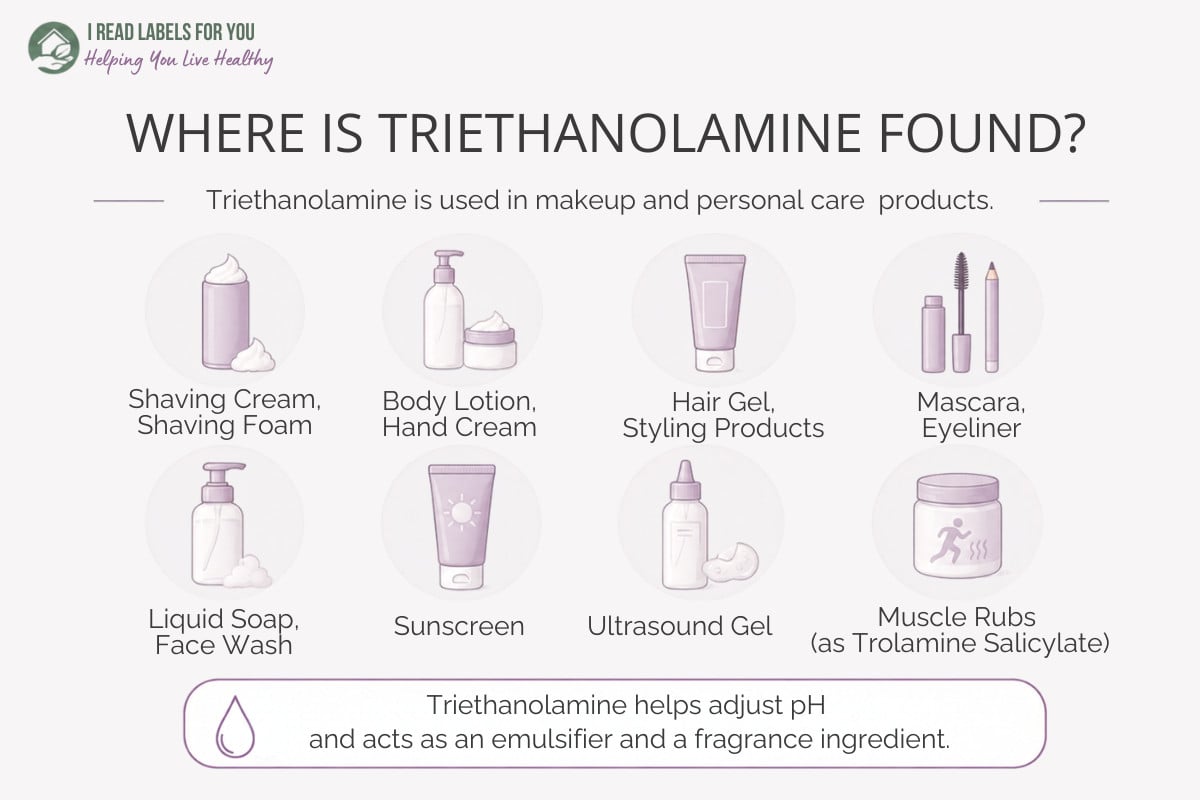
You’ll find Triethanolamine most often in:
- shaving cream and shaving foam
- body lotion and hand cream
- hair gel and styling products
- mascara and eyeliner
- liquid soap and face wash
- sunscreen
- ultrasound gel at the doctor’s office
- muscle rubs, listed as trolamine salicylate
In food, it appears rarely and indirectly. The U.S. Food and Drug Administration (FDA) lists it as a malting or fermenting aid, and permits it in food packaging.
How Is Triethanolamine Made?
Triethanolamine is made by reacting ethylene oxide with ammonia. The 2013 review states that Triethanolamine is produced by reacting 3 moles of ethylene oxide with 1 mole of ammonia.
Ethylene oxide is the manufacturing chemical worth pausing on. It’s classified as a known human carcinogen. Several ingredients I downgrade share that same starting material.
Be clear about what this does and does not mean. No source shows ethylene oxide left in the finished Triethanolamine. The same reaction does produce diethanolamine, however, and that one stays behind.
Does Triethanolamine Penetrate The Skin?
No, not in any meaningful amount from a normal product. Two markers usually decide this, and here they point opposite ways.
Size is no barrier. Triethanolamine weighs 149, far below the roughly 500 dalton ceiling where size starts blocking entry.
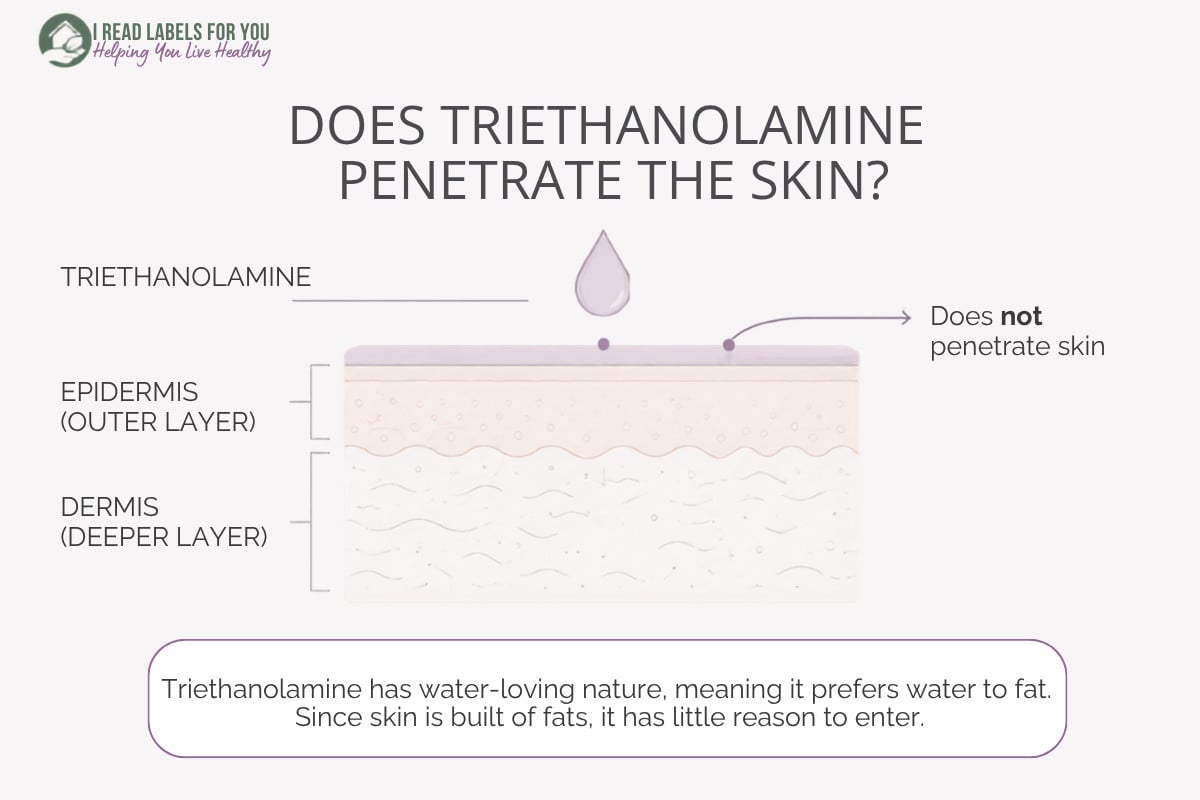
TEA’s water-loving nature is the real barrier, and it drives the answer. Its LogP is about negative 1.6, meaning it much prefers water to fat. Skin is built of fats, so it has little reason to enter.
The measurements agree. Applied to human skin as a lotion-style emulsion, 0.51 percent reached the fluid below after 24 hours. At the more typical pH of 7, the figure was 0.46 percent.
One caveat belongs here. Undiluted Triethanolamine behaves differently, because alkalinity damages the barrier it crosses. A 1997 review of all three ethanolamines found it crossed rat skin fastest of the three.
What Is Triethanolamine Called On Labels?
On cosmetics, it appears as Triethanolamine, sometimes shortened to TEA. In medicines, the same molecule is called Trolamine.
Watch the prefix too. Any ingredient beginning with TEA is a salt of this molecule:
- TEA-Lauryl Sulfate
- TEA-Stearate
- TEA-Cocoate
- TEA-Laureth Sulfate
- Trolamine Salicylate
Its registry number is 102-71-6. One name looks similar but is a different chemical: Triethylamine.
Does The U.S. FDA Restrict Triethanolamine In Food And Cosmetics?
No. The FDA neither prohibits nor restricts Triethanolamine in cosmetics. Its list of banned or limited cosmetic ingredients runs to eleven entries, and this one is not among them.
That short list is worth dwelling on. Eleven restricted ingredients, in a category people use daily, shows how little the agency constrains cosmetic chemistry.
The food side runs through the Generally Recognized As Safe pathway, which deserves skepticism. A company may decide its own ingredient is safe and simply notify the agency. Sometimes it notifies nobody at all.
The FDA does keep a cosmetics page that names Triethanolamine. Read it carefully and you’ll see it’s really about diethanolamine, the impurity.
Europe works from the opposite direction, using the precautionary principle. An ingredient must be shown safe before sale, rather than shown harmful afterward. The burden sits with the manufacturer instead of the public.
EU Regulations On Triethanolamine
Europe restricts Triethanolamine rather than banning it. It sits in Annex III, the restricted list, at entry 62, under the heading “Trialkylamines, trialkanolamines and their salts.”
Notice that the entry carries no registry number. Triethanolamine is caught by a chemical class description rather than by name. Searching the annexes for 102-71-6 therefore returns nothing.
The maximum is 2.5 percent in leave-on products. Rinse-off products carry no numeric ceiling, though every other condition still applies.
Those other conditions are where the real regulation sits, and each concerns purity:
- do not use with nitrosating systems
- minimum purity: 99%
- maximum secondary amine content: 0.5% (applies to raw materials)
- maximum nitrosamine content: 50 microgram/kg
- keep in nitrite-free containers
Read that list again and the logic appears. Europe does not treat this molecule as dangerous in itself. It treats it as something to keep clean and keep away from nitrite.
U.S. And EU Disagreements On Triethanolamine
The disagreement is not about whether Triethanolamine is safe. Both regions permit it, and neither calls it a carcinogen.
The disagreement is about purity. Europe caps diethanolamine in the raw material at 0.5 percent and requires 99 percent purity. No comparable American rule exists.
That gap has a measurable size. The industry review reports test material with diethanolamine from 0.04 percent up to 1.9 percent. Some material behind today’s safety conclusions would fail the European specification.
Canadian Regulations On Triethanolamine
Health Canada neither prohibits nor restricts Triethanolamine. It appears nowhere across the 663 entries of the Cosmetic Ingredient Hotlist.
Two neighboring entries tell the real story. Canada prohibits nitrosamines outright, naming N-nitrosodiethanolamine among them. Canada also prohibits secondary alkanolamines, which covers diethanolamine.
Consequently, the same pattern repeats across three continents. Regulators ban what this ingredient can carry or become, while permitting the ingredient itself.
Canada also supplied a figure worth knowing. It told the industry review that some leave-on products use Triethanolamine as high as 10 and 30 percent. A few reported ranges of 30 to 100 percent, far above Europe’s ceiling.
Can Triethanolamine Cause Skin Allergy And Sensitization?
No, Triethanolamine rarely causes true allergy. This is one of the best-answered questions in cosmetic ingredient science.
A German network tested 85,098 patients with Triethanolamine at 2.5 percent in petrolatum. Altogether 323 reacted positively, which is 0.4 percent. Most of those reactions were weak.
The authors went further than the number. They reported a pattern suggesting slight irritation rather than true allergy in many cases. They found no product exposure that raised the risk.
That paper ranks the three relatives, and Triethanolamine finishes last. Monoethanolamine tested positive in 3.8 percent of patients and diethanolamine in 1.8 percent. Alkalinity rises across the three, which the authors offered as part of the reason.
Real allergy does happen, so nobody should dismiss it. Reported cases include a reaction to an ultrasound gel and a case in a child. If a dermatologist confirms it, avoid every ingredient beginning with TEA.
Irritation is the more realistic everyday concern. An alkaline ingredient can sting or redden damaged skin, which differs from an allergy.
Is Triethanolamine A Hormone (Endocrine) Disruptor?
No evidence shows Triethanolamine disrupts hormones, though I want to be precise. This endpoint has not been tested, rather than tested and cleared.
The European Chemicals Agency never brought it to its endocrine disruptor group. Its evaluation report holds two endocrine headings, and both sit empty. Neither industry review nor either European opinion examines the question.
Searching the published literature returns the same silence. The few results pairing Triethanolamine with hormone terms use it as a laboratory buffer.
Stated honestly, that leaves an untested endpoint on a very high-volume chemical. Europe makes between 10,000 and 100,000 tonnes of it a year. The hormone claim seems to come from lumping all ethanolamines together.
Is Triethanolamine Safe To Use While Pregnant?
Yes, nothing in the research suggests Triethanolamine harms a pregnancy at cosmetic amounts. The reproductive testing is fuller than on many ingredients I review.
Rats received it on the skin daily for ten weeks before mating, then through pregnancy and nursing. The review records no effect on fertility, offspring growth or survival. Mice dosed at 2 grams per kilogram showed no developmental effects either.
An oral screening test in mice found nothing during the key window of pregnancy. The dose there was 1,125 milligrams per kilogram.
The only reason for care is contamination, not the molecule. A well-made product is unlikely to carry a meaningful amount. For daily choices during pregnancy, you should consult with your medical provider.
Are There Any Cancer Concerns Linked To Triethanolamine?
No, no agency that has examined Triethanolamine classifies it as a cancer risk. The real question is a different one, and it rewards following closely.
At the International Agency for Research on Cancer it sits in Group 3, meaning not classifiable for human cancer. It’s absent from the U.S. Report on Carcinogens and from California’s Proposition 65 list.
Animal studies did find something, and I should mention it here. Two-year skin studies gave “equivocal evidence” in male mice and some evidence in female mice. Neither reached the level called “clear evidence.”
A mechanism was proposed for those liver findings. Triethanolamine appears to block uptake of choline, a nutrient whose lack causes liver cancer in rodents. People are far less sensitive to that deficiency.
The Nitrosamine Question, Which Is The Real One
Triethanolamine can in theory become N-nitrosodiethanolamine, a listed carcinogen. The route runs through the diethanolamine impurity meeting a nitrite-releasing ingredient.
A study built to test that route gives the most useful answer available. Mice received Triethanolamine on the skin at 1,000 milligrams per kilogram. High oral doses of sodium nitrite were added deliberately, to force the reaction.
No nitrosamine was detectable in blood, gut contents or urine. Its conclusion was direct: the findings confirm no significant formation of the nitrosamine in living animals.
Contamination in real products is another matter. A 2012 European opinion records products reported to authorities at 52 to 56,750 microgram per kilogram. A German survey of 2007 to 2010 found the nitrosamine in 39 of 450 samples.
Two things keep that in proportion. First, those surveys never say which ingredient the nitrosamine came from. Second, the same committee called full contamination at the legal limit a highly unrealistic worst case scenario.
Is Triethanolamine Bad For The Environment?
No regulator classifies Triethanolamine as an environmental hazard. It carries no European hazard classification for aquatic toxicity.
Canada keeps it off the toxic substances list under its environmental protection act. Europe keeps it off both the very high concern list and the restriction list.
Volume is the honest counterweight. Europe picked it for evaluation partly because of wide dispersive use and high environmental release. That evaluation closed in 2015 with no need for follow-up action.
Unlike several ingredients I rate lower, no environmental hormone finding exists here.
Common Claims About Triethanolamine: What’s True And What’s Not
Claim: Europe Banned Triethanolamine
False. Europe restricts Triethanolamine and allows up to 2.5 percent in leave-on products. Lists of ingredients supposedly banned in Europe repeat this error often.
The confusion has an obvious source. Europe does ban diethanolamine, and the two names look almost identical.
Claim: Triethanolamine And Diethanolamine Are The Same Thing
False. What separates Triethanolamine and Diethanolamine is biology, not bureaucracy. The 1997 ethanolamine review found Triethanolamine is not processed by the liver, and leaves readily in urine.
Diethanolamine behaves oppositely. It’s neither readily processed nor readily cleared, so it builds up.
That difference explains everything else. California lists Diethanolamine as a carcinogen and leaves Triethanolamine off. Even the Environmental Working Group scores Diethanolamine 10 and Triethanolamine 6.
Claim: Triethanolamine Causes Hair Loss And Brittle Hair
Not proven, and I found no study behind it. The wording repeats across websites, which usually signals copying rather than checking.
A realistic concern sits nearby. An alkaline ingredient can roughen the hair cuticle, which is texture rather than loss.
Claim: Triethanolamine Is A Chemical Weapon Ingredient
Misleading. It sits on a Chemical Weapons Convention watch list as a possible starting material. That list tracks trade in ordinary industrial chemicals.
The same logic would flag fertilizer. It says nothing about the finished ingredient in your lotion.
What I Think About Triethanolamine – And What You Should Do
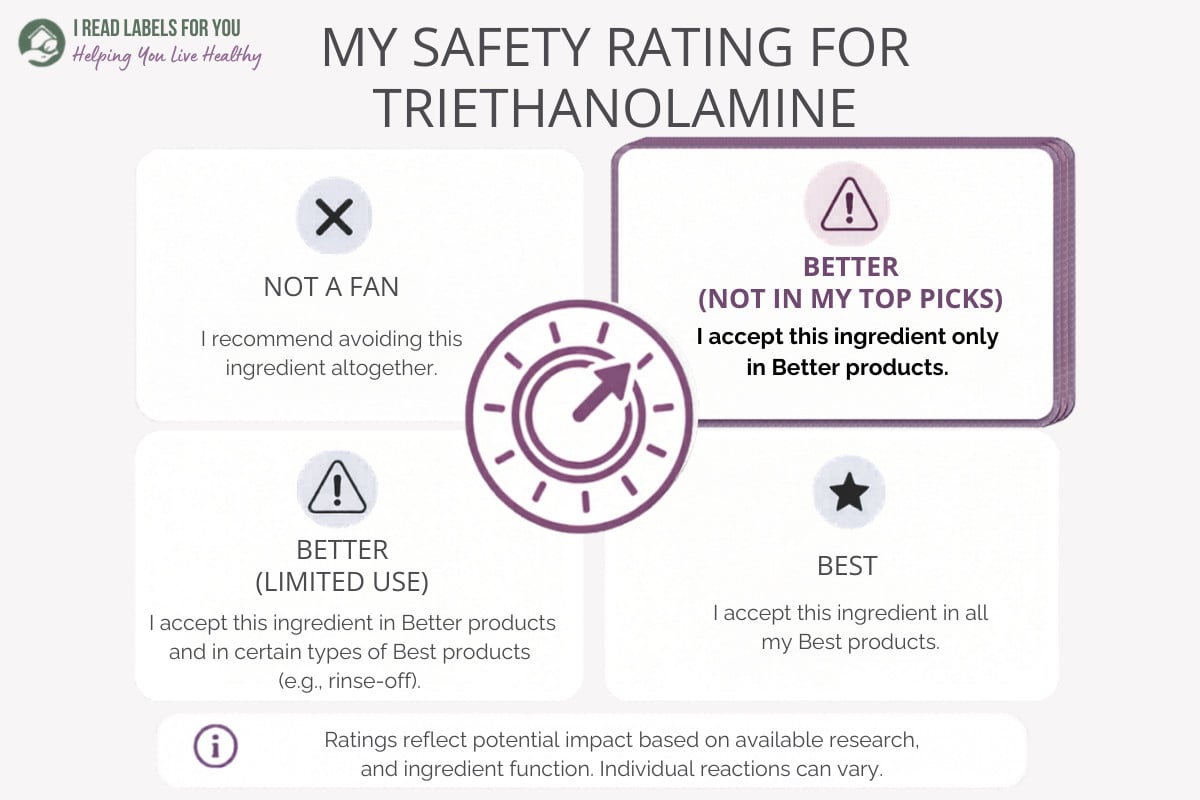
My rating for Triethanolamine is Better (Not In My Top Picks). It moved up my scale rather than down. I expected worse when I started studying it.
The hazard data are genuinely clean. No cancer listing anywhere, negative genotoxicity, and no reproductive effects. Skin absorption measures about half a percent, so Not A Fan would be unfair to the evidence.
Four Reasons TEA Still Misses My Best Picks
First, it’s made from ethylene oxide, a known human carcinogen. I weigh manufacturing footprint, and consistency means applying that here.
Second, the industry panel’s clearance is conditional. It calls Triethanolamine safe when products avoid irritation, hold down free diethanolamine, and cannot form nitroso compounds. A label tells you none of the three.
Third, the United States does not enforce the purity rules that make Europe’s clearance meaningful. No minimum purity, no diethanolamine cap, no nitrosamine limit.
Fourth, exposure adds up. It appeared in 3,756 formulations, including 413 eye-area products and 16 baby products. Another 203 touch mucous membranes at up to 19 percent.
What Should You Do?
For most people, seeing Triethanolamine on a label is no reason to put the product back. It’s a reason to check what sits beside it.
Here’s the rule that actually helps. Avoid Triethanolamine when the label also lists a nitrite or formaldehyde releasing preservative:
- 2-Bromo-2-Nitropropane-1,3-Diol (also called Bronopol)
- DMDM Hydantoin
- Diazolidinyl Urea
- Imidazolidinyl Urea
- Quaternium-15
A European committee named that exact pairing. It reported Triethanolamine stored with bronopol in an alkaline product yielding the nitrosamine over time.
Beyond that pairing, I’d pick products that adjust pH another way. Sodium hydroxide, potassium hydroxide, or arginine all do the same job. On a baby, on broken skin, or near the eyes, I’d take that option every time.
Frequently Asked Questions About Triethanolamine
Is Triethanolamine Safe To Use On The Face?
Yes, at the small amounts used in most facial products. Testing in 85,098 people found allergy in 0.4 percent, and absorption measures under one percent. If your skin barrier is damaged, the alkalinity may still sting.
Is Triethanolamine Carcinogenic?
No. It sits in Group 3 at the International Agency for Research on Cancer, and on no American cancer list. The concern is nitrosamines forming in poorly made products, which Europe limits and America does not.
What Is Another Name For Triethanolamine?
Look for TEA on cosmetic labels, or Trolamine on medicines. Anything starting with TEA, such as Tea-Lauryl Sulfate, is its salt. Its registry number is 102-71-6.
Why Is Triethanolamine In My Shaving Cream?
It reacts with fatty acids such as stearic acid to make a soft soap. That soap produces the thick, creamy lather shaving creams are known for. You’ll often see it listed near stearic acid or TEA-Stearate.
Does Triethanolamine Clog Pores?
Some pore-clogging charts give it a moderate rating. Those charts come from old rabbit ear tests rather than from people. If you’re acne-prone, watch how your skin responds instead of trusting a chart.
What Can I Use Instead Of Triethanolamine?
Brands can adjust pH with sodium hydroxide, potassium hydroxide, arginine or aminomethyl propanol. For you as a shopper, that means this ingredient is easy to avoid. Plenty of gels, lotions, and cleansers are made without Triethanolamine.
Why Does EWG Rate Triethanolamine Differently?
The Environmental Working Group (EWG) scores Triethanolamine 6 out of 10 in Skin Deep. Data quality is rated fair. That moderate score sits close to my own middle-tier rating.
The difference shows in their certification program. EWG marks it Unacceptable, so EWG Verified products cannot contain Triethanolamine at all. That’s stricter than my position.
My reading is that neither of us has the facts wrong. A certification program can exclude anything carrying an open question. I’d rather tell you how big each question is.
Sources
EU SCCS / SCCP Opinions:
SCCS/1458/11, Opinion on Nitrosamines and Secondary Amines in Cosmetic Products, adopted December 13 to 14, 2011, the opinion behind the Annex III entry 62 conditions: SCCS opinions portal
SCCS/1486/12, Opinion on NDELA in Cosmetic Products and Nitrosamines in Balloons, adopted June 26 to 27, 2012, revised September 18, 2012, the source of the market contamination figures: SCCS opinions portal
No SCCS or SCCP opinion exists on Triethanolamine as an individual ingredient (checked).
Cosmetic Ingredient Review (CIR) Reports:
Fiume MM, Heldreth B, Bergfeld WF, et al. Safety Assessment of Triethanolamine and TEA-Containing Ingredients as Used in Cosmetics. International Journal of Toxicology. 2013;32(Suppl 3):59S to 83S. Concluded safe with conditions on irritation, free diethanolamine and nitroso compounds: cir-reports.cir-safety.org
Elder RL, ed. Final Report on the Safety Assessment of Triethanolamine, Diethanolamine, and Monoethanolamine. Journal of the American College of Toxicology. 1983;2(7):183 to 235. Set a 5 percent ceiling for prolonged skin contact: cir-reports.cir-safety.org
European Union Regulatory Databases:
CosIng entry for Triethanolamine, functions listed as buffering, emulsifying surfactant, fragrance and cleansing surfactant: CosIng ingredient record
Annex III, entry 62, Trialkylamines, trialkanolamines and their salts, 2.5 percent in leave-on with purity conditions: CosIng Annex III
Annex II, entry 411, Secondary alkyl- and alkanolamines and their salts, which prohibits diethanolamine, checked; Triethanolamine not listed: CosIng Annex II
CLP Annex VI harmonized classifications, checked across all entries; Triethanolamine has no harmonized classification: ECHA CLP Annex VI
ECHA substance evaluation, concluded December 15, 2015, finding the carcinogenicity, skin sensitization and respiratory sensitization hazards unlikely: ECHA CHEM record
Other Regulators:
U.S. FDA, prohibited and restricted ingredients in cosmetics, checked; Triethanolamine not listed: FDA cosmetics ingredient restrictions
Health Canada Cosmetic Ingredient Hotlist, checked across both tables; Triethanolamine neither prohibited nor restricted: Health Canada Hotlist
Environment Canada, CEPA Schedule 1 List of Toxic Substances, checked; Triethanolamine not listed: CEPA Schedule 1
IARC Monographs Volume 77, 2000, Triethanolamine classified Group 3, not classifiable as to its carcinogenicity to humans: IARC classifications
NTP Report on Carcinogens, Fifteenth Edition, checked; Triethanolamine not listed: NTP Report on Carcinogens
California Proposition 65 list, checked; Triethanolamine not listed, while diethanolamine and N-nitrosodiethanolamine are: Proposition 65 list
PubChem Records (Chemistry, Identifiers, Skin Penetration, Hazard Codes):
Triethanolamine, PubChem CID 7618, molecular weight 149.19, CAS 102-71-6: PubChem CID 7618
Peer-Reviewed Studies:
Lessmann H, Uter W, Schnuch A, Geier J. Skin sensitizing properties of the ethanolamines mono-, di-, and triethanolamine. Data analysis of a multicentre surveillance network (IVDK) and review of the literature. Contact Dermatitis. 2009;60(5):243 to 255. PMID 19397616: PubMed 19397616
Saghir SA, Brzak KA, Markham DA, Bartels MJ, et al. Investigation of the formation of N-nitrosodiethanolamine in B6C3F1 mice following topical administration of triethanolamine. Regulatory Toxicology and Pharmacology. 2005;42(2):175 to 185. PMID 15905009: PubMed 15905009
Knaak JB, Leung HW, Stott WT, Busch J, Bilsky J. Toxicology of mono-, di-, and triethanolamine. Reviews of Environmental Contamination and Toxicology. 1997;149:1 to 86. PMID 8956558: PubMed 8956558
Almeida FT, Caldas R, Pereira T. Allergic contact dermatitis caused by triethanolamine in an ultrasound gel. Contact Dermatitis. 2020;82(1):64 to 65. PMID 31463962: PubMed 31463962
Milanesi N, Berti S, Gola M. Allergic contact dermatitis to triethanolamine in a child. Pediatric Dermatology. 2015;32(3):e112 to e113. PMID 25779610: PubMed 25779610
Weinhammer AP, Scheman A, Reeder MJ. Prevalence of Surfactant in the Contact Allergen Management Program. Dermatitis. 2019;30(6):358 to 362. PMID 31724989: PubMed 31724989
Natural Cosmetic Standards:
COSMOS-standard approved raw materials, checked; Triethanolamine not listed: COSMOS-standard approved raw materials
NATRUE certified and approved raw materials, checked; Triethanolamine not listed: NATRUE certified world
Skin Allergy Resource:
American Contact Dermatitis Society (ACDS), Helpful References including the Core Allergen Series 2020, checked; Triethanolamine not on the panel: ACDS Helpful References
Advocacy groups:
Environmental Working Group (EWG) Skin Deep entry for Triethanolamine, hazard score 6 with data rated fair, and marked Unacceptable for EWG Verified: EWG Skin Deep, Triethanolamine
Last verified: 09-22-2026

Download The Free Guide!
5 Powerful Steps To A Non-Toxic Home
Join our informed consumer community and get our free guide the “5 Powerful Steps To A Non-Toxic Home”.

Before commenting, please read our Comment Policy.