
Are Polyisobutene and Hydrogenated Polyisobutene Safe? A Simple Answer You Can Trust
 Written by Irina Webb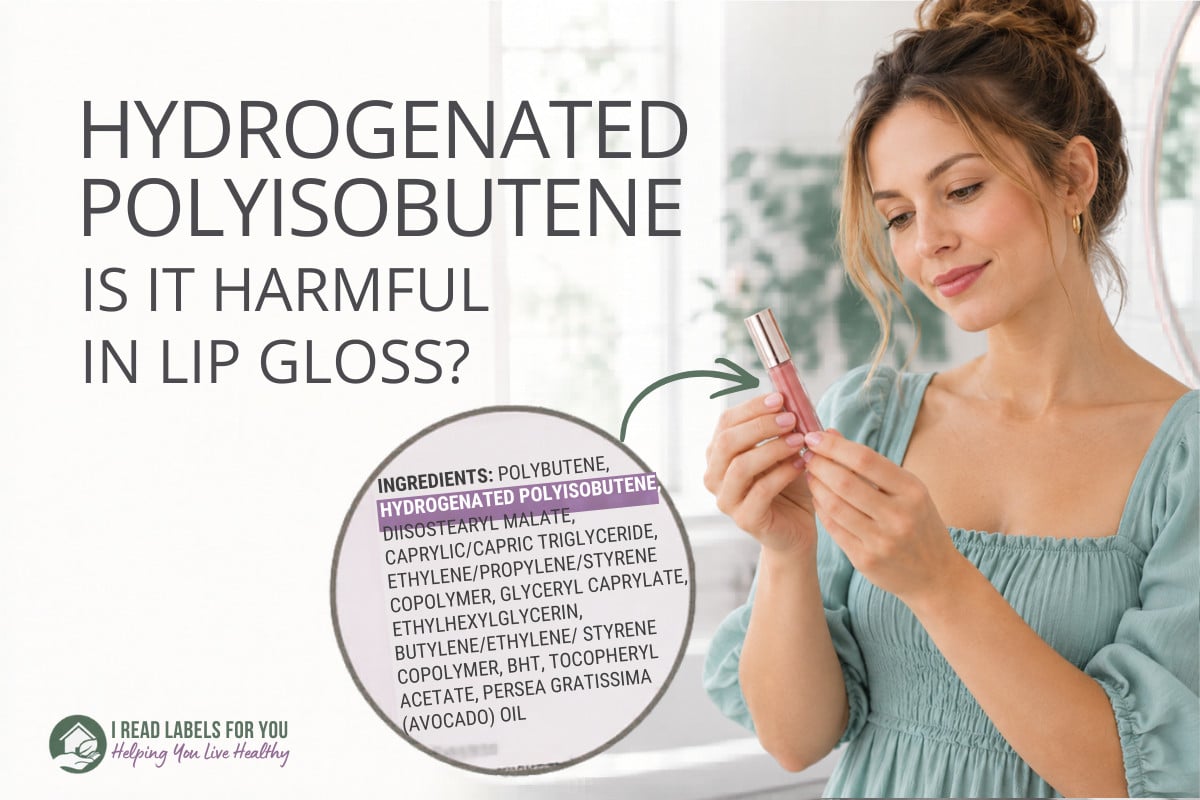
Yes, Polyisobutene and Hydrogenated Polyisobutene are safe on your skin, but I keep them out of lip products. Both are lab-made oils built from isobutylene, a gas from petroleum refining. On skin they rarely irritate and almost never cause allergies, but both get swallowed from lipstick, the hydrogenated one in large amounts. I rate both Better (Limited Use).
Hydrogenated Polyisobutene and Polyisobutene face no limits in the European Union, but nobody in Europe has reviewed them either. They are polymers, a group that Europe’s chemicals law excused from safety testing, and its expert panel for cosmetics has never assessed them.
Keep reading to learn why a lipstick ingredient can end up stored in your body fat, how the two ingredients differ, why size matters, and why Europe holds piles of data on the starting gas and none on the oils.
What Are Polyisobutene And Hydrogenated Polyisobutene?
Both are chains of isobutylene, a small gas molecule that factories separate from petroleum refinery streams. Polyisobutene is the longer chain, a sticky, rubbery material. Hydrogenated Polyisobutene is a short chain with hydrogen added to its last link, which turns it into a clear, odorless oil.
In fact, Hydrogenated Polyisobutene began as a substitute for squalene, an oil that once came mainly from shark liver. The 2008 report of the Cosmetic Ingredient Review (CIR), an industry-funded panel, calls it “a novel synthetic substitute for squalene.”
What Do Polyisobutene And Hydrogenated Polyisobutene Do In Cosmetics?
Hydrogenated Polyisobutene works as an emollient, a softening oil that spreads easily and leaves skin feeling smooth without greasiness. It also thickens oily formulas and adds shine and cushion to lipstick and gloss.
Polyisobutene, by contrast, works as a binder and film former. Its tacky texture helps lipstick and mascara stick and stay put.
Use levels differ sharply. According to the CIR’s 2020 report, Hydrogenated Polyisobutene appeared in 1,963 products, 865 of them lipsticks, at up to 95%. Polyisobutene is used far less, at up to 40% in lip products.
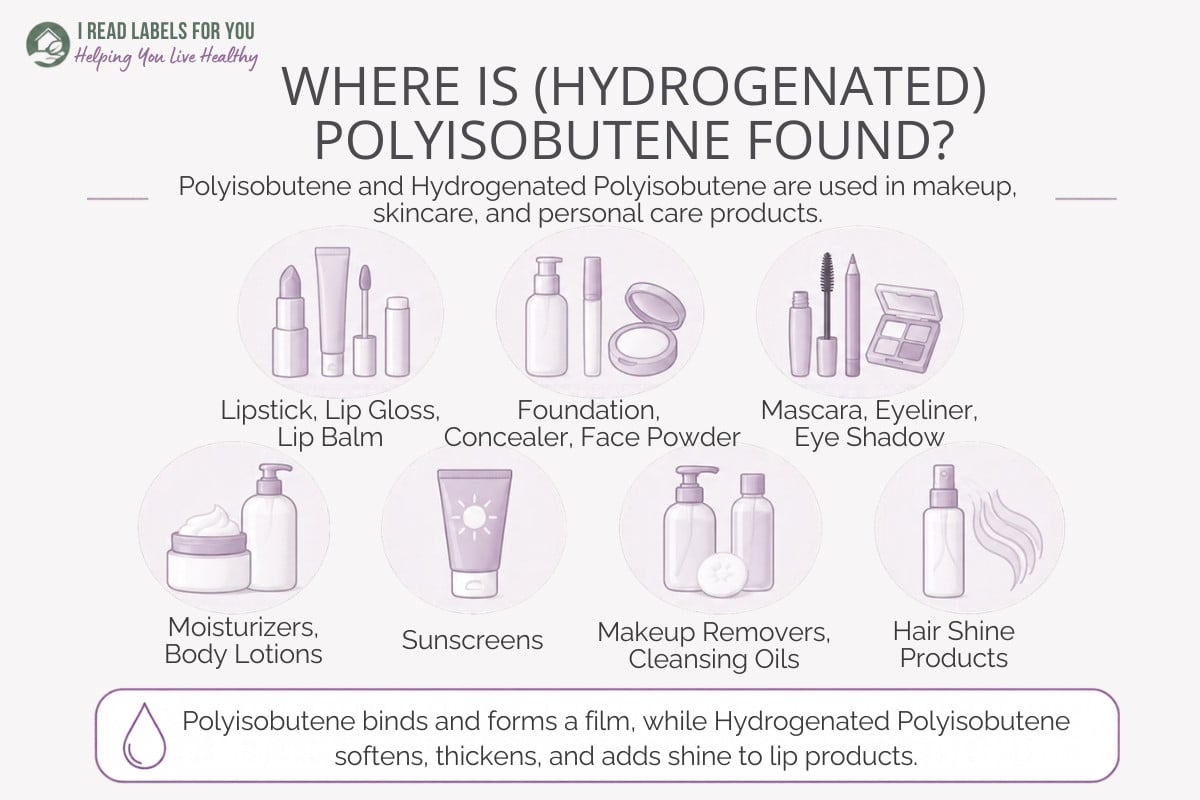
You’ll find these ingredients most often in:
- lipstick, lip gloss, lip balm
- foundation, concealer, face powder
- mascara, eyeliner, eye shadow
- moisturizers, body lotions
- sunscreens
- makeup removers, cleansing oils
- hair shine products
Neither ingredient is added to food in the European Union. In the United States, the Food and Drug Administration (FDA) allows Polyisobutene in chewing gum base. It permits the hydrogenated form only in food packaging materials.
How Are Polyisobutene And Hydrogenated Polyisobutene Made?
Factories link isobutylene molecules into chains at about -100°C, using strong acid catalysts. For Hydrogenated Polyisobutene, makers then add hydrogen, purify the oil and, in one supplier’s words, “super refined” it.
Suppliers quoted by the CIR panel report no detectable leftover isobutylene or solvents. One source notes up to 10 parts per million of hexane, a solvent. Another supplier lists polycyclic aromatic hydrocarbons, the cancer-linked impurities in some mineral oils, among the contaminants absent from its grades.
Two gaps remain. Nobody reports testing for the metal catalyst used in hydrogenation. Also, isobutylene comes from refinery streams that can carry butadiene, a known human carcinogen, though no butadiene test on either finished oil has been published.
Do Polyisobutene And Hydrogenated Polyisobutene Penetrate The Skin?
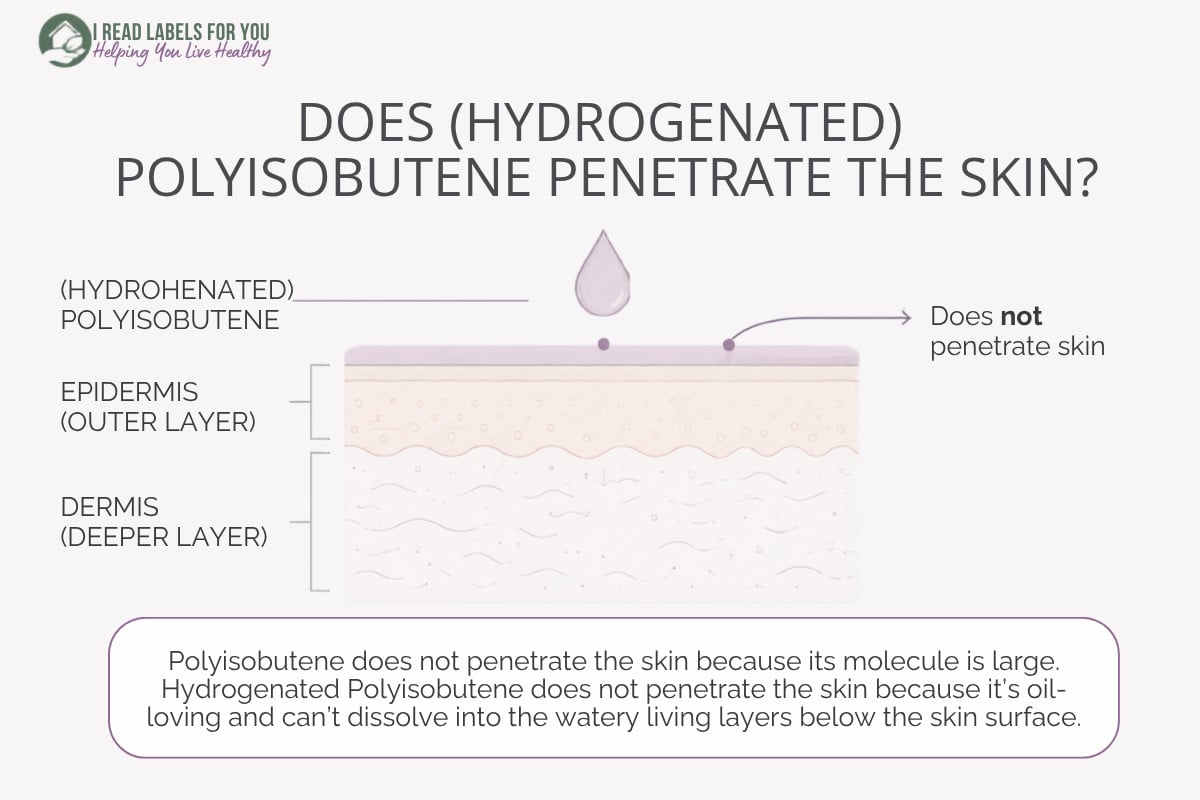
No, neither one is likely to get through healthy skin in meaningful amounts, but for different reasons, and nobody has measured it. Skin usually blocks molecules above about 500 daltons, a unit chemists use for molecule size.
Polyisobutene in cosmetics runs from 654 to 2,168 daltons, so its size alone holds it back. Hydrogenated Polyisobutene averages about 430 daltons, small enough to slip past that size limit.
What stops Hydrogenated Polyisobutene is chemistry. Its LogP, a number showing whether a chemical prefers oil or water, is modeled at about 13, which is extremely oil-loving. It can settle into the skin’s oily surface layer, yet it cannot dissolve into the watery living layers below.
What Are Polyisobutene And Hydrogenated Polyisobutene Called On Labels?
Watch for these names on an ingredient list:
- Hydrogenated Polyisobutene
- Polyisobutene
- Polyisobutylene
- Parleam
- Panalane
- Polysynlane
- Permethyl
Do not confuse these with Isobutane, a propellant gas, or with Squalane from olives or sugarcane. Those are different ingredients.
Does The U.S. FDA Restrict These Ingredients In Food And Cosmetics?
No, neither Polyisobutene nor Hydrogenated Polyisobutene faces FDA limits in cosmetics. The agency’s short roster of prohibited cosmetic chemicals leaves both off, and no FDA sign-off is required before a brand uses them.
That light touch is typical. The FDA restricts only a handful of cosmetic ingredients. For food, it lets companies label many additives Generally Recognized As Safe (GRAS) without a full agency review.
Europe works from the precautionary principle instead, acting on credible warning signs before harm is proven. Yet for these two oils, Europe has had no warning signs to act on, because nobody gathered the data.
EU Regulations On Polyisobutene And Hydrogenated Polyisobutene
Both ingredients are listed in the European Union’s CosIng database as Polyisobutene and Hydrogenated Polyisobutene, with no restrictions. Europe’s cosmetic safety experts, the Scientific Committee on Consumer Safety (SCCS), have never reviewed either one.
Under REACH, Europe’s main chemicals law, companies must test a chemical and file a safety dossier before selling it. Polymers were exempted when the law passed in 2006, and the European Chemicals Agency (ECHA) shows no dossier for either ingredient.
Meanwhile, isobutylene, the starting gas, has 86 dossiers. In 2025, ECHA ordered companies to run two new reproduction and pregnancy studies on it, due in 2029, because its files had none.
A 2025 draft revision of REACH would have required polymers to be registered too. However, the European Commission set that full revision aside in April 2026, leaving the gap open.
Canadian Regulations On Polyisobutene And Hydrogenated Polyisobutene
Canada does not restrict either ingredient. Neither appears on Health Canada’s Cosmetic Ingredient Hotlist, and Environment Canada does not name either one on its toxic substances schedule.
Can Polyisobutene And Hydrogenated Polyisobutene Cause Skin Allergy And Sensitization?
No, Polyisobutene and Hydrogenated Polyisobutene rarely cause skin allergy. Hydrogenated Polyisobutene has unusually strong testing: undiluted, it caused no allergic reactions in 200 people patched repeatedly over several weeks.
Further tests of Hydrogenated Polyisobutene in makeup remover, lip gloss, and face powder also came back negative. It did not react with sunlight either, in tests of phototoxicity and photoallergy.
Polyisobutene has much less data, just one negative test of a 10.5% eye shadow in 28 people. On the other hand, a 1996 case report describes one woman who became allergic to Polyisobutene in her stoma bag adhesive.
Neither ingredient is on the American Contact Dermatitis Society (ACDS) Core Allergen Series, and neither has been the society’s Allergen of the Year.
Are Polyisobutene And Hydrogenated Polyisobutene Hormone (Endocrine) Disruptors?
No, neither ingredient is a known hormone disruptor, but neither has been tested for hormone effects. The CIR panel’s reports include no hormone studies, and a PubMed search found none.
A three-generation rat feeding study found no effects on fertility or litters. Confusingly, the 2008 CIR report credits that study to a related polymer, polybutene, while the 2020 report credits it to Polyisobutene.
Are Polyisobutene And Hydrogenated Polyisobutene Safe To Use While Pregnant?
Probably yes on skin, but no study has looked at pregnancy for either ingredient directly. Neither seems to get through skin in meaningful amounts, and no birth-defect signal appears in the animal data on related polymers.
Lip products deserve more caution, because swallowed hydrocarbons can build up in fat and reach breast milk (see the claims section below). While expecting or nursing, you should consult with your medical provider about lip products in particular. Picking lip products low in both ingredients is a simple step.
Are There Any Cancer Concerns Linked To Polyisobutene And Hydrogenated Polyisobutene?
No, neither ingredient is linked to cancer. Neither appears on the lists of the International Agency for Research on Cancer (IARC), the U.S. National Toxicology Program (NTP) or California’s Proposition 65.
An 18-month mouse study painted a Polyisobutene oil on skin and found no tumors. However, that oil was a small industrial grade, not a cosmetic one. Neither ingredient has had a DNA-damage test of its own; the CIR panel relies on other polymers in the family.
The starting gas has one weak signal. In a 1998 NTP study, male rats breathing very high levels of isobutylene for two years developed more thyroid tumors. Female rats and mice did not.
Are Polyisobutene And Hydrogenated Polyisobutene Bad For The Environment?
Possibly, mainly because both are made from petroleum and are built to resist breaking down. Industry data quoted in the 2008 CIR report say these polymers do not build up in wildlife, because they are so insoluble in water.
Neither ingredient is approved by COSMOS or NATRUE, the two main natural cosmetic standards. In addition, no company has filed European environmental data on either one.
Common Claims About Polyisobutene And Hydrogenated Polyisobutene: What’s True And What’s Not
Claim: Hydrogenated Polyisobutene In Lip Gloss Is Unsafe To Swallow
This claim is partly true. A single swallow does nothing, but daily swallowing adds up. A 2016 study of 175 Swiss lip products warned that some of these hydrocarbons “are strongly accumulated and form granulomas in human tissues.”
The authors recommended that lip products contain “clearly less than 5%” of mineral and synthetic hydrocarbons combined. Hydrogenated Polyisobutene alone reaches 95% in some lipsticks.
In addition, a 2011 study of 142 new mothers linked daily lipstick use with higher levels of mineral oil hydrocarbons in body fat. To be fair, Germany’s Federal Institute for Risk Assessment concluded that lip products made to industry guidelines should not harm health.
Claim: Hydrogenated Polyisobutene In Skin Care Is Harmful
This claim is false for skin. It’s one of the best-tested emollients in cosmetics, with clean results even when applied undiluted in repeated patch tests. Its oil-loving chemistry keeps it in the outer skin layer.
Claim: Hydrogenated Polyisobutene Is Comedogenic
This claim is unproven. The only test used three rabbit ears. Two showed some surface thickening after three weeks, but the microscope found no clogged follicles.
Even the label is unclear: the 2008 CIR report credits that test to Hydrogenated Polyisobutene in one place and to Polyisobutene in another. No human acne study exists.
What I Think About These Ingredients — And What You Should Do
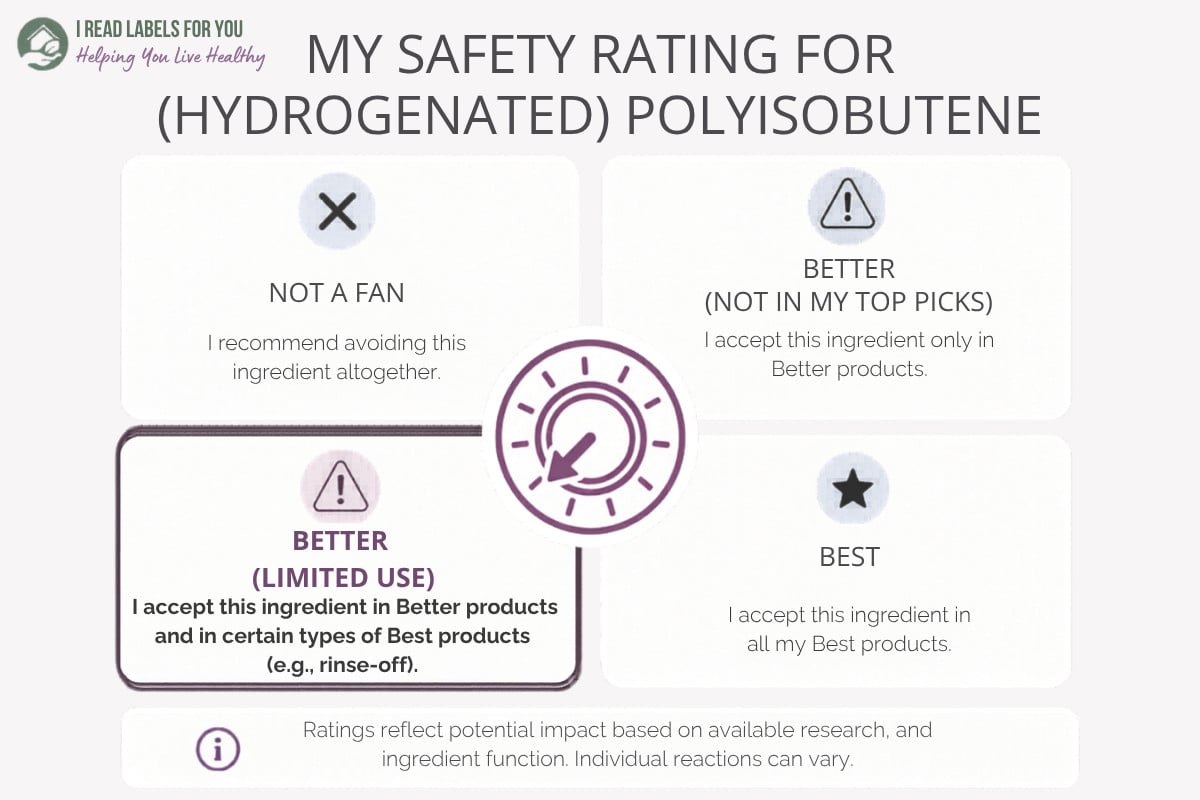
I rate Polyisobutene and Hydrogenated Polyisobutene Better (Limited Use). I accept both in my Best skin care, makeup, and hair products, but I keep them out of lip products.
On skin, Hydrogenated Polyisobutene has a stronger safety record than most ingredients I review. My concern is lipstick, where it reaches 95% and much of it ends up swallowed. Combined with research showing that similar hydrocarbons build up in the body, that’s reason enough to keep it off my lips.
Polyisobutene is larger and used less in lip products, at up to 40%. Still, its smallest grades may be close in size to hydrocarbons that build up in the body, and no study has checked. So it gets the same lip caveat.
Here’s what I suggest:
- check lipstick, gloss, and balm labels for Hydrogenated Polyisobutene or Polyisobutene near the top of the list
- choose lip products built on plant butters, plant oils, and waxes instead
- keep using skin care and foundation with either ingredient if you like how they feel
Frequently Asked Questions About Polyisobutene And Hydrogenated Polyisobutene
Is Hydrogenated Polyisobutene A Silicone?
No. It’s a hydrocarbon, made only of carbon and hydrogen, while silicones contain silicon and oxygen. Brands often use it in silicone-free formulas because it gives a similar smooth feel.
Is Hydrogenated Polyisobutene A Microplastic?
Probably not under European law. Europe’s microplastics rule covers solid plastic particles, and Hydrogenated Polyisobutene is a liquid oil dissolved in the formula. No regulator has ruled on it by name, though.
What Is A Natural Alternative To Hydrogenated Polyisobutene?
Plant-derived squalane, usually made from olives or sugarcane, is the closest match in feel. Jojoba oil and plant butters also work well, especially in lip products.
Is Polyisobutene The Same As Hydrogenated Polyisobutene?
No. They share the same building block, but Polyisobutene is a longer, stickier chain with one reactive end. Hydrogenated Polyisobutene is a shorter, fully saturated oil, less than half the size.
Why Does EWG Rate Hydrogenated Polyisobutene Differently?
The Environmental Working Group (EWG) gives Hydrogenated Polyisobutene its lowest hazard score, 1. I agree it’s safe on skin, but EWG’s score does not account for how much is swallowed from lipstick.
Sources
EU SCCS / SCCP Opinions:
No SCCS or SCCP opinion on Hydrogenated Polyisobutene or Polyisobutene (checked). SCCS opinions portal: SCCS opinions
Cosmetic Ingredient Review (CIR) Reports:
Cosmetic Ingredient Review Expert Panel (McLain VC, ed.), 2008. Final Report on the Safety Assessment of Polyisobutene and Hydrogenated Polyisobutene as Used in Cosmetics. International Journal of Toxicology 27(Suppl 4):83 to 106. Funded by the Personal Care Products Council. PMID 19101833: PubMed 19101833; CIR database: cir-reports.cir-safety.org
Burnett CL, Bergfeld WF, Belsito DV, et al., 2020. Safety Assessment of Polyene Group as Used in Cosmetics. International Journal of Toxicology 39(Suppl 2):59S to 90S: DOI 10.1177/1091581820952385
European Union Regulatory Databases:
CosIng entry 79008, POLYISOBUTENE, CAS 9003-27-4, no annex restrictions: CosIng 79008
The CosIng entry 76643, HYDROGENATED POLYISOBUTENE, CAS 40921-86-6 / 61693-08-1 (CIR uses 68937-10-0), no annex restrictions: CosIng 76643
CosIng Annexes II to VI (2026 versions), checked; neither ingredient listed. CLP Annex VI harmonized classification table (2026), checked; neither polymer classified: CosIng
ECHA CHEM, polyisobutene, EC 618-360-8. No REACH registration (polymer), not classified: ECHA CHEM
ECHA CHEM, hydrogenated polyisobutene / polybutene, hydrogenated, EC 614-821-2. No REACH registration, not classified: ECHA CHEM
ECHA CHEM, isobutylene (2-methylpropene), EC 204-066-3. REACH-registered; testing decision of May 15, 2025 requiring reproductive studies by August 20, 2029: ECHA CHEM activities
Trade press on the European Commission setting aside the full REACH revision, April 2026: National Law Review
Other Regulators:
U.S. FDA, prohibited and restricted cosmetic ingredients. Neither listed: FDA
U.S. FDA, 21 CFR 172.615, chewing gum base (polyisobutylene): eCFR 172.615; 21 CFR 178.3740 (hydrogenated polybutene in food-contact materials): eCFR 178.3740
Health Canada Cosmetic Ingredient Hotlist. Neither listed: Health Canada Hotlist
Environment Canada, CEPA Schedule 1. Neither listed: CEPA Schedule 1
International Agency for Research on Cancer (IARC). Neither ingredient nor isobutylene classified: IARC list
U.S. National Toxicology Program, Report on Carcinogens. Not listed: NTP Report on Carcinogens
California Proposition 65 list. Not listed: OEHHA
U.S. EPA Integrated Risk Information System. No assessment: IRIS A to Z list
German Federal Institute for Risk Assessment (BfR), opinion on highly refined mineral oils in cosmetics: BfR
PubChem Records (Chemistry, Identifiers, Skin Penetration, Hazard Codes):
Polyisobutylene, PubChem reference record (no CID), CAS 9003-27-4: PubChem polyisobutylene
Hydrogenated Polyisobutene, PubChem reference record (no CID), CAS 68937-10-0: PubChem hydrogenated polyisobutene
Isobutylene, PubChem CID 8255, CAS 115-11-7: PubChem CID 8255
Peer-Reviewed Studies:
Niederer M, Stebler T, Grob K, 2016. Mineral oil and synthetic hydrocarbons in cosmetic lip products. International Journal of Cosmetic Science. PMID 26352930: PubMed 26352930
Concin N, et al., 2011. Evidence for cosmetics as a source of mineral oil contamination in women. Journal of Women’s Health 20(11):1713 to 1719. PMID 21970597: PubMed 21970597
Parslew R, et al., 1996. Allergic contact dermatitis from polyisobutylene in stoma bags. Contact Dermatitis. PMID 8930483: PubMed 8930483
National Toxicology Program, 1998. Toxicology and carcinogenesis studies of isobutene in F344/N rats and B6C3F1 mice (inhalation studies), TR-487. PMID 12563344: PubMed 12563344
Natural Cosmetic Standards:
COSMOS-standard approved raw materials. Neither ingredient listed: COSMOS-standard approved raw materials
NATRUE certified and approved raw materials. Neither ingredient listed: NATRUE certified raw materials
Skin Allergy Resource:
American Contact Dermatitis Society (ACDS), Helpful References, including the Core Allergen Series 2020. Neither ingredient is on the series or has been Allergen of the Year: ACDS Helpful References
Advocacy groups:
Environmental Working Group (EWG) Skin Deep entry for Hydrogenated Polyisobutene. Hazard score 1, data limited: EWG Skin Deep
Environmental Working Group (EWG) Skin Deep entry for Polyisobutene. Hazard score 1, data limited: EWG Skin Deep
Last verified: 10-11-2026
Download The Free Guide!
5 Powerful Steps To A Non-Toxic Home
Join our informed consumer community and get our free guide the “5 Powerful Steps To A Non-Toxic Home”.

Before commenting, please read our Comment Policy.