
Is Zinc Oxide Safe? A Simple Answer You Can Trust
 Written by Irina Webb
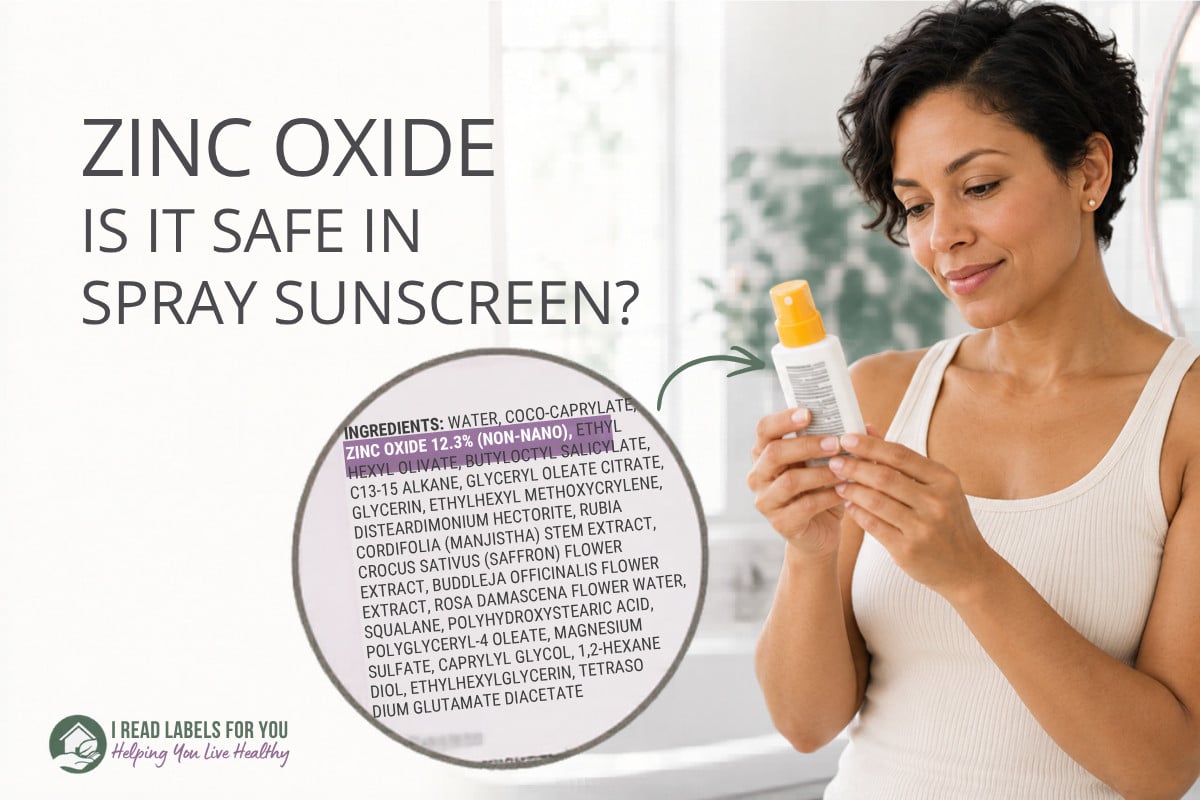
Yes, Zinc Oxide is safe on your skin, but I keep it out of loose powders and sprays you might breathe in. It’s a white mineral powder that blocks UV rays, colors makeup and soothes diaper rash, without entering skin or causing allergies. My rating is Better (Limited Use).
Zinc Oxide is approved in the European Union as a sunscreen filter at up to 25%, in both regular and nano sizes. However, Europe bars every use that may reach your lungs, because inhaled particles inflamed the lungs in animal tests. The U.S. Food and Drug Administration (FDA) approves it as a sunscreen active and a color additive, with no such limit.
Keep reading to learn:
- how much zinc from sunscreen actually reaches your blood
- why “reef safe” on a mineral sunscreen deserves a second look
- which makeup and sunscreen formats I choose, and which ones I skip
What Is Zinc Oxide?
Zinc Oxide is a white mineral made of zinc and oxygen, with the formula ZnO. In nature it occurs as a rare ore called zincite, but nearly all cosmetic grades are made in factories. It barely dissolves in water, which shapes how it behaves on your skin.
Size matters for this ingredient. Regular, or pigment-grade, particles are larger than 100 nanometers, while nano grades are smaller. One nanometer equals a billionth of a meter, so neither size is visible to the eye.
What Does Zinc Oxide Do In Cosmetics?
First, Zinc Oxide is a mineral sunscreen filter. It blocks both UVA rays, which age the skin, and UVB rays, which burn it. Unlike many chemical filters, it stays stable in sunlight.
Second, Zinc Oxide works as a white colorant, labeled CI 77947, that brightens and evens out foundation and powder. Third, it forms a protective layer over irritated skin, which is why doctors have used zinc pastes for diaper rash for generations.
In addition, Zinc Oxide has a life outside cosmetics. The FDA lists it as a nutrient generally recognized as safe in food. Europe also allows it in food supplements as a source of zinc.
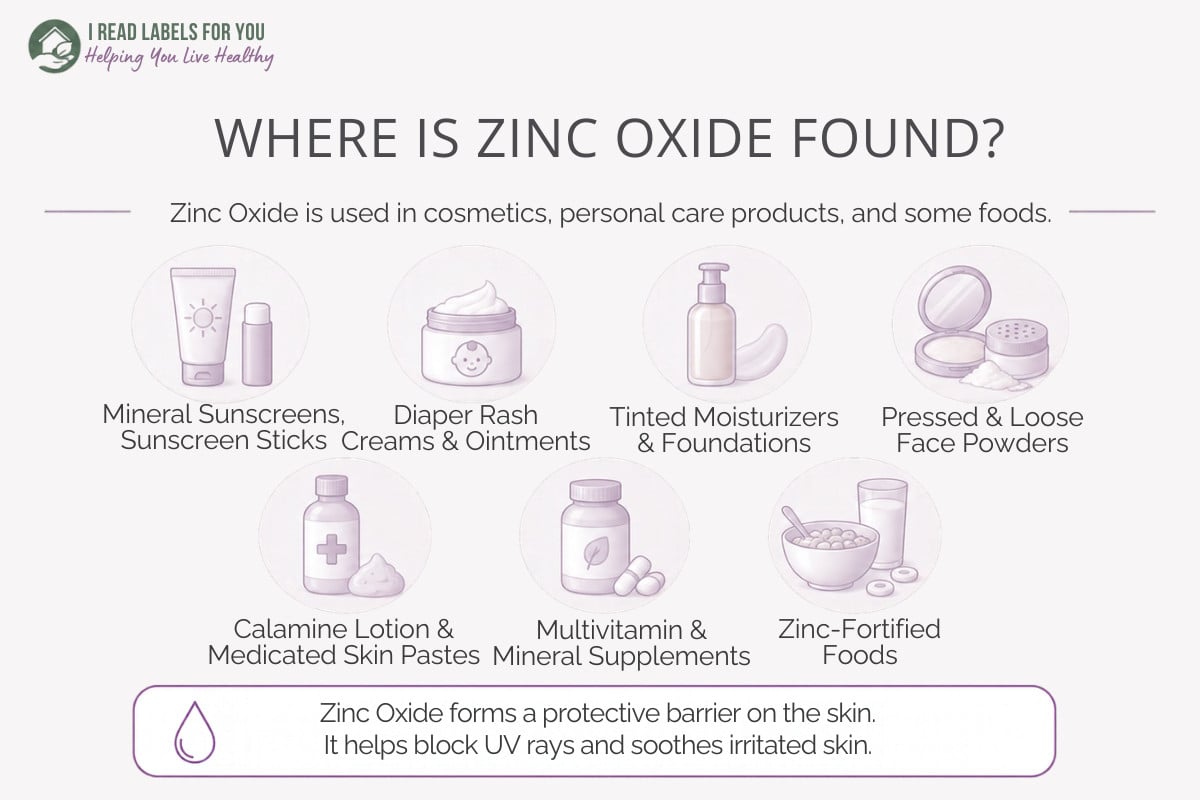
You’ll find Zinc Oxide most often in:
- mineral sunscreens and sunscreen sticks
- diaper rash creams and ointments
- tinted moisturizers and foundations
- pressed and loose face powders
- calamine lotion and medicated skin pastes
- multivitamin and mineral supplements
- zinc-fortified foods
How Is Zinc Oxide Made?
Factories make Zinc Oxide in three main ways, according to PubChem. In the French process, they boil zinc metal and burn the vapor in air. In the American process, they heat zinc ore with coal, then burn the zinc vapor that escapes.
The third route, the wet process, starts with a zinc salt dissolved in water. Workers turn it into a solid, then heat that solid until only Zinc Oxide remains. Nano grades come from similar wet chemical or high-heat methods.
Because zinc ore often travels with lead and cadmium, metal leftovers are the main purity question. PubChem notes that some technical grades contain “a few tenths of a percent lead.” Cosmetic grades are far purer, as the FDA limits below show.
Does Zinc Oxide Penetrate The Skin?
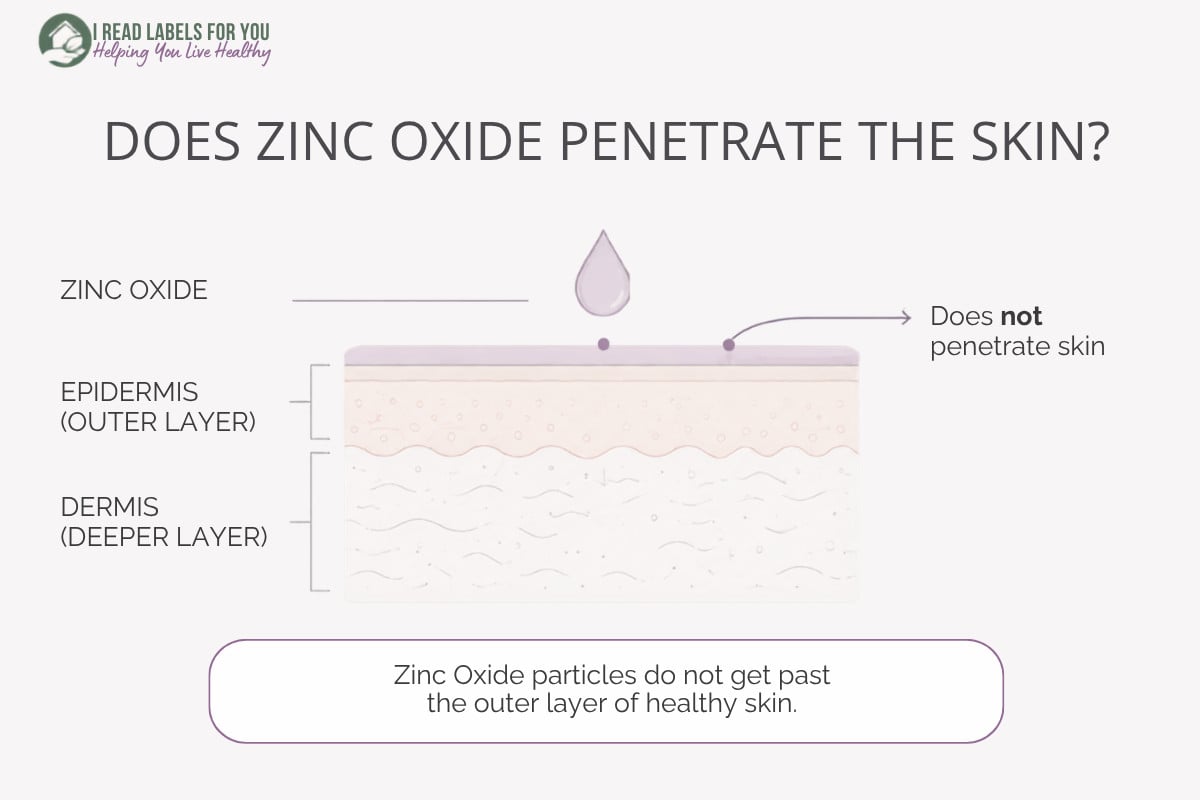
No, Zinc Oxide particles do not get past the outer layer of healthy skin. Here, particle size and its refusal to dissolve matter far more than molecule weight. The usual 500-dalton rule, where smaller molecules slip through, applies to dissolved chemicals, not solid mineral grains.
In a 2019 study of volunteers in Australia, people applied nano Zinc Oxide for five days. The particles collected on the surface and in skin creases but never entered the living skin cells beneath.
A tiny amount of dissolved zinc does get through, though, from both nano and regular particles. In a 2010 Australian beach study of 20 people, both sunscreen types raised blood tracer zinc to about one-thousandth of the zinc already there. Europe’s safety committee estimates at most 0.03% passes through, a figure measured with nano grades and applied to regular grades too.
What Is Zinc Oxide Called On Labels?
Watch for these names when you scan a label:
- Zinc Oxide
- Zinc Oxide (Nano)
- CI 77947
- Non-Nano Zinc Oxide
- Zinc White
- CI Pigment White 4
European law requires the word “nano” in brackets after any nano ingredient. U.S. labels have no such rule, so an American product may contain nano Zinc Oxide without saying so.
Does The U.S. FDA Restrict Zinc Oxide In Food And Cosmetics?
Yes, but only lightly. The FDA approves Zinc Oxide as a color additive for cosmetics, including eye makeup, with no batch testing required. Its purity rules cap lead at 20 parts per million, cadmium at 15, arsenic at 3 and mercury at 1.
For sunscreens, the FDA allows Zinc Oxide at up to 25%. In 2021, the agency proposed calling it generally recognized as safe and effective, but it has not finalized that step for Zinc Oxide. Notably, the FDA has no rule like Europe’s against using it in sprays.
EU Regulations On Zinc Oxide
The European Union lists Zinc Oxide three times in its cosmetic rules. As a UV filter, regular and nano forms together may reach 25% of a product. As a colorant, it has no upper limit.
However, all three entries carry the same warning: not for uses “that may lead to exposure of the end-user’s lungs by inhalation.” In practice, that rules out Zinc Oxide in sprays and in powders likely to be breathed in.
Nano grades face extra rules. They must be at least 96% pure and dissolve in water at less than 50 milligrams per liter. Moreover, half the particles must exceed 30 nanometers, and 99% must exceed 20.
Europe also limits nano grades to four coatings: triethoxycaprylylsilane, dimethicone, dimethoxydiphenylsilane/triethoxycaprylylsilane crosspolymer, and octyl triethoxy silane. All four are silicon-based ingredients that wrap each particle in a thin film.
Coatings have a practical job. When sunlight hits bare Zinc Oxide, it can form reactive oxygen molecules that stress cells in lab dishes. A 2011 review found that coatings reduce this reaction but cannot stop it completely, and silica coatings worked best.
On your skin, this matters far less, because the particles stay in the outer layers of dead skin cells, as the cancer section below explains. Notably, uncoated nano particles were also the ones that bleached corals in the 2018 lab study described below.
Europe’s Scientific Committee on Consumer Safety (SCCS) shaped these rules in 2012 and 2014. It found Zinc Oxide safe on skin up to 25% but concluded that “the use of ZnO nanoparticles in spray products cannot be considered safe.”
U.S. And EU Disagreements On Zinc Oxide
The biggest gap is breathing it in. Europe bars Zinc Oxide from sprays and products that may reach the lungs, while the FDA sets no such limit. As a result, spray mineral sunscreens can be sold in the U.S.
In addition, Germany is still reviewing nano Zinc Oxide under Europe’s chemical safety law. In 2019, the European Chemicals Agency asked companies for a 90-day inhalation study and a gene-damage test, and results are not yet public.
Canadian Regulations On Zinc Oxide
Canada does not restrict Zinc Oxide in cosmetics. Its name does not appear on the Cosmetic Ingredient Hotlist, where Health Canada names banned and limited cosmetic ingredients.
Likewise, Environment Canada has not added Zinc Oxide itself to Schedule 1, the country’s list of toxic substances. The only related listing covers metal-laden particles released from zinc plants, an industrial pollution concern rather than a cosmetic one.
Can Zinc Oxide Cause Skin Allergy And Sensitization?
No, Zinc Oxide does not cause skin allergy in most people, and true allergic reactions to it are essentially unreported. A 2023 review in the journal Dermatitis states, “There are no reports of ACD or PACD to the inorganic (physical) UV filters.”
Here, ACD means allergic contact dermatitis, and PACD means the same reaction triggered by sunlight. Furthermore, in a repeat patch test reviewed by the SCCS, none of 50 volunteers reacted to Zinc Oxide at 25%.
Dermatologists do not patch test for it in the American Contact Dermatitis Society (ACDS) Core Allergen Series. Nor has the society ever picked it as its yearly featured allergen. When people react to a zinc cream, the culprit is usually another ingredient, such as an emulsifier or rosin.
Is Zinc Oxide A Hormone (Endocrine) Disruptor?
No, Zinc Oxide is not a known hormone disruptor. None of the five European safety opinions on zinc compounds mentions hormone effects, and Europe has never screened it as a suspected disruptor.
Some laboratory papers report hormone or fertility changes in animals, but only with nano Zinc Oxide injected or fed at very high doses. Those routes have little to do with a cream that stays on the skin’s surface.
Is Zinc Oxide Safe To Use While Pregnant?
Yes, Zinc Oxide is safe to use on your skin during pregnancy, because so little zinc gets through. Zinc is also an essential nutrient that a growing baby needs.
In a 2014 study in pregnant hairless mice, tracer zinc from sunscreen reached the fetal liver. Yet total zinc levels did not change, and no harm appeared. Separately, Europe’s upper limit for zinc is 25 milligrams a day for adults, and the SCCS applies it during pregnancy too.
As a precaution, choose creams and lotions over sprays and loose powders while expecting. When pregnant or nursing, you should consult with your medical provider before any change to your skin care.
Are There Any Cancer Concerns Linked To Zinc Oxide?
No, Zinc Oxide carries no known cancer risk for people. California’s Proposition 65, the U.S. National Toxicology Program and the International Agency for Research on Cancer (IARC) all leave it off their lists.
In lab dishes, though, nano Zinc Oxide damaged chromosomes, with or without ultraviolet light. Even so, the SCCS judged the risk “negligible” on skin, because the particles do not reach living cells.
Likewise, a 2017 Korean risk assessment concluded that “ZnO displayed no carcinogenic potential, and skin penetration is low.”
Is Zinc Oxide Bad For The Environment?
Yes, Zinc Oxide can harm water life. Europe officially labels it very toxic to fish and other water life, with harm that lasts, and that is its only official hazard label.
Coral reefs are a particular worry. In a 2018 lab study from Italy, uncoated nano Zinc Oxide caused “severe and fast coral bleaching” in branching corals. By contrast, two modified titanium dioxide grades caused no bleaching.
On the plus side, both COSMOS and NATRUE, two leading natural cosmetic standards, approve dozens of Zinc Oxide materials. Still, mining and smelting zinc ore leave a sizable industrial footprint.
Common Claims About Zinc Oxide: What’s True And What’s Not
Claim: Avoid Nano Zinc Oxide Because It Penetrates The Skin
This claim is mostly false for healthy skin. In the 2019 volunteer study, nano particles stayed on the surface and in skin creases. Likewise, the SCCS saw no meaningful difference between damaged and healthy skin.
Still, the science is not unanimous. The 2011 review notes that nano particles were occasionally found in living skin layers, especially with Zinc Oxide and long-term use. The stronger reason to skip nano Zinc Oxide is a spray, where you can breathe it in.
Claim: Nano Zinc Oxide Gets Into Your Bloodstream
This claim is partly true. The particles themselves stay on the skin, but a trace of dissolved zinc does reach the blood, as the 2010 beach study showed.
In context, the amount is tiny. Your blood already holds about 12 milligrams of zinc, while the heaviest absorbers in that study took in roughly 0.03 milligrams. In fact, the bulk-grade sunscreen behaved much like the nano one.
Claim: Zinc Oxide Sunscreen Is Reef Safe
This claim is not proven. “Reef safe” is a marketing phrase with no legal definition in the U.S. Moreover, the 2018 coral study found uncoated nano Zinc Oxide bleached corals quickly.
Granted, that was a tank experiment at a single dose, not a test in the open ocean. Even so, a mineral label alone does not guarantee a sunscreen is gentle on reefs.
Claim: Zinc Oxide Mineral Powder Is The Cleanest Makeup Choice
This claim is half true. On the skin, Zinc Oxide is one of the mildest ingredients I review. However, loose mineral powder sends fine dust into the air you breathe.
That is the kind of use Europe bars. Therefore, a pressed powder or liquid foundation gives you the same mineral benefits without the dust.
What I Think About Zinc Oxide — And What You Should Do
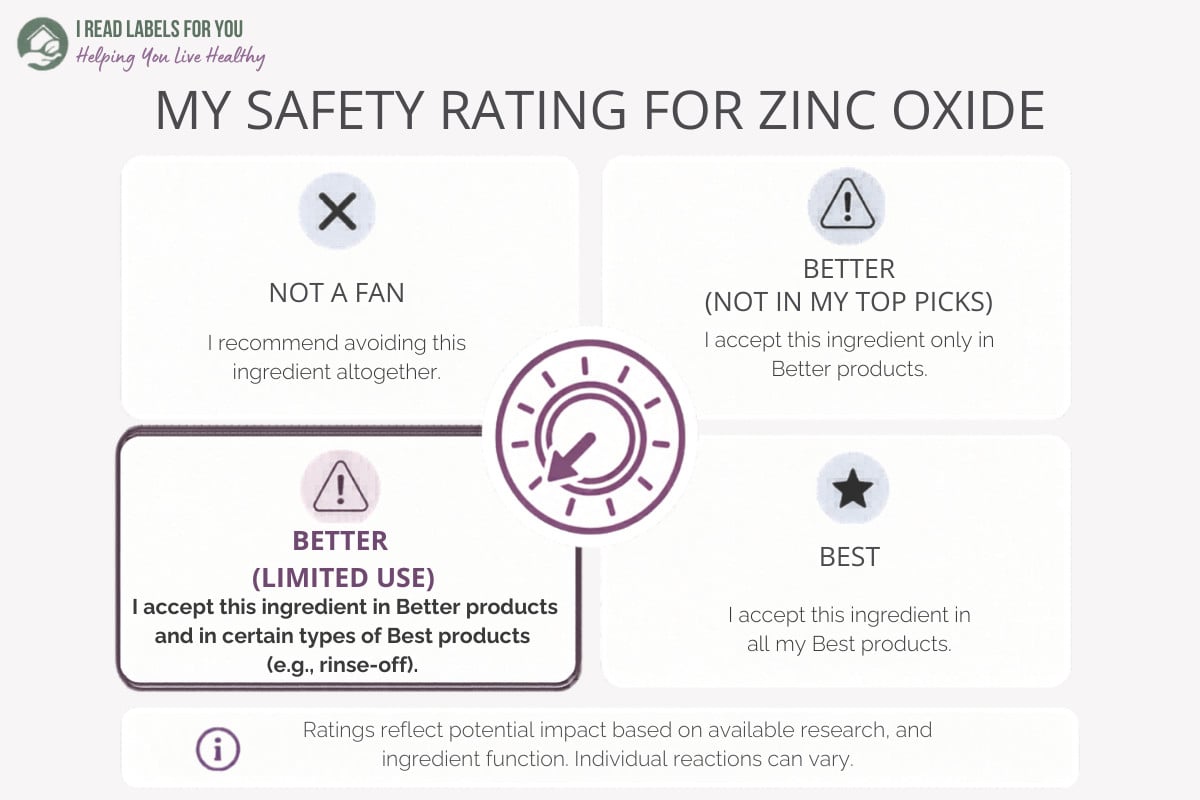
I rate Zinc Oxide Better (Limited Use). Happily, it belongs in creams, lotions, sunscreen lotions and sticks, diaper creams, and pressed or liquid makeup. Only loose powders and sprays stay off my list.
On skin, its record is excellent: it stays on the surface, it’s not an allergen, and no agency links it to cancer. My single concern is your lungs, which is the same line I draw for titanium dioxide.
Here’s what I suggest:
- choose sunscreen lotions and sticks over aerosol or pump sprays
- pick pressed powders and liquid foundations instead of loose mineral powders
- keep using zinc diaper creams, a format with a long and safe record
Frequently Asked Questions About Zinc Oxide
Is Nano Zinc Oxide Safe?
On intact skin, yes. Studies show nano particles stay in the outer layer, and Europe approves nano Zinc Oxide up to 25% under strict size and purity rules. The main exception is inhalation, which is why Europe bars nano Zinc Oxide from sprays.
Is Zinc Oxide Safe For Babies?
Yes, in creams and ointments. Zinc diaper creams have a long safety record, and the FDA approves Zinc Oxide as a skin protectant. Avoid sprays and loose powders near a baby’s face, where tiny lungs could breathe in the dust.
Should Diaper Creams Use Non-Nano Zinc Oxide?
I prefer non-nano in diaper creams, although the evidence does not demand it. The SCCS saw little difference between damaged and healthy skin, and both particle sizes behaved alike in the beach study.
Still, diaper skin is a worst case: often irritated, covered by a diaper and on a tiny body. The SCCS assessed nano grades for sunscreens, not for daily use under a diaper.
Nano particles only make Zinc Oxide look clear, which a diaper cream does not need. Consequently, choosing non-nano costs you nothing, and many brands state it on the label.
Is Zinc Oxide The Same As Titanium Dioxide?
No, they are different minerals, though both are mineral sunscreen filters. Zinc Oxide covers more of the long UVA range, while titanium dioxide is stronger against UVB. I rate both Better (Limited Use) for the same reason: breathing in the powder.
Sources
EU SCCS / SCCP Opinions:
SCCS/1489/12, Opinion on Zinc oxide (nano form), COLIPA S 76, adopted September 18, 2012, revised December 11, 2012. Safe on skin up to 25%; not safe in sprays; dermal absorption 0.03%, margin of safety 7.4: SCCS/1489/12
SCCS/1518/13, Revision of the Addendum to the Opinion SCCS/1489/12 on Zinc oxide (nano form), revised April 22, 2014. Nano specifications; lung concerns remain: SCCS/1518/13
SCCS/1539/14, Opinion for clarification of the meaning of the term “sprayable applications/products” for nano Carbon Black, Titanium Oxide and Zinc Oxide, second revision June 25, 2015: SCCS/1539/14
SCCP/1215/09, Clarification on Opinion SCCNFP/0932/05 on Zinc oxide, adopted January 21, 2009. Non-nano Zinc Oxide considered safe: SCCP/1215/09
SCCS/1657/23, Opinion on water-soluble zinc salts used in oral hygiene products, Submission II, adopted October 26, 2023. Zinc upper intake limit of 25 mg a day for adults, including in pregnancy: SCCS/1657/23
Cosmetic Ingredient Review (CIR) Reports:
No CIR report on Zinc Oxide found (checked): cir-reports.cir-safety.org
European Union Regulatory Databases:
CosIng entry 38968, ZINC OXIDE, functions include UV filter, colorant, bulking and skin protecting: CosIng 38968
CosIng Annex VI, entry 30, Zinc oxide, UV filter up to 25%, not for applications that may reach the lungs: Annex VI/30
The CosIng Annex VI, entry 30a, Zinc oxide (nano), with purity, size, solubility and coating conditions: Annex VI/30a
CosIng Annex IV, entry 144, Zinc oxide (CI 77947), colorant, not for applications that may reach the lungs: Annex IV/144
CosIng Annexes II, III and V (2026 versions), checked; not listed. CLP Annex VI harmonized classification, index 030-013-00-7, Aquatic Acute 1 and Aquatic Chronic 1 only: ECHA CHEM
ECHA CHEM, EC 215-222-5. REACH-registered; ongoing substance evaluation and compliance checks on nanoforms: ECHA CHEM activities
Other Regulators:
U.S. FDA, prohibited and restricted cosmetic ingredients. Not listed: FDA
U.S. FDA, 21 CFR 73.2991, Zinc Oxide as a cosmetic color additive, including the eye area: eCFR 73.2991
U.S. FDA, 21 CFR 73.1991, Zinc Oxide purity specifications (lead, cadmium, arsenic, mercury): eCFR 73.1991
U.S. FDA, 21 CFR 182.8991, Zinc Oxide generally recognized as safe as a nutrient: eCFR 182.8991
Health Canada Cosmetic Ingredient Hotlist. Not listed: Health Canada Hotlist
Environment Canada, CEPA Schedule 1. Zinc Oxide not listed; only particulate emissions from zinc plants listed: CEPA Schedule 1
International Agency for Research on Cancer (IARC). Not classified: IARC list
U.S. National Toxicology Program, Report on Carcinogens. Not listed: NTP Report on Carcinogens
California Proposition 65 list. Not listed: OEHHA
U.S. EPA Integrated Risk Information System, Zinc and Compounds. Inadequate information to assess cancer: IRIS A to Z list
PubChem Records (Chemistry, Identifiers, Skin Penetration, Hazard Codes):
Zinc Oxide, PubChem CID 3007857, CAS 1314-13-2. Manufacturing methods, solubility and hazard codes: PubChem CID 3007857
Peer-Reviewed Studies:
Gulson B, McCall M, Korsch M, et al., 2010. Small amounts of zinc from zinc oxide particles in sunscreens applied outdoors are absorbed through human skin. Toxicological Sciences 118(1):140 to 149. Reviewed in SCCS/1489/12. PMID 20705894: PubMed 20705894
Mohammed YH, Holmes A, Haridass IN, et al., 2019. Support for the safe use of zinc oxide nanoparticle sunscreens: lack of skin penetration or cellular toxicity after repeated application in volunteers. Journal of Investigative Dermatology 139(2):308 to 315. Free full text. PMID 30448212: PubMed 30448212
Osmond-McLeod MJ, Oytam Y, Kirby JK, et al., 2014. Dermal absorption and short-term biological impact in hairless mice from sunscreens containing zinc oxide nano- or larger particles. Nanotoxicology 8(Suppl 1):72 to 84. Free full text. PMID 24266363: PubMed 24266363
Ekstein SF, Hylwa S, 2023. Sunscreens: a review of UV filters and their allergic potential. Dermatitis 34(3):176 to 190. Abstract-only exception. PMID 36279254: PubMed 36279254
Kim KB, Kim YW, Lim SK, et al., 2017. Risk assessment of zinc oxide, a cosmetic ingredient used as a UV filter of sunscreens. Journal of Toxicology and Environmental Health, Part B 20(3):155 to 182. Abstract-only exception. PMID 28509652: PubMed 28509652
Corinaldesi C, Marcellini F, Nepote E, Damiani E, Danovaro R, 2018. Impact of inorganic UV filters contained in sunscreen products on tropical stony corals (Acropora spp.). Science of the Total Environment 637 to 638:1279 to 1285. Abstract-only exception. PMID 29801220: PubMed 29801220
Smijs TG, Pavel S, 2011. Titanium dioxide and zinc oxide nanoparticles in sunscreens: focus on their safety and effectiveness. Nanotechnology, Science and Applications 4:95 to 112. Free full text. PMID 24198489: PubMed 24198489
Natural Cosmetic Standards:
COSMOS-standard approved raw materials. 120 Zinc Oxide materials approved, most limited to UV filter use: COSMOS-standard approved raw materials
NATRUE certified and approved raw materials. Dozens of Zinc Oxide materials approved: NATRUE certified raw materials
Skin Allergy Resource:
American Contact Dermatitis Society (ACDS), Helpful References, including the Core Allergen Series 2020. Zinc Oxide is not on the series and has never been Allergen of the Year: ACDS Helpful References
Last verified: 10-15-2026

Download The Free Guide!
5 Powerful Steps To A Non-Toxic Home
Join our informed consumer community and get our free guide the “5 Powerful Steps To A Non-Toxic Home”.

Before commenting, please read our Comment Policy.