
Are Butane, Propane, And Isobutane Safe? A Simple Answer You Can Trust
 Written by Irina Webb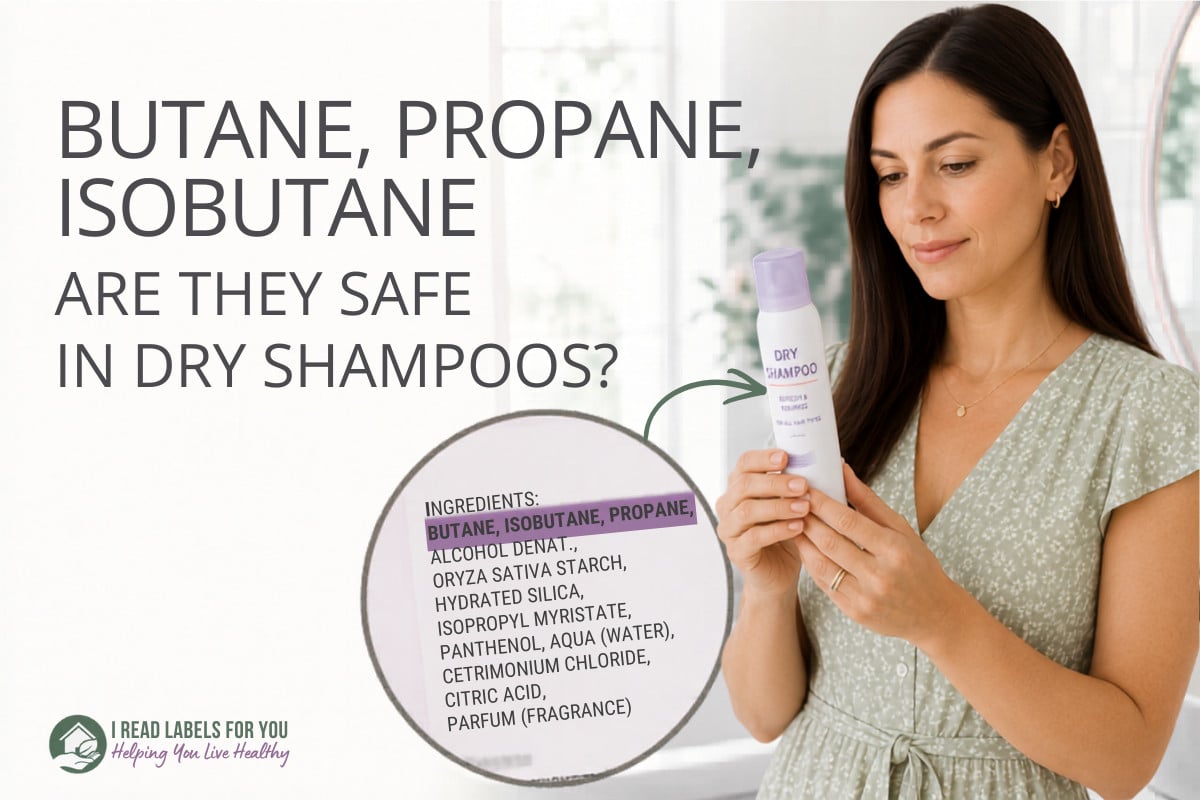
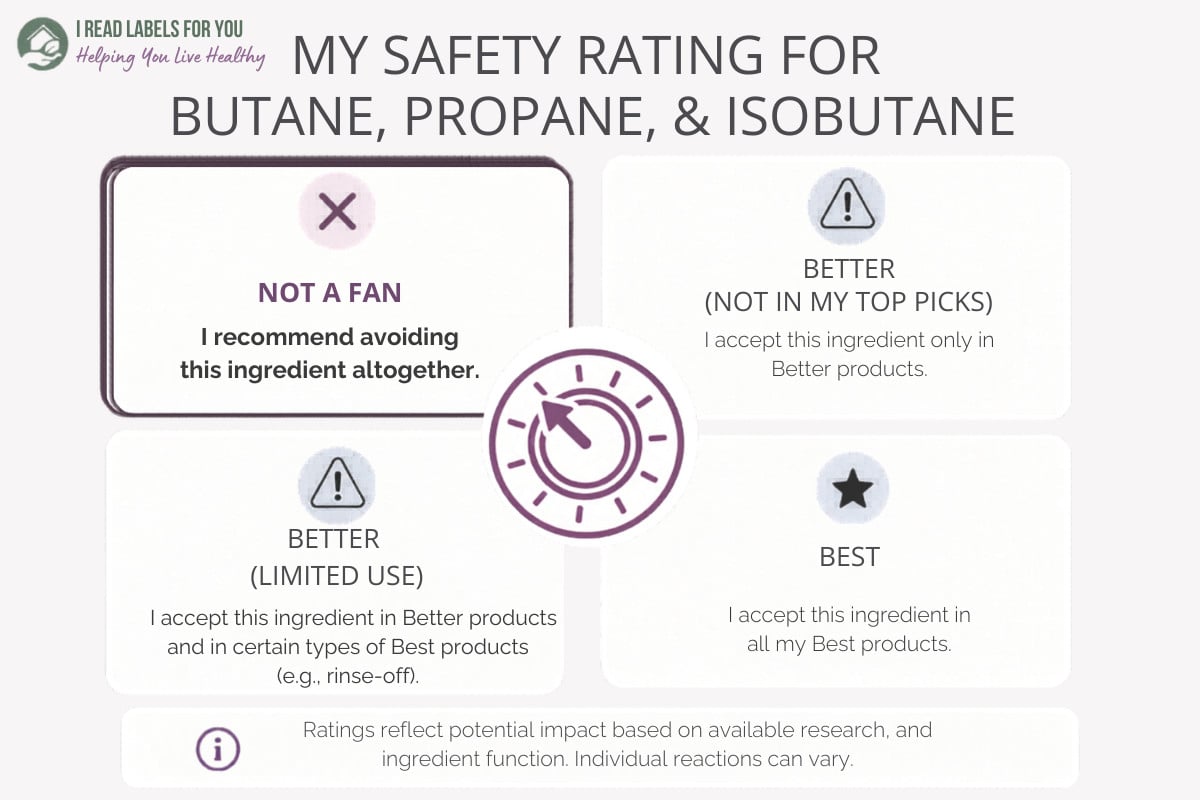
No, I do not consider Butane, Propane, and Isobutane safe as used in cosmetics. On the plus side, they are not sensitizers or hormone disruptors, and they barely absorb. On the minus side, used as propellants in aerosols, such as hair spray or dry shampoo, they can carry cancer-linked benzene or 1,3-butadiene that you can inhale. For this reason, I rate them Not a Fan.
The U.S. FDA, the EU, and Canada all allow Butane, Isobutane, and Propane in cosmetics. However, the EU and Canada restrict Butane and Isobutane if they contain more than 0.1% of the carcinogenic impurity 1,3-butadiene. None is listed on Canada’s CEPA list of toxic substances.
The post below clarifies the difference between Butane, Propane, and Isobutane and answers questions as to whether Butane is safe for cooking, and if gas stoves are bad for COPD and asthma patients.
What Are Butane, Propane, And Isobutane?
Butane, Propane, and Isobutane are light, colorless gases from the same chemical family. They are hydrocarbons, meaning they are built only from carbon and hydrogen, and they come from natural gas and petroleum.
The three are near-twins. Propane is the smallest, while Butane and Isobutane are the same size, just arranged in a slightly different shape. Because their properties differ only a little, formulators often blend them to fine-tune how a can sprays.
What Do Butane, Propane, And Isobutane Do In Cosmetics?
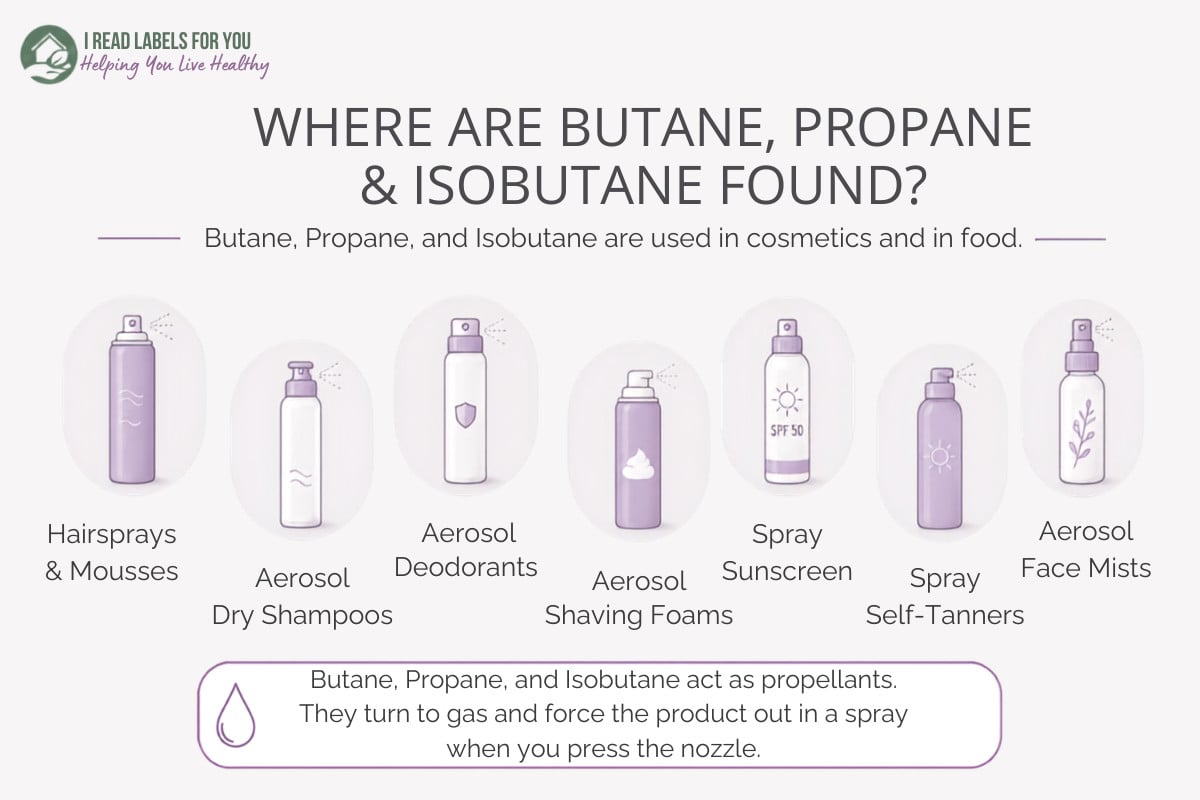
Butane, Propane, and Isobutane have one job in cosmetics: to act as propellants. Sealed under pressure inside an aerosol can, they turn to gas and force the product out in a spray when you press the nozzle.
They also thin some formulas and help them dry fast on the surface. Because they do the pushing, you will find these three gases most often in:
- hairsprays and mousses
- aerosol dry shampoos
- aerosol deodorants and antiperspirants
- aerosol shaving foams and gels
- spray sunscreens
- spray self-tanners
- aerosol face mists
They also serve as food propellants, listed as E943a for Butane, E943b for Isobutane, and E944 for Propane.
How Are Butane, Propane, And Isobutane Made?
Butane, Propane, and Isobutane are all pulled from natural gas and crude oil during refining, then compressed into liquid form. At heart, they are petroleum products.
Purity is the whole ballgame. Butane and Isobutane must be cleaned so a carcinogen called 1,3-butadiene stays below 0.1%. Propane sits outside that rule, yet all three can carry traces of benzene, another carcinogen, from their petroleum source.
Do Butane, Propane, And Isobutane Penetrate The Skin?
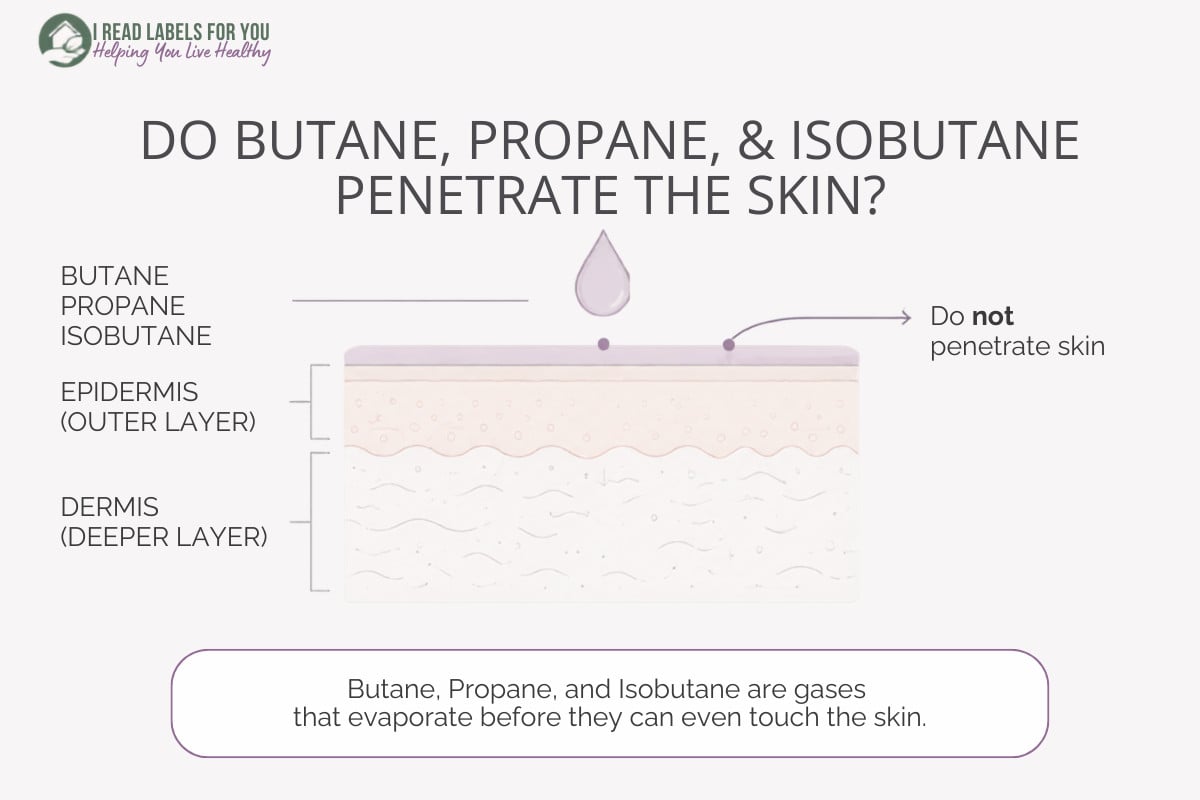
No, none of these gases soak into your skin in any real way. The reason is their volatility, not their size, so let me explain.
Each one is tiny and oily enough that, on paper, it could slip through the skin barrier. In practice, they are gases that boil far below room temperature, from about minus one to minus forty-two degrees Celsius.
That means they flash into vapor the instant they meet your warm skin. The safety reviewers said it plainly: most of the gas evaporates before it can even touch the skin. The real way it reaches your body is through your lungs.
What Are Butane, Propane, And Isobutane Called On Labels?
On an ingredient list they appear by their own names. The forms and codes you might see include:
- Butane (E943a)
- Isobutane (E943b)
- Propane (E944)
- N-Butane
- Propane/Butane/Isobutane Blend
They are often listed together near the end of an aerosol’s ingredients, since a single can may hold a blend of all three.
Does The U.S. FDA Restrict Butane, Propane, And Isobutane In Food And Cosmetics?
No, the U.S. Food and Drug Administration (FDA) does not restrict these three propellants in cosmetics, and it clears them as food propellants. Brands may use them freely in aerosols.
I hold that hands-off stance at arm’s length, and these gases show why. The FDA has confirmed that aerosol propellants can be a source of benzene contamination, yet it does not require that testing on the label.
None of the three sit on the FDA’s short list of prohibited and restricted cosmetic ingredients. That light-touch approach is one reason I weigh how Europe and Canada treat them, since both apply the precautionary principle and act on a risk before harm is proven.
EU Regulations About Butane, Propane, And Isobutane
The European Union allows all three as propellants, with one pointed condition for two of them. It bans Butane and Isobutane outright if either gas contains 0.1% or more of 1,3-butadiene, the carcinogenic impurity.
That rule lives in Annex II of the EU Cosmetics Regulation, the list of prohibited substances. Propane is not named there, because 1,3-butadiene is tied to the Butane and Isobutane family rather than Propane. In plain terms, Europe permits clean gas and forbids the contaminated kind.
Canadian Regulations About Butane, Propane, And Isobutane
Canada takes the same line and lists both Butane and Isobutane as restricted. Its Cosmetic Ingredient Hotlist allows each one only when its 1,3-butadiene content stays at or below 0.1%.
Propane is not on that restricted list, and none of the three appear on Canada’s list of toxic substances under Schedule 1 of the Canadian Environmental Protection Act. Still, the Hotlist rule shows regulators treat the impurity as the real risk.
Can Butane, Propane, Or Isobutane Cause Skin Allergy And Sensitization?
No, these gases do not cause skin allergy in any meaningful way. They evaporate on contact, and safety reviews found none of them is a skin sensitizer.
They are not on the American Contact Dermatitis Society allergen panel either. The concern with these propellants was never your skin, but your lungs and the impurities in the spray.
Are Butane, Propane, And Isobutane Hormone (Endocrine) Disruptors?
No, none of these gases is a hormone disruptor. European chemical authorities have not flagged them, and no endocrine assessment has raised a concern.
As simple hydrocarbons that leave the body quickly, they have no realistic path to affect your hormones. This is not the reason I dislike them.
Are Butane, Propane, And Isobutane Safe To Use While Pregnant?
On the skin, Butane, Propane, and Isobutane pose little risk during pregnancy, though the inhaled route makes aerosols worth minimizing. Breathing propellant fumes and any spray contaminants is not something I would want during pregnancy.
Every pregnancy is different, and I am not a medical professional. If you are unsure about aerosol products, you should consult with your medical provider, and non-spray options are an easy swap.
Are There Any Cancer Concerns Linked To Butane, Propane, And Isobutane?
Butane, Propane, and Isobutane themselves are not carcinogens. None of them is listed by IARC, the National Toxicology Program, or California’s Proposition 65, and safety studies on them showed they were not genotoxic.
The cancer worry sits with their impurities, and it is not hypothetical. Butane and Isobutane can carry 1,3-butadiene, a known human carcinogen kept under 0.1%. All three can also carry benzene, a second carcinogen, from their petroleum source.
In 2022, testing found benzene in popular dry shampoos and sprays, triggering large recalls, and the propellant was the likely source. That episode is the heart of my caution.
Are Butane, Propane, And Isobutane Bad For The Environment?
Butane, Propane, and Isobutane do not pollute water, but they are not green ingredients either. They are volatile organic compounds, which means they escape into the air and help form ground-level smog.
They are also petroleum-derived and extremely flammable. Between the fossil-fuel source and the air-quality effect, aerosol propellants carry a real environmental footprint.
Common Claims About Butane, Propane, And Isobutane: What’s True And What’s Not
Claim: Aerosol Propellants Contain Cancer-Causing Chemicals
This claim has a real basis, which is exactly why I rate these gases the way I do. They can carry two carcinogens as impurities: 1,3-butadiene in Butane and Isobutane, and benzene from the petroleum source of all three.
Regulators cap the 1,3-butadiene under 0.1%, and clean propellant should be benzene-free. Yet the 2022 recalls proved that contaminated sprays do reach store shelves, so the risk is not just theoretical.
Claim: These Gases Are Dangerous Because They Are Lighter Fluid
This one is half right. The Butane, Propane, and Isobutane in cosmetics really are the same gases used in lighters and camping stoves, purified to a higher grade.
But being a fuel is not the actual problem, since the purified gases are chemically simple. The genuine issues are that you inhale them and that they can carry carcinogenic impurities.
What I Think About Butane, Propane, And Isobutane — And What You Should Do
I land on Not a Fan for all three, even though the molecules are mild on skin. They are not sensitizers, they do not disrupt hormones, and they barely absorb, so on paper they look harmless.
My problem is how they are used and sourced. These are aerosol propellants you breathe in, they are petroleum-derived, they are highly flammable, and their sprays can carry benzene or 1,3-butadiene. For products that give your skin no benefit, that is too much downside.
The inhalation worry is more than theory. In one study, hairspray aerosol caused a brief drop in small-airway lung function right after it was breathed in. Separately, hairdressers who spray all day show more cough, wheezing, and lower lung-function scores than office workers. At the far extreme, deliberately inhaling these gases from a can can stop the heart, a tragedy known as sudden sniffing death.
Here is what I actually do. I skip aerosols and reach for non-spray swaps, such as pump hairsprays, loose-powder dry shampoos, and cream or stick deodorants. You avoid both the propellant and any hidden contaminants that way.
Frequently Asked Questions About The Propellants
What Is The Difference Between Butane, Propane, And Isobutane?
Butane, Propane, and Isobutane are close chemical cousins that differ only in size and shape. Propane is the smallest gas, while Butane and Isobutane are the same size in slightly different arrangements. In cosmetics they behave alike and are often blended, which is why I rate them together.
Is Butane Gas Safe For Cooking?
Butane is widely used as a cooking and camping fuel, and it is considered safe when burned with good ventilation. The risks there are fire and combustion fumes, not the gas touching your food. That is a very different situation from a cosmetic spray.
Are Butane Gas Stoves Banned?
No, butane stoves are not banned. The gas-stove-ban headlines you may have seen are about built-in natural gas ranges and indoor air quality, not portable butane stoves. Either way, that is a cooking and combustion topic, separate from butane used as a cosmetic propellant.
Are Gas Stoves Bad For COPD Patients?
Gas stoves can worsen indoor air by releasing nitrogen dioxide, which may bother people with COPD or asthma. Good ventilation and air purifiers help a lot. The key difference is burning: a stove sets the gas on fire, and that burning, called combustion, is what makes the irritating fumes. An aerosol simply sprays the gas out without burning it, so it does not create those fumes.
Is Butane, Propane, Or Isobutane Safe In Hair Spray?
The Butane, Propane, or Isobutane in hairspray is low-risk for your skin, but using it means breathing a fine mist. Because some aerosol sprays have tested positive for carcinogenic benzene, I prefer pump-style hairsprays instead.
Why Does EWG Rate These Propellants Differently?
The Environmental Working Group (EWG) gives Butane, Propane, and Isobutane form-dependent scores, low for solid products and as high as 7 for sprays. It also flags contamination and use restrictions as high concerns.
My rating is stricter because I weigh the inhaled route and the carcinogenic-impurity risk across all aerosol uses. Since these gases offer no skin benefit, I would rather avoid them than manage them.
Sources
EU SCCS / SCCP Opinions:
No dedicated SCCS or SCCP opinion on these propellants (checked); Butane and Isobutane are controlled through the EU Cosmetics Regulation Annex II (prohibited if ≥0.1% 1,3-butadiene). SCCS opinions portal
Cosmetic Ingredient Review (CIR) Reports:
Tucker R, et al. Isobutane, Isopentane, Butane, and Propane (re-review). International Journal of Toxicology. 2025;44(Suppl 1):17S–21S. Original Final Report 1982; re-review 2005. cir-reports.cir-safety.org
European Union Regulatory Databases:
CosIng entries — Butane (E943a), Isobutane (E943b), Propane (E944); propellant function; Butane/Isobutane qualifier “less than 0.1% w/w butadiene.” CosIng database
EU Cosmetics Regulation Annex II — Butane and Isobutane prohibited if they contain ≥0.1% 1,3-butadiene. CosIng Annexes
CLP Annex VI harmonised classification — Flam. Gas 1 (H220); Note U (carcinogen note applies only at ≥0.1% 1,3-butadiene). Annex VI to CLP
Other Regulators:
U.S. FDA — permitted cosmetic and food propellants (E943a/E943b/E944); not on the prohibited/restricted cosmetics list; FDA has noted aerosol propellants as a potential benzene source. FDA prohibited & restricted ingredients
Health Canada Cosmetic Ingredient Hotlist — Butane and Isobutane RESTRICTED (max 0.1% w/w 1,3-butadiene); Propane not listed. Hotlist
Environment Canada CEPA Schedule 1 — none of the three listed. Schedule 1
IARC — the gases are not classified; the impurity 1,3-butadiene is Group 1 (carcinogenic to humans), as is benzene. IARC classifications
NTP Report on Carcinogens — the gases not listed. NTP RoC
California Proposition 65 — the gases not listed (their impurities benzene and 1,3-butadiene are). Prop 65 list
PubChem Records (Chemistry, Identifiers, Skin Penetration, Hazard Codes):
Butane CID 7843 (CAS 106-97-8, MW 58.12); Isobutane CID 6360 (CAS 75-28-5, MW 58.12); Propane CID 6334 (CAS 74-98-6, MW 44.10). PubChem
Peer-Reviewed Studies:
Benzene detected in dry shampoos and aerosol sprays, prompting 2022 recalls (propellant-linked contamination). reporting on the benzene recalls
Swift DL, Zuskin E, Bouhuys A. Respiratory deposition of hair spray aerosol and acute lung function changes. Lung. 1979;156:149–158 (acute small-airway lung-function decrease after inhaling hairspray aerosol). DOI 10.1007/BF02714002
Occupational exposures, respiratory symptoms and lung function among hairdressers in Iran (cross-sectional study) — reduced VC/FVC/FEV1 and more cough, wheezing and breathlessness vs office workers. PMC8238693
Sugie H, et al. Three cases of sudden death due to butane or propane gas inhalation (abuse-level exposure; fatal cardiac arrhythmia / ‘sudden sniffing death’). Forensic Sci Int. 2004. PMID 15240046. PubMed 15240046
Natural Cosmetic Standards:
COSMOS-standard and NATRUE — Butane, Propane, and Isobutane are not approved raw materials (petroleum-derived propellants). COSMOS approved raw materials
Skin Allergy Resource:
American Contact Dermatitis Society — Helpful References, including the Core Allergen Series 2020 (none of the three is a panel allergen). ACDS Helpful References
Advocacy groups:
Environmental Working Group (EWG) Skin Deep entries for Butane, Propane, and Isobutane — form-dependent scores 3–7; contamination and use-restriction concerns flagged. EWG Skin Deep — Butane
Last verified: 2026-07-11
Download The Free Guide!
5 Powerful Steps To A Non-Toxic Home
Join our informed consumer community and get our free guide the “5 Powerful Steps To A Non-Toxic Home”.
Before commenting, please read our Comment Policy.